
A Causal Time Ontology for Qualitative Reasoning
Proceedings of the Fifteenth International Joint Conference on Artificial Intelligence. Diagnosis and Qualitative Reasoning. Pages 501-506.
© 1997 International Joint Conferences on Artificial Intelligence
Abstract
Aiming at explicit description of temporal meaning of causal relations generated by qualitative reasoning systems, this article proposes a ca~sal time ontology which defines a set of general time concepts in qualitative models, called causal time sc~les . Each of them associated with a modeling techmque represents a te111poral granularity and/o~ an ontological viewpoint. They allow us to spectfy temporal performance of the reasoning engines and to id~n tify a general causal reasoning scheme together wtth sophisticated feedback analysis. Lastly, we present a causal time resolution required to derive causal relations in fluid-related systems and a reasoning system satisfying it.
- [Allen, 1984] J. F. Allen. Towards a general theory of action and time. Artificial Intelligence, 23:123-154, 1984.
- [de Kleer and Brown, 1984] J. de Kleer and J. S. Brown. A qualitative physics based on confluences. Artificial Intel- ligence, 24:7-83, 1984. •
- [Forbus, 1984] K. D. Forbus. Qualitative process theory. Ar- tificial Intelligence, 24:85-168, 1984.
- [Fouche and Kuipers, 1992] P. Fouche and B. J. Kuipers. Reasoning about energy in qualitative simulation. IEEE Trans. on Systems, Man, and Cybernetics, 22(1):47-63, 1992.
- [Iwasaki and Simon, 1994] Y. Iwasaki and H. A. Simon. Causality and model abstraction. Artificial Intelligence, 67:143-194, 1994.
- [Iwasaki et al., 1995] Y. Iwasaki, A. Farquhar, V. Saraswat, D. Bobrow, and V. Gupta. Modeling time in hybrid sys- tems: how fast is "instantaneous"? Proc. of /JCAI-95, pages 1773-1780, 1995. IJCAI
- [Kitamura et al., 1996a] Y. Kitamura, et al. A method of qualitative reasoning for model-based problem solving and its application to a nuclear plant. Expert Systems with Applications, 10(3/4):441-448, 1996.
- [Kitamura et al., 1996b] Y. Kitamura, M. Ikeda, and R. Mi- zoguchi. A qualitative reasoning based on an ontology of fluid systems and its evaluation on a power plant. Proc. of PRICAI-96, pages 288-299, 1996.
- [Kuipers, 1994] B. J. Kuipers. Qualitative Reasoning. MIT Press, Boston, MA, 1994.
- Mars, 1995
- N. J. I. Mars, editor, Towards Very Large Knowledge Bases. lOS Press, 1995.
- [Mizoguchi and Ikeda, 1996] R. Mizoguchi and M. Ikeda. Towards Ontology Engineering. Technical Report AI-TR- 96-I, I.S .I.R., Osaka University, Osaka, Japan, 1996.
- [Nishida and Doshita, 1987] T. Nishida and S. Doshita. Rea- soning about discontinuous change. Proc. of AAAI-87, pages 643-648, 1987.
- [Rose and Kramer, 1991] P. Rose and M. A. Kramer. Qual- itative analysis of causal feedback. Proc. of AAAI-9I, pages 817-823, 1991.
- [Top and Akkermans, 1991] J. Top and H. Akkermans. Com- putational and physical causality. Proc. of /JCA/'91, pages 1171-1176, 1991. IJCAI
- [Washio, 1989] T. Washio. Causal ordering methods based on physical laws of plant systems. MITNRL-033, MIT, 1989.
- [Williams, 1984] B. C. Williams. Qualitative analysis of MOS circuits. Artificial Intelligence, 24:281-346, 1984.
References were extracted automatically from the PDF and may contain errors.
Full text extracted automatically from the PDF; figures, tables and equations may differ. The PDF is the version of record.
1 Introduction
Causality plays a crucial role in human understanding of be havior of physical systems. A lot of research has been car ried out on qualitative reasoning systems in order to derive causal relations from the models of the target systems, e.g.,[de Kleer and Brown, 1984]. Human recognition of causal rela tions is based on recognition of time delay (i.e., time interval) between the cause and the effect. Little, however, is known concerning temporal meaning of causal relations generate~ by the reasoning systems, that is, how long (or sh?rt) the tiJ?e intervals in the causal relations in the real physical behaviOr as discussed in [Iwasaki et al. , 1995]. There are the follow ing two explanations for it. First, there ~e ~any. modeling techniques and representations, each of whtch tmphes several temporal relations among variables. Secondly, su~h mode~s are interpreted by the reasoning engines on the basts of therr own time concepts behind their reasoning procedures. For example, using the same qualitative differential equations', QSIM [Kuipers, 1994] and the causal ordering ~rocedure pro posed in [Iwasaki and Simon, 1994] generate ~tfferent causal relations together with different temporal meanmgs. As a con sequence of the implicit existence of several .time. concepts, the temporal meaning of generated causal relatiOns 1s not clear for the users of the reasoning engines.
1 Strictly speaking, the causal ordering procedure [Iwasaki and Simon, 1994] needs additional information.
In this article, we do not discuss formal ontology based on axiomatization, aiming at getting on agreement on the con tent and the terminology. Next, we concentrate on ontologi cal issues. For the details of model representation, reasoning engine and its evaluation, see other articles[Kitamura et at., 1996a; Kitamura et at., 1996b].
2 A Causal Time Ontology
2.1 Theoretical Foundation
In our causal time ontology, behavior over time generated by the reasoning engine is represented in terms of events and links among the events, in a similar way in the history model[Forbus, 1984]. An event e E E represents instanta neous changes of qualitative values of parameters and their re sultant values at a time point. Changes of quantitative values are assumed to be continuous and differentiable. A new event e2 is generated by applying an operators o E 0 to an old event e1 according to the model M. A link l1 E L between e1 and e2 represents a causal relation according to the model M. There is an open time-interval t1 between e1 and e2, corresponding to the causal relation 11· The roles of operators o E 0 are to propagate changes and to generate new events, time intervals and hence partial temporal relations. Note that the symbol 't' always represents not a time point but a time interval in this article. Although events correspond to time points, we con centrate on time intervals in which changes propagate.
The causal time ontology provides categories of such time intervals, called causal time scales. A causal time scale repre sents a concept of time interval for propagation of effect. The notation 1(l) = T denotes a time interval t of a causal rela tion lis categorized into a time scale T. We can say that "the causal relation l is represented on the time scale T".
The ordinal relation T1 ~ T2 representing a time scale T1 is shorter (finer-grained) than T2 is defined as follows;
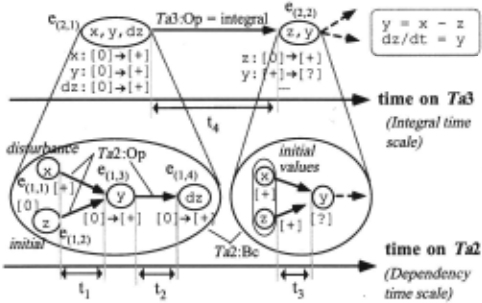
In other words, T1 represents faster events than that T2 does. This relation is transitive. The relation between Ta2 and Ta3 where Ta2 ~ Ta3 is shown in Figure 1. Although the figure shows the relation among concrete time scales due to limita tion of space, we explain the general relation here. When a certain condition becomes true in the reasoning process on a shorter time scale Ta2, the reasoning shifts to a neighboring longer time scale Ta3. Such a condition is called as a bound ary condition of Ta2 or a precondition of Ta3. The set of events grouped by the condition e 0 ,1)l e(l,2)· ··· , e0 ,4) on Ta2 is treated as the instantaneous events e(2,1) on Ta3. Then, the reasoning operator of Ta3 is applied to the event e(2, 1). Each time scale has an operator. The resultant values on Ta3 can be treated as the initial values on Ta2. The same applies to Ta3 ~ T4 cases recursively. In summary, a time scale T can be defined by a tuple of three elements, <Pc, Op, Be>, where these denote a precondition, an operator, a boundary condi tion, respectively. The elements of T1 are denoted by T1 :Pc, T1 :Op and T1 :Be, respectively.
2.2 Physical Meaning of Causal Relations
The relations l generated by the reasoning engine do not al ways make sense from the physical viewpoints. There are such cases where a link l represents an operational order which is not justified by the physical sense. In order to clarify the physical meaning of the causal relations, we will discuss two aspects of the physical meaning of each time scale, that is the interval-meaning and the ordinal-meaning. The former represents a physical justification of existence of the time in tervals on the time scale. The latter represents that of order of events on the time scale.
2.3 Causal Time Scales
This section defines 13 causal time scales shown in Table 1. The time scales are classified into four categories each of which represents a modeling technique together with partic ular modeling rationales. The direct modeling is to describe models using the mathematical differential equations which directly represent dynamic behavior over time. The time con stant modeling is to qualitatively categorize the time constants for modeling of phenomena. The component structure mod eling is to introduce the concept of "component", aiming at causal relations reflecting the physical structures of the target systems. The modeling of periods of interest such as initial re sponses allows the reasoning engine to neglect changes of no interest. The notation "Tx#" denotes a time scale, where 'x' denotes a category (a,b,c or d) and the number '#' represents ascending order in each category. In Table 1, each condition denoted by a notation "ex#" represents the boundary condi tion of the time scale listed above and the precondition of that listed below.
(a) Direct Modeling
In the direct modeling, temporal characteristics of the phe nomena are represented directly by the mathematical aspect of the models. The precondition of the time scale Ta3 is that a set of parameters are completely determined where every parameter in the set has values which satisfy all constraints. When the condition holds, the reasoning engine applies the integral operator and hence generates a new event. The in tegral operator embodies the qualitative mean value theorem X new = XaLd+dx / dt [de Kleer and Brown, 1984]. The time in tervals between the old events and the new events are catego rized to Ta3:integral time scale. The time in QSIM[Kuipers, 1994] corresponds to Ta3. Furthermore, Ta3 is categorized Table I : The causal time scales
(a) Direct Modeling
ca I: changes of parameter values
Tal : Mutual Dependency time scale
ca2: a set of inherently simultaneous equations are satisfied.
Ta2: Dependency time scale
ca3: a set of constraints are completely determined.
Ta3 : Integral time scale
Ta3p: Integral-from-equality time scale
Ta3i: Integral-to-equality time scale
ca4: a set of parameters reaches equilibrium.
Ta4: Equilibrium time scale
(b) Time Constant Modeling
Tb1 : A Faster Mechanism time scale
cb2: a faster mechanism reaches equilibrium.
Tb2: A Slower Mechanism time scale
cb3: a slower mechanism reaches equilibrium.
(c) Component Structure Modeling
Tel : Intra-component time scale
cc2: all parameters in a component are determined.
Tc2: Inter-component time scale
cc3: all parameters in a global structure are determined.
Tc3: Global time scale
cc4: all parameters in the whole system are determined.
Tc4: The Whole System time scale
(d) Modeling of Periods of Interest
Td1 : Initial Periods time scale
cd 1: the first event happens on a time scale.
Td2: Intermediate Transitional time scale
cd2: the last event happens on a time scale.
Td3: Final Periods time scale
into two types; Ta3p and Ta3i . The former represents the time intervals for integration from the same value as the land mark values to the interval of the landmark values. The lat ter represents those from the interval to the landmark values. Ta3p-< Ta3i holds.
On the other hand, until a set of parameters are com pletely determined, the time intervals are categorized to Ta2:dependency time scale. The precondition of Ta2 is that a set of inherently simultaneous equations 2 are satisfied. The time scale of the causal ordering theory [Iwasaki and Simon, 1994] corresponds to Ta2. Until the inherently simultane ous equations are satisfied, the time intervals are categorized to Ta1:mutual dependency time scale. Although this time scale has the interval-meaning mentioned in section 2.2, it has no ordinal-meaning. On the other hand, Ta2 and Ta3 can have both kinds of the physical meaning. When a set of parameters achieve its equilibrium, the reasoning shifts to Ta4:equilibrium time scale.
For example, consider a simple system modeled by the di rect modeling, y = x - z, dz / dt = y. A variable takes one of the three qualitative values, [ +], [0] and [-], where the land mark value is 0. In the initial state, all variables take [0] except for a disturbance x = [ +]. Figure 1 shows causal relations gen erated on Ta2 and Ta3 . In this case, the method of constraint satisfaction is simple propagation of values. First, the value of y becomes greater than 0 (denoted by [0] --+ [ +] in the figure) according to y = x - z. Next, the value is propagated to the derivative of z (denoted by dz in the figure) . At this point, ev ery parameter has a value which satisfies all constraints, that is, the precondition of Ta3 becomes true. Then the reason ing shifts to the longer time scale Ta3 . On the scale Ta3, the integral operator is applied to z , then z becomes greater than 0. Next, on Ta2, the new value of z is propagated toy and so on. Note that the change of y and that of dz happen at the same time point on the time scale Ta3 and then there is no causal relation between y and dz on Ta3, while the change of y causes that of dz after a small time interval t2 on the time scale Ta2.
2 This term represents such simultaneous equations which cannot be solved by substitution alone, borrowed from [de Kleer and Brown, 1984].
When model builders describe a phenomenon in terms of differential equations, the modeling rationale is to capture dy namic changes in the transitional behavior in Ta3 to its equi librium. In general, it implies that the time interval to achieve its equilibrium is longer than the other phenomena.
(b >' Time Constant Modeling
In order to represent differences in time constants, this mod eling technique divides the target system into such parame ter sets where the time intervals to achieve equilibrium Ta4 are extremely different from each other. In such a model, the (relatively) faster mechanism firstly reaches the equilibrium on the time scale Tb 1. Then the reasoning shifts to the time scale Tb2. This kind of modeling is found in [Iwasaki and Si mon, 1994; Kuipers, 1994]. This modeling has an advantage in reasoning efficiency because of separation of the reasoning space.
(c) Component Structure Modeling
This modeling is to divide the whole system into subparts ac cording to component structures based on the device ontol ogy [de Kleer and Brown, 1984]. In this article, devices in the minimum grain size are called "components". Tel repre sents internal behavior in components, while Tc2 represents behavior between neighboring components. Interactions be tween the global structures containing components are repre sented by Tc3. Those between more coarse-grained global structures are also represented by Tc3. Tc4 represents that the whole system eventually reaches equilibrium. The ordinal relations among these time scales reflect structural distances.
Although T c2 and T c3 have the interval-meaning, the con nection information alone cannot give the ordinal-meaning to them. We will discuss additional knowledge for the ordinal meaning later. On the other hand, Tel has no physical mean ing in any sense. This modeling technique implies such mod eling rationales that the causal relations should reflect func tioning components and the medium flow along the struc tures.
(d) Modeling of Periods of Interest
This modeling allows the reasoning engine to treat only par ticular temporal periods of interest such as initial behavior. The time scales constrain not length but the number of time intervals. For example, QUAF [Rose and Kramer, 1991] rea sons only the initial changes Td1 and the final responses Td3 without the intermediate transient behavior. This technique contributes to disambiguation of reasoning results and avoid ing reasoning costs.
| QSIM [Kuipers, 1994J | Tlq• : Ta3 , T2q• : Ta4 |
| QSEA [Kuipers, 1994, ch.7] | Tqa: Ta4 |
| Time-Scale [Kuipers, 1994, ch.12] | Tit. : Ta3 & Tbl, T2t. : Ta4 & Tbl, T3t. : Ta3 & Tb2, T4ts : Ta4 & Tb2 |
| QUAF [Rose and Kramer, 1991] | T1qf : 1 a3 & Tdl, T2qf : Ta3 & Td3 |
| Mythical Time [de Kleer and Brown, 1984] | '11mt : '1 al & '1 cl, T2mt : Tal & Tc2, T3mt : Ta3 & Tc4 |
| Causal Ordering [Iwasaki and Simon, 1994] | Tlco : Ta2, T2co: Ta3 |
| Abstraction [Iwasaki and Simon, 1994] | 'llab: '1 a2 & Tbl, T2ab: Ta3 & Tbl, T3ab : Ta2 & Tb2, T4ab : Ta3 & Tb2 |
3 Causal Time Scales in Reasoning Systems
3.1 Causal Time Resolutions
Let us characterize some of the existing reasoning systems in terms of the causal time scales. In general, a time resolu tion of a reasoning system is specified by a set of combinations of the primitive time scales discussed thus far. The notation T1 : Tx1 &Tx2 represents that the time scale T1 consists of Tx1 and Tx2· Table 2 shows the time scales which can be treated by some conventional qualitative reasoning systems. For example, QSIM[Kuipers, 1994] can cope with behavior on Ta3 and Ta4. QSIM uses only mathematical differen tial equations and adopts a kind of generate-and-test method for constraint satisfaction. Thus, no causal relation among transitional behavior to Ta3 is identified. The time of QSIM is corresponds to Ta3. QSEA[Kuipers, 1994, ch.7] treats only equilibrium states represented by Ta4. The time-scale abstraction[Kuipers, 1994, ch.l2] is a kind of the time con stant modeling represented by Tb. QUAF[Rose and Kramer, 1991] reasons only the initial changes Tdl and the final re sponses Td3 on the integral time scale Ta3.
The method proposed in [de Kleer and Brown, 1984] can generate causal relations among more fine-grained time scale Tal, called "mythical time", on the basis of the concept of device. Causal relations on T1mt. however, do not always have the physical meaning because Tlmt consists of Tal and Tel. On the other hand, in order to give the ordinal meaning to T2mt· de Kleer and Brown employ general heuris tics representing physical intuitions. Causal relations gener ated by them, however, are ambiguous due to the arbitrariness of heuristics application.
The causal ordering theory [Iwasaki and Simon, 1994] derives causal relations on Ta2, which have the ordinal meaning representing mathematical dependency. The theory, however, does not try to derive those on Ta 1. Two abstraction techniques corresponding to Tb are also discussed.
3.2 Primitive Reasoning Scheme
The primitive reasoning scheme of a reasoning system can be specified by the set of time scales which the system can cope with. Let T S be such a set and Ec be a current set of events to be carried out. The generic reasoning scheme for a current time scale Tc and neighboring time scales T1 and T2 where T1 -< Tc -< T2 is defined as below.
- On the time scale Tc, if an event e1 E Ec satisies the precondition Tc:Pc, the operator Tc:Op is applied to e1 and then a new event e2 and a new link l between e1 and e2 are generated. r(l) = Tc holds.
- The reasoning process shifts to the shorter time scale T1· Tc +- T1 and Ec +- e2 and go to step 1 recursively 3 .
- If e2 does not satisfies the boundary condition Tc :Be, go back to step 1 and E~ +- Ec- { e1} + { e2}.
- If e2 satisfies the boundary condition Tc:Bc, the reason ing process shifts to the longer time scale T2. All events in Tc are transferred to the event e3 on T2. Go to step I recursively.
The reasoning process starts with the minimum time scale Tmin in TS, given the initial value Ec. This reasoning pro cess repeats recursively until the boundary condition of the maximum time scale holds. There are such cases that T min needs a special operator to satisfy the precondition ofT min·
The reasoning processes of the conventional systems can be explained by their time scales shown in Table 2. For example, the reasoning method called time-scale abstraction [Kuipers, 1994, ch.l2] starts with the minimum time scale T1ts · Since Tits contains Ta3, the operator for Tlts is the integration 4 · When the boundary condition of T1ts becomes true, i.e., the faster system reaches equilibrium, the reasoning process shifts to T2ts· Because the system is in equilibrium, no reasoning is carried out in T2ts· Then, the reasoning process in T3to starts and then the slower behavior is generated. In principle, the reasoning process at T3ts backs to the shorter time scales T 1 ts and T2ts. In this case, however, because T2ts is in equi librium and hence has no more events, only checks of values are needed. The primitive scheme of the algorithm shown in [Kuipers, 1994] is identical with this one.
The reasoning result consists of a set of events E and a set of links L each of which has a time scale T E T S associ ated with it where r(l) = T. If there is a (transitive) causal relation between e1 and e2, r(e~, e2) denoting the time scale representing the time interval between el and e2 is defined as follows;
where Le c L consists of the links between e1 and e2. This implies that a chain of time intervals represented on a time scale can be represented on the same time scale. In other words, time intervals on a time scale T1 can never become longer enough to be categorized into the longer time scales than T1 unless the boundary condition is satisfied. In the cases of no causal relation, if T(e0, e1) ~ T(eo , e2) where eo repre sents the last common event (i .e., the junction event), we only can say that e 1 happens before e2. ·If not, there is no temporal order between such events.
3 The symbol '+-' denotes substitution
4 Strictly speaking, the operator of QSIM is not identical with in tegration. It represents possible transitions over time for reasoning efficiency.
3.3 Feedback and Causal Time Scales
Such phenomena that the effect of an event of a parameter is eventually propagated to the parameter itself are called as feedback. The time delay along the feedback loop plays a cru cial role in human understanding of feedback. For example, in the cases where the time delay along a feedback is very short and then the modeler has no interest in the transitional behav ior of the feedback, it is no need to generate causal relations among events in the feedback loop and to trace the changes of parameter values. Therefore, the reasoning engine can treat feedback according to the following heuristics.
Feedback heuristics : Whether or not a phenomenon is rec ognized as feedback depends on the time delay for the propa gation loop according to the pre-defined threshold values T. 1 and T.2 E T S. Let L be a set of the links contained in the propagation loop and Tt be the time scale for the time delay along the loop.
- If Tt ~ T81 then the phenomenon is not treated as feed back. The orders of events in L have no physical mean ing. If the new value after the feedback is different from the original value, that is viewed as contradiction at the same time point.
- IfTt >- T81 and T1 ~ T.2 then the phenomenon is treated as semi feedback. The orders of events in L have the physical meaning. If there is a conflict between the old and new values then the new value is neglected.
- If Tt >- Ts2 then the phenomenon is treated as feedback. The orders of events in L have the physical meaning. The values will be changed after the feedback.
The last one corresponds to the usual feedback. The first two are paraphrased as "the feedback is virtual, produced by the sequential operations of the reasoning method" and "there is no feedback which suppresses the original change instanta neously", respectively.
4 Time Scales for Fluid Systems
This section discusses a causal time resolution required to de rive the causal relations in the fluid-related systems. A finer grained time resolution than those of the conventional systems is required. Our reasoning system satisfying the required time resolution is also mentioned.
4.1 Required Time Resolution
Table 3 shows a time resolution, i.e., a set of time scales, required to derive causal relations in fluid systems based on the device ontology. The necessity to distinguish among these time units is justified by human recognition of causality or some assumptions. Firstly, the device ontology requires the discrimination between Tel of the Tl:inter-component time scale and TeL, of the T2 inter-component time scale. Secondly, in order to cope with global phenomena such as Tl -< T4 -< T2 -< T3 -< T5 -< T6 -< T7
| Name of time scale | Definition |
|---|---|
| Tl :lntra-Component time scale | Tal/2 & Tbl/2 & Tel |
| T2:1nter-Component time scale | Tal/2 & Tb2 & Tc2 |
| T3:Global time scale | Tal /2 & Tb2 & Tc3 |
| T4:Globally Simultaneous time scale | Tal/2 & Tbl & Tc3 |
| T5:/ntegral time scale | Ta3 & Tb2 & Tc3 |
| T6:Partial Equilibrium time scale | Ta4 & Tb2 & Tc3 |
| T?:Complete Equilibrium time scale | Ta4 & Tb2 & Tc4 |
changes in temperatures caused by global heat balances, hier archical structure (Tc3 of T3 and T4) is needed. The length of time interval of T3 is longer than that of T2 because of the structural distance represented by Tc2 and Tc3. There are, however, such cases where changes in non-neighboring com ponents are simultaneous, called globally simultaneous phe nomena. For example, on the assumption that fluid is incom pressible, flow rate of such fluid at each component changes at the same time. Thus, T4:globally simultaneous time scale which is combination ofTc3 and Tb1 is needed. Since it is as sumed that there is only one level of faster mechanisms which is represented by T4, the other scales are on Tb2. Because Tel in Tl represents the most primitive concept in the device ontology, TI ~ T4 holds. Because T4 represents almost si multaneous phenomena, T4 ~ T2 holds.
4.2 A Reasoning System for Fluid Systems
We have developed a reasoning system which can cope with the above seven time scales finer than those of the existing systems [Kitamura et al., 1996a; Kitamura et at., 1996b]. In general, a main issue to discuss is what contents we have to describe in order to build such a model that generates causal relations having the physical meaning. For the required time resolution, we employ the modeling schemes such as hierar chical components modeling, description of time constants and causal characteristics of components. The last knowl edge enables the reasoning engine to give the physical mean ing of causal relations among components on the Tc2 of T2. As discussed thus far, additional knowledge is needed for the physical meaning on Tc2. Considering components have their own causal characteristics, our approach is to ex plicitly describe inherent causal characteristics of each pa rameter in components, called causal specifications, context independently. Although such a description is prone to depen dent on context as discussed in [de Kleer and Brown, 1984], categories of causal relations [Kitamura et al., 1996b] helps capture causal characteristics context-independently.
The reasoning method of our reasoning system is based on the general reasoning scheme discussed in section 3.3. The reasoning of feedback is based on the feedback heuristics. In our system, since a part of causal relations in Tl have no phys ical meaning and T4 represents a very fast mechanism, the threshold values Tsl and Ts2 are set to TI and T4, respec tively.
The reasoning system has been successfully applied to a power plant [Kitamura et al., 1996b]. The model ofthe whole system consists of 27 components, 143 parameters and 102
constraints. All the reasoning results matched those obtained by a domain expert including their ambiguities.
5 Related Work
The time concept in QSIM is discussed in [Kuipers, 1994] from the mathematical viewpoint, which is categorized into Ta or Tb. Iwasaki and Simon show a causal ordering theory for hierarchical sets of variables and discuss how to generate such hierarchical sets according to time scale and strength of interaction among variables [Iwasaki and Simon, 1994]. The causal time ontology allows us to clarify the modeling ratio nales underlying such sets from the physical viewpoint.
Ontologies of time itself have been discussed elsewhere such as [Allen, 1984] where Allen has identified primitives for representing time itself, and categorized of logical rela tionship between them. The causal time ontology provides cognitive categories of time intervals from the viewpoint of causal ordering of physical systems.
In [de Kleer and Brown, 1984; Top and Akkermans, 1991], although general causal properties of devices haye been iden tified, causal relations generated by their methods..are ambigu ous in the case of inherently simultaneous equations. The TQ analysis [Williams, 1984] provides heuristics to analyze !.icn ited kinds of feedback according to time delay. A part of our causal specification corresponds to the descriptions of "exoge nous parameters" [Iwasaki and Simon, 1994] of each compo nent.
In [Forbus, 1984; Washio, 1989], causal characteristics of physical processes are described. One of 9ur global con straints corresponds to an energy constraint (a global filter) for QSIM [Fouche and Kuipers, 1992].
6 Summary
We have proposed a causal time ontology containing a set of causal time scales shown in Table 1 to reveal the struc ture of causal time underlying the qualitative models and the causal reasoning engines. Some conventional reasoning sys tems have been characterized with respect to causal order ing using the time scales shown in Table 2. Furthermore, we present a reasoning system which can generate finer-grained causal relations than the existing systems.
We confined the topic to continuous changes. A discrete model of a phenomenon is, however, often the result of mod eling according to such a rationale that the phenomenon is ex tremely faster than other phenomena, as discussed in [Iwasaki et al., 1995; Nishida and Doshita, 1987]. Thus, such discrete models can be viewed as another kind of temporal modeling techniques discussed in this article. Investigation on such dis crete changes remains as future work.
As discussed in section 4, the causal time scales enable us to specify temporal performance required to derive desired causal relations. They can be viewed as specification of goal of design. They will govern the constituents of the models and the reasoning procedures. Investigation on design method ology of causal reasoning systems based on the causal time scales is in progress.
Acknowledgments
The authors would like to thank Shinji Yoshikawa and Kenji Ozawa, Power Reactor and Nuclear Fuel Development Corp., and Munehiko Sasajima, I.S.I.R., Osaka University, for their help and comments on building the model of the power plant. The authors are grateful to the anonymous reviewers for valu able comments.
@inproceedings{ijcai1997p74,
  title     = {A Causal Time Ontology for Qualitative Reasoning},
  author    = {Kitamura, Yoshinobu and Ikeda, Mitsuru and Mizoguchi, Riichiro},
  booktitle = {Proceedings of the Fifteenth International Joint Conference on
               Artificial Intelligence, {IJCAI-97}},
  publisher = {International Joint Conferences on Artificial Intelligence},
  editor    = {Martha E. Pollack},
  pages     = {501--506},
  year      = {1997},
  note      = {Diagnosis and Qualitative Reasoning},
  url       = {https://ijcai.org/proceedings/1997/74},
}
TY - CPAPER TI - A Causal Time Ontology for Qualitative Reasoning AU - Kitamura, Yoshinobu AU - Ikeda, Mitsuru AU - Mizoguchi, Riichiro T2 - Proceedings of the Fifteenth International Joint Conference on Artificial Intelligence, IJCAI-97 PB - International Joint Conferences on Artificial Intelligence PY - 1997 SP - 501 EP - 506 UR - https://ijcai.org/proceedings/1997/74 ER -Copied
Machine-readable versions of this paper, for tools and AI agents:





