
Reasoning Symbolically About Partially Matched Cases
Proceedings of the Fifteenth International Joint Conference on Artificial Intelligence. Computer-aided Education. Pages 335-340.
© 1997 International Joint Conferences on Artificial Intelligence
Abstract
In teaching case-based argumentation skills, the CA TO program, an intelligent learning environment, guides students' assessments of partial matches between problems and cases by generating alternative interpretations of the similarities and differences. CA TO's Factor Hierarchy captures information about the significance of similarities and differences given the normative purposes of the domain classification. Its algorithms for emphasizing or downplaying significance tailor interpretations to the comparison context, block interpretations strongly contradicted by other factors and strategically determine how and how abstractly to characterize a difference. An empirical evaluation confirmed CATO's effectiveness in teaching basic argumentation skills.
- [Aleven & Ashley, 1997] V. Aleven and K. Ashley "Teaching Case-Based Argumentation through a Model and Examples: Empirical Evaluation of an Intelligent Learning Environment" To appear in Proc. AI in Education . Kobe, Japan. August.
- [Aleven and Ashley, 1996] V. Aleven and K. Ashley. How Different is Different? Arguing About the Significance of Similarities and Differences. In Smith and Faltings, ed. Advances in CBR . Lecture Notes in AI 1168. pp. 1-15. Springer: Berlin.
- [Ashley, 1990] K. Ashley, Modeling Legal Argument, Reasoning with Cases and Hypotheticals. MIT Press: Cambridge.
- Ashley and Rissland, 1988) .
- K. Ashley and E. Rissland. Waiting on Weighting: A Symbolic Least Commitment Approach. In Proc., AAAI-88. pp. 239-244.
- Morgan Kaufmann: San Mateo, CA. [Branting, 1991].
- Branting, L. K. Integrating Rules and Precedents for Classification and Explanation : Automating Legal Analysis. Ph.D. Dissertation. AI Lab., Tech. Rep. AI90-- 146. The University of Texas at Austin.
- [Burton, 1985] Steven J. Burton. An Introduction to Law and Legal Reasoning. Little, Brown: Boston.
- [Carbonell, 1983] Carbonell, J. G. "Derivational Analogy and Its Role in Problem Solving". In Proc. AAAI83. pp. 64-69.
- William Kaufmann: Los Altos, CA.
- Forbus, et a!. 1994]
- K. Forbus, D. Gentner, and K. Law "MAC/F AC : A Model of Similarity-based Retrieval" , Cognitive Science 19, 141-205.
- [Kolodner, 1993] J. Kolodner. Case-Based Reasoning. Morgan Kaufmann : San Mateo, CA.
- [Koton, 1988] P. Koton. Using Experience in Learning and Problem Solving. Ph.D. Thesis, MIT.
- Rissland, et al. 1996]
- E. Rissland, D. Skalak, and M. Friedman. "BankXX: Supporting Legal Arguments through Heuristic Retrieval". AI and Law. V. 4 No . I. pp . 1-71. Kluwer: Dordrecht.
- [Smyth & Keane, 1994] Smyth, B. and Keane, M. "Retrieving Adaptable Cases: The Role of Adaptation Knowledge in Case Retrieval" . In Topics in Case-Based Reasoning.
References were extracted automatically from the PDF and may contain errors.
Full text extracted automatically from the PDF; figures, tables and equations may differ. The PDF is the version of record.
1 Introduction
Traditionally, researchers in case-based and analogical reasoning have regarded as an obstacle the fact that cases can be described at various levels of abstraction. Carbonell abandoned a transformational approach to analogy in favor of a derivational approach because of the problems of recognizing analogous problems despite apparent differences in the language or levels of abstraction of their descriptions [Carbonell, 1983]. Describing cases at different levels of abstraction also frustrates isomorphism in structure-mapping approaches to analogical reasoning. Forbus acknowledges the obstacle as a limitation in MACIF A C. Either the cases all have to be described in the same way and at exactly the same levels of abstraction or else the mappings will fail [Forbus, et al. 1994, p. 198].
In argumentational or interpretive CBR applications, however, multilevel case descriptions are not just an inconvenient obstacle for computerizing analogical reasoning. They are an integral part of why and how experts reason with cases. Experts assess cases and similarity in terms of a general domain model, to the extent there is one. They fit new cases into the domain model and into the body of cases, grouping a new case with similar examples and reconciling it with negative examples. The level of abstraction with which to describe a case is an important degree of freedom in fitting it into a general model and reconciling it with other cases. The importance of similarities and differences varies as cases are characterized aleven+@pitt . edu abstractly in different ways and levels; the general model helps experts assess the importance of shared and unshared case features viewed more abstractly or less. By choosing the groupings and characterizations carefully, an expert may even extend the general domain model.
This is certainly true of legal case-based reasoning in which the general principles and policies of a legal domain inform a determination of what case features and which analogical similarities and differences are important [Burton, 1985]. Since quantitative weighting schemes are either inappropriate for or not sufficiently context-sensitive to be applied in legal argument [Ashley & Rissland, 1988], one needs to reason explicitly in terms of some model of why similarities and differences are significant. In law, however, the general model of a domain is often weak enough, and there is enough uncertainty about how cases fit the model and each other, that characterizing cases at different levels of abstraction is often done strategically; the level of abstraction an arguer chooses in asserting that cases are the same or different reflects the arguer's purpose.
In designing a program, CA TO, to teach first year law students basic skills of making case-based legal arguments to classify new cases, we have partially addressed three of four problems associated with comparing cases at multiple levels of abstraction, the problems of: (1) representing cases at multiple levels, (2) reasoning symbolically about partially matched cases in light of the possible abstract descriptions, and (3) modeling the strategic uses of case description. Students learn how to argue that the complaining party should win (or lose) its claim in a new case by drawing analogies to past cases where the corresponding side won (or lost) and by distinguishing or otherwise counteracting similar cases with the opposite result. CATO teaches students, among other things, how to characterize a problem abstractly in arguing that a particular side should win and how to characterize the significance of particular differences between the problem and past cases so as to emphasize or downplay that significance. The lessons should help us address the remaining problem (4): identifying and retrieving cases described at different levels of abstraction.
In making competing arguments that a partially matched case is close enough to a problem or not, CA TO alternatively interprets the differences in terms of more abstract characterizations contained in its domain model, the Factor Hierarchy. This graph captures information about the plausible significance of similarities and differences given the domain's normative purposes. It enables the program to determine which abstractions help an argument, hurt the argument, or are indifferent. Although CA TO's case representations do not include multiple levels of abstraction, CA TO does compare cases at multiple levels of abstraction. Its algorithms (for downplaying and emphasizing differences and for making issue-based arguments) select, from among all the abstractions at multiple levels and along multiple paths which may apply to a case, just the right ones (i.e., the focal abstractions) for characterizing the case in various argument moves. CA TO's algorithm for selecting focal abstractions implements strategic criteria so that the resulting arguments avoid contradictions and exposure to counterattacks. When there is conflicting evidence whether an abstraction applies, CA TO applies its general knowledge in the Factor Hierarchy to resolve the conflict by blocking certain interpretations, if possible. If not, its case-based arguments play out the conflict.
As compared with either CASEY or GREBE, CA TO employs an alternative approach and a different kind of model to guide interpretation of partial matches. CASEY reasons symbolically about differences between a problem and an explained, diagnosed case in terms of the strong causal diagnostic model used to generate the past case's explanation and evidence principles for characterizing whether differences are important. [Koton, 1988]. GREBE represents cases at multiple levels of abstraction in a structural sense. Each case's explanation is like a small structural model indicating which features are relevant to which conclusions. GREBE attempts to bridge gaps in the mapping of explanations by importing inferences from other case explanations and legal rules [Branting, 1991].
Neither CASEY nor GREBE have anything like a Factor Hierarchy that represents how features strengthen or weaken a conclusion and why, information which informs CA TO's arguments emphasizing or downplaying differences. Although CA TO's model cannot solve problems by itself as CASEY's can, that is to be expected given the differences between CASEY's medical domain and CA TO's legal one. While GREBE may compare cases at multiple levels of structural abstraction, it does not make sense to ask whether it strategically selects a level of abstraction at which to characterize similarity or differences as CA TO does in selecting focal abstractions. GREBE uses a different kind of model to make a different kind of argument.
2 CATO's Factor Hierarchy
Students use CA TO to analyze argumentation problems in a traditional casebook chapter on trade secret misappropriation, a legal regime protecting confidential commercial information from unfair access and use by competitors. Students may retrieve cases from CA TO's database of 14 7 trade secret cases. A special query language helps students formulate constraints that a case must satisfy to be useful in an argument and translate them into queries to retrieve relevant cases.
2.1 Factor Representation
In CATO, legal cases are represented by a short textual description of the facts and decision (i .e., the case squib) and a set of indexing factors. Factors represent stereotypical collections of facts which tend to strengthen or weaken a plaintiffs legal claim [Ashley, 1990] . CATO's representation is illustrated in Figure 1, showing a squib's description of the facts of the MBL case, and Figure 2, box I indicating the set of six factors indexing the case.
Facts: Chemi-Flex (a division of plaintiff) had developed, over a number of years, a molding process for manufacturing urethane belts. Defendant Diekman was a former employee. When he first worked for plaintiff, Diekman had signed an employer-employee agreement which contained a confidentiality and non-competition clause. However, when he was rehired in 1979, he refused to sign such an agreement. Following his second tenure with Chemi-Flex, defendant formed two companies and began to design centrifugal molding machines and designs for other belt-producing equipment. Plaintiffs employees were not aware of what information plaintiff considered to be confidential. Some employees, but not all, signed nondisclosure agreements. Plaintiffs plans, designs and customer data were not locked up; customer names and orders were not marked confidential; process formulas and machines were shown, without restriction, to employees, outside consultants and others; no licensing or confidentiality agreements were signed by outside parties with access to the process and formulas; and the entire process, formula and machinery were open to a team of engineers from a stockholder corporation of plaintiff. Customer names and specifications were on orders and requisitions located in various places in the plant. The use of plaintiffs process was known in the industry, although the process is not specifically discussed in any industry literature.
Figure I: Squib's Facts for MBL (USA) Corp. v. Diekman
Typically, legal disputes involve some factual strengths for the plaintiffs claim, the pro-plaintiff factors, and some weaknesses, the pro-defendant factors. In MBL, some factors favor the plaintiff (p ): the defendant had entered into nondisclosure and noncompetition agreements (at least, at one time), F4 and F13, evidence that plaintiff took at least one kind of measure to protect the security of its confidential information, F6. On the other hand, the agreement did not specifically indicate what information was regarded as secret, F5, some of the information had been disclosed to outsiders, F I 0, and in any event, some of the information was already known in the industry, F20.
In law, there is no algorithmic or statistical technique for combining strengths and weaknesses to come to a decision. Instead, lawyers make arguments by analogy to past cases presenting the same combinations of strengths and weaknesses, arguing for a similar result in the problem.
2.2 Constructing Arguments
CA TO's recipe for constructing such an argument is illustrated in Figure 3, which shows on the right side a set of steps for justifying a favorable decision for a side on a legal issue associated with his claim. On the left is an outline of an argument in favor of plaintiffs trade secret misappropriation claim in the MBL case focusing on one of two issues: that the information is a trade secret. Pursuant to the recipe, each issue argument attempts to capitalize on the related factual strengths and overcome the weaknesses. Accomplishing each goal requires finding and citing appropriate cases satisfying certain constraints. As the capitalized text indicates, in order to emphasize the strengths and downplay the weaknesses, the arguer needs to find cases which satisfy the specified constraints.
!"'
::··
!i'
.~:~
i·'·
| !.MBL F4 Agreed-Not-To-Disclose (p) * F5 Agreement-Not-Specific (d) = F6 Security-Measures (p) * FlO Secrets-Disclosed-Outsiders (d) = F13 Noncompetition-Agreement (p) * F20 Info-Known-To-Competitors (d) | 2. Elcor (p) - F4 Agreed-Not-To-Disclose (p) = F6 Security-Measures (p) = F13 Noncompetition-Agreement (p) * F15 Unique-Product (p) * F 18 Identical-Products (p) |
| 3.MBL F4 Agreed-Not-To-Disclose (p) * F5 Agreement-Not-Specific (d) = F6 Security-Measures (p) * FlO Secrets-Disclosed-Outsiders (d) F13 Noncompetition-Agreement (p) * F20 Info-Known-To-Competitors (d) = shared factor * distinction | 4. Sperry (p) * F2 Bribe-Employee (p) F3 Employee-Sole-Developer (d) = F4 Agreed-Not-To-Disclose (p) = F6 Security-Measures (p) * F7 Brought-Tools (p) * F15 Unique-Product (p) * F18 Identical-Products (p) * F26 Deception (p) |
CA TO's Factor Hierarchy provides information relating factual strengths and weaknesses (i.e., factors) to those legal issues for which they are relevant. CA TO uses this information in constructing its descriptions of the constraints on cases which would be useful in an argument (i.e., the capitalized text in Figure 3.) Excerpts of the Factor Hierarchy are shown in Figure 4. Base-level factors at the bottom of the Hierarchy are linked through intermediate legal concerns to high-level legal issues at the top. The nodes representing intermediate concerns and top-level issues are called "abstract factors". Each represents two opposite conclusions, one favoring plaintiffs and one favoring defendants . The links represent a (defeasible) support relation between the nodes. Links may be strong (thick) or weak (thin), indicating the level of support they provide, and are marked as to whether they support the same side as the primary conclusion of the parent node(+) or the opposing conclusion (-). CA TO uses the link strength to determine whether to block certain inferences (discussed below.) Currently, the Factor Hierarchy contains 26 base level factors for trade secret law, 16 abstract factors ( 5 of which are legal issues) and 50 links.
CATO's query language helps students translate argument constraints directly into queries for relevant cases from its database. For example, students could find cases relevant for plaintiffs argument on the trade secret issue using queries such as "(and F4 F6)" and "(or F4 F6) (or FlO F20)". Among the cases returned by the queries are the Elcor and Sperry cases. Figure 2 shows a factor comparison between the MBL case and each of the Elcor and Sperry cases which confirms that they satisfy the first query's constraints and thus are eligible to be used in the argument of Figure 3.
Deciding whether to include these cases in the argument necessitates reasoning about partial matches. As Figure 2 indicates, each case only partially matches MBL. Each case has numerous distinctions with respect to MBL. Distinctions are those unshared factors that tend to make the cited cases (Elcor or Sperry) stronger for plaintiff than MBL . In particular, if the case is employed in the argument, the opponent could respond to it by distinguishing it, that is, pointing out these relevant differences. Are the problem and cited case really the same or different? Are the distinctions between them really important? Do they warrant not including the cases in the argument?
3. Reasoning Techniques for Partial Matches
CA TO's Factor Hierarchy and techniques for emphasizing or downplaying distinctions help students frame answers to these questions, and thus reason about partial matches, by generating examples of arguments to consider. Figure 5 shows several arguments CA TO makes to emphasize or downplay a particular distinction (Fl5 Unique-Product (p)) between MBL (or versions thereof) and the Elcor and Sperry cases. In both Elcor and Sperry, the plaintiffs products were unique, no other competitors marketed products like that. Since pro-plaintiff F 15 was not in MBL, the defendant could distinguish these cases, pointing out that MBL was correspondingly weaker for plaintiff. This distinction is indeed, important. As CA TO's arguments in boxes 1 and 3 of Figure 5 indicate, CATO can make strong arguments on behalf of defendant emphasizing the distinction but cannot make any argument for the plaintiff downplaying it.
In emphasizing a distinction, one has to find abstract interpretations to use as "focal points" for characterizing the two cases as very different. One interprets the distinction's significance in a case, shows factors in that case which support the interpretation (i.e., "corroborating factors"), and shows factors in the other case supporting a contrary characterization (i.e., "contrasting factors"). In downplaying a distinction, by contrast, the goal is to dismiss the distinction, finding an abstract interpretation to use as a focal point for characterizing the two cases as the same.
In CA TO's algorithm for emphasizing a distinction the key is selecting the focal point for emphasizing a distin~tion D in case C 1 in favor of side S (either plaintiff or defendant.) A focal point is a 3-tuple comprising an abstract factor P to use as a focal abstraction for characterizing the distinction's significance, a set X of contrasting factors, and a set Y of corroborating factors. Set X comprises con-S factors in the other case C2. Set Y comprises pro-S factors in C 1. P is the most specific common ancestor in the Factor Hierarchy of D and the factors in X andY.
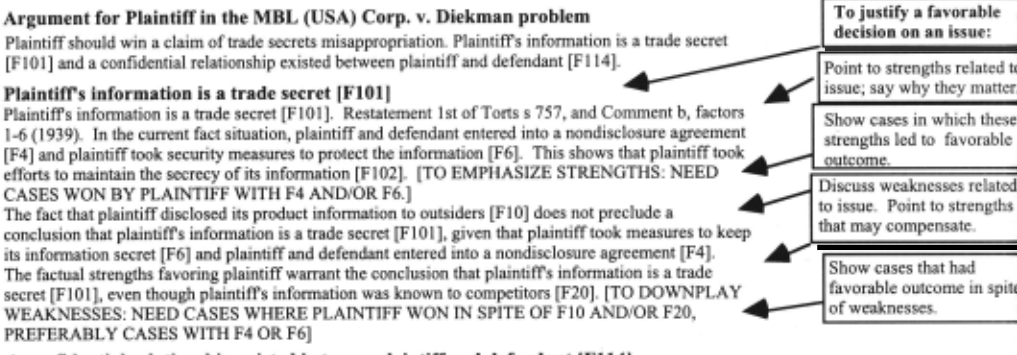
A confidential relationship existed between plaintiff and defendant [Fl14) ...
Figure 3: Sample CATO Issue-based Argument (left) and Recipe for Making It (right). (Factors and Abstract Factors are indicated in square brackets.)
To emphasize distinction D of case Cl as compared to C2 [where D favors side S]:
1. Select candidate focal points to emphasize D:
A. Find all combinations of a focal abstraction P and a set of contrasting factors X in C2 such that P is a most specific common ancestor of D and the factors in X.
B. Find all combinations of a focal abstraction P and a set of corroborating factors Y in C I such that P is a most specific common ancestor ofD and the factors in Y.
2. Organize candidate focal points
- Join candidate focal points with same focal abstraction P.
- Filter unsuitable factors and focal points. For each candidate:
- Check if contrast exists between C 1 and C2 for P's ancestors.
- If candidate has no contrasting factors, check if closed-world assumption is appropriate that pro-S conclusion associated with P is absent in C2.
- Remove contrasting or corroborating factors shared by C 1 and C2. (Shared factors not useful to draw contrast.)
- Consolidate candidate focal points whose focal abstractions are ancestor and descendant.
- Order the focal points by estimated strength: (1) X is not empty. (2) Y contains other factors beside D. (3) The rest.
3. Generate text for surviving focal points with templates.
The algorithm (and the one for downplaying a distinction in [Aleven and Ashley, 1996]) supports three "smart" techniques for reasoning symbolically about the significance of similarities and differences: (1) Tailor interpretations to fit the context of comparison. (2) Block interpretations strongly contradicted by other factors. (3) Strategically interpret similarities and differences.
Tailoring Interpretations: CA TO achieves a measure of context sensitivity in comparisons by virtue of the Factor Hierarchy's structure in which individual factors may relate to more than one abstract factor and by the Emphasize Distinction Algorithm's identifying abstract factors (P) as focal points which are the most specific common ancestors (msca) of the distinction to be emphasized (D), the contrasting factors, and the corroborating factors . (See [Kolodner, 1993] for other uses of msca.) By "context sensitivity", we mean knowing which similarities and differences are most salient in different circumstances and why: which should a reasoner focus upon, how should it characterize them, and which should it ignore. Although a normative concern may imply generally that a particular factual circumstance is significant, in the context of a particular problem and case, that assessment may be affected by the co-occurrence of other factual circumstances and other concerns, the arguer's rhetorical viewpoint and the dialectical role in which the arguer is engaged.
The effect of tailoring an interpretation of a difference may be seen in Figure 5. Each box shows an argument emphasizing the same distinction involving F 15 between the MBL case (and two variations of MBL) and the Elcor and Sperry cases, respectively. The arguments focus on different interpretations of the distinction in terms of abstract factors Fl06, Fl20, or Fl04. Depending on the context, one or other of these abstract factors is the focal abstraction. For instance, in Box 1, CATO interprets Fl5's significance in Elcor (C 1) in terms of abstract factor F 106 as showing that in Elcor, plaintiffs information was not known outside its business, whereas in MBL (C2) it was. In Box 3, Fl5 is significant in Sperry (Cl) because it suggests the defendant in Sperry got the information through improper means, unlike MBL (C2). In comparing MBL and Elcor, the algorithm finds that Fl06 is the most specific common ancestor ofF 15 and the contrasting factors in MBL, FlO and F20. In comparing MBL and Sperry, however, the algorithm finds that by selecting the more abstract F 120, additional corroborating factors can be brought to bear in a broader contrast distinguishing Sperry as a case turning upon improper means, namely F2, F7, and F26. The decision, to adopt F 120 as the interpretation, is made in the algorithm's consolidation step, 2C.
Other evidence of CA TO's context sensitive interpretations is in Figure 5. Comparing Boxes 1 and 2 shows the effect on the MBL/Elcor comparison of making MBL stronger for plaintiff by adding F8, so that the defendant saved product development time or expense by accessing plaintiffs information. CA TO now makes an argument downplaying the F 15 distinction interpreting it in terms of Fl04, a new focal abstraction indicating that the information was valuable. Boxes 3 and 4 show the effect on the MBL I Sperry comparison of making MBL stronger for plaintiff by adding F7, so that the defendant brought plaintiff's product-development tools with him to the defendant. CA TO again says the F 15 distinction shows possible improper means in Sperry, but this time CATO downplays the distinction, arguing on the basis of F7 that the MBL hypo and Sperry are the same.
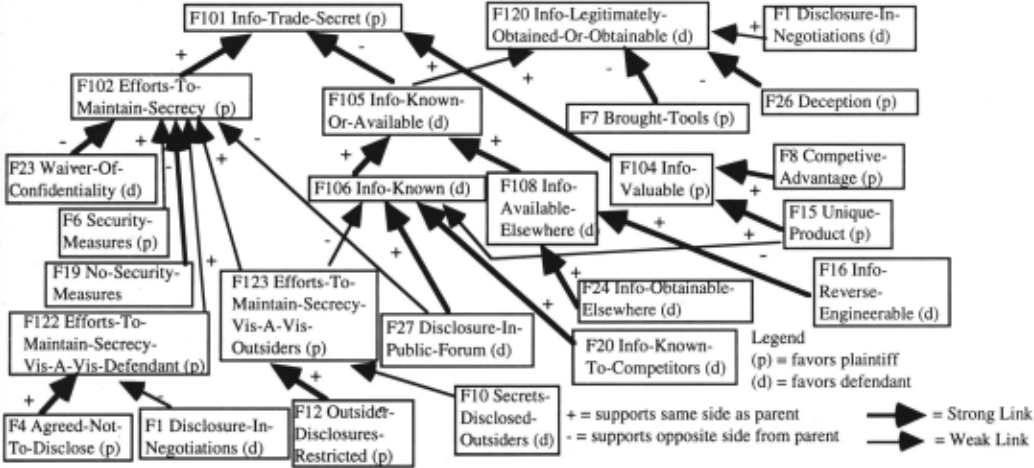
Blocking Interpretations: Link strengths in the Factor Hierarchy are designed to block certain interpretations in appropriate circumstances. The Hierarchy will characterize a similarity or difference in terms of only those abstractions not strongly contradicted by other factors. Evidence of blocking can be seen in Figure 5, Box 4, involving the MBL problem as modified by adding F7. As a result of blocking, CATO, arguing for defendant, does not characterize the MBL factors as evidence that defendant's means were not improper, as it does in Box 3. Where defendant brought plaintiff's product development tools, one does not want to argue that no improper means were used (F 120) solely on the basis of plaintiff's disclosures to outsiders (F I 0) and competitors' having knowledge of the information (F20). F7 is itself evidence of improper means. F7 should block the interpretation that F 10 and F20 are evidence of no improper means. In the Factor Hierarchy, Figure 4, a strong negative link from F7 to F 120 blocks the weak positive link from FI05 through which pro-defendant factors FlO and F20 in MBL are related to Fl20.
Strategic Interpretation: CA TO's algorithm for emphasizing distinctions (and for downplaying them) takes strategic considerations into account in deciding which abstraction path to follow in the Factor Hierarchy and how abstractly to characterize a distinguishing factor. One wants to characterize a distinction broadly enough to take advantage of all relevant contrasting and corroborating factors. One also wants to focus on distinctions that hold up at more abstract levels and avoid characteriziations so broad as to destroy the contrast or allow obvious objections.
An example of a strategic choice using the Factor Hierarchy is choosing a narrower interpretation of a distinction where a broader interpretation does not lead to a contrast, as shown by comparing Boxes 3 and 4 in Figure 5. After hypothetically modifying the MBL problem so that the defendant took product development information (F7), CA TO can still emphasize the F 15 distinction but this time does not focus on the improper means aspect (Fl20), as it did before in the MBL/Sperry comparison (Box 3). This would not be an effective way to draw a contrast, since in the modified problem there is also evidence of improper means (as CATO now points out in the new argument downplaying F 15). Instead, CA TO again interprets F 15 in terms ofF106, an abstract factor "lower down" in the Factor Hierarchy (see Figure 4). CATO eschews a broader interpretation in favor of a narrower one that more clearly contrasts with the other case, even though that means certain corroborating factors in the broader interpretation cannot be used.
How does CA TO use strategic considerations to decide which path to use and how far up or down the Factor Hierarchy to go in interpreting a distinction? The answer lies in heuristic policies embodied in CA TO's algorithm for emphasizing a distinction. The policies ensure that a sufficient contrast between the cases exists, with respect to both the focal abstraction itself (steps l.A and l.B) and its ancestors in the Hierarchy (step 2.B).
As a result, CA TO decides not to use F 120 in Box 4 for emphasizing the distinction, because there is no suitable contrast with respect to this abstract factor. F 120 must either not be supported for plaintiff in MEL, or supported for defendant as well. However, it is supported for plaintiff in MEL (by F7), but not supported for defendant. As noted above, pro-plaintiff factor F7 in MEL blocks the pro defendant inference from FlO and F20 to Fl20. Abstract factor Fl06, however, does satisfy the requirements of both heuristic policies. The two cases have opposing factors related to F I 06 itself (pro-plaintiff F 15 in Sperry, pro defendant FlO and F20 in MEL) . Also, they contrast suitably with respect to ancestors of Fl06: The path from F 106 to F I 05 to F I 01 does not contain abstract factors supported for plaintiff in MEL, satisfying the second heuristic policy.
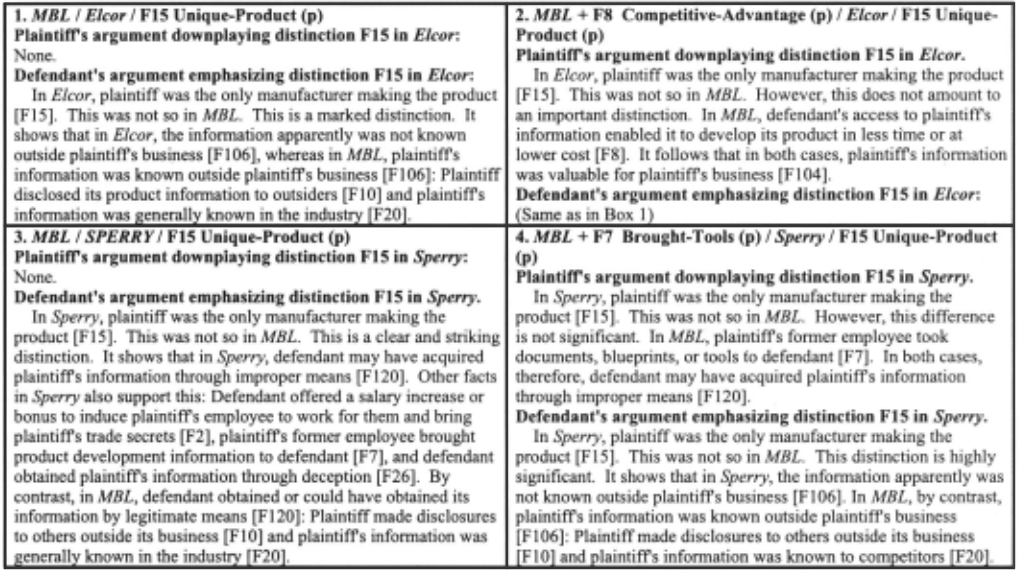
| 1. MBL I Elcor I F15 Unique-Product (p) Plaintiff's argument downplaying distinction Fl5 in E/cor: None. Defendant's argument emphasizing distinction F15 in Elcor: In Elcor, plaintiff was the only manufacturer making the product [F 15]. This was not so in MBL. This is a marked distinction. It shows that in E/cor, the information apparently was not known outside plaintiffs business [F I 06], whereas in MBL, plaintiffs information was known outside plaintiffs business [FI06]: Plaintiff disclosed its product information to outsiders [F I 0] and plaintiffs information was generally known in the industry [F20] . | 2. MBL + F8 Competitive-Advantage (p) I Elcor I F15 Unique Product (p) Plaintiff's argument downplaying distinction F15 in Elcor. In Elcor, plaintiff was the only manufacturer making the product [FI5). This was not so in MBL. However, this does not amount to an important distinction. In MBL, defendant's access to plaintiffs information enabled it to develop its product in less time or at lower cost [F8). It follows that in both cases, plaintiffs information was valuable for plaintiffs business [F I 04). Defendant's argument emphasizing distinction Fl5 in Elcor: (Same as in Box I) |
| 3. MBL I SPERRY I F15 Unique-Product (p) Plaintiff's argument downplaying distinction F15 in Sperry: None. Defendant's argument emphasizing distinction F15 in Sperry. In Sperry, plaintiff was the only manufacturer making the product [FI5] . This was not so in MBL. This is a clear and striking distinction. It shows that in Sperry, defendant may have acquired plaintiffs information through improper means [Fl20). Other facts in Sperry also support this: Defendant offered a salary increase or bonus to induce plaintiffs employee to work for them and bring plaintiffs trade secrets [F2], plaintiffs former employee brought product development information to defendant [F7], and defendant obtained plaintiffs information through deception [F26). By contrast, in MBL, defendant obtained or could have obtained its information by legitimate means [Fl20]: Plaintiff made disclosures to others outside its business [FlO] and plaintiffs information was generally known in the industry [F20). | 4. MBL + F7 Brought-Tools (p) I Sperry I F15 Unique-Product (p) Plaintiff's argument downplaying distinction F15 in Sperry. In Sperry, plaintiff was the only manufacturer making the product [FI5). This was not so in MBL. However, this difference is not significant. In MBL, plaintiffs former employee took documents, blueprints, or tools to defendant [F7] . In both cases, therefore, defendant may have acquired plaintiffs information through improper means [F120]. Defendant's argument emphasizing distinction Fl5 in Sperry. In Sperry, plaintiff was the only manufacturer making the product [F 15). This was not so in MBL. This distinction is highly significant. It shows that in Sperry, the information apparently was not known outside plaintiffs business [F I 06). In MBL, by contrast, plaintiffs information was known outside plaintiffs business [FI06]: Plaintiff made disclosures to others outside its business [FlO] and plaintiffs information was known to competitors [F20] . |
problems in terms of factors, retrieved cases to test certain hypotheses about the importance of certain factors, and then worked with a legal dispute much like the MEL case. They determined which factors apply, retrieved and compared cases as in Figure 2, practiced argument moves with the problem like those in the argument recipe of Figure 3 and in emphasizing and downplaying distinctions as in Figure 5, organized and wrote a multi-case argument and compared it with CATO's argument (as in Figure 3 but incorporating actual cases.)
All subjects took a pre-test and post-test of Basic Argument Skills. We also administered a more advanced take-home post-test involving a memo-writing assignment, considerably beyond the sophistication of the CA TO instruction, using a previous semester writing assignment grade as a control. The legal writing instructor graded the exams in a blind test.
| Basic Ar ment Skills | Memo Writin | ||||||
|---|---|---|---|---|---|---|---|
| Pre-Test | Post-Test | Prev. | Post-Test | ||||
| Ex per. Gr. Av | 60 | C- | 70 | C+ | 63 | 70 | B- |
| Control Gr. Av . | 55 | D | 68 | c | 63 | 79 | B+ |
4 Evaluation
An experiment with 30 first-year law students compared CA TO's instructional effectiveness to that of an accomplished legal writing teacher teaching the same material in a traditional way [A! even & Ashley, 1997]. The subjects were randomly assigned to experimental and control groups. All subjects read a traditional trade secret law casebook chapter.
The control group attended six classroom session of 50 minutes in small groups of about eight students. The human instructor discussed the casebook cases and presented a framework for analyzing t,rade secret problems. During two sessions, students made oral arguments about two problems in a moot court setting in which the instructor played the role of "judge". Students prepared for the moot court sessions in two 75 minute practice sessions outside of class.
In the experimental group's nine 50-minute sessions, students learned to use CA TO's tools to address the argumentation problems at the end of each section of the casebook following instructions in four workbooks. Students worked with CA TO in pairs. After sessions introducing students to CA TO's tools and to factors and their interpretations, students used CA TO to analyze As shown in Table 1, on the Basic Argument Skills tests, in both groups the improvement from pre- to post test was statistically significant (t-test, p < .05). There was no significant difference between the two groups, and their improvement scores (i.e., post-test score minus pre test score) did not differ significantly between the two groups (t-test, p > .05). On the memo-writing assignment however, the control group did better, and the difference was statistically significant. The previous semester's assignment showed no statistically significant difference.
5 Discussion and Conclusion
CA TO instruction lead to a significant improvement in students' basic argumentation skills, comparable to that achieved by a legal writing instructor teaching small groups. The subjects were all from a special program for students judged most in need of individualized attention, and the human instructor, the director of that program, was experienced and successful in teaching such students.
The memo-writing post-test shows a limitation on CATO's efficacy. While both groups learned basic argumentation skills, the control group integrated these skills better in a complex assignment. The human taught skills indirectly and holistically by engaging students in oral arguments without focusing on elements of argumentation. By contrast, CA TO taught students basic elements with examples gradually combining more elements. CA TO's exercises to help students integrate the components came at the end; few students had enough time to practice them. As a result, we need additional time and techniques for integration. For example, with an LCD projector, instructors could demonstrate complex arguments and techniques with CA TO in class which students could then practice with CA TO at home.
CA TO tackles some general problems of abstraction in case description. It illustrates, and the evaluation lends some support to the utility of, three techniques in comparing partially matched cases at multiple levels of abstraction, the use of: (I) factors to represent relevant similarities and differences, (2) a Factor Hierarchy to represent the significance of factors abstractly in terms of the purposes of the classification, and (3) a set of criteria for selecting focal abstractions. Implemented in CA TO's algorithms for emphasizing and downplaying differences and for making issue-based arguments, these criteria enable CA TO to select the right path and level of abstraction for characterizing a case.
CA TO's approach helps frame the remaining problems of representing, recognizing and retrieving cases described at different levels of abstraction. Given the range of choice in characterizing a case abstractly, and the underlying strategic considerations, any multilevel case representation must preserve flexibility of interpretation. Multilevel descriptions also complicate the problem of evaluating which candidate cases are best. The value of a case lies in its uses in arguments . Multilevel characterizations expand the ways a case may be used in arguments and responses. Those possible uses need to be folded into the retrieval process. BankXX's heuristicallyguided argument search employing complex argument evaluation functions [Rissland, et a!. 1996], or factoring adaptation cost into retrieval [Smyth and Keane, 1994] may provide models. In an educational context like CATO's, however, the uses of retrieved cases in arguments need to be played out explicitly for students to understand and learn from them.
@inproceedings{ijcai1997p50,
  title     = {Reasoning Symbolically About Partially Matched Cases},
  author    = {Ashley, Kevin D. and Aleven, Vincent},
  booktitle = {Proceedings of the Fifteenth International Joint Conference on
               Artificial Intelligence, {IJCAI-97}},
  publisher = {International Joint Conferences on Artificial Intelligence},
  editor    = {Martha E. Pollack},
  pages     = {335--340},
  year      = {1997},
  note      = {Computer-aided Education},
  url       = {https://ijcai.org/proceedings/1997/50},
}
TY - CPAPER TI - Reasoning Symbolically About Partially Matched Cases AU - Ashley, Kevin D. AU - Aleven, Vincent T2 - Proceedings of the Fifteenth International Joint Conference on Artificial Intelligence, IJCAI-97 PB - International Joint Conferences on Artificial Intelligence PY - 1997 SP - 335 EP - 340 UR - https://ijcai.org/proceedings/1997/50 ER -Copied
Machine-readable versions of this paper, for tools and AI agents:





