
Use of Abstraction and Complexity Levels in Intelligent Educational System Design
Proceedings of the Fifteenth International Joint Conference on Artificial Intelligence. Computer-aided Education. Pages 329-333.
© 1997 International Joint Conferences on Artificial Intelligence
Abstract
We are interested in problem-solving domains, like engineering and most "exact science" disciplines. In these domains, the knowledge to be acquired by the student is twofold: the domain knowledge itself, but also and mainly the knowledge necessary to solve problems in that domain. As a result, an educationoriented system in such a domain must encompass three knowledge types: the domain knowledge and the problem-solving knowledge, constituting the knowledge to be acquired and mastered by the student, and the tutoring knowledge, used by the system to facilitate the student's learning process. In this paper, we show how these three knowledge types can be modelled, how they should interact with one another in order to fulfil the system educational purpose, and above all how the abstraction and complexity levels can shed a uniformizing light on the system operation and make it more userfriendly. We thus hope to bring some contribution to the general and important problem of finding a generic architecture to intelligent tutoring systems.
- Anderson John R. (1986) Cognitive Modelling and Intelligent Tutoring. National Science Foundation (Washington, DC).
- Anderson, John R. & B. J. Reiser (1985) ''The LISP Tutor". Byte 10,no.4,p. 159-175.
- Brodie, Michael L., John Mylopoulos & Joachim W. Schmidt, eds. (1984) On Conceptual Modelling, Perspectives from Artificial Intelligence, Databases, and Programming Languages . Springer Verlag (New York).
- Brown, John S. & Richard R. Burton (1978) "Diagnostic models for procedural bugs in mathematical skills". Cognitive Science 2, p. 155-192.
- Clancey, William J. (1986) "Qualitative student models". Annual Review of Computer Science 1, p. 381-450.
- Clocksin, William F. & Christopher S. Mellish (1981) Program- ming in Prolog. Springer-Verlag (Berlin).
- Dfaz de Barraza Sanchez, Arantza & Isabel Fernandez de Castro, eds. (1996) Computer-Aided Learning and Instruction in Sci- ence and Engineering, Proceedings of the Third International Conference, CALISCE'96, San Sebastian (Espana), 29-31 July 1996. LNCS 1108, Springer (Berlin).
- Findler, Nicholas V., ed. (1979) Associative Networks . Academic Press (Orlando, FL).
- Frasson, Claude, Gilles Gauthier & Alan Lesgold, eds. ( 1996) Intel- ligent Tutoring Systems, Proceedings of the Third International Conference, ITS'96, Montreal (Canada), 12-14 June 1996. LNCS 1086, Springer (Berlin).
- Gagne, Denis & Andre Trudel (1996) "A highly flexible student- driven architecture for computer-based instruction". [Frasson & al., 1996], p. 66-74.
- Goldstein, Ira P. ( 1977) The Computer as Coach: an Athletic Para- digm for Intellectual Education. AI Memo 389, AI Laboratory, Massachusetts Institute of Technology (Boston, MA).
- Goldstein, Ira P. (1979) "The genetic epistemology of rule sys- tems". International Journal of Man-Machine Studies 11, no. 1' p. 51-77.
- Kim, Won & Frederick H. Lochovsky, eds. (1989) Object-Oriented Concepts, Databases, and Applications. ACM Press, Addison- Wesley Pub!. (Reading, MA).
- Kowalski, R. (1979) Logic for Problem Solving . North-Holland (Berlin).
- Lelouche, Ruddy & Jean-Fran~ois Morin (1996) ''The formula : a relation? Yes, but a concept too!". [Dfaz de Barraza Sanchez & Fernandez de Castro, 1996], p. 176-185.
- Lenat, D., F. Hayes-Roth & P. Klahr (1979): Cognitive Economy. Working Paper HPP-79-15, Stanford Heuristic Programming Project. Stanford University (CA), June, 46 pages.
- Malec, J. (1989) "Knowledge elicitation during dynamic scene description" . ACM-SIGART Newsletter : special issue on knowledge acquisition, no. 108, April, p. 162-163.
- Patel, Ashok & Kinshuk (1996) "Applied artificial intelligence for teaching numeric topics in engineering disciplines". [Dfaz de Barraza Sanchez & Fernandez de Castro, 1996], p. 132-140.
- Sleeman, D. H. & John Seely Brown, eds. (1982) Intelligent Tutor- ing Systems. Academic Press (London).
- Sowa, John F. (1984) Conceptual Structures . Addison-Wesley (Reading, MA).
- Wenger, Etienne (1987) Artificial Intelligence and Tutoring Sys- tems. Morgan Kaufmann (Los Altos, CA).
References were extracted automatically from the PDF and may contain errors.
Full text extracted automatically from the PDF; figures, tables and equations may differ. The PDF is the version of record.
Introduction
Besides the complexity of teaching itself, the domains taught vary considerably in complexity, type of interactions, type of evaluation, relationships between theory and practice, etc. This way, teachable domains can be classified according to the type of knowledge to be acquired by the student: "know", "know-how", and "know-how-to-be". Examples of such knowledge types are respectively: anatomy or a lan guage grammar, the skill to solve a mathematical or medical problem, and the capability to adapt to one's environment or to deal with personal relationships. Cost engineering knowl edge is of the second type.
Moreover, almost all teachable domains vary in com plexity, from simple basics to relatively complex problems to solve. Thus, a student should learn and master the basics of such a domain before he is taught wider notions. And when a human tutor detects errors or misunderstandings, he usually draws the student's attention on a small subset of the involved knowledge, so that he may correct his errors and/or misunder standings. Such an interaction is focused on either a given set
Jean-Fran~ois Morin
Departement d'infonnatique, Universite Laval Quebec G 1 K 7P4 Canada
Tel.: (418) 843-5193 Fax: (418) 843-9245
e-mail: morin@ift. ulaval. ca
of the domain knowledge or the scope of knowledge involved by a given problem.
Problem-solving or know-how domains are the ones in which we are interested here. In such a domain, hereafter called a KH-domain, the knowledge to be acquired by the stu dent is twofold: the domain knowledge itself, but also and mainly the knowledge necessary to solve problems in that do main. As a result, an education-oriented system in such a do main, which we here call a KH-ITS, must encompass three knowledge types: the domain knowledge and the problem solving knowledge, constituting the knowledge to be ac quired and mastered by the student, and the tutoring knowl edge, used by the system to facilitate the student's learning process.
This paper has a double purpose:
- we present each of the three types of knowledge in volved in a KH-ITS;
- for each type of knowledge, we show how abstraction and complexity levels appear and how it is possible to deal with them.
In order to do so, we present in section 1 our domain knowledge modelling and how we exemplify it in the case of cost engineering. Next, in section 2, we focus on the advan tage of separating the problem-solving knowledge from the domain knowledge in a KH-ITS, and we present some prob lem-solving activities in cost engineering as an example. In section 3, we briefly describe some principles of tutoring knowledge modelling in a KH-ITS. In each of these three sec tions, we show how to use abstraction and complexity levels, exemplifying the principles in the cost engineering domain. Finally, section 4 presents the educational interests of using abstraction and complexity levels when modelling the three types of knowledge involved in a KH-ITS.
1 Domain knowledge
In order to describe the domain knowledge, we first present its characteristics in a general KH-ITS (§ l.l). We then show how we model it in the cost engineering domain (§ 1.2), and how such an approach lets us introduce the no tions of abstraction and complexity levels(§ 1.3).
1.1 General
The first type of knowledge involved in every ITS, the domain knowledge (DK), contains all theoretical and factual aspects of the knowledge to be taught to the student. Al though its specific structure can be varied, it typically may in clude concepts, entities, and relations about the domain [Brodie & al., 1984], object classes and instances [Kim & Lo chovsky, 1989], possible use restrictions, facts, rules, [Kow alski, 1979; Clocksin & Mellish, 1981], semantic or associative networks [Findler, 1979; Sowa, 1984], etc.
The main system activities centred on this knowledge type are:
- theoretical explanations about the various knowledge ele~ents and their relationships in the teaching do mam;
- providing the other modules of the ITS, i.e. problem solving and tutoring, with the necessary background of domain knowledge that they need.
1.2 Application to cost engineering
In the particular domain of cost engineering, we chose to represent this type of knowledge with concepts, relations, and a special case of relations modelled as concepts, the factors. The model is presented with more details in [Lelouche & Morin, 1996].
Concepts can be basic entities like:
- Investment: It is an amount on which interest is com puted; depending on the context or the type of problem, it may also be called capital, loan, or present value.
- Interest: It is the amount exceeding the initial invest ment, received by the lender from the borrower at the moment of its repayment.
- Investment duration: It is the total time during which the interest is computed over the investment; this dura tion is uninterrupted.
- Future value: It is the total amount to be repaid at the term of an investment; it is equal to the total accumulat ed interest added to the initial investment amount or present value.
With the notion of compounding, some other concepts can be defined:
- Compounding: If the investment duration is long enough, a partial interest may be periodically added to the principal; that amount itself then produces interest for the remaining of the investment duration; this prin ciple is called interest compounding; when the interest is compounded before the term of the investment, the principal then augments accordingly, and becomes greater than the initial investment.
- Compounding period: It is the time elapsed between two consecutive interest compoundings; unless other wise specified, the interest is compounded yearly.
- Number of periods: It is the number of interest com poundings during the investment duration.
- Interest rate: It is the amount of interest payable for one period depending on the principal:
Capital amount
- Annuity: amount paid or received periodically (annual ly unless otherwise specified); although the periodic amounts may increase or decrease over time, we refer only to uniform (constant) annuities in this paper.
Concepts are linked to one another by various types of relations. The relations between concepts can be either usual knowledge-representation relations, like subclass of, element of, sort of, etc., or numerical relations represented by formu la:. Such a formula is given above. Another one is:
which, given the present value P of an investment over n pe riods at rate i, computes the corresponding future value F of that investment.
A formula such as (1) can be rewritten as:
thus introducing the factors cf)PF,i,n and cf)FP,i,n· Factors allow us to separate their definition (rightmost equalities above, a quantitative aspect) from their possible uses in the application domain (leftmost equalities, a qualitative aspect).
Similarly, the factor cf)APi n converts a series of identical annual amounts A into an unique present value P:
Actually, cf)AP,i,n is a sum of cf)FP factors. The factor cf)PA.i.n does the reverse process:
There exist other factors converting gradient and geometrical series of amounts into a present or future value; such factors are also computed as a sum of (f) FP,i,n factors.
Although the formula: related to these factors essentially involve quantitative aspects, the similarities and differences between them, and the circumstances regulating the use of ei ther one, are of a deeply qualitative ground. If the value of a factor is indeed calculated from two or three numerical pa rameters, the context in which they are defined depends on whether we have to timewise move an unique amount or a se ries of amounts, identical or not, or conversely to compute an equivalent annual amount, etc. In fact, this context corre sponds to the type of conditions that govern the investment, or investment conditions type, without respect to the amounts and durations involved, and is thus essentially qualitative.
This characteristic allows us to qualitatively describe re lationships between factors which are basically quantitative: the transitivity (cf)AFi n = cf)APi n X cf)PFi n) and inversion ((f) FP,i,n X (f) PF,i,n = 1)' relations. Moreover,'this qualitative de scription (including the notation) leads to a significant im provement of the pedagogical approach used to teach this subject to university students.
1.3 Abstraction and complexity levels
As it turns out, every factor introduces an intermediate abstraction level between the concepts implied the equation defining it. For example, in the case of formula (1), or equiv alently formulre (2) anq (3), we have (see figure 1):
- at the bottom of the hierarchy, the interest rate and the number of periods, basic concepts "making technicali ties explicit";
- above them, concepts more fundamentally related to the cost engineering problem being solved, namely the present and future values of the investment at hand;
- between these two levels, the intermediate one brought by the introduction of the factor 4.> FP or 4.> PF·
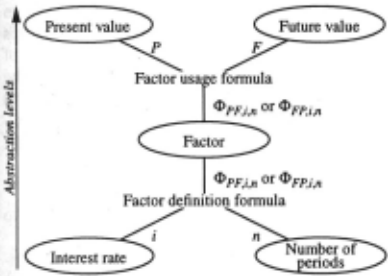
That intermediate status of the factor, originally just an intermediate variable in calculations [see formulre (2) and (3)], makes it appear as a pedagogically oriented concept, which clearly separates
- the computational, quantitative aspect of the factor def inition, i.e. the interest rate and the number of periods
- from the practical, qualitative aspect of the factor usage in a domain problem, i.e. the present and future values.
This follows the theory [Lenat & al., 1979; Malec, 1989] ac cording to which the use of multiple abstraction levels eases the modelling process and simplifies inferences which may be made on the domain concepts.
Most interestingly, our scaffolding approach can be made more general: we may present and use higher-level fac tors built upon these first ones. Indeed, "above" 4.> FP and 4.>PF· we can define factors to express the present and future values of a series of identical amounts (and vice versa), which are a first way to generalize this concept hierarchy. For example, the <l>AP factor is indeed a sum of 4.>FP factors:
where the last expression results from computing the geomet rical series shown. This example constitutes a proof of (4), but also and mainly shows that the 4.>AP factor is at a higher level than 4.>FP Note that this refers to a complexity level rath er than an abstraction level, since it is due to the way the 4.>AP factor is defined and computed.
In the sequel of the cost engineering course, other ab straction or complexity levels appear when introducing the factors related to investments made of periodic amounts in arithmetic or geometric progression, and the factors related to various depreciation types.
2 Problem-solving knowledge
In order to describe the problem-solving knowledge, we now present the general characteristics regarding problem solving knowledge modelling in a KH-ITS (§ 2.1). As we did in section 1, we then present our model in the cost-engineer ing domain (§ 2.2).
2.1 General
The second type of knowledge is specific to KH-do mains, henceforth to KH-ITSs. We call it problem-solving knowledge (PSK). It contains all inferential processes used to solve a problem resulting from the instantiation of a practical situation based on the domain knowledge [Kowalski, 1979; Patel & Kinshuk, 1996]. In other words, in order to be able to solve a problem, the problem-solving knowledge needs a the oretical background, which is found in the domain knowl edge. The processes stored in PSK may be represented in various ways, using either or all of logic [Kowalski, 1979], procedural networks [Brown & Burton, 1978], semantic net works with procedural attachments, (augmented) transition networks, production rules [Goldstein, 1979; Anderson & Reiser, 1985], etc.
The main system activities centred on this knowledge type are:
- providing the inferential tools for problem solving;
- providing the inferential tools for coaching a student in a problem-solving session.
The main advantage of separating the problem-solving knowledge from the domain knowledge is that it emphasizes the distinction between the domain itself and the skills used to solve a practical problem in that domain, thus simplifying the learning process. That knowledge separation into DK and PSK is common to all KH-domains; this is why we believe that KH-ITSs, which are aimed at helping the student to learn how to solve problems, should display the same knowledge separation.
Besides, we can use - we believe in a novel way - that separation between DK and PSK to define four generic oper ating modes in a KH-ITS, based on the type of knowledge in volved (DK or PSK), and on who "generates" it (the system or the student).
- In domain-presentation mode, the student asks the sys tem some information about a domain theoretical ele ment, and the system reacts by transferring to the student the required information or knowledge. The knowledge involved in this category is always DK, sys tem-generated.
- In demonstration mode, the student asks the system to solve a practical problem or to coach him while he solves a problem. In the first case, the problem typically comes from the student himself, whereas in the latter one the problem typically comes from the tutoring sys-
- tern. In either case, the main level of knowledge in volved is PSK, system-generated.
- In domain-assessment mode, the system prompts the student to develop a domain element, and the student thus expresses his understanding of that element. If judged necessary, the system may then intervene to cor rect that understanding. The knowledge involved in this mode is essentially DK, student-generated.
- Finally, in exercising mode, the system prompts the stu dent to solve a practical problem. The student then solves it step by step, showing what he understands of the involved problem-solving knowledge and of the as sociated domain knowledge. If necessary, the system may decide to intervene in order to help him reach his goal or to correct it. The knowledge involved in this mode is naturally PSK, student-generated.
2.2 Application to cost engineering
In the particular case of cost engineering, various problem-solving activities can be identified:
- identify the given problem data;
- identify the expected result;
- draw a temporal diagram to represent the relevant events;
- apply a formula;
- compare amounts located at the same date;
- compare amounts located at different dates;
- add amounts situated at the same date;
- add amounts situated at different dates;
- choose a reference date;
- move an amount from one date to another;
- 11 . collapse a series of periodic amounts into one single amount;
- explode an amount into a series of periodic amounts;
- etc.
As it turns out, many problem-solving tasks may be di vided into smaller ones, letting us introduce the notion of complexity levels in these tasks. For example, the comparison of two amounts situated at different dates implies:
- first, choosing a reference date at which to make the comparison;
- then, moving either (or both) amount(s) from its present date to the reference date;
- finally, comparing the amounts now both located at the same reference date.
These subactivities (of types 9, 10, and 5 respectively in the sample list above) thus appear to be of a lower complexity level than the initial one (of type 6). However, it is interesting to note that, although activity 6 turns out to be more complex than activity 5 (the latter is part of the former), both are stated using the same abstraction level.
It may also happen that some lower-level activities can only appear as components of a higher-level one. For exam ple, the activity "drawing a temporal diagram" (type 3 above) implies the following tasks, which can only be accomplished as part of that activity (hence their identification frc ,m 3a to 3d):
- draw a timeline to encompass all periods implied by the problem data;
- draw arrows representing the amounts involved in the problem data;
- if necessary, split an amount (or each amount in a se ries) to simplify the computations;
- qualitatively draw as a special arrow the expected result of the computations to be made.
3 Tutoring knowledge
We now briefly present the tutoring knowledge (TK) in order to help the reader to better apprehend the relationships of that knowledge with DK and PSK. This third type of knowledge contains all tutoring processes enclosed in the ITS. It is not directly related to the teaching domain or to problem solving, but helps the student to understand, assimi late, and master the knowledge included in DK and PSK [Gagne & Trudel, 1996].
The main system activities using TK are:
- ordering and formatting the topics to be presented to the student;
- monitoring a tutoring session, i.e., triggering the vari ous tutoring processes according to the system tutoring goal and the student's actions; such monitoring may imply giving explanations, asking questions, changing to another type of interaction, etc.;
- in a KH-domain, while the student is solving an exer cise, monitoring the student's problem-solving activi ties: understanding and assessing these activities, giving advice to correct or optimize them, giving hints or partly solving the exercise at hand (as required by the student or by the tutoring module), etc. ;
- continuously analysing the student's progress in order to optimize the tutoring process.
The advantage of separating the tutoring knowledge from the knowledge of the domain to be taught has been em phasized long ago [Goldstein, 1977; Sleeman & Brown, 1982; Clancey, 1986; Wenger, 1987], and lies in the reusabil ity ofTK in various domains. In the case of KH-domains, the domain to be taught clearly encompasses both DK and PSK indeed, the term "domain knowledge" applies to DK if refer ring to the knowledge type, and to DK + PSK if referring to the knowledge to be acquired. Therefore, as shown earlier, i a KH-ITS, knowledge ends up being separated into three cat egories rather than two.
We believe that the tutoring processes are triggered by tutoring goals which depend on the current educational set ting and learning context. In the current state of our research, our assumption is therefore the following: the underlying hi erarchy or hierarchies governing the way they interact with one another is not related to these processes per se, but rather to the goal to be attained when they are invoked. If that as sumption turns out to hold, then the dynamic structure of ed ucational goals and sub goals- which itself depends on the student's desires or abilities, the main underlying objective o the tutoring system, the student's state (e.g. of tiredness, etc.) and performance, etc. - will determine the succession of tu toring processes activated and tutoring interactions taking place. To our knowledge, the use of abstraction levels to in duce a dynamic hierarchy of tutoring goals is new, as is the assumption that such a hierarchy will play a major role in ac tivating the various tutoring processes and student-system in teractions.
4 Educational interests of the abstraction and complexity levels
In the above sections, we have described a complexity and abstraction-level approach to help model the three types of knowledge involved in a KH-ITS. In this section, we present the educational interests of our model. Sections 4.1 to 4.3 focus on the type of knowledge respectively presented in sections 1 to 3. Section 4.4 summarizes that discussion with some overall pedagogical interests of our approach.
4.1 Domain modelling
The factor hierarchy described in section 1 lets us derive an order for the presentation of factors to the student, from the lowest (simplest) level up to the highest, i.e. with increas ing understanding complexity. That does not imply that such an order is unique, or even the best (e.g. a student's personal interests might make another order more motivating for him), but it is justified by our model. This presentation order may itself induce a possible order for prerequisites; e.g., if a stu dent experiments difficulties to deal with <I>AP. has he well mastered <I> FP. a conceptually simpler factor?
Moreover, the intermediate abstraction levels will permit our ITS to exhibit a sharper error modelling. For example, the source of an understanding error concerning either rela tion in equation (2) or (3) is much easier to identify using the corresponding factor, either as a definition error or as a usage error, than an error concerning the global equation ( 1 ), where the definition and application relationships are not made ex plicit, and are therefore impossible to distinguish. Similarly, an error using a <I>AP factor may be diagnosed as resulting from an insufficient mastery of the simpler factor <I> FP as con cept (which in tum will be diagnosed as related either to the definition, or to the usage of that concept).
Finally, in a first development stage, this modularity will ease our defining the exercise types to be implemented into the ITS, and will ease the tutor module task of choosing the exercise type to challenge the student with. Later, once the ba sic system is operational, that modularity will help us develop an automatic exercise generator dealing with the domain ele ments to be mastered by the student. That approach will then help the student to acquire a better critical mind about the rel ative importance of know-how knowledge vs. domain knowl edge.
4.2 Problem-solving modelling
The problem-solving activities briefly presented in sec tion 2 naturally display abstraction and complexity levels. In deed, a standard cost engineering problem can be divided, possibly in more than one way, into major steps, which can then be split into simpler substeps. Such "relatively complex" cost engineering activities shown in section 2.2 were activity 3 (draw a temporal diagram) and activity 6 (compare amounts situated at different times). Using activities 5 and 6 as exam ples, we also made a distinction between the complexity lev el, based on the execution process, and the abstraction level, based on expressiveness or scope.
Such abstraction and complexity levels will let us intro duce multiple levels of explanations, which will ease their tai loring, vary the answers to the student's questions, and adapt to the theoretical and practical reminders needed by the stu dent.
Moreover, such an approach will lead the student to fo cus specifically on the activities for which he needs more tu toring, with the abstraction and complexity levels appropriate to his individual case.
That tutoring may take the form of explanations, guid ance, hinting, even partially solving the exercise on which the student is currently working.
| Functioning mode | Domain-presentation mode | Demonstration mode | Domain-assessment mode | Exercising mode | |
|---|---|---|---|---|---|
| Main type of knowledge involved | Domain knowledge | Problem-solving knowledge | Domain knowledge | Problem-solving knowledge | |
| Student's main goal | To learn | To assess his learning | |||
| Direction of the knowledge transfer | System ~ Student | Student ~ System | |||
| Typical interaction | Trigger (start) | The student asks the system ... | The system prompts the student. .. | ||
| some information about a domain theoretical element | to solve a practical problem or to coach him while he solves a problem | to develop a domain element | to solve a practical problem | ||
| Knowledge exchange | The system presents ... I | The student presents his view of ... | |||
| the requested element | a possible solution to the requested problem | the requested element | a possible solution to the given problem | ||
| Result (closure) | The student expresses his understanding ... | I The system assesses the student's answers, and possibly corrects them | |||
| of the element | I of the problem solution | ||||
4.3 Tutoring modelling
As presented in section 2, the distinction between DK and PSK leads to four natural functioning modes: the domain presentation mode, the demonstration mode, the domain-as sessment mode, and the exercising mode. Their main charac teristics are recalled in Table 2.
The abstraction levels of the tutoring goals aimed at by the system when invoking the tutoring processes is likely to result in a chain of recursive calls of these processes. This re cursivity will or will not be direct, depending on the tutoring interaction types being chained: the system might freely de cide to temporarily change between interaction types. How ever, the potential complexity of this chain is only apparent: because ofthe tutoring goal abstraction hierarchy, each newly invoked process will be called with a narrower scope, which naturally eliminates the risk of "forgetting" the initial tutoring goal or running into an infinite loop.
4.4 Overall interests of these abstraction and complexity levels
Abstraction levels are certainly not new. What we think is new is to use them in a systematic way to shed a uniformiz ing light on the system design and operation, and to make it more user-friendly once implemented.
First, they may help to better tailor the system tutorial in terventions to fulfil the student's needs and the system tutor ing goals, thus improving its conviviality and efficiency.
Then, all the capabilities presented above should result in smoother, more "natural", human-like interactions with the student. This improved ability to reproduce a human teacher's behaviour contributes again to make the system more user friendly.
Finally, although that aspect is not in the scope of this pa per, our refining of the three types of knowledge as described in sections I to 3 paves the way for the implementation of a structured error model, and eventually a student model.
Conclusion
This presentation of a possible knowledge structure for KH-domains, which emphasizes the separation between do main knowledge and problem-solving knowledge, shows how a general functioning theory of such an ITS - namely the four functioning modes described in section 4-can nat urally be derived.
Moreover, the abstraction and complexity levels high lighted throughout this paper can be used as a common para digm to help finding an appropriate representation for each knowledge type, and thus help creating more efficient ITSs. More generally, this paradigm can shed a uniformizing light on the system design, although it has never been used in a sys tematic way in the design or implementation of an ITS.
We thus hope to bring some contribution to the general and important problem of finding a generic architecture for intelligent tutoring systems.
Bibliographic references
- Anderson John R. (1986) Cognitive Modelling and Intelligent Tutoring. National Science Foundation (Washington, DC).
- Anderson, John R. & B. J. Reiser (1985) ''The LISP Tutor". Byte 10,no.4,p. 159-175.
- Brodie, Michael L., John Mylopoulos & Joachim W. Schmidt, eds. (1984) On Conceptual Modelling, Perspectives from Artificial Intelligence, Databases, and Programming Languages . Springer Verlag (New York).
- Brown, John S. & Richard R. Burton (1978) "Diagnostic models for procedural bugs in mathematical skills". Cognitive Science 2, p. 155-192.
- Clancey, William J. (1986) "Qualitative student models". Annual Review of Computer Science 1, p. 381-450.
- Clocksin, William F. & Christopher S. Mellish (1981) Program ming in Prolog. Springer-Verlag (Berlin).
- Dfaz de Barraza Sanchez, Arantza & Isabel Fernandez de Castro, eds. (1996) Computer-Aided Learning and Instruction in Sci ence and Engineering, Proceedings of the Third International Conference, CALISCE'96, San Sebastian (Espana), 29-31 July 1996. LNCS 1108, Springer (Berlin).
- Findler, Nicholas V., ed. (1979) Associative Networks . Academic Press (Orlando, FL).
- Frasson, Claude, Gilles Gauthier & Alan Lesgold, eds. ( 1996) Intel ligent Tutoring Systems, Proceedings of the Third International Conference, ITS'96, Montreal (Canada), 12-14 June 1996. LNCS 1086, Springer (Berlin).
- Gagne, Denis & Andre Trudel (1996) "A highly flexible student driven architecture for computer-based instruction". [Frasson & al., 1996], p. 66-74.
- Goldstein, Ira P. ( 1977) The Computer as Coach: an Athletic Para digm for Intellectual Education. AI Memo 389, AI Laboratory, Massachusetts Institute of Technology (Boston, MA).
- Goldstein, Ira P. (1979) "The genetic epistemology of rule sys tems". International Journal of Man-Machine Studies 11, no. 1' p. 51-77.
- Kim, Won & Frederick H. Lochovsky, eds. (1989) Object-Oriented Concepts, Databases, and Applications. ACM Press, Addison Wesley Pub!. (Reading, MA).
- Kowalski, R. (1979) Logic for Problem Solving . North-Holland (Berlin).
- Lelouche, Ruddy & Jean-Fran~ois Morin (1996) ''The formula: a relation? Yes, but a concept too!". [Dfaz de Barraza Sanchez & Fernandez de Castro, 1996], p. 176-185.
- Lenat, D., F. Hayes-Roth & P. Klahr (1979): Cognitive Economy. Working Paper HPP-79-15, Stanford Heuristic Programming Project. Stanford University (CA), June, 46 pages.
- Malec, J. (1989) "Knowledge elicitation during dynamic scene description". ACM-SIGART Newsletter : special issue on knowledge acquisition, no. 108, April, p. 162-163.
- Patel, Ashok & Kinshuk (1996) "Applied artificial intelligence for teaching numeric topics in engineering disciplines". [Dfaz de Barraza Sanchez & Fernandez de Castro, 1996], p. 132-140.
- Sleeman, D. H. & John Seely Brown, eds. (1982) Intelligent Tutor ing Systems. Academic Press (London).
- Sowa, John F. (1984) Conceptual Structures . Addison-Wesley (Reading, MA).
- Wenger, Etienne (1987) Artificial Intelligence and Tutoring Sys tems. Morgan Kaufmann (Los Altos, CA).
@inproceedings{ijcai1997p49,
  title     = {Use of Abstraction and Complexity Levels in Intelligent Educational System Design},
  author    = {Lelouche, Ruddy and Morin, Jean-François},
  booktitle = {Proceedings of the Fifteenth International Joint Conference on
               Artificial Intelligence, {IJCAI-97}},
  publisher = {International Joint Conferences on Artificial Intelligence},
  editor    = {Martha E. Pollack},
  pages     = {329--333},
  year      = {1997},
  note      = {Computer-aided Education},
  url       = {https://ijcai.org/proceedings/1997/49},
}
TY - CPAPER TI - Use of Abstraction and Complexity Levels in Intelligent Educational System Design AU - Lelouche, Ruddy AU - Morin, Jean-François T2 - Proceedings of the Fifteenth International Joint Conference on Artificial Intelligence, IJCAI-97 PB - International Joint Conferences on Artificial Intelligence PY - 1997 SP - 329 EP - 333 UR - https://ijcai.org/proceedings/1997/49 ER -Copied
Machine-readable versions of this paper, for tools and AI agents:





