
Task Ontology Makes It Easier To Use Authoring Tools
Proceedings of the Fifteenth International Joint Conference on Artificial Intelligence. Computer-aided Education. Pages 342-350.
© 1997 International Joint Conferences on Artificial Intelligence
Abstract
The main purpose of this paper is to illustrate the characteristics of ontology-based authoring tools for Computer Based Training (CBT) systems. It has two major advantages as follows. (A) It provides human-friendly primitives in terms of which users can easily describe their own model of a task( descriptiveness, readability). (B) It can simulate the abstract behavior of the model in terms of conceptual level primitives (conceptual level operationality). In this paper, we will discuss the basic issues on the concept of task ontology and then describe the design principle of an ontology-based authoring tool for Computer Based Training (CBT) systems.
- [Inui eta!. ,1990] Inui, M., Miyasaka, N., Matsubara, A., Fujita, M. Development of A Model-based Intelligent Training Sys- tem for Plant Operations. In Proceedings of International Conference on Advanced Research on Computers in Educa- tion, ARCE90, pages 89-94 , Tokyo, July 1990.
- [Major, 1995] Major,M.P. REDEEM: Creating Reusable In- telligent Courseware, In Proceedings of International Con- ference on Artificial Intelligence in Education, AI-ED95, pages 75-82, Washington, DC, August1995.
- [Mizoguchi eta!., 1996] Mizoguchi, R. , Sinitsa,K., lkeda,M. Knowledge Engineering of Educational Systems for Authoring System Design-A preliminary results of task ontology de- sign-, In Proceedings. of EuroAI-ED '96, pages.329-335, Lisbon, 1996.
- [Murray and Woolf, 1992] Murray, T, Woolf,B : Tools for Teacher Participation in ITS Design, In Proceedings of Intel- ligent Tutoring Systems ITS'92, Lecture Notes in Computer Science, 608 .. Springer Verlag, pages.593-600, Montreal, June 1992.
- [Van Marcke and Vedelaar, 1995] Van Marcke, K. and Vedelaar, H. Leamer adaptivity in generic instructional strategies. In Pro- ceedings of International Conference on Artificial Intelligence in Education, AI-ED95, pages 323-333, Washington, DC, Au- gust1995.
References were extracted automatically from the PDF and may contain errors.
Full text extracted automatically from the PDF; figures, tables and equations may differ. The PDF is the version of record.
1. Introduction
Recently much attention has been paid to the notion of"on tology" in the expectation that it can serve as the new, strong foundation of knowledge engineering. In the conventional approach to theory of knowledge, to give the operational se mantics of knowledge representation has been regarded as of major importance and the analysis of contents of knowledge has been considered to be subordinate to it. To solidify the foundation of knowledge engineering, however, many re searchers , especially in the field of knowledge sharing and reuse, has strongly felt necessity of the change of such a way of thinking. The key to the problem is to understand the es sential interaction between "form" and "contents" on equal importance. This implies that deep understanding of"content" will give us new insight into design of knowledge representa tion. The notion of"ontology" can be key to this issue.
The ultimate goal of research on ontology is to give the full picture of theory of knowledge. To make improvements in the study of this difficult issue, of course, it is important to accu mulate huge amount of"contents", and develop sophisticated ontology representation language as fundamental "form" of knowledge.
The same thing applies to the field of intelligent educational systems (IES). Building an IES requires a lot of work. At the present situation, however, it is always built from scratch. Few functional components are reusable and we cannot compare or assess the existing systems. Only existing contribution to the solution of the problem can be found in study of the authoring tools for educational systems. However, it is con sidered questionable whether substantial benefit for the au thors engaged in the complex task may be expected or not, since most of existing authoring tools do not satisfy the requirements for the authoring tools as shown below. .
- -To provide human-friendly primitives in terms ofwhtch authors can easily describe define their own skeleton of IES.
- To give appropriate guidance to authors based on th~ estab lished principle of the educational task by checkmg the rationality of the skeleton ofiES.
- To show the dynamic behavior of the IES in conceptual level by which the authors can examine its validity.
We think the key to the solution of the problem is intelligent support based on "task ontology" which serves as a theory of vocabulary/concepts used as building blocks for knowledge based systems. The issues here also include how to represent what we know about the fundamental characteristics of an IES as "task ontology" and how to integrate it into intelligent authoring tools. Our solution is integration of an ontology construction environment CLEPE as a part of the authoring tool we have developed. CLEPE provides us with all the func tions needed to satisfy the requirements shown above.
The most important role of CLEPE is to lay the theoretical foundation for IES development process. It maintains conti nuity from author's conceptual understanding of educational task to the computational semantics of lESs. It provides hu man friendly vocabulary for authors to describe the educa tional task. For the authoring tools, on the other hand, it speci fies the computational semantics of vocabulary and also pro vides a set of components represented in terms of both con ceptual primitives and object-oriented code fragments.
The goals of our research on task ontology are to exemplify the benefits of task ontology through the development of an ontology based authoring tool for Computer Based Training (CBT) systems. In this paper, we will discuss the basic issues on the concept of task ontology and then describe the design principle of an ontology-based authoring tool for Computer Based Training (CBT) systems.
2. What is task ontology
Now let us go into the detail of task ontology. Generally on tology is composed of two parts, that is, taxonomy and axi oms. Taxonomy is a hierarchical system of concepts and axi oms are rules, principles, or constraints among the concepts. From the viewpoint of the ontology use, axioms specify the competence of an ontology. In other words, a class of the ques tions to which the answers can be derived from the axiom specify the competence of the ontology.
Following the analogy to natural language processing, we can easily understand the role of task ontology as a system of semantic features to represent the meaning of the problem solving description. The advantages of the integration of task ontology is as follows:
- Task ontology provides human-friendly primitives in terms of which users can easily describe their own task (descriptiveness, readability).
- The system can simulate the problem solving processes at the conceptual level and show users the execution pro cess in terms of conceptual level primitives (conceptual level operationality).
- The system makes the task description runnable by translating it into symbol level code (symbol level operationality ).
For the moment, it may be useful to look more closely at the functional feature of task ontology. Here, let us introduce three models M(A), M(B), and M(C), which embody the functions A, B, and C listed above, respectively. According to the anal ogy of natural language again, M(A) corresponds to sentences of natural language, M(B) is an internal model of intended meaning represented by the sentences, and M(C) has a capa bility to simulate the dynamic, concrete story implied by the sentences.
From now on, M(A), M(B) and M(C) are called "lexical level model", "conceptual level model", and "symbol level model", respectively. Lexical level model mainly deals with the syn tactic aspect of the problem solving description, and concep tual level model captures conceptual level meaning of the de scription. Symbol level model corresponds to runnable pro gram and specifies the computational semantics of the prob lem solving. Ontology at the top layer is called lexical level ontology in terms of which M(A) is represented. Ontology at the middle layer is called conceptual level ontology which specifies computational semantics ofM(B). Lexical level on tology specifies the language in terms of which users exter nalize their own knowledge of the target task, while concep tual level ontology is an ontology which represents the con tents of knowledge in their minds.
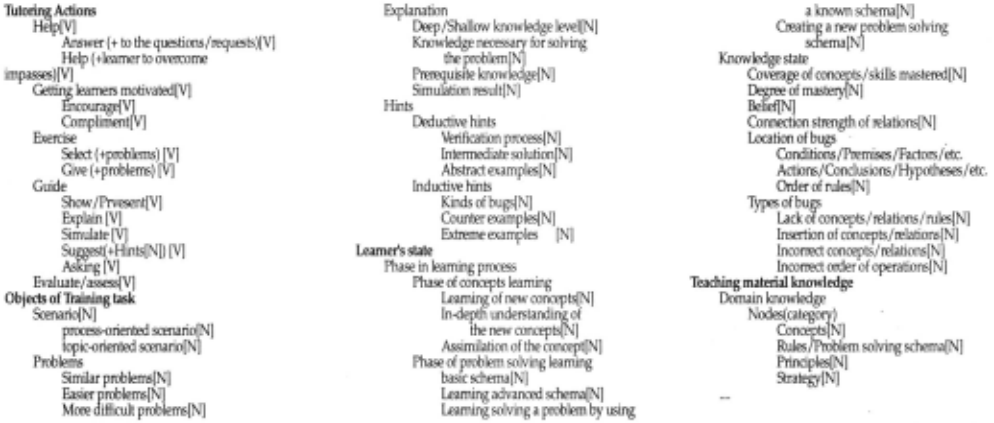
Figure 1 shows a taxonomy of terms included in lexical level ontology. Because of the space limitation, here we just show a part of the CBT ontology which we are building now (see [Mizoguchi et al. , 1996] for a more detailed account of IES ontology). All the terms of lexical level ontology are orga nized into word classes, such as, generic verb, generic noun, etc. :
- -Generic nouns[N] representing objects reflecting their roles appearing in the problem solving process,
- Generic verbs[V] representing unit activities appearing in the problem solving process,
- Generic adjectives modifying the objects.
Task ontology for computer-based training, for example, looks as follows :
- Nouns: "Problem", "Scenario", "Answer", "Example", "Accident", "Operation", "Hint", etc.
- Verbs: "Provide", "Show", "Ask", "Simulate", "Give", etc. Adjectives: "Unsolved", "Easy", "Correct", "Counter" etc.
- Verbs are defined as a set of procedures representing its operational meaning. So, they collectively serve as a set of reus-
able components for building lESs.
In the conceptual level ontology, the concepts to represent our perception of problem solving are organized into generic concepts, such as, activity, object, status, and so on. On top of that, a collection of symbol level CLOS code fragments are organized in symbol level ontology. There are some prerequi site relations among these three levels. Intuitively generic verb, generic noun, and generic adjective in lexical level ontology correspond to activity, object, and status in the conceptual level one, respectively. For each activity, at least one code fragment is prepared in the symbol level.
Thus, task ontology provides primitives in terms of which authors can describe their own educational task model. Using their own model, authors can easily put a piece of teaching material into the appropriate educational context, since it pro vides authors with abstract educational roles of various ob jects which could be easily instantiated to domain-specific objects. In the above examples, "problems", "examples", and "hints" represent such objects with educational roles.
One of the most important characteristics of task ontology is that meanings of verbs are also defined at the symbol level, that is, at least one executable code is associated with each verb to enable semiautomatic generation of runnable educa tional application.
Thus, roles of IES task ontology can be summarized as fol lows:
- (I) To provide vocabulary/concepts in terms of which one can compare and assess existing lESs.
- To formalize training tasks.
- To specify the tutoring/training context which contrib utes to making it easy to put domain knowledge into a right context, since it provides us with abstract roles of various objects which could be instantiated to domain specific objects.
- To provide reusable components for IES design and de velopment.
- To enable translation of the knowledge-level description of the skeleton ofiES into symbol-level executable code.
3. An Authoring tool based on CBT task Ontology.
Authors' work ofiES systems can be roughly sketched out in the following three stages.
- Design the skeleton of the CBT process of interest.
- Compile training material or training aids, for example, notes, pictures, sounds, simulator, etc. into the skeleton.
- Adjust the control of CBT process in detail.
Of course, the distinction among the stages is not necessar ily important for authors. Rather strict distinction sometimes becomes disadvantage of authoring tools. The reason for mak ing the distinction is to focus our discussion to the author's work which enjoy the ontology support.
The existing authoring tools in the literature [Inui eta!, 1990], [Major, 1995], [Murray and Woolf, 1992] seems to cover all the three stages. Especially, some authoring tools for ITSs( for example, [Van Marcke and Vedelaar, 1995] ) provide so phisticated set of descriptive primitives and corresponding computational components of IES for authors. When looking carefully at the support functions provided by them, however, we found that little effort has been done to give active guid ance based on the explicit first principle on education. The reason of this could be lack of explicit "ontology" as design rationale ofiESs. To embody active support of authoring pro cess, the authoring tool should know the rationale in the form of meta description of the design.
| Tutoring Actions Help[V[ Answer ( + to the questions |
| I requests )[V) Help ( +Ieamer to overcome impasses)[V) Getting learners motivated[V] Encourage[V] Compliment[V] |
| Exercise Select (+problems) [V) Give(+problems) [V] |
| Guide Show /Prvesent[V] Explain [V] Simulate [V] Sugges~ +Hints[N]) [V] Asking [V] Evaluate/ assess[V] of Training task Scenario[N) pi'OCesS-{)riented soenario[N] topic-oriented soenario[N) |
| Objects |
| Problems |
| Similar problems[N] |
| Easier problems[N] |
| More difficult problems[N] |
| a known schema[N] Creating a new Jroblem solving schema[N |
| Knowledge state Coverage of concerts/ skills mastered[N] ~of mastery[N) Bebef[N] Connection strength of relations[N] Location of bugs . Conditions/Premises/Factors/etc. Actions/Conclusions/Hypotheses/etc. Order of rules[N] Types of bugs Lack or concepts/ relations/ rules[N] Insertion of concepts/relations[N] Incorrect concepts/ relations[N] Incorrect order of operations[N] |
| Teaching material knowledge Domain knowledge Nodes(category) · Concepts[N) |
| Rules/Problem solving schema[N] Principles[N] Strategy[N) |
Based on the above consideration, we have tried to build IES ontology. Although the step we have made is not large, we believe that its implications to the future research in lESs area is not small. CBT ontology we discuss here uses the IES on tology as its core. We organize a set of concepts specific to training system under the IES ontology. In the following sec tions, we try to show the significance of the CBT ontology. First, we present brief overview of SmartTrainer which have been developed as a prototype of Intelligent CBT system, then we will show the image of the authoring tool based on the CBT ontology built based on the analysis of SmartTrainer's task.
3.1 SmartTrainer
SmartTrainer is a CBT System in the area of electric power systems. The target task of SmartTrainer is mainly to recover the accidents of substations in the electric power systems. When an accident happens, the electric power transmission will be interrupted, and the operators should recover it as quickly as possible. The operators should find the spot of the accident, continue to supply the electric power to some spe cial places such as hospital, police station at once by borrow ing some power from the other substations, find the causes of the accident and recover it within the limited time.
The goal of the training conducted by SmartTrainer is to im prove capability of not only skill-based or rule-based reason ing but also knowledge-based reasoning. The set of the sce narios incorporated into SmartTrainer has been designed by the experienced trainers. In order to let the trainee master the principled knowledge, SmartTrainer let them do practice first and then teach them the first principle behind it adaptively to their mistakes, and finally, check their learning result by prac tice again. This is a form of "learning by doing."
SmartTrainer is basically composed of three models, that is, training process model, teaching materials model, learner model, which are part of our CBT task ontology.
3.2 An Ontology-based Authoring Tool
Among three stages of authors' work listed above, we have concentrated on the first one, that is, design process of the skeleton of CBT process. Hereinafter, we sometimes call the skeleton of the CBT as the model of a CBT system to empha size the importance of existence the ontology which governs it. Therefore, the term model implies two ideas, one is that it has a set of general axioms to follow and the other is, in an ordinary sense, it abstracts the skeleton from the real CBT systems.
Basic teaching material prepared by the authors of CBT are the following
- knowledge needed for target operation,
- training scenario, and
- simulator of a target system.
The authors compile these three items into the skeleton of a CBT system at the first stage. The typical work of the compi lation is to put a fragment of knowledge( A) into the target operation context(B) appropriate for training. The most de sired thing for authors is the established guideline on the com pilation task, for example, the fundamental structure of the scenario, the typical style of questions, appropriate timing and method of learner modeling, and so on. As we discussed in the previous section, we have defined a set of terms to express the training task of the electric power system operation in the lexical level task ontology and the meaning of the terms in conceptual level task ontology. The author's task is to build a model of the intended training task in terms of the lexical level task ontology as a result of the compilation. Such terms and concepts are provided by an ontology maintenance system, which maintains the consistency between the task ontology and the model built based on the ontology. As a part of our "let him/her do operation". However, the selection violates ontology engineering project, an ontology maintenance envithe constraint on symptom/treatment rationality. It says that ronment, called CLEPE, has been developed. Further details direct explanation is better than indirect treatment when the of CLEPE will be described later. question asked to the student is not very difficult. The winOn the top ofCLEPE, we have been developing an authoring dow (6) shows the rationality and recommends the "explain the principle" treatment instead.
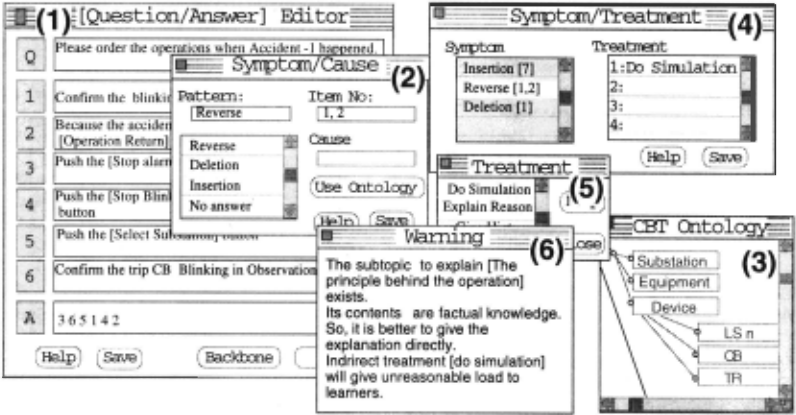
tools we have developed. When the authoring tool is activated, the author is asked to create a training scenario which is a series of question and answer sessions. The window ( 1) is for editing a question/answer session. Before the window appears, the author was asked to select one from several question/an swer types defined by CBT task .ontology. In this case, the author selected "ordering question." And then he/she inputs the components of the question/answer, that is, "question", "items to be ordered" and "correct answer." After inputting the question, the author edits a set ofleamer's errors , called "symptom" in the window (2). The author inputs the possible symptoms as one of "reversing", "missing", "superfluity", which are defined as subcategories of the symptom for order ing question in CBT task ontology. In addition, the author is asked to clarify the cause of the symptom by selecting one node from the domain knowledge shown in the window (3). Since SmartTrainer adopts overlay learner model, the cause is formalized as missing of the selected node. Although we assume that domain knowledge is prepared in advance, the author can modify it at anytime when needed. Once the au thor complete inputting a symptom, the symptom/treatment window (4) will appear. In this window he/she specifies the treatment for the symptom. The possible treatments are listed in the window (5) based on tutoring strategy concept defined in CBT task ontology. The treatment selected by the author is
tool for CBT systems. Figure 2 shows the image of the authoring tool interface. The interface is designed in full conFrom figure 2 one might get impression that the description sideration of the intuitively clear way to express the skeleton of the question is too detail for the first stage of the author's of training tasks. In other words, the structure of the interface work. Of course, the boundary between the first two stages of windows reflects the training task ontology and acts as the author's work is gray. Our intention of this is, however, that guideline on the author's task. the textual information acts as just labels of the entities of Figure 2 shows the snapshot of interface of the authoring questions. Without such labels, authors cannot structure the skeleton in their mind and also may lack the consistency of their design. Note that the textual information in the question frame is meaningless for ontology management environment at this stage.
3.3 Layers of Ontology
As we have discussed in section 2, task ontology is divided into three complementary partitions. From now on, we will focus on the two of them, that is, lexical level and conceptual level, which are the most important for authoring support func tion at the first stage of author's work. In figure 3, the two partitions are arranged in depth. The two partitions in depth are allotted different functions to each. Lexical level ontology specifies syntactical aspects and conceptual level specifies semantics of vocabulary.
In addition to that, task ontology has three layers arranged in vertical direction in order of the degree of task -domain de pendency. That is, core task ontology with the least depen dency and arranged at the lowest layer, task-type specific on tology at middle, and task-domain ontology at the highest.
Core task ontology lays foundation for upper layers by de fining inherent concept needed for modeling all the types of problem solving. Task-type specific ontology is a system/ theory of vocabulary/concepts for describing task models of a certain type of task, and task-domain ontology is one for describing domain models from the task type viewpoint. We have defined the CBT(Computer Based Training) ontol ogy which organizes a set of concepts specific to training system as a task specific ontology. Based on the top most layer ontology, authors build the model of task of interest. In our case, the model means a skeleton of an CBT system(SmartTrainer).
The relationship between ontology and model is not absolute one but rela tive one. For example, when building a task-specific ontology, it can be re- 0 T,1aps,nk!se~ttati_oft_ garded as a model, while the core task ontology as an ontology for the world. That is to say, an object can be consid ered as an ontology, meanwhile it can also be considered as a model based on the relatively lower layer. In prin ciple, a descriptive primitive of upper
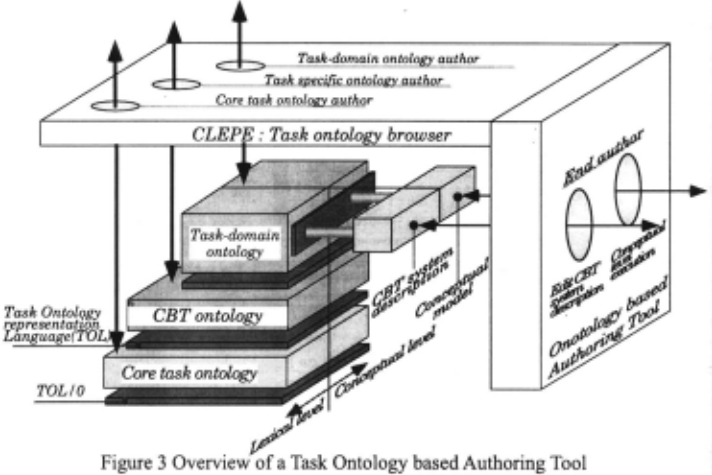
layer has richer meaning in the sense of human understanding than that of lower layer. Needless to say, the rigid computa tional semantics defined for the primitives at the lowest layer.
Thus, we could say an intended model of CBT systems is described based on the upper , front part of task ontology and the computational semantics of it is finally defined at the low est, rear part.
To characterize each layer from the above viewpoint, we can ideologically divide the authors concerned with the ontology into four types.
- the authors who develop training systems (end authors).
- The authors who build task-domain ontology (task-do main ontology authors).
- The authors who build task-specific ontology (task-spe cific ontology authors)
- The authors who build core task ontology-based on core task ontology (Core task ontology authors).
In our case,
- ( 1) End author: the instructor of electric power system op eration (instructor)
- Task-domain ontology author: staff of the software de velopment division of electric power company.
- Task-specific ontology author: IES/CBT ontology re searcher.
- Core task ontology author: general task ontology re searcher.
Note that each type ·of author needs appropriate guidelines corresponding to their jobs. Intuitively, the authors working in the upper layer are more constrained than those in the lower layer. Thus, the authoring tools is desired to have the capabil ity to switch the ontology layer to provide the appropriate guidelines for each type of the authors. The capability is real ized by integration of CLEPE into the authoring tool. In the next section, we will look into the role of CLEPE in detail.
4. Task Ontology Management : CLEPE
CLEPE supports both ontology authors who construct task ontology and end authors who develop application, CBT sys tems in our case. Figure 3 shows the overview of CLEPE and the ontology-based authoring tool we have developed. Ontol ogy authors are arranged above side and end authors right side.
Thin planes stand for languages. The language for task spe cific ontology author is called Task Ontology representation Language(TOL), whose semantics is specified by core task ontology and the base language TOL/0. TOL/0 provides de scription primitives for ontology authors and defines seman tics of upper-layer languages. Therefore all the semantics of task ontology described with TOL is specified ultimately at the level of TOL/0. An ontology author of core task ontology specifies the lexical entities and conceptual ones using TOL/0 primitives, e.g. Define-Core-Lexical, Define-Core-Concept, etc. By reading the specification of core task ontology into CLEPE, a set of conceptual primitives at the TOL level is in troduced. Task type specific ontology author specifies the con cepts appearing in the target task type with TOL.
The main work of an end author are as follows:
- ( 1) To describe an intended model of a training task in terms ofCBT task ontology (edit CBT system description),
- to make sure that his/her description is correctly inter preted by the system (trace the conceptual level execu tion process),
- to modify the description if necessary (debug the descrip tion).
In preparation for interpretation of the CBT task description written by an end author, CLEPE reads task ontology descrip tion represented with TOL. The task ontology description is translated into internal form by TOL-parser and stored into ontology base. Ontology Manager manages the ontology base and deals with the requests related to the ontology made by other modules, for example, inquiries for class information, creation of a class instance and so on. Once an end author completes editing his/her own description, CLEPE initiates the interpretation process. The model compiler compiles an internal form of the description and generates the conceptual model. Finally, he/she can run the conceptual model with ex ecutor.
4.1 Ontology Management
As we have discussed in 3.3, the relatively lower ontology provides the guideline on the construction of the relatively upper ontology. For example, the core task ontology act as a specification for the task-specific ontology. Definition of each concepts appearing in task-specific ontology layer should fol low the regulation enforced by core task ontology. "Verb word class" definition in the core task ontology (meta-layer), for example, specifies that all the verbs defined in task-specific ontology layer (base-layer) have "input-slot", "output-slot" and "effect slot" in its definition. Furthermore, a verb definition of"give" in task specific ontology layer specifies that the in . put slot of each instance of"give" appearing in the model layer for end authors should be filled with limited noun instances such as, "Hint", "Problem", and so on.
Ontology management function of CLEPE is to support the authors work in a certain layer based on the next lower ontol ogy. When it detects the inconsistency between model and ontology, it gives the authors some warning messages along with suggestions to encourage them to revise their models based on the ontology. The major merit of this function is that the authors could be guided kindly in their model building and the models is guaranteed to be consistent with the estab lished ontology.
4.2 Conceptual level execution
Once CLEPE generates a conceptual model, an end author can inquire some questions about the dynamic behavior of the model, for example, "how student model updated", or "then what kind of tutoring action will be taken place." CLEPE can produce answers based on the conceptual model, for example, "the student model will be updated based on the buggy knowl edge attached to the Ieamer's answer to the question," or "sys tem will show visual simulation to make Ieamer notice the crucial breakdown." Since the answer to the inquiry is de scribed at conceptual level, he/she could easily understand it. By keeping the continuity from the symbol level program code to conceptual level model, CLEPE can explain the symbol level execution result with conceptual level annotation.
Current implementation of conceptual level execution is lim ited to static analysis of the task model. The plan for the fu ture development includes dynamic analysis of the task model. The basic idea is to introduce the concept of pseudo-learner. Training task ontology includes a set of terms and concepts to specify the status of the Ieamer using vocabulary shown in figure I . By specifying certain property of Ieamer, for ex ample, "a Ieamer who prefers deductive way of thinking to inductive one" or "a Ieamer who is good at skill-based opera tion", the author c~m examines whether the training model behave well for the Ieamer or not by monitoring the results of conceptual level execution. The executor of the training model will assume the Ieamer's responses to the questions along the training scenario, and activate the tutoring strategies based on the leaner model. Showing the dynamic behavior of the model to the author, the executor can check the validity of the train ing model based on the task ontology. When some defects or shortcoming of the model are identified, the executor informs the authors and suggest a desirable way to make alternation to the model.
5. Conclusion
We have investigated the inherent characteristic of CBT through the development of SmartTrainer and tried to build CBT task ontology. The main purpose of this paper is to illus trate the characteristics of ontology-based authoring tools. It provides two major advantages as follows. (A) It provides human-friendly primitives in terms of which users can easily describe their own model of a task (descriptiveness, readabil ity). (B) It can simulate the abstract behavior of the model in terms of conceptual level primitives (conceptual level operationality ).
We have implemented a prototype of ontology-based authoring tool and systematically accumulating CBT ontol ogy and training scenarios. The most important, interesting part of CBT ontology is explicit description of the first prin ciple of training such as "learning by doing." Since the accu mulation of the ontology has been in steady progress, it is planned to pursue a close investigation of this issue in the near future.
@inproceedings{ijcai1997p51,
  title     = {Task Ontology Makes It Easier To Use Authoring Tools},
  author    = {Ikeda, Mitsuru and Seta, Kazuhisa and Mizoguchi, Riichiro},
  booktitle = {Proceedings of the Fifteenth International Joint Conference on
               Artificial Intelligence, {IJCAI-97}},
  publisher = {International Joint Conferences on Artificial Intelligence},
  editor    = {Martha E. Pollack},
  pages     = {342--350},
  year      = {1997},
  note      = {Computer-aided Education},
  url       = {https://ijcai.org/proceedings/1997/51},
}
TY - CPAPER TI - Task Ontology Makes It Easier To Use Authoring Tools AU - Ikeda, Mitsuru AU - Seta, Kazuhisa AU - Mizoguchi, Riichiro T2 - Proceedings of the Fifteenth International Joint Conference on Artificial Intelligence, IJCAI-97 PB - International Joint Conferences on Artificial Intelligence PY - 1997 SP - 342 EP - 350 UR - https://ijcai.org/proceedings/1997/51 ER -Copied
Machine-readable versions of this paper, for tools and AI agents:





