
In the Quest of the Missing Link
Proceedings of the Fifteenth International Joint Conference on Artificial Intelligence. Cognitive Modeling. Pages 310-314.
© 1997 International Joint Conferences on Artificial Intelligence
Abstract
This paper presents a generic model for a cognitive agent based on the hypothesis that the cognitive activity has three main characteristics: self-organization, evolutionary nature and history dependence. According to this model, a cognitive agent presents three levels: reactive, instinctive and cognitive. Each level, together with its lower levels, is intended to model a complete agent, each new level just increasing the behavior complexity. The generic model is instantiated into a computational architecture that integrates connectionist, evolutionary computation and symbolic approaches.
- [Bittencourt, 1996] G. Bittencourt. Boxing theories (ab- stract). Journal of the Interest Group in Pure and Applied Logics (IGPL), 4(1):479-481, 1996.
- [Bittencourt, 1997] G. Bittencourt. Concurrent infer- ence through dual transformation. Journal of the In- terest Group in Pure and Applied Logics (IGPL), in press, 1997.
- [Changeux, 1983] J.-P. Changeux. L'Homme Neuronal. Collection Pluriel, Librairie Artheme Fayard, 1983.
- [Fu, 1994] L. fu. Rule generation from neural networks. IEEE Transactions on Systems, Man and Cybernetics, 24(8) :1114-1124, August 1994.
- [Goldberg, 1989] D.E. Goldberg. Genetic Algorithms in Search, Optimization, and Machine Learning. Addison-Wesley Publishing Company, Reading, MA, 1989.
- [Kitano, 1995] H. Kitano. A model for hormonal modu- lation of learning. In Proceedings of IJCAI 14, 1995. IJCAI
- [Kohonen, 1987] T . Kohonen. Content-Addressable Memories. Springer-Verlag, Berlin, 1987.
- [McCarthy, 1980] J. McCarthy. Circumscription -a form of non-monotonic reasoning. Artificial Intelli- gence, 13(1,2) :27-39, 1980.
- [Minsky, 1986] M.L. Minsky. The Society of Mind. Si- mon and Schuster, New York, 1986.
- [Morin, 1991] E. Morin. La Methode 4, Les Idees. Edi- tions du Seuil, Paris, 1991.
- [Neumann, 1968] E. Neumann. Ursprungsgeschichte des Bewusstseins. Kindler Verlag GmbH, Miinchen, 1968.
- [Newell, 1980] A. Newell. Physical symbol systems. Cog- nitive Science, 4:135-183, 1980.
- [Peirce, 1974] C.S. Peirce. The Collected Papers of C.S. Peirce. Harvard University Press, Cambridge, Mass., 1974.
- [Piaget, 1963] J. Piaget. The Origins of Intelligence in Children. Norton, New York, 1963.
- [Rasmussen, 1991] Steen Rasmussen. Aspects of infor- mation, life, reality, and physics. In C. Langton, C. Taylor, J .D. Farmer, and S. Rasmussen, editors, Artificial Life II. Addison-Wesley, 1991.
- [Robinson, 1965] J.A. Robinson. A machine-oriented logic based on the resolution principle. Journal of the ACM, 12(1):23-41, January 1965.
- [Rumelhart and McClelland, 1986] D.E. Rumelhart and J. McClelland, editors. Parallel Distributed Process- ing: Explorations in the Microstructure of Cognition 1: Foundations, volume 1. M.I.T. Press, Cambridge, MA, 1986.
- [Salzberg, 1991] S.L. Salzberg. A nearest hyperrectangle learning method. In Machine Intelligence 6, pages 251-276. 1991.
- [Sloman, 1995] A. Sloman. A philosophical encounter. In Proceedings of IJCAI 14, 1995.
- [Sloman, 1996] A. Sloman. What sort of architecture is required for a human-like agent ? In Proceedings of AAAI-96, August 1996.
- [Smith, 1987] B.C. Smith. The correspondence contin- uum. Center for the Study of Language and Informa- tion, January 1987. Report No. CSLI 87-71.
- [Smullyan, 1968] R.M. Smullyan. First Order Logic. Springer-Verlag, 1968.
- [Varela et al., 1991] F.J. Varela, E. Thompson, and E. Rosch. The Embodied Mind: Cognitive Science and Human Experience. MIT Press, Cambridge, MA, 1991.
- [Wright, 1994] R. Wright. The Moral Animal. Vintage Books, New York, 1994.
References were extracted automatically from the PDF and may contain errors.
Full text extracted automatically from the PDF; figures, tables and equations may differ. The PDF is the version of record.
1 Introduction
During its forty years of existence, Artificial Intelligence (AI) research produced an heterogeneous set of meth ods adapted to solve problems in some, usually rather specific, domains. Efforts geared towards an unified the ory have not succeeded, even the fundamental research is divided among several uncompatible approaches, e.g., Physical Symbol Systems [Newell, 1980], Connection ism [Rumelhart and McClelland, 1986] and Evolution ary Computation [Goldberg, 1989]. Although methods from different approaches have been successfully com bined in some systems (e.g., neural networks and expert systems [Fu, 1994]), no general theory of Hybrid Systems is presently available.
This paper defines a generic model for a cognitive agent and proposes a computational architecture, coher ent with this model, that integrates all the approaches mentioned above. The model is based on the following basic hypothesis: (i) Cognition is an emergent property of a cyclic dynamic self-organizing process [Morin, 1991] based on the interaction of a large number of functionally independent units of a few types [Changeux, 1983]. (ii) Any model of the cognitive activity should be epistemo logically compatible with the Theory of Evolution. That applies not only to the "hardware" components of this activity but also to its "psychological" aspects [Wright, 1994]. (iii) Learning and cognitive activity are closely related and, therefore, the cognitive modeling process should strongly depend on the cognitive agent's partic ular history [Piaget, 1963].
·The author is partially supported by Conselho Nacional de Desenvolvimento Cientifico e Tecnol6gico (CNPq}, grant No. 352017/92-9.
The paper is organized as follows. In Section 2, we introduce the generic· model for a cognitive agent. In Section 3, we present a computational architecture co herent with the proposed model. In Sections 4, 5 and 6, we discuss some details of the proposed architecture that are relevant to the three adopted hypothesis. Finally, in Section 7, we summarize our proposal.
2 Generic Model
The proposed generic model for a cognitive agent presents three levels: reactive, instinctive and cognitive. Functionally, these three levels are similar to the reac tive, deliberative and meta-management components of Sloman's architectures for human-like agents [Sloman, 1996]. The model also presents some similarities with the Rasmussens's models [Rasmussen, 1991]. The reac tive level consists of an evolutionary environment, whose elements are patterns, extracted from perceptive infor mation about some external world, effector controls that can produce some action in the same external world and a population of reactive agents that tie together percep tion and action. This evolutionary environment is sub mitted to a Natural Selection process where the fitness function is associated with the emotions of the agent, de fined as a global response reflecting the agent's present state [Kitano, 1995]. The environment complexity and the agent variety are not bounded, phenomena such as co-evolution, arms race, parasitism, symbiosis, etc are expected to occur. In particular, the agents can orga nize themselves in co-evolutionary groups analogous to the agencies proposed by Minsky in his Society of Minds
[Minsky, 1986]. At this level, processing is totally par allel and is characterized by a rapid perception/action cycle. At the end of each cycle, the best agents in the community, according to the fitness function, are allowed to act, i.e., to emit control commands to the body. This first level is intended to model simple animals, such as insects. The reactive level definition has many points in common with the Enactive theory proposed by Varela et al. [Varela et al., 1991].
The instinctive level introduces a long term memory into the model. As the evolutionary process at the reac tive level proceeds and the situations repeat themselves in the world, it is possible to identify the populations of agents in the environment responsible for a useful action in a given situation. If we take, from these populations, the best and the worst agents, according to the fitness function, it is possible to abstract their properties and to obtain a general description of a given population, a kind of "genetic reserve" indexed by situation. We claim that long term memory is composed essentially by these descriptions and that the act of "remembering" corre sponds to the introduction at the reactive level ·of new populations, whose agents are genetically encoded accord ing to these general descriptions. Once there, these new populations are, up to a certain limit, able to recreate their original enviroment, from which they were gener alized. The long time effect of memory in such a model is analogous to the "breeding" and "taming" of reactive agent populations. At this level, processing is less mas sively parallel and is characterized by a much longer cycle that needs many repetitions of the same situation to be completed. The two lower levels together are intended to model more complex animals, such as mammals.
Finally, the cognitive level is concerned with the ma nipulation of the general descriptions generated at the instinctive level. Its functions are the usual cognitive functions: deduction, abduction and induction. The cog nitive level is based on two complementary activities: the learning of descriptions of relevant situations - a synthetic, holystic activity - and the generation of new strategies of action - an analytical, local activity. The contents of the cognitive activity, i.e., the contents of the short term memory, are defined to be exactly the relations between these two complementary activities.
Although the cognitive level could be based on any adequate symbolic logic formalism, it is "embodied" in a strict sense: on the one hand, its symbolic expressions refers to "lived" situation descriptions, giving it a "real" semantic. Moreover, these descriptions can be used to generate specific behavior patterns in a real world en vironment or in some "hypothetical" environment, sim ulated through the sentiments of the agent, defined as emotions induced through memories generated by cogni tive activities. On the other hand, the results of its inference mechanisms are intended to be useful as the seeds for new useful behaviors and not simply true theorems. These two interpretations of the symbolic expressions in the cognitive level - (i) representations of the prop erties of the instintive level descriptions and (ii) seeds for action skills - are similar to the representational and functional roles of Smith's impressions [Smith, 1987].
It is interesting to note that the instintive and cog nitive levels together can be thought of as a more com plex version of a reactive level agent , also functionally correcting perception and action. But in this case, the agent refers to an internal world: the reactive level en vironment. We claim that a necessary condition for the development of cognition is that this high level agent (which in some sense is the only one that we can really call "cognitive agent") be itself "embodied" in a commu nity of similar cognitive agents. Moreover, we propose that the structure of long term memory reflects a recon struction, at the reactive level, of the relevant structures of the environment in which the cognitive agent is itself embodied, particularly its social structures [Neumann, 1968]. The agents in this cognitive environment would have two communication channels: (i) experience, they (partially) agree about the effects of actions in the ex ternal world and about the contents of emotions and sentiments, i.e., they believe they have similar reactive levels; and (ii) language, they can share, through the representations at the cognitive level, knowledge about experience, specially that knowledge that would give rise to useful skills at the reactive level.
3 Architecture
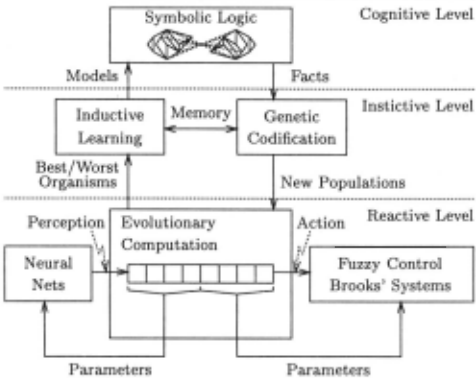
The instantiation of the above model for the human cog nition would rise several questions about its coherence with respect to the known facts about human evolution, physiology and psychology. We avoid these questions and, heeding Sloman's advice [Sloman, 1995], try to ex plore the design space through a computational architec ture for cognitive agents based on that model. The pro posed architecture, presented in figure 1, has the same three levels and is intended to be a minimal implemen tation of the generic model.
The central activity of the machine is performed by the Evolutionary Computation module at the reactive level. It computes some kind of genetic algorithm where the genotype of the population members encode control pa rameters of the perception and action mechanisms, rep resented in figure 1 as the Neural Nets and Fuzzy Con trol/Brooks' Systems modules, respectively. The func tion of the Neural Nets module is to account for percep tion and the Fuzzy Control/Brooks' Systems module rep resents the effectors of the agent. Both these technolo gies have interesting properties for our purposes: neural nets are able to learn how to extract patterns from raw information, even without an external supervisor [Koho nen, 1987], reducing the complexity of the situation iden tification process. Moreover, they can be easily coded into a genotype structure through the weights associ ated with the network links. Fuzzy control and Brooks' systems are able to control quite complex behaviors in a distributed way and can also be easily coded, because their mechanisms depend on a limited number of param eters.
The agents in the reactive level environment can be seen as "atomic potential actions" or "skill fragments" joining together the perception and action mechanisms and the actual functional capability for an effective guided action in the external world. The genotype of each of these agents encodes three types of information: (i) the weights to be used in the input neural nets, (ii) the parameters that define the action mechanism, e.g., the fuzzy set definitions in the case of a fuzzy control mech anism, and (iii) a functional definition of the connection between the neural net output and the effector control input. Such an agent, when it is "plugged" into the appropriate perception/action circuit, uses its encoded weights and parameters to tune the perception/ action mechanisms according to its necessity, and applies its encoded function to drive the relevant parts of the ex ternal effectors through the desired action according to the present perceptual input.
The model supposes a fitness function that attributes a grade to each reactive level agent and can be associated with some measure of the internal state of the machine. The real actions occur at the reactive level: after the genetic algorithm is running for some generations since the last action, the best agents according to the fitness function are activated. There are no central control and there are lots of things happening at the same time. Each action changes the internal state of the agent and the external environment, as perceived through the neural net module, and the cycle restarts. The model does not represent an "information processing machine", the per ceptual input represents a restriction on the generated actions but does not determine them. Furthermore, the machine may continue its activities independent of input and output, it is enough to simulate a previously learned fitness function to create a hypothetical situation. In fact, we claim that much of the machine activity would be performed during the periods of inactivity, in which it "sleeps" and "dreams".
To learn a fitness function, a memory mechanism is necessary. If we observe the "arena" at the reactive level and, as a situation repeats itself, collect the best and the worst agents in handling such situation, then the ge netic material in these agents can be used as examples and counterexamples in an Inductive Learning mecha nism (e.g., [Salzberg, 1991]) . The results of this induc tive mechanism are general descriptions of populations, that can be associated with appropriate fitness function values. The complexity of these descriptions is propor tional to the generality of the inductive learning mecha nism and its underlying representation language. If this language is general enough to be interpreted as a logical description of the world situations, then we can use it to give a semantic account to a symbolic logic module, where the learned descriptions are interpreted as models of the external world.
Finally, the cognitive level is defined as a theorem prov ing mechanism, although it presents some unusual fea tures in such systems: its expressions refer to well de fined structures, the general descriptions of the instinc tive level, and its inference results can be used to genet ically encode new populations at the reactive level, and therefore, their value as representations of the world can be tested in "real action" conditions. In our minimal model, the genetic codification module corresponds to a fuzzy control system generator, but in a more general specification it could be any control system generator, reintroducing the Cybernetics view that Control Theory is an important part of cognitive activity. Coherently with the generic model, we suppose that the machine would be "embodied" in a world where human beings and cognitive machines are joined in communities.
4 Self-Organizing Logic
The connection between a symbolic theorem proving mechanism and the elements in the instinctive level of the proposed architecture deserves a more detailed treat ment. The cognitive level activity could be described as follows. Initially, the learning mechanism, at the in stinctive level, selects the best reactive level agents. The genetic material of these agents encode situation descrip tions and adequate actions to be performed in these sit uations and it is used to derive a logical description of the relevant behaviors in these situations. The process that generates these descriptions is called conceptualiza tion. At the cognitive level, the logical descriptions are interpreted as possible models of the world. The main ac tivity of the cognitive level is to assume that the learned models are all the possible models for these situations and to derive an associated factual description that has exactly those models. This mechanism is very similar to McCarthy's Circumscription [McCarthy, 1980].
The usual theorem proving methods - Resolution [Robinson, 1965] and Semantic Tableaux [Smullyan, 1968] - present some properties that make them not ad equate for our purposes: (i) they present external, i.e., meta-logical, inference rules, (ii) they are not designed to generate a factual description from a set of possible model descriptions, only to the reverse, and (iii) their proof methods are local mechanisms. To avoid these problems, we propose a new inference method, based on the transformation between conjunctive and disjunctive canonical normal forms, the dual transformation, that involves only internal properties of the underlying logi cal system (i.e., there is no inference rule external to the logical language) and that has a global and concurrent nature [Bittencourt, 1997].
Given a logical formula W, we call a theory the two sets 4> and Ill that contain, respectively, the clauses and dual clauses associated with the canonical normal forms of W. The two sets 4> and Ill are a kind of "holographic" representation of each other. Each clause in 4> consists of a combination of all dual clauses in Ill and, conversely, each dual clause in Ill consists of a combination of all clauses in 4> .
Intuitively, the proposed inference algorithm consists in the elimination of the contradictory dual clauses, the combination of the associated substitution fragments into a set of independent substitutions, the application of these substitutions to the dual clause set and, finally, the generation, through the dual transformation, of the clause sets associated with these instances of the dual clause set. The clauses in these instances are new theo rems which can be added to the original clause set and the cycle may be repeated. Clearly this mechanism does not present external inference rules, all that is done is to exploit the duality of the canonical representations and their semantics.
The inference method is totally symmetric. It does not matter if we begin with clauses, i.e., a factual ac count of a situation, or dual clauses, i.e., a description of the possible models of the situation. Analogously to the elimination of contradictory dual clauses, in the clause form it is the tautologic clauses that can be eliminated.
Therefore, the repeated transformation between canoni cal representations is not only able to infer new theorems but it is also able to refine the theory.
These theoretic properties of the inference method are enough to eliminate the two first restrictions to theorem proving methods. The third one must necessarily take into account implementation concerns. Clearly, the most expensive operation of the proposed inference method is the dual transformation. To improve its efficiency, we developed a concurrent algorithm for the dual transfor mation, based on a geometrical representation, that, on the one hand, generates only dual clauses that are not subsumed by any other and, on the other hand, is natu rally concurrent and therefore easy to parallelize.
According to this algorithm, a theory is represented through a n dimensional hypercube, where n is the num ber of predicate symbols that occur in the theory. Each vertex of this hypercube can be associated with a certain combination of predicates given by those coordinates of the vertex that are not zero. A (dual) clause is asso ciated with the vertex labeled exactly with those pred icates that appear in its literals. The literals in each dual clause can be thought to represent some clauses where they appear or where there are literals subsumed by them. This information is stored in the geometric representation as integer sets associated with each lit eral that indicate in which (dual) clauses the literal is present. The result of this construction is that the dual transformation and the manipulations necessary to the inference/refinement mechanism can be done through lo cal communication between neighbor (dual) clauses in the hypercube. The holographic properties of the canon ical representation allow for a global effect in one form to be calculated locally in the other form [Bittencourt, 1996].
This representation allows the integration of the in stinctive and cognitive levels: the learning mechanism could be thought of as concurrently "feeding" each sep arate node of the hypercube with the appropriate dual clause representation of some situation. After some re finement/inference steps the new inferred model descrip tions can be directly verified through the learning mech anism. Furthermore, the clause representation can be used to generate new reactive level populations, whose action effects could again be verified through the learn ing mechanism. It is interesting to note that this kind of integration does not eliminate the robustness of the reactive level environment. In the model, the cognitive activity can influence the global behavior, but its scope is limited.
Another interesting property of the representation is that it easily supports a special kind of higher-order logic, where the theories, with their predicate and func tion symbols as parameters, are considered as new atomic formulas . This property has much in common with Peirce's semiosis process [Peirce, 1974]. Accord ing to Peirce, a sign (S) represents an object ( 0) for another sign, the interpreter (I). This last sign - called an habit or mental law - may determine another inter preter I 1 , which may determine an I2, etc. The actu alization of the potentially infinite sequence I, I1 , h, ... is called semiosis. This triadic relation can be found in all three levels of the model. In particular, at the cogni tive level, the memorized descriptions are the signs that represent possible models to theories and theories are signs that represent new populations to the instinctive level. Moreover, theories as signs may represent possible (hypothetical) models for other theories, mediated by a meta-conceptualization process.
5 Evolution
In the proposed model, we are double committed with the evolutionary approach: on the one hand, the most important component of the model is in itself an evo lutionary mechanism - the reactive level - and, on the other hand, the model is designed in such a way that the components at each level could have evolved one af ter the other, because both, the reactive level and the pair reactive/instinctive levels, are complete models of simpler agents.
The choice of an evolutionary mechanism as the base of the model is inspired by the fact that the function of the central nervous system is to integrate the most differ ent perception and action mechanisms. This integration could be done through a genetically "wired" functional mechanism, but none would be flexible enough to adapt itself to a variable environment. A more robust solu tion is to use a simulation of the relevant characteristics of the external world, under the same natural selection principles, to make more secure decisions about future actions. If the real-time simulation is reliable enough, even without a memory, a reactive level agent would be able to "learn" how to act in a given situation, i.e., the adequate reactive level agents will be (slowly) selected through interactions with the real world. The problem is that, without a memory, the range of experiences is limited to the actually lived situations and that implies that certain situations, e.g., fatal ones, cannot be simu lated.
In this sense, long term memory is an improvement to a previously existing mechanism. An improvement which allows off-line simulations, because memory allows the simulation of the internal fitness function associated with hypothetical situations. These hypothetical simula tions greatly accelerate the evolutionary process at the reactive level. The cognitive level is another improve ment of the mechanism, because it allows the creation, through inference, of models of situations that never occurred in the agents' experience, further accelerating the evolutionary process at the reactive level. But its full strength comes from the fact that it also allows the es tablishment of a second communication channel between agent and world: language. Language may be used in the description of abstract situations, in particular, it allows one to conceptualize social situations and to reconstruct the relevant social relations into a coherent internal the ory that can be suitably simulated at the reactive level.
6 Learning
One of the central issues of the model is the fitness func tion to be provided and its relation with the meaning of the words "emotions" and "sentiments", loosely intro duced in the model description. More formally, we call emotions an internally generated feedback mechanism, based on perception and memory, able to guide the evo lution of the reactive level environment in such a way that the global agent survives. Emotions are the keys for long term memory, only emotionally important learned descriptions are memorized and the same emotions are able to fetch them from memory.
According to the model, long term memory existed prior to symbolic cognitive activity and it was in some sense adapted to cognitive purposes. As cognitive prod ucts, models and factual descriptions, do not have in principle any emotional contents, to memorize them it is necessary to artificially create these emotional contents. These cognitively generated emotions we call sentiments. Because sentiments are associated with cognitive states and therefore to language constructions, they are funda mental for the appropriate learning of social behaviors, mainly transmitted through language. The coherence between sentiments and emotions is the base for the cog nitive development. If the descriptions we learn lead in fact, at the reactive level, to the emotional effects we were told they should, we can have the "sentiment" that we learned an useful thing.
Although the theories at the cognitive level are strictly grounded in the learned descriptions, the real "meaning" of these descriptions is different for each cognitive agent, because it is defined as the effect of these descriptions when their associated populations are introduced in the reactive level, and this effect is determined by the par ticular history of the reactive level environment, i.e., by the history of emotions and sentiments that guided its development.
7 Conclusion
In their book The Embodied Mind, Varela et al. [Varela et al., 1991] propose three questions about cognition and answer them from three points of view: the cog nitivist research program, the emergence (connectionist)
- program and their own Enaction theory. To summarize our proposal, we answer the same three questions from the point of view of the proposed model:
- What is cognition ? The articulation of two paral lel evolutionary processes: one that occurs in an in ternal environment where a history of structural cou pling brings forth a (physical) world, i.e., the reactive level, and, another that occurs in an external sentimen tal/social/cultural environment where a history of sym bolic exchanges, mainly through language, between cog nitive agents brings forth, in each one, a (sentimental) world, i.e., the cognitive level. The integration between the environments is mediated by the long term memory.
- How does it work ? The reactive level is based on an evolutionary process guided by the emotions and the cognitive level is based on a cyclic process that trans forms factual descriptions into models and vice versa. The models are interpreted as memorized general de scriptions of situations and the factual descriptions are used to generate new reactive level populations. Cog nitive theories can be communicated through language. The cognitive level can also generate sentiments, i.e., ar tificial emotions, that allow it to influence memory con tents.
- How do I know when a cognitive system is function ing adequately ? When it becomes part of an ongoing existing physical and sentimental/social/cultural world.
Acknowledgments
The author is grateful to all those that helped in the development of this paper, in particular the LCMI team and the anonymous referees.
@inproceedings{ijcai1997p46,
  title     = {In the Quest of the Missing Link},
  author    = {Bittencourt, Guilherme},
  booktitle = {Proceedings of the Fifteenth International Joint Conference on
               Artificial Intelligence, {IJCAI-97}},
  publisher = {International Joint Conferences on Artificial Intelligence},
  editor    = {Martha E. Pollack},
  pages     = {310--314},
  year      = {1997},
  note      = {Cognitive Modeling},
  url       = {https://ijcai.org/proceedings/1997/46},
}
TY - CPAPER TI - In the Quest of the Missing Link AU - Bittencourt, Guilherme T2 - Proceedings of the Fifteenth International Joint Conference on Artificial Intelligence, IJCAI-97 PB - International Joint Conferences on Artificial Intelligence PY - 1997 SP - 310 EP - 314 UR - https://ijcai.org/proceedings/1997/46 ER -Copied
Machine-readable versions of this paper, for tools and AI agents:





