
Mental Tracking: A Computational Model of Spatial Development
Proceedings of the Fifteenth International Joint Conference on Artificial Intelligence. Cognitive Modeling. Pages 301-308.
© 1997 International Joint Conferences on Artificial Intelligence
Abstract
Psychological experiments on children's development of spatial knowledge suggest experience at self-locomotion with visual tracking as important factors. Yet, the mechanism underlying development is unknown. We propose a robot that learns to mentally track a target object (i.e., maintaining a representation of an object's position when outside the field-of-view) as a model for spatial development . Mental tracking is considered as prediction of an object's position given the previous environmental state and motor commands, and the current environment state resulting from movement. Following Jordan and Rumelhart's (1992) forward modeling architecture the system consists of two components: an inverse model of sensory input to desired motor comm"nds; and a forward model of motor commands to desired sensory input (goals). The robot was tested on the "three cups" paradigm (where children are required to select the cup containing the hidden object under various movement conditions). Consistent with child development, without the capacity for self-locomotion the robot's errors are self-center based. When given the ability of self-locomotion the robot responds allocentrically.
- [Acredelo et al., 1984] L.P. Acredelo, A. Adams, and S.W. Goodwyn. "The role of self-produced movement and visual tracking in infant spatial orientation". Journal of Experimental Child Psy- chology, 38:312-327, 1984.
- [Acredelo, 1979] L.P. Acredelo. "Laboratory versus home: The effect of environment on the 9-month- old infant's choice of spatial refence system". De- velopmental Psychology, 15:666-667, 1979.
- [Bower, 1979] T.G.R. Bower. "Human Develop- ment". W.H. Freeman and Company, 1979.
- [Brooks and Lynn, 1993] R. A. Brooks and A. S. Lynn. "Building Brains for Bodies". Technical report , MIT. AI Lab, 1993.
- [Dresher, 1991] G.L. Dresher. "Made-up Minds: A Constructivist Approach to Artificial Ingelli- gence". MIT Press, 1991.
- [Elman et al., 1996] J .L. Elman, E.A. Bates, M.H. Johnson, A. Karmiloff-Smith, D. Parisi, and K. Plunkett. "Rethinking Innateness: A Connec- tionist Perspective on Development". MIT Press, 1996.
- [Elman, 1990] J. L. Elman. Finding structure in time. Cognitive Science, 14:179-211, 1990.
- [Elman, 1993] J. L. Elman. Learning and devel- opment in neural networks: The importance of starting small. Cognition, 48:71-99, 1993.
- [Franceschini et al., 1992] N. Franceschini, M. Pi- chon, and C. Blanes. From insect vision to robot vision. Phil. Trans. R. Sac. Lond., B337:283-294, 1992.
- [Jordan and Rumelhart, 1992] M.I. Jordan and D.E. Rumelhart. "Forward Models: Super- vised learning with a distal teacher". Cognitive Science, 16:307-354, 1992.
- [Kermoian and Campos, 1988] R. Kermoian and J .J. Campos. "Locomotor experience: A facil- itator of spatial cognitive development". Child Development, 59:908-917, 1988.
- [Klahr and Wallance, 1976] D. Klahr and J.G. Wallance. "Cognitive development: An informa- tion processing view". N J: Erlbaum, 1976.
- [Piaget, 1971] J. Piaget. "The construction of real- ity in the child". New York: Ballantine., 1971.
- [Tani, 1995] J. Tani. "Self-Organization of Sym- bolic Processes through Interaction with the Physical World". In Proc. of IJCA/'95, pages 112-118, 1995. IJCAI
- [Thelen and Smith, 1994] E. Thelen and L.B. Smith. "A Dynamic Systems Approach to the Development of Cognition and Action". MIT Press, 1994.
References were extracted automatically from the PDF and may contain errors.
Full text extracted automatically from the PDF; figures, tables and equations may differ. The PDF is the version of record.
1 Introduction
This research challenges the traditional approach of theory construction in cognitive development by using the framework of robot learning. Tradition ally, researchers in cognitive development (e.g., de velopmental psychologist) have focused on general and abstract descriptions of experimental data as explanations for their observations. However, de velopmental psychology is intrinsically limited with respect to the question "how does development oc cur?", because of difficulties in the methodology (e.g., scientists should not open an infant's head to check for internal representations, and should not Akio Sashima and Steven Phillips ETL, MITI 1-1-4 Umezono Tsukuba-shi Ibaraki, 305 Japan
{sashima,stevep}~etl.go.jp
control their everyday experiences). Instead of real infants, we need a substitute that can be used for testing the theory and controlling conditions with out ethical limitation. Consequently, the require ment of a computer simulation can no longer be ignored.
Over the past few decades several studies have been conducted on computational models of cog nitive development. For example, Klahr and Wal lance developed a computer model of acquisition of number conservation 1 using self-modifying produc tion system [Klahr and Wallance, 1976]. Drescher proposed a schema mechanism to elaborate and test Piaget's theory from a constructivist's perspective [Dresher, 1991]. However, what is lacking in these approaches is an account of the interaction between children and environment. Consequently, models based on these approaches sometimes lack realism. We should pay more attention to the dynamics of cognitive development in the real world.
In contrast to these approaches, we propose us ing autonomous robots as the subject of cognitive development, and constructing computer programs by which robots can develop or learn analogously to infants. The advantage of using robots is twofold. First, · we can utilize a robot's vision sensors and actuators as the inputs and outputs of the model. This forces us to use the same input stimuli and action goals as those of the infant, whereas the in put and output representations of a computer sim ulation must be assumed. Second, we can con struct a theory absorbing activeness in cognitive de velopment. Recently, researchers have emphasized the importance of activeness (i.e., mobility) of in fants during development [Thelen and Smith, 1994]. However, the theory derived from this stream needs to be tested and refined in more detail. We believe that using a robot leads us to a more concrete the ory. More recently, Elman et. al. published an exciting book on development from a connectionist perspective [Elman et al., 1996]. We follow their ap proach, but concentrate much more on interaction between individuals and environment.
1 Conservation is a term introduced by Piaget for the child's understanding that quantitative aspects of a set of materials are not changed or affected by transformations of the display itself.
As a first step to constructing a complete com putational theory of cognitive development , we ad dress the question of how infants relate to their spa tial environments, and how this changes as the in fant matures. To explore these issues, we focus on the change of mental tracking: the ability to update spatial relations between self and object without real (visual) tracking during the locomotion. We modeled the development of mental tracking as a learning task for a simulated robot, and conducted experiments simulating an infant's experience of lo comotion.
The following sections describe our first results of modeling infant's spatial development. In Section 2, psychological evidence for spatial development is introduced. In Section 3, we elaborate our model for the development of mental tracking. Section 4 describes an empirical experiment with a simulated robot. In Section 5, we discuss the implications of our approach and future work.
2 Psychological Evidence for Spatial Development
2.1 Egocentrism in early infants
Piaget suggested that before infants are 1 year old, they exhibit a kind of sensorimotor egocentrism [Pi aget, 1971]. Although the term egocentrism refers to young children's general tendency to view the world solely from their own perspective 2 , we focus on infant's egocentric behavior in the spatial envi ronments and how egocentric behavior changes into the allocentric behavior that normal adults exhibit. In other words, we address the question of how in fants relate to their spatial environment, and how this changes as the infant matures.
Figure 1 shows an experiment designed to investi gate infant's spatial searching [Bower , 1979]. A doll (prize) was put inside one of three cups, in this case the middle one, and then the infant moved around the table. The doll's relative position from the in fant's view was changed from 'middle' to 'right'. Thus, the infant should look for the doll under the right cup. However, early infants frequently fail to compensate for changes in their own spatial posi tion. They continue to turn in the direction that previously led them toward the target (middle cup). The egocentric behavior in the searching task can be observed up to the age of about 18-months, but older children consistently show non-egocentric be havior on spatial tasks that involve searching for objects from different view points.
2 Piaget used the word egocentrism referring not only to spatial behavior but also to more general aspects of young children such as egocentic communication.
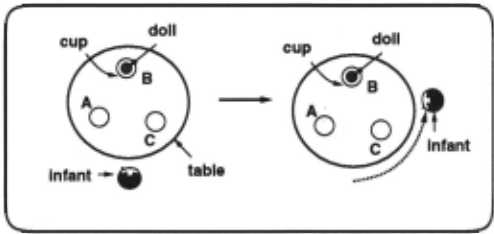
In the searching task the containers (cups) used to hide the prize were the same size and color. However, the actual environment provides much more information than position. In fact, infants can search the prize more correctly when distinctive cues (landmarks) are provided [Acredelo, 1979].
Phenomena concerning egocentrism are quite controversial and there are still many on-going stud~ ies. However, it's important to note that egocentic encoding of the target 's position is not so irrational for infants who cannot move around. Pre-walking infants don't have to take into account changes in their own position in order to search for the target.
2.2 Effect of Locomotor Experience
So far, we have seen an interesting developmental change in infants spatial behavior. 12-year-olds be have egocentrically and 18-year-olds do not. What is the difference between 12-year-olds and 18-year olds? How does egocentric behavior change into allocentric behavior? Experience in moving around environments seems to be one of the factors that ef fects the difference in the searching task. Kermoian and Campos suggested the importance of locomotor experience [Kermoian and Campos, 1988]. Infants who have experience in a walker or who can crawl are superior in spatial tasks to infants who have no such experiences.
Acredelo, Asams and Goodwyn conducted exper iments to test the role of self-locomotion as opposed to passive transport concerning infant's spatial cog nition [Acredelo et al., 1984]. Their results suggested the importance of active movement with vi· sual tracking. When 12-month-olds walked to the other side of a layout and have the opportunity to continually looked in the direction of a hidden prize, they looked in that direction more often and sub sequently did better at turning toward the object from the new location than children who were car ried. In contrast, when they could not see the prize as they walk from one position to the other, they were subsequently no better in turning toward it than children who were carried. Based on these re sults they hypothesized self-produced motion leads to more effective deployment of visual attention.
3 Learning to Mentally Track
The psychological experiments mentioned previ ously suggest two important factors for the spatial development:
- self-locomotor experience; and
- visual tracking.
Yet, it is still unclear what information is central in promoting the change from egocentric behavior to allocentric behavior. In Acredelo's experiments, 18-month-olds can behave correctly without visual tracking of the target object. This leads us to the necessity of modeling the mechanism of the change, taking into account of the effect of locomotion ex perience.
In this section, we focus on the change of the abil ity of updating the spatial relation between self and target object without visual tracking during loco motion. We call this ability mental tracking, and propose a learning architecture for mental tracking by which robots can learn it analogously to infants. Firstly, we present our assumptions and identify the information that is available during the experience of self-locomotion.
3.1 Formalization as a Robot Learning Task
The Robot
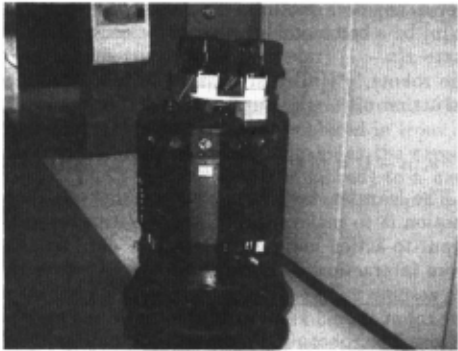
Figure 2 shows a robot that was used for model ing infant spatial development. The robot is based on Nomad 200 (Nomadic Technologies,Inc.). It can control two wheels and trunk orientation. The robot is equipped with a movable stereo-camera (Sony EVID30 x 2) that is connected with a vision · processing unit that uses a Fujitsu tracking module and DSP board(TMS320C40 x 2) for accelerating image processing. Using these facilities, the robot can detect relative distance and orientation to the target.
Locomotion Experience
Suppose that the above robot is the infant who has just started toddling. What types of information can the robot receive from walking? We assume that the self-locomotion experience of robots can be characterized by applying a next-state function f and an output function g successively. At time step n- 1 the robot produces motor command u[n- 1]. In conjunction with the state of the environment x[n- 1], the motor command determines the next state:
Corresponding to each state x[n] there is also a sensation y[n]:
We assume that the robot has access to the state of the environment: y([n]) can be seen as visual information directly obtained from the camera. The formalism is analogous to a standard state-action loop of mobile robot.
The Learning Task for Visual Tracking
Now we model the experience of locomotion with visual tracking. Locomotion experience with visual tracking can be modeled with a robot that moves while tracking the target with its movable camera and trunk. In other words, the task of visual track ing can be seen as generation of motor commands to the camera and the trunk to keep the target ob ject on the center of the visual image. Note that we should consider two types of motor commands; one for moving and the other for visual tracking.
Let y*([n]) be a desired sensation, and in this case the target object in the center of the visual image.
Let Um [ n] be a motor command for moving 3 , and uv[n] be a command for visual tracking. Given the state x[n- 1] (representing the current posture of the robot), y*([n]) and um[n], the robot produces an action uv[n- 1]:
The learning task for visual tracking with loco motion is to make appropriate adjustments to the input-to-action mapping h based on data obtained from interaction with the environment. Note that we assume um[n- 1] is also given. This is because the robot should know how to move to the next po sition. The robot produces um[n- 1] independently of visual tracking.
3.2 The Learning Architecture for Mental Tracking
So far, we have defined the learning task for vi sual tracking with locomotion: Nonetheless, what we need is a model of mental tracking. It must be noted here that mental tracking can be accomplished by mentally simulating visual tracking. In other words, if the robot can learn to track the target while in motion, the robot can mentally track the target by applying input-to-action mapping h suc cessively as an internal process. First, we present a learning architecture for visual tracking with loco motion, and then describe how to use the acquired knowledge for mental tracking.
Learning Inverse Model
As mentioned above, the learning task for visual tracking is to determine a proper command uv[n-1] given x[n-1], um[n-1], y*([n]). This is analogous to the so called inverse model in control system design. A controller receives the desired sensation y*([n]) as input and must find actions that cause actual sensa tions to be as close as possible to the desired sensa tion. The controHer must invert the transformation from actions to sensations.
·We developed this mechanism based on the neu ral network architecture proposed by Jordan and Rumelhart [Jordan and Rumelhart, 1992]. There are several reasons for using their approach. One of the advantages of this architecture is that we don't need an explicit teacher. The robot can use the difference between predicted position of the target and the next input of the target position as training data. Another reason is that the architecture is ca pable of addressing the many-to-one mapping prob lem from actions to sensations. The robot shown in Figure 2 must control at least two parameters, one for the camera and the other for the trunk to track the target. So there are infinite number of possible inverse models 4 ·
3 The motor command can be seen as the command to move the robot's two wheels.
Using these features, the mechanism learns to produce appropriate motor command uv[n- 1] to keep the target in the center of the visual image, given the current state x[n- 1] and a motor com mand to move to the next position um[n- 1].
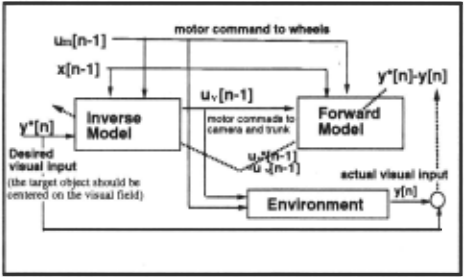
Figure 3 shows the learning architecture for visual tracking. y*([n]) denotes a desired position of the target in the visual image, u~[n -1] denotes a proper command to the movable camera. y([n]) denotes the actual position of the target in the visual image, and uv[n- 1] denotes the actual motor command for the movable camera.
In order to learn the in verse model to keep the target in the center of the field-of-view, we need the difference between the proper command u~[n - 1] and actual command uv[n- 1] to adjust the motor command:
We used the method described in [Jordan and Rumelhart, 1992]. Firstly the robot learns a for ward model based on the difference between y*[n] (the output forward model) and y[n]. Here the dif ference ( 4) can be acquired by backpropagating the difference between y*[n] and y[n] through the for ward model. Then, the robot learns the inverse model based on the difference ( 4).
The Network Architecture
We implemented the above learning architecture us ing a feedforward network based on the block dia gram shown in Figure 3. The network is composed of two subnetworks: one for the inverse model; and the other for the forward model. The inverse model consists of 5 input, 15 hidden and 1 output units. The forward model consists of 6 input, 15 hidden and 3 output units. The output of the inverse model is taken as input to the forward model.
4 See [Jordan and Rumelhart, 1992] for more details.
Mental Tracking via Acquired Knowledge
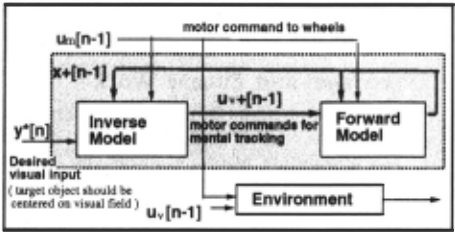
Figure 4 illustrates the way to mentally track the target using the learned visual tracking. The shaded portion denotes the acquired knowledge for visual tracking. The command for moving around in the environment is denoted as um[n- 1].
Note that the robot uses the output of the for ward model as the current state x+[n- 1], instead of actual input from the camera (environment). In order to mentally track the target with locomotion, the robot produces virtual command ut[n- 1] to the forward model as an internal process.
4 Empirical Experiments with a Simulated Robot
4.1 The Set up
In the following experiments, we simulated three stages of a child's development of motor skills with the robot by varying its permitted actions. In stage 1, the robot is only permitted head rotation. In stage 2, the robot can rotate both head and body. Finally, in stage 3, the robot is also permitted self locomotion, whereas in stages 1 and 2, locomotion was performed by an external agent.
For each stage, the forward and inverse models of the network were trained until:
Forward model Prediction error was less than 0.0005 for 50 training steps, or 50000 training steps were completed.
Inverse model The difference between the proper command u~[n -1] and actual command uv[n-
1] was less than 0.0005 for 50 training steps, or 50000 training steps were completed.
4.2 The Three Cups Task
Following the "three cups" paradigm [Bower, 1979] discussed previously, the robot is placed in front of three cups and shown which cup hides the target ob ject 5 . The robot moves (or is moved) to a new position from which it must predict which cup hides the target object.
4.3 Results
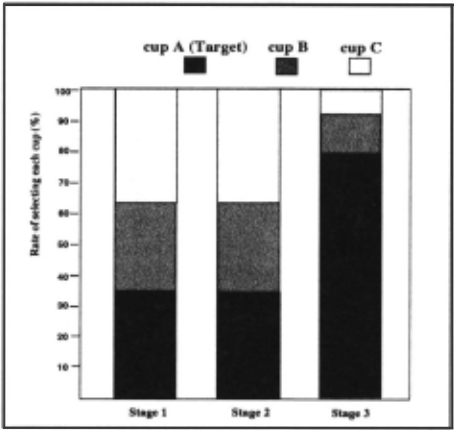
Figure 5 shows the rate of selection one of three cup after training for each of the three stages. The target cup (cup A) is black. The robot's perfor mance at stages 1 and 2 was at chance level (35%). However, analysis showed that responses were con sistent with an egocentric based prediction, not ran dom choice. For example, from an allocentric per spective, a cup on the left-hand side of one's field of view would appear on the right-hand side if one views the cups from behind. From an egocentric perspective, however, one would predict the target as being on the left-hand side, which was the robot's prediction for stages 1 and 2. Since the cups were arranged in the shape of an equilateral triangle, only 35% of positions will yield a correct predic tion based on egocentric knowledge. Under random choice there is no correlation between the relative positions of the selected cups before and after move ment. In stage 3, when the robot also had control of translational movement, its predictive accuracy was above chance and egocentric levels, and more consistent with an allocentric based choice. Thus, locomotion experience was important for learning to predict the target's position.
5 This was done by labeling the target cup at the initial location.
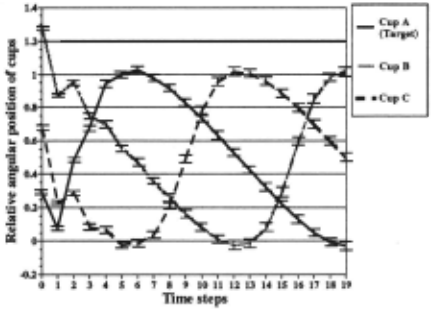
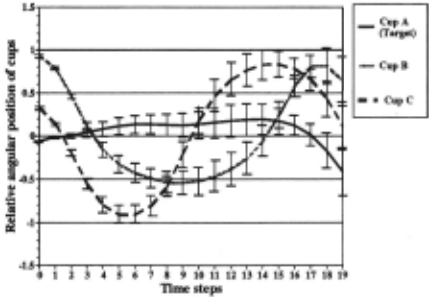
The contrast between egocentric behaviour (at stage 1) and allocentric behaviour (at stage 3) is made clearer by plotting cup position in the robot's field-of-view as a function of the robot's location.
Figure 6 shows the angular position of each cup relative to the center of the robot's field of view at various locations around the cups. The robot was moved along the circumference of a circle en closing the cups (see Figure 1), and cup positions were recorded at 1/20th intervals. For example, 0 on the x-axis corresponds to the robot's initial position. For the y-axis, negative and positive values correspond to the left and right halves of the field of-view (respectively). For each location, the cup with the smallest angular position (in magnitude) is the selected cup. For example, at position 5, cup C was selected. As evident from Figure 6, the robot always selected the leftmost cup as the target. In other words, the robot adjusted its head so that the leftmost cup (relative to the robot) was positioned at the center of the field-of-view (0 angular posi tion). Consequently, the other two cups appeared in the right half of the field-of-view. This is to say that the robot behaved egocentrically. Crossovers on the graph (e.g., position 8) occurred because there are 6 locations on the circumference of the enclosing circle for which one cup is occluded by another.
Figure 7 shows mental tracking at the end of stage 3. As can be seen from the graph the target cup (cup A) remains closest to the center of the robot's field-of-view for most locations (i.e., it behaved al locentrically ). Again, the exceptional cases (i.e., crossovers) are due to occlusions.
5 Discussion and Future Work
So far we have described mental tracking as a computational model of infant's spatial develop ment. The simulation results support the evidence found in developmental psychology: the impor tance of self-locomotion. Furthermore, the results of our simulation suggest that experience of self locomotion with visual tracking can accelerate spa tial development. This offers the key to an under standing of how egocentric behavior changes into allocentric behavior.
As for mental tracking, Tani proposed a similar idea in the context of robot navigation [Tani, 1995]. He developed a robot that is capable of mentally simulating action plans based on a forward model ing scheme using recurrent network learning. Al though he was not concerned with cognitive devel opment, he did suggest its relevance to cognition.
Perhaps the closest approach to ours is the Cog Project of Brooks and colleagues [Brooks and Lynn, 1993]. They have been developing human-body like robots, humanoid. The idea of creating humanoids to investigate human cognition is very attractive in a sense that intelligence cannot come without body. We believe that the key concept of using robot for modeling cognitive development can be achieved even with simple mobile robots.
Current simulations were limited to one step back in time (i.e., target visible from the previ ous time step). For more complex environments, the target will be outside the field-of-view for indefinite periods. An obvious (and elegant) solution is to incorporate recurrent connections and have the network learn to remember positional informa tion (e.g., [Elman, 1990]). However, learning to maintain information over long periods in the ab sence of additional input is difficult without special learning techniques (e.g., incremental learning, [El man, 1993]). The extent to which mental tracking is maintenance of internal representations , or the search for alternative visual cues is an interesting research issue. And one that can best be addressed in real-world active environments such as we have proposed with the use of robots.
In our simulations, we divided child's develop ment of motor skills into three stages. In gen eral, however, motor skills develop more gradually, and interact with spatial development more tightly. More likely is that the development of motor skills and spatial knowledge interact both ways [Thelen and Smith, 1994]. We need to explore this kind of interaction in future work.
6 Conclusion
In this paper, we addressed the question of how in fants relate to their spatial environment, and how this changes as the infant matures. To explore these issues, we introduced mental tracking as a key con cept, and propose a learning architecture for men tal tracking analogous to infants. Although there is much work to be done, we believe that the idea of using autonomous robots as the subject of develop ment will open a new approach to modeling cogni tive development. We take inspiration from recent work in robot vision, where the problem of making a robot see generated predictions leading to discov eries in insect vision [Franceschini et al., 1992]. We expect similar results for cognitive development.
Acknowledgement
We thank Hideki Asoh for his comments on initial stage of this work. We also thank Motoi Suwa, Kazuhisa Niki and Hideyuki Nakashima for their support.
@inproceedings{ijcai1997p45,
  title     = {Mental Tracking: A Computational Model of Spatial Development},
  author    = {Hiraki, Kazuo and Sashima, Akio and Phillips, Steven},
  booktitle = {Proceedings of the Fifteenth International Joint Conference on
               Artificial Intelligence, {IJCAI-97}},
  publisher = {International Joint Conferences on Artificial Intelligence},
  editor    = {Martha E. Pollack},
  pages     = {301--308},
  year      = {1997},
  note      = {Cognitive Modeling},
  url       = {https://ijcai.org/proceedings/1997/45},
}
TY - CPAPER TI - Mental Tracking: A Computational Model of Spatial Development AU - Hiraki, Kazuo AU - Sashima, Akio AU - Phillips, Steven T2 - Proceedings of the Fifteenth International Joint Conference on Artificial Intelligence, IJCAI-97 PB - International Joint Conferences on Artificial Intelligence PY - 1997 SP - 301 EP - 308 UR - https://ijcai.org/proceedings/1997/45 ER -Copied
Machine-readable versions of this paper, for tools and AI agents:





