
A Model for Hormonal Modulation of Learning
Proceedings of the Fourteenth International Joint Conference on Artificial Intelligence. Connectionist Models. Pages 532-539.
© 1995 International Joint Conferences on Artificial Intelligence
Abstract
Recent studies in neurobiology have discovered that many hormones exist in the brain, and play key roles in learning and memorization. In this paper, we discuss the possible role of hormones in learning, and propose a new learning model which incorporates hormonal effects on learning. The model is a variant of reinforcement learning with modulation on learning rate and the frequency of mental rehearsal. The modulation enables the system to focus its learning on data which are evaluated as important for the system's overall performance. The experiment demonstrates that the incorporation of hormonal modulation improves behavior learning performance, and such an evaluation network can be acquired through the evolutionary mechanism.
- [Ackley and Littman, 1992] Ackley, D. and Littman, M. , "Interactions Between Learning and Evolution," Langton, C. et al. (Eds.)Artijicial Life II, Addison- Wesley, 1992.
- [Buck, 1986] Buck, M., "The Psychology of emotion," (eds.) LeDoux, J. E. and Hirst, W., Mind and Brain, Cambridge University Press, 1986.
- [Castellano and Pavone, 1988] Castellano, C. and Pavone, F. , "Effects of ethanol on passive avoidance behavior in the mouse: involvement of GABAergic mechanisms," Pharmacol. Biochem. Behav. 29, 321- 24, 1988.
- [Castellano, 1975] Castellano, C. , "Effects of morphine and heroin on discrimination learning and consolida- tion in mice," Psychopharmacology 42, 235-42, 1975.
- [de Wied, 1965] de Wied, D., "The influence of the pos- terior and intermediate lobe of the pituitary peptides on the maintenance of a conditioned avoidance re- sponse in rats," Int. J. Neuropharmacol. 4, 157-167, 1965.
- [de Wied, 1974] de Wied, D., "Pituitary-adrenal system hormones and behavior," Schmitt, F. and Worden, F. ( eds.) The Neurosciences: Third Study Program, The MIT Press, 1974.
- [de Wied, 1984] de Wied, D., "Neurohypophyseal hor- mone influences on learning and memory" , Lynch et al. (eds.) Neurobiology of Learning and Memory, 1984.
- [de Wied and Bohus, 1978] de Wied, D. and Bohus, B., "The modulation of memory processes by vasotocin: The evolutionary oldest neurosecretory principle," Prog. Brain Res. 48, 152-156, 1978. 1538 CONNECTIONIST MODELS [Flood and Cherkin , 1986] Flood, J . and Cherkin, A., "Scopolamine effects on memory retention in mice: a model of dementia?", Behav. Neural Biol. 45 , 169-84, 1986.
- [Flood et al., 1987a] Flood, J., Hernandez, E. and Mor- ley, J. , "Modulation of memory processing by neu- ropeptide Y," Brain Res. 422, 218-34, 1987.
- [Flood et al., 1987b] Flood, J., Smith, G. and Morley, J. , "Modulation of memory processing by cholecy- tokinin dependence on the vagus nerve," Science, 236, 832-34, 1987.
- [Gold, 1984] Gold, P., "Memory modulation: Roles of peripheral catecholamines," Squire, R. and Butter, N. (Eds. )Neuropsychology of Memory, Guilford, 1984.
- [Hall, 1992] Hall, X. , An Introduction to Molecular N eu- robiology, Sinauer Associates, 1992.
- [Lin, 1990] Lin, 1., "Self-improving reactive agents: Case studies of reinforcement learning frameworks," Proc. of Simulation of Adaptive Behavior 1, 1990.
- [McGaugh, 1989] McGaugh, J. L., Involvement of Hor- monal and Neuromodulatory Systems in the Regula- tion of Memory Storage, Ann. Rev. Neurosci., 1989, 12:255-87.
- [Ortony, 1987] Ortony, A., "Subjective importance and computational models of emotions," Hamilton, V. el al. (Eds.) Cognitive perspectives on emotion and mo- tivation, Kluwer Academic Publisher, 1987.
- [Pollack, 1991] Pollack, J., "The Induction of Dynami- cal Recognizer," Machine Learning, Vol. 7, Num. 2/3, 227-252, 1991.
- [Pfeifer, 1988] Pfeifer, R., "Artificial intelligence models of emotion," Hamilton, V., Bower, G. H., and Frijda, N. H., (Eds.) Cognitive perspectives on emotion and motivation, Kluwer, 1988.
- [Schlesinger et al., 1986] Schlesinger, K, et al., "Sub- stance P facilitation of memory: effects in an appeti- tively motivated learning task," Behav. Neural Biol. , 45, 230-39, 1986.
- [Sutton, 1990] Sutton, R., "Reinforcement Learning Ar- chitecture for Animat," From Animals to Animats: Proc. of SAB-90, MIT Press, 1990.
- [Tani, 1995] Tani, J., "Self-Organization of Symbolic Processes through Interaction with the Physical World," Proceedings of the Fourteenth International Joint Conference on Artificial Intelligence (IJCAI- 95 ), Montreal, 1995. IJCAI
- [Toda, 1985] Toda, M., "Emotion viewed as tightly or- ganized, genetically determined system of behavior- selection programs," Spence, J. & Izard, C., (Eds.) Motivation, emotion, and personality, North-Holland, 1985.
- [Vecsei et al., 1986] Vecsei, L., et al. "Somatostatin and ( d-trp68, d-cys 14 )-somatostatin delay extinction and reverse electroconvulsive shock induced amnesia in rats," Phychoneuroendocrinology, 11, 111-15, 1986.
- [Whitley and Hanson, 1989] Whitley, D., and Hanson, T., "Optimizing Neural Network Using Faster, More Accurate Genetic Search," Proc. of ICGA-89, 1989.
- [Yonkov et al., 1986] Yonkov, D. et al. , "Participation of Angiotensin II in Learning and Memory," M ethods Find. Exp. Clin. Pharmacal. 8, 203-6, 1986.
References were extracted automatically from the PDF and may contain errors.
Full text extracted automatically from the PDF; figures, tables and equations may differ. The PDF is the version of record.
1. Introduction
Recent developments in neuroscience and molecular bi ology have identified several neural systems which dis charge hormones and neuropeptides according to emo tional and other internal body status. Traditionally, hor mones have been thought to control the homeostasis of internal organs, but recent findings suggest that the cen tral nervous system itself produce hormones, thereby af fecting behavior and learning. In this paper, we discuss the possible role of hormones in learning, and propose a variant of reinforcement learning. The central claim in this paper is that hormonal modulation of learning (HML) enables the system, or the agent, to focus learn ing on important incidents for performance and survival, thus improving the total behavioral performance over learning agents without hormonal modulations. Evolu tionary acquisition of learning focus is essential for au tonomous systems in an open dissipative environment. In such an environment, a priori acquisition of training data and a behavior evaluation function is not possible. In addition, importance of the event is not related with the frequency the event takes place. This paper discusses the use of hormoal modulation of learning for designing autonomous agents in the open dissipative environment.
This section presents a brief overview of molecular neu robiology relevant to the discussions in this paper. The central issue is how signals among neurons are transmit ted and modulated. In the traditional literature, neu rotransmitters such as acetylcholine, glutamate, and {3aminobutyric acid are considered to be the sole chemi cal components mediating inter-neuron information pro cessing. However, recent studies, particularly in the last decade, revealed that many chemical substances known as hormones are playing important roles in the cen tral nervous system. For details, refer to [Hall, 1992; McGaugh, 1989].
2.1. Neurotransmitters
It is well understood that chemical substances medi ate signal transmission among neurons. When elec tric impulses, which propagate through the axon, reach a pre-synaptic site (or axon terminal) , chemical sub stances such as acetylcholine (ACh), glutamate, and 1-aminobutyric acid (GABA) are released into the synapse. ACh and glutamate mediate excitory connec tions, and GABA mediate inhibitory connections. These neurotransmitters act on ion channels on the surface of the post-synaptic site (Fig. 1-left). The ion chan nels then open to intake N a+ which causes elevation of the action potential. This process causes fast excitatory postsynaptic potentials (fEPSF). This part of the infor mation processing has been modeled in current neural networks. However, there are other chemicals involved in the information processing.
2.2. Biogenic amines
The second group of chemicals, the biogenic amines, in clude serotonin (5-hydroxytryptamine) , histamine, nore pinephrine, epinephrine, and dopamine. These chemicals are known as hormones, and are used by endocrine and other cells as well as by neurons. Synaptic communica tion mediated by amines has aspects of both fast and slow transmission. Typically, amines are released by paracrine discharge, which means it diffuses to nearby synapses, as opposed to specialized discharge of neuro- Figure 1: Synapse - Traditional transmitters which acts only at the synapse where the chemicals are discharged. This is illustrated in Fig 2.
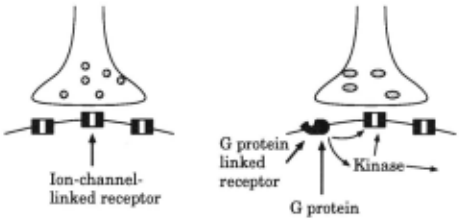
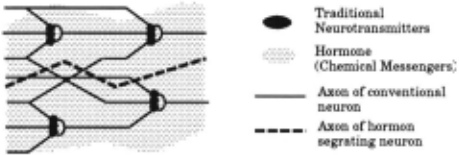
Amines act on G protein-linked receptors, and not di rectly on the ion channels. The process involves the intra-cellular second messengers such as cAMP and PKC to open the ion channels (Fig 1-right). The signal trans mission through this process is slow in both onset (tens of milliseconds) and in duration (possibly a few hours).
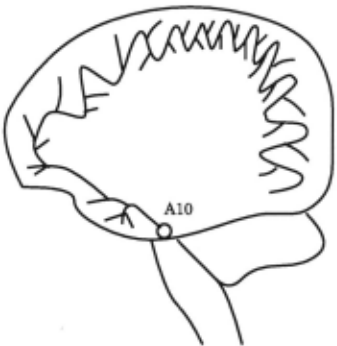
Amines are discharged from specialized neural sys tems called the A, B, and C neural systems. Fig. 3 shows an example of projection from the A1o neural sys tem. Many hormone producing neurons exist in the hypothalamus and project axons throughout the neo cortex. Norephinephrine is discharged from A1 to A1, dopamine is discharged from As to A1s, and epinephrine is discharged from the C system. The B system discharges serotonin. Amines are produced at the cell body and transported through the axon. Functionally, amines affect the mental state of the human, such as emotion[Buck, 1986]. Dopamine, norepinephrine, and epinephrine produces pleasure, anger, and fear, respec tively. Several experiments demonstrate effect on mem ory and learning [Gold, 1984; Hall, 1992].
2.3. Neuropeptide
The third class of chemicals are neuropepetides, also a kind of hormone. In the 1960s, de Wied proposed that adrenocorticotropic hormone (ACTH) and vaso pressin (VP) modulate memory and learning by act ing on the central nervous system [de Wied, 1965; 1974]. Research indicated that memory is both en hanced and impaired by post-training treatment affect ing the monoaminergic[Gold, 1984], cholinergic [Flood and Cherkin, 1986], and inhibitory amino acid systems [Castellano and Pavone, 1988] as well as .Pepti~e systems, including ACTH[de Wied, 1974], VP [de W1ed, 1984], and opioid peptide [Castellano, 1975]. Recent find in&s indicate that other peptides, including substance P [Schlesinger et al., 1986], CCK [Flood et al., 1987b] , angiotensin II [Yonkov et al., 1986], somatostatin [Vecsei et al., 1986], and neuropeptide Y [Flood et al., 1987a], modulate memory storage.
In general, neuropeptides mediate slow transmissions. Currently, over 40 neuropeptides have been identifie? in the central nervous system, and several neuropeptldes were found to co-exist at one pre-synaptic site.
3. Implications for Learning Theory
Models of neural networks and learning theories must be revised in order to incorporate functions of biogenic amines and neuropeptides. Due to the limitations of pa per length, we focus on a model incorporating functions of biogenic amines. Among many possible impacts, this section focuses on three aspects that have immediate im pacts on learning theory.
3.1. Elevation of Action Potential
With regard to the forward propagation of a signal, the current model uses equation:
where a; is the activation level of the neuron i, Wij is a weight between neuron i and j, and h is the bias. By incorporating hormonal activity, this needs to be revised to:
where o:, {3 and "( are constants, akt is the activation level of a neuron discharging the chemical messenger k at time t , and Rik is an amount of receptors for the chemical messenger k on synapse i. Rik may be a constant, or it may change depends on stimuli and genetic information. With higher discharge of amines, the base level to trigger activation of the neuron i decreases. Thus, the circuit consisting of the neuron with the receptor will be more sensitive to the input.
3.2. Modulation of Weight Modification
Next , amines also affect learning in neural networks. Take the example of hebbian learning, the current model uses the equation:
where cis a constant, ai and aj are activation levels of neurons i and j, respectively. This needs to be changed to:
where (k is a parameter defining positive or negative effects of hormone k for weight up-date strength. This equation means that the degree of weight modification is modulated by hormonal discharge around the synaptic site.
3.3. Mental Rehearsals
Speculating from the elevated action potential of the neurons and known neural circuits in the brain, we may be able to assume the existence of mental rehearsal and its modulation by hormones. Mental rehearsal in this paper means the repeated internal exposure of patterns for memorization. This process does not have to be a conscious process. We speculate that mental rehearsal occurs through the closed loop formed by upward pro jections from the hippocampus to the neo-cortex and back projections from the neo-cortex to the hippocam pus. With a crude abstraction, this can be schmatized as in Fig. 4. Short Term Memory (STM) represents the hippocampus, and three Long Term Memory (LTM)
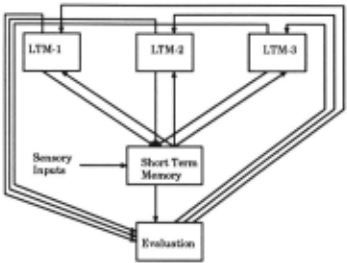
units represent regions of the neo-cortex receiving spe cific neural projections from the limbic system. There is state-dependency in each region of LTM units. The evaluation unit represents a part of the limbic system which evaluates preference of the given inputs and acti vates neural systems A, B, and C. Metaphorically, this may correspond to various emotional states.
In this circuit, inputs are quickly learned by STM, and the closed loop between STM and LTM creates a resonance, a repeated propagation of pulses representing certain patterns. Without an active hormonal discharge, this resonance resolves very quickly. However, with an active hormonal discharge, i.e. active A, B, and C neu ral systems, the baseline action potential for neurons in LTMs is elevated so that sustained (or longer duration) resonance can be created. Some reinforcement learning use mental rehearsal to speed-up learning [Sutton, 1990; Lin, 1990], however, this model adds the modulation of the mental rehearsal frequency.
In summary, hormones modulate learning so that data which are evaluated as important are learned with more frequent mental rehearsal and a higher learning rate than unimportant data. This is critical for survival because life-related situations form only a fraction of the events we are exposed to in daily life. Thus the successful agent must evaluate the importance of the event to enhance the learning effect. This conclusion is consistent with psychological studies on emotion [Ortony, 1987]
4. A Model
Discussions in the previous section lead us to propose a new model of reinforcement learning. The model is a variant of reinforcement learning, and can be applied to existing learning algorithms. A basic architecture is shown in Fig. 5. The model consists of a genetically determined reaction network (React), an evaluation net work (also genetically determined) (Eval), and a policy network (Policy).
When an input is given to an agent implementing the model, it is received by Policy, Eval , and React. Given the input, React produces motor control reac tions, Eval produces reinforcement reward (reward) and focus (focus) which will be explained later, Policy pro duces a motor control output. The final motor action is determined by adding outputs from React and Policy.
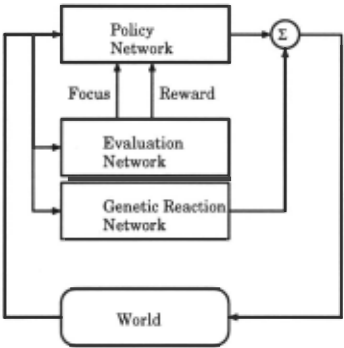
In the model React, Eval and Policy are imple mented using feed-forward neural networks whose initial connection weights are genetically determined by means of the GA process. In this experiment, we used the di rect encoding method [Whitley and Hanson, 1989]. For Policy, weights are modified through a learning mecha nism. React and Policy use a 16-8-8 network, and Eval uses 17-8-2 network. For Eval, there are 17 input nodes because 16 for sensory inputs and 1 for internal energy level. Activation levels of two output nodes correspond to Reward and Focus. In this paper, we use one pol icy network rather than three networks. As a learning mechanism for the model, we employ a modified version of Evolutionary Reinforcement Learning (ERL: [Ackley and Littman, 1992]). The learning component of the ERL is Complementary Reinforcement Back Propaga tion (CRBP). Fig. 6 shows the algorithm of CRBP.
We made an extension to the original CRBP to incor porate learning modulation by hormones. CRBP in its original form only takes reward to change its learning behavior, and no modulation is made on the maximum number of mental rehearsals 1 nor the learning rate pa rameter. In our model, focus produced from Eval cap tures the level of hormonal discharge, thus affecting the learning rate and the maximum amount of back propa gation allowed for learning. When focus is almost zero, almost no mental rehearsal is allowed. A high focus level allows a large number of mental rehearsals and a larger learning rate. This means that focus level determines which event is important. The existance of focus is the major extension from ERL. Fig 7 shows a new algo rithm. Revised parts are shown with underlines. focus and reward correspond to r and f in Fig. 7. With this modification, a revised CRBP should be able to focus learning on significant data.
1 We use the term mental rehearsal referring to the itera tive weight update in CRBP. Specifically, from step 2 to step 6.
- Receive vector it. If t = 0 go to 7. Otherwise com pute reinforcement r = f(it ,it-d·
- Generate output errors ej. If r > 0, let ej = (aj - sj)sj(l-sj), otherwise let ej = (1-aj-Sj)sj(1-sj) ·
- Back propagate errors.
- Update weights. Llwjk = TJ€kS j .
- Forward propagate again to produce new sj's. Gen erate temporary output vector a*.
- If ( r > 0 and a* =/= a) or ( r < 0 and a* = a), go to 2.
- Set network input to it. Forward propagate to pro duce sj's.
- Generate a binary output vector a. Given a uniform random variable ( and parameter 0 < v < 1,
- Perform the action associated with a. Let t = t + 1. Go to 1.
Figure 6: Complementary Reinforcement Back Propa gation
- Receive vector Zt. If t = 0 go to 7. Otherwise compute reinforcement r = g(it,it-1), and focus f = h(it) · Set 'fJ = /3/, and the maximum mental rehearsal mmax =If·
- Generate output errors ej. If r > 0, let ej = (aj - sj)sj(l-sj), otherwise let ej = (1-oj-Sj)sj(1-sj)·
- Back propagate errors.
- Update weights. Llwjk = 'f}ekSj. m = m + 1.
- Forward propagate again to produce new sj's. Gen erate temporary output vector a*.
- If ( ( r > 0 and a* =/= a) or ( r < 0 and a* = a)) and (m < mmax), go to 2.
- Set network input to it. Forward propagate to pro duce sj's.
- Generate a binary output vector a. Given a uniform random variable ( and parameter 0 < v < 1,
- Perform the action associated with a. Let t = t + 1. Go to 1.
Figure 7: CRBP with hormonal modulation
5. Experiments
5.1. Artificial world
The experiment assumes an artificial world consisting of a 100 by 100 grid. The emotional agent moves around in this world. There are food sites and enemies. Fig 8
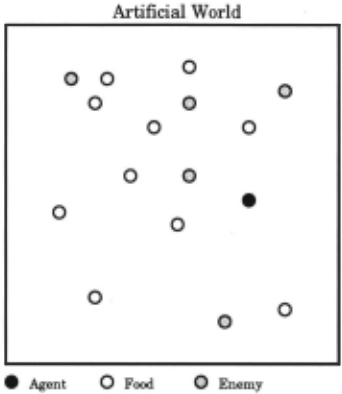
shows a snapshot of the world. Experiments reported in this paper assume 10 food sites and 5 enemies. The agent consumes 1 unit of energy per grid unit moved. The agent will die if its energy reaches zero. Each food site gives the agent 50 units of energy. When the agent is attacked by the enemy, the agent loses 10 points of energy.
Simple sensor systems are available for the agent. It has two types of sensors for 8 directions. Each sensor covers 45 degrees. One type of sensor detects food; the other type detects enemies. Strength of the sensor read ings corresponds to the distance to the object.
5.2. Evolution
A genetic algorithm was used to simulate the evolution ary process. The genetic algorithm uses real value di rect encoding to represent weights [Whitley and Han son, 1989], two point crossover, an elitist reproduction strategy combined with proportional reproduction, and an adaptive mutation rate ranging from 1% to 10%. The population size for the following experiments is 20. The initial values for the weights encoded on the chromosome are distributed with a range of ±2.0. After a predefined time period (100 time units), each individual is evaluated based on its energy level. If an individual has already been killed by an enemy attack, its fitness is equal to the number of time units it has survived.
5.3. Results
A series of experiments was carried out to evaluate the new learning model. The model has been compared with several other models so that four indepdent models were tested, including:
- Genetic reaction only (Gen)
- Genetic reaction and fixed reinforcement (Fix)
- Genetic reaction and ERL (ERL)
- Genetic reaction and ERL with hormonal modula tion (HML-ERL)
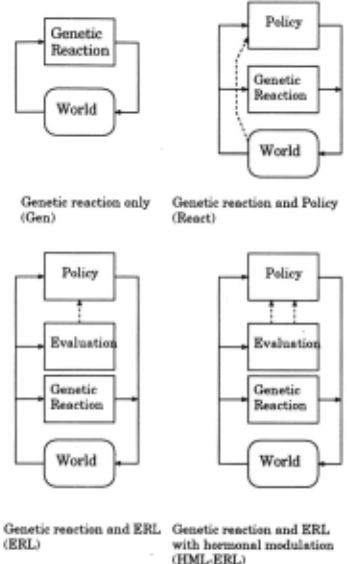
Fig. 9 shows the architecture for each model. First, an agent with only a genetic reaction circuit Gen was evolved and tested in the artificial world. This data is used as a baseline to measure the effects of other circuits on behavior performance. Next, an agent with Eval and Policy with pre-programmed reinforcement was tested. Policy receives positive reinforcement when it eats food and negative reinforcement when attacked by the en~ emy. Thus, its learning behavior is based on CRBP with a fixed evaluation circuit. The third experiment was carried out using the model proposed in this paper. The control experiment was carried out using the same architecture, but without modulating the learning rate or numbers of mental rehearsals. The control group is equivalent to evolutionary reinforcement learning (ERL: [Ackley and Littman, 1992]).
The average performance of these variations are shown in Figure 10. This is a typical result from 20 experiments performed on the same task. Several interesting results can be discovered. First, the proposed model attained the best performance. This supports our hypothesis that hormonal modulation improves learning capability. Sec ond, the genetic-reaction-only model (Gen) outperformed all other models except the proposed model (HML-ERL).
For the model with fixed reinforcement (Fix), the per formance is significantly worse than the model with genetic reaction alone. The problem for this model is that the evolution and behavior of the genetic reaction cir cuit and the learning and behavior of the policy network are not coordinated, so that two independent behav ior modules are evolved and learned without interact ing. This experimental result clearly demonstrates that simply adding a learning module on top of the reactive module does not necessarily improve the agent's overall performance.
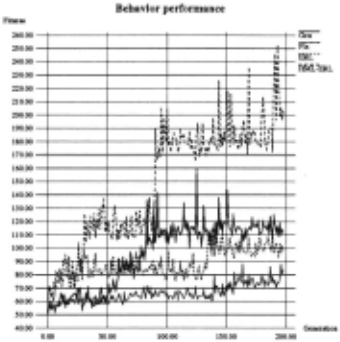
The surprise comes with the performance of ERL. It shows a significantly worse performance than the pro posed model HML-ERL, and equivalent to or even worse than the agent with only the genetic reaction module (Gen). The only difference between the proposed model and this model is in the existence of learning rate and mental rehearsal modulation based on the signals from the evaluation module. In the original ERL, reinforce ment learning is triggered for every input ragardless of its importance. Thus, memories of important events are scrambled by weight updates caused by a large number of unimportant and often noisy inputs. The environ ment in this experiment is sparse than the experiment environment in lAckley and Littman, 1992] where agents using ERL performed better than genetically-hard-coded agents. Thus, the result is dependent upon the eviron ment .
6. Discussions
6.1. Evolution of Learning Control
HML is closely related with emotion. Since the discharge of hormone is associated with changes in emotional sta tus, HML can be viewed as emotion-driven learning. Emotion has already been considered as a mechanism of behavior control [Toda, 1985; Pfeifer, 1988]. We consider that emotion also controls learning by regulating the dis charge of hormone. However, it is not clear how emo tional control emerged through evolution. Experiments indicate that agents with the genetical-determined be havior module, Gen, perform almost as well as HML-ERL.
In some runs, Gen outperformed HML-ERL at the early stage of evolution. This is because an appropriate eval uation network was not acquired at the early stage of evolution for HML-ERL. If several agents co-exist in the same environment, HML-ERL and ERL could have been extinct due to slow acquisition of an evaluation network. Thus, there is a need to evolve complex agents using an incremental built-up approach. In this case, the first step is to use emotion, more precisely a hormonal discharge, as the sole mechanism of behavior control. The main question is, how was the more complex module can be created and connected to the older module. This is our major future research target .
6.2. Symbol Grounding
HML can be applied as a solution for the symbol ground ing problem. The basic approach is to evaluate an input sequence, and decide which input to focus for learning. This means that partitioning of a signal stream may be possible. While various studies demonstrate that forma tion of attractors from an input stream is possible [Pol lack, 1991; Tani, 1995], these input streams need to be partitioned. Each attractor can be viewed as a symbol representing a specific pattern of the sensory input. The input seluences in these studies are either a sequence of symbols Pollack, 1991], or a sequence of continuous si& nal with a hand-coded partitioning function [Tani, 1995j. For example, in Tani's robot navigation using dynamical systems approach [Tani, 1995], learning is invoked only when sensory input shows a pattern of a road branching for a maneuver. Without the hand-coded partitioning function, learning is always activated. In this case, at tractors are not formed. This suggests that partitioning of the input stream is necessary for the self-organization of the symbols. The question is how the partitioning function emerged. Our hypothesis is that a neural cir cuit for partitioning, which provides focus in HML, was acquired through evolution, and the first level partioning was performed using this circuit. Thus, the acquisition of focusing circuits using hormonal modulation leads to the formation of a primitive set of symbols. If this hy pothesis is correct, it means that hormonal modulation plays an important role in symbol grounding.
7. Concludings Remarks
In this paper, we discussed the possible role of hormones in learning, and proposed and examined a new model of reinforcement learning. The proposed model is de rived from recent findings in molecular neurobiology. Al though the model examined and the task was a simple one, it clearly demonstrates the effectiveness of using hormonal modulation for learning. The result of this ex periment has two implications. First, it shows that mod eling hormonal activities enables the focus of attention for learning, thereby improving behavioral performance. This would be an important approach for autonomous agents behaving in the real world, because such an agent needs to determine what is important for its survival or task accomplishment. The proposed model enables the agent to learn vital events even if they are rare events. Seocnd, the result supports biological findings regarding memory modulation by hormones from computational perspectives. While there is much evidence for memory modulation by hormones, these are at either molecular level or behavioral level. No study so far has documented the role of hormonal modulation at the mesoscopic level.
Although we used ERL as a basis of the experiment and the model was proposed as a modification of ERL, the basic idea can be applied to other learning algo rithms. Now, it is an open question whether the method proposed has universality so that it improves learning performance when applied to various learning models. If this is the case, the hormonal modulation enables the focusing of learning by evaluating learning data on the basis of the system's goal.
Further research topics will be to incorporate the ef fects of neuropepetides and multiple amines for focusing.
Acknowledgments
I would like to thank members of Sony Computer Science Laboratory for useful discussions, and Prof. Susumu Tonegawa (MIT) and Dr. Gen Matsumoto (ETL) for insightful comments.
@inproceedings{ijcai1995p70,
  title     = {A Model for Hormonal Modulation of Learning},
  author    = {Kitano, Hiroaki},
  booktitle = {Proceedings of the Fourteenth International Joint Conference on
               Artificial Intelligence, {IJCAI-95}},
  publisher = {International Joint Conferences on Artificial Intelligence},
  editor    = {Chris S. Mellish},
  pages     = {532--539},
  year      = {1995},
  note      = {Connectionist Models},
  url       = {https://ijcai.org/proceedings/1995/70},
}
TY - CPAPER TI - A Model for Hormonal Modulation of Learning AU - Kitano, Hiroaki T2 - Proceedings of the Fourteenth International Joint Conference on Artificial Intelligence, IJCAI-95 PB - International Joint Conferences on Artificial Intelligence PY - 1995 SP - 532 EP - 539 UR - https://ijcai.org/proceedings/1995/70 ER -Copied
Machine-readable versions of this paper, for tools and AI agents:





