
Device Representation and Reasoning with Affective Relations
Proceedings of the Fourteenth International Joint Conference on Artificial Intelligence. Qualitative Reasoning and Diagnosis. Pages 1814-1819.
© 1995 International Joint Conferences on Artificial Intelligence
Abstract
Device representation and reasoning with affective relations occupies a middle ground between classical model-based diagnosis and heuristic expert systems. A device is modeled by specifying a set of diagnostically motivated affective relations among its components. Reasoning is then performed by a set of inference rules that reason with the model to propagate symptoms through the components. Representation and reasoning with affective relations extends several benefits of classical model-based diagnosis- the model as a unifying framework for knowledge, methodical coverage of the domain , and diagnostic reasoning based on equipment design and causality-to a class of problems where classical model-based diagnosis cannot be applied because the required models cannot be reasonably obtained or represented . Our work evolved from our redesign of a heuristic expert system for monitoring long-distance telephone switching systems, and is applicable to highly complex self-checking systems.
- [Abbott , 1990] K. H. Abbott. Robust Fault Diagnosis of Physical Systems in Operation. PhD thesis, Rutgers University, 1990.
- [Abu-Hanna et al., 1991] A. Abu-Hanna, R. Benjamins, and W. Jansweijer. Integrating functional models in model based diagnosis. Model-Based Reasoning Work- shop Notes from AAAI-91, 1991.
- [Albert, 1994] P. Albert. ILog Rules, embedding rules in C++: Results and limits. In Embedded Object- Oriented Production Systems Workshop, 1994.
- [ATT, 1995] ATT Bell Laboratories. R++ User Man- ual, 1995. URL address: http:/ jwww.research.att.- com/orgs/ssrfpeoplejpfps/UserManual.ps. Link
- [Chandrasekaran and Mittal, 1982] B. Chandrasekaran and S. Mittal. Deep versus compiled knowledge ap- proaches to diagnostic problem-solving. In Proc. of the National Conference on Artifical Intelligence, pages 349-354, Pittsburgh, PA, 1982.
- [Clancey, 1985] W. Clancey. Heuristic classification. Ar- tificial Intelligence, 27:289-350, 1985.
- [Crawford et al., 1994] J. Crawford, D. Dvorak, D. Lit- man, A. Mishra, and P. Patel-Schneider. Path-based production rules. In OOPSLA-94 Workshop on Em- bedded Production Systems in Object-Oriented Lan- guages, Portland, OR, 1994.
- [David et al., 1993] J. David, J . Krivine, and R. Sim- mons, editors. Second generation expert systems. Springer-Verlag, 1993.
- [Davis and Hamscher, 1988] R . Davis and W. Ham- scher. Model-based reasoning: Troubleshooting. In H. Shrobe, editor, Exploring Artificial Intelligence: Survey Talks from the National Conferences on Ar- tificial Intelligence. Morgan Kaufmann, 1988.
- [Hal, 1993] The Haley Enterprise. Rete++: Seamless Integration of Rules and Objects Using the Rete Algo- rithm and C++, 1993.
- [Hart, 1982] P. E. Hart. Direction for AI in the eighties. SIGART Newsletter, (79), 1982.
- [Beckerman and Wellman, 1995] D. Beckerman and M. P. Wellman. Bayesian networks. Communications of the ACM, 38(3):27-30, 1995.
- [Miranker et al., 1993] D. P. Miranker, F. H. Burke, J. J. Steele, D. R. Haug, and J. Kolts. The C++ embeddable rule system. International Journal on Ar- tificial Intelligence Tools, 2(1):33-46, 1993.
- [Newell, 1982] A. Newell. The knowledge level. Artificial Intelligence, 18:87-127, 1982.
- [Sticklen and Bond, 1991] J. Sticklen and W. E. Bond. Guest editors' introduction: Functional reasoning and functional model. IEEE Expert, pages 20-21, April 1991.
References were extracted automatically from the PDF and may contain errors.
Full text extracted automatically from the PDF; figures, tables and equations may differ. The PDF is the version of record.
1 Introduction
Following their advent in the 1970's, expert systems were successfully applied in a number of commercially impor tant areas. However, as these systems grew in size and complexity, it became clear that they had important lim itations. For example, large collections of interacting rules turn out to be difficult to understand or modify. These limitations can be traced to a set of now well known problems with "surface" or "first-generation" ex pert systems [Hart, 1982; David et al., 1993], for exam ple, unintended rule interactions, conflicting rules, and knowledge implicit in the rules.
To address these problems, a wide variety of "second generation" expert systems have been proposed in the literature, encompassing both "deep" approaches (e.g. ,
·currently supported by the Air Force Office of Scientific Research under grant number 92-0693 and by ARPA/Rome Labs under grant numbers F30602-91-C-0036 and F30602-93C-00031. Much of this work was done while at AT&T Bell Laboratories.
Daniel L. Dvorak, Diane J. Litman Anil K. Mishra, Peter F. Patel-Schneider
AT&T Bell Laboratories 600 Mountain A venue Murray Hill, NJ 07974 U.S.A.
knowledge level analyses [Clancey, 1985], deep compiled knowledge [Chandrasekaran and Mittal, 1982], m?del based reasoning [Davis and Hamscher, 1988], funct10n~l reasoning [Sticklen and Bond, 1991]), as well as hybnd approaches that integrate multiple representation and reasoning techniques. For example, in the domain of device diagnosis, model-based approaches generally rep resent the structure and behavior of the device declara tively and then reason about the device from firs~ ~rin ciples (rather than via a collection of ad-hoc heunsttcs).
Generally speaking, the commercial impact ofsecond generation expert systems has not matched the impact of their simpler first-generation counterparts. A maJor fac tor in this relative lack of commercial impact of second generation approaches, especially the more sophisticated approaches based on model-based reasoning, is the high up-front cost of developing a model of complex real-world devices. To take an extreme but very real example, con sider the problem of developing a model of a modern tele phone switching system (or some other equally com~lex device such as a nuclear power plant or large chemtcal refinery). A telephone switch can easily have thousands of circuit packs, each of which is of the complexity of a personal computer. Clearly any behavioral or func tional model of such a device will have to be at quite a high level. Unfortunately, there do not seem to be any good high level languages for even giving a b.ehavioral or functional description of these complex devtces. One might expect to be able to use some mathematical model, queuing theory for example, but we are not aware of an.y evidence that such an approach would be useful. It 1s clear that such an approach would be almost completely disjoint from the approaches that domain expe~ts take to monitoring and diagnosing these types of devtces.
To understand the approach that domain experts take, it is essential to understand that modern complex de vices are largely self-checking. 1 That is, they generally monitor their own operation and produce alarms that indicate the nature of most failures. This type of self checking is, of course, essential precisely because humans cannot keep an adequate model of such complex devices in their head. To produce commercially important moni toring and diagnostic systems in these domains it suffices to automate the largely mechanical process that domain experts use to understand the alarms produced by these complex self-checking devices.
1 We use the term "self-checking" to refer to built-in ca pabilities ranging from verification tests that signal when a device is malfunctioning to limited diagnosis that identifies suspects from evidence localized in time and space.
Unfortunately most existing work on first- and second generation expert systems provides relatively little help in this endeavor. First-generation approaches tend to break down due to their well-understood limitations. Second-generation model-based approaches are not di rectly applicable because of the lack any real model of these complex devices.
This paper presents an approach based on affective relations. Affective relations define a highly abstract non-behavioral representation for modeling devices. An affective relation is so named because one component af fects another in some diagnostically important way. The affective relation model is not used to simulate device behavior (in fact it is much too weak for that) . Instead the model is a way to organize knowledge about the do main in a coherent way; ad-hoc heuristics are replaced by a small set of general principles for monitoring and diagnosis from affective relation models. Unlike tradi tional device models, affective relations are easy to ac quire from front-line experts such as operators and main tenance technicians because they represent precisely the kind of knowledge that is needed to diagnose routine problems, particularly in complex self-checking devices.
We illustrate our approach by presenting a rational re construction of an existing rule-based monitoring and di agnosis system for the 4ESS®telephone switching system (the 4ESS handles most AT&T domestic long-distance calls). By comparing the older rule-based design with the design based on affective relations, we demonstrate how the use of affective relations (like traditional model based approaches) provides generality, clarity and con ciseness that allows for increased inferential power and reduced maintenance costs.
The larger import of our work is the identification of a middle ground between surface approaches and tradi tional model-based approaches. Our experience shows that a model of the affective relations between the com ponents of a device is a particularly useful level of representation because it brings many of the benefits of model-based reasoning to domains where full device models cannot be built.
2 Affective Relations
Affective relations models are applicable to domains sat isfying two basic criterion:
- Devices can be naturally broken down into compo nent devices such that the components generally in teract via known pathways.
- These pathways can be characterized by a small set of affective relationships between components.
Abstractly, reasoning with affective relations proceeds by examining the output of the device to determine the state of key components, and then propagating this in formation through the affective relations to deduce the state of other components. Actions are then performed based on the nature of the alarm messages from the de vice and the states of the components. To make this more concrete the rest of this section presents an exam ple of an affective relation model.
2.1 Device Representation
The key elements of our device model are 1) a set of basic classes (e.g., Device), 2) a set of diagnostically mo tivated affective relations relating device components, 3) a set of relations relating other classes in the model , and 4) a set of properties and general relationships specifying the semantics of the relations, i.e., the knowledge that is implicit in any explicitly specified knowledge. See Fig ure 1 for a knowledge level [Newell , 1982] description of a portion of the device model 2 . (See [ATT, 1995] for a symbol level description of a much larger portion of the device model.)
Affective relations link components to other com ponents in diagnostically useful ways. For exam ple, immediate-part-of means that a direct subcom ponent/component relationship exists between two de vices. Part-of reflects direct as well as transitively closed subcomponent/component relations, while its in verse subpart reflects direct and transitive compo nent/subcomponent relations. Depends-on means that the correct functioning of a device depends on the cor rect functioning of another device; dependent represents the inverse relation between the two devices. Standby means that if one device fails , its standby partner will take over automatically; it also means that reliable op eration is jeopardized if one device fails.
Other relations link devices to other classes in the model. Self-alarm means that a device is signaling an alarm. However, a problem with one device may not necessarily cause that device to itself signal an alarm; instead, the problem may affect a second de vice, causing it to signal an alarm. Part-alarm and dependent-alarm link devices to alarms signaled by other devices. Part-alarm relates a device to an alarm on another device when the alarming device is a subpart ofthe device; dependent-alarm relates devices to alarms based on depends-on. Devices are either functional or not. If a device depends on another device that is not functional , the dependent device is also not functional. If a device is in simplex mode, it means that none of the device's standbys are functional.
To illustrate the use of these relations, we examine in some detail a digital toll switching system known as a 4ESS switch. A portion of the basic class hierarchy is shown in Figure 2. 3 The class Device is broken down into a series of 4ESS-specific subclasses. Each major type of component of the 4ESS (down to the level of field-replaceable units) adds a class to the general device ontology shown in Figure 1.
Figure 3 shows how some of the key portions of the model of the 4ESS switch are instantiated using the gen eral and domain-specific portions of the ontology shown
2 We use typewriter font for relations and sans serif for classes (and their members) .
3 To eliminate jargon, hardware component names have been replaced with ABC, etc.
| Classes: | Device | Alarm | Boolean | |||
|---|---|---|---|---|---|---|
| Affective relations, and their domain and range: | ||||||
| immediate-part-of part-of subpart | Device, Device Device, Device Device, Device | depends-on dependent standby | Device, Device Device, Device Device, Device | |||
| Other relations, and their domain and range: | ||||||
| self-alarm part-alarm dependent-alarm | Device, Alarm Device, Alarm Device, Alarm | functional simplex | Device, Boolean Device, Boolean | |||
| Properties, and the affective relations they characterize: | ||||||
| Symmetric: Transitive: Inverses: V x | standby part-of, subpart (part-of, subpart), (depends-on, dependent) [simplex(x,true) | = V y (standby(x,y) | => functional(y,false))] | |||
| General relationships: V x V y [immediate-part-of(x,y) => part-of(x,y)] V x V y [part-alarm(x,y) = 3 z (subpart(x,z) 1\ self-alarm(z,y))] V x V y [dependent-alarm(x,y) = 3 z (depends-on(z,x) 1\ self-alarm(z,y))] V x V y [(depends-on(x,y) 1\ functional(y,false)) => functional(x,false)] | ||||||
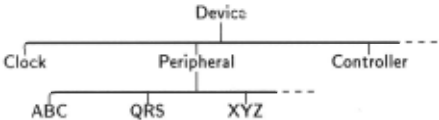
in Figures 1 and 2, respectively. The actual4ESS switch and its components are each defined as members of one of the device classes, e.g., Device( 4ESS) defines the switch 4ESS to be an instance of type Device. Note that the model is isomorphic to the device: for each type of com ponent in the device there is a class in the model and for each component in the device there is one instance in the model. Affective relations are asserted between device instantiations, e.g., immediate-part-of (Clock 0, 4ESS). Recall that the properties of and the general rela tionships between the affective relations (Figure 1) spec ify the knowledge that is implicit in an explicitly defined model such as Figure 3. Thus, because of the first general relationship in Figure 1, immediate-part-of (Clock 0, 4ESS) entails part-of (Clock 0, 4ESS), which in turn en tails the inverse relation subpart ( 4ESS, Clock 0). Sim ilar inferences can be drawn from the other immediate part-of assertions. Then, transitivity entails further subpart and part-of relations. The depends-on asser tions entail a set of inverse dependent relations. Because standby is defined to be symmetric, standby (A-CNTL 0, A-CNTLl) entails standby (A-CNTL 1, A-CNTLO), and similarly for the other standby assertions.
Figure 4 pictorially represents the model. Each box represents a device. The immediate nesting of boxes depict immediate-part-of relations. The labeled arrows depict some of the other explicit (e.g., standby (A-CNTL
0, A-CNTLl)) and impliCit (e.g., standby (A-CNTL 1, A CNTLO)) affective relations linking devices.
Note that affective relations among components are not traditional relations of structure or behavior or function except in some very abstract sense. Unlike typical behavioral models, the relations do not define or constrain the input/output behavior of components. Rather, affective relations express aspects of the design at a level of abstraction that expert human troubleshoot ers use to link symptoms to suspects. This will be illus trated below. Furthermore, the use of the model for diagnostic reasoning not only motivates but also limits what must be explicitly represented in the model. We do not need to represent every type of component or every relationship between components, but only those which participate in an expert's causal analysis of alarms.
2.2 Diagnostic Reasoning from the Model
Our use of an explicit model of the components of a mon itored device and affective relations between components brings many of the benefits of traditional model-based reasoning to domains, such as 4ESS alarm monitoring, where conventional models are too costly to acquire. For example, one benefit is that the approach allows us to replace heuristic rules of first-generation expert systems with diagnostic rules that reason from the device model using general principles expressed in terms of the affec tive relations. In this section we informally contrast our approach to diagnostic reasoning in the 4ESS domain with a previously developed heuristic approach.
In our domain, diagnostic reasoning involves real-time monitoring of alarms and other informational messages from the 4ESS switches, e.g., to correlate alarm messages coming from the various components, ignore transient alarms, recognize chronic problems, run diagnostics, and signal problems requiring human attention. The moni toring system takes input in the form of alarm messages
Device( 4ESS) Clock( Clock 0) Clock( Clock 1) ABC(ABC 6) Controller(A-CNTL 0) Controller( A-CNTL 1) SPC(SPC 0) SPC(SPC 1) QRS(QRS 0) Controller(Q-CNTL 0) Controller(Q-CNTL 1) depends-on(A-CNTL 0, Clock 0) depends-on(A-CNTL 1, Clock 1) depends-on(Q-CNTL 0, Clock 0) depends-on(Q-CNTL 1, Clock 1) immediate-part-o:f(Ciock 0, 4ESS) immediate-part-o:f(Ciock 1, 4ESS) immediate-part-o:f(ABC 6, 4ESS) immediate-part-o:f(A-CNTL 0, ABC 6) immediate-part-o:f(A-CNTL 1, ABC 6) immediate-part-o:f(SPC 0, ABC 6) immediate-part-o:f(SPC 1, ABC 6) immediate-part-o:f(QRS 0, 4ESS) immediate-part-o:f(Q-CNTL 0, QRS 0) immediate-part-o:f(Q-CNTL 1, QRS 0) standby(A-CNTL 0, A-CNTLl) standby(SPC 0, SPC 1) standby(Q-CNTL 0, Q-CNTL1)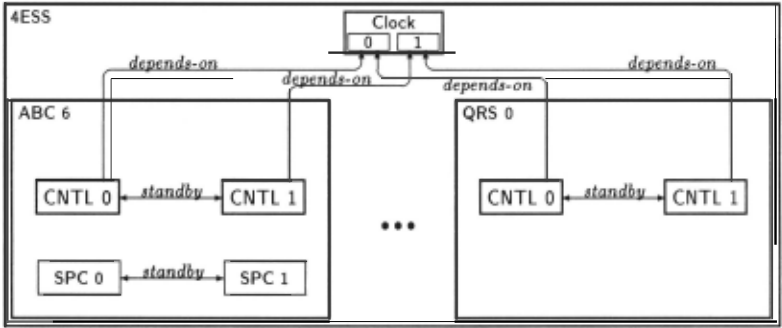
and produces output in the form of warning and action messages to field technicians. An expert system was orig inally developed for monitoring of the 4ESS switches in 1990. The system was designed as a conventional rule based system using an OPS5-compatible language. It contained several hundred heuristics gleaned from many interviews with domain experts. Three example heuristics are shown below. .
- IfF-level alarms are occurring concurrently for more than one component in a peripheral device, add the number of alarms together and threshold on the sum.
- If a type-ABC component is in normal mode, per form thresholding of alarms, but if it is in simplex mode, ignore thresholding and alert on any F-level alarms.
- If F-level alarms are occurring on different type ABC and QRS components, but all alarms are on the same controller number, then suspect the clock.
Device representation and reasoning with affective re lations allows us to replace such heuristics with diagnos tic rules that reason from our device model using first principles. For example, one such general principle is:
- Concurrent . alarms on multiple components of a larger device indicate a problem at the device level.
We capture this principle by using part-alarm to link alarms on components to any larger devices the compo nents are part of. We then threshold on the number of such links (looking for a device linked to a large num ber of alarms on different subparts). This subsumes the first heuristic rule above and is clearly both simpler and more general. For example, the new rule covers all types of alarms and all levels of nesting in the part-o:f hierar chy. Of course this reformulation is only possible because of the explicit representation of the immediate-part-of , part-o:f , and subpart relations between components. 4
We can also take advantage of the explicit encoding of standby. In the normal situation where a component is active and its standby is ready, alarms undergo thresh olding before an alert is issued. However, if the standby is out of service then any alarm should generate an im mediate alert . By making standby explicit in our model, and defining simplex in terms of this affective relation, the second heuristic rule above can be replaced with the following more general principle:
- If a device's standby is not functional, then alert on any alarm.
Again, note that the new rule covers all devices that have a standby, not just ABCs, and similarly covers all types of alarms.
4 Thresholds go up as one travels up the part-of hierarchy, e.g., many alarms on many components are necessary before concluding that there is a problem with the 4ESS.
Finally, a dependency-based rule of monitoring allows us to recognize the failure of a device from alarms on the device's dependents. For example, if Clock 0 in Fig ure 4 is failing , this may be indicated by alarms on the dependent components CNTL 0 in ABC 6 and CNTL 0 in QRS 0. By making depends-on explicit in our model , the third heuristic rule above (whose rationale for impli cating the clock is particularly obscure) can be replaced with the following more general principle:
- Concurrent alarms on multiple dependents of a device indicate a problem with that device.
This rule clarifies that diagnostic reasoning traces up a dependency chain to identify a common point of failure. Depends-on can also be exploited to propagate state in formation, as was shown in the fourth general relation ship of Figure 1.
2.3 A Detailed Example
The basic activity in the 4ESS expert system is the anal ysis of alarms. Alarm messages from the switch, in con junction with the semantics of the model, trigger the dynamic creation of the relevant portions of the device model. From this model general purpose diagnostic rules determine the root cause of the alarm.
At startup, the model of the 4ESS only contains a small set of core device types, associated instantiations, and immediate-part-of relations between the instanti ations. This is because in a complex device such as the 4ESS, we have found it to be prohibitively difficult to build up a complete device configuration in advance. In general, device types as well as the number and arrange ment of actual components vary among switching instal lations. Most devices and affective relations are thus dy namically created, in response to both the computation of the entailments of the model, as well as to the rule based processing of the alarms. For example, returning to the model of Figures 3 and 4, only 4ESS, Clock 0, Clock 1, and the two immediate-part-of relations relat ing the 4ESS and the clocks are initially asserted in the model.
An example of an alarm message from the switch is shown in the top portion of Figure 5. 5 The message as signs a unique identifier to the alarm, specifies the alarm type, and states that the alarm is occurring on the spec ified subunit of the specified unit of the 4ESS. That is, units link devices to the 4ESS as a component, while subunits link devices to units.
Processing of the alarm causes the device model to be updated as shown in the middle of Figure 5. Intuitively, a representation of the alarm is created and added to the model, the devices mentioned in the message are either found in the model or created and added to the model, and the alarm just created is related to the lowest level device mentioned in the alarm. In particular, the first assertion in the figure creates an instantiation alarm1 and declares it to be a member of the class Alarm. (Alarms also have an internal structure which is not shown, e.g., alarm1 has a slot "id" filled by "22257", etc.) The unit
5 We have simplified the alarm, to enhance the clarity of this section.
New Alarm:
id:22257; type:F-LEV; unit:ABC 6; subunit:A-CNTL 0
Assertions added to the device model:
Alarm(alarm1)
ABC(ABC 6)
immediate-part-of(ABC 6, 4ESS)
Controller(A-CNTL 0)
immediate-part-of(A-CNTL 0, ABC 6)
self-alarm(A-CNTL 0, alarm1)
Further implicit assertions:
part-of(ABC 6, 4ESS)
part-of(A-CNTL 0, ABC 6)
part-of(A-CNTL 0, 4ESS)
subpart(4ESS, ABC 6)
subpart(ABC 6, A-CNTL 0)
subpart(4ESS, A-CNTL 0)
part-alarm(ABC 6, alarm1)
part-alarm(4ESS, alarm1)
Figure 5: A simplified alarm message, and some device model additions.
and subunit devices referred to in the alarm message will also be added to the model, along with the corresponding configurational relations between the 4ESS and the unit, and between the unit and the subunit . Thus, device ABC 6 is instantiated, declared to be a member of the class ABC, and linked to the device 4ESS (already instantiated at startup) via immediate-part-of. Similar processing occurs for A-CNTL 0. Finally, a self-alarm assertion is added which relates A-CNTL 0, the device component that actually signaled the alarm, to alarml.
As at startup, the semantics of the model in conjunc tion with the immediate-part-of assertions will cause implicit part-of and subpart relations to be explicitly added to the model, as shown in the bottom of Fig ure 5. These assertions, in conjunction with the second general relationship in Figure 1, will in turn cause the assertions part-alarm (ABC 6, alarm1) and part-alarm ( 4ESS, alarm 1) to be added to the model. Thus, the alarm is propagated to other devices to which it is rele vant , by adding a part-alarm relation from any devices the alarming device is a component of, and the alarm. In this case it adds this relation between the two com ponents which have A-CNTL 0 as a subpart ( 4ESS and ABC 6), and A-CNTL O's alarm (alarm1). This captures the fact that a failure in 4ESS or in ABC 6 could have caused the alarm. At this point the computation of the implicit portions of the model is complete; initial pro cessing of the alarm has resulted in dynamic construc tion of a portion of the model shown in Figures 3 and 4, and incorporation of the alarm into the model. 6
6 Although not illustrated here, other relations in the model (e.g., depends-on, standby) can also be dynamically created. This is done by supplementing the general relation ships shown in Figure 1 with domain specific relationships, e.g., for all devices of type controller, the device depends-
Once our model is created, diagnostic rules of infer ence determine the root cause of the alarms by reason ing from the model. In particular, creation of the rela tions self-alarm, part-alarm, and dependent-alarm between devices and alarms trigger the diagnostic rules. For example, the following rule formalizes the first ex ample from Section 2.2 7 :
The rule is an example of a thresholding rule that de termines when a non-alarming component is not func tional, based on thresholding of the part-alarm rela tions in which it is involved. The domain specific relation part-threshold holds if there are a sufficient number of alarming devices that are components of the device x. When a threshold is met and a device asserted to be non-functional, a warning message can be sent to a technician.
Assume part-threshold is defined to be true when a device has at least two alarming components. The rule would thus not be satisfied for any device after the first alarm. If the switch then generated an alarm on another component of ABC 6, say self-alarm (SPC 0, alarm2), part-alarm (ABC 6, alarm2) would be among the newly entailed relations, and part-threshold (ABC 6, true) would now be satisfied. This would entail :functional (ABC 6, false), and an operator could be sent a warning message. Again, this example illustrates how our ap proach supports reasoning from the device model using general principles involving affective relations.
2.4 Status and Implementation
Our implemented reconstruction of the original heuris tic 4ESS alarm monitor includes a fairly simple ontology such as that shown in this paper , along with a small number of diagnostic rules about the 4ESS switch. This has already allowed us to achieve approximately 10% of the functionality of the original expert system. Further more, our implementation uses a much more principled and organized knowledge base with fewer rules. We are currently extending the functionality of our prototype, and it appears that our methodology will extend to the entire 4ESS monitoring problem.
The device model as well as the diagnostic rules of inference are implemented using R++ [Crawford et a/., 1994; ATT, 1995], an extension to C++ that supports forward chaining directly on C++ objects. The explicit encoding of the 4ESS device model is represented in a declarative , object-oriented manner using C++ objects corresponding to the physical devices and to the other basic classes in the ontology, and inter-object pointers corresponding to the affective and other relations be tween the classes. The entailments of the model, as well as the diagnostic rules of inference, are both rep resented using the rule construct of R++. R++ rules are
on the dock device having the same number. Thus, when an alarm causes a controller to be created, the appropriate depends-on assertion from the controller to a clock is entailed.
7 ln reality, a warning is sent and further evidence obtained before inferring non-functional.
if-then rules that are associated with C++ classes and that are inherited according to the C++ class hierarchy. Because the R++ rules are tightly integrated with the C++ object-oriented class mechanisms - which are used to define the explicit portion of the device model - it is natural to write rules that operate on the model. Fur thermore, because the condition of an R++ rule must traverse inter-object pointers, rules in fact must be writ ten using relations (such as affective relations) that are explicitly defined between classes. Finally, the associ ation of rules with classes allows subclasses to inherit rules as well as attributes from superclasses. This allows us to write rules for one type of device and have them inherit to all instances of that type.
3 Related Work
Work by Abu-Hanna et al. [Abu-Hanna et al., 1991] ar gues that functional models are generally easier to obtain than behavioral models; furthermore, by representing design intent, functional models help identify relevant suspected causes of a symptom and are thus attractive for the suspect generation task. The need to represent diagnostically useful models at a level that is easy to ob tain is also a conclusion drawn in our work. However, our affective relations do not encode purpose or intent (ex cept perhaps at a very high level), and are thus at even a more abstract level of representation than the func tional models of Abu-Hanna et al. Abbott 's work on operative diagnosis [Abbott , 1990] is also similar to ours in that her model includes a directed graph of "paths of propagation" to relate symptoms to suspects. Ab bott's paths indicate only that one component may af fect another, so they are the most abstract kind of affec tive relation. Our 4ESS switch monitoring example uses more detailed relations because they were readily avail able from 4ESS technicians , enabling more focused di agnosis. Work from the uncertain reasoning community on Bayesian networks [Heckerman and Wellman, 1995] annotated directed graphs that encode probabilistic re lationships - can also be viewed as a modeling language for representing a kind of affective relation (often viewed as cause/effect). Because our work inputs information about a device, organizes and processes this information under an existing taxonomy of knowledge about related devices, and uses an existing taxonomy of knowledge to control the generation of a diagnosis, our work also fits within Clancey's general framework of heuristic classifi cation [Clancey, 1985].
Although it has not been the focus of this paper, our work also seeks to bring some of the benefits of object-oriented modeling to bear on the task of build ing expert systems. The object-oriented basis of R++ has proven critical to our success in implementing our approach as it provides for both a taxonomy of classes to directly represent abstractions in the domain and a tight integration of rules with these abstractions, thus allowing us to write rules to do diagnosis within the model. There are several other attempts to integrate object-oriented and rule-based reasoning [Albert , 1994; Hal, 1993; Miranker et al., 1993] that could be used to provide some of the same benefits as R++ does.
4 Conclusions
Device representation and reasoning with affective re lations provides a middle ground between model-based reasoning and heuristic expert systems, for monitoring and diagnosing complex devices that are largely self checking. While model-based diagnosis would seem to be well suited for such tasks, in practice the models of traditional approaches are often too difficult to obtain (e.g., due to system complexity, inadequate documen tation, lack of an appropriate representation language) . This has often led developers to rely on heuristic expert systems, which themselves have many well-known limita tions. By providing an abstract level of device modeling based on a set of diagnostically motivated and easy to acquire affective relations, our work brings the advances of model-based reasoning to domains in which the de velopment of traditional models is difficult. These ad vances include: (1) a unifying framework for knowledge and diagnosis based on general principles, (2) a useful tool for focusing knowledge capture (our models seem to correspond well with an expert's knowledge and can be visually displayed (as in Figure 4)), and (3) a more methodical coverage of the domain. Our work at the symbol level also brings to expert systems the benefits of relatively recent advances in object-oriented knowledge representation - principally the use of objects to orga nize knowledge, and a tight integration of objects within the rule-based paradigm.
For the longer term, a further objective of our work is the development of a shared ontology similar to that of Figure 1, but which can be used to monitor and diagnose many different kinds of devices. A key question is the extent to which general principles of causality and di agnosis apply across different kinds of devices, e.g., how far should symptoms be propagated up the part-of hi erarchy? We would also like to model systems that are not necessarily self-checking, as the basic point of our approach should still apply (i.e. , when designing a rep resentation, don't reason at a finer level than required).
A driving force behind our work has been to develop a pragmatic solution, one that balances the fact that developers of commercial systems have only limited re sources to invest, but that they also have a desire to obtain the benefits found in "ideal" approaches. In the end the essential contribution of device representation and reasoning with affective relations is the identifica tion of a particularly useful level of abstraction for mod eling complex devices - represent the affective relation ships between components that are used by experts when reasoning about the device. This level of abstraction is high enough that large and complex devices can be rep resented but still detailed enough to allow effective mon itoring. The use of such models brings the advantages of model-based reasoning to domains previously handled only with heuristic methods.
Acknowledgments
We would like to thank our management, especially R. Brachman, R. Dube, P. Warty, and M. Wish, for their support of this project . We would also like to thank S.
Carrel for the implementation of many of these ideas us ing R ++, D. Etherington for comments on an earlier draft of this paper, and B. Kuipers for helpful discussions.
@inproceedings{ijcai1995p233,
  title     = {Device Representation and Reasoning with Affective Relations},
  author    = {Crawford, James M. and Dvorak, Daniel and Litman, Diane J. and Mishra, Anil and Patel-Schneider, Peter F.},
  booktitle = {Proceedings of the Fourteenth International Joint Conference on
               Artificial Intelligence, {IJCAI-95}},
  publisher = {International Joint Conferences on Artificial Intelligence},
  editor    = {Chris S. Mellish},
  pages     = {1814--1819},
  year      = {1995},
  note      = {Qualitative Reasoning and Diagnosis},
  url       = {https://ijcai.org/proceedings/1995/233},
}
TY - CPAPER TI - Device Representation and Reasoning with Affective Relations AU - Crawford, James M. AU - Dvorak, Daniel AU - Litman, Diane J. AU - Mishra, Anil AU - Patel-Schneider, Peter F. T2 - Proceedings of the Fourteenth International Joint Conference on Artificial Intelligence, IJCAI-95 PB - International Joint Conferences on Artificial Intelligence PY - 1995 SP - 1814 EP - 1819 UR - https://ijcai.org/proceedings/1995/233 ER -Copied
Machine-readable versions of this paper, for tools and AI agents:





