
Filling Knowledge Gaps in a Broad-Coverage Machine Translation System
Proceedings of the Fourteenth International Joint Conference on Artificial Intelligence. Natural Language. Pages 1390-1396.
© 1995 International Joint Conferences on Artificial Intelligence
Abstract
Knowledge-based machine translation (KBMT) techniques yield high quality in domains with detailed semantic models, limited vocabulary, and controlled input grammar. Scaling up along these dimensions means acquiring large knowledge resources. It also means behaving reasonably when definitive knowledge is not yet available. This paper describes how we can fill various KBMT knowledge gaps, often using robust statistical techniques. We describe quantitative and qualitative results from JAPANGLOSS, a broad-coverage JapaneseEnglish MT system.
- [Brown et al., 1993] P. F. Brown, S. A. Della-Pietra, V. J. Della-Pietra, and R. L. Mercer. The mathe- matics of statistical machine translation: Parameter estimation. Computational Linguistics, 19(2), June 1993.
- [Carlson and Nirenburg, 1990] L. Carlson and S. Niren- burg. World modeling for NLP . Technical Report CMU-CMT-90-121, Center for Machine Translation, Carnegie Mellon University, 1990.
- [Chow and Schwartz, 1989] Y. Chow and R. Schwartz. The N-Best algorithm: An efficient search proce- dure for finding top N sentence hypotheses. In Proc. DARPA Speech and Natural Language Work- shop, pages 199-202, 1989.
- K. W. Church and W. A. Gale. A comparison of the enhanced Good-Thring and deleted estimation methods for estimating probabil- ities of English bigrams. Computer Speech and Lan- guage, 5:19-54, 1991.
- [Elhadad, 1993] M. Elhadad. FUF: The universal unifier-user manual, version 5.2. Technical Report CUCS-038-91, Columbia University, 1993.
- [Hatzivassiloglou and Knight, 1995] V. Hatzivassiloglou and K. Knight. Unification-based glossing. In Proc. IJCAI, 1995. IJCAI
- [Knight and Chander, 1994] K. Knight and I. Chander. Automated postediting of documents. In Proc. AAAI, 1994.
- [Knight and Hatzivassiloglou, 1995] K. Knight and V. Hatzivassiloglou. Two-level, many-paths genera- tion. In Proc. ACL, 1995.
- [Knight and Luk, 1994] K. Knight and S. K. Luk. Build- ing a large-scale knowledge base for machine transla- tion. In Proc. AAAI, 1994.
- [Knight et al., 1994] K. Knight, I. Chander, M. Haines, V. Hatzivassiloglou, E. Hovy, M. Iida, S. K. Luk, A. Okumura, R. Whitney, and K. Yamada. Integrat- ing knowledge bases and statistics in MT. In Proc. Conference of the Association for Machine Transla- tion in the Americas ( AMTA), 1994.
- [Lavie, 1994] A. Lavie. An integrated heuristic scheme for partial parse evaluation. In Proc. A CL (student session), 1994.
- [Nirenburg and Frederking, 1994] S. Nirenburg and R. Frederking. Toward multi-engine machine trans- lation. In Proc. ARPA Human Language Technology Workshop, 1994.
- [Nirenburg et al., 1992] S. Nirenburg, J. Carbonell, M. Tomita, and K. Goodman. Machine Translation: A Knowledge-Based Approach. Morgan Kaufmann, San Mateo, Calif., 1992.
- [NMSU/CRL et al., 1995] NMSU/CRL, CMU/CMT, and USC/lSI. The Pan- gloss Mark III machine translation system. Techni- cal Report CMU-CMT-95-145, Carnegie Mellon Uni- versity, 1995. Jointly issued by Computing Research Laboratory (New Mexico State University), Center for Machine Translation (Carnegie Mellon University), Information Sciences Institute (University of Southern California). Edited by S. Nirenburg. 1396 NATURAL LANGUAGE [Nyberg and Mitamura, 1992] E. Nyberg and T. Mita- mura. The KANT system: Fast, accurate, high- quality translation in practical domains. In Proc. COLING, 1992.
- [Okumura and Hovy, 1994] A. Okumura and E. Hovy. Ontology concept association using a bilingual dictio- nary. In Proc. of the ARPA Human Language Tech- nology Workshop, 1994.
- [Penman, 1989] Penman. The Penman documentation. Technical report, USC/Information Sciences Institute, 1989.
- [Pereira and Grosz, 1993] F . C . N. Pereira and B. J . Grosz. Introduction. Artificial Intelligence, Special Volume on Natural Language Processing, 63(1-2), Oc- tober 1993.
- [Smadja and McKeown, 1991] F . Smadja and K. R. McKeown. Using collocations for language generation. Computational Intelligence, 7( 4), December 1991.
- [Tomita and Nyberg, 1988] M. Tomita and E. Nyberg. The GenKit and Transformation Kit User's Guide. Technical Report CMU-CMT-88-MEMO, Center for Machine Translation, Carnegie Mellon University, 1988.
- [White and O'Connell, 1994] J. White and T. O'Connell. Evaluation in the ARPA machine translation program: 1993 methodology. In Proc. ARPA Human Language Technology Workshop, 1994.
- [Wilks, 1975] Y. A. Wilks. Preference semantics. In E. L. Keenan, editor, Formal Semantics of Natural Language. Cambridge University Press, Cambridge, UK, 1975.
- [Yamron et al., 1994] J . Yamron, J . Cant, A. Demedts, T. Dietzel, andY. Ito. The automatic component of the LINGSTAT machine-aided translation system. In Proc. ARPA Workshop on Human Language Technol- ogy, 1994.
References were extracted automatically from the PDF and may contain errors.
Full text extracted automatically from the PDF; figures, tables and equations may differ. The PDF is the version of record.
1 Introduction
Knowledge-based machine translation {KBMT) tech niques have led to high quality MT systems in circum scribed problem domains [Nirenburg et a/., 1992] with limited vocabulary and controlled input grammar [Ny berg and Mitamura, 1992]. This high quality is delivered by algorithms and resources that permit some access to the meaning of texts. But can KBMT be scaled up to unrestricted newspaper articles? We believe it can, pro vided we address two additional questions:
- In constructing a KBMT system, how can we ac quire knowledge resources {lexical, grammatical, conceptual) on a large scale?
- In applying a KBMT system, what do we do when definitive knowledge is missing?
There are many approaches to these questions. Our working hypotheses are that {1) a great deal of useful knowledge can be extracted from online dictionaries and text; and {2) statistical methods, properly integrated, can effectively fill knowledge gaps until better knowledge bases or linguistic theories arrive.
When definitive knowledge is missing in a KBMT sys tem, we call this a knowledge gap. A knowledge gap may be an unknown word, a missing grammar rule, a missing piece of world knowledge, etc. A system can be designed to respond to knowledge gaps in any number of ways. It may signal an error. It may make a default or random decision. It may appeal to a human operator. It may give up and turn over processing to a simpler, more robust MT program. Our strategy is to use pro grams (sometimes statistical ones) that can operate on more readily available data and effectively address par ticular classes of KBMT knowledge gaps. This gives us robust throughput and better quality than that of de fault decisions. It also gives us a platform on which to build and test knowledge bases that will produce further improvements in quality.
*This work was supported in part by the Advanced Re search Projects Agency (Order 8073, Contract MDA904-91C-5224) and by the Department of Defense. Vasileios Hatzi vassiloglou's address is: Department of Computer Science, Columbia University, New York, NY 10027. All authors can be reached at lastname@isi.edu.
Our research is driven in large part by the practi cal problems we encountered while constructing JAPAN GLOSS, a Japanese-English newspaper MT system built at USC/lSI. JAPANGLOSS is a year-old effort within the PANGLOSS MT project [Nirenburg and Frederking, 1994; NMSU /CRL et a/., 1995), and it participated in the most recent ARPA evaluation of MT quality [White and O'Connell, 1994].
2 System Overview
This section gives a brief tour of the JAPANGLOSS sys tem. Later sections address questions of knowledge gaps on a module-by-module basis.
Our design philosophy has been to chart a middle course between "know-nothing" statistical MT [Brown et a/., 1993] and what might be called "know-it-all" knowledge-based MT [Nirenburg eta/., 1992]. Our goal has been to produce an MT system that "knows some thing" and has a place for each piece of new knowl edge, whether it be lexical, grammatical, or conceptua.l. The system is always running, and as more knowledge IS added, performance improves.
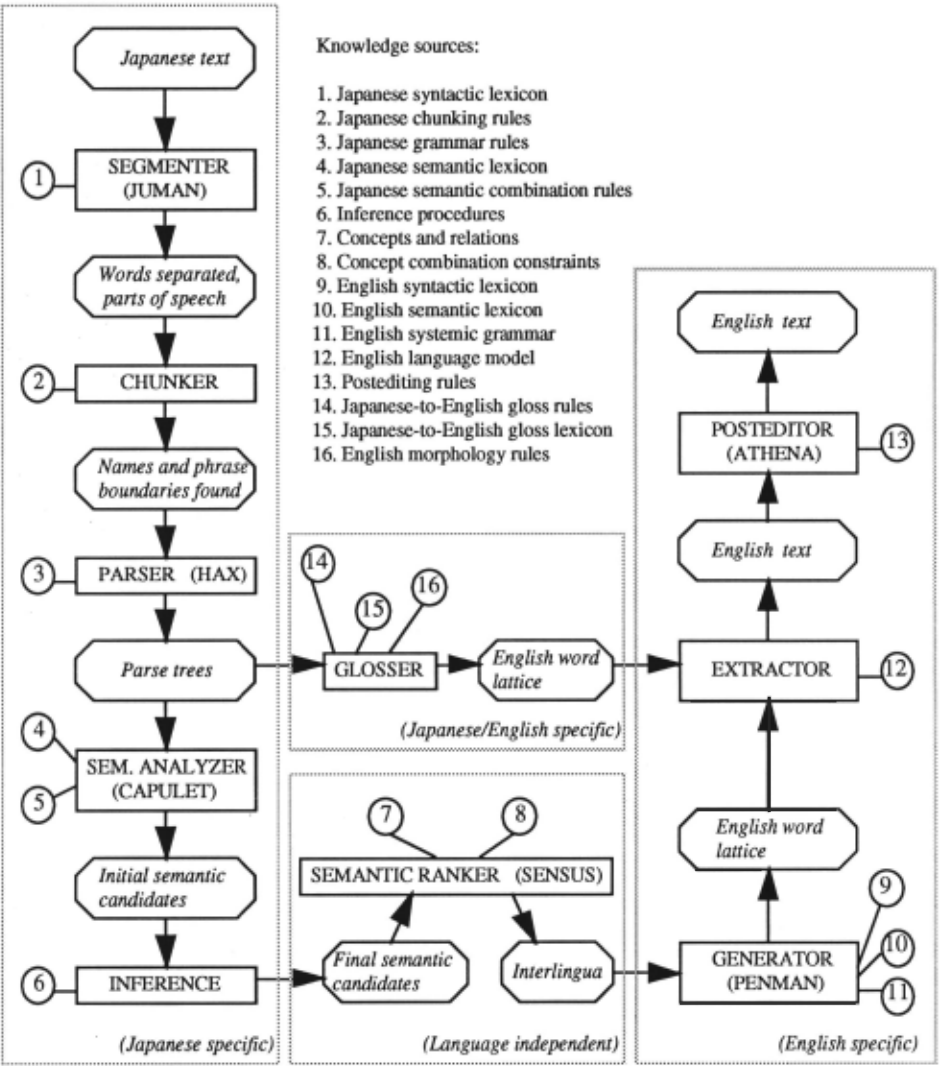
Figure 1 shows the modules and knowledge resources of our current translator. With the exceptions of JU MAN and PENMAN, all were constructed new for JAPANGLOSS. The system includes components typ ical of many KBMT systems: a syntactic parser driven by a feature-based augmented context-free grammar, a semantic analyzer that turns parse trees into candidate interlinguas, a semantic ranker that prunes away mean ingless interpretations, and a flexible generator for ren-
~ ....................................................................... ·:
dering interlingua expressions into English.
Because written Japanese has no inter-word spacing, we added a word segmenter. We also added a pre parsing ( chunking) module that performs several tasks: (1) dictionary-based word chunking, (2) recognition of personal, corporate, and place names, (3) number/date recognition, and ( 4) phrase chunking. This last type of chunking inserts new strings into the input sentence, such as BEGIN-liP and END-NP. The syntactic grammar is written to take advantage of these barriers, prohibit ing the combination of partial constituents across phrase boundaries. VP and S chunking allow us to process the very long sentences characteristic of newspaper text, and to reduce the number of syntactic analyses. We also em ploy a limited inference module between semantic anal ysis and ranking. One of the tasks of this module is to take topic-marked entities and insert them into particu lar semantic roles.
The processing modules are themselves independent of particular natural languages-they are driven by language-specific knowledge bases. The interlingua ex pressions are also language independent . In theory, it should be possible to translate interlingua to and from any natural language. In practice, our interlingua is sometimes close to the languages we are translating. Here is an example interlingua expression produced by our system:
(h-709 I HAVE-AS-A-GOAL :SEISER (c-710 I COMPANY-BUSINESS :Q-MOD (n-711 I NEW-VIRGIN)) :PHENOMENON (f-712 I FOUND-LAUNCH :TEMPORAL-LOCATING :THEME c-710) (c-713 I CALENDAR-MONTH :MONTH-INDEX 2) :AGENT c-710)The source for this expression was a Japanese sentence whose literal translation is something like: as for new company, there is plan to establish in February.
The tokens of the expression are drawn from our con ceptual knowledge base (or ontology), called SENSUS. SENSUS is a knowledge base skeleton of about 70,000 concepts and relations; see [Knight and Luk, 1994] for a description of how we created it from online resources. Note that the interlingua expression above includes a syntactic relation Q-MOD ("quality-modification"). While our goal is to replace such relations with real semantic ones, we realize that semantic analysis of adjectives and nominal compounds is an extremely difficult problem, and so we are willing to pay a performance penalty in the near term.
In addition to SENSUS, we have large syntactic lexi cal resources for Japanese and English (roughly 100,000 stems for each), a large grammar of English inherited from the PENMAN generation system [Penman, 1989], a large semantic lexicon associating English words with any given SENSUS concept, and hand-built chunking and syntax rules for the analysis of Japanese. Sample rules can be found in [Knight et a/., 1994].
We have not achieved high throughput in our semantic analyzer, primarily because we have not yet completed a large-scale Japanese semantic lexicon, i.e., mapped tens of thousands of common Japanese words onto conceptual expressions. For progress on our manual and automatic attacks on this problem, see [Okumura and Hovy, 1994] and [Knight and Luk, 1994]. So we have encountered our first knowledge gap-what to do when a sentence produces no semantic interpretations? Other gaps in clude incomplete dictionaries, incomplete grammar, in complete target lexical specifications, and incomplete in ter lingual representations.
3 Incomplete Semantic Throughput
While semantic resources are under construction, we want to be able to test our other modules in an end to-end setting, so we have built a shorter path from Japanese to English called the glossing path.
We made very minor changes to the semantic inter preter and rechristened it the glosser. Like the inter preter, the glosser also performs a bottom-up tree walk of the syntactic parse, assigning feature structures to each node. But instead of semantic feature structures, it assigns glo.sses, which are potential English translations encoded as feature structures. A sample gloss looks like this:
((GLOSS ((OP1 ((OP1 (·OR· "a" "an" "the" "·empty·")) (OP2 "national police agency") (OP3 (·OR· "+plural" "·empty·")))) (OP2 ((OP1 ( (OP1 (·OR· "a" "an" "the" "·empty·")) (OP2 (·OR· "plan" "objective")) (OP3 (·OR· "+plural" "·empty·")))) (OP2 "of") (OP3 ( (OP1 (·OR· "a" "an" "the" "·empty·")) (OP2 ((OP1 ((OPl ((OP1 "gun") (OP2 (·OR· "engraving tool" "knife" "saber" "sword")))) (OP2 (·OR· "mood" "divisor" "doctrine" "process" "way" "method" "rule" "law")))) (OP2 (·OR· "alteration" "amendment")))) (OP3 (·OR· "+plural" "·empty·")))))))))In this structure, the OP1, OP2, etc. features represent sequentially ordered portions of the gloss. All syntactic and glossing ambiguities are maintained in disjunctive ( ·OR*) feature expressions.
We built three new knowledge resources for the glosser: a bilingual dictionary (to assign glosses to leaves), a gloss grammar (to assign glosses to higher con stituents, keying off syntactic structure) , and an English morphological dictionary.
The output of the glosser is a large English word lat tice, stored as a state transition network. The typical network produced from a twenty-word input sentence has 100 states, 300 transitions, and billions of paths. Any path through the network is a potential English translation, but some are clearly more reasonable than others. Again we have a knowledge gap, because we do not know which path to choose.
Fortunately, we can draw on the experience of speech recognition and statistical NLP to fill this gap. We built a language model for the English language by estimating bigram and trigram probabilities from a large collection of 46 million words of Wall Street Journal materiaJ.l We smoothed these estimates according to class mem bership for proper names and numbers, and according to an extended version ofthe enhanced Good- Turing method [Church and Gale, 1991] for the remaining words. The resulting tables of conditional probabilities guide a sta tistical extractor, which applies a version of the N-best beam search algorithm [Chow and Schwartz, 1989] to identify an ordered set of "best" paths in the word lat tice (i.e., the set of English sentences that are most likely according to our model). Due to heavy computational and memory requirements, we have not yet completed the trigram version of our model. But even when only bigrams are used, comparing the statistical extractor to random path extraction reveals the power of statistics to make reasonable decisions, e.g.:
(random extractor) " ... planned economy ages is threadbare ... " (bigram extractor) " ... planned economy times are old ... "The statistical model of English gives us much better glosses. A full description of our glossing system, includ ing our use of feature unification, appears in [Hatzivas siloglou and Knight, 1995]. Interestingly, we originally built the statistical model to address knowledge gaps in generating English from interlingua, not glossing. We return to these gaps (and the statistical model) in Sec tion 8.
4 Incomplete Dictionaries
Lexical incompleteness causes problems for both seman tics and glossing. Numbers and dates are typical un known words; we take a finite-state approach to recog nizing and translating these. Another important class of unknown words comprises katakana loanwords and for eign proper names, which are represented in Japanese with approximate phonetic transliterations. For exam ple, kurinton should be translated as Clinton, and sutep paa mootaa as stepper motor. The knowledge-based ap proach is to pack our dictionaries with every possible name and technical term, but this approach quickly leads to diminished returns. To plug the rest of the gap, we have again applied statistical techniques, this time to English spelling. Given a Japanese transliteration like kurinton, we seek an English-looking word likely to have been the source of the transliteration. "English-looking" is defined in terms of common four-letter sequences. To produce candidates, we use another statistical model for katakana translations, computed from an automatically aligned database of 3,000 katakana-English pairs. This model tells us that Japanese ku is sometimes a translit eration of English c (especially at the beginning of a word), sometimes of ck {especially at the end), some times of cu, etc., with associated probabilities. Another extractor program delivers a reasonable transliteration, for example, preferring Clinton over Kuleentn.
1 Available from the ACL Data Collection Initiative, CD ROM 1.
5 Incomplete Grammatical Analysis
Unlike spoken language, newspaper text is generally grammatical. However, it is frequently ungrammatical with respect to our knowledge resources at any given time. Newspaper sentences are very long, and every new text contains some unusual syntactic construction that we have not yet captured in our formal grammar. We also encounter problems with non-standard punctuation as well as wrong segmentation, part-of-speech tagging, and phrase chunking. For these reasons, we made an early decision to do all parsing, semantic interpretation, and glossing in a bottom-up fashion, dealing indepen dently with sentence fragments when need be. But be cause Japanese and English word orders are so different, a fragmentary parse usually leads to a bad translation.
One method of overcoming these difficulties is to en sure a full parse with statistical context-free parsing. Low probability rules like ADV ~ ADJ guarantee that a full parse will be returned [Yamron et a/., 1994]. We avoided this technique because we wanted to keep our feature-based grammar, in order to have fine-tuned con trol over the structures we accept and assign. Inspired by [Lavie, 1994], we turned to word skipping as a gram matical gap-plugger. This approach seeks out the largest grammatical subset of words in a sentence, with the hope that the skipped words are peripheral to the core mean ing of the sentence {or perhaps simply stray punctuation marks). Rather than port the LR-parsing-based tech niques of [Lavie, 1994] to our bottom-up chart parser, we developed heuristic techniques for spotting suspicious words and dropping them. Our most general method is to automatically process large sets of parsed and un parsed sentences, looking for statistical differences be tween the two sets. For example, if a part-of-speech hi gram appears frequently in unparsed sentences, this is a clue that one of the two words (or both) should be dropped. We also use grammar-specific heuristics such as: don't drop a single noun from a noun sequence, drop phrasal boundaries only in pairs (and only when the internal material is completely parsed), etc. Skipping raises our full-parse rate from 40% to 90%.
6 Incomplete Semantic Constraints
This section and the next return to incompleteness in semantics. KBMT systems usually model world knowl edge as a collection of "hard" constraints that any interlingua must satisfy. Unsatisfactory semantic candi dates are pruned away, leaving a single sensible interpre tation. In many cases, however, semantic constraints are too strong, and all interpretations are ruled out. Preference semantics [Wilks, 1975] was devised to han dle just this problem. Within the KBMT tradition, role restrictions can be augmented with relaxable-to state ments [Carlson and Nirenburg, 1990], as in: the agent of a say-event must be a person, or relaxable-to an organization.
Our approach has been to further soften the impact of semantic constraints. We assign a score (between 0 and 1) to any in terlingua fragment, as follows. We first extract all stated relations between entities. To each relation, we assign scores based on domain constraints and range constraints in the conceptual knowledge base. There are five possible heuristic scores, depending on the suitability of the role filler: satisfies basic constraint (1.0); satisfies relaxed constraint, but is not mutually disjoint from concepts satisfying basic constraint (0.8); satisfies relaxed constraint but is mutually disjoint from basic constraint (0.25); satisfies neither basic nor relaxed constraint (0.05); is mutually disjoint from concepts sat isfying basic or relaxed constraint (0.01). Scores for all of the relations are multiplied to yield an overall score. No interlingua expression is ever assigned a zero score.
This approach is like language modeling, but here the basic unit is the relational/conceptual n-gram (e.g., <eat, patient, worm>) rather than the word n-gram. And our scoring is based on hand-built inherited con straints rather than data. Still, we can view the con ceptual knowledge base as a device that assigns a pri ori probabilities to interlingua fragments, in analogy to how our language model assigns probabilities to English strings.
This analogy makes it possible to describe KBMT in a statistical framework. Direct statistical MT systems [Brown et al., 1993] use a noisy channel model in which a human is assumed to be speaking English, but the signal is corrupted, and out comes Japanese. Bayes' Theorem is used to retrieve the original, uncorrupted signal:
That is, the best English translation is the sentence E that maximizes the a priori probability of E times the probability that if E were the original signal, it would have been corrupted into the Japanese sentence J. Esti mating the probability distributions P(E) and P(J I E) allows us to rank translations.
A noisy channel model of KBMT adopts a different model of a human, one in which he hears English, but by the time it gets into his head, it has been corrupted into Interlingua. When he speaks, the Interlingua signal is further corrupted into Japanese. We can model this process statistically as:
Now there are four probability distributions to esti mate, one of which is P(I), exactly the a priori proba bility of an Interlingua expression described above.
While the full statistical model of KBMT is not used in JAPANGLOSS, it is useful to view what we do (and don't do) in this light. For example, P(I I E) sug gests a model of English generation that explicitly shies away from ambiguous E's, because they spread prob abilities thinly across several l's. For example, if i is RE'NT-TO(SPEAKER,HOUSE, ?) , it is better to say I'm rent ing my house to someone rather than the correct but ambiguous I'm renting my house. Most language gener ation systems focus on accurate renditions rather than unambiguous ones, although as Pereira and Grosz [1993, p. 12] remark, this is changing:
"The coextensiveness of natural language per ceivers and producers both enables and requires the language generator to reason about the generated language in reflective terms: 'how would I react if I heard what I am about to say?' This reflective as pect of language generation is essential at all levels of generation ... "
7 Incomplete Interlingua Expressions
Even with full semantic throughput and accurate rank ing of in terlingua candidates, a full account of text mean ing is beyond the state of the art. It is easy to record verb tenses, but difficult to make the inferences required to lay out stated (and unstated) events on a time line. If the source language is Japanese, we have additional prob lems: no articles (a, an, the), no overt singular or plural marks, no agreement constraints, omitted subjects, no marked future tense, and so on. In KBMT, we need some semantic representation of these things in order to generate languages like English. This leads researchers to envision microtheories [NMSU /CRL et al., 1995] of time, space, reference, and so on. Many such microthe ories are not yet available, however, so we have another knowledge gap to fill.
We can focus on the problem of definite and indef inite reference, which manifests itself as article selec tion (a, an, the) in Japanese-English MT. Rather than handle this problem during semantics, we postpone the solution-not only until English generation, but un til after generation, in an automatic postediting step. Our posteditor inserts articles into article-free English text lKnight and Chander, 1994]. It was trained on 80 megabytes of English and performs with an accuracy of 81%. The training was done with decision trees rather than n-grams, so that we could flexibly integrate long distance features that typically control the selection of articles. Human posteditors can achieve 96%, so we still have more features to explore. Viewing article selection as a postediting step (independent of the Japanese source text) means that we can attack the problem statistically without the need for a large parallel corpus of Japanese and English. Our automatic posteditor has applications outside of MT, such as improving English text written by native Japanese speakers (or Chinese, Russian, etc.).
8 Incompleteness in Generation
We have encountered several classes of knowledge gaps in large-scale generation. Large-scale in our case means roughly 70,000 concepts/relations and 91,000 roots/phrases. First, we must anticipate incomplete ness in the input specification, as described in the last section. Second, lexical syntactic specification may be incomplete-does verb V take a nominal direct object or an infinitival complement? Third, collocations may be missing. Knowledge of collocations has been success fully used in the past to increase the fluency of generated text [Smadja and McKeown, 1991]. In particular, such knowledge can be crucial for selecting prepositions (on the field versus in the end zone) and other forms. And fourth, dictionaries may not mark rare words and gen erally may not distinguish between near-synonyms. We constantly strive to augment our knowledge bases and lexicons to improve generation, but we also want to plug the gap with something reasonable.
Our approach is one of bottom-up many-paths gen eration [Knight and Hatzivassiloglou, 1995], in analogy to bottom-up all-paths parsing. If the generator can not make an informed decision (lexical selection, comple ment type, spatial preposition, etc.), it pursues all pos sibilities. This is in contrast to many industrial-strength generators [Tomita and Nyberg, 1988; Penman, 1989] that never backtrack and usually default their difficult choices. Other generators [Elhadad, 1993] do backtrack but still use default or random schemes for making new selections.
Our generator packs all paths into efficient word lat tices as it goes, and the final output is also a word lattice. Because the generator produces the same data structure as the glosser, we can select a final output us ing the same extractor and language model described in Section 3. This approach combines the strengths of knowledge-based generation (e.g., generally grammati cal lattice paths, long-distance agreement, parallel con joined expressions) with statistical modeling (e.g., lo cal dependencies, lexical const.raints, common words and collocations) . As in Section 3, we can compare random path extraction with n-gram extraction:
(random extractor) "The nev companies vill have as a purpose launching at February." (bigram extractor) "The nev company plans to establish in February." (random extractor) "A subsidiary of the Perkin Elmer Co. on the Japan bears majority of the stock." (bigram extractor) "A subsidiary of Perkin Elmer Co. in Japan bears a majority of the stock."As the generator becomes more knowledgeable, its output lattices become leaner, and dependence on auto matic statistical selection is reduced. However, the sta tistical component is still useful as long as uncertainty remains, and improvements in language modeling will continue to have a big effect on overall performance.
9 Conclusion
We have reported progress on aspects of the JAPAN GLOSS newspaper MT system. In particular, we have described the integration of statistical and heuristic methods into a KBMT system. While these methods are not a panacea, they offer a way to fill knowledge gaps until better knowledge bases become available. Further more, they offer a way of rationally prioritizing manual tasks: if a statistical method solves your problem 90% of the time, you may not want to invest in a knowl edge base. In other cases, statistics may offer only a small benefit over random or default choices; then, a more careful analysis is c_alled for.
Acknowledgments
We would like to thank Yolanda Gil and the IJCAI re viewers for helpful comments on a draft of this paper.
A JAPANGLOSS MT Output
A.l Interlingua-Based Sample
Citizen Watch announced on the eighteenth to establish a joint venture vith Perkin Elmer Co., a major microcircuit manufacturing device manufacturer, and to start the production of the microcircuit manufacturing device.
The nev company plans a launching in February.
The subsidiary of Perkin Elmer Co. in Japan bears a majority of the stock, and the production of the dry etching device that is used for the manufacturing of the microcircuit chip and the stepper is planned.
A.2 Glosser-Based Sample
The "gun possession" penalties important--national police agency plans of gun sword legal reform.
The national police agency defend policies that change some of gun sword lav that put the brakes on the proliferation of the 31st gun. Change plans control recovery plan of the wrong owning step currency--make the decision by the cabinet meeting of the middle of this month in three pieces support estimate of the filing in this parliament.
@inproceedings{ijcai1995p179,
  title     = {Filling Knowledge Gaps in a Broad-Coverage Machine Translation System},
  author    = {Knight, Kevin and Chander, Ishwar and Haines, Matthew and Hatzivassiloglou, Vasileios and Hovy, Eduard H. and Iida, Masayo and Luk, Steve K. and Whitney, Richard and Yamada, Kenji},
  booktitle = {Proceedings of the Fourteenth International Joint Conference on
               Artificial Intelligence, {IJCAI-95}},
  publisher = {International Joint Conferences on Artificial Intelligence},
  editor    = {Chris S. Mellish},
  pages     = {1390--1396},
  year      = {1995},
  note      = {Natural Language},
  url       = {https://ijcai.org/proceedings/1995/179},
}
TY - CPAPER TI - Filling Knowledge Gaps in a Broad-Coverage Machine Translation System AU - Knight, Kevin AU - Chander, Ishwar AU - Haines, Matthew AU - Hatzivassiloglou, Vasileios AU - Hovy, Eduard H. AU - Iida, Masayo AU - Luk, Steve K. AU - Whitney, Richard AU - Yamada, Kenji T2 - Proceedings of the Fourteenth International Joint Conference on Artificial Intelligence, IJCAI-95 PB - International Joint Conferences on Artificial Intelligence PY - 1995 SP - 1390 EP - 1396 UR - https://ijcai.org/proceedings/1995/179 ER -Copied
Machine-readable versions of this paper, for tools and AI agents:





