
Unification-Based Glossing
Proceedings of the Fourteenth International Joint Conference on Artificial Intelligence. Natural Language. Pages 1382-1388.
© 1995 International Joint Conferences on Artificial Intelligence
Abstract
We present an approach to syntax-based machine translation that combines unification-style interpretation with statistical processing. This approach enables us to translat e any Japan ese newspaper article into English, with quality far better than a word-for-word translation. Novel ideas include the use of feature structures to encode word lattic es and the use of unifi cati on to co mpos e and manipulat e lattices . Unification also allows us to specify abstract features that delay target-language synthesis until enough source-language information is assembled. Our statistical component enables us to search efficiently among competing translations and locate those with high English flu ency.
- [Bah! et a/., 1983] L. R . Bah!, F. Jelinek, and R . L. Mer- cer. A maximum likelihood approach to continuous speech recognition. IEEE Transactions on Pattern Analysis and Machine Intelligence PAM!, 5(2) , 1983.
- [Brown et a/., 1993] P. F . Brown , S. A. Della-Pietra, V. J . Della-Pietra, and R. L. Mercer. The mathe- matics of statistical machine translation: Parameter estimation. Computational Linguistics, 19(2) , June 1993.
- [Chow and Schwartz, 1989] Y. Chow and R . Schwartz. The N-Best algorithm: An efficient search proce- dure for finding top N sentence hypotheses. In Proc. DARPA Speech and Natural Language Work- shop, pages 199-202, 1989.
- K. W. Church and W. A. Gale. A comparison of the enhanced Good-Turing and deleted estimation methods for estimating probabil- ities of English bigrams. Computer Speech and Lan- guage, 5, 1991.
- [Dowty et a/. , 1981] D. R . Dowty, R. Wall, and S. Pe- ters. Introduction to Montague Semantics. Reidel, Dordrecht, 1981.
- [Good, 1953] I. J . Good. The population frequencies of species and the estimation of population parameters. Biometrika, 40 , 1953.
- [Jelinek and Mercer, 1980] F. Jelinek and R. L. Mercer. Interpolated estimation of Markov source parameters from sparse data. In Pattern Recognition in Practice. North-Holland , Amsterdam, 1980.
- [Jelinek eta/., 1975] F. Jelinek, L. R . Bah!, and R. L. Mercer. Design of a linguistic statistical decoder for the recognition of continuous speech. IEEE Transac- tions on Information Theory, 21(3), 1975.
- [Kaplan and Bresnan , 1982] R.M. Kaplan and J. Bres- nan . Lexical-functional grammar: A formal system for grammatical representation. In The Mental Repre- sentation of Grammatical Relations. MIT Press, Cam- bridge, MA, 1982.
- [Knight and Chander, 1994] K. Knight and I. Chander. Automated postediting of documents. In Proc. AAAI, 1994.
- [Knight and Hatzivassiloglou, 1995] K. Knight and V. Hatzivassiloglou. Two-level, many-paths genera- tion. In Proc. ACL, 1995.
- [Knight and Luk , 1994] K. Knight and S. K. Luk . Build- ing a large-scale knowledge base for machine transla- tion . In Proc. AAAI, 1994.
- [Knight et a/., 1994] K. Knight, I. Chander, M. Haines, V. Hatzivassiloglou, E. Hovy, M. Iida, S. K. Luk, A. Okumura, R. Whitney, and K. Yamada. Integrat- ing knowledge bases and statistics in MT. In Proc. Conference of the Association for Machine Transla- tion in the Americas (AMTA}, 1994.
- [Knight et a/., 1995] K. Knight, I. Chander, M. Haines, V. Hatzivassiloglou, E. Hovy, M. Iida, S. K. Luk , R. Whitney, and K. Yamada. Filling knowledge gaps in a broad-coverage MT system. In Proc. IJCAI, 1995.
- [Moore, 1989] R. Moore. Unification-based semantic in- terpretation. In Proc. ACL, 1989.
- [Nguyen et a/. , 1994] L. Nguyen, R. Schwartz, Y. Zhao, and G. Zavaliagkos. Is N-Best dead? In Proc. ARPA Human Language Technology Workshop. Ad- vanced Research Projects Agency, 1994.
- [NMSU/CRL et a/., 1995] NMSU/CRL, CMU/CMT, and USC/lSI. The Pan- gloss Mark III machine translation system . Techni- cal Report CMU-CMT-95-145 , Carnegie Mellon Uni- versity, 1995. Jointly issued by Computing Research Laboratory (New Mexico State University), Center for Machine Translation (Carnegie Mellon University), Information Sciences Institute (University of Southern California). Edited by S. Nirenburg. [Okumura and Hovy, 1994] A. Okumura and E. Hovy. Ontology concept association using a bilingual dictio- nary. In Proc. of the ARPA Human Language Tech- nology Workshop, 1994.
- [Penman, 1989] Penman. The Penman documentation . Technical report, USC/Information Sciences Institute, 1989.
- [Shieber, 1986] S. Shieber. An Introduction to Unification-Based Approaches to Grammar. Univer- sity of Chicago, 1986. Also, CSLI Lecture Notes Se- nes.
- [Viterbi, 1967] A. J. Viterbi. Error bounds for convo- lution codes and an asymptotically optimal decoding algorithm. IEEE Transactions on Information The- ory, 13:260-269, 1967.
- [White and O'Connell, 1994] J. White and T. O'Connell. Evaluation in the ARPA machine translation program: 1993 methodology. In Proc. ARPA Human Language Technology Workshop, 1994.
- [Yamron et a/., 1994] J . Yamron, J. Cant, A. Demed ts , T . Dietzel, andY. Ito. The automatic component of the LINGSTAT machine-aided translation system. In Proc. ARPA Workshop on Human Language Technol- ogy, 1994.
References were extracted automatically from the PDF and may contain errors.
Full text extracted automatically from the PDF; figures, tables and equations may differ. The PDF is the version of record.
1 Background
JAPANGLOSS [Knight et a/. , 1994; 1995] is a project whose goals are to scale up knowledge-based machine translation (KBMT) techniques to handle Japanese English newspaper MT, to achieve higher quality output than is currently available, and to develop techniques for rapidly constructing MT systems. We built the first ver sion of JAPANGLOSS in nine months and recently par ticipated in an ARPA evaluation of MT quality [White and O'Connell, 1994]. JAPANGLOSS is an effort within the larger PANGLOSS [NMSU/CRL et a/., 1995] MT project.
Our approach is to use a KBMT framework, but to fall back on statistical methods when knowledge gaps arise (as they inevitably will) . We syntactically analyze Japanese text, map it to a semantic representation, then generate English. Figure 1 shows a sample translation.
Parsing is bottom-up, driven by an augmented context-free grammar whose format is roughly like that of [Shieber , 1986] . Our grammar rules look like this:
((NP -> S NP) ((X1 syn infl) = (·DR· kihon ta-form rentai)) ((XO syn) = (X2 syn)) ((XO syn comp) =plus) ((XO syn s-mod) = (X1 syn)))*This work was supported in part by the Advanced Re search Projects Agency (Order 8073, Contract MDA904-91C-5224) and by the Department of Defense.
Kevin Knight
USC/Information Sciences Institute 4676 Admiralty Way Marina del Rey, CA 90292 knight@isi.edu
((instance HAVE-AS-A-GOAL) (senser <1> ((instance COMPANY-BUSINESS) (q-mod ((instance NEW-VIRGIN))))) (phenomenon ((instance FOUND-LAUNCH) (agent <1>) (temporal-locating ((instance MONTH)INPUT: INTERLINGUA: ((sem (index 2)))))))) OUTPUT:The new company plans to establish in February.
Figure 1: Sample JAPANGLOSS Translation.
The semantic representation contains conceptual to kens drawn from the 70,000-term SENSUS ontology [Knight and Luk, 1994]. Semantic analysis proceeds as a bottom-up walk of the parse tree, in the style of Mon tague and Moore [Dowty et a/., 1981 ; Moore, 1989] . Se mantics is compositional, with each parse tree node as signed a meaning based on the meanings of its children. Leaf node meanings are retrieved from a semantic lex icon, while meaning composition rules handle internal nodes. Semantic rules and lexical entries are sensitive to syntactic structure, e.g. :
((N -> "kaisha") ((xO sem instance) COMPANY-BUSINESS)) ((NP -> S NP) ((X2 synform) (·NOT· rentaidome)) ((XO sem instance) = rc-modified-object) ((XO sem head) = (X2 sem)) ((XO sem rel-mod) = (X1 sem)) (·DR· (((X1 map subject-role) =c X2)) (((X1 map object-role) =c X2)) (((X1 map object2-role) =c X2))))Generation is performed by PENMAN [Penman,
1989), which includes a large systemic grammar of En glish. Gaps in the generator's knowledge are filled with statistical techniques [Knight and Hatzivassiloglou, 1995; Knight and Chander, 1994), including a model that can rank potential generator outputs. The English lexicon includes 91,000 roots, comparable in size to the 130,000 roots used in Japanese syntactic analysis.
All of these KBs, however, are still not enough to drive full semantic throughput. Major missing pieces include a large Japanese semantic lexicon and a set of ontologi cal constraints. We are attacking these problems with a combination of manual and automatic techniques [Oku mura and Hovy, 1994; Knight and Luk, 1994]. Mean while, we want to test our current lexicons, rules, and analyzers in an end-to-end MT system.
We have therefore modified our KBMT system to in clude a short-cut path from Japanese to English, which we describe in this paper. This path skips semantic analysis and knowledge-based generation, but it uses the same syntactic analyses, lexicons, etc., as the full system. We call this short-cut glossing, and it features a new com ponent called the glasser, whose job is to transform a Japanese parse tree into English, using easily obtainable resources. Our glosser achieves 100% throughput, even when the parser fails to fully analyze the input sentence and only produces a fragmentary parse tree.
2 Bottom-Up Glossing
In thinking about the glossing problem-turning Japanese parse trees into English-we had the follow ing goals and insights:
- Quality. Glossing necessarily involves guessing, as is most obvious from an ambiguous word like bei, which may be glossed as either rice or American. Without a semantic analysis, improved guessing is the road to improved quality.
- All potential translation guesses can be packed into an English word lattice, of the sort used in speech recognition systems .
- Guesses can be ranked with a statistical lan guage model and the most promising ones can be identified with a search procedure.
- Component re-use. It is possible to build a glosser very quickly if we re-use representations and mod ules from a full KBMT system.
- Word lattices can be stored and manipulated as feature structures.
- The compositional semantic interpreter can serve as a glosser, if we provide new knowledge bases.
- The statistical model we built for ranking gen erator outputs [Knight and Hatzivassiloglou, 1995] can also be used for glossing.
This section describes how we put together an MT system based on these ideas. We concentrate here on the components and knowledge bases, deferring linguis tic and statistical aspects to following sections.
Word lattices model ambiguities from three sources Japanese syntactic analysis, lexical glossing, and English synthesis. Here is a small sample lattice:
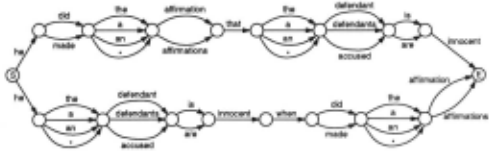
This lattice encodes 768 possible translations; the two main pathways correspond to two different parses. The star symbol (*) stands for an empty transition.
Our original bottom-up semantic analyzer transforms parse trees into semantic feature structures. However, we can make it produce word lattices if we encode lattices with disjunctive feature structures, e.g.:
((gloss (·DR· ((op1 "he") (op2 ( ·DR· "did" "made")) (op3 ((opt (·DR· "the" "a" "an" "*empty·")) (op2 (·DR· "affirmation" "affirmations")) (op3 "that") (op4 ((opt ((opt (·DR· "the" "a" ((opt "he") "an" "·empty·")) (op2 (·DR· "defendant" "defendants" "accused")))) (op2 ((op1 (·DR· "is" "are")) (op2 "innocent")))))))) (op2 (·DR· "defendant" "defendants" "accused")) (op3 ((op1 (·DR· "is" "are")) (op2 "innocent"))) (op4 "when") (op5 ((opt ( ·DR· "did" "made")) (op2 ((opt (·DR· "the" "a" "an" "*empty·")) (op2 (·DR· "affirmation" "affirmations"))))))))))In the above representation, ·OR* marks mutually dis joint components of the gloss, while the features op1 , op2 , etc. represent sequentially ordered portions of the gloss.
This structure can be transformed automatically into a format suitable for statistical processing. As part of that transformation, we also do a bit of English morphol ogy, to simplify the analyzer's work. The analyzer still runs as a bottom-up walk of the parse tree, using unifi cation to implement Montague-style composition. How ever, we replace the conventional semantic lexicon with a gloss lexicon, easily obtainable from an online Japanese English dictionary:
((N -> "kai.sha") ((xO gloss) = (·DR· "company" "firm")))We also replace semantic rules with glossing rules, e.g.:
((NP -> S NP) ((XO gloss op1) = (X2 gloss)) ((XO gloss op2) = (·OR· "which" "that")) ((XO gloss op3) = (X1 gloss)) ((XO tmp) = (X2 tmp)))This rule says: to gloss a Japanese noun phrase (NP) created from a relative clause (s) combining with an other noun phrase (NP), glue together the following-an English gloss of the child NP , a relative pronoun (either which or that), and an English gloss of the S. The rule also propagates abstract features ( tmp) from the child NP to the parent. We return to these features in the next section.
We built a set of 171 complex rules to match the struc tures in our syntactic grammar. Our new semantic ana lyzer composes glosses (word lattices) rather than mean ings, so we call it the glasser.
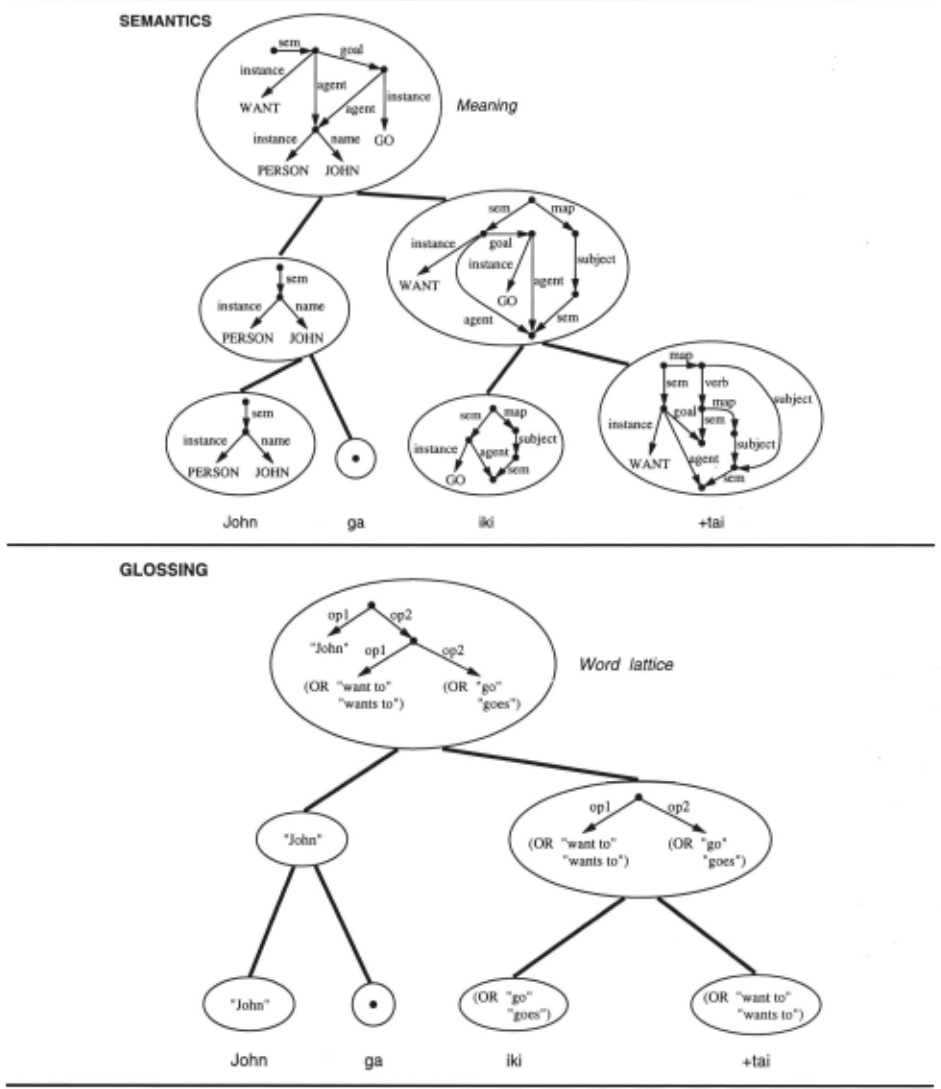
Figure 2 compares glossing and semantic interpreta tion. Each parse tree node is annotated with its analysis. Sentence-level analyses appear at the top. These analy ses are then fed to subsequent JAPANGLOSS modules to the generator (in the case of semantic analysis) or directly to the statistical model (in the case of glossing).
3 Linguistic Aspects
As Figure 2 shows, semantic interpretation makes much more flexible use of unification as a combinator than glossing does. In fact, most of our glossing rules sim ply concatenate word lattices and insert function words. Concatenation lets us put a direct object after a verb in English, for example, even though it comes before the verb in Japanese. However, many Japanese struc tures are different enough from English that this strat egy breaks down. Consider the sentence John ga Bill ni tabesaseta, parsed as:
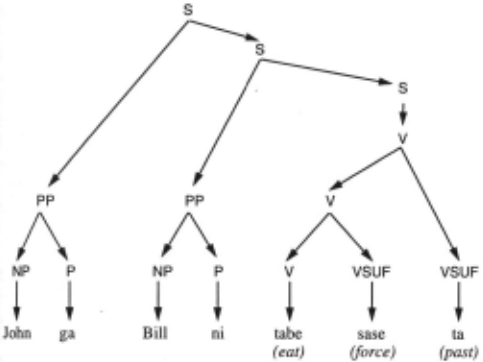
One translation of this sentence into English is John forced Bill to eat. The difficulty is how to assign word lattices to intermediate nodes in the parse tree. If we assign forced to eat to tabesaseta, there will be no way for us to squeeze in the word Bill at the next level. Our solution is to use unification to pass abstract features up the parse tree. We store abstract information under a top-level feature called tmp, parallel to the gloss and syn (for syntactic) feature structures. So the feature structure at the lowest S node looks like:
((gloss (·OR· "eat" "ingest")) (tmp ((force+) (past +))))The complex (S -> PP S) rule then successfully un packs the abstract features into words at the next level:
((gloss ((op1 "forced") (op2 "Bill") (op3 "to") (op4 (·OR· "eat" "ingest")))))How to efficiently turn bundles of abstract features into English is a difficult general problem lying at the heart of natural language generation. Our glosser tack les only simple instances of this problem, involving at most three of four features. Three binary features can require up to eight rules to "spell out," and we some times must specify all cases. Often, however, we see a decomposition in which one abstract feature spells itself out independently of the others. In these cases, there is no exponential blowup in the required number of glosser rules.
Here is a fragment of rules dealing with the above example:
((V -> V VSUF) ((xO tmp) = (x1 tmp)) (·XOR· (((x2 syn entry-form) = "sase") ((xO gloss) = (x1 gloss)) ((xO tmp force) = +)) (((x2 syn entry-form) = "ta") ((x1 tmp force) =c +) ((xO gloss) = (x1 gloss)) ((xO tmp past) = +)) ( ( (x2 syn entry-form) = "ta") ((xO gloss op1) (x1 gloss)) ((xO gloss op2) ="+past")))) ((S -> V) ((xO gloss) ( (xO tmp) = ( (PP -> NP p.) (x1 gloss)) (x1 tmp))) ((xO syn entry-form) = (x2 syn entry-form)) ((xO gloss) = (x1 gloss))) ((S -> PP S) (·XOR· (( (x1 syn entry-form) = "ga") ((xO gloss op1) = (x1 gloss)) ((xO gloss op2) = (x2 gloss))) (( (x1 syn entry-form) = "ni") ((x2 tmp force) =c +) (·XOR· (((x2 tmp past) =c +) ((xO gloss op1) = "forced")) (((xO gloss op1) = (·OR· "force" "forces")))) ((xO gloss op2) (x1 gloss)) ((xO gloss op3) "to") ((xO gloss op4) (x2 gloss)))))In this notation, =c (a symbol borrowed from Lexical Functional Grammar [Kaplan and Bresnan, 1982]) means the feature sequence must already exist in the incoming child constituent, and *XDR* sets up a disjunc tion of feature constraints, only one of which is allowed to be satisfied.
4 Statistical Language Modeling
Our glosser module proposes a number of possible trans lations for each Japanese word or sequence of words that have been matched to a syntactic constituent by the bottom-up parser. Each such translation unit represents a lexical island according to the knowledge the glosser has, i.e., a piece of text for which no other constraints are available. At the same time, the various renditions of each translation unit can combine together, leading to many possible translations at the sentence level. In order to select among the many combinations of these possi bilities, we need an objective function that will score them, hopefully ranking the correct translation near the top. To accomplish this task, we approximate correct ness by fluency, and further approximate fluency by like lihood, selecting the combination of words and phrases that seems most likely to occur in the target language. This approach offers two advantages:
- Because we measure likelihood at the sentence level , we take into account interactions between words and phrases that are produced from different parts of the Japanese input. For example, bei in Japanese may mean either American or rice, and sha may mean either shrine or company. If both possibilities survive for both words after the glosser processes beisha, the likelihood criterion will select American company, which is almost always the correct trans lation. In addition, ranking potential translations by their probability in the target language indirectly handles collocational constraints and allows the cor rect choice of function words which may not appear in the source text at all (e.g., articles in Japanese) or are subject to non-compositional lexical constraints (e.g., prepositions in English, as in afraid of, or on Monday versus in February).
- In the absence of additional lexical constraints orig inating from neighboring target language words and phrases, individual translations containing more common and widely used words are preferred over translations that contain more rare and obscure words. In this way, the Japanese word kuruma will be translated as car and not as motorcar. This tac tic is optimal when no disambiguating information is available, since it selects the most likely transla tion, avoiding rare and very specialized alternatives.
In the remainder of this section we discuss how we measure the probability of an English sentence from the probabilities of short sequences of words (n-grams [Bah! et al., 1983]) , how we estimate these basic probabilities of n-grams, how we handle problems of sparse data by smoothing our estimates, and how we search the space of translation possibilities efficiently during translation so as to select the best scoring translations .
4.1 The sentence likelihood model
As we discussed in the previous paragraph, we want to associate with each English sentence A a likelihood mea sure Pr(A). Since the number of such sequences is very large and our training text is not unlimited, we cannot expect to count the occurrences of A in a corpus and then use a classic estimation technique such as maximum likelihood estimation. 1 Instead, we adopt a Markov as sumption, according to which the probability of seeing a given word depends only on the short history of words appearing just before it in the sentence. Using a his tory of one or two previous words, the stochastic process that generates sequences of English words is approxi mated by a first or second order Markov chain (bigram or trigram model) respectively. For reasons of numerical accuracy with finite precision computations, we convert probabilities to log-likelihoods. Then, the log-likelihood of a sequence of words S = w1 w2 ... Wn is
Unfortunately, this likelihood model will assign smaller and smaller probabilities as the sequence be comes longer. Since we need to compare alternative translations of different lengths, we alleviate this prob lem by adding a heuristic corrective bonus which is an increasing function of sentence length. After experiment ing with several such functions, we have found that the function f(n) = 0.5n, where n is the length of the word sequence, gives satisfactory results when added to the log-likelihood measure. This is equivalent to adding an exponential function of length to the original probabili ties.
4.2 Estimating n-gram probabilities
To estimate the conditional bigram and trigram proba bilities used in our model , we processed a large corpus of carefully written English texts and we measured the frequencies of one-, two-, and three-word sequences in it . Since we aim at translation of unrestricted Japanese newspaper articles, we selected the Wall Street Journal (WSJ) corpus 2 as the most representative available col lection of English texts that our output should imitate. We processed the 1987 and 1988 years from the WSJ corpus, giving us 46 million words of training text, con taining approximately 300,000 different word types.
The large number of different word types makes our modeling task significantly more complicated than previ ous similar language models. These models were usually designed for speech recognition tasks, where the vocab ulary was limited to at most a few thousand frequent English words. With our vocabulary of 300 ,000 words, we have 9 · 10 10 different bigrams, and 2. 7 · 1016 differ ent trigrams. Handling such large numbers of n-grams is problematic in terms of storage space and retrieval speed. Furthermore, estimating probabilities for these is difficult , since most of them do not occur in our training text. 3
1 Even with unlimited text, such an approach is not feasi ble because of practical limitations in terms of memory and hardware speed.
2 Available from the ACL Data Collection Initiative as CD Rom 1.
In order to reduce the number of n-grams for which we need to estimate probabilities, we first implemented a simple schema of class-based smoothing. We developed finite-state automata that use features like word posi tion, capitalization, and types of characters in the word to separate the words into one of four classes: numbers, monetary amounts, proper names, and regular words. We then treat all words in each of the first three classes as the same word, pooling their frequencies together and us ing uniform maximum likelihood estimates for all words in each class, irrespective of whether the particular word has been seen in the training corpus or not.
The class-based smoothing reduces the number of words for which we need to estimate individual prob abilities to 120,000; more importantly, it reduces the number of bigrams by a factor of 7.5 and the number of trigrams by a factor of 22.5. Still, many of the sur viving n-grams have not been observed in the training corpus, and to estimate their probability as zero would be clearly incorrect, given the compositionality of the English language. Good [1953] has proposed a method that addresses this problem and is theoretically optimal under rather general distributional assumptions (namely, that each n~gram follows a marginal binomial distribu tion). The resulting Good-Thring estimator replaces the observed frequency r with the corrected frequency
where Nr is the number of n-grams that occur r times. The corrected frequencies r· are subsequently used to provide estimates of probabilities through the maxi mum likelihood formula. In general, probability mass is "stolen" from the observed n-grams (proportionally more from those that have been observed a few times than from the more frequent ones), and redistributed to the unseen n-grams.
The Good-Thring estimator still suffers from one dis advantage; it assigns the same probability to all n-grams that have not been seen in the corpus (and for that mat ter, to all n-grams that have been seen the same number of times in the corpus). Church and Gale [1991] have proposed an enhanced version of the estimator for hi grams, in which a secondary predictor based on unigram (word) probabilities is used to separate the bigrams into bins, and the Good-Thring formula is applied separately ·within each bin. The rationale of this approach is that pairs of frequent (or infrequent) words are expected to be frequent (or infrequent) themselves; departures from this norm become notable when the bigrams are separated into bins according to the likelihood of their component words, and these differences lead to different estimates for the bigram probabilities even if the bigrams have the same frequency in the corpus. Church and Gale [1991] provide empirical evidence that indicates that the en hanced Good-Thring estimator outperforms both simple estimators such as the MLE and (to a lesser extent) other complex estimators such as an enhanced version of the deleted estimation method [Jelinek and Mercer, 1980].
3 Recall that the latter contains 4.6 · 10 7 words, and con sequently only a slightly higher number of bigrams and tri grams, when the special end-of-sentence token is taken into account.
We have implemented the basic Good-Thring method for single words, allowing for 130,000 unseen words. We then use the Good-Thring estimates of proba bilities of words to compute the secondary predictor log(Pr(A) Pr(B)), in the enhanced Good Thring esti mator for the bigram AB. We have also extended the enhanced method to trigrams ABC, using the sec ondary predictor log(Pr(AB) Pr( C)) that combines the estimated probabilities of the initial bigram and the fi nal word. 4 We smooth the secondary predictor by using 2 or 3 bins per order of magnitude (for trigrams and bigrams, respectively), and we smooth the counts of n grams in each bin ( Nr) with a dynamically self-adjusting local smoother.
4.3 Searching the word lattice space
In the previous two subsections we discussed how any sequence of words can be assigned a likelihood estimate, appropriately modified for length. This in principle would allow ranking the various translation alternatives by simply computing the likelihood for each of them. However, the word lattices produced by the glosser com pactly encode billions of possible translations: a simple linear chain of states with 30 states and two arcs leaving each state represents 2 30 , or about one billion, paths, each corresponding to a potential translation.
Consequently, a method is needed to efficiently search the word lattice and select a small set of highly likely translations . We adopted the N-best algorithm for this purpose [Chow and Schwartz, 1989]. Unlike the widely used Viterbi algorithm [Viterbi , 1967], which only pro duces a single best scoring path, this algorithm offers the advantage of producing any number of the highest scoring paths in the lattice; these paths can then be rescored with a more extensive (and expensive) method. It also offers controlled accuracy (i.e., the extent of sub optimality can be arbitrarily decreased by the amount of memory made available to the search), and empirical studies [Nguyen et a/., 1994] have shown that it per forms equally well with other, mo~ complicated meth ods. Finally, no forward estimates of the viability of a partial path are required (as is, for example, the case in the A* or stack decoder [Jelinek et a/., 1975; Bah! et al., 1983] algorithm).
We first perform a topological sort of the states in the word lattice, so that we can visit each state after all its predecessors have been processed. As we process a given state, we keep a list of the best scoring sequences of words reaching that state from the start state of the lattice. At each state, we extend all word sequences end ing at the predecessors the the current state, recompute their scores, and prune the search space by keeping only a prespecified number of sequences, specified by the width of the global search beam. In practice, we have found that a beam of 1,000 hypotheses per node gives accu rate results at reasonable search speed. The sequences are stored compactly via pointers to the preceding states (along with information about the specific arc taken at each step), and maintained in a fast priority queue to avoid sort ing. This allows us to simulate an HMM of any order, as well as trace any number of final sentences (up to the beam width) when the final state of the lat tice is reached. The complexity of the search algorithm is slightly superlinear in terms of the beam width, the number of states, the n-gram length used in the model, and the average fan-out in the lattice (number of arcs leaving each state) .
4 log(Pr(A) Pr(B) Pr(C)) is another predictor which we believe may outperform log(Pr(AB) Pr(C)) because it is less correlated with log(Pr(ABC) ). But computing this alterna tive predictor, even off-line, is impractical because of the very large number of possible trigrams.
5 Results
The glasser is currently being used in our machine trans lation system as a fall-back component in cases of pars ing or semantic transfer failures . We participated in the most recent (September 1994) ARPA evaluation of machine translation systems (see [White and O'Connell, 1994] for a discussion of the evaluation methodology em ployed) with promising results. A sample of translations produced by the glossing module is given below, in the form of Japanese input followed by the correct transla tion and the translation given by the glasser. Due to space limitations, we are showing output on small ex ample sentences , although JAPANGLOSS typically op erates on much longer sentences characteristic of news paper text .
att-~Kf~~~k~~~M?~~~o
He has unusual ability in English.
He holds a talent that exceeded the English language.
.t; (l)tl'f¥\ltiJA'£? ko
The news got abroad.
The information spread.
~ ! ~ tt ~ ~ (1) ~ {t tc m rc; -e ! tJ: ~ tt- t! tJ: t:> fJ: ~ 0
Living creatures must be adaptable to environmental change.
Animal circumstances accommodation variation does not enable.
8*K*~~~3ti!'£?~-±~~~~b L~c1§5o
Visitors to Japan always admire Mt . Fuji.
Tourists that coming in Japan be decided, and say that Mt. Fuji is splendid.
· t± an tc &~-e ~ ~ o
He is adverse to violence.
He has the contrary to violence.
All the above translations have been obtained with the bigram language model, as heavy computational and storage demands have delayed the deployment of the more precise trigram model. We expect higher qual ity output when the trigram model becomes fully oper ational.
6 Related Work and Discussion
The glasser described in this paper is a type of transfer MT, and it follows in the tradition of syntax-based MT systems like SYSTRAN. However, our use of statistics allowed us to avoid much of the traditional hand-coding, and to produce a competitive MT system in nine months. Other statistical a.pproaches to MT include CANDIDE [Brown et a/., 1993J, which does not do a syntactic anal ysis of the source text , and LINGSTAT [Yamron et a/. , 1994], which does probabilistic parsing. Both LING STAT and JAPANGLOSS require syntax because they translate between languages with radically different word orders .
Our use of features in syntax, glossing, · and seman tics gives us the flexibility to correct translation errors, capture generalizations, and rapidly build up a complete MT system. As the features become more abstract , the analysis deepens, and our translations improve-this is knowledge-based work . Improvements will also come from better statistical modeling. Our future work will be directed at finding these improvements , and at studying the interaction between knowledge bases and statistics.
Acknowledgments
We would like to thank Yolanda Gil , Kenji Yamada, and the IJCAI reviewers for helpful comments on a draft of this paper.
@inproceedings{ijcai1995p178,
  title     = {Unification-Based Glossing},
  author    = {Hatzivassiloglou, Vasileios and Knight, Kevin},
  booktitle = {Proceedings of the Fourteenth International Joint Conference on
               Artificial Intelligence, {IJCAI-95}},
  publisher = {International Joint Conferences on Artificial Intelligence},
  editor    = {Chris S. Mellish},
  pages     = {1382--1388},
  year      = {1995},
  note      = {Natural Language},
  url       = {https://ijcai.org/proceedings/1995/178},
}
TY - CPAPER TI - Unification-Based Glossing AU - Hatzivassiloglou, Vasileios AU - Knight, Kevin T2 - Proceedings of the Fourteenth International Joint Conference on Artificial Intelligence, IJCAI-95 PB - International Joint Conferences on Artificial Intelligence PY - 1995 SP - 1382 EP - 1388 UR - https://ijcai.org/proceedings/1995/178 ER -Copied
Machine-readable versions of this paper, for tools and AI agents:





