
PHI - A Logic-Based Tool for Intelligent Help Systems
Proceedings of the Thirteenth International Joint Conference on Artificial Intelligence. Intelligent Tutoring Systems. Pages 460-465.
© 1993 International Joint Conferences on Artificial Intelligence
Abstract
We introduce a logic-based system which improves the performance of intelligent help systems by supplying them with plan generation and plan recognition components. Both components work in close mutual cooperation. There are two modes of cross-talk between them, one where plan recognition is done on the basis of abstract plans provided by the planner and the other where optimal plans are generated based on recognition results. The examples which are presented are taken from an operating system domain , namely from the UNIX mail domain.
- [Appelt and Pollack, 1990] D.E. Appelt and M. Pollack. Weighted abduction for plan ascription. Technical re- port., AI Center, SRI International, Menlo Park, 1990.
- [Bauer, 1993] M. Bauer. Plan recognition under uncer- tainty. Research Report, DFKI, 1993. to appear.
- [Ben-Ari ct al., 1982] M. Ben-Ari, J .Y. Halpern, and A. Pnueli. Deterministic propositional dynamic logic: finite models, complexity, and completeness. Comput. System Sci., 25 :402-417, 1982 .
- [Bibel, 1986] W. Bibel. A deductive solution for plan generation. New Gener-ation Camp., 4:115-132, 1986.
- [Biundo and Dengler, 1993] S. Biundo and D. Dengler. The logical language for planning LLP. Research Re- port, DFKI, 1993. to appear.
- [Biundo et al., 1992] S. Biundo, D. Dengler, and J . Koehler . Deductive planning and plan reuse in a command language environment. In Pmc. of lOth ECAI, pages 628-632, 1992.
- [Biundo, 1992] S. Biundo . Automatische Synthese rekursiver Programme als Beweisverfahr•en. Springer IFB 302, Berlin, Heidelberg, New York, 1992.
- [Breuker , 1990] J . Breuker. EUROHELP Developing Intelligent Help Systems. EC, Kopenhagen, 1990.
- [Constable, 1986] R.L. Constable. Implementing Math- ematics with the Nupr-1 Proof Developmt:nt System.
- [Fann, 1970] K.T . Fann. Peirce 's Thwr•y of Abduction. Martinus Nijhoff, The Hague, 1970.
- [Fikes and Nilsson, 1971] R.E. Fikes and N.J. Nilsson. Strips: A new approach to the application of theorem proving to problem solving. AI, 2:189-208, 1971. IJCAI
- [Green, 1969] C. Green. Application of theorem proving to problem solving. In Proc. of 2th IJCAI, pages 219- 239, 1969. IJCAI
- [Hammond, 1990] K. J. Hammond. Explaining andre- pairing plans that fail. AI, 45 :173-228, 1990.
- [Hanks and Weld, 1992] S. Hanks and D. S. Weld. Sys- tematic adaptation for case-based planning. In Pmc. of 1st AlPS, pages 96-105, Washington, D.C., 1992.
- Morgan Kaufmann. [Heisel et al., 1990]
- M. Heisel, W. Reif, and W . Stephan. Tactical theorem proving in program verification. In Proc . of lOth CADE. Springer LNCS 449, 1990.
- [Heisel et al., 1991] M. Heisel, W. Reif, and W. Stephan. Formal software development in the KIV system. In Automating Software Design, R. McCartney and M.R. Lowry (eds.). AAAI Press, 1991.
- [Helft and Konolige, 1990] N. Helft, and K. Konolige . Plan recognition as abduction and relevance. Draft version, AI Center, SRI International, Menlo Park, 1990.
- [Kakas ct al., 1992] A.C. Kakas, R.A. Kowalski, and F . Toni. Abductive logic programming. Draft ver- sion, Department of Computer Science, University of Cyprus, Nicosia, and Imperial College of Science, Technology and Medicine, London, 1992.
- [Kambhampati and Hendler, 1992] S. Kambhampati and J . A. Hendler. A validation-structure-based the- ory of plan modification and reuse . AI, 55 :193 -258, 1992.
- [Koehler, 1992] J. Koehler. Towards a logical treatment of plan reuse. In Pmc. of 1st AlPS, pages 285-286, Washington, D.C ., 1992. Morgan Kaufmann.
- [Kroger, 1987] F. Kroger . Temporal Logic of Programs. Springer, Heidelberg, 1987.
- [Kruse d al., 1991] R. Kruse, E. Schwecke, and J. Hein- sohn. Uncertainty and Vagueness in Knowledge Based Systems. Springer, 1991.
- [Manna and Waldinger, 1980] Z. Manna and R . Waldin- ger . A deductive approach to program synthesis. ACM Transactions on Programming Languages and Systems, 2:90-121, 1980 . IJCAI
- [Manna and Waldinger, 1987] Z. Manna and R. Waldin- ger. How to clear a block: Plan formation in situa- tional logic. Journal of Automated Reasoning, 3:343- 377, 1987.
- [Nilsson, 1980] N.J . Nilsson. Principles of Artificial In- telligence. Springer, New York, 1980.
- [Norvig et al., 1993] P. Norvig, W. Wahlster, and R . Wilensky. Intelligent Help Systems for UNIX - Case Studies in Artificial Intelligence . Springer, Hei- delberg, 1993 . to appear .
- [Paul, 1993a] G . Paul. Approaches to abductive reason- ing -an overview. AI Review, 1993. to appear.
- [Paul, 1993b] G. Paul. A generalized abductive prin- ciple for a modal temporal logic. Research Report, DFKI, 1993. to appear .
- [Paulson, 1990] L. Paulson. Isabelle: The next 700 the- orem provers. In P. Odifredi, editor, Logic and Com- puter Science . Academic Press, 1990.
- Peirce, 19311958)
- C .S. Peirce. Collected Papers of Charles Sanders Peirce (eds. C. Hartshorne et al.). Harvard University Press, 1931-1958.
- [Pratt, 1979] V. Pratt. Models of program logics. In Pmc. of 20th Annual IEEE Symposium on Founda- tions of Computer Science, pages 115-122, 1979.
- [Rosner and Pnueli, 1986] R . Rosner and A. Pnueli. A choppy logic . In Symposium on Logic in Computer Science, Cambridge, Massachusetts, 1986.
- [Shafer and Pearl, 1990] G. Shafer and J. Pearl, editors. Readings in Uncertain Reasoning. Morgan Kaufmann Publishers, Los Altos, 1990.
- [Shafer, 1976] G. Shafer. A Mathematical Theory of Ev- idence . Princeton University Press, Princeton, 1976.
- [Shanahan, 1989] M. Shanahan. Prediction is deduction but explanation is abductio~. In Proc. of 11th /JCAI, pages 1055-1060, 1989.
- [Thies and Berger, 1992] M.A. Thies and F . Berger. Plan-based graphical help in object-oriented user in- terfaces. In Proc. of the International Workshop on 'Advanced Visual Interfaces', Rome, Italy, 1992.
- [Wrern, 1992] A. Wrern . Reactive abduction. In Proc. of 1 Otlt ECAI, pages 159-163, 1992.
- [Wolper, 1985] P. Wolper. The tableau method for tem- poral logic: an overview. Logique et Anal., 28:119- 136, 1985.
References were extracted automatically from the PDF and may contain errors.
Full text extracted automatically from the PDF; figures, tables and equations may differ. The PDF is the version of record.
1 Introduction
Intelligent help systems aim at providing advanced ac tive help to the users of complex software systems ( cf. [Breuker , 1990; Thies and Berger, 1992; Norvig et a/., 1993]). The performance of these help s~stem~ can be considerably improved if they are supplied w1th plan r·ecognition and plan generation capabilities. Observing a user and recognizing his goals enables the system to help by taking into account the current state of the sys tem as well as the user's level of education and current behavior. Moreover, if a planning capability is available user-specific support can be given by proposing appro priate plans which exactly is what the PHI system a1ms to achieve.
PHI ( cf. the figure below) is a tool for intelligent help systems. It provides both a plan recognizer and a plan ning component and one of its main characteristics con sists in the close mutual cooperation between the two components.
There are several cross-talk modes. The first one is devoted to realizing plan recognition on the basis of ab stract plans produced by the planner. Abstract. plans are those which represent a variety of "concrete" ob servable action sequences by admitting several degrees of freedom like variables (abstracting from the objects in volved), abstract commands (abstracting from the names of actions which have the same effects), ~r temporal ab straction (abstracting from the point in time at which an action occurs).
*This work was supported by the German Ministry for Re search and Technology (BMFT) under contract ITW 9000 8 a.s part of the PHI project.
The generation of plans is based on standard assull_lp tions concerning goals that typically occur or are spec1fic to a certain user. Abstract plans are generated from these formal plan specifications. In doing so, the plan ner not only performs planning from first principles but is able to reuse already existing plans which are stored in a library (planning from second principles). The plans provided serve a.S plan hypotheses in the recog nition process. Taking abstract plans instead of c?n crete ones keeps the hypothesis space of manageable s1ze. The plan hypotheses are passed to the recognition com ponent where they are provided with numerical values which reflect the probabilities of their being confirmed by the subsequent observations. These a priori probabil ities mirror a specific user's behavior, and are taken from the user model. Having observed the user's actions step by step the plan recognizer consequently tries to confirm the plan hypotheses by proving that the action sequence observed up to now is an admissible "instance". Hy potheses which are not confirmed are rejected a~d with that the probability distribution of the hypothesis space changes dynamically.
In the first cross-talk mode the plan recognizer is able to determine the most likely plan a user follows by car rying out appropriate "instantiations" on valid plan hy potheses. Thus, services like semantic plan co~pletwn can be offered at any time during the observatiOn pro cess.
The second cross-talk mode is devoted to providing the user with optimal plans whenever suboptimal behavior has been recognized or aid has explicitly been sought.
The system is completely logic-based. It requires a proper axiomatization of the basic commands of the ap plication system and certain domain constraints. The logic LLP which we have developed for that purpose combines features of both traditional programming and temporal logics. The plan generation and recognition components are special purpose inference procedures. Plan generation is done deductively using a sequent cal culus for LLP, whereas plan recognition follows an ab ductive principle.
The application domain, from which we present exam ples, is a subset of the operating system UNIX, namely its mail system, where commands like type, delete, or save manipulate objects like messages or mailboxes.
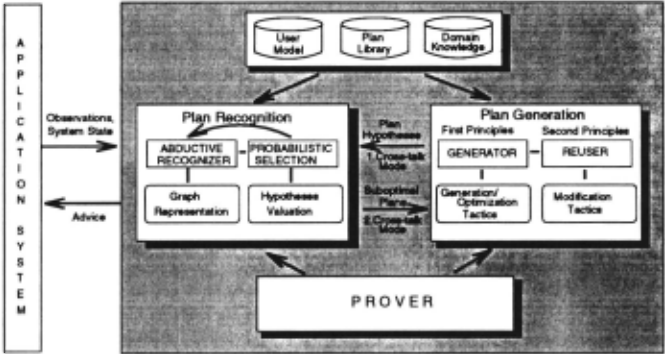
The paper is organized as follows: After a short intro duction to the formal framework in section 2 we describe the plan generation and recognition components in sec tions 3 and 4, respectively. We demonstrate by means of an example how the system works in the first cross talk mode. Finally, we conclude with some remarks in section 5.
2 The Formal Framework
Plan generation and plan recognition are carried out on a common logical basis. The logical language for plan ning (LLP) [Biundo and Dengler, 1993], which we have developed for this purpose, combines features of Choppy Logic [Rosner and Pnueli, 1986) with the Temporal Logic for Programs [Kroger , 1987) . This entails the considera tion of plans as programs as has also been proposed by other authors (cf. [Green , 1969), [Bibel, 1986), [Manna and Waldinger, 1987)) . LLP is an interval-based modal temporal logic. It provides the modal operators O(next), ()(sometimes), 0 (always), and .the binary modal opera tor; (chop), which expresses the sequential composition of formulas. Besides these operators control structures (e.g., conditionals) are also available, as in programming logics. Basic actions, which in our example domain are the elementary mail commands, are axiomatized like as signment statements in programming logics . The state changes which they perform are reflected in changing the values of certain variables . The type command, for example, is represented by the following axiom schema:
where P is a metavariable for formulas. The schema states: If the mailbox mb is open (i .e., the open-flag of(mb) equals true) and message x is not yet deleted (i.e., the delete-flag df(x, mb) equals false) and we exe cute the type command then formula P holds in the next state, provided the formula we obtain by replacing each ocurrence of the term r f( x, mb) in P by T (i.e., the weak est precondition of P w.r .t . type(x, mb)) has held before.
The substitution instructions correspond to the effect of the type command. Replacing P by r f( x, mb) = T we obtain the following action axiom:
It states that if a certain message x in a current mailbox mb has not yet been deleted and we execute the type command then the message is read in the next state (i .e., the read-flag r f( x, mb) is set to true).
Plans are represented by a certain class of LLP for mulas . Besides basic actions (denoted using the execute predicate EX) they contain the chop operator, control structures, and also temporal abstractions.
Plan specifications are LLP formulas of the form as follows : [preconditions 1\ Plan) --+ goals i.e., if the pre conditions hold in a situation where we carry out Plan, then the goals will be reached. For example the following formula
specifies the plan "Display the content of mailbox M on the screen and then read message x". Plan is a metavari able for a plan formula.
Plan generation ( cf. section 3) is carried out by con structively proving the specification formula. While proving the specification formula the plan metavariable Plan is replaced by a plan (formula) which satisfies the specification. Proving ( 1), for example, results in the following plan:
As the UNIX mail language does not of course provide any control structures, this plan has to be considered as abstract, apart. from the fact that the variable x occurs in it.
In section 3 we will see how the conditional plan above is generated from first principles . We can then demon strate planning from second principles by reusing and modifying this plan so that it meets a new specification:
is obtained as a result. In a plan recognition example ( cf. section 4) this plan can then serve as one of the plan hypotheses .
3 Plan Generation
The planning system (cf. [Biundo eta/., 1992)) works by using techniques of planning from both first and second principles. Planning from first principles begins with a plan specification. The plan is generated on the basis of the domain know/ulge provided. Planning from sec ond principles adds the ability to incorporate previously generated plans and the problem solving knowledge ob tained thereby. In the first cross-talk mode, abstract plans are generated in order to provide the plan recog nizer with plan hypotheses. To generate these hypothe ses , the planner works from second principles by reusing formerly generated plans.
3.1 Planning from First Principles
By using a sequent calculus for LLP ( cf. [Biundo and Dengler, 1993)) the plan generator tries to find a con structive proof for the plan specification formula so that an instantiation for the plan metavariable can be ob tained. We thus have a plan the execution of which is sufficient to reach the goals specified, i.e., a plan which meets the specification. Following the paradigm of tac tical theorem proving ( cf. [Constable, 1986), [Heisel et a/., 1990), [Paulson, 1990)) the proof is guided by special planning tactics written in a metalogical tactic language.
As for plan specification ( 1) , the proof is carried out by dividing the specification formula into subformulas, i.e. , those representing single subgoals which the plan has to reach. We can simultaneously introduce a structure into the plan metavariable Plan , which states that Plan should consist of at least two subplans: Plan = P1 ;P2 .
Let us now consider the generation of a plan for P2 . The corresponding subgoal reads:
Usually subgoals of this type are proven by using non logical axioms which describe basic actions. Thereby, the plan metavariable is instantiated by a basic plan for mula. The instance of the type axiom below is selected because it can reach the desired goal of setting r f to T :
The preconditions of this action however must hold in order to make the axiom applicable. One of these precon ditions is missing from the subgoal above. Following a deductive version of the means-ends analysis (cf. [Fikes and Nilsson, 1971), [Nilsson, 1980)) we therefore intro duce an additional subplan which produces the missing precondition . Thus, P2 becomes the composition of a one-armed conditional and a subplan P 4, respectively:
The new subgoal obtained is:
To properly instantiate P3 an instance of the undelete action axiom can be used; this tells us that the execution of undelete(x, M) makes df(x, M) = F true in the next state, should it not have held before. In a similar way P 4 can now be instantiated by using the type action axiom.
The overall plan which results after the proof tree has been completed and all plan metavariables have been instantiated, is the plan given by formula (2) above. It clearly meets the specification in ( 1) .
In addition to sub goals whose proof leads to instantia tions of the plan meta variables, as in the above examples, so-called plan assertions must also be proven. These rep resent certain properties which are required by the plan to be generated . A typical example in our case is the fact that the formula of(M) = T-which acts as a pre condition to the whole plan-does survive the execution of subplan P1 . This fact is proven by regression where we generate the weakest preconditions of of(M) = T w.r.t . all basic actions occurring in P1 . In our system, planning from first principles is, like several other ap proaches to deductive planning ( cf. [Green, 1969], [Bibel, 1986), [Manna and Waldinger, 1987)) closely related to work done on deductive program synthesis where pro grams are ~enerated by proofs ( cf. [Manna and Waldin ger , 1980),[Heisel et a/., 1991), [Biundo, 1992)) .
3.2 Planning from Second Principles
The ability of a planner to modify a plan is considered as a valuable tool for improving the efficiency of planning by avoiding the repetition of the same planning effort because instead of generating a plan from scratch, plan reuse tries to exploit knowledge stored in previously gen erated plans.
The reuser first takes the current specification and searches in a plan library for a plan which can be reused as its solution. Since we concentrate on plan modifica tion in this paper, we suppose that the search in the plan library terminates successfully with a plan specifi cation and describe how the reuser verifies whether the plan belonging to it provides a solution to the current planning problem. The verification is carried out by a formal proof in which the prover verifies that at least the preconditions the plan requires hold in the current sit uation and that at most the goals achieved by the plan are required as current goals.
If the proof succeeds, the plan provides a provably sound solution to the current planning problem; if it fails , the plan has to be modified.
The modification tactics analyze the failed proof and modify the plan using information from the generation process that lead to this plan.
Let us assume, for example, that specification (3) is given to the planner in the first cross-talk mode. Plan ning from second principle starts and tries to reuse plan (2) .
Comparing it with specification (1) it is obvious that more preconditions are given, but even more goals are required in (3). In this case, the prover reports a fail ure because more goals are required in specification (3) than are achieved by the plan . The modification tactic identifies the missing sub goal df( x, M) = T for which a subplan has to be generated from first principles . Fur thermore, it has to inspect the temporal structure of the plan to be reused in order to determine the point in time at which this subplan has to be inserted. For this pur pose, explicit representations of the temporal models of both specifications are constructed and compared during the proof.
A plan is a solution if it achieves at least all the goals that are required in the current specification, i.e., if the plan achieves some additional subgoals it is still con sidered to be a solution . In some applications however, plans have to be minimal in the sense of achieving exactly the goals required . The plan reuse component is able to perform the necessary optimizations in these cases.
In the example, the reuser detects that the case analy sis in the reused plan is superfluous because the condition on which it depends is explicitly given in the specifica tion. Therefore, the conditional can be deleted from the plan. The result of the modification process is a plan skeleton for a sequential plan
containing the reusable subplan identified during the proof and a meta variable Plan1 as a "placeholder" for the completing subplan which has to be generated in order to reach the additional goal.
The generator uses the plan skeleton as a partial in stantiation of the plan metavariable Plan in specifica tion (3). This simplifies the constructive proof of the specification: The partial proof tree for which an in stantiation of the metavariable is already known can be easily expanded without further search effort. To re place the metavariable Plan1 occurring in the skeleton, the generator has to plan from first principles leading to the instantiation EX(delete(:1:, M)). The interleaving of proof tree reconstruction and generation ensures that the modified plan provides a provably sound solution to the current plan specification that can be sent to the plan recognizer as a plan hypothesis.
The approach we follow investigates plan reuse in the general context of deductive planning and has been de scribed in more detail in (Biundo et a/., 1992; Koehler , 1992) . Other current approaches investigate plan reuse and modification in the framework of classical STRIPS like planners, e.g., the hierarchical planner and modifi cation system PRIAR [Kambhampati and Hendler, 1992), or in the framework of case-based reasoning, e.g., the sys tems SPA [Hanks and Weld, 1992) or CHEF [Hammond, 1990). The experiments reported by some of the authors give evidence that plan reuse might indeed be more effi cient than planning from scratch. How far these results generalize is studied in a complexity-theoretic analysis of plan modification vs. plan generation by Nebel and Koehler ( cf. these proceedings). In contrast to practical experiences it turned out that plan modification is not uniformly as easy as planning from scratch .
3.3 Generating Optimal Plans
The second cross-talk mode is concerned with the gener ation of optimal and user-satisfactory plans . The gener ator receives a plan specification which either belongs to a plan recognized as suboptimal by the plan recognition component or is derived from a request for passive help.
Planning in this mode is based on a dynamically changing adjustment of the generation process triggered by plan quality criteria derived from the user model. The generator considers, e.g., the user's preferences, his knowledge about the domain, and his typical behavior in order to generate satisfactory plans for him. It produces a user-adapted concrete plan that meets the specifica tion and is as short as possible according to the number of basic actions used. Since planning is done deductively the adjustment essentially places a restriction on the sets of nonlogical axioms and rules.
If, on the basis of the current plan quality criteria, no plan can be found , then the criteria must be minimally changed in order to generate a plan. The necessary devi ations are recorded and can be used by a tutorial system to teach the user accordingly. In the case of a recognized suboptimal plan, the generated optimal plan is, e.g., the basis for an active user support of the help system. Gen eration of optimal plans is only carried out from first principles because the reuse of concrete plans requires consideration of dynamically changing plan quality cri teria which can contradict the aim of making planning more efficient.
4 Plan Recognition
The recognition of plans in this logic-based context is realized by a generalized abductive process with a proba bilistic valuation of hypotheses. Starting from plan hy potheses synthesized by the plan generation component and observations of user actions, an attempt is made to identify a hypothesis describing the user's pursued plan. The use of probabilistic reasoning allows us to determine one "best" hypothesis to offer user-specific help, e.g., by doing semantic plan completion.
4.1 The Abductive Recognizer
Plan recognition, which is the identification of a user's behavior given an observed goal or action, can be viewed as an inherently abductive problem, if a plan hypothesis P is interpreted as an assumption explaining the ob served action a, i.e., T U {P} f= a, where T describes the domain knowledge (e.g., [Appelt and Pollack,~ 1990), (Shanahan, 1989), (Helft and Konolige, 1990l,tWrern, 1992)) . P is required to be a ground instance of an ele ment of a set of predefined candidate explanations called abducibles. 1
1 For a.n introduction to abduction see, for example, [Peirce, 19.31 19.58] or [Fa.nn, 1970] . An overview can be found
However , this "classical" abduction principle is insuf ficient for temporal hypotheses incorporating an implicit representation of time, because the correctness criterion is no longer satisfied ( cf. [Paul, 1993b]). To overcome this deficiency the abductive process is divided into two phases: 1. A guessing phase where modal hypotheses are adopted-these abducibles are the abstract plans provided by the plan generation component- and 2. a validation phase where the hypotheses are verified with respect to the sequence of observed actions . This is the task of plan recognition .
In addition , the ground instance requirement has to be adapted to our modal logic context . It is generalized in such a way that hypotheses are made more precise not only by instantiating variables but in a temporal sense as well. We concretize the hypotheses according to the observations made in each recognition step .
This process of concretizing will be explained using a short example with two observation steps. It is assumed we are given the following plan hypothesis synthesized by the generation component as described in section 3.
Suppose we have the additional hypotheses
i.e., contrary to the first hypothesis the header command is not expected to be the first action but may also occur at some later stage. In addition , a mailbox named P is supposed to be the current one here.
Observing the user execute the action EX(fol der(P, M)) , i e , he moves from the mailbox M to the mailbox P, leads to the rejection of P 1 and the following concretized hypotheses:
Concerning ?1 we definitely anticipated EX(hea der(M)) . This cannot be concretized with the first ob servation and thus the hypothesis has to be rejected . In ?2 and ?3 the initially expected user action is not specified , we only know that the given action sequence is executed at some time. So, after observing an action not matching the first expectation, we know that this se quence cannot start before the next observation , i.e., we get as parts of the new hypotheses ?2 1 and ?3 1 the for mula O()EX(header(P)) , stating that the action header is anticipated at some future time and not before the next state.
If the second observation is EX(header(P)), the con cretization of both ?2 and P3 is a disjunction of two hypotheses. Either we recognize the header command in the "sometimes" sequence, or we make a decision to expect it later. Thus, we have
in [Kakas et a/ . , 1992] and [Paul, 1!193a] .
As the hypotheses for ?3 are similar we will omit them here.
A hypothesis is said to be recognized if the sequence of observations implies its concretization. Considering the example, this is the case for P2 if, e.g., the next observations are EX(type(2, P)) and EX(delete(2, P)) .
Besides the theoretical foundations, a method was de veloped for computing concretized explanations. An al gorithm solving this problem must be able to identify at each state of time the part of the considered hypothe ses being affected at that moment. To do this in an efficient way, we use a transformation of LLP formu las into graphs that contain solely first-order formulas . 2 This transformation is carried out once before starting recognition. The plan recognition process is realized by moving through the graph according to the observations made. A theorem prover is used to deduce relations between abstract commands in the hypothesis and ob served actions. Several properties of this generalized ab duction principle have been proven. For details see [Paul , 1993b].
The method described above allows us to recognize temporal abstractions as well as abstract plans. We are able to retransform the graph in each iteration step, thus obtaining a history of the actions observed and a descrip tion of the expected continuation of the plan. By that we are able to offer semantic plan completion at any time as long as valid hypotheses are available. Proba bilistic selection ( cf. section 4.2) is the method used in determining the "best" hypothesis for that purpose.
4.2 Probabilistic Selection
The plan recognizer described so far manipulates sets of plan hypotheses each of which is considered equally plausible. If, however, a decision for one alternative is required (e.g., to offer semantic plan completion to the user at an early stage), we must be able to determine the "best" choice among them. To do so, we can exploit knowledge about user preferences stored in a kind of user model and encoded in a probabilistic mechanism.
Probabilistic reasoners (e.g., [Kruse et a/., 1991]) use a knowledge base as a back-up, which contains the set of all possible hypotheses together with numerical values assigned to them representing their specific probability. These numbers usually stem from long-term observations of the domain and from statistics. The situation in the first cross-talk mode, however, is somewhat different be cause the search space of the plan recognizer-the set of all plan hypotheses-is generated dynamically. So, we cannot expect to have any statistical information at hand that directly applies to it . Yet, we can evaluate the user behavior observed according to criteria like typical action sequences, frequently pursued goals, etc.
2 Graph- or so-called tableau-based methods are used for a variety of modal logics. See, for example, [Pratt, 1979], [Ben-Ari eta/. , 1982], and [Wolper, 1985] .
If we know, for example, that the user tends to delete a message immediately after reading it, and that he usu ally prefers the type command to next, we might come up with a set C of LLP formulas similar to abstract plans or plan specifications ( cf. section 2) describing the user's default behavior. Each formula is assigned a numeri cal value representing the statistical information about it. In the example above, C might include the following entries
The entry C3 here means that for a small part. of all observed cases, we know only that the user executed a type or· a next command to read his messages, expressed by using the abstract command reruLmail. The formula in C3 is more general than those of C1 and C.2 . Such relations induce a hierarchical structure on C that. is exploited during the numerical computations.
The numerical values distributed among the mem bers of C sum up to 1 and form a mass distribution from Dempster-Shafer theory (DST) (cf. [Shafer , 1976], [Shafer and Pearl , 1990]). While interpreting the value 1 as perfect certainty, smaller numbers represent. the de gree of partial confidence we might have in the validity of the various propositions.
From a mass distribution m, we can derive the so called belief and plausibility functions Belm and Plm , respectively. These two values make up a probability in terval stating that the "true" probability of some propo sition A lies somewhere between B elm(A) and Plm(A) , but cannot be determined on the basis of the knowledge at hand. Thus, we are able to express par·tial ignorance. 3
Classifying the plan hypotheses obtained from the plan generator according to the formulas C; in C , a set of valuated hypotheses sets PH C; is obtained each of which inherits the numerical value originally attributed to its classification criterion in C. In our example, P1 and P2 become members of the class PH c, , P3 becomes an element of PH c,. In addition, they are all placed in class PH c ,. Thus the original hierarchy of classification criteria according to generality mentioned above mirrors itself in the subset/superset relation of the associated hypotheses sets that make up the plan hiemrchy PH.
After this preprocessing, the probabilistic selection module in every recognition step obtains the most. re cent observation together with information about. those hypotheses which are no longer valid. On the basis of this knowledge, we can compute an updated mass distribu tion on PH reflecting the impact of the new observation on the a-priori valuation of the hypotheses. Dempster's rule is the basis for this computation which is explained in more detail in [Bauer, 1993].
3 For an examination of the relations between mass distri butions, probabilities , and DST see [Kruse et ul., 1991].
Let us assume we are g1ven the information that P1 is no longer valid. Then , the observation EX(header(Priv)), for example, may lead to a new mass distribution where PHc, = {P2 } and PHc, = {P3 } are attributed the values 0.5 and 0.35, respectively, and PHc, = {P2,P3} is valuated with 0.15. If we recall from DST that the belief in a set A of hypotheses is computed by summing up the respective mass values attributed to all of its subsets and the plausibility is the result of adding the mass values of all sets having a non-empty intersection with A, we can interpret these numbers as follows: Currently, hypothesis P2 appears to be the most likely because its probability lies somewhere in the in terval [0 .5, 1]. If semantic plan completion is required, P2 is the current offer of the system to the user . If we are forced to additionally provide a hypothesis definitely containing the plan pursued by the user, we can choose the disjunction of P2 and P3 because the set PH c, which contains these only is the smallest set with attributed be lief 1, i.e., it represents the most specific hypothesis we certainly believe in. This property uniquely determines the disjunction of P2 and P3 because all other plan hy potheses that might be contained in PH are attributed mass 0 and thus are considered impossible according to the evidences obtained so far.
5 Conclusion
A new approach in implementing intelligent help systems has been introduced. It is based on a logic developed especially for the command language environments in which help systems are embedded. Plan recognition and plan generation components are special purpose infer ence processes . They work in close mutual cooperation (cross-talks). One cross-talk mode is devoted to plan recognition on the basis of abstract plans provided by the planner; another mode works on generating optimal plans on the basis of recognition results. Planning from first as well as from second principles is done deductively combining ideas borrowed from the logic-based treat ment of programs with those of tactical theorem proving. The resulting plans are provably sound w.r .t . their spec ifications. Plan recognition is based on a new abductive principle for modal logics . The recognizer is addition ally supplied with a probabilistic reasoner , a means to improve the help provided by taking into account user specific characteristics as well as general heuristics.
Realizing plan generation and recognition in such a strictly logic-based way nevertheless does not cause any considerable inefficiencies, even for "real" mail plans that are much more complex than the examples shown in this paper . This suggests evaluating the PHI approach even for richer application domains. A prototype of the PHI system has been implemented in SICSTUS PROLOG on a SUN SPARC computer.
@inproceedings{ijcai1993p65,
  title     = {PHI - A Logic-Based Tool for Intelligent Help Systems},
  author    = {Bauer, Mathias and Biundo, Susanne and Dengler, Dietmar and Koehler, Jana and Paul, Gabriele},
  booktitle = {Proceedings of the Thirteenth International Joint Conference on
               Artificial Intelligence, {IJCAI-93}},
  publisher = {International Joint Conferences on Artificial Intelligence},
  editor    = {Ruzena Bajcsy},
  pages     = {460--465},
  year      = {1993},
  note      = {Intelligent Tutoring Systems},
  url       = {https://ijcai.org/proceedings/1993/65},
}
TY - CPAPER TI - PHI - A Logic-Based Tool for Intelligent Help Systems AU - Bauer, Mathias AU - Biundo, Susanne AU - Dengler, Dietmar AU - Koehler, Jana AU - Paul, Gabriele T2 - Proceedings of the Thirteenth International Joint Conference on Artificial Intelligence, IJCAI-93 PB - International Joint Conferences on Artificial Intelligence PY - 1993 SP - 460 EP - 465 UR - https://ijcai.org/proceedings/1993/65 ER -Copied
Machine-readable versions of this paper, for tools and AI agents:





