
Map Validation and Self-location in a Graph-like World
Proceedings of the Thirteenth International Joint Conference on Artificial Intelligence. Robotics and Vision. Pages 1648-1652.
© 1993 International Joint Conferences on Artificial Intelligence
Abstract
We present algorithms for the discovery and use of topological maps of an environment by an active agent (such as a person or a mobile robot). We discuss several issues dealing with the use of pre-existing topological maps of graph-like worlds by an autonomous robot and present algorithms, worst cases complexity, and experimental results (for representative real-world examples} for two key problems. The first of these problems is to verify that a given input map is a correct description of the world (the VALIDATION PROBLEM} . The second is to determine the robot's physical position on an input map (THE SELF-LOCATION PROBLEM)' We present algorithms which require O(N ) and O(N 3 ) steps to validate and locate the robot in a map (where N is the number of places in the map).
- [Arkin, 1990] R . Arkin. Integrating behavioural, per- ceptual , and world knowledge in reactive navigation . Robotics and Autonomous Systems, 6:105-122, 1990.
- [Ayache and Faugeras, 1989] Nicholas Ayache and Olivier D. Faugeras. Maintaining representations of the environment of a mobile robot. IEEE Journal of Robotics and Automation, Vol. 5, N0.6:804-819, 1989.
- [Basye and Dean, 1990] Kenneth Basye and Thomas Dean . Map learning with indistinguishable locations.
- In M. Henrion L. N. Kanal J. F . Lemmer, editor, Un- certainty in Artificial Intelligence 5, pages 331-340. Elsevier Science Publishers, 1990.
- [Bollobas, 1985] B. Bollobas. Random Graphs. Aca- demic Press, London , 1985.
- [Bondy and Murty, 1976] J . A. Bondy and U. S. R. Murty. Graph Theory With Applications. North- Holland, New York, 1976.
- [Brooks, 1986] R. Brooks. A robust layered control sys- tem for & mobile robot. IEEE Journal of Robotics and . Automation, 2(1) :14-23, March 1986.
- [Brooks, 1989] R. Brooks. A robot that walks: Emer- gent behaviours from a carefully evolved network. N eural Computation , 1(2) :253-262, Summer 1989.
- [Connell, 1990] J . Connell . Minimalist Mobile Robotics: A Colony-style Architecture for an Artificial Creature. Academic Press, Boston, MA, 1990. [
- Cox, 198!•]
- I. Cox. Blanche: Position estimation for an aut•momous robot vehicle. In Proceedings of the IEEEjRSJ International Workshop on Robots and Systems (IROS}, pages 432-439, 1989.
- [Davis, 1986] Ernest Davis. Representing and Acquiring Geographic Knowledge. Pitman and Morgan Kauf- mann Publishers, Inc., London and Los Altos, Cali- fornia, 1986.
- Dudek et al., ~. G . Dudek, P. Freedman, and S. Hadjres. TJsing iocal information in a non-local way for map- ping graph-like worlc.s. In this proceedings.
- [Dudek et al., 1988] G. Dudek, M. Jenkin, E. Milios, and D. Wilkes. Robotic exploration as graph construc- tion. Technical Report RBCV-TR-88-23, Research in Biological and Computational Vision , Department of Computer Science, University of Toronto, 1988.
- [Dudek et al., 1991] G. Dudek , M. Jenkin, E. Milios, and David Wilkes. Robotic exploration as graph con- struction. IEEE Trans. on Robotics and Automation, 7(6) :859-864, 1991.
- [Dudek et al., 1993] G. Dudek, M. Jenkin, E. Milios, and D. Wilkes. Map exploration, validation and self- location in a graph-like world. Technical report, De- partment of Computer Science, York University, 1993.
- [Elfes, 1987] A. Elfes. Sonar-based real-world mapping and navigation. IEEE Journal of Robotics and Au- tomation, 3(3):249-265, 1987.
- [Engelson and McDermott, 1992] S. P. Engelson and D. V. McDermott. Maps considered as adaptive plan- ning resources. In AAAI Fall Symposium on Appli- cations of Artificial Intelligence to Real-World Au- tonomous Mobile Robots, Cambridge, MA, 1992.
- [Guibas and Stolfi, 1984] L. Guibas and J. Stolfi. Prim- itives for the manipulation of general subdivisions and the computation of Vornoi diagrams. ACM Transac- tions on Graphics, 4, 1984.
- [Kuipers and Levitt, 1988] B. Kuipers and T. Levitt. Navigation and mapping in large-scale space. In AI Magazine, pages 25-43, 1988.
- [Latombe, 1991] Jean-Claude Latombe. Robot Motion Planning. Kluwer Academic Publishers, Standford University, 1991.
- [Levitt and Lawton, 1990] T . Levitt and D. Lawton. Qualitative navigation for mobile robots. Artificial Intelligence, 44(3) :305-360, August 1990.
- [Lumelsky and Stepanov, 1987] V. Lumelsky and A. Stepanov. Path-planning strategies for a point mobile automaton moving amidst unknown obstacles of arbitrary shape. Algorithmica, 2( 4):403-440, 1987 .
- [Mataric, 1992] M. Mataric. Integration of representa- tion into goal-driven behaviour-based robots. IEEE Transactions on Robotics and Automation, 8(3):304- 312, June 1992.
- [Meng, 1987] A. Meng. Free space modelling and geo- metric motion planning under location uncertainty. In Workshop on Spatial Reasoning and Multisensor Fu- sion, pages 430-440.
- Morgan Kaufmann, 1987.
- [Smith and Cheeseman, 1986] R. Smith and P. Cheese- man. On the representation and estimation of spa- tial uncertainty. International Journal of Robotics Re- search, 5(4) :56-68, Winter 1986.
References were extracted automatically from the PDF and may contain errors.
Full text extracted automatically from the PDF; figures, tables and equations may differ. The PDF is the version of record.
1 Introduction
One of the problems confronting an autonomous mobile robot is that of maintaining an internal description of its environment . Without a useful internal representa tion (a map) and knowledge of the robot's position and orientation with respect to this map, many robotic tasks become difficult, if not impossible. Some tasks may be amenable to behaviour-based approaches, and for such tasks an internal description of the environment may not be required, for example [Brooks, 1986; Brooks, 1989; Connell, 1990; Arkin, 1990]. For other tasks, especially complex structured tasks, which are specific to particu lar landmarks in the environment, a map of the environ ment is crucial. If the robot is to have a map, what form would this map take, and how should it be acquired?
There are many possible ways in which a map can be built. Perhaps the simplest is to have the map input manually (offline}. Although an attractive approach due to its ease of implementation, a manually crafted map of the environment may not be the best map for the robot to use; the features and structures most natural for hu mans may not correspond well to features and structures to which the robot has sensory access. It may be better to have a robot create the map itself.
·Financial support from NSERC Canada, and the Ontario-Quebec interchange program is gratefully acknowl edged. We also thank Xiaotie Deng and Andy Mirzaian for many helpful discussions.
Several map representations have been proposed in the literature. These include: metric representations [Ay ache and Faugeras, 1989; Latombe, 1991; Lumelsky and Stepanov, 1987; Cox, 1989; Elfes, 1987], which explicitly model the two or three dimensional position of struc ture in the environment, probabilistic representations [Meng, 1987; Smith and Cheeseman, 1986], which retain many metric properties in the representation, but aug ment the representation with uncertainty information, graph-based representations [Kuipers and Levitt, 1988; Davis, 1986; Basye and Dean, 1990], which represent locations of interest. Hybrid maps, which combine el ements of each of these representational levels have also been proposed [Engelson and McDermott, 1992; Arkin, 1990]. Integration of a map within a reactive framework has been explored [Mataric, 1992].
When an autonomous agent explores its own environ ment, the fundamental problem that the robot has to address is the "have I been here before" problem. If the environment is modelled in a metric manner, this prob lem can be viewed as equivalent to the following: Given the current position and orientation of the robot {known with a particular covariance error matrix with respect to a world-centered coordinate system), has the robot been previously at that same position with the same ori entation, but via a different path? If the environment is represented in a graph-like manner, the question be comes "have I visited this location before", and if so which entrance did I use last time I entered here?
In previous work [Dudek et al., 1991; Dudek et al., 1988] we described and analyzed an algorithm for build ing a graph-like map of an a priori unknown world (see also section 3}. This work assumes that a topological, rather than metric, description of the world is desirable at some level in a descriptive hierarchy [Kuipers and Levitt, 1988]. A graph-like map was chosen because it represents the minimal information that a robot must be able to sense in order to distinguish one place from another. The exploration algorithm allows the robot to form a model of its world by exploring the world sys tematically with the use of one or more distinct markers that can be dropped and picked up at will. These markers can be recognized if they are found on the path of the robot . The exploration algorithm works by building up a known subgraph of the world, exploring unknown edges incident on the known subgraph, and thus incrementally adding to it. The algorithm requires the robot to make O(N 3 ) moves between locations in the worst case, where N is the number of distinguished locations in its envi ronment. These locations correspond to vertices in the graph-like map that is produced while the moves corre spond the edge traversals. Note that it is not possible for the robot to explore its environment without some navi gational aid. As an example, regular graphs of the same degree (i.e. graphs in which each vertex has the same number of incident edges, equal to the degree) are indis tinguishable from each other without markers, because each vertex appears identical to every other vertex.
This paper addresses two related problems: Given a map of the world, how can an active agent (robot) deter mine whether the map is correct in its description of the connectivity among locations. This is the MAP VALIDA TION problem. A related problem is: given a map, how can an active agent determine its current location and orientation on the map (the SELF-LOCATION problem), where "orientation" is equivalent to the correct corre spondence between the map edges and the world edges incident on the correct location.
2 The World Model
The algorithms presented in this paper operate on an augmented graph-like representation of the world which is defined below. Although the pros and cons of such a representation are beyond the scope of this paper, we view this abstraction as a lowest common denominator for real robotic systems, yet as nevertheless rich enough to represent location in a meaningful way.
2.1 Definitions
The robot's "purpose in life" is to use its ability to act and to perceive in the graph domain in order to build an augmented graph 1 which is isomorphic [Guibas and Stolfi, 1984] to the finite world it has been assigned to explore. The robot's inputs are its sensations and it can interact with the world only through its actions.
The World The world is defined as an embedding of an undirected graph G:
with set of vertices V and set of edges E. Note that in practice such a graph could be defined within a con tinuous environment based of landmarks or other fea tures [Kuipers and Levitt, 1988]. The vertices are de noted by:
We will restrict the world model to graphs G that con tain no cycles of length ~ 2, i.e. the graph contains no degenerate or redundant paths. This restriction pro hibits the world from having multiple edges between two vertices or an edge incident twice at the same vertex.
1 By an augmented graph we mean a graph as well as con straints on how it is embedded.
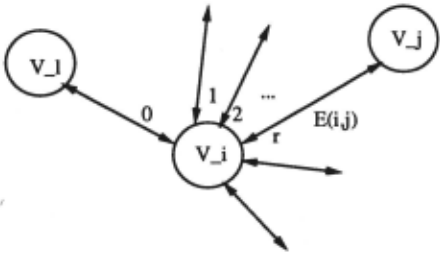
The definition of an edge is extended slightly to allow for the explicit specification of the order of edges incident upon each vertex of the graph embedding. This ordering is obtained by enumerating the edges in a systematic manner (e.g. clockwise if the graph is planar) from some standard starting direction. An edge Ei,j incident upon Vi and Vj is assigned labels n and m, one for each of Vi and Vj respectively. n represents the ordering of the edge Ei,j with respect to the consistent enumeration of edges at Vi, m represents the ordering of the edge Ei,j with respect to the consistent enumeration of the edges at Vj . The labels m and n can be considered as general directions, e.g. from vertex Vi the nth exit takes edge Ei,j to vertex Vj.
Movement and Action The robot can move from one vertex to another by traversing an edge (a move), it can pick up a marker that is located at the current ver tex, and it can put down a marker it holds at the current vertex (a marker operation). The robot in general has K markers at its disposal.
Assume the robot is at a single vertex, Vi, having en tered the vertex through edge Ei,l· In a single move, it leaves vertex Vi for vertex Vj by traversing the edge E;,j, which is r edges after E;,1 according to the edge order at vertex Vi (see Figure 1). This is given by the transition function:
We assume the following property about the transition function:
If 6(v;,E;,1,r) = Vj and 6(vj,Ei,j,s) = Vt, then 6(vj,Ej,k,-s) =Vi.
This implies that a sequence of moves is invertible, and can be retraced. We also assume that there does not ex ist at -:f; -s such that 6(vj,E-,t,t) =Vi and that there does not exist at such that o(vj' Ej,k, t) = Vj' i.e. there are no redundant or degenerate paths.
A single move is thus specified by the order r of the edge along which the robot exits the current vertex, where r is defined with respect to the edge along which the robot entered such vertex. Note that in the special case of a planar embedding of a graph, enumeration of edges in a clockwise fashion satisfies the above assump tion.
Perception The robot's perception is of two kinds, marker-related and edge-related perception.
Marker-related Perception. Assume that the robot is at vertex v;, having arrived via edge E;,j. The marker-related perception of the robot is a K-tuple B, = (bs1, bs2, ... , bsK), where bsJ: has a value from the set {present, not- present}, according to whether marker k is present at vertex v;.
Edge-related Perception. The robot can determine the relative _positions of edges incident on the vertex v; in a consistent manner, e.g. by a clockwise enumeration (in the planar case) starting with E;,j. As a result, it can assign an integer label to each edge incident on v;, rep resenting the order of that edge with respect to the edge enumeration at v;. The label 0 is assigned arbitrarily to the edge E;,j, through which the robot entered ver tex v;. The ordering is local, because it depends on the edge Ei,j· Entering the same vertex from two different edges will lead to two local orderings, one of which is a permutation of the other. Note that if the graph is planar and a spatially consistent (e.g. clockwise) enu meration of edges is used, then two permutations will be simple circular translations of each other. But this will not hold in general, and in this paper we only assume that the edges can be ordered consistently. If the robot visits the same vertex twice, it must relate the two differ ent local orderings produced and unify them into a single global ordering, for example by finding the label of the 0-th edge of the second ordering with respect to the first ordering. Determining when the same vertex has been visited twice and generating a global ordering for each vertex is part of the task of the following algorithms.
3 Map building: exploration
In earlier work ([Dudek et al., 1988; Dudek et al., 1991]) we demonstrated that in general it is not possible for a robot to explore and map an unknown environment with this sort of limited sensory perception. Additional infor mation is required. This is not a particularly startling re sult: fairy tales, and mythology are full of stories of heros who avoided becoming lost within a maze by dropping markers or unwinding string as they went . The basic problem is that, when the explorer enters an unknown environment, he cannot always determine if he has re turned to a previously visited location.
In these earlier papers it was also demonstrated that, as long as the explorer had a single unique marker which could be dropped and picked up at will, it was possi ble for the explorer (or robot) to fully map his environ ment (an arbitrary graph) within O(N 3 ) steps (although complexity for most typical cases appears substantially better than this worst-case bound). The basis of the al gorithm is the maintenance of an explored subgraph of the full graph. As new vertices are encountered, they are added to the explored subgraph, and their outgoing edges are added to the set of edges that lead to unknown places and therefore must be explored.
The cost of exploring the graph in terms of edges tra versed by the robot (mechanical complexity) is O(N 3 ), where N is the number of nodes. This follows from the need to go back and actually visit all of the locations in the known sub-graph to solve the "have I been here before" problem. Often it is not necessary to explore an environment completely from scratch. A map may al ready be available and it may suffice to determine if the existing map of the world corresponds to its current state and, if not, to determine where the two are inconsistent.
4 Map validation
The MAP VALIDATION problem is defined as follows. The robot is given a map of its environment, and it is told which map vertex is its current location and also the correspondence between one map edge incident on the current map vertex and a physical exit from the cur rent physical vertex. This gives the robot a position and orientation with respect to the map. The problem is to determine whether the map is correct. One issue is whether this can be done more efficiently than full ex ploration. This paper gives an algorithm for validation that requires at most O(N 2 ) moves of the robot.
The key idea underlying the validation algorithm is to construct a spannin~ tree rooted at the current vertex (a simple operation [Bondy and Murty, 1976]), to verify the presence in the world of that tree first, and then to verify the remaining edges of the graph-like world (which is akin to an exploration task). We now describe the algorithm, in the case in which the robot is equipped with a single movable marker.
- Validate a spanning tree rooted at the start position.
- (a) Compute a spanning tree ST of the map, rooted at the initial vertex v0 .
(b) Validate ST. This involves backup up the tree in the manner of the exploration algorithm to verify that every vertex on the tree is unique and has a local signature (degree) matching the corresponding vertex on the map. This has complexity (N 2 + N)/2 or O(N 2 ) . If this validation fails, the entire validation fails.
- Validate the edges outside the spanning tree, by checking that they connect the correct two vertices. The efficient way to do this is to check all edges that are incident on a single vertex with a single physical traversal of the graph.
- For each vertex v; of the graph (connected to at most N - 1 vertices)
- (a) leave the marker there
- (b) visit all neighbours of v;, Vj of the map via ST ( O(N) effort )
- (c) for each Vj (having an edge ( v;, vi) accord ing to the map) check physically whether edge ( v;, vi) exists by traversing it and looking for the marker at the other end.
Step 1 is based on traversing the spanning tree for the graph. A graph's spanning tree has O(N) nodes and O(N) edges and thus this step requires O(N 2 ) moves of the robot. Note that a graph's spanning tree can be computed efficiently [Bondy and Murty, 1976].
Step 2 requires, in the worst case, O(N 2 ) moves.
Thus, the entire algorithm requires 0( N 2 ) moves in the worst case.
In the case in which we have at least N movable, dis tinguishable markers available, we can save a substantial number of moves by making a single re-traversal of the spanning tree to validate all non-tree edges. In this case, O(M) moves may be required in the worst case, for M the number of edges in the graph.
For the case of k markers, · where k < N, we cut the number of traversals of the spanning tree by a factor k by placing all k markers at different vertices, and then traversing the spanning tree ST once for this marker placement , thereby validating the edges incident on all k vertices.
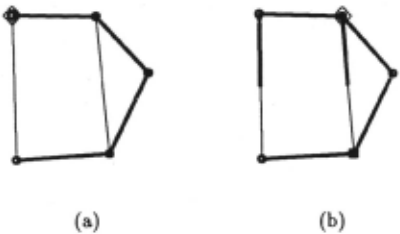
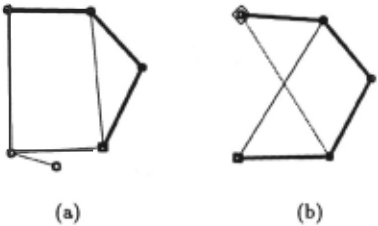
Figure 2 shows the state of the validation process at two stages in the validation of a simple graph. Figure 2a shows the validation process after the validation of the spanning tree of the graph, while Figure 2b shows the same graph . after half of each of the graph edges have been validated. Treating this graph as a map, two cor rupted versions and the point of failure of the validation process are shown in Figure 3. Figure 3a is a graph having an extra edge. The validation process (indicated by the heavy lines) fails in the spanning tree validation stage as the spanning trees do not agree (the degree of one of the nodes on the spanning tree is incorrect). Fig ure 3b shows a corrupted world in which the spanning trees agree but · in which the graph edges are incorrect. Here the spanning tree is constructible, but the graph edges disagree.
5 Self-location and validation if the current position and orientation is unknown
Now consider the more general problem in which the robot is given a map of its environment, but is not told its location and orientation with respect to the map. In this section we show an algorithm for performing two tasks at once: validating the correctness of the map, and, in case the map is correct, finding the correspon dence between the map and the world. The latter is the SELF-LOCATION PROBLEM, which in our case involves identifying the initial vertex on the map and/or the cor rect "orientation" (i.e. the mapping between physical exits from that vertex and map edges incident on that vertex).
Two major issues are involved here:
- Under what conditions does the problem have a unique solution? In graphs with symmetries it may not be possible to uniquely identify the robot posi tion.
- Can the problem can be solved efficiently? This pa per gives an al§orithm for SELF-LOCATION problem that uses O(N ) moves.
To solve the general problem, we first form all possi ble hypotheses using the given map, corresponding to all possible initial vertices and orientations (i.e. their refer ~nce edges) in the map. The number of such hypotheses
If D is the maximum degree of any vertex, the number of hypotheses is O(N D) . Assuming that D = O(N), there are O(N 2 ) hypotheses in total (in typical real environ ments D << N) .
The idea of the algorithm is to carry out exploration but, at the same time that we form the explored sub graph S :1.nd the list of unexplored dges U, we also es tablish a correspondence between their elements ( ver tices and edges) and elements of each hypothesis. Such a correspondence creates expectations about the vertices and edges that are being explored, which, when violated, cause the rejection of a hypothesis. In other words, the robot "imagines" that each hypotheses is correct until this is contradicted by what is found in the real world.
The above algorithm is identical to the exploration al gorithm described in [Dudek et al., 1991], except that additional data structures are added to it. We gener ate one map for each hypothesis, and we establish links from the edges and vertices of each hypothesis to the edges and vertices of the explored subgraph. With each step of the exploration algorithm, we scan all of the hy potheses and then check whether their expectations are satisfied, rejecting the hypotheses for which they are not. It should be noted that in realistic situations, pruning of most hypotheses would occur extremely quickly. For ex ample, all hypotheses that have an incorrect degree for the starting node are immediately falsified. The algo rithm that performs self location has three major stages, each of which consists of an exploration action and result followed by management of the set of map hypotheses. These stages are as follows.
Exploration action: Vertex Validation. A step of the algorithm consists of the selection of an unexplored edge e from U, and validation of the vertex v2 at the other end of edge e = ( v1 , v2 ). Validation of the vertex consists of placing the marker there and visiting all ver tices of S, staying insideS, looking for the marker. If the marker is found at vertex Vi of the explored subgraph, then vertex v2 is identical to the already known vertex Vi .
Hypothesis testing action: Vertex validation. Each hypothesis expects a specific Vi, and if the true Vi is not the expected one, the hypothesis is rejected. For the remaining hypotheses, Vi is linked with the appropriate vertex, as well as all the incident edges.
Exploration action: Vertex inS and Edge order ing. In case vertex v2 is in S, edge e = ( v1 , v2) must be assigned an index with respect to the edge ordering of vertex v2 . To determine this, the robot drops the marker at v1 and goes back to v2 along the shortest path in the explored subgraph S. At v2 , it tries going out of the vertex along each of its incident edges. One of them will take the robot back to Vt, which the robot will immedi ately recognize by the existence of the marker. Note that the index of e with respect to the edge ordering of v1 is known by construction. Edge e is added to the subgraph S and removed from U.
Hypothesis testing action: Vertex in S and Edge ordering. Each hypothesis expects a specific index for e with respect to vertex v2, and therefore if the true index is not the same as expected, the hypothesis is rejected.
Exploration action: Vertex not inS. If the marker is not found anywhere in S, then vertex v2 is not in the subgraph S and therefore must be added to it. The unexplored edge e is also added to S, which has now been augmented by one edge and one vertex. Edge e is the reference edge for vertex v2· All other edges incident on v2 are assigned an index with respect to it and added to U.
Hypothesis testing action: Vertex not inS. Each hypothesis expects a specific degree for v2 . Therefore, if the true degree is not the same as expected, the hypoth esis is rejected.
The above algorithm performs validation and self location simultaneously, since only the following cases are possible:
- The map is correct, in which case a single hypothesis will not get rejected until the whole graph has been explored. This hypothesis establishes the proper mapping between the map and the world.
- The map is correct and contains symmetries, in which case more than one hypothesis may remain valid until the end. In this case we can safely dis card all valid hypotheses but one (they are identical anyway), and use it for solving path planning prob lems in that world.
- The map is incorrect, in which case all hypotheses get rejected sooner or later.
In the case of a correct map with symmetries, the self location problem is unsolvable without additional infor mation. Examples of additional information which may be brought to bear include: metric information on dis tances and orientation, the ability to check whether a region with a given cycle as its boundary contains a ver tex not belonging to the cycle, or the ability to decide which side of an edge a vertex is on - treating edges as infinite lines that divide 2D space into two [Levitt and Lawton, 1990].
6 Discussion and Conclusions
We have considered issues relating to the use of a priori maps of an environment. A realistic problem is that of how to deal with changes to the environment or errors in the map. We call this the MAP RECOVERY PROBLEM: given a partially incorrect map of an environment, how can one (optimally or near-optimally) determine where the errors in the map are and correct them. This could arise, for example, either is a map was constructed in correctly or if the environment changed. Assumptions are the same as those for the validation algorithm. Of course, if the map is totally different from the world, one has to discard it and run the full exploration algorithm. In general, there are various ways in which one map can be modified to produce another; the precise definition of optimality is crucial. However, if we limit the allow able set of transformations, it may be possible to devise efficient algorithms for fixing a "defective" map. For ex ample, possible constraints could be: to assume damage is local, only node deletion might be allowed but no node addition, only edge deletion might be allowed, etc. Many such constraints have real world analogues (for example, only edge deletions might correspond to navigating in an office where some of the doorways had been closed) . We leave this as a future research problem.
We have presented new algorithms that suggest how a mobile robot might make use of a priori maps of a known environment. The SELF-LOCATION and MAP VAL IDATION problems suggest how a robot with a map could initially begin using it once out of the packing crate it was shipped in. The algorithms presented here have been implemented and a number of experiments has been conducted on several types of random graphs [Bollobas, 1985] . Comparisons between the actual performance of the exploration and the validation algorithm, as well as three-dimensional examples, are presented in [Dudek et al., 1993]. In another paper of this proceedings [Dudek et a/. , ], the case of exploration without markers is being examined.
@inproceedings{ijcai1993p228,
  title     = {Map Validation and Self-location in a Graph-like World},
  author    = {Dudek, Gregory and Jenkin, Michael R. M. and Milios, Evangelos E. and Wilkes, David},
  booktitle = {Proceedings of the Thirteenth International Joint Conference on
               Artificial Intelligence, {IJCAI-93}},
  publisher = {International Joint Conferences on Artificial Intelligence},
  editor    = {Ruzena Bajcsy},
  pages     = {1648--1652},
  year      = {1993},
  note      = {Robotics and Vision},
  url       = {https://ijcai.org/proceedings/1993/228},
}
TY - CPAPER TI - Map Validation and Self-location in a Graph-like World AU - Dudek, Gregory AU - Jenkin, Michael R. M. AU - Milios, Evangelos E. AU - Wilkes, David T2 - Proceedings of the Thirteenth International Joint Conference on Artificial Intelligence, IJCAI-93 PB - International Joint Conferences on Artificial Intelligence PY - 1993 SP - 1648 EP - 1652 UR - https://ijcai.org/proceedings/1993/228 ER -Copied
Machine-readable versions of this paper, for tools and AI agents:





