
A Symbolic Model for Learning the Past-Tenses of English Verbs
Proceedings of the Thirteenth International Joint Conference on Artificial Intelligence. Natural Language. Pages 1143-1148.
© 1993 International Joint Conferences on Artificial Intelligence
Abstract
Rumelhart and McClelland first studied and implemented an artificial neural network (ANN) model for learning the past tenses of English verbs, and it became a landmark test for ANNs in language learning. Their model received widespread criticism from Pinker & Prince, Lachter & Bever, Plunkett & Marchman, and Prasada & Pinker. Recently MacWhinney and Leinbach design a new ANN model in an attempt to answer some of the criticisms: They even pose a specific challenge claiming that no symbolic model can perform as well as their ANN. In this paper, we take up their challenge, and construct a Symbolic Pattern Associator (SPA) that can learn symbolic trees and rules from any input/output patterns. In an experimental comparison with the connectionist models based on the same set of verbs, the SPA is able to generalize much better from the training examples to unseen regular and irregular verbs. The SPA's results are also more psychologically realistic than ANN models when compared with human subjects. In addition, the SPA represents the acquired knowledge in symbolic rules which are meaningful to human observers. Such rules can be generalized further and can be integrated in other knowledge domains and language learning modules. Our results support the view that language learning and language processing is a rule-governed process.
- [Atlas et al., 1990] L. Atlas, R. Cole, J. Connor, M. El- Sharkawi, R. Marks, Y Muthasamy, and E. Barnard. Per- formance comparisons between backpropagation networks and classification trees on three real-world applications. In D. Touretzky, editor, Advances in Neural Information Pro- cessing Systems, Vol 2, pages 622 -629. San Mateo, CA: Morgan Kaufmann Inc., 1990.
- [Fodor and Pylyshyn, 1988] J.A. Fodor and Z. Pylyshyn. Connectionism and cognitive architecture: A critical anal- ysis. In S. Pinker and J. Mehler, editors, Connections and Symbols, pages 3 -71. Cambridge, MA: MIT Press, 1988.
- [Kim et al., 1991] J. Kim, A. Pinker, A. Prince, and S. Prasada. Why no mere mortal has ever flown out to center field. Cognitive Science, 15:173 -218, 1991.
- [Kucera and Francis, 1967] H. Kucera and W. Francis. Com- putational Analysis of Present-Day American English. Provedance, Rl: Brown University Press, 1967.
- [Lachter and Bever, 1988] J. Lachter and T. Bever. There- lation between linguistic structure and associative theories of language learning -a constructive critique of some con- nectionist learning models. In S. Pinker and J. Mehler, editors, Connections and Symbols, pages 195 -24 7. Cam- bridge, MA: MIT Press, 1988.
- [MacWhinney and Leinbach, 1991] B. MacWhinney and J. Leinbach. Implementations are not conceptualizations: Revising the verb model. Cognition, 40:121 -157, 1991.
- [MacWhinney, 1990] B. MacWhinney. The CHILDES Project: Tools for Analyzing Talk. Hillsdale, N J: Erlbaum, 1990.
- [Muggleton and Feng, 1990] S. Muggleton and C. Feng. Ef- ficient induction of logic programs. In Proceedings of first International Conference on Algorithmic Learning Theory. OHMSHA Tokyo, 1990.
- [Pinker and Prince, 1988] S. Pinker and A. Prince. On lan- guage and connectionism: Analysis of a parallel dis- tributed processing model of language acquisition. In S. Pinker and J. Mehler, editors, Connections and Sym- bols, pages 73 -193. Cambridge, MA: MIT Press, 1988.
- [Pinker, 1991] A. Pinker. Rules of language. Science, 253:530 -535, 1991.
- [Plotkin, 1970] G.D. Plotkin. A note on inductive general- ization. In B. Meltzer and D. Michie, editors, Machine In- telligence 5, pages 153-163. Elsevier North-Holland, 1970.
- [Plunkett and Marchman, 1991] K. Plunkett and V. March- man. U-shaped learning and frequency effects in a multi- layered perceptron: Implications for child language acqui- sition. Cognition, 38:43 -102, 1991.
- [Prasada and Pinker, 1992] S. Prasada and A. Pinker. Gen- eralization of regular and irregular morphological patterns. In press, Language and Cognitive Processes, 1992.
- [Quinlan, 1986] R. Quinlan. Induction of decision trees. Ma- chine Learning, 1(1 ):81 -106, 1986.
- [Quinlan, 1990] J.R. Quinlan. Probabilistic decision tree. In Y. Kodratoff and R.S . Michalski, editors, Machine learn- ing: An artificial intelligence approach, volume III. Mor- gan Kaufmann Publishers, 1990.
- [Rumelhart and McClelland, 1986] D. Rumelhart and J. Mc- Clelland. On learning the past tenses of english verbs. In D. Rumelhart, J. McClelland, and the PDP Re- search Group, editors, Parallel Distributed Processing Vol 2, pages 216 -271. Cambridge, MA: MIT Press, 1986.
- [Shavlik et al., 1991] J.W. Shavlik, R.J. Mooney, and G.G. Towell. Symbolic and neural learning algorithms: An ex- perimental comparison. Machine Learning, 6(2):111-144, 1991.
- [Valiant, 1984] L.G. Valiant. A theory of the learnable. Comm. ACM, 27(11):1134-1142, 1984.
References were extracted automatically from the PDF and may contain errors.
Full text extracted automatically from the PDF; figures, tables and equations may differ. The PDF is the version of record.
1 Introduction
One of the most important connectionist contributions to language learning and language processing studies has been the attempt to model children's acquisition of the past tenses of English verbs. After the publication of the results of the first landmark connectionist simulation of this learning task [Rumelhart and McClelland, 1986], a number of critical reviews [Pinker and Prince, 1988; Lachter and Bever, 1988; Plunkett and Marchman, 1991; Pinker, 1991; Kim et a/., 1991; Prasada and Pinker, 1992] have appeared. A subsequent attempt at improv- Marin Marinov Department of Philosophy Sofia University 15 Ruski Bd., Sofia-1000, Bulgaria ing the original results with a new connectionist model was made by MacWhinney and Leinbach [MacWhin ney and Leinbach, 1991]. The connectionist models of learning the English past tense are specifically designed to refute the hypothesis that cognition in general, and language learning in particular, can best be explained as a rule-governed process where rules operate on sym bolic representations. The debate about the validity of this Rules and Representation Hypothesis is central to the dispute between connectionism and the symbol processing approach ( cf. [Fodor and Py lyshyn, 1988; Pinker and Prince, 1988]) . The proper way of debating is by contrasting competitive implementations. Thus, a symbolic implementation is needed that can be con trasted with the connectionist models. This is, in fact, a specific challenge posed by MacWhinney and Lein bach [MacWhinney and Leinbach, 1991], claiming that no symbolic methods would work as well as their model. In this paper we present a Symbolic Pattern Associa tor that can learn the past tenses of English verbs much better than the connectionist models. But in sharp con trast to the connectionist models, our SPA can express the acquired knowledge in production rules. Our results support the view that language learning and language processing is a rule-governed process.
2 Review of Previous Work
No previous symbolic methods have been tried on this task. We review the two main connectionist models of learning the past tenses of English verbs and the subse quent criticism in this section.
2.1 Rumelhart and McClelland's Model
Rumelhart and McClelland's PDP (Parallel Distributed Processing) learning model [Rumelhart and McClelland, 1986] is designed specifically to refute the Rules and Rep resentations Hypothesis. They claim that the outcome of their experiment disconfirms the view that there exist ex plicit (inaccessible) rules that underlie human knowledge oflanguage. Rumelhart and McClelland's model is based on a simple perceptron-based pattern associator inter faced with an input/output encoding/decoding network which allows the model to associate verb stems with their past tenses using a special Wickelphone/Wickelfeature phoneme-representation format . The learning algorithm is the classical perceptron convergence procedure. Rumelhart and McClelland's simulation use the "tra ditional" learning paradigm in which the training and the testing sets are mutually disjoint . The errors made by the model during the training process broadly follow the U-shaped learning curve in the stages of acquisition of the English past tense exhibited by young children. The testing sample consists of 86 "unseen" low frequency verbs (14 irregular and 72 regular) that are not randomly chosen. The testing sample results have a 93% error rate for the irregulars. The regulars fare better with a 33.3% error rate. Thus, the overall error rate for the whole test ing sample is 43% - 37 wrong or ambiguous past tense forms out of 86 tested.
2.2 MacWhinney and Leinbach's Model
MacWhinney and Leinbach [MacWhinney and Leinbach, 1991] report a new connectionist model on the learning of the past tenses of English verbs. They claim that the results from the new simulation are far superior to Rumelhart and McClelland's results and that they can answer most of the criticisms addressed at the earlier model. The major departure from Rumelhart and Mc Clelland's model is that the Wickelphone/Wickelfeature representational format is replaced with the UNIBET [MacWhinney, 1990] phoneme representational system which allows the assignment of a single-letter ASCII code to each phoneme. However, MacWhinney and Leinbach use special templates with which to code each phoneme and its position in a word. The actual input to the net work is created by coding the individual phonemes as disjoint sets of phonetic features in a way similar to the coding of Wickelphones as Wickelfeatures. The network has two layers of 200 "hidden" units fully connected to adjacent layers. This number is arrived at through trial and error. In addition, MacWhinney and Leinbach' s network has an additional special-purpose set of connec tions that allow it to copy the left-justified phonological form of the input directly onto the output in order to facilitate learning.
Altogether 2062 regular and irregular English verbs are selected for the experiment - 1650 of them are used for training (1532 regular and 118 irregular) but strangely only 13 low frequency irregular verbs are used for testing. (cf. [MacWhinney and Leinbach, 1991], p. 144). Training the network takes 24,000 epochs. At the end of training there are still 11 errors on the irregular pasts. MacWhinney and Leinbach believe that if they allow the network to run for several additional days and give it additional hidden unit resources, it probably can reach complete convergence. ([MacWhinney and Lein bach, 1991], p. 151) The error rate on the very small and biased test sample of 13 unseen irregular verbs is 69.2%! However, for no obvious reason they do not test their model on any of the unseen regular verbs. ([MacWhin ney and Leinbach, 1991], p. 151) Further, more "hid den" features in representation that may facilitate learn ing (such as phonetic feature coding, templates, copy connections) are assumed than in the first ANN simula tion by Rumelhart and McClelland. Thus, MacWhinney and Leinbach's new model actually represents a set-back in comparison to Rumelhart and McClelland's model, rather than an improvement .
2.3 Criticism of the Connectionist Models
Previous and current criticism of the connectionist mod els of learning the past tenses of E;nglish verbs cen tre mainly on several issues [Pinker and Prince, 1988; Lachter and Bever, 1988; Plunkett and Marchman, 1991; Pinker, 1991; Kim et al., 1991; Prasada and Pinker, 1992]:
- Very high error rates and low reliability of the ex perimental results.
- Inappropriateness of the training and testing proce dures.
- "Hidden" features of the representational format and the network architecture that facilitate learn ing.
- Opaque knowledge representation and integration of acquired knowledge.
3 The Symbolic Pattern Associator
Unfortunately, in the absence of a symbolic learning model that could match even the modest results achieved by Rumelhart and McClelland's and MacWhinney and Leinbach's models, the connectionists could set aside all criticism of their models. Noting the absence of rival symbolic models MacWhinney and Leinbach pose a spe cific challenge to the critics of connectionism:
If there were some other approach that pro vided an even more accurate characterization of the learning process, we might still be forced to reject the connectionist approach, despite its successes. The proper way of debating concep tualizations is by contrasting competitive im plementations. To do this in the present case, we would need a symbolic implementation that could be contrasted with the current implemen tation. ([MacWhinney and Leinbach, 1991], p.153)
We take up MacWhinney and Leinbach's challenge and present a symbolic learning model that can learn the past tenses of English verbs much better than any PDP model so far. We hope that the success of our symbolic learning model will demonstrate the vacuousness of the connectionist criticism of the Rules and Representations Hypothesis.
The core of our model is a general purpose Symbolic Pattern Associator (SPA for short). The SPA is a very general and efficient symbolic algorithm for associating arbitrary patterns which have a finite number of at tributes. If all the attribute values are discrete or sym bolic, ANNs do not have any systematic advantage over the SPA in their prediction or generalization ability. On the contrary, as this paper will demonstrate exactly the opposite is true in the task of learning the English verb past tenses.
3.1 The Architecture of the Symbolic Pattern Associator
The SPA is based on c4.5 [Quinlan, 1990] which is an implementation of the ID3 learning algorithm [Quinlan, 1986]. ID3 is a program for inducing classification rules in the form of decision trees from a set of given exam ples which may contain unknown or noisy entries. It uses information gain as a criterion to select attributes as roots of the subtrees. The divide and conquer strat egy is recursively applied in building subtrees, until all remaining examples in the training set belong to a sin gle concept (class) ; then a leaf is labeled as that con cept. The information gain guides a one-step look-ahead greedy heuristic search for the most relevant or discrim inative attribute that maximally reduces the entropy in the divided set of the examples. The use of this heuris tic results in building small decision trees which have a good generalization power in general.
Although ID3 has been very successful in compet ing with the learning and representational capabilities of neural networks, they are essentially limited in the type of learning task that they can perform. If the task is to learn to classify a set of different patterns into several mutually exclusive categories, as many of the most successful connectionist simulations actually do, ID3 has been shown to perform as well as, or even some times better than neural networks [Shavlik et a/., 1991; Atlas et a/., 1990]. However, if the task is to classify a set of (input) patterns into (output) patterns of many attributes, ID3 cannot be applied directly. The reason is that since ID3 treats the different output patterns as mutually exclusive classes, the number of classes would be exponentially large, and more importantly, any gen eralization among attributes within the patterns would be lost .
To turn ID3 or any similar classification system into general purpose symbolic pattern associators, we apply ID3 on all output attributes and combine individual de cision trees into a "forest" or set of trees. Each tree takes as input the set of all attributes in the input patterns, but is concerned with determini"ng the value of one at tribute in its output pattern. More specifically, if the attributes ofinput (t1 to tn) and output (w1 towm) pat terns can be represented as:
Ll, ... , Ln; Wl, ... ,Wmthen a total of m decision trees are built, one for each output attribute Wi (1 ~ i ~ m) taking all input at tributes t1, ... , Ln per tree. Once all of m trees are built using ID3, they can be used jointly to determine the out put pattern w1, .. . ,wm from any input pattern t1, .. . ,Ln. Clearly, any pattern association task can be solved by the SPA. Similar to ID3, our SPA is very general and simple to use: one only needs to prepare input and out put attribute name files, and training and testing files containing pairs of patterns.
An important feature of the SPA is explicit knowledge representation. Since decision trees can be transformed into propositional rules, sets of rules for all output at tributes can be obtained. These rules are sometimes meaningful to the human observer . In addition, further processing and integration of these rules with high-level knowledge is possible (see SECTION 4.4) .
3.2 Application of the SPA to the Learning of Past Tenses
In order to answer the challenge posed to the sym bolic processing approach by the connectionist models of learning the past tenses of English verbs, we structured our experiment in such a way as to guarantee a maximal common basis for a comparison between the performance of these models and the SPA. Since MacWhinney and Leinbach used a much larger set of verbs than Rumel hart and McClelland, we borrowed their original list of verbs. The set that we use contains 1404 stem/past tense pairs. Because of the large overlap in the verb sets used in our experiment and in MacWhinney and Leinbach's simulation, our results can be compared directly with their results. Even though Rumelhart and McClelland used altogether only 506 verbs, the overlap between the two sets is still sufficient for a similar comparison.
However, in order to guarantee a more thorough test ing of the SPA and a fair comparison with the connec tionist models, we decided on several significant changes in MacWhinney and Leinbach's, and Rumelhart and Mc Clelland's experimental set up:
- We do not use Wickelphones/Wickelfeature, pho netic features, or consonant/vowel templates. In stead , we use simple and straightforward left to-right ASCII coding of phonemes in UNIBET [MacWhinney, 1990] format . Also, unlike MacWhinney and Leinbach's model , we do not include any special purpose copying devices that would allow for a present tense form of a verb to influence directly the output of our system. Below are some input/output pairs of verbs (shown in the spelling form) (abandon- abandoned), (accelerate accelerated), (arise- arose), and (become- became) used in SPA (where$ represents blank) :
- To guarantee unbiased and reliable results, we use only randomly drawn training and testing samples in several independent trials. This allows us, in con trast to the connectionist simulations, to vary the sizes of the training and testing samples at different trials and thus to achieve a more robust estimate of the inductive generalization capabilities of our model.
- Two methods of random sampling are implemented. (1) Adopting the traditional learning paradigm, both training and testing samples contain at most one copy of each stem/past-tense verb pairs. Both training and testing samples are drawn randomly from the whole set of 1404 verb pairs with no over lap between training and testing. Both regular and irregular verbs may be drawn randomly into train ing/testing samples. This set-up best tests the gen eralization power of the SPA.
6,b,t,n,d,6,n,$,$,$ ... > 6,b,t,n,d,6,n,d,$,$,$,$ .. . I,k,s,E,l,6,r,e,t,$ ... > I,k,s,E,l,6,r,e,t,I,d,$ . . . 6,r,3,z,$,$,$,$,$,$ ... > 6,r,o,z,$,$,$,$,$,$,$,$ .. . b,I,k,6,m,$,$,$,$,$ ... > b,I,k,e,m,$,$,$,$,$,$,$ .. .(2) Adopting the PAC [Valiant, 1984] learning paradigm, both training and testing samples are drawn randomly from the same set of verbs (with replacement) according to a probability distribution proportional to the Kucera-Francis frequency of the verbs [Kucera and Francis, 1967]. Thus, the error rate in the testing sample converges to the proba bility of incorrect response of a verb stem randomly drawn according to the same probability distribu tion. Verb pairs may have multiple copies in train ing/testing samples, and training and testing sam ples may overlap. This set-up best reflects the ac tual learning of children who encounter frequently used verbs more often. Using testing and training samples with possible overlap best reflects how well they could have learned in the same environment.
Note that no information about regular or irregu lar forms is provided in both training and testing in put/output verb pairs. It is SPA's task to learn rules for regular and irregular verbs, and to apply acquired rules to unseen verbs, which can be either regular or irregular, unknown to SPA.
4 Learning Results of the SPA
4.1 Performance Comparison between the SPA and the Connectionist Models
The results from the two series of experiments allow us to make a direct comparison between the inductive generalization capabilities of the SPA and the neural networks used in the connectionist simulations. TA BLE 1 compares the error rates of Rumelhart and Mc Clelland's model (R&M), MacWhinney and Leinbach's model (M&L) and the two averaged results (both with 1,000 training examples) achieved by the SPA by adopt ing the "traditional" and the PAC learning paradigms 1 . It is interesting to study the kind of errors that the SPA makes using the traditional learning paradigm (no overlap between training and testing). Incorrect results for irregular verbs are mainly due to the fact that they are treated by the SPA as regular (Reg.), but the no change (No-chg.), vowel change (V-chg.), and consonant change (C-chg.) errors contribute relatively little to the overall error rate. Note that most of the no-change, vowel change and consonant change are more or less ;========:;:;:::::::;;:;;::;:;::::::;::::::;;:;::::;=::::;::=~:;==r=:::::;;:;;;::;::===; "meaningful", since children may make the same mis11 R&M I M&<L I Tr .. ~~~n .. I I ~~~ I takes (See Section 4.2) . In contrast to the connectionist simulations, very few errors contain phonetically unreal istic transformations (Imp.). TABLE 2 summarizes the types of errors.
model. If we adopt the traditional learning paradigm, the overall success rate of the SPA is well above the un realistically low success rate of Rumelhart and McClel land's model. MacWhinney and Leinbach did not test the overall inductive capabilities of their model at all. The result of testing irregular verbs is not reliable at all: it based on one test of 13 specifically chosen irregular verbs. On the regular verbs, our model shows a much stronger tendency to capture the regularities underlying regular past formation than do the connectionist models. However, the results of the three models on the irregu lar pasts are not psychologically realistic. One possible solution is to adopt the PAC learning paradigm which resembles much closer the actual learning conditions for humans and can allow a proper use of frequency infor mation. We cannot speculate whether the connectionist models would achieve better results adopting the PAC learning paradigm but it is clear that the performance of the SPA, especially on the irregulars, improves dramat ically.
Another disadvantage for the connectionist models is that they are extremely slow. Possibly, because of this the connectionist simulations did not allow the train ing/testing of several different randomly drawn samples of verbs. This is quite unfortunate because there are hid den pitfalls in carrying out just a single test on a single verb set; the results, especially on irregular verbs, tend significantly to alternate from sample to sample.
| Verb | Sample | Correct | ncorrect ~'lb. | |||
|---|---|---|---|---|---|---|
| I Type | Size | (%) | Rer; . | No-chr; . | V-C-chr;. | mp. |
| lrrer;ular | 35 | 25.7 | 51.4 | 8.6 | 11.4 | 2.9 |
| Rer;u ar | 265 | 89.1 | n " | 6.4 | 3.78 | 0.75 |
| To I& | 300 | 81.7 | 6.0 | 6.1 | 4.63 | 1.0 |
4.2 Comparison to Human Performance on Pseudo-Verbs
It is difficult to compare SPA (or ANNs) performance with human adults in predicting unseen verbs simply be cause all irregular verbs are frequently used in everyday life (in fact, the 10 most frequently used English verbs are irregular). Thus adults know most of the irregu lar verbs already. In order to achieve direct comparison with human subjects on "novel" verbs, we perform an ex periment using Prasada and Pinker (1992) pseudo-verb
| 11 R&M I | M&<L I | Tr .. ~~~n .. I | I ~~~ | |
|---|---|---|---|---|
| emp a. tea | Yea | Yea | No | No |
| Tr&lmD« S&mple S1ze | 420 | 1650 | 1000 | 1000 |
| Teal S&mple Size | 86 | 13 | 300 | 500 |
| R&ndom S&mplea | _No | _ll_o | Yea | Yea |
| Reaulla A ver&«ed Over Muhiple Tria.la | No | No | Yea | Yea |
| 'II> Correcl On ra.~mnr; TO I& Re1ula.ra lrre&ula.rs | 97.0 98 .0 95.0 | 99.3 100.0 90.7 | 100.0 100.0 100.0 | 100 .0 100.0 100.0 |
| "' orrect n eattn& Tolal Re«ulau lrre«ul&u | 57.0 66 .1 7.1 | N/A N/A ~!) 30.8 | 82.2 ± 1.6 89.8 ± 0.9 17.6 ± 8.2 | 93.9 ± 0 .9 92.7 ± 0 .8 95.4 ± 1.2 |
| Av«. Le&rmn« Time | 280 1\U | weeka . | 70.2 aec | 59.5 aec |
Table 1: A comparison between SPA and the Connec tionist Models
It is indisputable that the SPA achieves a much better overall performance than the connectionist models. Al though the training results of the three models are simi lar, the crucial measure of the success of a learning model -the testing results -are clearly in favour of the symbolic testing paradigm to see if SPA produces psychologically realistic results.
1 The average learning time for the SPA is the CPU time obtained from the MIPS M/2000, which is rated at 20 MIPS.
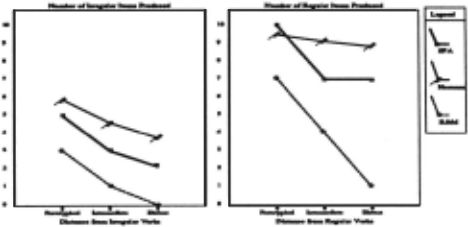
Prasada and Pinker create 60 English-like pseudo verbs. The verbs are divided into two main groups - irregular-like and regular-like pseudo-verbs. Each of these groups are subdivided into three classes - ~roto typical, Intermediate, and Distant [Prasada and Pmk~r, 1992], which resemble to different degrees ordina~y Ir regular and regular English verbs. Prasada and Pmker carry out a test of Rumelhart and McClelland's model using the pseudo-verb paradigm. They train the network oil the 422 verbs (341 regular and 81 irregular) which are used in Rumelhart and McClelland's simulation. The model is trained for 200 epochs and then is tested on the pseudo-irregular verbs. To assess the psychological va lidity of these results, Prasada and Pinker carry out an experiment with 24 native English speakers. They want to test specifically the likelihood of people actually pr~ ducing regular and irregular past tense forms, so that 1t would be possible to compare directly the human results with the connectionist simulations. As we can see (also on FIGURE 1 (a) and (b)), the difference between Rumel hart and McClelland's simulation and human subjects' responses is quite large.
. In order to test the inductive capabilities of the SPA in comparison with human subjects and with Rumel hart and McClelland's connectionist model we perform the following experiment: We train the SPA on all1,404 of the verbs in the original verb set. The training set includes 1,262 regular and 142 irregular English verbs. When we test the SPA on the 60 pseudo-verbs, all of the past tense forms produced by our SPA are "good" pseudo-past forms . That is, in contrast to the Rumel hart and McClelland's model, no normal English verbs and no bizarre consonant changes or strange suffixes are produced. We list (in the spelling form) some of Prasada and Pinker's pseudo-verbs and the past tense forms produced by the SPA after it learns from 1404 (real) verbs. As we can see, SPA is making "intelligent" decisions in predicting past tenses of the pseudo-verbs: some are treated as irregular and SPA produces sensible irregular past tenses, while others are treated as regular verbs.
spling ~--+ splang
skring ~--+ skrung
sprink ~--+ sprink
queed ...... queeded (SPA classifies it as a regular verb)
goav ...... wev (Why? SPA has learnt go~--+ went!)
On FIGURE 1 (a) and (b), our results for the pseudo irregular and for the pseudo-regular pasts ar~ plotted together with the results from the human subJects and from the Rumelhart and McClelland's model. Our re sults for the pseudo-irregular class are actually closer to the result from the human subjects than the results of Rumelhart and McClelland's model. Especially for the pseudo-regular items the SPA performed_ m~ch closer to the human subjects than the connectlomst model. This demonstrates that the SPA's performance on both pseudo-irregulars and pseudo-regulars is psychologically realistic, whereas the connectionist model fails at the pseudo-regulars and is not very close to the human subjects on pseudo-irregulars.
-
Figure 1: (a) Pseudo-Irregular (b) Pseudo-Regular
4.3 U-shaped Learning Curve of Regular and Irregular Verbs
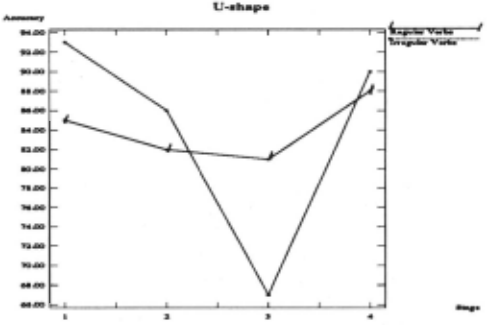
A U-shaped learning curve has been observed in the ac quisition of regular and irregular verbs ~y young c~i! dren. Very briefly, during the early phase m the acqmsl tion of the English past tense, children apparently learn a relatively small number of high frequency irregular and regular verbs correctly. During the intermediate phase, children learn an increased number of medium frequency verbs, the majority of which are regular. Children begin to overregularize the irregular verbs, even the ones that they have correctly learned before. In the late phase, competence similar to that of mature speakers who pr<? duce both regular and irregular past tenses correctly 1s observed.
The SPA is also able to model the U-shaped curve ap parently exhibited by children in the early stages of de velopment that Rumelhart and McClelland try to model [Rumelhart and McClelland, 1986] . To model the U shape using the SPA, we change the training size and m, a parameter in the program c4.5 (ID3). The pa rameter m represents the minimal number of exceptions that c4.5 can tolerate without building new branches to accommodate these exceptions. In all of our other ex periments we report in the paper, m is fixed at 1 (si~ce there is no noise in our data). Four stages of successive past-tense acquisition are created. Training and testing samples are drawn randomly adopting the PAC learning paradigm. This paradigm best reflects the natural learn ing environment in which learning and testing are based on the same probability distribution. The stages are as follows:
- Training size = 500 and m = 1. The verb set is small and the SPA learns/memorizes 100% correctly the training sample. This models the early phase in children's acquisition of the English past tense. Since some irregular verbs have very high frequency, they are reproduced quite well in the testing sam ple by simply memorizing them from the training sample.
- Training size = 1000 and m = 5. When more and more regular and irregular verbs are presented to the SPA, m can be set to a larger number to a!-
low generalization of regular verbs. Since the to tal of regular verbs out-numbers the total of irregu lar verbs in the training sample, such generalization leads to only a small increase in the error rate on regular verbs.
- Training size = 1000 and m = 10. SPA generalizes further . At this time, most learned irregular verbs are treated as "noise" by the SPA and they are sim ply regularized. The second and the third stages model the intermediate phase in children's acquisi tion of the English past tense.
- Training size = 3000 and m = 10. m is now fixed but the training sample is increased. The number of appearances of irregular verbs is increased, and when it is greater than m, these irregular verbs will not be treated as "noise" and branches in the trees for these irregulars are built up. At this stage, the SPA captures rules for regulars and reproduces ir regulars both very well . This models the late phase in children's acquisition of the English past tense, where competence of mature speakers is observed.
See FIGURE 2 for the U-shaped curve produced by the SPA.
-.00~----L----L----L---~--~----~ -·
4.4 Representation of Acquired Knowledge and Higher-Level Processing
We consider the comparative results previously pre sented to be a convincing proof that the SPA outper forms both MacWhinney and Leinbach's, and Rumel hart and McClelland's connectionist models in the task of learning the past tenses of English verbs. However, symbolic learning systems such as our SPA have an addi tional significant advantage over the connectionist learn ing models. In sharp contrast to the complete absence of knowledge representation capacities in connectionist pattern associators, the SPA can express the acquired knowledge in the form of production rules; this is an ex plicit knowledge representation format that opens the possibility for these rules to be generalized and inte grated with lexical, morphological, and syntactic rules. Thus, unlike the connectionist models, the SPA does not
1\
leave the integration of the acquired linguistic knowledge as a complete mystery.
The decision trees produced during the learning pro cess are a useful symbolic format that lends itself to an easy conversion into production rules. In this particu lar experiment, the production rules resulting from the conversion of all trees can be classified into three dif ferent groups, corresponding to the three different types of branches of a "typical" tree - identity-mapping rules, suffix-adding rules, and exceptional changes rules. TA BLE 3 presents a sample of the different types of rules produced by the SPA in one of our experiments. (Note that the indexes have the following meanings: Ln gives the value of the nth comronent of the input vector; Wn - gives the value of the nt component of the output vec tor, and the rule is derived from the nth decision tree.)
| Identity Rules | If t1 - p, then w1 - p If t2 = p, then w2 = p If t 3 = d, then W3 = d If t4 = p, then W4 = p If t5 = i, then W5 = i |
| Exceptional rules (for go ...... went) | If t1 = g and If t2 = o, then w1 = w |
| Suffix-adding rules | lf .t4 = p and t r, =$, then W5 = t If t4 = r and tr, = $, then W5 = d If t 5 = p and L6 = $, then W6 = t If t5 = r and L6 = $, then W6 = d If £6 = p and £7 = $, then W7 = t If L6 = r and t7 = $, then W7 = d |
If we look at the first of the suffix-adding rules we can see that it expresses the following information: look at the fourth phoneme of an input verb form and look at the fifth, if the fourth is /p/ and the fifth is blank, i.e. if we are at a verb ending, then add the unvoiced /t/ as the fifth phoneme to the output form of the verb. The second rule is: if the fourth input phoneme is /r/ and the fifth is blank $, then add the voiced /d/ as the fifth phoneme to the output form of the verb, etc. Since all trees that map input patterns onto the middle portion of the output patterns have a very similar branch struc ture, it is not surprising to find that they all produce very similar production rules. For example, in TABLE 3 we have followed all the productions for the phonemes /r/ and /p/ produced by the fifth, sixth, and seventh trees. In fact, most trees for Wi (i ~ 4) have a very sim ilar structure. This suggests that the SPA has learned to distinguish between verbs that receive a voiced or un voiced suffix '-ed' in the regular past tense formation.
SPA itself cannot generalize from the phonetic rules for verbs of particular length to general phonetic rules for verbs of any length. In essence, SPA (and ANNs) can not make the step from propositional production rules to first-order rules. But because, in contrast to the neu ral networks, the SPA is able to represent its position dependent knowledge in explicit rule form, it is not dif ficult to see how this knowledge can be generalized to first-order form. First, the propositional rules derived by the SPA are changed to a form in which the posi tion indexes are represented as terms. Then there are a number of symbolic learnine; programs, such as GOLEM [Muggleton and Feng, 1990J, which utilize the least gen eral generalization (LGG) [Plotkin, 1970] that can be applied to produce automatically new rules that are position independent first order phonetic rules like: For all n, if L(n) = k & L(n + 1) = $ then w(n + 1) = t where L(n) stands for any phoneme at position n. Clearly, this is a rule in first-order logic and it applies to verbs of any length. Thus, adding suffix to "verb stem" is represented by this rule.
The rules that we have induced by generalizing the position relevant phonetic rules are still purely phonetic. We can easily see that they will give the wrong answer if the phonemes over which they range are part of an adjective or a noun instead of a verb stem. Clearly, we need to integrate these phonetic rules with morphologi cal and lexical information to produce the correct rules for the past-tense formation in English. If purely pho netic information cannot be represented in a form that can be readily interfaced and integrated with lexical, morphological, and syntactical information available to other language processing subsystems, it is hard to imag ine how adult linguistic competence is developed. The connectionist models consider the acquisition of the En glish past tense as a totally isolated affair and fail to explain how the knowledge acquired by the networks is integrated with other types of linguistic knowledge. Symbolic approaches, on the contrary, can represent the acquired knowledge as sets of production rules that can easily be unified into more general first-order phonetic production rules. This highlights the great advantages in terms of representation of acquired knowledge that the SPA has over the connectionist models of language learning.
5 Conclusions
In the paper we present a symbolic method for learning the past tenses of English verbs. In comparison to the connectionist approaches, our method has several dis tinctive advantages, and is much closer to actual human performance. Our results support the view that language learning and language processing is a rule-governed pro cess.
Acknowledgement
We thank B. MacWhinney for providing us with the verb data used in their simulation.
@inproceedings{ijcai1993p158,
  title     = {A Symbolic Model for Learning the Past-Tenses of English Verbs},
  author    = {Ling, Charles X. and Cherwenka, Steven and Marinov, Marin},
  booktitle = {Proceedings of the Thirteenth International Joint Conference on
               Artificial Intelligence, {IJCAI-93}},
  publisher = {International Joint Conferences on Artificial Intelligence},
  editor    = {Ruzena Bajcsy},
  pages     = {1143--1148},
  year      = {1993},
  note      = {Natural Language},
  url       = {https://ijcai.org/proceedings/1993/158},
}
TY - CPAPER TI - A Symbolic Model for Learning the Past-Tenses of English Verbs AU - Ling, Charles X. AU - Cherwenka, Steven AU - Marinov, Marin T2 - Proceedings of the Thirteenth International Joint Conference on Artificial Intelligence, IJCAI-93 PB - International Joint Conferences on Artificial Intelligence PY - 1993 SP - 1143 EP - 1148 UR - https://ijcai.org/proceedings/1993/158 ER -Copied
Machine-readable versions of this paper, for tools and AI agents:





