
Symbolic Revision of Theories with M-of-N Rules
Proceedings of the Thirteenth International Joint Conference on Artificial Intelligence. Machine Learning. Pages 1135-1141.
© 1993 International Joint Conferences on Artificial Intelligence
Abstract
This paper presents a major rev1s1on of the EITHER propositional theory refinement system. Two issues are discussed. First, we show how run time efficiency can be greatly improved by changing from a exhaustive scheme for computing repairs to an iterative greedy method . Second, we show how to extend EITHER to refine M-of-N rules. The resulting algorithm, NEITHER (New EITHER), is more than an order of magnitude faster and produces significantly more accurate results with theories that fit the M-of-N format. To demonstrate the advantages of NEITHER, we present preliminary experimental results comparing it to EITHER and various other systems on refining the DNA promoter domain theory.
- [Buchanan and E.H. Shortliffe, 1984] G.G. Buchanan and eds. E.H. Shortliffe. Rule-Based Expert Systems:The MYCIN Experiments of the Stan- ford Heuristic Programming Project. Addison-Wesley Publishing Co., Reading, MA, 1984.
- [Danyluk, 1991] A. D. Danyluk. Gemini: An integra- tion of analytical and empirical learning. In Proceed- ings of the International Workshop on Multistrategy Learning, pages 191-206, Harper's
- Ferry, W.Va., Nov. 1991.
- [Ginsberg et al., 1988] A. Ginsberg, S. M. Weiss, and P. Politakis. Automatic knowledge based refine- ment for classification systems. Artificial Intelligence, 35:197-226, 1988.
- [Ginsberg, 1990] A. Ginsberg. Theory reduction, the- ory revision, and retranslation. In Proceedings of the Eighth National Conference on Artificial Intelligence, pages 777-782, Detroit, MI, July 1990.
- [Mahoney and Mooney, 1992] J. Mahoney and R. Mooney. Combining symbolic and neural learn- ing to revise probabilistic theories. In Proceedings of the ML92 Workshop on Integrated Learning in Real Domains, Aberdeen, Scotland, July 1992.
- Mahoney and Mooney, in press] J. J. Mahoney and R . J . Mooney. Combining neural and symbolic learn- ing to revise probabilistic rule bases. In Advances in Neural Information Processing Systems, Vol. 5, San Mateo, CA, in press.
- Morgan Kaufman. [Matwin and Plante, 1991]
- S. Matwin and B. Plante. A deductive-inductive method for theory revision. In Proceedings of the International Workshop on Mul- tistrategy Learning, pages 160-17 4, Harper's Ferry, W.Va., Nov. 1991.
- [Murphy and Pazzani, 1991] P. M. Murphy and M. J. Pazzani. ID2-of-3: Constructive induction of M-of- N concepts for discrimin ators in decision trees. In Proceedings of the Eighth International Workshop on Machine Learning, pages 183-187, Evanston, IL, June 1991.
- [Ourston and Mooney, 1990] D. Ourston and R . Mooney. Changing the rules: a comprehensive approach to theory refinement. In Proceedings of the Eighth National Conference on Artificial Intelligence, pages 815-820, Detroit, MI, July 1990.
- Ourston and Mooney, in press] D. Ourston and R . J. Mooney. Theory refinement combining analytical and empirical methods. Artificial Intelligence, in press.
- [Ourston, 1991] D. Ourston. Using Explanation-Based and Empirical Methods in Theory Revision. PhD the- sis, Department of Computer Sciences, University of Texas, Austin, TX, August 1991.
- [Quinlan, 1986] J. R. Quinlan. Induction of decision trees. Machine Learning, 1(1):81-106, 1986.
- [Richards and Mooney, 1991] B. Richards and R. Mooney. First-order theory revision. In Proceed- ings of the Eighth International Workshop on Machine Learning, pages 447-451, Evanston, IL, June 1991.
- [Rumelhart et al., 1986] D. E. Rumelhart, G. E. Hinton, and J. R. Williams. Learning internal representations by error propagation. In D. E. Rumelhart and J . L. McClelland, editors, Parallel Distributed Processing, Vol. I, pages 318-362. MIT Press, Cambridge, MA, 1986.
- [Spackman, 1988] K. A. Spackman. Learning categori- cal decision criteria in biomedical domains. In Proceed- ings of the Fifth International Conference on Machine Learning, pages 36-46, Ann Arbor, MI, June 1988.
- [Towell and Shavlik, 1991] G. Towell and J . Shavlik. Re- fining symbolic knowledge using neural networks. In Proceedings of the International Workshop on Mul- tistrategy Learning, pages 257-272, Harper's
- Ferry, W.Va., Nov. 1991.
- [Towell and Shavlik, 1992] G. Towell and J . Shavlik. Interpretation of artificial neural networks: Map- ping knowledge-based neural networks into rules. In R. Lippmann, J. Moody, and D. Touretzky, editors, Advances in Neural Information Processing Systems, volume 4. Morgan Kaufmann, 1992.
- [Towell et al., 1990] G . G . Towell, J. W. Shavlik, and Michie! 0. Noordewier. Refinement of approximate domain theories by knowledge-based artificial neu- ral networks. In Proceedings of the Eighth National Conference on Artificial Intelligence, pages 861-866, Boston, MA, July 1990.
- [Towell, 1991] G. G . Towell. Symbolic Knowledge and Neural Networks: Insertion, Refinement, and Extrac- tion. PhD thesis, University of Wisconsin, Madison, WI, 1991.
- [Whitehall et al., 1991] B. L. Whitehall, S. C. Lu, and R. E. Stepp. Theory completion using knowledge- based learning. In Proceedings of the International Workshop on Multistrategy Learning, pages 144-159, Harper's Ferry, W.Va., Nov. 1991.
References were extracted automatically from the PDF and may contain errors.
Full text extracted automatically from the PDF; figures, tables and equations may differ. The PDF is the version of record.
1 Introduction
Recently, a number of machine learning systems have been developed that use examples to revise an ap proximate (incomplete and/or incorrect) domain theory lGinsberg, 1990; Ourston and Mooney, 1990; Towell and Shavlik, 1991; Danyluk, 1991; Whitehall et a/., 1991; Matwin and Plante, 1991]. Most of these systems revise theories composed of strict if-then rules (Horn clauses). However, many concepts are best represented using some form of partial matching or evidence sum ming, such as M-of-N concepts, which are true if at least M of a set of N specified features are present in an example. There has been some work on the induc tion of M-of-N rules that demonstrates the advantages of this representation [Spackman, 1988; Murphy and Paz zani , 1991]. Other work has focused on revising rules that have real-valued weights [Towell and Shavlik, 1992; Mahoney and Mooney, 1992]. However, revising theories with simple M-of-N rules has not previously been ad dressed. Since M-of-N rules are more constrained than rules with real-valued weights, they provide a stronger bias and are easier to comprehend.
·This research was supported by the NASA Graduate Stu dent Researchers Program under grant number NGT-50732, the National Science Foundation under grant IRI-9102926, and a grant from the Texas Advanced Research Program un der grant 003658144.
This paper presents a major revision of the EITHER propositional theory refinement system [Ourston and Mooney, 1990; Ourston and Mooney, in press] that is significantly more efficient and is also capable of revising theories with M-of-N rules. EITHER is inefficient because it computes a potentially exponential number of repairs for each failing example. The new version, NEITHER (New EITHER), computes only the single best repair for example, and is therefore much more efficient.
Also, because it was restricted to strict Horn-clause theories, EITHER did not produce as accurate results as KBANN (a neural-network revision system) on the DNA promoter problem [Towell and Shavlik, 1991; Towell and Shavlik, 1992]. Some aspects of the promoter concept fit the M-of-N format, since there are several potential sites where hydrogen bonds can form between the DNA and a protein; if enough of these bonds form, promoter activity can occur. EITHER attempts to learn this concept by forming a separate rule for each poten tial configuration by deleting different combinations of antecedents from the initial rules. Since a combinatoric number of such rules is needed to accurately model an M-of-N concept, the generality of the resulting theory is impaired. NEITHER, however, includes the ability to generalize a rule by lowering the threshold on an M-of N rule. Including threshold changes as an alternative method for covering misclassified examples was easily incorporated within the basic EITHER framework.
To demonstrate the advantages of NEITHER, we present experimental results comparing it to EITHER and various other systems on refining the promoter domain theory. NEITHER runs more than an order of magnitude faster than EITHER and produces a significantly more accurate theory with minor revisions that are easy to understand.
2 Theory Revision Algorithm
2.1 The EITHER Algorithm
The original EITHER theory refinement algorithm has been presented in various levels of detail in [Ourston and Mooney, 1990; Ourston and Mooney, in press; Ourston, 1991]. It was designed to repair propositional Horn-clause theories that are either overly-general or overly-specific or both. An overly-general theory is one that causes an example (called a failing negative) to be classified in categories other than its own. EITHER spe cializes existing antecedents, adds new antecedents, and retracts rules to fix these problems. An overly-specific theory causes an example (called a failing positive) not to be classified in its own category. EITHER retracts and generalizes existing antecedents and learns new rules to fix these problems. Unlike other theory revision systems that perform hill-climbing (and are therefore subject to local maxima), EITHER is guaranteed to fix any arbitrar ily incorrect propositional Horn-clause theory [Ourston, 1991].
EITHER Main Loop
Compute all repairs for each example While some examples remain uncovered Add best repair to cover set Remove examples covered by repair end Apply repairs in cover set to theory
NEITHER Main Loop
While some examples remain end Compute a single repair for each example Apply best repair to theory · Remove examples fixed by repair
Figure 1: Comparison of EITHER and NEITHER algo rithms.
The algorithm used by EITHER for both generalization and specialization is shown in the top half of Figure 1. There are three basic steps. First, all possible repairs for each failing example are computed. Next, EITHER enters a loop to compute a subset of these repairs that can be applied to the theory to fix all of the failing exam ples. This subset is called a cover. Repairs are ranked according to a benefit-to-cost ratio that trades off the number of examples covered against the size of the re pair and the number of new failing examples it creates. The best repair is added to the cover on each iteration. Lastly, the repairs in the cover are applied to the theory. If the application of a repair over-compensates by cre ating new failing examples, EITHER passes the covered examples and the new failing examples to an induction component. 1 The results of the induction are added as a new rule when generalizing or as additional antecedents when specializing.
The time consuming part of this algorithm is the first step where all repairs for a given failing example are found. Figure 2 illustrates this process for theory gen eralization where EITHER is searching for leaf-rule 2 an-
1 EITHER uses a version of lo3 [Quinlan, 1986] for its induction.
2 A leaf rule is a rule whose antecedents include an observ able or an intermediate concept that is not the consequent of any existing rule.
. -- b·c
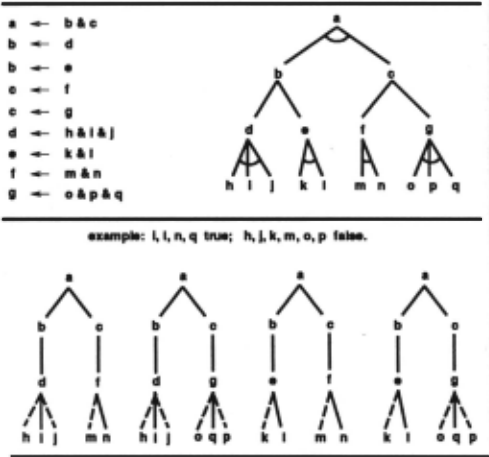
tecedent retractions to correct failing positive examples. The upper half of the diagram shows an input theory both as rules (on the left) and as an AND-OR graph. The lower half of the diagram shows a hypothetical fail ing positive example and its partial proofs. 3 From these proofs there are four possible repairs which will fix the example: retract h, j , m; retract h, j , o , p; retract k, m; retract k, o, p. Theory specialization follows a similar process to return sets of leaf-rule retractions which fix individual failing negative examples.
2.2 Speeding Up EITHER
We have recently implemented a new version of EITHER (NEITHER) that takes a different approach, as shown in the bottom half of Figure 1. Two new algorithms form the basis for the difference between EITHER and NEITHER. First, calculation of repairs is now achieved in linear time. Second, all searches through the theory (for deduction, antecedent retraction and rule retraction) are optimized in NEITHER to operate in linear time by mark ing the theory to avoid redundant subproofs. NEITHER abandons the notion of searching for all partial proofs in favor of a greedy approach which rapidly selects a single best repair for each example. The three steps of the old EITHER algorithm can then be integrated into a single loop (see Figure 1).
To illustrate how repairs are computed in linear time, refer again to Figure 2. Rather than computing all par tial proofs, NEITHER works bottom-up, constructing a single set of retractions. When multiple options exist, NEITHER alternates between returning the smallest op tion and returning the union of the options, depending whether the choice involves an AND or OR node. For generalization, retractions are unioned at AND nodes because all unprovable antecedents must be removed to make the rule provable. At OR nodes, only the smallest set of retractions is kept since only one rule need be prov able. For specialization, these choices are reversed. Re sults are unioned at OR nodes to disable all rules which fire for a faulty concept. At AND nodes, the smallest set of rule retractions is selected since any single failure will disable a rule.
3 A partial proof is one in which some antecedents cannot be satisfied.
| Generalization | SpectahzatiOn | ||||||||
|---|---|---|---|---|---|---|---|---|---|
| change | resulting rule | b | c | be | change | resulting rule | b | c | be |
| orig. rule | a +- 2 of (b,c) | N | N | y | ong. rule | a+- 1 of (b,c) | y | y | y |
| threshold -1 | a+- 1 of (b,c) | y | y | y | threshold + 1 | a+- 2 of (b,c) | N | N | y |
| delete b | a +- c | N | y | y | delete rule | none | N | N | N |
As an example, in Figure 2 the antecedent retraction calculations for the example would begin at the root of the graph, recursively calling nodes b and c. Retraction for node b then recurses on nodes d and e . When the recursion returns back to node b a choice must be made between the results from nodes d and e because node b is an OR node. Since the latter requires fewer retractions, it is chosen as the return value for node b . This process continues, resulting in a final repair: retract k, m.
Note that this algorithm is linear in the size of the theory. No node is visited more than once, and the com putation for choosing among potential retractions must traverse the length of each rule at most once. The fi nal repair is also minimum with respect to the various choices made along the way; it is not possible to find a smaller repair that will satisfy the example. This new algorithm thus trades the complete information available in the partial proofs for speed in computation.
2.3 Adding M-of-N Rules to NEITHER
With M-of-N rules, there are six types of revisions that can be made to a theory. As before, antecedents may be deleted or rules may be added to generalize the theory, and antecedents may be added or rules deleted to spe cialize the theory. The two new revisions are to increase or decrease the threshold: decreasing generalizes a rule and increasing specializes it .
To incorporate these two new revisions, NEITHER must be changed in four places. First, the computation of a repair for each failing example must take thresholds into account . For generalization, one need only retract enough antecedents to make the rule provable; there is no need to retract all false antecedents if the rule has a threshold. For example, if the rule for e in Figure 2 had a threshold of 1 there would be no need to retract k to prove this rule. A similar accounting for thresholds is required for computing rule deletions for specializa tion. Note that during generalization the threshold of each rule from which antecedents are retracted must be decreased by the number of antecedents retracted to ac count for the smaller size of the rule.
Second, NEITHER must compute threshold repairs. Calculating threshold changes can be done in conjunction with the computation of antecedent and rule dele tion repairs since it is directly related to how many of antecedents of a rule are provable. For generalization, we change the threshold to the number of antecedents which are provable. In specialization, we set the threshold to one more than the number of provable antecedents.
Third, a mechanism must be provided for selecting be tween a threshold change and a deletion. Effectively, this amounts to deciding which type of revision to try first. The philosophy used in NEITHER is to try the most ag gressive changes initially in the hopes that the resulting repair will cover more examples. If the repair creates new failing examples, the less ambitious repairs are tried in turn with induction used as a last resort. During gen eralization, more radical repairs are those which create more general rules (i.e., rules which can prove more ex amples). In specialization, the opposite is true. As with EITHER, if all changes result in new failing examples, the algorithm falls back to induction to learn new rules or add new antecedents.
Table 1 compares equivalent threshold and deletion changes for generalization and specialization. The columns labeled with b, c and be indicate whether the corresponding rule will conclude a when just b, just c or both b and c are true. Note that in both cases, the threshold change results in a more general rule. This means that threshold changes should be tried before an tecedent deletions during generalization, but tried after rule deletions during specialization.
Fourth and finally, the induction component of NEITHER must be altered slightly to accommodate threshold rules. When the application of a repair causes new failing examples to occur, NEITHER resorts to in duction as did EITHER. The result of the induction cannot, however, simply be added to the theory as be fore. Table 2 illustrates the problem. The original rule shown can be used to prove both the positive and nega tive examples, and deleting this rule or incrementing its threshold only prevents the positive example from being proved. Assume that induction returns a new feature, d, which can be used to distinguish the two examples (i.e., d is true for the positive example but false for the nega tive example). Because the original rule has a threshold, adding d directly will still allow both examples to prove the rule. This problem remains even if one tries to in crement the threshold in addition to adding d. Instead, the rule must be split by renaming the consequent of the original rule, and creating a new rule with the renamed consequent and the results of induction as the new rule's antecedent list .
| example features | pos. example | neg. example |
| b, c, d | b, -.c, d | b, c, -.d |
| orig. rule | pos. example | neg. example |
| a .- 1 of (b,c) | y | y |
| add to rule | pos. example | neg. example |
| a .- 1 of (b,c,d) | y | y |
| split rule | pos. example | neg. example |
| X - 1 of (b,c) a.- X,d | y y | y N |
3 Experimental Results
3.1 Experimental Design
For the purposes of this paper, the resulting algorithm is labeled NEITHER-MOFN. We tested both NEITHER and NEITHER-MOFN against other classification algorithms using the DNA promoter sequences data set [Towell et a/., 1990]. This data set involves 57 features, 106 ex amples, and 2 categories. The theory provided with the data set has an initial classification accuracy of 50%. We selected this particular data set because EITHER per formed poorly on data sets best modelled using M-of-N rules. In addition to testing EITHER, NEITHER and NEITHER-MOFN, we ran experiments using ID3 [Quin lan, 1986], backpropagation lRumelhart et a/., 1986] and RAPTURE [Mahoney and Mooney, in press] (a revision system based on certainty factors).
The experiments proceeded as follows. Each data set was divided into training and test sets. Training sets were further divided into subsets, so that the algo rithms could be evaluated with varying amounts of train ing data. After training, each system's accuracy was recorded on the test set . To reduce statistical fluctua tions, the results of this process of dividing the examples, training, and testing were averaged over 25 runs. The random seeds for the backpropagation algorithm were reset for each run. Training time, and test set accuracy were recorded for each run. Statistical significance was measured using a Student t-test for paired difference of means at the 0.05 level of confidence (i.e., 95% certainty that the differences are not due to random chance) .
3.2 Results
The results of our experiments are shown in the three graphs of Figures 3, 4 and 5. Figure 3 compares the learning curves of the systems tested, showing how pre dictive accuracy on the test set changes as a function of the number of training examples. As can be seen NEITHER-MoFN's performance was significantly better than all other systems except RAPTURE and KBANN . 4 RAPTURE out-performed NEITHER-MOFN with small numbers of training examples but their accuracy was comparable with larger inputs. NEITHER's accuracy was on par with backpropagation, but was lower than EITHER for small training sets and higher than EITHER
4 Technically, the last difference between backpropagation and NEITHER-MoFN was only significant at the 0.1 level.
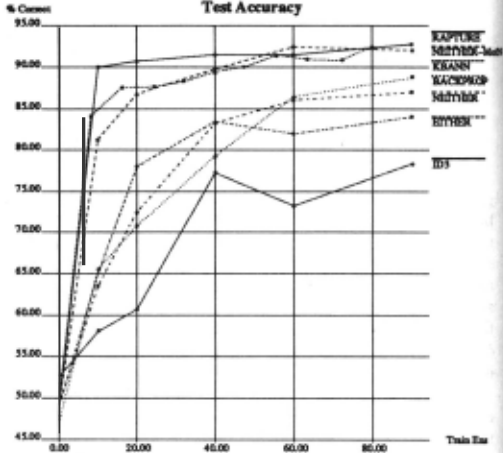
for large training sets. Note, that Figure 3 is not direct comparison of NEITHER and KBANN since the results re ported were compiled from different subsets of the DNA promoter sequences data set. Io3 had significantly lower accuracy than the other systems.
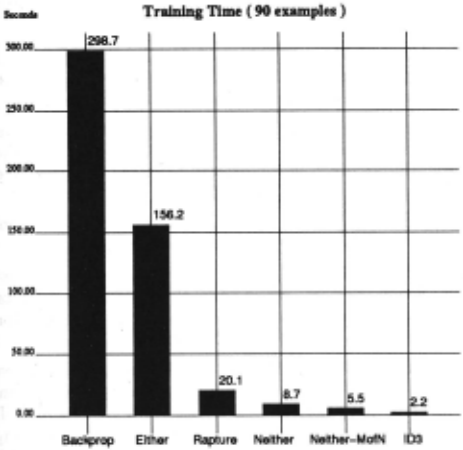
Figure 4 shows a comparison of training times. Both NEITHER-MoFN and NEITHER were more than an order of magnitude faster than backpropagation and EITHER. Only ID3 ran faster than NEITHER-MoFN.
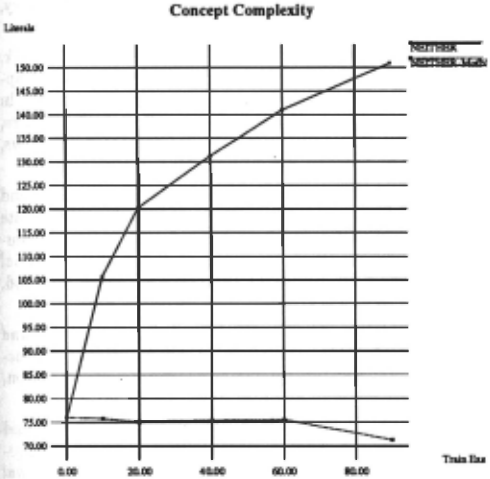
We also collected data on the average complexity of the revised theories produced by both NEITHER and NEITHER-MOFN. Complexity was measured as the to tal size; i.e., the total number of all literals in the theory. The results are shown in Figure 5. As can be seen from this graph, NEITHER-MoFN not only produces less com plex resulting theories but also produces theories closer in size to the original.
3.3 Discussion
Many of our expectations were borne out by the experi mental results. Both NEITHER and NEITHER-MOFN ran more than an order of magnitude faster than EITHER due to the optimized algorithms discussed in section 2. NEITHER-MOFN's increase in accuracy was also ex pected since the new algorithm is able to concentrate on making M-of-N revisions directly. Also, the fact that NEITHER-MOFN generates less complex theories is not surprising, again because it can directly modify thresh old values rather than create new rules. In short, by adding one more operator to the generalization and spe cialization processes, NEITHER-MoFN is able to accu rately revise a theory known to be difficult for sym bolic systems, without having to sacrifice the efficiency of a symbolic approach. Finally, the most comparable learning-curve results from [Towell, 1991] would indicate that KBANN's accuracy in the promoter domain is about
4 Related Work
Several researchers have developed methods for inducin~ M-of-N concepts from scratch. CRLS [Spackman, 1988j learns M-of-N rules and out-performed standard rule in duction in several medical domains. ID-2-of-3 [Murphy and Pazzani, 1991] incorporates M-of-N tests in decision tree learning and out-performed standard decision-tree induction in a number of domains. Both projects clearly demonstrate the advantages of M-of-N rules.
SEEK2 [Ginsberg et al., 1988] includes operators for refining M-of-N rules; however, its revision process is heuristic and it is not guaranteed to produce a revised theory that is consistent with all of the training exam ples. NEITHER uses a greedy covering approach to guar antee that it finds a set of revisions that fix all of the misclassified examples in the training set . Also, unlike NEITHER, SEEK2 cannot learn new rules or add new an tecedents to existing rules.
KBANN [Towell and Shavlik, 1992] revises a theory by translating it into a neural network, using backpropa gation to refine the weights, and then retranslating the result back into symbolic rules. NEITHER's symbolic re vision process is much more direct and, from all indica tions, significantly faster. Although KBANN's results are referred to as M-of-N rules, they actually contain real valued antecedent weights and therefore are not strictly M-of-N. In addition, KBANN's revised theories for the promoter problem are also more complex in terms of number of antecedents than the initial theory [Towell, 1991], while NEITHER actually produces a slight reduc tion. Therefore, NEITHER's revised theories are less com plex and presumably easier to understand. Finally, un like KBANN, NEITHER is guaranteed to converge to 100% accuracy on the training data .
RAPTURE [Mahoney and Mooney, 1992] uses a com bination of symbolic and neural-network learning meth ods to revise a certainty-factor rulebase [Buchanan and E.H. Shortliffe, 1984]. Consequently, it lies some where between NEITHER and KBANN on the symbolic connectionist dimension. As illustrated in the results, its accuracy on the promoter problem is only slightly su perior to NEITHER's. However, its real-valued certainty factors make its rules more complex.
5 Future Work
The current version of NEITHER needs to be enhanced to handle a number of issues. We need to incorporate a number of advanced features from EITHER, such as constructive induction, modification of higher-level rules, and the ability to handle numerical features and noisy data. Also, we could to extend our methods to handle negation as failure and incorporate the ability to handle M-of-N rules into first-order theory revision [Richards and Mooney, 1991]. Finally, we need to perform a more comprehensive experimental evaluation of the system.
This paper has presented an efficient propositional the ory refinement system that is capable of revising M-of-N rules. The basic framework is a modification of EITHER [Ourston and Mooney, 1990]; however, the construction of partial proofs has been reduced from exponential to linear time and a method for revising the thresholds of M-of-N rules has been incorporated. The resulting sys tem runs more than an order of magnitude faster and produces significantly more accurate results in domains requiring partial matching, such as the problem of rec ognizing promoters in DNA.
Acknowledgements
Special thanks to Chris Whatley for his help implement ing NEITHER.
@inproceedings{ijcai1993p157,
  title     = {Symbolic Revision of Theories with M-of-N Rules},
  author    = {Baffes, Paul T. and Mooney, Raymond J.},
  booktitle = {Proceedings of the Thirteenth International Joint Conference on
               Artificial Intelligence, {IJCAI-93}},
  publisher = {International Joint Conferences on Artificial Intelligence},
  editor    = {Ruzena Bajcsy},
  pages     = {1135--1141},
  year      = {1993},
  note      = {Machine Learning},
  url       = {https://ijcai.org/proceedings/1993/157},
}
TY - CPAPER TI - Symbolic Revision of Theories with M-of-N Rules AU - Baffes, Paul T. AU - Mooney, Raymond J. T2 - Proceedings of the Thirteenth International Joint Conference on Artificial Intelligence, IJCAI-93 PB - International Joint Conferences on Artificial Intelligence PY - 1993 SP - 1135 EP - 1141 UR - https://ijcai.org/proceedings/1993/157 ER -Copied
Machine-readable versions of this paper, for tools and AI agents:





