
Combining FOIL and EBG to Speed-up Logic Programs
Proceedings of the Thirteenth International Joint Conference on Artificial Intelligence. Machine Learning. Pages 1106-1112.
© 1993 International Joint Conferences on Artificial Intelligence
Abstract
This paper presents an algorithm that combines traditional EBL techniques and recent developments in inductive logic programming to learn effective clause selection rules for Prolog programs. When these control rules are incorporated into the original program, significant speed-up may be achieved. The algorithm is shown to be an improvement over competing EBL approaches in several domains. Additionally, the algorithm is capable of automatically transforming some intractable algorithms into ones that run in polynomial time.
- [Bratko, 1990] I. Bratko. Prolog Programming for Artificial Intelligence. Addison Wesley, Reading:MA, 1990.
- [Braudaway and Tong, 1989] Wesley Braudaway and Chris Tong. Automatic synthesis of constrained generators. In Proceeding6 of the Eleventh International Joint conference on Artificial intelligence, Detroit, Ml, 1989.
- [Bruynooghe et al., 1989] Maurice Bruynooghe, Danny De Schreye, and Bruno Krekels. Compiling control. Journal of Logic Programming, 6:135-243, 1989.
- [Chase et al., 1989] M. Chase, M. Zweban, R. Piazza, J. Burger, P. Maglio, and H. Hirsh. Approximating learned search control knowledge. In Proceedings of the Sixth In- ternational Workshop on Machine Learning, pages 40-42, Ithaca, NY, June 1989.
- [Cohen, 1990] W. W. Cohen. Learning approximate control rules of high utility. In Proceedings of the Seventh Inter- national Conference on Machine Learning, pages 268-276, Austin, TX, June 1990.
- [DeJong and Mooney, 1986] G . F. DeJong and R. J. Mooney. Explanation-based learning: An alternative view. Machine Learning, 1{2):145-176, 1986.
- [Dietterich, 1986] T. Dietterich. Learning at the knowledge level. Machine Learning, 1:287-316, 1986.
- [Keller, 1987] R. Keller. The Role of Explicit Contextual Knowledge in Learning Concepts to Improve Performance. PhD thesis, Rutgers University, New Brunswick, N, 1987. Also appears as tech. report ML-TR-7.
- [Laird et al., 1986] J. Laird, P. Rosenbloom, and A. Newell. Chunking in soar: The anatomy of a general learning mechanism. Machine Learning, 1{1) , 1986.
- [Langley, 1985] P. Langley. Learning to search: From weak methods to domain specific heuristics. Cognitive Science, 9{2):217-260, 1985.
- [Minton, 1988] S. Minton . i' Quantitative results concerning the utility of explanation based learning. In Proceedings of the Seventh National Co ference on Artificial Intelligence, pages 564-569, St.
- Paul, MN, August 1988.
- [Mitchell et al., 1986] Tom M. Mitchell, Richard M. Keller, and Smadar T. Kedar-Cabelli. Explanation-based gener- alization: A unifying view. Machine Learning, 1{1):47-80, 1986.
- [Pazzani and Kibler, 1992] M. Pazzani and D. Kibler. The utility of background knowledge in inductive learning. Ma- chine Learning, 9:57-94, 1992.
- [Prieditis and Mostow, 1987] A. Prieditis and J. Mostow. Prolearn: Towards a prolog interpreter that learns. In Proceedings of the Sixth National Conference on Artificial Intelligence, Seattle, WA, Jul 1987.
- [Quinlan, 1990] J .R. Quinlan. Learning logical definitions from relations. Machine Learning, 5{3):239-266, 1990.
References were extracted automatically from the PDF and may contain errors.
Full text extracted automatically from the PDF; figures, tables and equations may differ. The PDF is the version of record.
1 Introduction
Explanation-based learning (EBL) research in logic pro gramming has generally focussed on learning macros (compiled rules) [Mitchell et al., 1986; DeJong and Mooney, 1986; Prieditis and Mostow, 1987], while EBL work in planning and production systems has tended to focus on learning search-control rules [Minton, 1988; Laird et al., 1986]. Recently, Cohen [Cohen, 1990] has argued the advantages of learning search control rules for the clause selection problem in logic programming. Clause selection is the process of deciding which of sev eral applicable clauses to use in reducing a particular subgoal in the course of a proof. Incorporating a set of accurate control rules for clause selection into a Prolog program has the potential to reduce or eliminate back tracking thereby producing significant speed-up.
Standard EBL methods can be applied to clause se lection; however, they tend to produce control rules that are accurate but highly complex. The complexity of the rules makes them costly to use and can often degrade overall performance rather than improving it [Minton, 1988] . Cohen's system, AxA-EBL, handles this problem by combining EBL with induction to learn a small set of "approximate" control rules with reduced match cost. AxA-EBL was shown to out-perform standard EBL con trol rules across a number of problem solving domains.
Our system, DoLPHIN , (Dynamic Optimization of Logic Programs through Heuristics INduction) can be viewed as an extension of the AxA-EBL approach. DoLPHIN improves on AxA-EBL in two significant ways. First, we employ a more powerful induction al gorithm, namely Quinlan's FOIL [Quinlan, 1990]. Sec ond, whereas AxA-EBL "explains" clause selection de cisions for subgoals without considering the structure of the surrounding proof, DOLPHIN explicitly considers the surrounding proof during induction. This is beneficial since conditions that cause the application of a clause to eventually fail may lie outside of the proof of the specific subgoal to which the clause is applied.
Empirical results in five problem domains show that our approach produces approximate control rules of high utility and consistently outperforms competing ap proaches. In particular, we show that, unlike existing methods, DoLPHIN can transform an O(n!) generate and-test sorting program into an O(n 2 ) insertion sort by learning from a single problem.
2 The DOLPHIN Algorithm
The DOLPHIN algorithm attempts to optimize a Prolog program by learning clause selection heuristics. The in put to the learning system is a Prolog program, a spec ification of which predicate constitutes the "top-level" goal and a set of training problems. The output is a modified program that incorporates learned clause selec tion heuristics. The algorithm proceeds in three phases: example analysis, control rule induction, and program specialization. The algorithm is explained in depth and illustrated by way of a simple example in the following subsections.
2.1 Example Analysis
In the example analysis phase, the training problems are solved using the existing program, and traces of the proofs are analyzed to produce two outputs: a set of correct and incorrect clause selection decisions for each clause of the program, and a generalized proof of each training example.
A selection decision for a clause is a partially instan tiated subgoal to which the clause was applied at some point in the proof process of a training problem. A cor rect decision is one that appears in a successful proof. A correct decision for a given clause is an incorrect deci sion for any prior program clause whose head also unifies with it; since we are considering only the first proof of each training problem, the prior clause must have been
naivesort(X,Y) :- permutation(X,Y), ordered(Y). perautation( [], []). perautation([XIXs],Ys) insert(X,Xs,[XIXs]). inaert(X,[YIYs],[YIYs1]) ordered ( [X] ) . perautation(Xs,YsO), insert(X,YsO,Ys). insert(X,Ys,Ys1). ordered([X,YIYs]) :-X ·< Y, ordered([YIYs]).tried unsuccessfully by the top-down, left-to-right Prolog prover.
Standard EBG techniques [DeJong and Mooney, 1986; Mitchell et al., 1986] are used to generalize the proof trees of the training problems. The goal of this gen eralization is to remove those elements of the proof that are dependent on the specific facts of the example while maintaining the overall structure of the proof. In DoLPHIN this is done by "retracing" the proof steps on a top-level goal that has uninstantiated input arguments.
As an example, consider the naive sorting program in Figure 1, which sorts a list by generating permutations until it finds one that is ordered. Permutations are gener ated by permuting the tail of the input list and inserting the head somewhere in the permuted tail.
| Positives | Negatives |
|---|---|
| insert (9, 0 ,A) insert(1,[3,4,5],A) insert (5, 0 ,A) insert(3, [4] ,A) insert(4, 0 ,A) | insert(9, [5] ,A) insert(9,[4,5],A) insert(9,[3,4,5],A) insert(9,[1,3,4,5],A) insert(5, [4] ,A) insert(5,[3,4],A) |
The only nondeterminism in this program comes in the definition of the predicate, insert/3. This nonde terminism could be eliminated by learning a control rule for the first clause that accurately predicts when the item should be placed at the front of the list. Given the top level example, nai vesort ( [9, 1, 5, 3, 4] , X), the exam ple analysis phase discovers five examples of correct uses of the clause ;l.nd six failed attempts. These selection decision examples, shown in Table 1, represent positive and negative examples of the concept, usetuLinsert_1 (i.e., subgoals to which it is useful to apply the first rule of insert/3) .
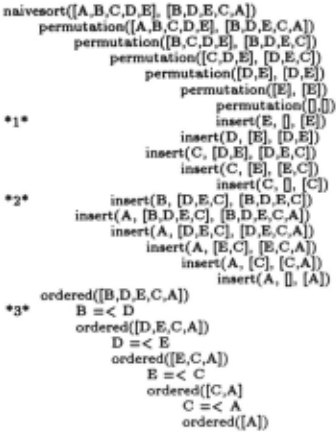
The generalized proof extracted from the trace of this problem is shown in Figure 2 (the numbered lines are discussed in a later section) . The proof provides a con text that "explains" the success of the correct decisions. Generalized proofs are used along with the selection de cision examples to do control rule induction.
2.2 Control Rule Induction
Control rule learning in DoLPHIN amounts to finding an operational definition for the class of sub goals to which a given clause should be applied. A number of recent sys tems have addressed the issue of relational concept learn ing in a logic programming framework [Quinlan, 1990] .
The choice of a FoiL-like framework was motivated by a number of factors. First, FoiL is relatively simple and has proven efficient in a number of domains. Second, the general FOIL algorithm has a "most general" bias which tends to produce simple definitions. This is important in creating classification rules with low match cost . Third, it is easy to bias FOIL with prior knowledge [Pazzani and Kibler, 1992]; we use the generalized proofs produced in the example analysis phase to guide the induction.
2.2.1 Basic FoiL Algorithm
FOIL attempts to learn a definition of a concept in terms of some given background predicates. The defini tion comprises a set of function-free definite clauses that cover all of the positive examples of the concept, and none of the negative examples.
FOIL may be viewed as a basic covering algorithm. FoiL attempts to find a clause which covers some of the positive examples, but none of the negative. The pos itive examples covered by the clause are removed from consideration, and the process repeats to find additional clauses until all of the positive examples are covered. Each successive clause is constructed by a general-to specific hill-climbing search. FoiL adds antecedents to the developing clause one at a time. At each step FOIL evaluates all possible literals that might be added and se lects the one that maximizes an information-based gain heuristic. Since FoiL learns clauses that are function free, the generation of candidate literals to add to the developing clause essentially consists of trying each background predicate with all possible combinations of vari ables currently in the clause and new variables.
The informed FOIL algorithm employed by DoLPHIN is more focused and efficient because it replaces the expo nential search through all variablizations of each pred icate with a search through literals in the generalized proofs produced in the example analysis phase. It has the additional advantage of being able to learn defini tions containing function symbols, which are necessary in control rules for arbitrary Prolog programs.
2.2.2 Using the Results of EBG to Guide FOIL
The generalized proofs of top-level examples can be seen as giving the context for the appropriate applica tion of clauses used within the proof. The operational nodes of the proof represent all of the primitive condi tions that had to be satisfied for the proof to succeed. DoLPHIN employs induction in an attempt to identify a small set of simple tests that provide significant guidance in determining whether the application of a given clause is likely to be part of a complete proof. It is important to note that the conditions being sought may not neces sarily lie in the proof of the specific sub goal to which the clause is applied. A decision to use a clause may turn out to be wrong not because the clause itself could not succeed, but rather, because it did succeed and produced bindings that could not be used in completing the sur rounding proof. This is especially common in programs that implement a generate-and-test paradigm.
DoLPHIN employs the same general covering algorithm as FoiL but modifies the clause construction step. Suc cessive specializations of a clause are generated by con sidering the successful uses of the program clause for which the heuristic is being learned. Suppose we are learning a definition of the concept "subgoals for which the clause, A+-B, is useful." The most general clause cov ering the examples is simply useful (A') +-true, where A' is a "copy" of A having uninstantiated arguments; call this clause, C. C can be specialized by (partially) instan tiating some of its variables, or by adding antecedents to its body. The former is achieved by unifying A' with some (generalized) subgoal that was solved by the origi nal clause, A+-B. The latter is done by unifying A' with a subgoal and adding an operational literal from the proof that shares some variables with that subgoal. The clause specialization search algorithm is detailed in Figure 3.
SPEC-PAIRS is a list of specializations analogous to all literals that would be considered by FoiL for ex tending a clause. Each pair consists of a "template" to instantiate variables in the head of the clause, and a literal to add to the clause body. A pair with the literal, true, represents specializing by variable instanti ation only. The generalize ( <SUBGOAL, LITERAL>) call on the line labeled ** is included so that specializations adding an operational literal only instantiate variables to the extent required; sub-terms appearing in SUBGOAL that are not in LITERAL are generalized to unique (unin stantiated) variables. The algorithm repeatedly selects the best specialization and applies it to the developing clause. Specialization terminates when no further im provement is found in the information-gain metric. The
Let PC be the original program clause Let PROOFS be the set of generalized proofs Let C be (control rule) clause to specialize SPEC-PAIRS := {} for each PROOF in PROOFS · SUBGOALS := subgoals in PROOF solved by PC for each SUBGOAL in SUBGOALS add <SUBGOAL,true> to SPEC-PAIRS for each LITERAL in PROOF if operational(LITERAL) and share_vars(LITERAL, SUBGOAL) add generalize( <SUBGOAL,LITERAL>) to SPEC-PAIRS repeat SPECIALIZATIONS := {} for each <SUBGOAL,ANTE> in SPEC-PAIRS add to SPECIALIZATIONS the clause created by unifying C's argument with SUBGOAL and appending ANTE to C's body C := clause with best info-gain in SPECIALIZATIONS until no specialization has positive information-gainclause may still cover negative instances, permitting the learning of approximate definitions.
2.2.3 Control Rules for Naivesort
Control rule induction for the naivesort problem is straight-forward. Initially the set of clauses for the con cept, useful..insert_1, is empty, and the covering algo rithm attempts to find a clause that covers some of the positive examples from Table 1. The initial clause,
useful..insert_1(insert(A,B,C))+- truecovers all of the positive and negative examples. DoLPHIN will attempt to specialize it .
In performing specialization, SPEC-PAIRS will contain, among others, the pairs:
<insert(E,[],[E]),true> <insert(B, [DIX], [B,DIXJ), B =< D>The first is created by unification with the subgoal la beled *1 *in the generalized proof (Figure 2) : The second is created from the subgoal labeled *2* and the opera tional literal labeled *3*. The sub-term [E,C] from *2* has been generalized to a new variable, X, since [E,C) does not appear in the operational literal and is there fore unnecessary for connecting it to the subgoal.
Applying these two pairs to produce specializations yields the clauses:
usefuLinsert_l (insert (A, D , [A] ) ) +- true usefuLinsert_1(insert(A, [BjC], [A,BjC])+- A =< BThese along with other possible specializations, will be evaluated on the examples in Table 1 to determine which produces the most gain. In this case, the first clause cov ers more positive examples and is preferred. Since the clause covers no negative examples, no further specializa tion is needed. This clause is picked as the first clause of the concept definition. The positive examples covered by the clause are removed and the process repeats. On the second iteration, the winning specialization is the second clause shown above. At this point, all of the positive ex amples are covered, and we have found a definition for when it is useful to apply the first clause of insert/3.
insert(A, B, [AlB]) :- useful_insert_1(A,B,[AIB]),!. insert(A, [BIC], [BID]) :- !, insert(A, C, D). useful_insert_1(A, [],[A]):-!. useful_insert_1(A, [BIC], [A,BIC]) :- A =< B, ! .2.3 Program Specialization Phase
Once clause selection rules have been learned, they are passed to the program specialization phase which "folds" this control information into the original program. The basic approach is to guard the body of each clause with the selection information, forcing the clause to fail quickly on subgoals to which it should not be applied.
For non-disjunctive (single clause) control rules, the learned conditions are simply placed into the original program clause preceding the original conditions, and the clause head is unified with the argument of the con trol rule. For disjunctive control rules, a single new lit eral is added at the front of the program clause. This new literal has the same arguments as the clause head. The definition of the new literal comprises the set of learned control rules with the heads modified so that what were originally arguments of the subgoal are made direct ar guments of the predicate. A cut ( "!") is appended to the body of each clause of this definition since there is no reason to consider multiple proofs of the usefulness of the original program clause.
A decision is also made as to whether the control in formation has made the program clause deterministic. If the learned control rules cover no incorrect decisions in the training data, then it is assumed that the modi fied clause is deterministic and a cut is placed after the added condition(s). This has the effect of committing to the program clause once it has been selected as useful.
Returning to the sorting example, folding the clause selection rules back into the program as described pro duces a new definition of insert/3 shown in Figure 4. In effect, permutation/2 has been .modified to produce or dered permutations. Careful inspection shows that this is a version of the insertion sort algorithm, and we have actually made an O(n!) sort into an O(n 2 ) version by learning from a single top-level example. By inserting conditions from the testing portion of a generate-and test program into the generating portion, DOLPHIN is performing test incorporation [Dietterich, 1986] which, as illustrated here, can sometimes dramatically enhance the efficiency of an algorithm.
3 Experimental Results
3.1 Experimental Design
The DoLPHIN system has been evaluated on five problem domains: Two generate-and-test programs, naivesort and N-queens, and three "standard" EBL problems ~£LEX, RW, and BW borrowed from [Cohen, 1990]. The N-queens problem is adapted from a Prolog program given in [Bratko, 1990]. The problem is to find a place ment of N queens on an NxN chessboard such that no queen is attacking another. The program implements a generate and test strategy where a configuration is rep resented by a permutation of the list, [l..N].
pLEX is a simplified symbolic integration solver using state-space search with iterative deepening. The actual Prolog code for the solver is the same as that used in [Co hen, 1990]. RW and BW are planning domains utilizing means-ends analysis planners, which were automatically generated from operator definitions. RW is based on the STRIPS robot world. BW is generated from the blocks world operators. Control rules were learned for a single recursive predicate having seven arguments and averag ing about 5 conjuncts per clause. This predicate con sisted of 18 and 12 clauses in RW and BW respectively. Since problems in these domains can be quite difficult, the planner provides for bounds on both plan length and CPU time.
In each domain, a set of testing problems was chosen as a benchmark. DOLPHIN was then run on indepen dently derived training sets of various sizes to produce "optimized" versions of the programs. These programs were then run on the examples in the testing set to eval uate their performance. For each training set size, 10 trials were run and the results averaged.
In order to guarantee the completeness of the final pro gram, we adopt the strategy used by [Cohen, 1990] and retain the original clauses. In testing, we first attempt to solve the problem using the optimized program. If this fails, the original program is then used to find a solution to the problem.
The examples for the naivesort problem were drawn from randomly generated lists of size three to eight. The testing set contained 100 such lists. The data for the N-queens domain consisted of the nine problems corre sponding to the 4-queens through 12-queens problems. The four largest problems were used as the test set, and training was done on successively larger subsets of the smaller problems. The pLEX training and testing prob lems are from [Keller, 1987]. In the planning domains, problems were generated by taking a random walk of bounded length in the state space of the planner in a manner identical to [Cohen, 1990].
3.2 Results
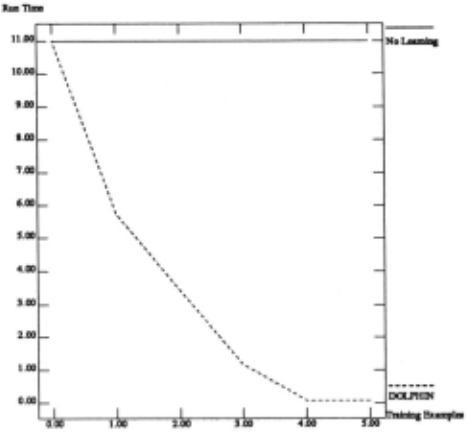
In all domains tested, DoLPHIN was able to significantly improve the performance of the initial program. Figure 5 shows an average learning curve for the naivesort. It is not surprising that DoLPHIN produces programs for the sorting problem that are significantly faster. We have already shown how the 0( n!) sort can be "optimized" into a polynomial version. What is, perhaps, surprising is how few examples are necessary on average to learn the enhanced program. The points on the graph represent averages over ten trials, and the intermediate averages reflect the proportion of those trials for which insertion sort was successfully learned. The graph shows that two examples are usually sufficient to learn insertion-sort, and four examples virtually guarantee success.
In the N-queens problem, there is no local condition that can simply be moved into the permutation portion of the program to render it deterministic. In this case DoLPHIN learned rules that were more heuristic. Nev ertheless, the results were similar to those for naivesort with training on the 4-8 queens problems yielding more than six-fold speedup for solving the larger problems in the testing set.
In the EEL domains, DOLPHIN was compared to three alternative learning strategies: EEL-macro, EEL control, and AxA-EEL. EEL-macro used the EEG mech anism from DoLPHIN to learn macro-rules for the top level goal. The learning mechanism first tried to prove an example using it's learned rules. If no learned rule applied, the problem was solved using the normal solver and the subsequent proof was generalized to produce a new macro, which was added to the end of the list of learned rules. During testing, each problem was first attempted using only the learned macros; if no macro matched the problem, it was solved using the original solver without the macros. The results for AxA-EEL and EEL-Control were taken from [Cohen, 1990]. AxA EEL is Cohen's integration of induction and explanation discussed earlier. EEL-control is a "rational reconstruc tion" of standard EEL control rule learning applied to the clause selection problem.
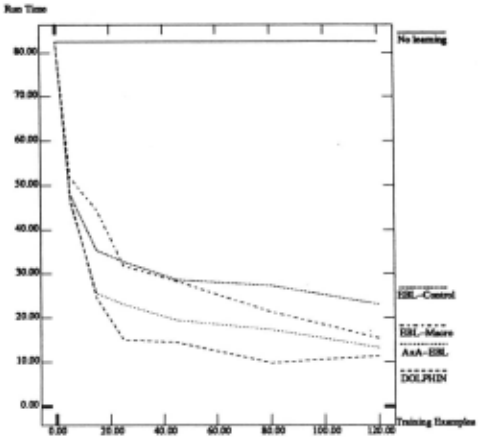
While the relative effectiveness of the three alterna tives varied across domains, DOLPHIN always produced speedup as good or better than the best of the com peting approaches and reached maximum speedup with fewer training examples. The average learning curve for the RW domain, shown in Figure 6, is representative. Al though one must be cautious when making comparisons across implementations, the consistency of the results in these domains supports the conclusion that DOLPHIN produces better speed-up than any of the competing approaches and converges to an efficient program more rapidly.
It is also worth noting that EEL-macro, AxA-EEL and EEL-control all fail on the naivesort and N-queens problems, although the reasons differ. EEL-macro suffers from the recursive, unbtmnded nature of the problems. This strategy is forced to acquire generalized proofs of all permutations of various sized lists with little hope of achieving significant coverage on novel examples. AxA EEL fails to learn any control rules for these programs at all. AxA-EEL only considers explanations of the imme diate subgoal to which a clause was applied. The proof of the subgoal in this case is just true, because the first clause of insert/3 has no antecedents. Hence, the only learnable condition is true, which is not a useful heuris tic. These two problems nicely illustrate the advantage of considering the surrounding proof context when ex plaining a successful clause application. Finally, EEL control shares the shortcomings of both E:aL-macro and AxA-EEL.
4 Related Work
Early research in learning control rules [Mitchell et al., 1986; Langley, 1985] did not focus on the utility problem, approximation, or application to logic programming. LEX-2 combined induction and EEL by inducing over complete explanation-based generalizations. DOLPHIN on the other hand, uses induction to select the most useful pieces of EEL generalizations. Also, DOLFHIN takes advantage of recent progress in relational learning, namely, FOIL.
The first use of approximations in learning control rules was probably MetaLEX [Keller, 1987]. However, it used a fairly simple method of simplifying learned rules by removing conditions. Approximating control rules was also investigated in [Chase et al., 1989]; how ever, their system, ULS, does not employ induction and is therefore limited to conservative approximations, pro ducing relatively modest improvements in efficiency.
The most closely related work is AxA-EEL [Cohen, 1990] mentioned above. AxA-EEL "explains" correct uses of a clause by compiling out a generalized macro for the subgoal to which the clause was applied. AxA EBL searches a pool of approximations of these macros to find a small set of rules that maximizes coverage of positive examples and minimizes the coverage of nega tives. DOLPHIN improves on AxA-EBL by using a more powerful inductive learning mechanism (FOIL) and con sidering the entire top-level proof as the explanation for the successful application of a clause to a subgoal.
Researchers in knowledge compilation and logic pro gramming have examined test incorporation as an optimization technique [Braudaway and Tong, 1989; Bruynooghe et al. , 1989]. Research has concentrated on analytically identifying sound program transforma tions. The test incorporation necessary to optimize the particular programs presented in this paper is either un sound (N-queens) or would require information exter nal to the program (transitivity of $ in naivesort) to demonstrate soundness. DoLPHIN which relies on em pirical techniques, performs a wider range of optimiza tions automatically and can "tune" the performance of a program to the distribution of examples.
5 Future Research
Experiments with DoLPHIN have raised a number of is sues that require further investigation. One shortcom ing of the current approach is its critical dependence on the form of the program that is being optimized. Using an alternative definition ofpermutation/2 which selects an item to be the head of the permutation and then re cursively computes a permutation to be the tail would prevent DOLPHIN from learning the insertion-sort heuris tic. In order to achieve significant performance enhance ment on this program, the system would have to learn to choose the minimum element from a list. Inventing a recursive control-rule of this sort requires augmenting DOLPHIN with constructive induction techniques.
Other changes to the inductive mechanism might also prove useful. While the simplicity of the control rules learned by DoLPHIN tends to increase their utility, there is no explicit use of match-cost or operationality. An in teresting avenue of investigation would be to incorporate notions of operationality into the hill-climbing mecha nism to bias the search toward more efficient heuristics.
Finally, programs often use a single predicate in differ ent ways. It these cases it might be useful to specialize the different uses of a predicate independently.
6 Conclusions
DoLPHIN is the. first system to combine recent develop ments in inductive logic programming with EBG in order to improve the efficiency of logic programs. By using the FOIL algorithm to select the most useful portions of gen eralized explanations, DoLPHIN can learn approximate control rules of high utility. In particular, by examin ing the entire proof when generating control rules for any subgoal, DoLPHIN can perform a kind of test incor poration on logic programs. Test incorporation allows DOLPHIN to transform some intractable algorithms into ones that run in polynomial time.
Acknowledgments
This research was supported by the National Science Foundation un der grant IRI-9102926, the NASA Ames Research Center under grant NCC 2-629, an_d the Texas Advanced Research Program under grant 003658114. We wish to thank William Cohen who provided code for the planning domains and helpful comments on an earlier version of this paper. Thanks also to Je-Nien Ernst who provided some of the data on EBL-macro.
@inproceedings{ijcai1993p153,
  title     = {Combining FOIL and EBG to Speed-up Logic Programs},
  author    = {Zelle, John M. and Mooney, Raymond J.},
  booktitle = {Proceedings of the Thirteenth International Joint Conference on
               Artificial Intelligence, {IJCAI-93}},
  publisher = {International Joint Conferences on Artificial Intelligence},
  editor    = {Ruzena Bajcsy},
  pages     = {1106--1112},
  year      = {1993},
  note      = {Machine Learning},
  url       = {https://ijcai.org/proceedings/1993/153},
}
TY - CPAPER TI - Combining FOIL and EBG to Speed-up Logic Programs AU - Zelle, John M. AU - Mooney, Raymond J. T2 - Proceedings of the Thirteenth International Joint Conference on Artificial Intelligence, IJCAI-93 PB - International Joint Conferences on Artificial Intelligence PY - 1993 SP - 1106 EP - 1112 UR - https://ijcai.org/proceedings/1993/153 ER -Copied
Machine-readable versions of this paper, for tools and AI agents:





