
Using Aspiration Windows for Minimax Algorithms
Proceedings of the Twelfth International Joint Conference on Artificial Intelligence. Automated Reasoning. Pages 192-196.
© 1991 International Joint Conferences on Artificial Intelligence
Abstract
This paper is based on investigations of several algorithms for computing exact minimax values of game trees (utilizing backward pruning). Especially, the focus is on trees with an ordering similar to that we have actually found in game playing practice. We compare the algorithms using two different distributions of the static values, the uniform distribution and a distribution estimated from practical data. Moreover, this is the first systematic comparison of using aspiration windows for all of the usual minimax algorithms . We analyse the effects of aspiration windows of varying size and position. The use of an aspiration window not only makes alpha-beta search competitive, but there also exists previously unpublished dependencies of its effects upon certain properties of the trees. In general, the more recently developed algorithms with exponential space complexity are not to be recommended for game-playing practice, since their advantage in having to visit fewer nodes is more than outweighed under practical conditions by their enormous space requirements. Finally, we propose a method for an analytic determinatwn of estimates of the optimal window size, presupposin~ evidence about some charactenstic properties of the domain of application. In summary, we discovered and found empirical evidence for several effects unpredicted by theoretical studies.
- Campbell, M.S., and Marsland, T.A., A Comparison of Minimax Tree Search Algorithms, Artificial Intelligence 20 (4), 1983, 347- 367.
- Fishburn, J ., and Finkel, R.A. Parallel Alpha-Beta Search on Arachne. Tech. Report #394, Department of Computer Science.
- Kaindl, H., Useful Statistics from Tournament Programs,/CCA Journal 11 (4), 1988,156-159.
- Kaindl, H., Tree Searching Algorithms, in Computers, Ch€ss , and Cognition. T. A. Marsland andJ. Schaeffer, Eds., New York: Springer-Verlag, 1990,133-158.
- Kaindl, H., Wagner, M., and Horacek, H., Comparing Various Pruning Algorithms on Very Strongly Ordered Game Trees, Proc. New Directions in Game-Tree Search Workshop, Edmonton, Canada, May, 1989, 111-120.
- A comprehensive version is avail- able as Tech. Report #50, Department of Statistics and Computer Science, University of Vienna, Austria, January, 1988.
- Knuth, D.E., and Moore, R.W., An Analysis of Alpha-Beta Pruning, Artificial! ntelligence 6 (4), 1975, 293-326.
- Korf, R.E., Depth-First Iterative-Deepening: An Optimal Ad- missible Tree Search, Artificial! ntelligence 27 (1 ), 1985, 97-109 .
- Marsland, T.A., and Campbell, M.S., Parallel search of strongly ordered game trees, ACM Comput. Surv. 14 <4l,1982, 533-552.
- Marsland, T.A., Reinefeld, A., and Schaeffer, J ., Low Overhead Alternatives to sss•, A rtificiall ntelligence 31 (2 ), 1987, 185-199.
- Musczycka, A., and Shinghal, R., An empirical comparison of pruning strategies in game trees, IEEE Trans. Syst. Man Cybern. 15 (3),1985, 389-399.
- Pearl, J ., Asymptotic Properties of Minimax Trees and Game- Searching Procedures,Artificiallntelligence 14 (2),1980,113-138.
- Pearl, J ., Heuristics: Intelligent Search Strategies for Computer Problem Solving. Reading, M!lsS: Addison-Wesley Pub!. Co.,1984.
- Reinefeld, A., An Improvement of the Scout Tree Search Algorithm, Journal of th€ International Computer Ch€ss Association 6 (4), 1983,4-14.
- Reinefeld, A., Spielbaum-Suchverfahren. Berlin: Springer- Verlag, 1989.
- Schaeffer, J ., Experiments in Search and Knowledge. Ph.D. Thesis, University ofWaterloo, Ontario, May, 1986.
- Schaeffer, J ., The History Heuristic and Alpha-Beta Search Enhancements in Practice, IEEE Trans. Pattern Anal. Mach. lntell. PAMI-11 (11),1989,1203-1212.
- Shams, R., Ein experimenteller Vergleich ausgewiihlter Such- verfahren. Diplomarbeit, Institut fUr Praktische Informatik, Technische Universitiit Wien, 1990.
- Stockman, G.C., A Minimax Algorithm Better than Alpha-Beta?, Artificial Intelligence 12 (2), 1979, 179-196.
References were extracted automatically from the PDF and may contain errors.
Full text extracted automatically from the PDF; figures, tables and equations may differ. The PDF is the version of record.
1. Introduction and Background
For long, the only known method for computing the exact minimax value of a game tree without gener ating this tree in its entirety was the so-called alpha-beta algorithm (for a description and histori cal review see for instance [Knuth & Moore 75]). In the meantime, several other pruning algorithms have been found. A short review and references will be given in Section 2, and more elaborate descriptions can be found for instance in [Kaindl90] and in the cited references.
· The contribution of this author was performed as "Diplom arbeit" supervised by the second author (comparable to a Master's thesis) before joining Alcatel·ELIN Forschungs zentrum. It was supported by SIEMENS AG Osterreich, especially in providing facilities.
Naturally the question arises which is the most efficient algorithm (more precisely, under which conditions). For some of these algorithms there exists exact formulae for the expected number of terminal positions on certain game trees (random trees with uniform branching degree and distinct terminal values) [Pearl 84]. These render alpha beta (in its pure form) clearly less efficient than its competitors. However, for trees of the kind occur ring in real games the situation is not this clear: [Marsland & Campbell 82] defined strongly ordered trees, in which 70% of the time the first branch from each node is best. [Campbell & Marsland 83] and [Marsland et al. 87] investigated different tree ordering types using a form of Monte Carlo simu lation.
With respect to issues of relative efficiency, such criteria seem to be a promising attempt to model the actual conditions occurring in computer game playing. Therefore, we actually gathered such data (among others) with the chess program MERLINl>. The statistics compiled from 438 move decisions (most of them under tournament conditions) showed a mean value of 90.3% (with a standard deviation of 8.2%) for the relative frequency of the first branch from each node being "best" (more such statistics can be found in [Kaindl 88]). Since we were mainly interested in a comparison using parameters which reflect best the practical condi tions occurring in real game playing, we choose to investigate very strongly ordered trees.
Comprehensive experiments under such condi tions showed some interesting results (see [Kaindl et al. 89]). As a main result, alpha-beta (in its pure form) is also less efficient than its competitors on ordered trees, although it profits most from an in creased ordering of the trees. In practice, however, many enhancements to alpha-beta are used (see [Schaeffer 86, 89] for a comprehensive set of experi ments comparing their performance in the domain of computer chess) . While most of these enhance ments just serve the purpose of achieving improved ordering, it is also common practice to use an aspira tion window for alpha-beta, but to our best knowl edge there is no published account of the effects of varying window size. Note, that alpha-beta was only compared in its pure form (in particular without such windows) in the previous theoretical studies. Our comparisons gave a strong indication of its improve ments using such a window, which made it fully com petitive to the newer algorithms. While this en hancement is often used for improving alpha-beta, we are not aware of a published comparison of the ef fects of using windows for the other algorithms. Hence, we found it interesting to compare "all" the minimax search algorithms using such a window.
1 MERUN is a collaborate effort of the second and the third author together with Marcus Wagner. It played some major computer tournaments, for instance it tied for lOth out of 22 participants at the World Computer Chess Championship in 1983, and for 6th outof24 participants at the World Computer
Chess Championship in 1989.
Moreover, we had serious doubt that in practice all the possible values are equally likely resulting from the static evaluator, as usually assumed in theoret ical studies. Therefore, we became interested in the effects of using a distribution of the values estimated from practical data, compared to having them equal ly distributed. The question is, how the simplifying assumption of uniform distribution affects the re sults.
Since using an aspiration window always bears the danger of having to repeat the search (re-search), in case the minimax value is outside the window, the ef fort for computing it may even become greater than that when using no window at all. While the tech niques of estimating the positioning of such a win dow are quite developed, its size is only determined by experienced guessing. Hence, we present the first method for an analytic determination of estimates of the optimal window size.
2. Algorithms Compared
Like alpha-beta (AB), the newer algorithms SCOUT [Pearl 80] and palphabeta [Fishburn & Finkel 80] have linear space requirements. These have similar average performance [Musczycka & Shinghal85]. In our experiments, we actually used a slightly im proved variant called negascout (NS) [Reinefeld 83]. SSS* [Stockman 79] and DUAL* [Marsland et al. 87] are best-first search algorithms and consequently have exponential space requirements.
Enhancements to NS have led to INS (informed NS), which saves information for the case that sub trees must be re-searched [Marsland et al. 87]. Hence, INS has storage requirements comparable to SSS* or DUAL* (see also [Schaeffer 86]). These enhancements have similar effects as the use of the usual hash tables in game playing programs.
AB is normally used in practice in its refined ver sion aspiration alpha-beta (AAB). Usually, game playing programs can estimate the minimax value quite accurately to lie within a certain range, even before the search is done. (This ability is strongly re lated to the use of iterative deepening in most pro grams: searching the tree successively deeper and deeper, see e.g. [Korf 85].) This range is usually called the aspiration window, and its bounds are used as an (artificial) initialisation of the parameters a and ~at the root. Quite similarly toNS, a re-search with modified parameters is necessary, when the ac tual minimax value is not inside this window.
More precisely, a slightly modified version of the alpha-beta algorithm is used in this context today which was proposed by [Fishburn & Finkel 80]. In case the minimax value is outside the original win dow, it can provide tighter bounds for the re-search. Hence, they called it "Fail-soft Alpha-Beta" (abbrevi ated here by F AB). More details on this can be found in [Marsland & Campbell82]. However, we could not find any quantitative data on the savings compared to the original version of aspiration alpha-beta which is not utilizing the advantages ofF AB. (This version we call OLDAAB here.)
In the following we generalize the method of using a window for all the given algorithms. The use of an aspiration window for NS and INS is analogous to that for AB. We call these algorithms ANS and AINS. However, for the corresponding versions of SSS* and DUAL*, ASSS* and ADUAL*, the window is useful only from one side, by initialising their in ternal bound with the upper or the lower bound of the window, respectively. When the minimax value is inside the window, this is obvious from their way of handling their internal bound. Of course, when the value of the second bound of the window is reached or exceeded, stopping the search is possible according to [Campbell & Marsland 83] and [Reinefeld 89]. How ever, when the exact minimax value has to be deter mined this is not to be recommended. A re-search with the new bound would have to be done, in effect wasting resources by searching again parts of the tree whose results would be available when con tinuing the stopped search. Therefore, ASSS* and ADUAL* cannot utilize their second bound, and they should not be hindered by it. A pseudo-code formula tion of the key part of ASSS* looks like the following:
Analogously, the key part of ADUAL* can be formu
Value:= SSS*(Position, b); if Value = b then Value := SSS*(Position, + 00 ); end if; lated as follows : Value:= DUAL*(Position, a); if Value= a then Value := DUAL*(Position, -oo); end if;
3. Experiment Design
As usual for mathematical analysis as well as simulation studies, the standard model of a uniform game tree of width wand depth d has been used. In our experiments, we kept w fixed (w = 5) while varying d from 3 to 9.
Since the approach of generating such trees pro posed and used by [Schaeffer 86] requires only O(wd)
storage, we have also adopted it for our experiments. It works on the principle of deriving the value of a subtree from information available at its parent node. A minimax value is chosen and used with the specified ordering criteria to build a tree from the root down. The ordering parameters can be specified here in the form of w weights reflecting the chance that each of the w moves from any node will lead to a subtree having the minimax value of this node. A more detailed description can also be found in [Marsland et al. 87].
While we have made some few experiments with random trees (independent and identically distri buted, see [Pearl 84]), our emphasis was on uery strongly ordered trees. For the chance of the first branch being best we chose the values 70%, 80%, and 90%. Since the effect of the ordering of the remaining moves appears to be largely negligible [Kaindl et al. 89], we assumed them to have equal chance of being best.
Let the distribution function Fx (x) = P (X S x) characterise the random variable X ranging over the same interval as the -static evaluation function f(n). The probability p = P (X = x) for node n is the proba bility of the event that f(n) returns x. Fx(x) has bee!'). assumed to be uniform (as usual) and alternatively estimated from practical data of a chess program. The compiled statistics revealed that the static val ues around 0 occured very frequently. For this rea son, a normal distribution could not fit these data well (according to statistical tests). Hence, we de fined a distribution function Fx 1 (x) approximating our data as an estimate of Fx (x) (see [Shams 90]) . It seems that the exact shape of the distribution func tion is not really important for the results of the simulation runs, only the values around 0 must have a significantly higher probability.
Several different window sizes were chosen in our experiments: 1, 79, 159, 239, 319, 399, 479, and 639 values inside the window, out of the range - 999 ... 999. (This corresponds to 0.05%, 4%, 8%, 12%, 16%, 20%, 24% and 32% of the total value range.) The window containing 1 value has been called nar row window by [Marsland et al. 87] and is of special interest, because it is the smallest window possible for a successful search. The window position has been chosen uniformly over the whole range. In case the minimax value is outside the window, we have performed additional experiments, in which it was more likely that the window position is "closer" to the minimax value (a more realistic assumption) .
In these experiments, 20 simulations were done for the case, that the minimax value MM is inside the window (a, b), and 20 in case it is outside. This means 10 simulations with MM S a, and 10 with MM ~ b. In both of these cases AAB, ANS and AINS perform a re-search in the sense of "failing low" and "failing high", respectively. However, ASSS* only re searches if MM ~ band ADUAL* does so if MM S a. The overall performance figure is gained by weighting the data according to the frequency observed in practice (see below) .
Generally, every stochastic event has been simu lated by a call to a pseudo-random number generator, parameterized independently of the relative frequen cies achieved earlier in the tree generation process. While the seed for the random number generator was different for each of the generated trees, each of the algorithms searched the same trees, of course. As a measure of performance we selected the number of bottom positions (NBP), as usual. It is known, that some of the algorithms (SSS* and DUAL*) have more overhead than others (AB, NS and INS) [Marsland et al. 87]. However, whether this is signifi cant (in the sense of running time) depends strongly on the cost of going from one node to another and evaluating terminal nodes in the domain of application, as well as the encodings. In particular, the running times of SSS* and DUAL* in the simulations are significantly larger than those of AB, NS and INS. The situation is atypical, however, since in the simulations just calls to a random number generator are performed instead of real operations, which are usually more expensive.
The empirical data have been prepared in illustrative figures. Of course, only a very limited se lection of these can be presented here. A compre hensive set is available, however, in [Shams 90].
4. Results of Using Aspiration Windows
Specific results regarding AB and AAB should be noted. Many of the published comparisons of mini max algorithms as well as our experiments show that AB (in its pure form) is less effective than its newer competitors. Some investigations of its im provement through an aspiration window . indicate savings on the order of 20% (according to our experi ence with MERLIN and [Gillogly 78, Baudet 78, Marsland 83]) , which make the alpha-beta algorithm competitive. This is also supported by our results with AAB. They showed even a slight superiority of AAB in case of using a window of realistic size.
The deeper the search, the more can be saved in absolute terms of NBP using AAB instead of AB. Compared to the algorithms which do not use a win dow, AAB shows the least degradation in perform ance (relative to the minimal tree) when the search depth is increased. From our empirical data it seems that the use of an aspiration window leads to a certain reduction in branching factor, depending on the window size.
So the question arises, whether the other algo rithms can utilize a window just as well. Based on ex periments with chess programs, we could conjecture that NS and its variants only marginally improve by use of an aspiration window. In fact, these algo rithms use a similar idea internally. As described above, ASSS* and ADUAL* can use windows only from one side. Actually, the results of our experi ments provide empirical evidence that AB profits most from using an aspiration window.
...
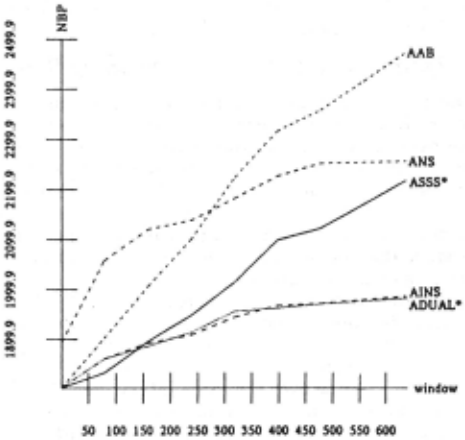
Now let us have a more detailed look at these results. First we consider the case that" the minimax value is inside the window. When using small win dows like those in practice, ANS is the worst of the algorithms compared here, although NS is clearly better than AB. In the average, the gain in efficiency by decreasing window size is approximately "linear", though with a different slope for the various algo rithms (see Fig. 1). Moreover, we observed some exceptional cases, when a larger window results in a more efficient search than a smaller one. This is par ticularly remarkable for AAB, but it is only possible here when both bounds of one window differ from the bounds of the other. An example and a proof sketch for this phenomenon can be found in [Shams 90].
In very strongly ordered trees, the differences caused by various window sizes are small. There may be the hint for practice to avoid too small windows, since the risk of having to re-search may be greater than the savings. The method for estimating the win dow size presented below takes this into account implicitly.
If the first search fails, a re-search has to be done with an opened window. In these cases, ASSS* is the most efficient algorithm. With increasing ordering of the trees, AINS becomes nearly as efficient as ASSS*. ANS is here better than AAB, just as NS is better than AB, while without "failing" and when using smaller windows AAB is more efficient than ANS.
· 9
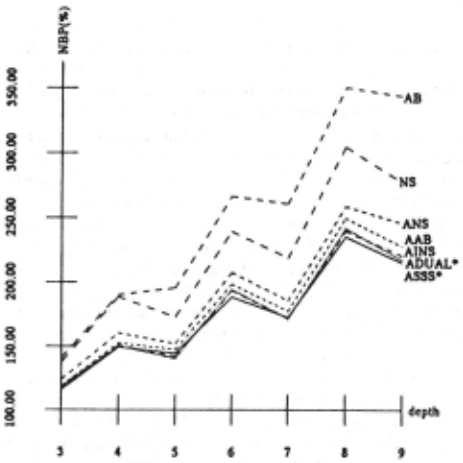
Fig. 2. Comparison of algorithms to minimal tree- NBP(% ), one re-search (in case of aspiration algorithms), window containing 79 values, 80% first-move-best, distribution of terminal nodes' values according to Fx 1 <xJ, width = 5.
Again, there is an approximately linear behavior according to the window size, though with different slopes and more pronounced differences among the algorithms. Moreover, there is a different reason here for exceptions: An initially larger window may well cause a more costly first search, but this may result in a better bound for the second one, in effect reducing the overall effort. These exceptional cases are more frequent than those occurring when the minimax value is inside the window.
There is also an interesting phenomenon when the minimax value is identical to one of the bounds. Each of the two searches may visit fewer bottom nodes than the minimal tree contains, while the sum must of course be at least as large.
In general, our results showed that "failing low" is more expensive than "failing high". This observation coincides with the results of experiments with the minimal window as reported by [Marsland et al. 87].
As described above, ASSS* and ADUAL* can use only one of the window bounds. Hence in our experi ments, re-searches are performed only in 10 instead of 20 cases, in which the minimax value is outside the window. Taking the results of all 20 simulation runs into consideration, these algorithms are the most efficient ones, ASSS* being the best. However, concentrating on the re-search cases only, ADUAL* is surprisingly inefficient, while ASSS* is still the best. Plausible reasons for this phenomenon are that ADUAL* visits comparably many nodes in the in itial failing search, and it "fails low", which we have observed to be more costly than "failing high" (as SSS* does) .
Focussing on practical conditions, a comparison should be made on combined data. Hence, we have chosen the frequency of re-searches (1 out of20 cases) according to our experiences with MERLIN, which have been confirmed by statistics compiled from the five games played at the World Computer Chess Championship in 1989. There, out of 815 individual searches using AAB (usually, iterative deepening uses more than one search for one move decision) a mean value of 5.4% (with a standard deviation of 22.6%) resulted for the relative frequency of re searches. Therefore, we weighted the re-search data with a factor of 1120 and the remaining ones with 19/20. This means that the essential results of the case in which the minimax value is inside the window still hold. Fig. 2 shows the relative efficiency of the investigated aspiration algorithms, and com pares them also to AB and NS.
The results of our experiments with random trees suggest that the relative gain in efficiency by using an aspiration window is nearly the same for all investigated algorithms, except that AB and NS (the ones with linear storage requirements) profit more. However, their aspiration versions are still less efficient than those of the others.
Our comparison of AAB with OLDAAB revealed a previously unknown property ofF AB. With increas ing search depth their efficiency becomes more and more the same. Empirical data showing this phe nomenon are illustrated in [Shams 90, Figs. 90-101]. As we found out, the main reason is that with in creasing depth it is more likely that F AB returns the same value as the original AB, namely the alpha or beta bound. Hence, it appears that the advantage of F AB over the original alpha-beta algorithm is only marginal. However, since it cannot be worse and its overhead is negligible, F AB is still to be preferred.
5. Effects of Different Distributions
All the algorithms are more efficient on trees with uniform distribution of terminal values than on those having terminal values distributed according to Fx . A plausible reason for this effect is as follows . As u~ual in practice, the minimax value lies more likely near the mean of the distribution of all the values. In contrast, when using the uniform distribu tion, more often large values (positive and negative) outside the window occur, which result more fre quently in cutoffs.
Especially AB shows more gain in efficiency from a better ordering on trees with terminal values distrib uted according to Fx , presumably because there is simply more to gain. tn the average, DUAL* is most efficient on trees with both distributions, but using Fx the performance of INS becomes essentially the sarhe (see [Shams 90, Figs. 9-11]}. On trees with uni form distribution of the terminal values, SSS* is even slightly more efficient than DUAL* when searching to even depths, while it is clearly worse for odd depths. Fx 1 makes SSS*'s performance slightly worse. In general, the results of dependencies on the distribution of terminal values also hold for the aspiration variants of these algorithms.
6. Estimating an Optimal Window Size
One goal of our experiments is to produce a basis for determining suitable search parameters to minimize the overall cost of the search (measured by NBP) . Hence, certain properties of the domain have to be estimated or empirical evidence has to be collected by means of statistical observations. In order to de termine a window size which can be expected to produce the lowest possible cost, we need data about two properties of the domain:
- the distribution of the static values Fx (x) as described above, and
- the distribution of the minimax values Fy (x) = P (Y s x) which characterises the random variable Y also ranging over the same interval as X; p = P (Y = x) for node n is the probability of the event that the minimax value MM (n) is identical to x.
The function Fy (x) is us~d to estimate the proba bility of avoiding a re-search, depending on the window size. Of course, Fx(x) and Fy (x) are related to the static evaluation function used.
The cost of a search depends on whether the mini max value is inside (Gin) or outside (Gout> the pregiven window, and consequently in the average case on the frequency of each of these occurrences. Gin and Cout depend on Fx(x) and on the window size s. As slight simplifications which seem to be justified in most practical cases of interest we assume s to be odd, and a window centered around 0 (the data col lected have been shifted appropriately) . The total cost can be computed according to the formula
If the functions can be formulated analytically, the derivation of Ctotal with respect to scan be computed to get the extreme values, the minimum of which is the optimal window size. For our purpose, Fy (x) is based on statistics compiled from the tournament games of the chess program MERLIN at the World Championship in 1989. Unfortunately, the usual continuous distributions for estimating Fy (x) could not fit these data well (according to statistical tests) . Therefore, we had to use the discrete values of our statistics. As for the functions Cin and Gout we have applied interpolation between the data obtained from the simulation runs. The results are sum marized in Table 1.
| AAB | ANS | AINS | ASSS• | ADUAL• | |
|---|---|---|---|---|---|
| Sopt | 81 (1.23) | 53 <0.83) | 135(2.11) | 81 (1.27) | 123 (1.92l |
| ctotal | 1997.59 | 2102.85 | 1914.82 | 1881.82 | 1898.33 |
Although the optimal window size is significantly different for each of the algorithms, their absolute differences of cost are within a margin of about 5 percent for "reasonable" choices of the window size (about 50 to 150). Nevertheless, a correlation be tween total cost and optimal window size can be ob served. The difference between AINS and ADU AL* manifests in larger cost of re-searches for AINS. Hence, a larger window for AINS is plausible despite its larger cost. The estimate of an optimal window size for SSS* is due to its comparably low value for Cin at a specific window size (79). In other regions, its cost is always slightly higher than that of DUAL*.
7. Conclusion
The main results can be summarized as follows:
- Pure alpha-beta search is the least effective backward-pruning algorithm also on very strongly ordered trees. However, using an aspiration win dow can make it competitive since it profits most from using such a window. Under realistic condi tions AAB is fully competitive (see Fig. 2), which is also supported by experience with computer chess. Moreover, we have observed previously unpub lished dependencies of using such a window upon certain properties of the trees.
- While ASSS* and ADUAL* visit slightly fewer nodes than their counterparts, we would suggest that they should not be used especially in domains where good ordering can be achieved, because this minor advantage is more than outweighed by their exponential space complexity. Achieving such an ordering should be feasible in most structured do mains, using methods like the history heuristic of [Schaeffer 86, 89]. Moreover, even though these al gorithms visit fewer nodes, they are likely to be slower in practice due to their overhead in man aging the list of"open" nodes.
- Regarding the algorithms with linear space com plexity, NS can only slightly be improved by using an aspiration window (ANS). Using smaller win dows, AAB has been found to be more efficient than ANS, and only the variant of NS with expo nential . space complexity, AINS, is comparably better (see Fig. 2).
- Our comparison between the variants of aspiration AB using F AB in contrast to the original version of alpha-beta search revealed that the deeper the search the more likely F AB returns one of the bounds as its result.
- The assumption of uniform distribution of terminal values must be handled with care, since it affects the results.
- Presupposing evidence about some characteristic properties of the domain of application, we found a method for an analytic determination of estimates
of the optimal window size for each of the algo rithms compared.
Purely theoretical studies did not provide us with these results, since realistic modelling of the condi tions in practice makes the analysis at least very dif ficult. More and more simplifications often lead to the loss of important conditions. For instance, alpha beta search under realistic conditions is by far not as inefficient as suggested by theoretical analysis. Purely empirical studies in specific domains, on the other hand, always leave doubt on the generality of their results. Our experien·ce with computer chess is consistent with the results of the simulation studies (as far as they are comparable). We hope that our ap proach of less rigid modelling and the use of simul ation studies can help to bridge the gap between theory and practice.
Acknowledgments
We would like to thank Jonathan Schaeffer for giving us a very good basis for our experiments, in providing us especially with the C code of his tree generation algorithm. Wolfgang Ginzel's effort in writing software for plotting the figures is greatly acknowledged.
@inproceedings{ijcai1991p29,
  title     = {Using Aspiration Windows for Minimax Algorithms},
  author    = {Shams, Reza and Kaindl, Hermann and Horacek, Helmut},
  booktitle = {Proceedings of the Twelfth International Joint Conference on
               Artificial Intelligence, {IJCAI-91}},
  publisher = {International Joint Conferences on Artificial Intelligence},
  editor    = {John Mylopoulos and Ray Reiter},
  pages     = {192--196},
  year      = {1991},
  month     = {8},
  note      = {Automated Reasoning},
  url       = {https://ijcai.org/proceedings/1991/29},
}
TY - CPAPER TI - Using Aspiration Windows for Minimax Algorithms AU - Shams, Reza AU - Kaindl, Hermann AU - Horacek, Helmut T2 - Proceedings of the Twelfth International Joint Conference on Artificial Intelligence, IJCAI-91 PB - International Joint Conferences on Artificial Intelligence PY - 1991 SP - 192 EP - 196 UR - https://ijcai.org/proceedings/1991/29 ER -Copied
Machine-readable versions of this paper, for tools and AI agents:





