
The Reason for the Benefits of Minimax Search
Proceedings of the Eleventh International Joint Conference on Artificial Intelligence. Search. Pages 322-326.
© 1989 International Joint Conferences on Artificial Intelligence
Abstract
Since there existed no convincing theoretical explanation for the usually observed benefits of minimax search in practice, we investigated two instances of a class of tree models which are based on the concept of quiescence. (This way the strict separation of static and dynamic aspects in practical programs is modeled.) We performed Monte Carlo simulations, enhanced by analytic results. The behaviour of these models in our studies generally corresponds quite well to observations in practice (especially that of the model based on the more restrictive definition of quiescence). Hence, we found empirical evidence for an earlier conjecture, and these results can serve as an important step towards understanding the reason for the benefits of minimax search .
- Abramson, B., An Explanation of and Cure for Minimax Patholo- gy, in Uncertainty in Arti{iciallntelligence (L. N. Kana! and J . F. Lemmer, Eds.), Amsterdam: North-Holland. 1986, 495-504.
- Althofer, 1., Generalized Minimax Algorithms are no Better Error Correctors than Minimax Itself, in Advances in Computer Chess 5 (D.F. Beal, Ed.), Amsterdam: North-Holland. 1989, 265- 282.
- Beal, D.F., Benefits of minimax search, in Advances in Computer Chess 3 (M .R.B . Clarke, Ed.), Oxford: Pergamon Press, 1982, 17- 24.
- Bratko, 1. , and Gams, M., Error analysis of the minimax principle,in Advances in Computer Chess 3 (M.R.B. Clarke, Ed.), Oxford: Pergamon Press, 1982, 1-15.
- Chi, P., and Nau, D.S., Comparison of the MINIMAX and PRODUCT Back-Up Rules in a Variety of Games, in Search in Artificiallntelligence (L.Kanal and V. Kumar, Eds.), New York: Springer-Verlag, 1988,450-471.
- Kaindl, H., Quiescence Search in Computer Chess, in SlGART Newsletter 80 (special issue on game-playing (M .A. Bramer, Ed.)), 1982a, 124-131, reprinted in Computer Game-Playing: Theory and Practice, Chichester, England: Ellis Horwood, 1983, 39-52.
- Kaindl, H., Dynamic Control of the Quiescence Search in Com- puter Chess, in Proc. EMCSR-82, Vienna, April, 1982b, 973- 978. Amsterdam: North-Holland.
- Kaindl, H., Searching to Variable Depth in Computer Chess, in Proc. lJCAI-83, Karlsruhe, August. 1983,760-762 . IJCAI
- Kaindl, H., Minimaxing: Theory and Practice, AI Magazine 9 !3) , 1988,69-76.
- Knuth, D.E., and Moore, R.W, An Analysis of Alpha-Beta Pruning, Artificial Intelligence 6 (4) 1975,293-326.
- Michon, G., Recursive Random Games : A Probabilistic Model for Perfect Information Games . Ph. D. Dissertation , lJ ni versity of California, Los Angeles, CA, 1983.
- Nau, D.S., Pathology on game trees: a summary of results, in Proc. First National Conference on Artificiallntelligence, Stanford, CA, 1980, 102-104.
- Nau, D.S., An investigation of the causes of pathology in games, Artificiallntelligence 19 (3), 1982,257-278.
- Nau, D.S., Purdom, P., and Tzeng, H.C., Experiments on alternatives to minimax, lnternational Journal of Parallel Programming 15 (2) , 1986, 163-183.
- Pearl, J ., On the nature of pathology in game searching, Artificial Intelligence 20 (4), 1983,427-453.
- Scheucher, A., Minimaxing und Quiescence: Eine experimentelle Untersuchung. Diplomarbeit, Technical Univ. of Vienna, 1989.
- Schriifer, G., Presence and Absence of Pathology on Game Trees, in Advances in Computer Chess 4 (0 F. Beal, Ed.), Oxford: Pergamon Press, 1986, 101-112.
- Shannon, C.E., Programming a computer for playing chess, Phil. Mag . 41, 1950, 256-275.
- Turing, A.M. et al., Digital computers applied to games, in Faster than Thought(B.V. Bowden, Ed.), London: Pitman, 1953,286- 295.
References were extracted automatically from the PDF and may contain errors.
Full text extracted automatically from the PDF; figures, tables and equations may differ. The PDF is the version of record.
1 INTRODUCTION
For a long time, there was universal agreement to use minimax search in programs for two-person , perfect information games. In fact, this approach is very suc cessful in games like chess, checkers, or kalah. Usually it shows a dramatic improvement in playing strength with increasing search depth. However, the discovery of minimax pathology [Nau 80] demonstrated that in certain game trees deeper minimax search can also have detrimental effects. In the meantime several mod els have been analysed which show pathological behav iour, and several models which do not (see [Kaindl 88] for a critical overview). Recently, [AlthOfer 89] proved for special game trees that under certain conditions not only minimax searches fail , but also every other algo rithm. However, none of these models explains convin cingly, why minimax search is this beneficial in prac tice (by showing dramatic improvements of the deci sion quality with increasing search depth, and having a convincing relationship of the assumptions and the observed phenomena with "reality").
From extensive experience with computer chess practice, [Kaindl 88] developed an illustrative model based on an abstract concept of qutescence. In the fol lowing we sketch this and a related model, describe the design of our experiments, and present the results of our simulation studies investigating the behaviour with increasing search depth.
2 BACKGROUND
In general , the move decision in "interesting" games is based on bounded look-ahead to artificial terminal nodes. Usually, the "worth" of such nodes can only be estimated heuristically. This is normally done by a stat-
'Hermann Kaindl Marxergasse 18/2/1 1030 Wien Austria
ic evaluation function f(n), assigning a single point val ue-usually ranging over an interval of integer val ues-to a node n. (In the following we assume that f(n) represents this value from the viewpoint of the side on move in the evaluated position, which is represented by the node n.) These values are propagated towards the root of a search tree according to a back-up rule, usual-. ly via minimaxing.
Definition 2.1. A minimax value MMr(n) of a node n can be computed recursively as follows (in the nega max framework):
(2) else: MMr(n) : = max, (-MMr(n;)) for all successors n;ofn.
(1) If n is considered terminal: MM,-(n): = f(n) ;
Usually, the primary interest is not the minimax value of the tree itself, but rather the move to be selec ted at the root (the given position) . In accordance with this back-up rule, the choice is one of what may be se veral moves leading to the maximum (backed-up) value of the successors. Since the depth of such searches will be important for the purpose of this paper, we also de fine a special case of using this rule.
Definition 2.2. MMra. (n) is the minimax value of node n resulting from exactly d applications of the recursion (2) in definition 2.1 in every branch of the search tree.
In fact, MMrd (n) defines the minimax value from a full-width search of the tree below n to uniform depth d (according to the "type A strategy" described by [Shannon 50]). While this kind of look-ahead is still the usual paradigm in computer game-playing practice, f does not directly denote here the static evaluator itself, but a simple dynamic quiescence evaluator based on the static one. In this paper it is sufficient to consider f as some heuristic function which evaluates nodes with some error.
3 THE CONCEPT OF QUIESCENCE
These quiescence evaluators are dynamic in the sense that they themselves perform a search-a rather selec tive quiescence search: for instance in chess, most pro grams try capture moves, searching for (relatively) quiescent positions (where the side on move cannot profitably capture). The term "quiescent" was already coined by [Shannon 50], and explained using an exam ple of capture moves from the domain of chess. Indepen dently, also Turing derived the same concept from his considerations about chess programming-he called quiescent positions "dead" (see [Turing et al. 53]). Due to the difficulties in controlling more elaborate quies cence searches, even now most chess programs restrict themselves to consider capture (and sometimes also checking) moves there. More sofhisticated domain-spe cific aspects as well as a genera framework for controlling such a quiescence search can be found in [Kaindl 82a, b].
However abstracting from the issues of a specific game, what is the domain-independent concept of quiescence all about? Generally, we would not consider a position as quiescent if its value can be changed dras tically by moves or move sequences. These values are derived from the static evaluation function and/or the back-up rule. (Capture moves in chess significantly change the static values assigned by the materially dominated evaluation functions.) Based on this, [Kaindl 88] defined an abstract model of quiescence (rewritten here more formally).
Definition 3.1. A node k is n-ply-quiescent iff f(k) = MMrn(k).
This definition is already tailored towards a simpli fied environment with two-valued functions. As indi cated above, these functions usually return a wider range of values. Therefore in practice, strict equality would be achieved very seldom, and a relaxation, for example, in the sense of "small difference" would be more realistic. Moreover, it only relates the values of the nodes at a certain constant distance of a given node with its own value. While this has been considered suf ficient for illustrative purposes, a more restrictive defi nition may provide a more realistic model, e.g. one re quiring stability up to a certain depth.
Definition 3.2. A node k is up-to-n-ply-quiescent iff k is i-ply-quiescent for all i E {l..n}.
4 TREE MODELS BASED ON QUIESCENCE
The question to be answered is, why deeper and deeper minimax searches usually achieve better and better results in practice. While this may seem intuitively "clear" at first glance when considering a concrete domain like chess, up to now a convincing explanation based on a general model has not been given. The key question for this can be stated using Ken Thompson's words: 1) "What is it in the tree?"
We are rather convinced now that the central con cept for such an explanation is quiescence. Based on it, the following criteria specify tree models with simpli fied properties, which should nevertheless capture what is important for strongly beneficial behaviour of minimax search. Hence the question is, whether searches in such trees using the minimax back-up rule show such behaviour.
Definition 4.1. A class of game tree models is speci fied by the following assumptions:
- The tree structure has a uniform branching degree b.
- True values of nodes (TV) are either WIN or LOSS.
- True values have the game-theoretic relationship.
- Heuristic values (assigned by f) are either +1 (estimating WIN) or -1 (estimating LOSS).
- Probabilities of errore+ and e- are defined as follows (k being a node):
- e+(k) = P({(k) = +11TV(k) =LOSS)
- e-(k) = P(f(k) = -1 TV(k) = WINl
- For all nodes l that are quiescent and for all nodes m that are not quiescent the following conditions hold:
e+(l) < e+(m)
e-(l) < e-(m)
e+(l) < e-(m)
e-(l) < e+(m)
ll private communication of the second author with Ken Thompson in San Francisco, October, 1984.
- The number of nodes that are quiescent is small compared to the number of nodes that are not quies cent.
Substituting "n-ply-quiescent" for "quiescent" here results in the model presented in [Kaindl 88], using "up-to-n-ply-quiescent" yields a related model. Both of these model instances have been investigated to study also the influence of the respective definition of quies cence.
In order to make studying the behaviour of these models feasible at all, they are kept as simple as pos sible. Hence, the relationship of these assumptions to reality and their possible influence on the behaviour should be discussed. Criterion ( 1) assumes a uniform branching of the tree, which is normally not the case in practice. However, according to [Michon 83] this prop erty as a special case of "non-inertness" even seems to further pathological behaviour (the contrary of what we are going to show). Criteria (2) and (4) assume only two possible values for the true as well as the heuristic values. While especially the second of these simplifica tions seems strong, for instance the studies of [Bratko & Gams 82] and [Pearl83] show that they did not influ ence the behaviour of their models. Assumption (5) dis tinguishes two different probabilities, since the analy ses of [Schrti.fer 86] and [Pearl 83] indicate that this may be important for the behaviour. We will describe below whether this is also the case with our models.
In summary, assumptions (1) to (5) are fairly stan dard. However, assumptions (6) and (7) are new and should model "what it is in the tree" (based on the con cept of quiescence). Assumption (6) states that the er rors of statically evaluating quiescent nodes are usual ly smaller than those of evaluating nonquiescent ones. (Why else are resources spent for quiescence search?) Assumption (7) models the current situation in do mains like chess, checkers, or kalah, where at least up to now no static evaluation functions have been written that are sufficient to capture their dynamic aspects. If they were, the searches would not have to discover this much. (We have also investigated this case within our simulation studies.)
As the parameters of the models are important for the investigations, we will enumerate them explicitly. The shape of the game tree is completely specified by the uniform branching degree b, but also the probabili ty p = P (TV(k) = WIN) for all nodes k may be impor tant (see e.g. [Pearl 83]). The remaining parameters characterize the properties of the static evaluation function f: The errors e+ and e- have to be considered twice, once for quiescent nodes (eq+, eq-) and once for nonquiescent nodes (en+, en-). The number n of n-ply quiescent or up-to-n-ply-quiescent is of special interest, since a relationship with the benefits of searching n plies deep has been conjectured by [Kaindl 88]. At last, also the probability fraction = P(k is quiescent) for all nodes k can be parametrized, determining the average fraction of the number of quiescent nodes to the total number of nodes.
Besides specifiying the model assumptions we also have to define how the behaviour of the models shall be measured. The question is whether the errors made by the evaluation function are increased or decreased by backing up the heuristic estimates through several levels of the tree via minimaxing. Hence we define the probability of the error made by the minimax value of a certain search depth in estimating the true value as follows, using the fact that in our models P (TV(k) = WIN)+ P(TV(k) =LOSS) = 1. (The quality of the move choice at the root is directly related to this error.)
Definition 4.2. For node k and search depth d ed(k) = P(((MMrd(k) = +1) A (TV(k) =LOSS)) v ((MMrd(k) = -1) A (TV(k) =WIN))).
5 EXPERIMENT DESIGN
Sinc.e we have investigated the models performing sim ulatwns, we had to generate game trees according to the criteria of the models. Within these trees, minimax searches were performed.
5.1 Tree Generation
While these models have resisted formal analysis up to now, even programming the generation of game trees according to their criteria was nontrivial. Hence we will sketch the most important aspects here. (The reader interested in algorithmic details is referred to [Scheucher 89].) Generally, every stochastic event has been simulated by a call to a pseudo-random number generator, parametrized independently of the relative frequencies achieved earlier in the tree generation process.2l
Due to the complex relationships between the true and the heuristic values within whole subtrees it was rather clear that the trees should be generated top down from the root. These relationships can be viewed as constraints which have to be satisfied within the trees. And it is more convenient to propagate such con straints down the tree and to assign values satisfying them, rather than just assigning values at the bottom which have to be retracted often (since the constraints cannot be satisfied with them). Similarly, it was rather clear that the trees had to be stored explicitly, as gener ating them "on the fly" while searching them seemed unrealistic due to the complex relationships.
Also it proved useful to assign the true and the heu ristic values "simultaneously". Predetermining either of them (e.g. the true values) all over the generated tree first, leads to an undesirable effect: Since there are severe constraints to be satisfied for the remaining values, the probabilities of error (e+ and e- for quiescent and for nonquiescent nodes) as parametrized may differ too much from the actually achieved relative frequen cies. Hence, we decided to generate the tree recursively as follows.
First, for some node k and its children nodes ki true values are assigned according to the game-theoretic relationship and the "probability-to-win" parameter p . They are also labelled as "quiescent" or "nonquiescent" according to the parametrized fraction (of the former). Then these successors are assigned heuristic values ac cording to the probabilities of error. (In fact, some of them already may have had one attached, which is not altered here.) After that, for each of the subtrees rooted in the nodes ki the generating program tries to assign heuristic values to certain descendant nodes so as to satisfy the respective criteria, depending on the label of node k; ("quiescent" or "nonquiescent") and the used definition of quiescence (3.1 or 3.2). This process itself works recursively through these subtrees, ensuring the required minimax values: Either one branch has to be followed (selected at random) , or all the successors have to result in a predetermined value. Of course, it is easier to satisfy the constraints imposed by the defini tion of n-ply-quiescence than those by up-to-n-ply quiescence. For the latter, it may happen that the process of assigning heuristic values deeper in the tree has to backtrack, since the constraints could not be satis fied. In such a case other choices are tried first at those nodes where only one branch has to result in a pre determined value.
2) The ones used are named nrand48 and erand48, and they are available under UNIX'" Svstem V. UNIX is a registered trademark of AT&T.
5.2 Simulation Runs
After the generation of such a game tree, mtmmax searches were performed within this tree. (Of course, backward pruning was used to avoid unnecessary effort; see for instance [Knuth & Moore 75] for a de scription of the a-~ procedure.) These searches comput ed minimax values MMrd for all the possible depths d in such a tree. ( f is characterized in such a simulated tree search by the corresponding parameters.) The goal of performing these searches was to gather data about the behaviour of the error made by the minimax value in estimating the true value, depending on the search depth. These data provided relative frequencies for ed. In gathering them, we kept records whether the root nodes of the searches were labelled "quiescent" or "non quiescent" since we expected different behaviour of the respective errors.
In order to study the influence of the parameters of the models, we varied them in certain ways (which are described together with the results). We investigated mainly parameter constellations fulfilling the assump tions of the models. However, "near misses"-in the sense that just one assumption is not fulfilled-seemed also to be of interest in order to see whether the respec tive assumption is necessary for the models to show the expected behaviour.
In addition to the parameters of the models them selves there are also parameters for the investigations via simulation. The size of a generated tree is deter mined here not only by the uniform branching degree b, but also by its depth dg. Since there was a maximum of available working memory determined by the given resources, pairs of b and dg were chosen so as to result in trees just fitting into the available memory. While of course searches not only from the root of the generated tree were possible, none of them were directed into the region below (dg- n) levels from this root. (n is the parameter in definition 3.1 or 3.2, respectively.) The reason is that within this region the conditions of the models cannot be guaranteed, since it contains nodes for which the property of n-ply-quiescence (or up-to-n ply-quiescence) cannot be ensured (because correlated nodes would be outside of the generated tree).
Another parameter for a simulation run is the seed for the pseudo-random number generator.3l For gather ing data about several trees with an otherwise identi cal parameter constellation, this seed was varied. The simulations reported in this paper have been run over a period of about two months on a workstation, mainly overnight or on weekends.
6 RESULTS
Since the given parameter values (especially for proba bilities) could not always be achieved accurately within the generated trees (also due to the constraints to be satisfied), the sampling of the data was done according to the actual values in these trees (especially relative frequencies). For this reason the figures shown below plot the results of using certain parameter values out of an interval. We will discuss the results of parameter constellations "inside" and "outside" of the models sep arately, while always pointing to the peculiarities aris ing from the difference between n-ply-quiescence and up-to-n-ply-quiescence.
3) In fact , the seeds for the ··instances" of erand48 were results of calls to nrand48, which was initialized by a single seed.
As these models were developed primarily from observations of minimaxing practice, we will empha size the discussion of the relationship of phenomena shown by these models with "reality". Hence, we will restrict the presentation of the results to that of search depths d ;£ n, since for d > n mainly unrealistic phe nomena have shown up. (For a discussion of these, the interested reader is referred to [Scheucher 89].) Some how it seems, as if there is too little to discover for the searches probing deeper than n within the trees accord ing to our models. We might imagine that games like chess are characterized by a "large" n. Just before the presentation of the results gained from the simula tions, let us briefly show straightforward analytic re sults about our models.
Lemma 6.1. Let e+ (k) and e- (k) be error proba bilities (according to definition 4.1), and p = P(TV(k) = WIN) for node k. Then the probability of the total (static) error can be computed as e (k) = e+ (k) · (1-p) + e-(k). p .
Proof" straightforward by using the multiplication theorem of probability theory and the fact that in our models P(TV(k) =WIN)+ P(TV(k) =LOSS) = 1 I
Corollary. When restricting the scope to quiescent nodes land using the corresponding error probabilities eq+ (l) and eq-(l), the respective error probability eq (l) can be computed analogously.
Theorem 6.1. Full-width searches to depth d = n using minimaxing and rooting in nodes l, that are n ply-quiescent, result in the error probability
eqn(l) = eq+(l) · (1-p) + eq-(l) ·p.
Proof"
eqn(l) = P(((MMrn(l) = + 1) A (TV(l) =LOSS)) v
((MMrn(l) = -1) A (TV(l) =WIN)))
= P((({(l) = + 1) A (TV(l) =LOSS)) v
(({(l) = -1) A (TV(l) =WIN)))
= eq(l) = eq+(l)·(1-p)+eq-(l) ·p
1
Theorem 6.2. For all depths d E {l..n}, full-width searches using minimaxing and rooting in nodes l, that are up-to-n-ply-quiescent, result in the same error probability eqd(l) = eq+(l)·(1-p)+eq-(l)·p. Proof" analogous to the proof of theorem 6.1, but using definition 3.2 instead of3.1 1
Especially the result of the last theorem may seem quite unrealistic, in telling that the error probability of searches from certain nodes is independent of the search depth( ;£ n). However on the contrary, also in practice the searches starting at nodes which are quies cent do not pay off: Whether their heuristic estimate is good or not, the value remains rather stable even when searches are performed. (Usually the fraction of quies cent nodes is very low.) The exact result of this theorem exaggerates, of course, but no more than the assump tion of equality in the model definitions of quiescence it is based upon. In the figures shown below, the data about searches starting at nodes, that are up-to-n-ply quiescent, are computed using this theorem.
6.1 "Inside"
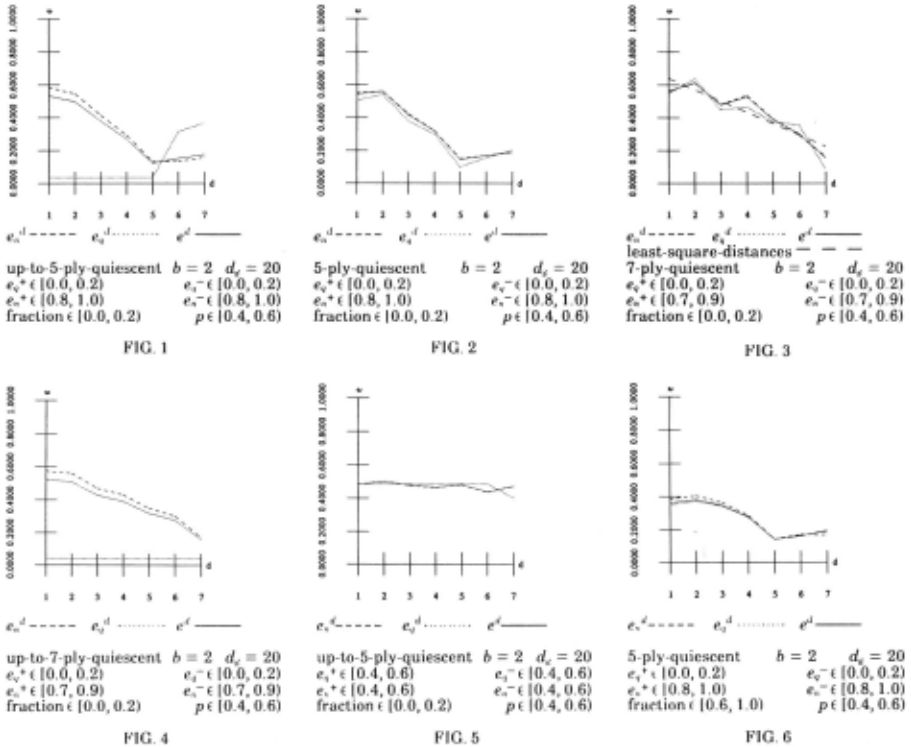
In general (for d ;£ n), both models usually show a str~mg error reduction with increasing d, corresponding qmte well to that usually observed in practice. Fig. 1 shows a typical case for the model based on up-to-n-ply quzescence. The length of the 99.9% confidence interval for the data of nonquiescent nodes at d = 1 is 2 X
0.002288, that at d = 5 is 2 X 0.006265.4) However, especially the model based on n-ply-quiescence also shows certain phenomena of increasing error. First we will discuss these phenomena, and then we will analyse the influence of the various parameters of the models.
Let us compare the relative frequencies for e 1 and e 2 in the model based on n-ply-quiescence. With the exception of n = 2, the error rate generally increases here from the 1-ply to the 2-ply searches. Fig. 2 may illustrate this phenomenon by showing a typical case (comparable to that of Fig. 1). We cannot relate it to practice, and it is not really clear why it arises. But we can see from our data comparing both models, that its effect is related to the weaker stability provided by the definition of n-ply-quiescence. While also the model based on up-to-n-ply-quiescence shows different behav iour in this case, the error is usually reduced at d = 2 compared to that at d = 1.
More generally, the model based on n-ply-quies cence sometimes also leads to increases in error when going from odd to even search depths. Systematically, the behaviour here is worse than that when going from even to odd depths, while the overall tendency is al ways towards an error reduction. Fig. 3 illustrates such "oscillations" and the average behaviour (showing the straight line of least square distances) . It is interesting to notice that minimaxing did also relatively better when the search depth was odd in the studies of [N au et al . 86]. Up-to-n-ply-quiescence strongly dampens these oscillations (see e.g. Fig. 4). Since these phenomena are not known to have occured in practice, we attribute them to artificial assumptions in the models, such as keeping n constant for every quiescent node in a tree.
How does an increase of the parameter n influence the behaviour of the models? As to be expected, it re duces the overall rate of improvement per ply. But it also leads to stronger osc~llations, especially for n-ply quzescence (compare for mstance Figs. 2 and 3). For varying values of b, the same patterns can be observed indicating no significant influence of this parameter or{ the general behaviour. However, different values of p influence the phenomena described above: When nodes k have a larger and larger probability P(TV(k) =WIN) (especially larger than 0.5), the strange phenomenon regarding 2-ply searches fades and even disappears. In much the same way the oscillations between odd and even dei;>ths are dampened by increasing values of p.
The mfluence of varying error probabilities for the static evaluation is of special interest here, since in creasmg errors at nonquiescent nodes (even any one of en+ or en-) cause stronger improvement with increasing search depth, whereas low errors at such nodes do not e':en result in error reduction. There may be even a hmt for the practical use of minimaxing, not to worry too much about estimating the values of nonquiescent nodes accurately. In fact, the most successful chess pro grams up to now do not use mechanisms Oike swap-off analysis) which are attempting this for assigning static scores. The influence of these errors is stronger than that of the errors at quiescent nodes (especially it shows up, that any one of en+ or en- should be large to achieve (strong) improvements).
4) Because of the way of tree generation and searching, we have more data for the shallower searches, and those of quiescent nodes are partially computed using the theorems. Whenever f~as1ble, the computed values of e./ are plotted instead of rela tive frequenc1es . The complete set of figures is available in [Scheucht:r 891, ~howing a much stronger variation of parame ters than IS posstble here due to space limitations.
For different error probabilities of overestimating and underestimating (e+ =t= e-), we could not find differ ent results compared to the case of (nearly) equal probabilities. Especially in contrast to the result of [Schrufer 86], it was not necessary for e- to be negli gible to avoid pathology.
6.2 "Outside"
Let us look at the effects of violating the assumptions (6) and (7) in definition 4.1, first one at a time. When some error probability at quiescent nodes becomes larger or equal to one of that at nonquiescent ones, the relative frequencies for ed are nearly independent of the search depth d, i.e. no improvements can be found. (See Fig. 5, for instance.) According to theorem 6.2, for up-to-n-ply-quiescence the probabilities of the backed up errors at quiescent nodes become large, and strangly enough even larger than those at nonquiescent nodes.
What happens, when the number of quiescent nodes is not "small" compared to that of nonquiescent ones? When the fraction of the number of quiescent nodes in creases, the relative frequencies for ed become already smaller at lower depths d, but they also cannot be reduced very much (see e.g. Fig. 6). This phenomenon can be related to rare cases in computer chess practice, in particular to certain chess endgames with very few possibilities for capturing pieces or promoting pawns.
Hence, from the results of our simulation studies we can see that both these new and critical assumptions are necessary. In addition, experiments of violating them simultaneously lead to completely unrealistic effects.
7 RELATED WORK
Now let us briefly compare our results with those of some of the earlier attempts to explain the benefits of minimax search observed in practice. Previous work suggests that independence of the true values or inde pendence of the errors made by the static evaluation function is a necessary condition for pathology in mini maxing. Note, that assuming independence instead of our critical assumptions (6) and (7), our models would be a generalization of a pathological one analysed by [Pearl 83]. Due to these assumptions (and our way of tree generation) we also avoid the "minimax conver gence" and the related necessity to have a specific value of the "probability-to-win" parameter p for "fair games" (see e.g. [Nau 82]). Hence, most of the attempts to show nonpathological behaviour are based on vari ous assumptions about "dependencies".
[N au 82] investigated (via N -games) the influence of dependencies between the true values which arise "incrementally" so that the strength or weakness of a board position tends to be roughly the same for sibling nodes. But although this sibling correlation in Nau's simulation was considered extremely strong by [Pearl 83, p. 443], for instance Table 5 in [Nau 82] shows only modest improvements in decision quality with increas ing search depth. These dependencies also cause the same static evaluation function to be clearly more ac curate for N -games than for the structurally equi v alent P-games (in which pathology occurs). This can be related to the more general result by [Chi & Nau 88] that low error rates favour minimaxing, especially versus product propagation. In order to achieve bene ficial behaviour in our models only a minority of nodes must be evaluated with low error-the quiescent ones. (This seems to be more realistic.)
Very similar to this "incremental" sibling relation ship is the idea of "clustering" of true values investi gated by [Beal 82]. In order to make a comparison feasible, we gathered data about the "clustering factor" (as defined by [Beal 82]) in our models during the sim ulation runs. (In our models this factor cannot be con· stant over all the levels of a search tree.) In the aver age, for the data at b = 2 a value of about 0.6 was found, at b = 4 about 0.4. Most interestingly, compared to the data plotted in the Appendix of [Beal 82] this would mean error reduction in the former and error increase in the latter case. However, we could neither find such an influence on the behaviour depending on b nor one depending on the data about the "clustering factor" in our models. Hence, while our assumptions obviously induce such clustering in our trees, its actual strength does not influence the behaviour critically.
In general, some of the earlier investigated depen dencies are plausible to exist in real games (while their actual strength is not this clear). However, is the enor mous effort spent on searching deeper, because there are such dependencies? We think that the searches are performed deeper to discover dynamic aspects not incor porated in the usual static evaluation function (see also [Kaindl 88]). And this is modeled here based on the concept of quiescence. The concepts introduced by these models appear to be more fundamental, in having a very plausible relationship to "reality", and in induc ing certain dependencies, for instance those denoted as "clustering".
[Pearl 83] investigated the argument that deeper searching avoids traps, in a very simplified model con sidering only actual terminal nodes (that is, mates and stalemates) at all levels of the game tree as "traps". Based on practical data and experience, [Kaindl 88] argues that this type of trap alone does not seem to make a strong contribution to the benefits of minimax search in computer chess. In a higher sense, this "trap argument" actually served as a basis in developing the models investigated here. But they neglect Pearl's type of "trap" which easily can be evaluated without error. [Abramson 86] postulates instead of such "traps" (but with the same consequences) that the evaluation func tion must be able to recognize more and more forced wins (evaluated without error) as search deepens, to avoid pathology. Our models require neither of these strong assumptions to show beneficial behaviour of minimaxing---only a minority of nodes must be evalu ated with low error. (This distinction is insofar very important as e.g. the first model in [Pearl83] can avoid pathological behaviour only when one of the errors (e+ ore- in our notation) is equal to 0.)
8 CONCLUSION
In summary, we found empirical evidence for the con jecture stated in [Kaindl 88], that the benefits of mini max search usually observed in practice can be explained via the concept of quiescence. However, while the definition of n-ply-quiescence has been considered suffi cient for illustrative purposes, the more restrictive definition of up-to-n-ply-quiescence resulted in a more realistic model. The most unrealistic issue here ap pears to be that n is constant all over the tree. Hence, using a random variable may be an interesting idea. Moreover, we investigated the (important) case "du ring" a game, ignoring completely the real end with actual terminal nodes. However, this can be modeled by introducing nodes which can be evaluated without error (like Pearl's "traps"). While our searches have been performed to uniform depth d, quiescence searches also might be simulated within our game tree models after all they are based on quiescence.
ACKNOWLEDGMENTS
We would like to thank SIEMENS AG Osterreich for supporting this research, especially by providing machine time for the simulation studies and facilities for typing this paper. Wolfgang Ginzel's effort in writing software for plotting the figures is great ly acknowledged.
@inproceedings{ijcai1989p51,
  title     = {The Reason for the Benefits of Minimax Search},
  author    = {Scheucher, Anton and Kaindl, Hermann},
  booktitle = {Proceedings of the Eleventh International Joint Conference on
               Artificial Intelligence, {IJCAI-89}},
  publisher = {International Joint Conferences on Artificial Intelligence},
  editor    = {N. S. Sridharan},
  pages     = {322--326},
  year      = {1989},
  month     = {8},
  note      = {Search},
  url       = {https://ijcai.org/proceedings/1989/51},
}
TY - CPAPER TI - The Reason for the Benefits of Minimax Search AU - Scheucher, Anton AU - Kaindl, Hermann T2 - Proceedings of the Eleventh International Joint Conference on Artificial Intelligence, IJCAI-89 PB - International Joint Conferences on Artificial Intelligence PY - 1989 SP - 322 EP - 326 UR - https://ijcai.org/proceedings/1989/51 ER -Copied
Machine-readable versions of this paper, for tools and AI agents:





