
Multi-Dimensional Heuristic Searching
Proceedings of the Eleventh International Joint Conference on Artificial Intelligence. Search. Pages 316-320.
Abstract
A heuristic improvement technique referred to as multi-dimensional heuristics is presented. Instead of only applying the heuristic between two states xl and x2, when a distance estimate of X 1 X 2 is needed, this technique uses a reference state R and applies the heuristic function to (X1 ,R) and (X2,R) and compares the resulting values. If two states are close to each other, then they should also be approximately equidistant to a third reference state. It is possible to use many such reference states to improve some heuristics. The reference states are used to map the search into an N-dimensional search space. The process of choosing reference states can be automated and is in fact a learning procedure. Test results using the 15-puzzle are presented in support of the effectiveness of multi-dimensional heuristics. This method has been shown to improve both a weak 15-puzzle heuristic, the tile reversal heuristic, as well as the stronger Manhattan distance heuristic.
- [De Champeaux and Sint, 1977] D. De Champeaux and L. Sint. An Improved Bidirectional Heuristic Search Algorithm. Journal ofthe ACM, 24:177-191, 1977.
- [Hart et al., 1968] P. Hart, R. Duda, and B. Raphael. A Formal Basis for the Heuristic Determination of Min- imum Cost Paths. IEEE Trans. on SSG, 4 1968.
- [Korf, 1985] Richard E. Korf. Depth-First Iterative- Deepening: An Optimal Admissible Tree Search. Ar- tificial Intelligence, 27:97-109 , July 1985 .
- [Nelson, 1988] Peter C. Nelson. Parallel Bidirectional Search using Multi-Dimensional Heuristics. Ph.D. Dissertation, Dept. of Electrical Engineering and Computer Science, Northwestern University, June 1988.
- [Rich, 1983] Elaine Rich. Artificial Intelligence .
References were extracted automatically from the PDF and may contain errors.
Full text extracted automatically from the PDF; figures, tables and equations may differ. The PDF is the version of record.
1 Introduction
Traditional heuristic search involves ordering state ex pansions relative to their estimated costs of participat ing in a solution. This cost is computed by a function j = g + h where g is the known cost (depth) and h is an estimate of the remaining cost or distance to the goal [Hart et al., 1968]. This paper proposes a general method of improving h. Instead of estimating h by eval uating a given state X with respect to the goal G several new reference states are used to gain perspective lNelson, 1988]. The relative position of X and G among the refer ence states will be used to estimate the distance between X and G.
Assuming h is of a general nature and can be used to estimate the distance between any two states in the search space, then h can be used to estimate the distances from the reference states to both G and X. For each reference state R;, a difference value LlR; =I h(X, R;) -l~(�, R;) I is computed, which is the absolute value of the difference between the estimated distances from X to R; and from G to R;. Note that Lawrence J. Henschen Dept. of Electrical Engineering and Computer Science Northwestern University Evanston, Illinois 60208
if the goal is used as a reference state Rk, then tl.Rk is just the traditional heuristic estimate h. These differ ence values LlR;, where 1 :S i :S n and n is the number ofreference states, will be used to give a better estimate of the actual distance from the X to G. The new esti mate will be referred to as fin and will be proportional to the values of LlR1, LlR2 ... LlRn as will be discussed in section 2. The method for combining the LlR values to get Hn is based on mapping the search space into an N -dimensional space which is why fin is referred to as a multi-dimensional heuristic or MDH. Another key part of the calculation of fin is that the tl.R values are independent of each other and can be computed simulta neously on a multiprocessor architecture. Also h(G, R;) is fixed and need only be computed once for each R; .
We would hope that a smaller tl.R; value for reference stateR; would indicate that X is closer to G. The intu ition is that if X is close toG, then both states should be approximately the same distance from any given refer ence state, thus yielding a small LlR value. The farther X is from G, then the greater the LlR value will be. Fig ure 1 illustrates this. In this example only one reference
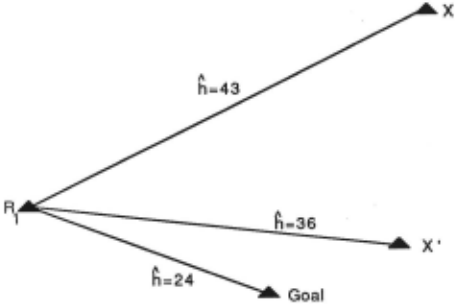
node is being used. Nodes X, X', and G are estimated to be 43, 36 and 24 units away from R1 respectively. The tl.R1 value for X is 19 while tl.R1 for X' is 12. With re spect to R1 we see that X' has a smaller tl.R1 value than does X which is obviously farther away from G than X'. Also note that because H1 will be proportional to LlR1 ,
...
H1(X') will be less than H1(X).
Of course, if X lies directly opposite R; from G, it may have a small f:j.R; and still be far away from G. For each reference node there will be such a re~ion of decli nation relative to a given goal [Nelson, 1988j. The fix for this involves adding more reference nodes and position ing these reference nodes so their (estimated) distances to each other is relatively large and their (estimated) distances to the goal node varies.
The calculation of ii n and the reasons for viewing the search space as an N -dimensional space are explained in section 2. Section 3 reports on some empirical data using MDHs for the 15-puzzle. Concluding remarks and ideas for further research are contained in section 4.
2 Viewing the Search as an N -space
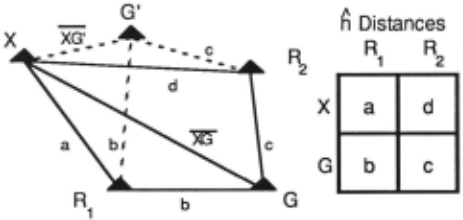
At this point we demonstrate why a planar view can not be used satisfactorily to compute a distance from X to G using reference nodes and explain why the term "multi-dimensional" has been chosen to refer to this idea of using many reference states to estimate a distance to the goal. Figure 2 shows a typical case in using MDHs. The distance in question is between X and G. Estimates of the distances between the reference states to X and G are known. This planar or 2-dimensional view yields many possible values for the estimated distance between the states X and G. Two of these distance estimates are shown in figure 2. The solid lines indicate one possible layout while the dotted lines show another. Geometry can be used to explain the difficulty here even though the concept of an angle in a problem space is undefined. Because the angle values in figure 2 are not known, an infinite number of distance estimates can be found for XG by varying the angles LR1XR2 and LR1GR2 (or equivalently moving R1 or R2) while still preserving all the distances between X and G and the reference states. If these angles are set by using h to estimate the dis tance from R1 to R2, the resulting value of R1R2 may lead to other inconsistencies. For example we know that R1R2 ::=; a+d, but perhaps (the estimated value of R1R2) f1(R1 , R2 ) > a+ d. The computation of these differ ent distances is relatively expensive and it is not known which to use as an estimate. That is, should H2 be XG', X G, or one of the other possible distance values. The addition of a third reference state does not remedy this problem of multiple values for XG [Nelson, 1988].
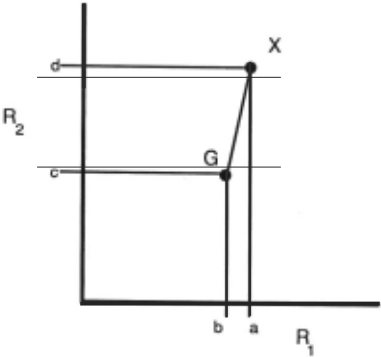
This inability to uniquely determine a distance for XG in the planar view is the impetus for a different model of the search space and reference states. This new model uses the reference states to set up an N-dimensional search space. The number of dimensions is equal to the number of reference states. The current and the goal states are mapped into this N-space and their dis tance estimate is computed using the standard distance
formula V(x2- x1) 2 + · · · + (z2 - zt) 2 . The mapping of the states into the N-space is done by letting the esti mated distance of the goal (current state) to any given reference point R; be the coordinate value of the goal (current state) with respect to the R; axis. The exam ple shown in figure 2 would be mapped into a 2-space depicted by figure 3.
This representation solves the problems associated with the planar view. There is only one distance value associated with any two states mapped into theN-space. The computational cost of ii n is also quite reasonable. This model yields the desired property that for any given {:j.R;, if {:j.R; decreases while everything else is con stant, then so does the distance estimate between the two states. This requirement was mentioned in section 1 which stated that ii n should be proportional to the f:j.R values.
One question has been raised as to how the MDH value should be computed if the original h consists of k compo nents. Although this would really have to be examined on a case by case basis, there are really two reasonable approaches to consider:
- Ignore that h is a vector of components since it is still a distance estimator and can be used to esti mate distances between the reference nodes.
- Analyze each component of h to see which compo nents, if any, can be improved by using the multi dimensional scheme. For each component which can
be improved using MDHs, pick a set of (possibly dis tinct) reference nodes and redefine h such that the appropriate components are actually MDHs. For example let
where h; is replaced with the improved MDH com ponent fi ii;.
Probably most heuristics which are built with a num ber of different components are already quite good and may not be able to achieve much of an improvement by using the first approach which ignores the different components. It may be more likely to improve such a heuristic by focusing on improving specific components of the heuristic with MDHs. The improvement of a spe cific component in this case would of course be defined in terms of how this component affects the accuracy of h.
For any given state space problem and the h being used to estimate distances to the reference states, there are at least two questions that need to be answered in order to apply MDHs:
- what should the value of n be, that is how many reference states should be used, and
- which reference states should be used to approxi mate the N -space.
The next section addresses these questions.
3 Test Results
The multi-dimensional approach was tested on the 15puzzle using the A" algorithm as described by [Rich, 1 983]. The goal of the testing was not to show that there exists an MDH which is more effective than any other existing heuristic, but rather to show that MDHs may be used to improve some existing heuristics. Therefore, initially a heuristic was chosen for the 15-puzzle which had room for much improvement, this heuristic being a tile reversal count. Later the multi-dimensional scheme was tested on a much stronger 15-puzzle heuristic, the Manhattan distance heuristic.
3.1 Tile Reversals and MDHs
The first set of tests used h as the number of tile rever sals. A tile reversal in state a with respect to state b has the meaning that a(i) = b(j) and b(i) = a(j) where i and j are adjacent tiles [De Champeaux and Sint, 1977]. The rationale for the heuristic is that if a reversal occurs between a state and the goal, then it takes many moves to get the tile positioned correctly. The problem with tile reversals is that they do not occur often, so most of the heuristic values are 0, and the search just flattens out into a breadth first search. Usually tile reversals are one component of a more sophisticated heuristic for the 15-puzzle. Note also that this choice for h is general in that it may be applied to any two nodes in the 15-puzzle search space.
The reference states were picked by first generating a number of states in a random fashion from which the reference states would be chosen. Then several hundred legal states (i.e. reachable from the goal) for which the distances to the goal were known were evaluated with an MDH using all the randomly generated reference states. (These legal states were found with their distances by generating nodes in reverse from the goal node.) Ideally an MDH would have reference states that yield distance estimates proportional to the actual distances. Therefore a score was kept to determine the predictive accuracy of each reference state. This was done by first computing the average of h(x) I Hn(x) for every x where xis one of the several hundred legal states, h(x) is the actual dis tance from x to the goal, and fi n(x) is the MDH value for x using the n randomly generated reference states. Once this average is computed, h(x) I Hn(x) was (retrieved) recomputed for every state x. The ratio for each state x was compared with the average ratio taken for all the states. If this ratio was close to the average ratio, then every reference node which participated in the calcula tion received a "good" mark. If the ratio was not close to the average ratio, then all the reference nodes which helped to calculate it received a "bad" mark. At the end the score was tallied by subtracting the number of bad marks from the number of good marks. The score for a reference state indicates whether that R; helps or hin ders the MDH in achieving the goal of yielding distance estimates proportional to actual distances. These scores were computed for each of the possible reference states and a few of these states with the lowest scores (net goodness values) were eliminated from the set of possible reference states. This process was repeated many times with each iteration eliminating possible reference states until there remained 13 possible reference states. This learning procedure, which is described more formally in [Nelson, 1988], is general and could be applied to other problem domains as long as states can be generated in reverse order from the goal state.
Figure 4 shows the results from tests run on 30 puzzles using from 1 to 13 reference states. The goal state was added as a reference state and was ordered as the first reference state, thus the 1-dimensional trial is exactly identical to a traditional A" search using tile reversals as the h. The number of nodes expanded is inversely proportional to the number of dimensions used by the MDH with the exception of some relative maxima at dimensions 5 and 7. With the addition of each of the first 3 dimensions, the search space is cut in half. The graph in figure 4 shows that for these puzzles the best value for N is probably 4, since there is relatively little improvement in adding any dimension past the fourth dimension.
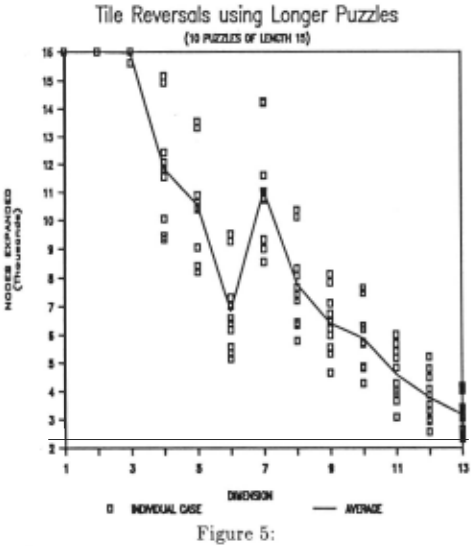
The initial set of tests for the tile reversal case were run on puzzles with solution paths of length 10. Although the average path lengths for the 15-puzzle is about 50, these shorter puzzles were simple enough so that every dimension was capable of finding a solution without run ning out of memory. Using the same 13 reference nodes more tests were run on puzzles with solution paths of length 15, or a 50% increase from the previous tests. The results were consistent with the tests run on shorter puz zles. The biggest difference is that no puzzles were solved by dimensions 1 or 2 because the algorithm ran out of memory. Only one puzzle was solved in dimension 3. In the higher dimensions we see a dramatic decrease in the number of nodes expanded as extra reference nodes are added. These results are shown in figure 5. Although dimension 5 is no longer a relative maxima, dimension 7 still is. Another difference in these tests is that it ap pears that the best value for N would be 13. Dimension 6 is a relative minima but by going out to dimension 13 the average number of nodes expanded is cut in half as opposed to using only 6 reference nodes. If the puzzle lengths are increased further the results are similar in that there is the same downward trend in the number of nodes expanded as extra reference nodes are added. As would also be expected the lowest dimension capable of solving these more difficult puzzles also increases as the path length increases.
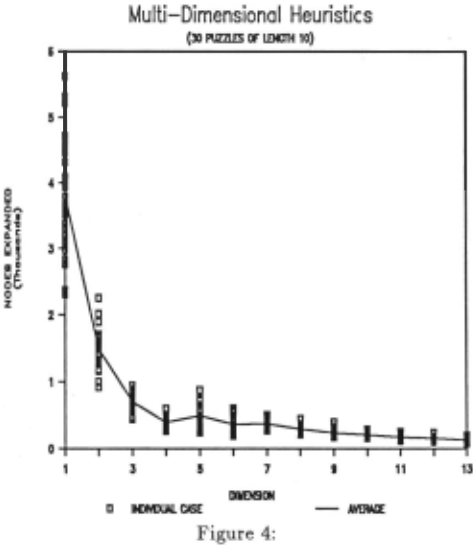
The test results demonstrate how it may be possible to develop an MDH for a given problem domain. In this case the rather simple concept of tile reversals was by it self an inadequate heuristic . However with the addition of the multiple reference states to map the search into an N -space, the use of tile reversals as the h was a much bet ter heuristic for solving 15-puzzles. This suggests that MDHs might prove especially useful for search spaces where relatively little is known about the problem. A simple heuristic h could be derived and a corresponding i\tiDH might still be effective even if h was not .
3.2 Manhattan Distance and MDHs
An interesting question is whether MDHs could be used to improve a good heuristic for the 15-puzzle. Some tests were run to determine the effect of MDHs when applied to the Manhattan distance heuristic. This heuristic is an admissible heuristic that is also quite good; it gives the number of moves to reach the goal if the tiles could be moved "through" each other.
The learning procedure used to find reference nodes for tile reversals proved ineffective for the Manhattan distance. Instead another "learning" procedure was used to choose reference nodes which would improve the Man hattan heuristic . Reference nodes 1 and 2 were set to be the goal and a "reversed" goal respectively. Now the 100 randomly generated nodes in [Korf, 1985] were tar geted as the superset for the additional reference nodes to be added. Each of the 100 random puzzles was chosen as reference node 3 and the resulting MDH was tested on solving 10 trial puzzles. After looping through all 100 possible choices for Ra, it was found that puzzle 30 minimized the number of node expansions using 3 di mensions. Puzzle 30 was therefore chosen as Ra. This process was repeated 4 more times to pick (dimensions) reference nodes 4 through 7. This resulted in adding 5 distinct reference nodes, selected from the 100 ran domly generated puzzles, which minimize node expan sions when solving the 10 test puzzles. The addition of these 5 reference nodes with the original two yields an MDH with 7 dimensions. Figure 6 shows the result of solving the 10 puzzles using these reference nodes. This new MDH shows an improvement with the addition of every reference node. It also turns out that the path lengths were optimal for every puzzle solved which is surprising since this MDH is obviously not admissible.
It is a reasonable question to wonder if the improve ment offered by MDHs to the Manhattan distance re sulted from extra weight being placed on the heuristic . The heuristic distance estimate, h, obviously increases as more reference nodes are added, while the known distance component, g, remains the same. To explore this possibility some tests were run where all 7 reference nodes were chosen to be the goal state. The result of do ing this is really just an increase in weight. There was no improvement offered by using the goal as the reference nodes. For these trials dimension 1 is the minimum or optimal MDH. It also turned out that almost half of the solutions found using these reference nodes were not op timal with respect to the length of their solution paths. Thus we can conclude that the improvement is not the result of a weight change in the heuristic.
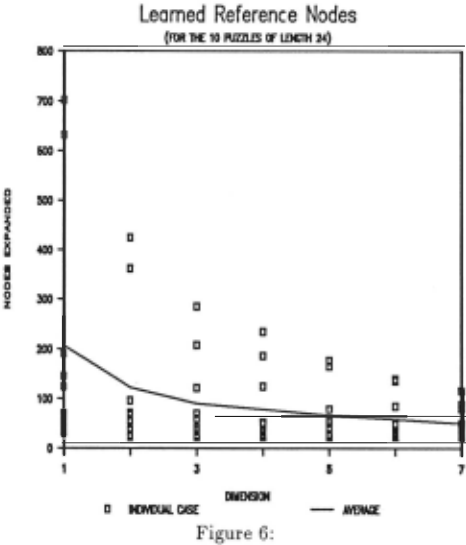
The results in figure 6 look very promising. The set of reference nodes form an MDH which significantly im proves an already good heuristic. However the manner in which the reference nodes were picked suggest the possi bility that these reference nodes are "tuned" or suitable for only these 10 puzzles. After all , reference nodes 3 through 7 were chosen by a trial and error process which involved solving each of these 10 puzzles hundreds of times. If the reference nodes are only suitable for these puzzles, it is quite obvious that the overhead in choosing the reference nodes far outweighs the benefit provided by using them.
In order to test the general effectiveness of these ref erence nodes on other puzzles, some more tests were run using the MDH created by these 7 reference nodes to solve randomly generated 15-puzzles. Most randomly generated puzzles are not solvable by A·, using the Man hattan distance heuristic with or without this MDH in stance, because of exponential memory requirements. A "pre-screening" was conducted on these randomly gen erated puzzles by using the Manhattan distance to esti mate a minimum path length. Any puzzle whose lower bound was greater than 20 was immediately discarded.
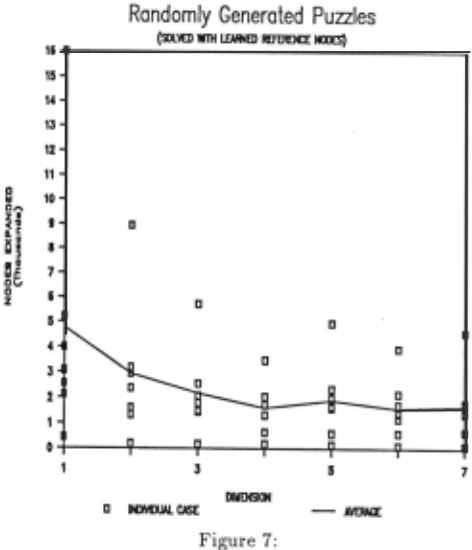
75 puzzles were generated with a lower bound path length :::; 20. Of these 75 puzzles, only 7 were able to be successfully solved by any of the 7 dimensions. The path lengths of these puzzles ranged from 22 to 30 with the average being 26. The worst case, with respect to the number of node expansions, for each of the 7 puz zles occurred in dimension 1, while the best cases were distributed over dimensions 4 through 7. For these ran domly generated puzzles the MDH proved very success ful. A graph of the results is shown in figure 7. There is a significant downward trend in the average number of nodes expanded as extra reference nodes or dimen sions are added. So it appears that the reference nodes which were originally found for 10 specific puzzles are also capable of reducing search costs for randomly gen erated puzzles. In fact no randomly generated puzzle was found to expand fewer nodes in dimension 1, which is equivalent to using A· without MDHs, than in any of the higher dimensions. Of course many puzzles were not solvable for any of the 7 dimensions. Additionally the path lengths were again optimal in every dimension for at least 6 of the 7 puzzles. The seventh puzzle was not solvable for dimension 1, the only provably admissi ble dimension, and therefore the optimal path length for this puzzle is not known.
The reasons for the success of MDHs in improving the 15-puzzle Manhattan distance heuristic is not as intu itive as to why MDHs improve the 15-puzzle tile reversal heuristic. Although the existence of a tile reversal be tween two states a and b is known to imply a significant difference between states a and b, the occurrence of a tile reversal is not likely. Using MDHs with numerous reference states in effect multiplies the likelihood of de tecting tile reversals enabling the detection of previously undetected differences. When using the Manhattan dis tance heuristic, it is unclear that a reference state will detect any previously undetected differences. However there is a new difference that may be detected. This dif ference is whether or not states a and b are estimated to be equidistant from the reference state. The importance of this difference is seen in the fact that when using the Manhattan distance heuristic states a and b will be es timated to be equidistant to every s.tate in the problem space only when a = b. Furthermore the importance of these differences is also supported by the test results which selected a good set of reference states even though, disregarding parity, only approximately 20 000 ~gg 000 000 or .0000000005 percent of the states in th~ se~rch sp'ace were considered in selecting these reference nodes.
4 Conclusions
Heuristic searching can be improved by using a set of reference states to gain perspective on the position of a generated state with respect to the goal. Some heuristics will not detect some of the differences (distance) between two states if these states are only evaluated with respect to each other. Sometimes these differences can be found by evaluating the states with respect to a reference state and looking at the net difference between the two states and the reference state. That is, using a particular h, X1 and X2 may have no differences. But if h is used to compare X1 and X2 with a third state X3 , it may be that X1 and X2 do not have the same differences with X3 . In other words, h(X1, X2 ) = 0 implying X1 = X2 , while h(X1,Xa) ::f h(X2,Xa)showingthatX1 ::f X2 . For good heuristics, which will usually only yield h(X1, X2) = 0 when X1 = X2, it may seem that there is no benefit offered by introducing a third state into the evaluation process. However for any h there will be a "difference" elucidated by using a third state or reference state which is in essence a check to see whether or not xl and x2 are equidistant from this third state.
When multiple reference states are used to gain per spective on the distance between X and G, a co-planar view of the search space will yield an infinite number of estimates for X G. Instead the reference states are used to map the search into an N-space. This view yields only one estimate for XG. Furthermore this multi dimensional mapping has the property that if the net number of differences with respect to a reference state decreases between X and G, then so will the correspond ing if n· This is desirable because the closer two states are to each other, then the closer their difference values should be with respect to a reference state. Geomet rically speaking, two points that lie near one another should be approximately the same distance from a third point. The converse of this is not always true as there exists a region of declination for every R; and G. This region of declination can be overcome by using many reference points which are spread out. By doing so, it makes it very unlikely that any one generated state will lie in the declination regions for any significant portion of the reference nodes.
MDHs have been tested on the 15-puzzle for 2 differ ent heuristics. MDHs were first shown to offer a signif icant improvement in decreasing the number of nodes expanded when a tile reversal count is used as the h. These tests demonstrated that a weak heuristic based on a simple concept might be greatly improved by using the multi-dimensional scheme. Furthermore once an h is chosen, the process of creating the MDH, that is the picking of the reference nodes, can be automated. This may prove very beneficial for a sort of "computer-aided" generation of heuristics for problems where there exist easily identifiable simple heuristic information, but for which no good heuristics are known. The second set of tests experimented with using MDHs to improve the al ready good Manhattan distance heuristic. MDHs were shown to be capable of improving this heuristic as well. This is somewhat surprising since the Manhattan dis tance heuristic is known to be one of the best 15-puzzle heuristics and shows that an MDH improvement is not exclusive to weak heuristics. An additional interesting result of the testing is that optimal solutions were found with respect to path lengths. This was unexpected since the higher dimensions of both MDH instances, particu larly the Manhattan distance MDII, obviously overesti mate distance values.
Further research concerning MDHs is planned in sev eral different areas. In addition to the multi-dimensional model, there may be other models which could effectively represent the concept of using reference states for heuris tic improvement. New and improved learning procedures could be developed to pick reference states. It would also be nice to identify other problems for which MDHs may offer an improvement.
Acknowledgments
Rich Korf has been generous in allowing us to use some of his programs which included a random 15-puzzle gen erator.
@inproceedings{ijcai1989p50,
  title     = {Multi-Dimensional Heuristic Searching},
  author    = {Nelson, Peter C. and Henschen, Lawrence J.},
  booktitle = {Proceedings of the Eleventh International Joint Conference on
               Artificial Intelligence, {IJCAI-89}},
  publisher = {International Joint Conferences on Artificial Intelligence},
  editor    = {N. S. Sridharan},
  pages     = {316--320},
  year      = {1989},
  month     = {8},
  note      = {Search},
  url       = {https://ijcai.org/proceedings/1989/50},
}
TY - CPAPER TI - Multi-Dimensional Heuristic Searching AU - Nelson, Peter C. AU - Henschen, Lawrence J. T2 - Proceedings of the Eleventh International Joint Conference on Artificial Intelligence, IJCAI-89 PB - International Joint Conferences on Artificial Intelligence PY - 1989 SP - 316 EP - 320 UR - https://ijcai.org/proceedings/1989/50 ER -Copied
Machine-readable versions of this paper, for tools and AI agents:





