
Call-Graph Caching: Transforming Programs into Networks
Proceedings of the Eleventh International Joint Conference on Artificial Intelligence. Tools. Pages 122-127.
© 1989 International Joint Conferences on Artificial Intelligence
Abstract
There are computer programs that use the same flow of control when run on different inputs. This redundancy in their program execution traces can be exploited by preserving suitably abstracted call-graphs! for subsequent reuse. We introduce a new programming transformation Call-Graph Caching (CGC) which partially evaluates the control flow of sets of such programs into a network formed from their call-graphs. CGC can automatically generate efficient state-saving structure-sharing incremental algorithms from simple program specifications. As an example, we show bow a straightforward, inefficient LISP program for conjunctive match is automatically transformed into the RETE network algorithm. Simple and understandable changes to elegant functional (and other) programs are automatically translated by CGC into new efficient incremental network algorithms; this abstraction mechanism is shown for a class of conjunctive matching algorithms. We establish criteria for the appropriate application of CGC to other AI methods, such as planning, chart parsing, consistency maintenance, and analogical reasoning.
- [Abo, 1983] Abo, A.V., Hopcroft, J.E., and llliman, J.D. Data Structures and Algorithms. Addison-Wesley, Read- ing, Massachusetts, 1983.
- [Abo, 1986] Abo, A.V., Sethi, R., and llliman, J.D. Compilers: Principles, Techniques and Tools. Addison- Wesley, Reading, Massachusetts, 1986.
- [Baer, 1980] Baer, J. Computer Systems Architecture. Com- puter Science Press, Rockville, Maryland, 1980.
- [Carbonell, 1983] Carbonell, J. G. Learning by Analogy: Formulating and Generalizing Plans from Past Ex- perience. In R. S. Michalski, J. G. Carbonell and T. M. Mitchell (editors), Machine Learning, An Artificial Intelligence Approach. Tioga Press, Palo Alto, CA, 1983.
- [Doyle, 1979] Doyle, J. A Truth Maintenance System. Artificial Intelligence, 12:231-272, 1979. 128 Tools
- [Ferrante, 1987] Ferrante, J., Ottenstein, KJ., and Warren, J.D. The Program Dependence Graph and Its Use in Optimization. ACM Transactions on Programming Lan- guages and Systems, 9(3):319-349, July 1987.
- [Forgy, 1979] Forgy, C.L. On the Efficient Implementation of Production Systems. PhD thesis, Department of Com- puter Science, Carnegie Mellon University, February, 1979.
- [Futamura, 1971] Futamura, Y. Partial evaluation of com- putation process --an approach to a compiler-compiler. Computer Systems Controls, 2(5):45-50, 1971.
- [Hoover, 1987] Hoover, R.Incremental Graph Evaluation. PhD thesis, Cornell University, May, 1987.
- [Knuth, 1973] Knuth, D.E. Fundamental Algorithms. Addison-Wesley, Reading, Massachusetts, 1973.
- [Laird, 1986] Laird, J. E., Rosenbloom, P. S. and Newell, A. Chunking in SOAR: The Anatomy of a General Learn- ing Mechanism. Machine Learning, 1, 1986.
- [Minton, 1988] Minton, Steven M. Learning effective search control knowledge: An explanation-based approach. PhD thesis, Carnegie Mellon University, February, 1988.
- [Miranker, 1987] Miranker, D.P. TREAT: A New and Ef- ficient Match Algorithm. PhD thesis, Columbia Univer- sity, January, 1987.
- [Mitchell, 1986] Mitchell, T. M., Keller, R. M. and Kedar- Cabelli, S. T. Explanation-Based Generalization: A Unifying View. Machine Learning , 1:47-80, 1986.
- [Paige, 1982] Paige, R., and Koenig, S. Finite Differencing of Computable Expressions. ACM Transactions on Pro- gramming Languages and Systems, 4(3):402-454, 1982.
- [Perlin, 1988a] Perlin, M.W. Reducing Computation by In- tegrating Inference and User Interface. Technical Report CMU-CS-88-150, Carnegie Mellon University;
- Pitts- burgh, PA, June, 1988.
- [Perlin, 1988b] Perlin, M .W. Transforming Programs into Networks: Call-Graph Caching, Applications and Ex- amples. Technical Report CMU-CS-88-202, Carnegie Mellon University, Pittsburgh, PA, December, 1988.
- [Pugh, 1988] Pugh, W.W. Incremental Computation and the Incremental Evaluation of Function Programs. PhD thesis, Cornell University, August, 1988.
- [Reps, 1983] Reps, T., Teitelbaum, T., and Demers, A. Incremental context-dependent analysis for language- based editors. ACM Trans. Prog. Lang. Sys. , 5(3):449-477, July 1983.
- [Schank, 1977] Schank, R. C. and Abelson, R. P. Scripts, Goals, Plans and Understanding. Hillside, NJ: Lawrence Erlbaum, 1977.
- [Stolfo, 1982] Stolfo, S.J., and Shaw, D.E. DADO: A Tree- structured Machine Architecture for Production Systems. In Proceedings of National Conference on Artificial Intelligence, pages 369-388, August, 1982. AAAI.
- [Winograd, 1983] Winograd, T. Language as a Cognitive Process, Volume I: Syntax. Addison-Wesley, 1983.
References were extracted automatically from the PDF and may contain errors.
Full text extracted automatically from the PDF; figures, tables and equations may differ. The PDF is the version of record.
1 Introduction
Caching is a general efficiency mechanism for exploiting redundancy in computation by reusing previously computed information. For example, AI systems often cache problem solving experience learned over time, or knowledge, as a set of programs. Intelligent interactive systems apply this program set over repeated cycles of interaction with external data input. We define as persistent those intelligent inter active systems that apply all knowledge to all data on every cycle. Straightforward implementations of persistent sys tems are often inefficient, since only some programs in the knowledge base are relevant each cycle, and potentially reusable intermediate computations are discarded.
We have identified a key source of computational redun dancy: a program's flow of control, or "call-graph" struc ture. This control-flow redundancy can be exploited by
*This work was supported in part by grant R29 LM 04707 from the National Library of Medicine, and by the Pittsburgh N.MR Institute.
1 A call-graph is a trace of an executing program's flow of procedural control. With recursive languages like LISP, this is the explicit tree of a program's dynamic procedure calls.
2 Call-Graph Caching
Call-graph caching is a program transformation from ar bitrary programs2 into network programs. After defining our notion of "program", and establishing what "network programs" are, we motivate how the control flow of a program can be cached into a network. We then present the mechanics of the transformation, and describe an implemen tation.
2.1 Programs
Programming languages provide action constructs that operate on input data, sequenced according to some control organization. The actions are applied to the data by an evaluator (such as LISP's EV AL), which may also partially determine the control sequencing. Program execution proceeds by traversing the program's actions according to the control organization, and evaluating the actions on the data. For example, LISP's control mechanism is recursion, which coordinates the A-expression actions on data ar guments, such as symbols and lists. Traversal of a LISP program's code tree recursively executes EV AL on the A-expressions and arguments at each node in the tree.
2.2 Network Programs
There are programs that operate by traversing an acyclic network. The actions of such programs reside and are ex ecuted at network nodes, while their control organization is represented by network links. The links of the directed acyclic3 graph (DAG) encode a partial ordering of the nodes. Programs whose network traversals are guaranteed to respect this partial ordering belong to the class NET WORK. Partial order enumeration is usually implemented with some version of topological ordering [Knuth, 1973), and assures that every DAG node is visited exactly once: after each of its predecessors have been visited.
When input data is presented to the leaves, computations propagate through the network. The results of local node computations can be locally stored in node memory. A node uses memories of predecessor nodes in bottom-up NETWORK computation similarly to a stack frame's use of recursive return values in usulll programming languages. Since the network persists between cycles, finite differencing [Paige, 1982] can reduce redundant computa tions at a node. To implement this incremental strategy, node memory is divided into a short-term buffer and a longer-term store, the use of which is shown below.
NEfWORK programs are very efficient, with overhead at most linear in IDAGI, the number of nodes and edges [Hoover, 1987). Propagating from all the leaves, and keeping newly computed values in nodes' buffer memory, topological ordering assures that each node is recomputed exactly once [Perlin, 1988a]. If changes are made to only a subset of DAG leaves, using the store memory (which per sists between change cycles) the computation need only be propagated to the transitive closure DAG subset AF FECTED, IAFFECI'EDI ~ IDAGI. This produces state-saving algorithms that perform minimal recomputation, directed from just the changes to their input. 4 When coupled with finite differencing, state-saving incremental algorithms result.
2Qur initial focus in Sections 2 and 3 is on functional-style LISP programs. In Section 4 we look at other programming language styles, such as rules.
3Graphs with cycles are also admissible, as long as the cycles are broken at run time; i.e., the graph acts like a DAG.
The price for this efficiency is inflexible control structure: NEfWORK program DAGs have the restricted form of basic blocks [Abo, 1986]. Despite this limitation, NET WORK finds extensive application. Efficient incremental spreadsheets use the algorithm sketched above. Conjunctive matching programs are often cast in network form for ef ficiency. Other potential applications include the represen tation of dependency relations, multiple inheritance, consis tency maintenance reasoning [Doyle, 1979], and incremen tal attribute grammar evaluation [Reps, 1983].
2.3 Caching Control Flow
Let P(x,y) be a program in some language, having ar guments x andy. Suppose that P's control structure is inde pendent of y. Then partial evaluation [Futamura, 1971] of P(x,y) with respect to some fixed Xo will yield a new program P' Xo(y) of one argument having a unique call graph.
An interactive program's input either depends on external factors, or is independent of external interactions. Now sup pose that program P(x,y) is interactive, and its argument xis independent of external factors. Then P'(y)
- completely characterizes P(x,y)'s interactions with the external environment, and
- has a unique call-graph.
We define an interactive program P(x,y) to be basic when x is independent of external factors, and P's control structure is independent of y.
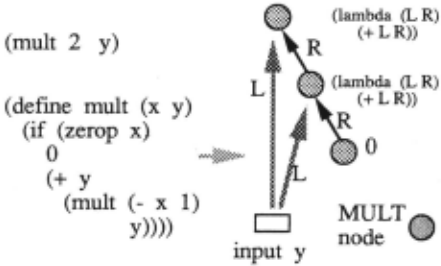
P'(y) has a unique call-graph which can be cached as a NETWORK program for later reuse. The program's actions are encoded in the call-graph nodes; each node is allocated local memory. The program's control flow decisions are recorded as call-graph edges. Applying input data to the call-graph leaves, a bottom-up graph traversal (respecting the nodes' partial ordering represented by the edges) can correctly execute the program. We therefore have a new NETWORK program operationally equivalent to the par tially evaluated P, as illustrated in Figure 1.
4Further efficiency gains are possible by restricting the DAG traversal to the subgraph influencing only select node computa tions.
2.4 The Transformation
We describe the Call-Graph Caching (CGC) transformation in several loosely coupled steps. The first step assembles the call-graph from its subgraph components. The second collects a set of call-graphs into a network. The resulting cached call-graph network structure is used (and reused) as a data cache. Pedagogical examples on simple polynomials are detailed in [Perlin, 1988b].
2.4.1 Building the Call-Graph
Control-Flow Caching is an algorithm which builds the call-graph of a program on some input. The construction takes as
· input either
- the compile-time text of a program, together with its partial input, or
- the run-time program executing on its complete input, and
· outputs the call-graph of that program.
The procedure employs an auxilliary data structure, the Control-Flow Cache, which is used in the assembly of the final call-graph structure. There is also an optional ar gument specifying the key execution steps to cast into graph nodes.
Control-flow caching proceeds as three separate steps. First, with a program, (partial) input, and a user-definable set of the key steps to abstractS a trace is formed of the program's execution. Each node in the resulting call-graph represents one (key) step in the program's trace. The actual formation of the call-graph is facilitated by specific control flow cache management strategies. One such strategy is the above abstraction mechanism of recording only the "key" steps as nodes. Another strategy, used in chart parsing [Winograd, 1983], is exploiting the constraints posted in the control-flow cache to help reduce the execut ing program's computation, i.e., dynamic programming. Yet another, say for a LISP program, would be to passively cache the succession of execution branches into a full call tree. Regardless of the specific strategies, the resulting call graph captures (in space) the program's execution over time, as shown in Figure 2, step 1.
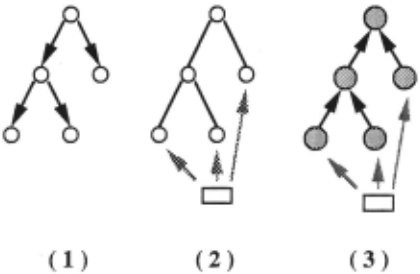
Program P(x,y) has thus far been evaluated on input XQ, with the partially evaluated P'(y) preserved as a call-graph. The second step of Control-Flow Caching connects the ex ternal input y to the program's graph. As shown in Figure 2, step 2, the resulting call-graph of the complete program is aDAG6.
5This user-definable set ranges from the empty set to all possible steps.
The third step operationalizes the call-graph into a us able data structure. For example, graph nodes can be aug mented with the requisite buffer and store memory with a system-specific representation.
At this point, saving and reusing just this single call graph provides a fully functional state-saving NETWORK program. Directing input y through the graph in a partially ordered node enumeration, with the node memories as a data cache, will perform the computations of P(:xo,y). More efficient incremental evaluation via finite differencing is ef fected by using the local buffer memory to (1) record in tracycle computations and (2) differentially update the local intercycle store memory.
2.4.2 Collecting Call-Graphs
The Call-Graph Caching transformation is completed by collecting a set of P(:xo,y) call-graphs, for a variety of P's and :xo's. This set is called the Call-Graph Cache, and, like other caches, usually employs efficient cache management strategies. For example, spreadsheets and conjunctive matchers exploit common . shared prefix structure, with trie-like [Abo, 1983] merging of call-graphs into a single connected network. In allocating the often limited resource of space, another common strategy is to perform a cost/benefit analysis, determining which call-graphs stay in the cache, and which are removed.
2.4.3 Using the Call-Graph Cache
After building the call-graphs of {P(xi,y) I ie I} and col lecting them into a call-graph cache, the resulting network is used (and reused) as a data cache. Values or sets of values of y propagate bottom-up through the network, employing the buffer memory within each propagation cycle, and store memory between cycles. For efficiency and correctness, the network traversal control mechanism is partial order enumeration (implemented with a topological sort).
This completes the transformation of a finite set of basic programs (in any programming language) into an efficient state-saving NETWORK program.
2.5 An Implementation
To demonstrate the workability of Call-Graph Caching, we implemented in Common LISP a simple partial evaluator EV AL ', which transforms a large class of LISP programs into their corresponding call-graphs. The input to EVAL' is the symbolic LISP expression representing "P(:xo,y)", for some P and :xo. and a set of labels denoting the key execu tion steps to cache. The output is a call-graph, where each node specifies
- the label of the node type;
- a lambda expression containing all the infor mation required to execute the node's computa tion when applied to the values of its immediate predecessor nodes;
6This is because the caching of the program's execution over time breaks (i.e., unravels) any cycles present in the flow of con trol.
- recursively, the nodes of its immediate predecessors.
EV AL' performs the following computations:
- Arrive at (the label of) a key node (i.e., LISP function or symbol) to be abstracted.
- Perform EV AL' on the unevaluated arguments to the function.
- Substitute these values into the function, and then execute EV AL' on the LISP function's code tree.
1bis delayed evaluation is done recursively, caching the control structure into a call-graph. The call-graph's nodes abstract out the set of labelled functions, preserving the lo cal actions required for later execution.
We have also developed a variety of network structure sharing programs for merging call-graphs, and a partial or der network traversal toolkit for executing these cached Call-Graph networks as programs. Our working implemen tations have demonstrated the efficacy of transforming simple LISP specifications into efficient incremental net work programs on AI examples such as RETE matching.
3 RETE Networks: An Example of Call-Graph Caching
RETE matching is a state-saving structure-sharing in cremental algorithm used in OPS-5 and other production systems for conjunctively matching many patterns against many objects. Because it provides excellent average-case behavior for an important NP-hard AI problem, it has been extensively studied and varied. It is also a good example of the Call-Graph Caching program transformation, illustrating nontrivial usage of the Control-Row Cache and the Call Graph Cache.
3.1 Rule Matching
Forward-chaining Rule Systems (or "production systems") such as OPS-5 are programming languages with match as their control element. Program data is organized into a set of rules, having left-hand-side (LHS) tests and RHS actions. External input (often called "working memory") comes from a slowly varying set D of data objects. If a rule's tests match objects, the rule becomes a candidate for firing; when executed, its actions serve to modify D.
Following common practice, we fix the form of the rules' LHSs to be a set of conjunctive conditions, each condition containing tests restricting the set of matchable objects. An instantiation of a rule having n LHS conditions is ann-tuple of objects satisfying the rule's LHS tests. On every inter action cycle, the rule evaluator must try to match each rule against all possible combinations of objects in D, forming its set of instantiations
{instE Dnl 'ilteste Rule, test(inst)},
where Dn is DxDx. .. xD, n times. Letting TEST be the set of allowable tests, and TESTS be its power set 2TEST, Match may be described as a function which filters the set of pos sible instantiations Dn into those satisfying some tests in TESTS,
Since all conditions are matched against all objects, we may rewrite Match in the more convenient form
Match(TESTS,D) ~ DxDxD .. .D, which applies a set of tests to a set of objects, producing a filtered set of n-tuple instantiations.
Production systems are persistent, in that they
- maintain their knowledge in a finite set of ex perientially derived programs (the rule set), and
- apply all programs to all available data on each interactive cycle.
They are also inefficient. Consider just one rule having n conditions matching against only two data objects- the set of candidate instantiations Dn grows exponentially in n. In fact, conjunctive rule matching is NP-hard [Minton, 1988). Generally, however, only a small fraction of the object set changes each cycle. So instead of rigidly applying all rule programs to the data, perhaps the incremental changes to data should drive the matching computation.
For each rule program in the rule set specifying some tests in TESTS, Match(tests,D) is the computationally ex pensive subprogram. Observe that with
P =Match, x =tests, andy= D,
- x is independent of the external data input D, and
- the conjunctive matcher P(x,y) is programm able so that P's control is independent of y (e.g., Section 3.2).
Therefore Pis basic, and Call-Graph Caching will generate an efficient state-saving structure-sharing incremental Matching algorithm.
3.2 Transforming Rule Matching into RETE Networks
We illustrate the use of Call-Graph Caching by generating the RETE network from a simple functional programming specification of the matching function.
- We start from an easily specified, though in efficient, set of functional programs.
- Using an auxilliary Control-Row Cache, par tial evaluation of the basic program match(T0,D) produces a call-graph capturing match'(D)'s control flow. This call-graph is usable as an incremental data-driven state-saving NETWORK program which can store processed input data as intermediate matching results.
- The Call-Graph Cache merges the individual call-graphs in order to conserve space, and achieve some speedup. 1bis is done by test sharing: nodes with common test prefixes are combined to form a single trie data structure.
We now detail this construction of the RETE network algo rithm.
3.2.1 Rule Matching as LISP Programs
A rule specifies a fixed set of tests T 0 for its match com ponent. The conjunctive match program Match(T0,D) can be formulated so that its control is independent of working memory D. We now write such a filter Match as a functional-style LISP program.
For efficiency on a serial processor, we first impose a fixed ordering on the rules' conditions. Each test examines one or more objects in a candidate n-tuple E Dn; these objects are now ordered by the condition ordering. We now order the test set: associate to each test the number of the last object it examines, and arrange the tests with respect to this index. For efficiency, the match is performed by a conditional AND, testing a candidate n-tuple against the first test subset, then the second, and so on through the nth. Within the kth test subset, k :5: n, the tests may be further grouped into two classes:
A. alpha tests on a single object E D, and
B. beta tests on more than one object, i.e., k tuples E Dk.
There are many ways to write the LISP code for this simple filter (e.g. , as one function, iteratively, recursively, etc.). While the CGC transformation is independent of pro gramming style, for clarity, we present Match using linear recursion.
; Match rule's tests against the data. (define match (tests data) (beta-jo in (first tests) (second tests) data)) Join together the preceding sift and ; join sets with a filtering beta test. (define beta-join (A B D) (if (null A) , ( () ) (filter (first B) (set-product (alpha-sift (first A) D) (beta-join (rest A) (rest B) D))))) ; Sift the objects with alpha tests. (define alpha-sift (A D) (set-filter A D))Match takes a preordered set of tests, and a set of data objects as its arguments. The key interesting function is beta-join, which merges the simple alpha-sift filter with fur ther recursive calls to beta-join; this produces a linearly recursive call-graph. Note how the tests in match's tests argument are deposited locally at each level of filtering, and that no control decisions are made using the data argument.
The auxilliary function set-filter returns the subset satis fying some predicate tests, while the function set-product operates similarly on a pair of sets.
3.2.2 Building the Call-Graph
STEP 1. For any rule r, calling EV AL' on match(testsr,D) with the set of labels {match, alpha-sift, beta-join} will save the calling structure of the rule's tests. The control-flow cache is used with the functional program match to store to the growing call tree. As shown in Figure 3 A, the call-graph has a linear spine, with the appropriate tests localized at each node.
STEP 2. In Figure 3 B, the free input variable data is attached to the call-graph as an input source, turning the call tree into a DAG.
STEP 3. The graph structure of this single rule's match component can now be completed. Memory for the intra cycle buffer and the inter-cycle store (and other information) can be specialized into a specific graph representation. This call-graph can be reused as a bottom up NETWORK filtering program. In Figure 3 C, the domains of the filtered objects are shown.
Using the buffer memory, partial order traversal of the call-graph from the data computes the filtered instantiation subset of on. If the nodes' longer-term store memories are initially loaded with D (and then continually updated), only changes to the object set M> are needed for computing fur ther instantiations. That is, the call-graph is a incremental state-saving data-driven NETWORK program for comput ing the state of a single rule's match.
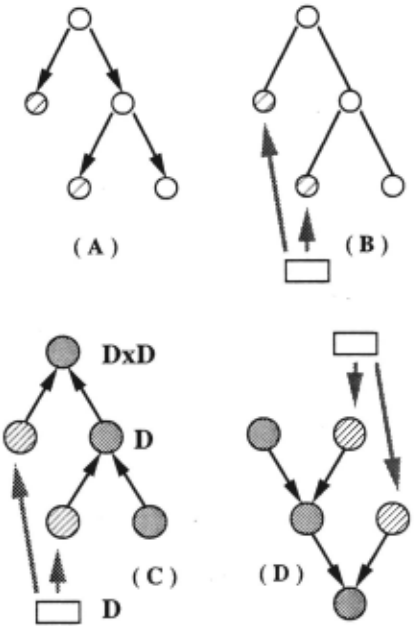
This is not surprising: Figure 3 D shows the. RETE net wort beta join topology, which is isomoiphic to the Match call-graph in Figure 3 C.
3.2.3 Collecting Call-Graphs
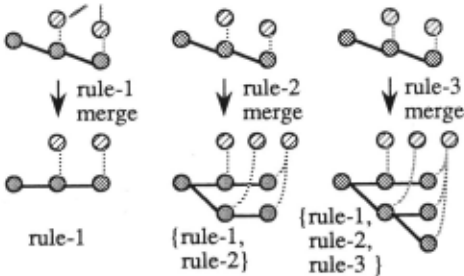
A rule system is comprised of a finite set of rules; we therefore form the corresponding set of call-graphs, one for each rule's match component. This set is the Call-Graph Cache. One cache management strategy for conserving cache space (with some associated speedup) is to merge the call-graph DAGs into one connected networt. The matcher's behavior is unchanged if, proceeding from the data input source, nodes are merged based on prefix sharing of tests. A succession of call-graphs merging into a com mon beta-join node trie is depicted in Figure 4.
When an alpha discrimination net is added to the beta join trie, the classical RETE match networt is generated. We implemented this addition by modifying the alpha-sift LISP function to perform its tests tail recursively. This illustrates bow CGC readily produces new desired networt topologies from small changes in LISP program specifications.
3.2.4 Using the Call-Graph Cache
Partial Order traversal of the RETE networt will perform the match of the rule set (cached as a shared set of call graphs) against working memory input D. The intracycle buffer and intercycle store memories at each node are used as a data cache to preserve the partial match computations
(within and between) each cycle. Working memory ele ments are then incrementally added or deleted from these memories.
3.3 Alternate Join Topologies
Call-Graph Caching generates more than RETE networlcs: one application is the generation of families of efficient con junctive matchers. By making simple variations in match's USP specification, and changing which key function names are cached into call-graph nodes, many different join topologies can be designed, easily specified, and automati cally constructed. Also, there are other Call-Graph Cache merging strategies besides trie-based prefix sharing.
The RETE example was described above: a linearly structured call graph. One known alternative approach is to not cache the beta join nodes [Miranker, 1987]. Another is to structure the call graph as binary tree [Stolfo, 1982], reducing the long linear chains problematic in RETE. We are currently exploring and assessing a variety of new join topologies using CGC as a rapid prototyping tool. These topologies can be custom tailored to task-specific require ments, such as learning or parallelism.
4 Other Uses
With general recursive computation, actions (e.g., floating point arithmetic, file access) are often expensive, whereas actions' control organization and input data can be unin teresting. With intelligent systems, however, actions (e.g., precomputed motions, user queries) are commonly mun dane; it is the sequencing of such actions to achieve con crete goals that is complex and computationally difficult. Since the CGC method explicitly records such control deci sions for subsequent modification and reuse, it provides both a conceptual frameworlc and an implementation strategy. ID script-based planning [Schank, 1977], for ex ample, knowledge-based action sequences are retrieved, and each simple action step is replayed. Analogical reasoning [Carbonell, 1983] can extend this retrieval by transformations of retrieved plans. Other applications of CGC in AI are discussed below.
4.1 Control-Flow Caching
The control-flow cache may simply record the unraveling of an execution tree over time, as in the RETE example, or take a more active role, such as enabling constraint-directed dynamic programming. For example, in efficient context free parsing, each graph node represents an individual firing of a grammar production; the control-flow cache (or "chart") records past firings to constrain future ones.
If rule firings are recorded as CGC nodes, the call-graph of a rule system's problem solving instance forms a trace of the rules' executions. This record (DAG) of the rule and data dependencies may then aid in consistency maintenance analysis for exploring alternative reasoning scenarios. Here the call-graph would form a NETWORK program utilizing its data cache, with ground instance changes incrementally propagated via DAG traversal.
4.2 Call-Graph Caching
Persistent processes maintain their knowledge in a program cache; this cache is augmented or modified as the knowledge changes over time. When the cached programs have call-graphs with sufficient redundancy (e.g. , are basic), the knowledge may be compiled into an efficient Call Graph Cache networlc. For example, consider the rule trace discussed above: DAGs representing arbitrary rule execu tion are not likely to share similar morphology, and, there fore, they are not usually cached as networlcs. Rather, such call-graphs are abstracted into networlcs having a single in ner node (or "chunk") using EBG [Mitchell, 1986] or some other execution trace generalization method. These reformed networlcs have sufficient operationality to then be reused in the program cache, resulting in potential efficiency improvements. (In some systems [Laird, 1986], they may be compiled into RETE networlcs at a lower level of abstrac tion for further efficiency gains.)
There are many common persistent processes comprised of basic programs. For example, a (multiple) inheritance networlc will be automatically generated as the cached call graph set from the process of successive subset classifica tion on some input set. As another example, window sys tems may be thought of as caching an inefficient "painter's algorithm" redisplay execution into a call-graph based on the in-front-of relation. Efficiencies accrue since, in general, the data inside the windows is independent of win dow redisplay.
4.3 Extensions
CGC is applicable when persistent interactive intelligent systems are comprised of basic programs. Since not all programs are basic, we consider how to use CGC under weaker assumptions.
As in Section 2.3, let P'(y) be a partially evaluated program. P'(y) need not have a unique call-graph for CGC to be useful. As long as its set of call-graphs is manageable, some caching strategy could succeed. For instance, P'(y) might have only a small finite number of call-graphs. Alter natively, a skewed distribution of P'(y)'s call-graphs could probabilistically ensure manageability. Extending the RETE match example, when disjunction (i.e., choice) is in troduced into primarily conjunctive rules, there is still much redundancy in control flow. Though weaker, this redun dancy is effectively exploited in RETE-based OPS-5 via copying and conflict resolution.
4.4 Future Work
The CGC transformation lets us reexamine many networlc algorithms as partially evaluated programs which have their call-graphs preserved. Further, as with RETE, it may be the case that reformulation of the networlc into a new program in some appropriate language leads to clearer specification of the algorithm. Since NETWORK-like efficiency is guaranteed by the CGC transformation, improvements can then be effected in the abstracted programming language, rather than in the low-level NETWORK language.
Conversely, given a clear specification of a set of programs in some language, when control-flow redundancy is present (whether guaranteed by the "basic" property, or simply empirically observed) CGC becomes another route for improving performance. Possibilities include:
- Refining classic state-saving incremental net work algorithms where call-graph redundancy has already been observed.
- Reexamining inefficient AI architectures for reusable redundancy in control-flow.
- Developing new and efficient persistent inter active processes by starting from precise, in efficient programs that have sufficient control flow redundancy for the CGC transformation to succeed.
5 Conclusion
The Call-Graph Caching program transformation is simpler than many modem compilation techniques. Nonetheless, CGC can mechanically transform programs having suf ficient control-flow redundancy into highly efficient in cremental counterparts. CGC's chief practical use is in rapidly specifying (and testing) complex network algorithms as simple programs in ordinary programming languages. This was demonstrated with the RETE matching example.
Intelligent systems, unlike fully general computation, must often rely on viable sequences of actions in order to solve their problems. To the extent that such systems ex ploit redundancies in their control (i.e., sequencing) deci sions as they evolve over time, CGC can help in the analysis and implementation of this aspect of intelligence. We there fore suggest that the caching and reuse of call-graphs could prove applicable to a broad range of problem areas and tech niques in AI.
Acknowledgments
Jaime Carbonell provided much assistance in the initial for mulation of these ideas. Peter Lee, David Steier, and Milind Tambe also contributed to the ideas' evolution.
@inproceedings{ijcai1989p20,
  title     = {Call-Graph Caching: Transforming Programs into Networks},
  author    = {Perlin, Mark},
  booktitle = {Proceedings of the Eleventh International Joint Conference on
               Artificial Intelligence, {IJCAI-89}},
  publisher = {International Joint Conferences on Artificial Intelligence},
  editor    = {N. S. Sridharan},
  pages     = {122--127},
  year      = {1989},
  month     = {8},
  note      = {Tools},
  url       = {https://ijcai.org/proceedings/1989/20},
}
TY - CPAPER TI - Call-Graph Caching: Transforming Programs into Networks AU - Perlin, Mark T2 - Proceedings of the Eleventh International Joint Conference on Artificial Intelligence, IJCAI-89 PB - International Joint Conferences on Artificial Intelligence PY - 1989 SP - 122 EP - 127 UR - https://ijcai.org/proceedings/1989/20 ER -Copied
Machine-readable versions of this paper, for tools and AI agents:





