
Chart Parsing of Flowgraphs
Proceedings of the Eleventh International Joint Conference on Artificial Intelligence. Tools. Pages 116-120.
© 1989 International Joint Conferences on Artificial Intelligence
Abstract
This paper will present a generalisation of chart parsing able to cope with the case where the object being parsed is a particular kind of diagram (a flow graph) and the grammar is an appropriate type of graph grammar (a flowgraph grammar). A feature that often occurs in such diagrams is structure sharing. This paper also discusses the problem of diagram recognition in the case where structure sharing is allowed, noting that we want to permit structure sharing, but not enforce it.
- [Brotsky, 1984] Brotsky,D.C. AnAlgorithmforParsingFlow Graphs. Technical Report AI-TR -704 MIT Artificial Intelligence Laboratory, 1984.
- [Della Vigna and Ghezzi, 1978] Della Vigna, P. and Ghezzi, C. Context Free Graph Grammars. Information and Control 3 7, pp. 207-233, 1978.
- [Earley, 1970] Earley J. An Efficient Context-Free Parsing Algorithm. CACM 13{2) pp.94-102, 1970.
- [Ehrig, 1979] Ehrig H. Introduction to the Algebraic Theory of Graph Grammars (A Survey). Graph Grammars and their Application to Computer Science and Biology. (eds. Claus, V., Ehrig, H. and Rozenberg, G.) Lecture Notes in Computer Science, Springer-Verlag, 1979.
- [Feder, 1971] Feder,J. PlexLanguages. Information Sciences, Vol. 3, pp. 225-241, 1971.
- [Fu, 1974] Fu, K.S. Syntactic Methods inPatternRecognition, New York: Academic Press, 1974.
- [GonzalezandThomason,1978] Gonzalez,R.C.andThomason, M.G. Syntactic P atternReco gnition: Ani ntroduction. Addison- Wesley, 1978.
- [Pfaltz and Rosenfeld, 1969] Pfaltz, J.L., and Rosenfeld, A. Web Grammars. Proc. UCAI 1, pp. 609-619, 1969.
- [Rich, 1981] Rich C. Inspection Methods in Programming MIT Artificial Intelligence Laboratory AI-TR-604, 1981.
- [Rosenfeld and Milgram, 1972] Rosenfeld, A. and Milgram, D.L. Web Automata and WebGrammars.Machineintelligence 7 pp.307-324
- eds.
- Meltzer, B. and Michie, D.) Edinburgh University Press, 1972.
- [Thompson and Ritchie, 1984] Thompson H. and Ritchie, G. Implementing Natural Language Parsers. Artificial Intelligence: Tools, Techniques, andApplicationspp.245-300 ( eds. 0' Shea, T. and Eisenstadt, M.) Harper and Row, 1984.
- [Zelinka, 1986] Zelinka,L.M. Automated Program Recognition. MSc Thesis MIT Dept. Electrical Engineering and Computer Science, 1986.
References were extracted automatically from the PDF and may contain errors.
Full text extracted automatically from the PDF; figures, tables and equations may differ. The PDF is the version of record.
1 Introduction and Motivation.
Many applications make use of diagrams to represent complex objects. Examples are electrical circuit diagrams and Programmer's Apprentice [Rich, 1981] style plan diagrams. In such applications it is often necessary to systematically recognise how some diagram has been pieced together from other diagrams. This is analogous to the parsing problem for strings, and this paper will present a generalisation of chart parsing [Thompson and Ritchie, 1984] able to cope with the case where the object being parsed is some kind of diagram (a flowgraph) and the grammar is an appropriate type of graph grammar (aflowgraphgrammar). Often the various components of the diagrams can be regarded as producers of values which are fed as inputs to other components which in turn produce values to be passed on elsewhere. A feature that often occurs is structure sharing, when one component feeds one or more of its results to more than one other component (fan-out). In this situation the source component can be viewed as playing more than one role in the whole structure, and could have been duplicated so that separate copies of the component were responsible for each of these roles. This leads to no change in functionality, although there may be a loss in efficiency as measured by the number of components (electrical circuit case), or computational effort and code size (plan diagram case). This paper also discusses the problem of diagram recognition in the case where structure sharing is allowed, noting that we want to permit structure sharing, but not enforce it.
The symmetric case of structure-sharing arising through fan-in, rather than fan-out is not dealt with explicitly in this paper. However, the parsing algorithm is easily modified to cope with it, the neccessary modifications to the algorithm being similar to those needed for fan-out. Tha algorithm described in this paper has been implemented ill POP-11 .
2 Notation and Definitions.
Flowgranhs and flow grammars will be defined as special cases of plex languages and plex grammars first studied by Feder [ 1971]. A~ is a structure consisting of labelled nodes having an arbitrary number, n, of distinct attaching points, used to join nodes together. A node of this kind is called ann attaching point entity (NAPE). Attaching points of NAPEs are not connected directly together, but are connected via intermediate points known as tie-points. A single tie-point may be responsible for connecting together two or more attaching points. If the direction of the connections is important then the plex is known as a directed plex. Many types of graph structure (e.g. webs [Pfaltz and Rosenfeld, 1969, Rosenfeld and Milgram, 1972], directed graphs, and indeed, strings) can be regarded as special cases of directed plexes. We will only consider the special case of directed plexes in which each NAPE's attaching points (from now on called ~ are subdivided into two mutually exclusive groups, known as innut oorts (restricted to only have incoming connections) and output oorts (restricted to only have outgoing connections). We will further restrict ourselves to the special case in which each port of a NAPE is only connected to a single tie-point. This type of plex will be called a flowgraoh and is a generalisation of Brotsky' s [ 1984] use of the term. See Figure 1 (top) for an example of a simple flowgraph.
Just as a set of strings constitutes a language, so a set of plexes constitutes a plex language, and it is possible to define a plex grammar and the plex language generated by a plex grammar. Similar remarks apply to flowgraphs, webs, and graphs etc.
A production in a string grammar specifies how one string may be replaced by another, either in producing strings or in recognising them. In plex grammars the same is true but we encounter a difficulty (due to the 2-dimensional nature of plexes) not apparent in the string case. In the string case a production like
applied to a string
results in the string
···· daXYbe ·.···
and the question of how the replacement string is to be embedded in the host string in place of A never arises because there is a single obvious choice i.e. whatever is to the left of A
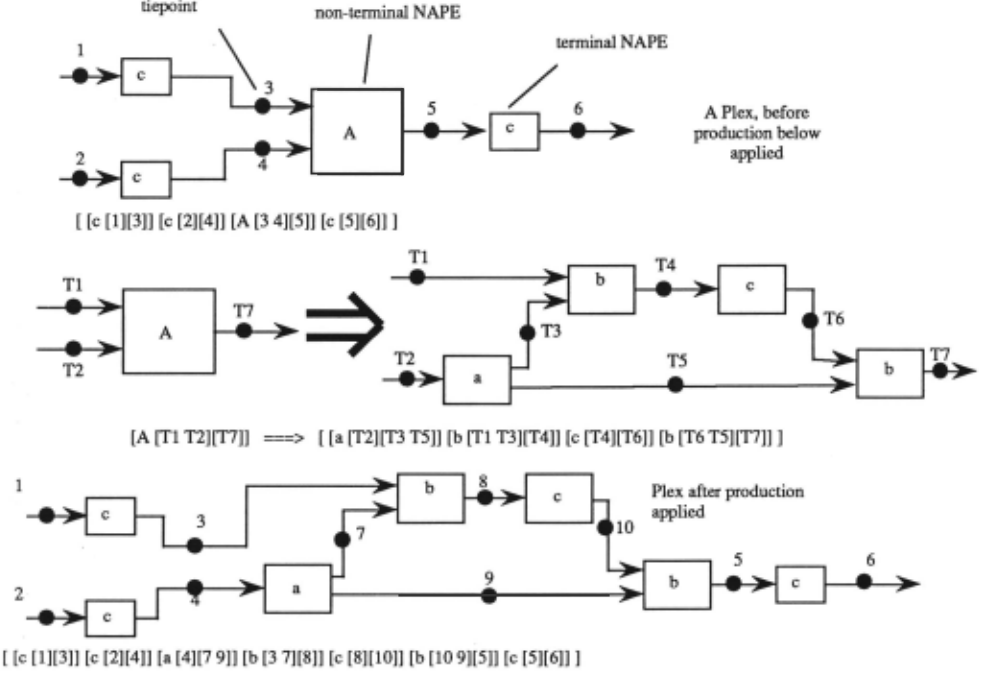
in the original string is to the left of the replacing string, and similarly on the right. In the graph case we no longer have this simple left-right ordering on the NAPEs and this question of embedding becomes much more complicated. Most of the discussion of this topic is in the web and graph grammar literature (e.g. [Pfaltz and Rosenfeld, 1969, Rosenfeld and Milgram, 1972]), but most of it applies (with some slight modifications) to the flowgraph case as well. The approach taken here is to specify with each production which tie-points on the left hand side correspond to which tie-points on the right and then connect everything connecting to one of these left hand tie-points (from the surrounding subgraph) to its corresponding right-hand tie-point.
We define a flowgraph grammar G to be a 4-tuple (N,T,P,S) where:
N is a fmite non-empty set of NAPEs known as nonterminals.
Tis a finite non-empty set of NAPEs known as terminals.
P is a finite set of productions.
S is a special member of N known as the initial (or start) NAPE
and the intersection of N and T must be empty.
IfwearbitrarilyordertheinputandoutputportsofaNAPE then each NAPE in a flow graph can be represented in the form of a triple
(NAPE-label, input list, output list)
where NAPE-label is the label on the NAPE, and input list is a list in which the ilh entry is the tie-point to which the ilh input port is connected. Similarly the output list specifies to which tie-point each of the output ports is connected. Using this convention a complete flow graph G can be represented as a set Gc (known as the component set) of such triples.
With the above conventions the productions in a flow graph grammar have the general form
where
A is known as the left-side structure, represented as a component set
C is known as the right-side structure, represented as a component set
L 1 is the left-side input tie-point list
R, is the right-side input tie-point list
Lois the left-side output tie-point list, and
R 0 is the right-side output tie-point list.
L 1 and R 1 must be of the same length, as must L and R , and specify how an instance of the right-side stru~ture is 0 to be embedded into a structure W containing an instance of the left side structure which is being rewritten according to the production. The rewriting and embedding is done as follows:
The instance of the left-side structure is removed from W and replaced by an instance of the right -side structure. Now, for each tie-point X in L, any previous connections from NAPEs in W to X are replaced by connections from the same attaching points of the same NAPEs to the corresponding tie-point in R 1 · The same is done for tie-points in L 0 and R 0 · Note that one can eliminate the need for explicit storing of R 1 and R 0 by simply using the same variable names on the left and right hand sides of the production to denote corresponding tie-points.
J ustas in the string case, by considering various restrictions on the form of X and Y in a production of the form:
one can arrive at the notions of context-sensitive, context-free, and regular flow graph languages [Ehrig, 1979]. In particular, restricting the productions to have a single NAPE in their left side structure gives us the flow graph equivalent of context-free string languages, and we will only concern ourselves with these from now on. In this case we no longer need to store L 1 and L 0 since the input and output lists of the single triple on the left of the production already specify this information. See Figure 1 for an example of the notation and of the rewriting process.
3 Chart Parsing of Context-free Flowgraphs.
In a chart parser, assertions about what has been found by the parsing algorithm are kept in a "database" known as the~. Such assertions will be called covering Patches (or simply patches), and are of two kinds - complete patches and P.lJ!1llil patches. A complete patch is a statement that a complete grammatical entity (corresponding to some terminal or non terminal symbol of the grammar) has been found. Partial patches are assertions that part of some grammatical entity has been found, and about what would need to be found in order to complete the grammatical entity concerned. One can think of a patch as being a closed loop drawn round some subgraph of the flowgraph, indicating that this subgraph corresponds to all or part of some grammatical entity as defmed by the grammar. If we regard the right-side structures of rules as uninstantiated templates, then complete patches with non-terminal labels correspond to the occurrence of an instantiation of the right side structure of some rule, thus forming an occurrence of the left-side structure of the rule. Partial patches correspond to partially instantiated instances of the right-side structure of some rule, and thus to partially recognised instances of the left sidestructure of the rule. Each patch A contains the following information:
- label(A) - the name of the grammatical entity corresponding to the patch, and is always one of the terminal or non-terminal symbols of the grammar.
- inputs(A) - a set of input tie-points for the patch.
- outputs(A) - set of output tie-points for the patch.
- comPOnents<Al- a list of the other patches involved in making up this patch i.e. what other patches have been used to recognise this patch.
- needed(A) - a description of what else needs to be found to complete the patch. In the case of a complete patch this will be empty, and for partial patches will be a flowgraph structure, represented as a list of triples.
For a partial patch, the input and output tie-points (i.e. those by which the patch connects to the surrounding flowgraph) are each subdivided into two categories -the set of~ tie-points where the patch itself is still seeking other components to attach to these tie-points, and the set of inactive tie-points which are those which would be inputs or outputs of the patch were it complete. A NAPE needed by a partial patch will be called immediatelY Deeded if any of its tie-points are active. The comPOnents entry of a patch lists (instantiated versions of) those NAPEs in the right hand side of the rule which have been completely instantiated, and the needed entry lists uninstantiated (as yet) parts of the rule. Note that some of the tie-ooints in the needed entry may be instantiated. These are where the needed NAPEs connect to the ones already found. We will say that a partial patch A is extendable by a complete patch B (or that B can extend A) in the case where A immediately needs a patch of the same type as B and the instantiated tie-points in this needed patch do not conflict with any instantiations actually occurring in B.
The essence of the chart parsing strategy can then be stated as follows:
Every time a complete patch is added to the chart a search is made for any partial patches immediately needing a patch of the sort just added at the appropriate place. For each of these partial patches a new patch is made extending it by the complete one, and this new patch is then added to an agenda of patches to be processed at some appropriate time. Similarly, every time a partial patch is added to the chart a search is made for any complete patches which could be used to extend the partial patch just added, and any are found new patches are made which extend the partial one, and these are added to the agenda to be processed when appropriate. Note that patches are only ever added to the chart. They are never removed, thus avoiding the need to redo work that has been done before.
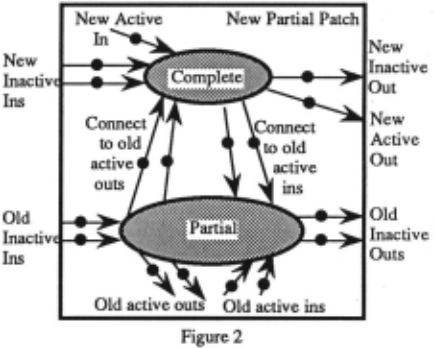
It should be clear from this that the basic operation of the algorithm is that of joining a complete patch to a partial patch to make a new enlarged patch. Fig. 2 shows a partial patch being joined to a complete patch to make a new patch (the enclosing box). The resulting patch has the same items in its comPOnents entry as the original partial patch plus the complete patch. Its Deeded entry is equal to that of the original partial patch minus the needed patch corresponding to the complete patch. Note that the matching of a needed patch to an actual complete patch may introduce further instantiations of tie points in the Deeded entry of the new patch. On connecting the two patches all the inactive tie-points of the partial patch remain inactive. Some of its active tie-points will correspond to tie-points of the complete patch (this is where the two patches actually join). Other active tie-points remain active in the new patch since it is still looking for other patches to attach to them. Of the complete patch's (input and output) tie-points somehavealreadybeenmentionedi.e.thoseconnectingdirectly to the partial patch. Others will become new inactive tie-points of the resulting patch since it will not be looking for anything to attach to them. However other (input and output) tie-points of the complete patch may now become active (viewed as belonging to the new patch) since it may now expect other patches to attach to them in order to complete itself. Provided all these distinctions are kept clear there is no great difficulty in implementing the joining operation.
The initialisation of the chart and the agenda now needs to be described. To begin with a complete patch is made for each of the terminal NAPEs in the original graph, and these are added to the agenda. If the algorithm is to be run top-down then an additional step is needed in which partial patches with empty comPOnents entries are made for every rule in the grammar whose left-side structure is labelled by the start symbol of the grammar. Each such rule leads to several such empty patches, one for each permutation of the input tie-points of the original graph. The inactive-inputs and active-outputs ~ for each of these patches are the permuted inputs. The needed entry is just the right -side structure of the rule with any appropriate instantiations of the tie points occurring in it.
The complete algorithm is shown as Algorithm 1 below. When it terminates the parse is regarded as successful if the chart contains a complete patch for S, and the inouts and Qll1WUS. entries are the same as the input and output tie-points of the graph being parsed.
The only remaining issue is how to organise the chart so that it can be searched efficiently. The chart is first of all divided into two parts, one for complete patches, and one for partial. The part for complete patches is organised as two arrays, one for indexing each patch by its inputs, and one for
initialise chart and agenda; until the agenda is empty do pick a patch A from the agenda; unless A is already in the chart then . add A to the chart; if A is complete then for each partial patch B in chart extendable by A do make a new patch extending B with A and put on agenda; endfor; else if bottom-up then for each ruleR in P such that rhs(R) has an input NAPE labelled by label( A) do for each such NAPE X in R do make new empty patch B with label(B)=lhs(R) and needed(B)=rhs(R) with instantiations dependent on match between X and A and inputs(B)=inputs(A) and active-outputs(B)=inputs(A); add B to agenda; endfor; endfor; endif; for each complete patch B in chart which can extend A do make a new patch extending A with B and put on agenda; endfor; if top-down then for each object C immediately needed by A do for each rule R in P with lhs(R)=label(C) do make new empty patch B with label(B)=label(C) and needed(B)=rhs(R) with instantiations dependent on match between C and lhs(R) and inputs(B)=inputs(C) and active-outputs(B)=inputs(C); add B to agenda; endfor endfor endif endif endunless enduntil;indexing by its outputs. So each complete patch is entered several times into the chart, once for each of its inputs and outputs. For further efficiency each of the elements in these arrays is a hash table and the patches are actually entered into these hashed by their label. This enables efficient retrieval of all patches with a particular label at a particular place in the graph. In a similar fashion partial patches are entered into their part of the chart indexed by their input and output tie-points, and hashed by the labels of each of the patches they immediately need. Note that there may be several of these.
Finally, note that a similar trick can be used to store the grammar rules themselves in order to enable efficient retrieval of appropriate rules.
4 Structure-Sharing Flowgraphs.
As stated in the introduction we are also interested in the case where structure sharing is allowed. To make this more precise we define a relation collapses on the set of flowgraphs over some set of NAPEs by:
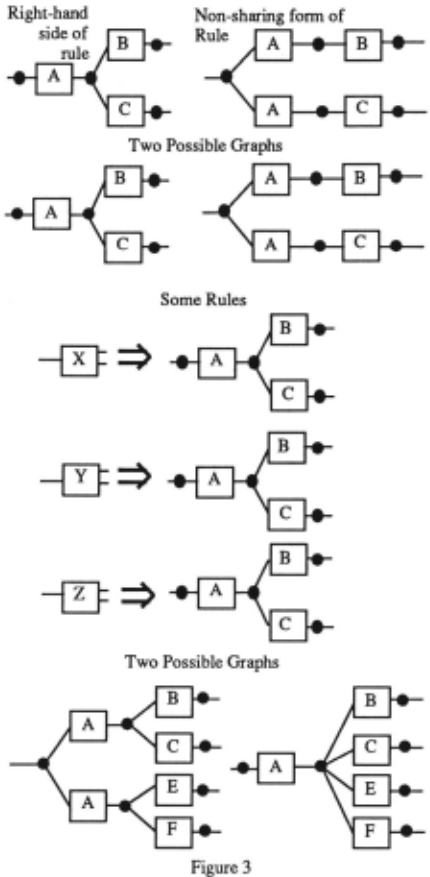
G2 collapses G 1 iff G 1 and G2 are flow graphs, and G 1 < contains two triples of the form T1 =(A,( t 1 , ··· ,t,),(xl' ... ,x.,)) and T2=(A,(tl' ... ,t,),(yl' ... ,y..,)), and G2< can be obtained from G1 < by removing these two triples and replacing them by a single triple of the form TI=(A,(~ , ... ,t,),(z 1 , ··· ,zm)) and then replacing all occurrences of xl' ... ,xm and y I'" ·· ,y m by zl' ... ,zm respectively throughout the remaining triples. In other words, G2 collapses G 1 iffG 1 contains two instances of some NAPE A (say) which have the same inputs, and G2 is identical toG 1 except that the two instances of A have been replaced by a single instance of A (with the same inputs) and all NAPES which originally connected to the outputs of one or other of the two instances of A now connect to the single instance (in G2). This amounts to identifying the two instances of A and their corresponding tie points.
The reflexive, transitive, symmetric closure of collapses is then an equivalence relation (share-equivalence) on the set of flowgraphs, and we then want any parsing algorithm which can recognise some graph G to also be able to recognise any flow graphs share-equivalent toG. We also want the grammatical formalism used to be able to generate not only the flow graphs derivable directly from the grammar, but also all share equivalent flowgraphs. This can be done if we allow at any point in the generation of a flow graph the replacement of the graph so far generated (G 1) by any graph G2 for which either G 1 collapses G2 m: G2 collapses G 1. A flow graph grammar with the addition of this rewriting rule will be referred to as a structure sharing flowgraoh grammar (a SSFG). Figure 3 illustrates several phenomena that can occur with SSFGs, and which motivated the above defmition.
To see how the chart parsing algorithm can be modified to cope with SSFGs it should first be noted that for any flow graph G there is a smallest flow graph G min which is share-equivalent to G. Secondly it should be noted that the right-side structure of any rule in a SSFG can be replaced by any flowgraph share equivalent to it without altering the generative capacity of the grammar. We can thereforedefineacanonical form foraSSFG in which each rule of the form:
A==>B
has been replaced by the rule:
A==>B ..
So the first change to the algorith~ is actually to change the grammar to its canonical form, and to use this new form of the grammar for parsing. The second change is to the action of adding a complete patch to the chart. Previously the only check that was done was to see if the patch was already in the chart. Now the algorithm must additionally check that there is no other patch with the same label and the same inputs in the chart. If there is then the algorithm must collapse the new patch and the one that was there already into a single patch with a new set of output tie-points and identify the original outputs of the two patches with these new tie-points. Provided tie-points in the various triples making up the patches are represented as pointers to pointers to tie-points (rather than storing the tie points directly in the triples) then simply changing the values of the second set of pointers will implement the identification universally throughout all patches in the chart. If the information that this has been done is needed by an application the algorithm can make a note of this fact either by annotating the tie-points involved or by an assertion held separately.
5 Discussion
Although there is quite a lot of literature on the generative abilities of various types of graph grammar formalisms (see e.g. [Ehrig, 1979, Feder, 1971, Fu, 1974, Gonzalez and Thomason, 1978, Pfaltz and Rosenfeld, 1969, Rosenfeld and Milgram, 1972]), there is relatively little on parsing strategies, except for rather restricted classes of graph and web grammars [e.g.Della Vigna and Ghezzi, 1978]. In its top-down strictly left-to-right form chart parsing of context-free string languages corresponds to Earley's algorithm [Earley, 1970], which was generalised by Brotsky [1984] to parsing flowgraphs of the kind described here, except that his algorithm could not cope with fan-out at tie-points. However the approach taken here can also run bottom-up, and can cope with the case in which there is fan-out Running bottom-up is particularly useful in applications in which we want to recognise as much as possible even though full recognition may be impossible {because of errors in the graph, or because the grammar is neccessarily incomplete). Zelinka [ 1986] has modified Brotsky' s algorithm to cope with fan-out, but her algorithm only runs in a pseudo bottom-up fashion by starting it running top-down looking for every possible non-terminal at every possible place in the graph. As discussed earlier the algorithm presented here is also easily modified to cope with structure sharing in a natural way, and indeed can also be easily generalised to run right-to-left as well as left-to-right It can also be easily modified to cope with fan-in at tie-points.
A particular advantage of a chart parser is that it quite explicitly keeps a record of all partial patches it finds. This is useful in applications for which we may not just wish to verify that some graph can be generated from some grammar, but also to enable the system to make suggestions based on "near-miss" information about how to correct the graph. It is in such applications that it may be useful to modify the algorithm to run right-to-left as well, since this may enable one to find more "near-misses" (i.e. those missing. their start NAPEs) than one would find if the parser only ran left-to-right.
The algorithm presented here runs in time polynomial in the size (measured by the number of tie-points T) of the graph being parsed provided that we do not allow the right -hand sides of rules to have "dangling" points (i.e. tie-points which are neither input or output tie-points of the rule, but which do not have both incoming and outgoing connections). If we allow these then there are graphs for which the algorithm will take time exponential in the size of the graph. Some intuition into why the algorithm runs in polynomial time can be gained if one considers the maximum number of possible patches that can be built The algorithm only distinguishes patches which differ in at least one of their input tie-points, their output tie-points, or their label. The maximum number (K) of inputs andmaximum number (M) of outputs in a patch is determined by the grammar, as is the number of possible labels (L). So the number of possible patches is bounded above by the product of L and the number of possible ways of selecting at most K out ofT tie-points, and the number of ways of choosing at most M out ofT tie-points. This gives us O(L.TK+M) patches altogether. Stemming from this fact a careful analysis then shows that the whole algorithm only takes timepolynomial in T. Full details will appear in a future paper. In this connection it should be noted that although the algorithm performs flowgraph recognition in polynomial time, it does not find all oarses in polynomial time. This is because for some flowgraphs and some grammars there may well be an exponential number of parses (this is also true of Earley's algorithm operating on strings!). The algorithm will however find a parse if one exists. If an application requires all possible parses, then the algorithm can be modified to store any patch which is equal to one already in the chart in terms of its inputs, outputs, and label, but not equal in terms of its comoonents, in an auxiliary data structure. At the end of the parsing there will then be enough information around in the chart to enable subsequent calculation of all the possible parses.
@inproceedings{ijcai1989p19,
  title     = {Chart Parsing of Flowgraphs},
  author    = {Lutz, Rudi},
  booktitle = {Proceedings of the Eleventh International Joint Conference on
               Artificial Intelligence, {IJCAI-89}},
  publisher = {International Joint Conferences on Artificial Intelligence},
  editor    = {N. S. Sridharan},
  pages     = {116--120},
  year      = {1989},
  month     = {8},
  note      = {Tools},
  url       = {https://ijcai.org/proceedings/1989/19},
}
TY - CPAPER TI - Chart Parsing of Flowgraphs AU - Lutz, Rudi T2 - Proceedings of the Eleventh International Joint Conference on Artificial Intelligence, IJCAI-89 PB - International Joint Conferences on Artificial Intelligence PY - 1989 SP - 116 EP - 120 UR - https://ijcai.org/proceedings/1989/19 ER -Copied
Machine-readable versions of this paper, for tools and AI agents:





