
The Classification, Detection and Handling of Imperfect Theory Problems
Proceedings of the Tenth International Joint Conference on Artificial Intelligence. Knowledge Acquisition. Pages 205-206.
Abstract
In recent years knowledge-based techniques like explanation-based learning. qualitative reasoning and case-based reasoning have been gaining considerable popularity in AI. Such knowledge-based methods face two difficult problems : 1) the performance of the system is fundamentally limited by the knowledge initially encoded into its domain theory 2) the encoding of just the right knowledge to enable the system to function properly over a wide range of tasks and situations is virtually impossible for a complex domain . This paper describes research directed towards the construction of a system that will detect and correct problems with domain theories. This will enable knowledge-based systems to operate with imperfect domain theories and automatically correct the imperfections whenever they pose problems . This paper discusses the classification of imperfect theory problems. strategies for their detection and an approach based on experiment design to handle different types of imperfect theory problems .
- I . T . M . Mitchell, R. Keller and S. Kedar-Cabelli , "Explanation- Based Generalizat ion: A Unify ing V ieu•," !llachine Leaming 1, I (January 1986), pp. 47-80.
- G. F. DeJong and R. J . Mooney, "Explanation-Based Learning: An Alternative Vieu•," Machine Learning 1, 2 (April 1986), .
- K . 0. Forbus, "Qualitati ve Process Theory," T echnical Report 789, Ph .D. Thesis, MIT AI Lab, Cambridge, M A, A u gu st 1984.
- R. C. Schank, D ynamic Memory, Cambridge University Press, Cambridge, England, 1982.
- S. C. Stanfill and D. Waltz, "Memory-Based Reasoning," Technical Report 86-7, Thinking Machines Corporation, Cambridge, MA , March 1986 .
- P. E. Utgoff, "Shift of Bias for Inductive Concept Learning ," in !lluch ine uuruiug: Au Artificiul lmelligence Approuch , \ 'ol. 11, R. S. Michalski, J. G. Carbonell , T . M . Mitchell (ed.), Morgan Kaufmann, Los Altos, CA , 1986.
- R. Doy le, "Constructing and Refining Causal Explanations from an Inconsistent Domain Theory ," AA AJ-86 , .
- S. A . Raja money , "A utomated Design of Experiment s for Refining Theories," M . S. Thesis, Department of Computer Science, U niversit y of Illinois, U rbana, IL, May 1986.
- S. Raja money, G. F. DeJong and B. Faltings, "Towards a Model of Conceptual Knowledge Acquisition through Directed Experimentation ," JJCAJ-85 , . IJCAI
- B. Falkenhainer, "A n Examination of the Third Stage in the Analogy Process: Verification-Based Analogical Learning ." JJC.41- 87,
- P. V. Tadepalli , "Learning in Intractable Domains," in Mach ine Learning : .-\ Guide To Cu rrent Research , T . M . Mitchell , J . G. Carbonell and R. S. Michalski (ed . ), Kluwer Academic Publishers, Hingham , MA, 1986, pp. 337-342 .
- S. A. Chien, "Extending Explanation-Based Learning: Failure- Driven Schema Refinement," Jrd JEEE Conference on A l Applications, .
- S. W. Bennett , "Approxima tion in Mathematical Domains," JJCAJ-87 ,.
References were extracted automatically from the PDF and may contain errors.
Full text extracted automatically from the PDF; figures, tables and equations may differ. The PDF is the version of record.
TilE CLASSIFICATION, DETECfiON AND HANDLING OF IMPERFECf TIIEORY PROBLEMS
Shankar Rajamoney Gerald DeJong
Coordinated Science Laboratory University of Jllinois at Urbana-Champaign Urbana. IL 61801
- the inconsistent theory problem: the system can derive inconsistent statements from its theory.
- the intractable theory problem: the deductions are computa tionally prohibitive and hence cannot be completed.
However. the underlying issues are too murky and subtle for the above categories to be cleanly separable. For example. inconsistencies and incompleteness in domain theories may be due to abstractions and approximations which make the theory tractable [7]. Inconsistent theory problems can be due to an incomplete theory if information necessary to nullify one of the inconsistent statements is missing. Inconsistent statements can also result from the incomplete theory problem if the system is operating under the closed world assumption and does not con sider the possibility of new information influencing its computa tions [8]. Apart from the above problems of interacting categories. the classification of Mitchell et al. also ignores certain kinds of incompleteness and inconsistencies.
A complete taxonomy of imperfect theory problems includes two types of incompleteness and inconsistencies. The first type of incompleteness is the one discussed above in which a deduction cannot be completed because some relevant knowledge is missing. The second type of incompleteness is due to the lack of sufficient detail in the relevant knowledge. Unlike the first case. deductions can be constructed leading to a conclusion. However. the lack of detail results in the system having to make assumptions and leads to the problem of multi ple mutually inconsistent proofs for a conclusion. This type of incompleteness also results in large search spaces because the system does not have the required control knowledge to select the correct path at each choice point. The first type of incon sistency involves wrong knowledge that has to be identified and retracted. The second type of inconsistency involves missing knowledge that would have defeated the deduction leading to one of the inconsistent statements.
There are two aspects to the imperfect theory problems - detection of the imperfections and the revision of the domain theory - and both of these present difficulties. This paper describes various strategies for dt:lecting problems with the domain theory and a uniform approach based on experiment design to handle each type of problem. The system is assumed to start with an initially imperfect but operational theory. This is a psychologically motivated assumption since people also use simplified domain theories to make conclusions computationally tractable and they are still able to operate satisfactorily. During the course of the system's operation. problems with its domain theory are identified and corrected. No changes are made until a problem is detected.
U DETECTION OF THE IMPERFECI' THEORY PROBLEMS
This section describes four strategies for detecting problems with domain theories. Though the detection strategies are dis cussed in the context of expumation construction for
ABSTitACI'
In recent years knowledge-based techniques like explanation-based learning. qualitative reasoning and case-based reasoning have been gaining considerable popularity in AI. Such knowledge-based methods face two difficult problems: 1) the performance of the system is fundamentally limited by the knowledge initially encoded into its domain theory 2) the encod ing of just the right knowledge to enable the system to function properly over a wide range of tasks and situations is virtually impossible for a complex domain. This paper describes research directed towards the construction of a system that will detect and correct problems with domain theories. This will enable knowledge-based systems to operate with imperfect domain theories and automatically correct the imperfections whenever they pose problems. This paper discusses the classification of imperfect theory problems. strategies for their detection and an approach based on experiment design to handle different types of imperfect theory problems.
I INTRODUCI'ION
This paper addresses the problem of imperfect theories in AI systems. It is increasingly apparent that knowledge is essen tial for intelligent behavior. This has led to a new trend in AI towards knowledge-intensive methods like explanation-based learning [ 1. 2]. qualitative reasoning [3]. and case-based reason ing [4. 5].
The primary shortcoming of these approaches is not in the representation of the knowledge - a task that is relatively well understood - but in the subtleties of selecting the appropriate knowledge. The expert who is handcoding the knowledge has to anticipate the rich variety of tasks and the wide range of situa tions for which the knowledge may be used in order to insure that the system will function properly. Also. all AI systems that rely on a programmer-specified domain theory are funda mentally limited by their initial knowledge. For example. [6] shows how the knowledge built into a learning system drasti cally influences its learning capability.
What is needed is a system that will automatically detect and correct problems with its domain theory. This will free the expert from the tedious and often impossible task of handcoding all the relevant knowledge. It will enable the use of "quick and dirty" methods to facilitate the construction of operational but imperfect domain theories. These domain theories can then be automatically debugged and corrected by the system.
Mitchell et al. [1] have briefly classified problems with imperfect domain theories into three categories:
- the incomplete th$ory problem: the deductions required can not be computed because relevant information is missing.
This re.earch ..... supported in part by a University of Illinois Cognitive Science/ Artificial Intelligence Fellowship and in part by the Ollce of Nan! Re.earch ·under grant N-00014-86-K-030'1.
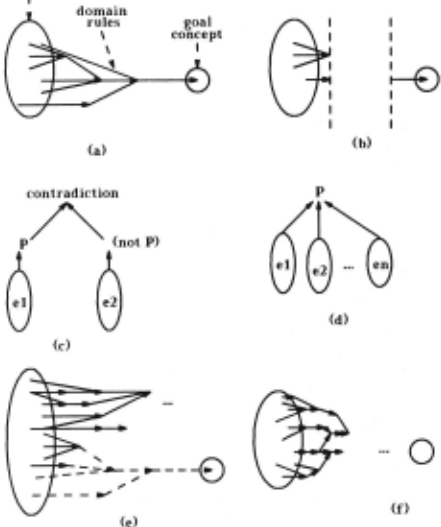
explanation-based learning [1. 2] they are also applicable for other problem solving tasks like qualitative reasoning and plan ning. Explanation construction involves using facts and rules from the domain theory to show why a training instance is an example of the goal concept (Figure Ia). The problems due to imperfect domain theories that are encountered during explana tion construction are:
Broken Explanation: There are gaps in the explanation leading to a broken explanation (Figure I b). The rules or facts that are required to complete the explanation are missing from the domain theory (incompleteness- type 1).
Contradiction: The system constructs explanations for conclu sions which are contradictory (Figure lc). This problem may be due to wrong rules or facts in the domain theory (inconsistency -type I) or due to missing rules or facts (inconsistency- type II) that would resolve the contradiction by defeating one of the explanations (el or e2) thereby leading to the withdrawal of the corresponding previously justified conclusion (P or (not P)).
Multiple Explanations: The system constructs multiple expla nations for a conclusion when only one explanation is expected to be true in the real world (Figure td). This problem is due to lack of knowledge which would help distinguish between the alternate explanations (incompleteness - type II). This problem is especially important for explanation-based learning as is has implications for the new concept definition.
Resources Exceeded: The system exceeds the resources (time. memory. etc.) allotted to it while constructing an explanation. This type of problem can be further classified as:
Large Search Space Problem: The system has to search a large space during the construction of an explanation (Figure le). Though the explanation may exist and its size may be compar able to previous successful explanations the system cannot con struct it since there are too many paths to explore. The system does not have the knowledge to decide between the alternate
domain facts traini~g example paths (incompleteness- type II) and is forced to search all paths. Small Links Problem: The links connecting the explanation are too small and too many for the system to construct the complete explanation within the allotted resources (Figure I f) (intractable theory problem). This problem is independent of the large search space problem and may occur even when no search is involved.
III DEALING WITH THE IMPERFECT THEORY PROBLEMS
Dealing with the above problems requires the acquisition of new knowledge. This section describes ongoing research on an extension to an approach discussed in [8. 9] that can be used to deal with the above problems.
A. A Brief Review of the Experiment Design Approach
An approach that deals with the contradiction problem due to an inconsistent domain theory (type II) is described in [8. 9]. The approach involves: 1) Monitoring the execution of the system's plans. 2) Detection of contradictions if the system's predictions are not compatible with the observations. 3) Hypothesizing reasons which could resolve the contradiction. 4) Designing experiments to test each hypothesis. 5) Incorporating the information obtained by the experiments into the domain theory. Five classes of experiments are described in [8]. These experiments are used to discriminate among hypotheses. perform measurements. find. dependencies among parameters. classify objects based on their behavior with respect to a property and define new properties of objects based on their behavior in a situation. These experiments are used to obtain new knowledge that is relevant to the determination of the correct hypothesis.
B. Extending the Experiment Design Approach
The experiment design approach can be applied to each of the problems described in section 2:
Broken Explanation: The system must be able to hypothesize different ways of filling the gaps in the explanations. In [8. 9] the hypotheses were suggested by the system after an analysis of the situation that Jed to the failure. Alternatively such hypotheses may be formed by analogy to previous experiences [tO]. Once alternate hypotheses that can complete the explana tion have been formulated experiments are designed to determine the best hypothesis.
Contradiction: Experiments are designed to test each link in each explanation to isolate the faulty rule or fact that leads to the contradiction. Once the fault has been isolated then hypot!Jeses are formulated to correct the fault . If the contradic tion is due to wrong rules or facts (inconsistent - type I) then the hypotheses can involve retraction of rules. If the contradic tion is due to missing knowledge (inconsistent - type II) then the hypotheses can involve positing rules that defeat the explana tion. Experiments are designed to identify the best hypothesis. Multiple Explanations: Multiple explanations arise due to the Jack of knowledge required to distinguish between the alterna tive explanations (incompleteness - type II). Experiments are designed to gather the information that the system needs to decide which explanations cannot hold for the given situation. This will enable it to determine the correct explanation.
Resources Exceeded: The large search space problem can be han dled by designing experiments to gather the information needed to make the right choice whenever alternatives develop. A number of approaches have been suggested for the small links problem [7. 11-13]. [13] shows how approximations can be used to make explanations tractable. [12] describes an incremental failure-driven technique to refine abstract theories when the current theory fails to provide a satisfactory explanation. The approach suggested by [7. 11] involves describing the domain theory at different levels of abstraction. This allows the expla nation to be constructed using fewer higher-level links. However. due to the abstractions and approximations a number of alternate low-level explanations may be possible for one higher level explanation and this failure cannot be handled by examin ing the more detailed levels. This is the "hierarchical" multiple explanation problem and the experiment design approach can be applied to find the correct explanation.
C. An Example
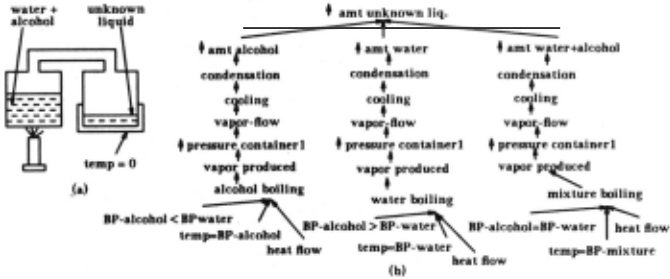
The system is given the distillation scenario shown in Fig ure 2. A mixture of alcohol and water is heated and it is observed that an unknown liquid is formed in the second con tainer and that its amount is increasing. The domain theory does not have rules or facts that allow the system to determine which liquid will boil first (incomplete- type II) and therefore it has to take into account all possibilities. The system constructs three different explanations for the increase in the amount of the liquid in the second container (the multiple explanation prob lem). For example. if the boiling point of alcohol is less than that of water then when the temperature of the mixture reaches the boiling point of alcohol the heat flow to the mixture will cause alcohol to boil. Boiling will produce alcohol vapor which will cause the pressure in the conta·iner to increase. The pressure will become greater than the pressure in the second container and there will be a flow of alcohol vapor to the second container. This vapor will cool and condense since the second container is at a very low temperature. The condensing alcohol forms the expla nation for the observed formation and increase in the amount of the unknown liquid. Similarly. if the boiling point of alcohol is less than or equal to that of water then water or a mixture of alcohol and water will condense in the second container. It is important to determine which explanation is correct since the explanation is worth generalizing and learning only if a useful goal is being achieved- for example. if alcohol is condensing then we have separated alcohol from water or obtained a purer ver sion of alcohol (distillation). The system identifies the correct explanation by designing experiments to determine whether the liquid formed in the second container is water. alcohol or a mix ture of both. This example also illustrates the large search space problem if the above task is part of a much larger task - like understanding a distillation factory - that builds in separate directions on each explanation. Then the above experiments help in pruning the search space by immediately eliminating two of the three choices for the unknown liquid. The system can also design experiments to select the correct path during explanation ·construction by determining independently whether the boiling point of water is greater than. equal to or le~>.'i than that of alcohol and applying that information to the given situation.
IV CONCLUSIONS
In this paper we have discussed problems with and exten sions of Mitchell et al. 's classification of imperfect theory prob-
)ems. Four strategies for detecting imperfections in domain theories were described. A uniform approach for handling these problems based on experiment design was also described and illustrated by an example. These methods were discussed in the context of explanation construction for explanation-based learn ing. However the detection strategies and the experiment design approach are general and can be applied to other knowledge intensive AI areas like case-based reasoning. expert systems and qualitative reasoning.
ACKNOWLEOOMENTS
We would like to thank Ray Mooney and Steve Chien for their helpful comments on drafts of this paper.
@inproceedings{ijcai1987p40,
  title     = {The Classification, Detection and Handling of Imperfect Theory Problems},
  author    = {Rajamoney, Shankar A. and DeJong, Gerald},
  booktitle = {Proceedings of the Tenth International Joint Conference on
               Artificial Intelligence, {IJCAI-87}},
  publisher = {International Joint Conferences on Artificial Intelligence},
  editor    = {John McDermott},
  pages     = {205--206},
  year      = {1987},
  note      = {Knowledge Acquisition},
  url       = {https://ijcai.org/proceedings/1987/40},
}
TY - CPAPER TI - The Classification, Detection and Handling of Imperfect Theory Problems AU - Rajamoney, Shankar A. AU - DeJong, Gerald T2 - Proceedings of the Tenth International Joint Conference on Artificial Intelligence, IJCAI-87 PB - International Joint Conferences on Artificial Intelligence PY - 1987 SP - 205 EP - 206 UR - https://ijcai.org/proceedings/1987/40 ER -Copied
Machine-readable versions of this paper, for tools and AI agents:
 Welcome
 Future Conferences
 AI Journal Division
 IJCAI Proceedings
 About IJCAI
 IJCAI Awards