
Towards a Model of Conceptual Knowledge Acquisition Through Directed Experimentation
Proceedings of the Ninth International Joint Conference on Artificial Intelligence. Learning and Acquisition. Pages 688-689.
© 1985 International Joint Conferences on Artificial Intelligence
Abstract
Most current Artificial Intelligence systems require a complete and correct model of their domain of application. However, for any domain of reasonable size, it is not feasible to construct such a model. The main thrust of this project is to build a system that can continuously update its model through a constant monitoring of the real world. The project involves the development of a system that starts with an incomplete and incorrect model of the world. While performing its tasks the system is occasionally confronted by observations which are inconsistent with its current beliefs. It attempts to explain these observations by hypothesizing reasons for the inconsistencies and devising experiments to pinpoint the flawed belief. Based on the results of the experiments the system revises its beliefs to accommodate the previously inconsistent observations.
- J. Carbonell, "Experiential Learning in Analogical Problem Solving," Proceeding s of the National Conference on Artificial Int elligence, Pittsburgh, P A., 1982, 168-171.
- G. DeJong, "Automatic Schema Acquisition in a Natural Language En v ironment," Proceedings of the National Con fe rence on Artificial Intelligence, Pittsburgh, P A, 1982, 410-413.
- G. DeJong, B. Faltings, R. Mooney, P. O'Rork e, S. Rajamoney, A.M. Segre and J. Sha v lik, "A Review of Explanation-Based Learning," Technical Report in preparation, Coordinated Science Laboratory, Urbana, IL, 1985.
- P. Langley, "Data-driven Discovery of Ph ysical Laws," Cognitive Science 5, (1981 ), 31-54.
- R. Michalski and R. Stepp, "Learning from Observation: Conceptual Clustering," in Ma chine Learning, Ryszard Michalski, Jaime Carbonell, Tom Mitchell (ed.), Tioga Publishing Company, Palo Alto, 1983, 331 -363.
- T. Mitchell, "Learning and Problem Solving," Proceedings of the Eighth International J oint Conference on Artificial Int elligence, ](arlsruhe, West German y, 1983, 1139-1151. IJCAI
- R. Schank, D ynamic Memory, Cambridge University Press, Cambridge, 1982.
- E. Y. Shapiro, "Inductive Inference of Theories from Facts," Research Report 192, Yale Un iversity, Yale, February, 1981.
- P. H. Winston, T. 0 . Binford and M. Lowry, "Learning Physical Descriptions from Functional Definitions, Examples, and Precedents," Artificial Intelligence Laboratory Memo No. 679, M.I.T., Cambridge, MA, January 1983.
References were extracted automatically from the PDF and may contain errors.
Full text extracted automatically from the PDF; figures, tables and equations may differ. The PDF is the version of record.
TOWARDS A MODEL OF CONCEPTUAL KNOWLEDGE ACQUISITION THROUGH DIRECTED EXPERIMENTATION
Shankar Rajamoney Gerald DeJong Boi Faltings*
Coordinated Science Laboratory University of Illinois at Urbana-Champaign Urbana, IL 61801
A. System Overview
Our system has a world model of its domain that drives its reasoning. A number of beliefs are implicit in the structure of the world model. When situations arise that cannot be explained with the current world model thereby leading to a contradiction, the system starts questioning its beliefs. It first questions beliefs directly linked to the contradiction. Only if these fail to give a con sistent explanation does it question secondary causes of the con tradiction, beliefs on which the primary beliefs rested, and the beliefs behind the questioning and investigation process. The underlying assumption is that the number of errors in the model is small. The system performs a series of experiments directed at finding the belief at fault. Once the belief has been identified it is revised to give a model consistent with the current observations.
The planner used by the system predicts the observations the system will make when the plans are executed. The system con stantly compares these predictions with the actual observations. Whenever it finds changes in the world that were not a conse quence of some plan, it tries to explain them as an effect of processes running independently from the system (for example, evaporation).
One of the system's implicit beliefs is that liquids cannot pass through solids. While carrying out its normal activities, the sys tem inadvertently encounters an example of osmosis, a process unk nown to the system. Osmosis is a natural phenomenon that occurs when two solutions are separated by a permeable solid. If the con centrations of the two solutions are different then a flow of solvent through the solid takes place in such a way as to minimize the difference in concentrations.
The system's observation of osmosis cannot be explained with its current knowledge of the world. The information deduced from the contradiction enables the system to devise experiments to deter mine which of its beliefs is wrong and to discover some charac teristics of the osmosis process.
The observation of the phenomenon of osmosis results in the system revising its world model. It modifies its belief to allow for liquids to pass through solids under special circumstances. In the process, it discovers the concept of permeability of solids and a new form of flow which we know as osmosis.
B. The Osmosis Example
The system is given a goal of forming a mixture of specific amounts of solutions, #$Solution] and #$Solution2, of known con centrations, concl and conc2 (cone] > conc2). In order to achieve this goal it generates a subgoal of temporarily storing the specified amounts of the two solutions in containers. As it happens the only suitable container has two compartments separated by a permeable membrane. The planner, not realizing the significance of the parti tion, plans to pour the two solutions of differing concentrations into the two compartments. As a part of its monitoring of the real world, it expects a number of observations including a decrease in
ABSTRACT
Most current Artificial Intelligence systems require a complete and correct model of their domain of application. However, for any domain of reasonable size, it is not feasible to construct such a model. The main thrust of this project is to build a system that can continuously update its model through a constant monitoring of the real world. The project involves the development of a system that starts with an incomplete and incorrect model of the world. While performing its tasks the system is occasionally confronted by obser vations which are inconsistent with its current beliefs. It attempts to explain these observations by hypothesizing reasons for the inconsistencies and devising experiments to pinpoint the flawed belief. Based on the results of the experiments the system revises its beliefs to accommodate the previously inconsistent observations.
I INTRODUCTION
Machine Learning is of increasing importance in Artificial Intelligence [Carbone1182, Michalski83, Mitche1183, Schank82, Winston83~ In this paper, we shall describe a new form of explanation-based learning which involves designing and conduct ing experiments in the "real" world to help with the explanation of some observation. When human learning behavior is considered, it seems that there are two classes of explanatory learning to be dis tinguished. The first is the acquisition of schematic knowledge, i.e. the high-level learning of plans and scripts (e.g., how to behave at a restaurant). This form of learning does not, in principle, enhance the power of the knowledge that is already there, but makes its application more efficient via chunking with schemata. The second is the acquisition of conceptual knowledge. This form of learning adds new capabilities that the previous knowledge did not provide.
Note that there are marked differences between the two forms. Schematic knowledge may be learned from a single observa tion. For example, the basic structure of a script for kidnapping might be clear from a single observation, provided there is enough knowledge to understand the dependencies between the individual events in that situation. This has been demonstrated in work on explanatory schema acquisition [DeJong82~
Acquiring new concepts, on the other hand, is more difficult. When people discovered radioactivity, it took them a long time to formulate the proper concept. This is a case where the previous knowledge is not sufficient to explain the observations and thus rea soning has to be replaced by experimentation. Another point to observe in this example is that new concepts are not discovered by a sea1·ch for them, but by noticing discrepancies between the world model pre.dictions and the way the world behaves. New concepts arise Ollt of the necessity to explain these discrepancies while main taining a knowledge base consistent with the earlier observations.
This work \\'AS supported in psrt by the Air Force Office of Scientific Research under grant F49620·82·K·0009 and in part by the National Science Foundation under grant NSF·IST-83-17889.
' IBM Fellow
II THE SYSTEM
the amount of solutions in the two original containers, and the appearance of specified amounts of solution in the two compart ments of the selected container.
C. Contradiction Detection
The system verifies the predictions made by the planner by comparing the predictions with its input observation stream. Immediately after execution of the plan it finds that all the predic tions made by the planner are confirmed. However the next time it examines the container it finds that the amounts of the two solu tions have changed. This change was not predicted by the planner.
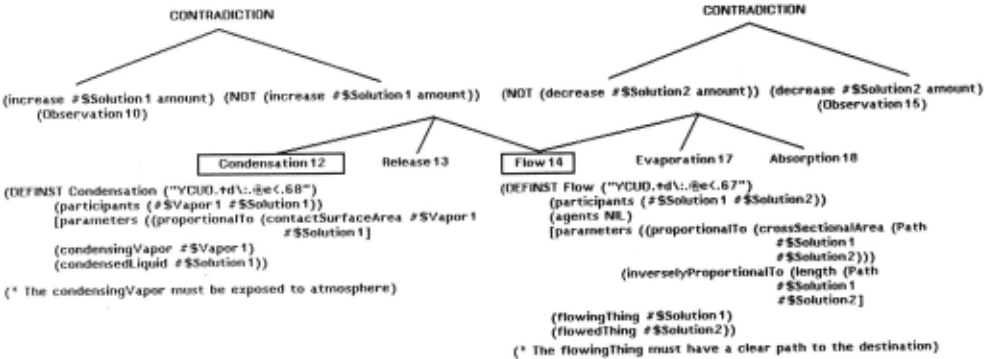
The explanation module tries to relate the change to an effect of one of the known processes for changing the amount of a solu tion. The relevant processes are evaporation, condensation, absorp tion (in which the solid absorbs liquid like a sponge), release Cin which the solid releases the absorbed liquid), and flow. The system tries to explain the observations as a result of these processes by activating the corresponding schemata and checking if the change caused by running each process is compatible with the observations. However, it finds that none of the processes can be activated since each of them has preconditions which cannot be satisfied. Evapora tion and condensation require exposure to the atmosphere and since the compartments are closed by lids they cannot be activated. Absorption and release require the container to have an absorbent property. Flow requires a free path from the source to the destina tion. These requirements are not met in the present situation. So the system is left with a contradiction in which it has observations for ;,hich its current world model has proven inadequate (Figure 1).
D. Beliefs Tested
The explanation structure that resulted in the contradiction involves a number of processes. Each process seems inapplicable because one or more preconditions are not satisfied in the current situation. The beliefs on which the contradiction rests are obtained from the reasons for the failure of each process to run. The beliefs are:
- ( 1) The procedure for classifying solids into absorbent and non absorbent classes is right,
- Liquids require a clear, solid-free path to flow, and
- Evaporation and condensation require exposure to the atmo sphere.
For the observation to be valid one of these beliefs must be wrong and to find out which one the system performs a series of experiments. Note that on the first attempt at findmg an explana tion the system tests only the immediate causes of fa1lure of the primary processes.
E. The Experiment Designer
There are two stages of experimentation:
- ( 1) The first stage involves distinguishing among the five processes that would explain the contradiction,
- The second stage involves constructing a series of experiments which are used to generalize the specific instance of the process observed.
The partially instantiated processes, the failed preconditions, and the unexplained observations form the input to the experiment design module. The ideal experiment would reproduce the setup in the original observation in such a manner that only one of the processes is active and all the other competing processes are elim inated totally. However, it is impossible to eliminate the possibility of some processes (for example, absorption, since one cannot build a container without walls). Furthermore, this may be undesirable because the process, which is itself suspect, may continue to influence the observations in some hidden manner. For example, one might think that flow can be eliminated by separating the two compartments and moving one away from the other, but the belief being questioned, namely, liquids cannot flow through solids, is still in effect; this time with a longer path through more solids like tables and floors.
Some means of discriminating all the instantiations of the five processes simultaneously is required. Note that the basis for distin guishing the processes cannot depend on the preconditions because they are suspected of not activating processes when they should have. One characteristic of a process is that the time rate at which the process progresses depends on geometrical parameters (length, area etc.), state variables (temperature, pressure etc.), and the pro perties of the participants. The system bases its experiments upon the rate at which each process progresses. Note that a secondary belief, which forms the basis for the investigation, is that the pro portionalities of the rates on the above parameters do not change.
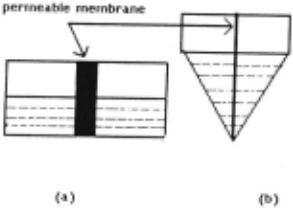
Experiments are designed such that one of the processes is allowed to dominate the rest by having an environment in which its rate is enhanced and the other competing processes' rates inhi bited. If the original observations are reproduced in a much shorter time period then the evidence points to the dominating process as the cause of the observation. The flow process rate depends on the cross-sectional area and the length of the path from the source to the destination, the evaporation and condensation rates depend on the surface area of contact between the liquid and its vapor, and the absorption and release rates depend on the surface area of con tact between the absorbing solid and the absorbed liquid. By mani pulating the geometry of the containers it is possible to build con tainers in which everything else remains as in the original setup, but parameters like contact surface area, cross-sectional area and length are maximized or minimized to allow one process to dom inate the other competing ones.
In our particular example the system comes up with experi ment specifications to distinguish each process. The set of specifications to distinguish the process flow is shown in Figure 2 and an experiment that meets these specifications relative to the ori ginal setup is shown in Figure 3. The system requests that the experiments be carried out and the results returned. Based on the combined results the system concludes that some form of the pro cess flow caused the original observation.
| #$Experiment 112 |
| Process being tested Flow14 |
| Specifications ((maximize (crossSectionaiArea (Path #$Solution 1 |
| #$Solution2))) (minimize (length (Path #$Solution 1 |
| #$Solution 2))) (minimize (contactSurfaceArea #$Vapor2 |
| # $Solution2)) (minimize (contactSurfaceArea #$Container3 |
| #$Solution2)) (minimize (contactSurfaceArea #$Vapor 1 #$Solution 1)) |
| (rninirnize (contactSurfaceArea #$Container Z #$Solution 1))) |
| Competing Processes (Condensation 12 Release 13 Evaporation 17 Absorption 18) |
F. Revising the World Model
The most specific revision of the world model would be to create a new process that resembles the process flow in most respects. However this process will have preconditions that permit flow when the two specific solutions are separated by the specific partition as in the example above. Our current efforts are concen trated on generalizing this specific case using explanation-based learning [DeJong85) in conjunction with a further series of experi ments aimed at discovering the properties of the participants that played a crucial role in the example. ln any case, the important thing to note is that the system no longer believes that liquids can not pass through solids and has a specific example to disprove it.
ill CONCLUSIONS
We have explored a model for making experiments to explain inconsistencies between the system's knowledge and the real world. In some respects, this is similar to work described in [Langley81) but our approach uses the world model to drive the experimenta tion. Also, some results on testing hypotheses using experiments have been reported in [Shapiro81L Shapiro's approach is, however, of a more theoretical nature, and is impractical because it uses a large number of experiments.
The project is still in its infancy. The next step is to improve the experiment design, where the project addresses serious philo sophical issues about knowledge and the closed world hypothesis. Our approach to this so far has been to copy people's behavior and try the simple explanations first. Only if these fail are the more basic assumptions that underlie them retracted.
@inproceedings{ijcai1985p133,
  title     = {Towards a Model of Conceptual Knowledge Acquisition Through Directed Experimentation},
  author    = {Rajamoney, Shankar A. and DeJong, Gerald and Faltings, Boi},
  booktitle = {Proceedings of the Ninth International Joint Conference on
               Artificial Intelligence, {IJCAI-85}},
  publisher = {International Joint Conferences on Artificial Intelligence},
  editor    = {Aravind Joshi},
  pages     = {688--689},
  year      = {1985},
  note      = {Learning and Acquisition},
  url       = {https://ijcai.org/proceedings/1985/133},
}
TY - CPAPER TI - Towards a Model of Conceptual Knowledge Acquisition Through Directed Experimentation AU - Rajamoney, Shankar A. AU - DeJong, Gerald AU - Faltings, Boi T2 - Proceedings of the Ninth International Joint Conference on Artificial Intelligence, IJCAI-85 PB - International Joint Conferences on Artificial Intelligence PY - 1985 SP - 688 EP - 689 UR - https://ijcai.org/proceedings/1985/133 ER -Copied
Machine-readable versions of this paper, for tools and AI agents:
 Welcome
 Future Conferences
 AI Journal Division
 IJCAI Proceedings
 About IJCAI
 IJCAI Awards