
Knowledge-based Knowledge Elicitation
Proceedings of the Tenth International Joint Conference on Artificial Intelligence. Knowledge Acquisition. Pages 201-203.
© 1987 International Joint Conferences on Artificial Intelligence
Abstract
A method for using the advantages of domain-specific knowledge acquisition for a general purpose knowledge acquisition tool is introduced. To adapt the knowledge acquisition tool for a specific application and a specific problem solving strategy (e .g . heuristic classification, such diagnostic strategies as establish and refine), acquisition knowledge bases (AKBs) are integrated in the system to guide the employment of different knowledge elicitation methods (interview techniques, protocol analysis, semantic text analysis and learning mechanisms). Acquisition knowledge bases are predefined deep models, consisting of structured objects to represent important concepts of a domain . These knowledge bases are used in addition to the already acquired knowledge to trigger specific elicitation methods by an analysis of incompleteness and inconsistency of the existing knowledge in the system. Furthermore, methods for integrating these kinds of knowledge acquisition tools with machine learning approaches are discussed .
- Brachman, R.J . "What IS-A is and isn't: an analysis of taxonomic links in semantic networks." IEEE Com uter, 1.6 (special issue: Knowledge RepreSen- tation , 1. 83
- Eshelman, L., D. Ehret, J . McDermott and M. Tan "MOLE: A Tenacious Knowledge Acquisition Tool." In: Boose, J.H. and Gaines, B. (Eds.): Proceedings of the "Knowled e Ac uisition for Knowled e- Based Systems Workshop", Banff, Canada to appear at Academic Press 1987).
- Waterman, D.A. and A. Newell "Protocol Analysis as a Task for Artificial Intelligence." Artificial Intelli- gence, 2 (1971), 285•31. IJCAI
References were extracted automatically from the PDF and may contain errors.
Full text extracted automatically from the PDF; figures, tables and equations may differ. The PDF is the version of record.
ABSTRACT
A method for using the advantages of domain-specific knowledge acquisition for a general purpose knowledge acquisition tool is introduced. To adapt the knowledge acquisition tool for a specific application and a specific problem solving strategy (e.g. heuristic classification, such diagnostic strategies as establish and refine), acquisition knowledge bases (AKBs) are integrated in the system to guide the employment of different knowledge elicitation methods (interview techniques, protocol analysis, semantic text analysis and learning mechanisms). Acquisition knowledge bases are predefined deep models, consisting of struc tured objects to represent important concepts of a domain. These knowledge bases are used in addition to the already acquired knowledge to trigger specific eli citation methods by an analysis of incompleteness and inconsistency of the existing knowledge in the system. Furthermore, methods for integrating these kinds of knowledge acquisition tools with machine learning approaches are discussed.
A. Introduction
The knowledge acquisition tool KRITON is designed for use by inexperienced users, unfamiliar with AI tech niques (e.g. a domain expert) as well by well-trained knowledge engineers. KRITON is a general purpose knowledge acquisition tool incorporating different eli citation methods, such as interview techniques, proto col analysis, semantic text analysis and machine
learning methods.
Therefore KRITON is a hybrid knowledge acquisition tool comparable to AQUINAS (Boose and Bradshaw 1986) and KADS (Hayward, Wielinga and Breuker 1986).
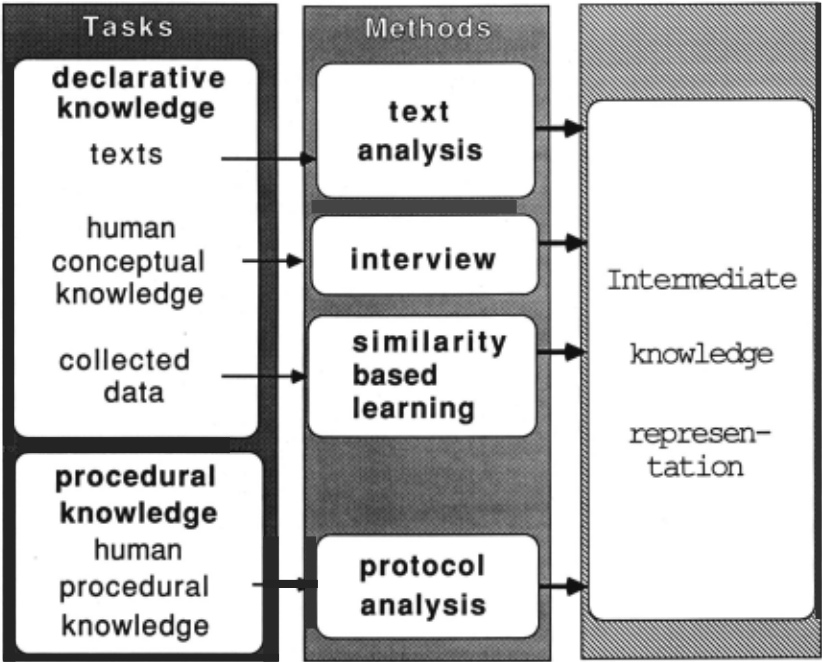
Each knowledge elicitation method is used for captur ing knowledge from only one specific knowledge source: 1) interview methods, using the repertory-grid techniques also used in (Boose and Bradshaw 1986) and a laddering component for an analysis of the tax onomic structure of a domain, are employed for the acquisition of declarative knowledge; 2) protocol analysis, related to the original work in (Waterman and Newell 1971), is restricted to the elicitation of procedural knowledge; and 3) semantic text analysis is used to search for important text fragments, fre quency analysis of relevant keywords and the genera tion of semantic text structures. For a more complete description of the use· of these methods in KRITON see (Diederich, Ruhmann and May 1986) .
KNOWLEDGE-BASED KNOWLEDGE EIJCITATION
Joachim Diederich
German Research Institute for Mathematics and Data Processing Schloss Birlinghoven D-5205 Sankt Augustin 1
West Germany
All output of the above mentioned elicitation methods is represented in an Intermediate Knowledge Representation Level. The purpose of this intermedi ate knowledge representation is the storage of the already available knowledge in a way that makes it possible to employ different knowledge elicitation methods.
The aim of this paper is an introduction to the method of knowledge-based knowledge elicitation through several elicitation methods in a hybrid knowledge acquisition tool. This is done by using inter mediate stages of knowledge representation as a
blackboard for further refinement.
B. Utilization of Already Acquired Knowledge
The employment and use of the already acquired knowledge has major advantages and is an important task for knowledge acquisition tools. General purpose knowledge acquisition systems like KRlTON are not so complete in their support of the knowledge acquisition process as domain-specific systems. For example, OPAL (Musen 1986) is complete for the domain of cancer therapy. The only chance for a general pur pose knowledge acquisition tool to achieve such a capability is to use as much as possible of the already acquired knowledge to adapt the system for a specific domain.
Another problem arises if different problem solving strategies (e .g. heuristic classification) are to be sup ported. In this case meta-knowledge is necessary to realize different strategies of applying the available knowledge.
In KRITON, already captured knowledge is used in several ways, depending on its amount and quality. Moreover, existing knowledge is completed by "acquisi tion knowledge bases" (AKBs) for better guidance of the ongoing elicitation process. These acquisition knowledge bases are viewed as an integral part of the KRITON system. In every stage of the acquisition pro cess, the user can use these knowledge bases in addition to existing knowledge for better employment of the KRITON facilities for knowledge-based
knowledge elicitation.
AKBs contain a set of structured objects defining important concepts of the domain. They are predefined declarative deep models of a domain with the sole purpose of optimizing the ongoing acquisition process. There is no guarantee that the AKBs them selfs are complete or consistent: they are a result of an acquisition process and they are used only for the pupose of further knowledge elicitation.
Depending on the richness and quality of the existing knowledge, the already acquired knowledge is used in the following ways:
- Subject of further spezialization processes.
- Guidance of the acquisition process by discovery of missing components
- Completion of domain-dependent deep models (AKBs).
Section D will give an introduction to the use of already captured knowledge in addition to AKBs.
Intermediate Knowledge Representation
Figure 1: Knowledge Elicitation and Intermediate Knowledge Representation
C. Intermediate Knowledge Representation Level
Some knowledge acquisition tools include different knowledge representation stages to represent inter mediate results of the total knowledge acquisition pro cess, e.g. OPAL (Musen 1986) and KADS (Hayward et al. 1986). Especially if learning mechanisms come into play, an intermediate knowledge representation level is useful to maintain information closer to the sources. The step from generated rules back to the original facts is often necessary for evaluating the results of the acquisition process.
In our system, all output from the knowledge elicita tion techniques is translated into an intermediate knowledge representation system. This representation system has two subparts: a descriptive language for functional and physical objects, representing the gen eric concepts, and a propositional calculus represent ing the transformation path of these concepts during the problem solving process.
The description language consists of structured objects, their features and interrelations and is used to define semantic relations in a domain. The classification of taxonomic relations is similar to that in (Brachman 1983). This semantic net is the goal language for the interview and textual analysis methods.
The second part of the intermediate knowledge representation language is a propositional calculus, using semantic primitives to describe the basic rela tions of concepts discovered by protocol analysis. The set of semantic primitives is not complete and will have to be updated for each application domain (e.g. engineering).
The intermediate knowledge representation level allows the use different knowledge sources and per mits the tool to be extended with elicitation methods currently not available. Moreover, it can be used for the generation of various knowledge · bases for different expert system shells and knowledge representation systems.
From this point of view, an Intermediate Knowledge Representation supports at least these six desirable properties:
- Openess of the system (possible integration of currently unknown elicitation methods) .
- Knowledge acquisition for different knowledge representation languages.
- Storage of incomplete and inconsistent knowledge for the ongoing acquisition process.
- Integration and employment of acquisition knowledge bases.
- Maintaining information closer to the sources (e.g. through references to the original expert utterances, protocols etc.).
- Management of knowledge bases with varying degrees of completeness in different knowledge representation languages.
D. Using Incomplete Knowledge for Refinement and Specialization
The discovery of incomplete knowledge and the search for hypotheses with best evidence is one important feature of knowledge acquisition tools, e.g. MOLE (Eshelman, Ehret, McDermott and Tan 1986).
In KRITON, the employment of a certain knowledge elicitation method depends not only on decisions of the knowledge engineer but also on requirements the system discovers by analysis of the already acquired knowledge.
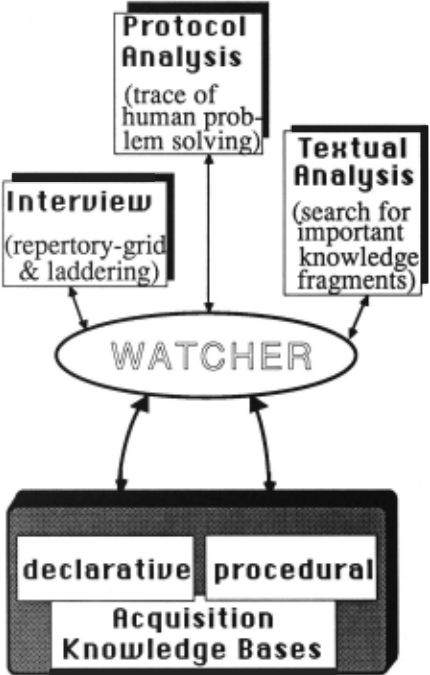
A significant role in dealing with incomplete knowledge is played by "Watcher", which is a per manently active demon controlling the intermediate knowledge representation for missing components.
The user (the knowledge engineer or expert) might have generated several objects during the incremental text analysis without any relation to the taxonomic organization of the objects of the corresponding domain (e.g. no information about the inheritance paths, part-of relations or instance relations was given). These items are known to the system, but should be subject of further investigations. Watcher checks all objects at the intermediate knowledge representation level for rrussmg, but possible or indispensable links (e .g. every object has to be placed in a taxonomic organization), sends a message to the user and recommends the employment of an elicita tion method to complete the knowledge base. .
Here is a simple example. As part of an AKB, the sys tem has stored at the intermediate knowledge representation level a "part-of" relation between the objects "motor" and "car". Watcher will discover this relation and will trigger an interview. More precisely, Watcher selects a question from the laddering com ponent to explore the "part-of" relation between "motor" and "car". First, "physical-part-of" relations are analysed, next "subset" or "generalization" rela tions and so on, until the most specialized relation is found.
Watcher is also invoked if an elicitation method starts, informing the user about incomplete parts of the knowledge base . Furthermore, the user can delegate the selection of concepts to be used in an interview to Watcher. This demon then looks for semantically related but incomplete objects and triggers a laddering to exploring that domain in more detail.
To deal with incomplete knowledge and use this kind of knowledge for specialization tasks, Watcher clearly needs meta-knowledge.
The discovery of missing objects and links In a seman· tic structure is only possible by using knowledge about the required semantic relations for an object. At this point , knowledge about semantic structuring in KRI· TON comes into play. Although Watcher is realized purely procedurally now, the KRITON approach could profit from a knowledge-based organization of Watcher.
The general aim of this approach is to extend the facilities of the knowledge based Watcher. The purpose of this component is not only to recommend knowledge elicitation methods but also to automati· cally employ them.
E. Integrating Machine Learning and Psychological Ell citation Methods
There are several ways to integrate machine learning with cognitive science methods. First, learning mechanisms can be used as knowledge elicitation methods, together with interview techniques, incre mental textual analysis and protocol analysis. Second, learning mechanisms can operate on structured objects at the intermediate knowledge representation level to find similarities between them and recommend a certain organization of the structured objects (e.g. if an analogy is discovered) . Third, the learning com ponent can observe user activities on line, support the user with feedback about regularities in his use of the system and display connected items in the form of rules. This last possibility has been adopted in KRITON.
The KRITON architecture supports such an integra tion. The intermediate knowledge representation sys tem allows the storage of knowledge together with references to the sources of a particular entry. This facility avoids a major disadvantage of learning sys tems. In KRITON, the step back from generated rules to the original facts and sources is always possible by special markers at the intermediate knowledge representation level.
In addition, the above described application of learn ing mechanisms supports the knowledge-based knowledge elicitation process. Because the state of the existing knowledge in the system may always change, additional information about similarities and regularities of parts of the intermediate knowledge representation is necessary.
F. Conclusion
We are aiming at an integrated, modular tool for knowledge acquisition in knowledge-based systems. The system should be open in the sense that it pro· vides facilities for its own extension and elaboration.
Important extensions, which have already been imple mented, include acquisition knowledge bases for the adaptation of the system to a certain domain and to a a certain problem solving strategy. Acquisition knowledge bases are used for the employment of knowledge elicitation methods to specialize and com plete the already acquired knowledge.
ACKNOWLEDGEMENTS
Thanks to Joachim Hertzberg and Tom Gordon, who read drafts of this paper.
@inproceedings{ijcai1987p39,
  title     = {Knowledge-based Knowledge Elicitation},
  author    = {Diederich, Joachim},
  booktitle = {Proceedings of the Tenth International Joint Conference on
               Artificial Intelligence, {IJCAI-87}},
  publisher = {International Joint Conferences on Artificial Intelligence},
  editor    = {John McDermott},
  pages     = {201--203},
  year      = {1987},
  note      = {Knowledge Acquisition},
  url       = {https://ijcai.org/proceedings/1987/39},
}
TY - CPAPER TI - Knowledge-based Knowledge Elicitation AU - Diederich, Joachim T2 - Proceedings of the Tenth International Joint Conference on Artificial Intelligence, IJCAI-87 PB - International Joint Conferences on Artificial Intelligence PY - 1987 SP - 201 EP - 203 UR - https://ijcai.org/proceedings/1987/39 ER -Copied
Machine-readable versions of this paper, for tools and AI agents:
 Welcome
 Future Conferences
 AI Journal Division
 IJCAI Proceedings
 About IJCAI
 IJCAI Awards