
Drastic Cut of Man's Work in Reliability Studies by Using an Expert System
Proceedings of the Tenth International Joint Conference on Artificial Intelligence. Knowledge Representation. Pages 541-543.
© 1987 International Joint Conferences on Artificial Intelligence
Abstract
We show here how we have been able, thanks to the use of artifical intelligence techniques, to find a neat solution to the problem of the automation of reliability studies . We have introduced rule-based representation at two levels : - the modelling of the studied system, which is very general and versatile, and nevertheless quantifiable because of the rule-base representation . - the storage of the reliability engineers' knowledge about failure modes and effects · for conventional components . The productivity of the reliability studies has been substantially improved with this approach .
Full text extracted automatically from the PDF; figures, tables and equations may differ. The PDF is the version of record.
EDF
Direction des etudes et recherches
Service RNE 1, av . du General de Gaulle 92141 Clamart FRANCE tel : (1) 47 65 55 07
ABSTRACT
We show here how we have been able, thanks to the use of artifical intelligence techniques, to find a neat solution to the problem of the automa tion of reliability studies . We have introduced rule-based representation at two levels :
- the modelling of the studied system, which is very general and versatile, and neverthe less quantifiable because of the rule-base re presentation .
- the storage of the reliability engineers' knowledge about failure modes and effects ·for conventional components .
The productivity of the reliability studies has been substantially improved with this approach .
KEYWORDS : reliability - reliability model - auto mation - expert system - event sequences.
I INTRODUCTION
As systems involved in human activity become increasingly sophisticated and as their destructi ve power grows, the need for more and more com plex reliability and safety studies is more acute ly felt.
Some attempts /1/ /2/ have been made to automate reliability studies using an algorithmic ap proach, but they have been limited because the mo dels used were not general enough, and could har dly allow the introduction of knowledge on stu died systems. Therefore, EDF (Electricite de Fran ce) has chosen a different and ori&inal approach , based on expert systems, which involves two le vels of rules :
- A knowledge This level is level, using first order rules. the expert system concerning the studied systems .
- A modelling level, which results from the ap plication of the knowledge rules to a minimum, simplified (essentially topological) descrip tion of the studied system.
According to the nature of the studied system, two types -of modelling are used.
- If there are no dependencies between the compo nents of the studied system, modelling can be simple, and results, in a straightforward way, to a very commonly used reliability model, cal led fault-tree. An expert system called EXPRESS, building fault-trees for thermo-hydraulic sys tems is now operational /3/.
DRASTIC CUT OF MAN'S WORK IN RELIABILITY STUDIES BY USING AN EXPERT SYSTEM
M. BOUISSOU
N. VILLATTE
Universite Pierre et Marie Curie 4 place Jussieu 75005 Paris FRANCE
- But, if there are dependencies (for example, a diesel generator starts when a normal power sup ply fails), another type of modelling has to be used, either to solve the whole problem, or as a complement to the fault-tree. This is why we ha ve created a new model that makes it possible to introduce all the information on the propaga tion of interactions throughout the system, whe reas the fault-tree model cannot. At the same ti me, we have created a specialized inference engi ne called GSI, able to derive from this model a fully automatic computation of a system failure probability. GSI is designed to take into ac count all the dependencies in the calculation of the system failure probability.
Since GSI (as conventional programs that deal with fault-trees) does not contain any kno wledge about studied systems, we have introdu ced the reliability engineers' knowledge in an expert system, that can automatically generate the GSI model of a system, from the minimum in formation needed to describe it.
But, of course, GSI can be used without the ex pert system.
In this paper. we shall first list the main features of the GSI model. secondly explain bow the associated expert system works. and finally &ive the performance data for these tools witb two illustrative examples .
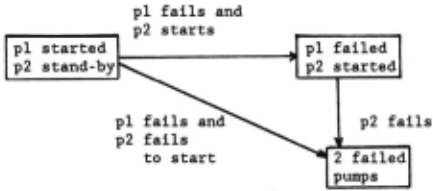
When there are dependencies between the compo nents, the model generally used is the ~
~ Here is an example pump system, where the the first one fails . of state graph for a 2 second pump starts when The use of such models has been considerably limited so far by the fact that the number of states increases very quickly with the size of the system (for example, a system with N compo nents, if each component ha~ only two states (working, failed) may have 2 states !). Moreo ver, a slight modification of the hypotheses about the system thouroughly changes the graph ! This is why we have developed :
1) a reliability calculation method /6/ , based on sequences of events, · that can be used for big graphs (over lO~states), whereas conventional methods are limited to graphs covering about 100 states at most. The "secret" of the method lies simply in the omission of what is negligi ble, and in the awareness of the extent of what has been neglected .
2) the GSI rule based model /4/,/5/, to repla ce the transition matrix of the graph.That mo del contains all the information necessary to build the matrix automatically ,but is, of cour se, much more readable, modular, modifiable ... /8/.
II THE GSI MODEL
Such a model, associated with the speciali zed inference engine we have developed (Genera tion of Sequences by Inference), is a real ex pert system for the system modelled .
By merely introducing minor changes in the facts or rules such information as the system fai lure probability for different missions, with dif ferent initial states .. can easily be obtained. What is this model like ? It includes :
- a list of components and variables of the sys tem, with their initial state .
- 3 distinct rule bases :
- the interaction rule base describing the propagation of information through the sys tem. Example,
if water-supply - "none" or
power-supply - "none" or pump - "failed" then pump-flow :- 0
This is one of the types of rules used in diagnosis problems.(For example, see the "si mulation rules" of /9/).
- the occurrence rule base, indicating what can happen in the current state of the sys tem. Examples,
- the failure rule base , indicating whether the system is fail~d. Example,
if diesel-generator - "operating" then possible (diesel-generator :-"short-failure"), (diesel-generator :- "long-failure") if diesel-generator - "required-to-start" then possible (diesel-generator :- "operating") (diesel-generator :- "fail-to-start")if (pump-flowl + pump-flow2)<100
then failure :- "yes"
With this qualitative knowledge, GSI can auto matically generate the sequences between any gi ven initial state of the system and a failed sta te. If, moreover, the occurrence rates of the events listed in the occurrence rules are ente red into GSI, it can compute their probabilities . An expert system has then been created for the studied system.
III ENTERING THE RELIABILITY ENGINEERS' KNOWLEDGE
GSI is a general tool which, itself , does not contain knowledge about the studied systems. So, it is interesting to automate the writing of the GSI model as much as possible by using an expert system. So far, we have created such a knowledge base for power supply systems, and we are going to describe its use .
To implement that knowledge-base, we have used the general-purpose ALOUETTE inference engi ne . /7/ .
The following diagram shows the different steps (automatically linked) of the creation of a complete GSI model, using the expert system.
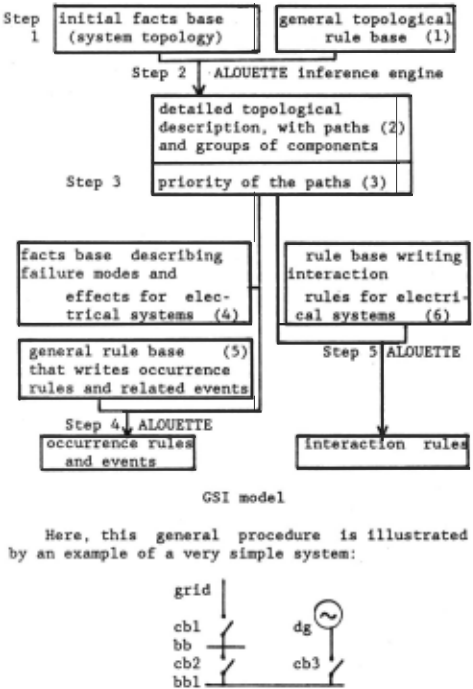
First step :
The user defines the topology of the system and the nature of its components, which obviou sly is the minimum information that can be given to describe a system.
Here are examples of facts taken from the descrip tion for the above example
( grid , next-item , cbl ( cbl , next-item , bb ( bbl , target , yes ) ( grid , source , yes ) ( dg source , yes ) ( grid , nature , grid ) ( bb nature , busbar) ( dg nature , diesel-generator ) ( cbl , nature , circuit-breaker )llilLl :
A general rule base (1) ( 56 rules), valid for any electrical or hydraulic system, builds the paths from a source to a target using these initials facts . This rule base is also used by EX PRESS . In our example, two paths are created : bbl-by-grid and bbl-by-dg .
lliJLl :
At this point, the user must indicate the priorities of the different possible paths to the expert system.
In our example, he will have to enter the two facts
( bbl-by-grid , priority , 1 ( bbl-by- dg , priority , 2Step 4 :
Some general facts (4), valid for any electri cal system, are grouped with the facts (2), and (3) . They describe all that can happen to electri cal components, according to their nature, and their state . For example, a circuit-breaker can open inadvertently, only if it is closed, and ope rable . This event involves two variables,which re present
- the position of the c .b . (closed/open)
- its operating state (OK/failed)
This is described in the facts base by the following facts :
( circuit -breaker, failure-mode , inadv-opening) ( inadv-opening, initial-condition , initl ) ( inadv-opening, initial-condition , init2 ) ( initl , name , component ) ( initl , value, OK ) ( init2 , name , state ) ( init2 , value , closed inadv-opening, result, ·resull inadv-opening, result, resul2 resull , name , component ) resull value , failed ) resul2 , name , state ) resul2 , value, open )The other failure modes taken into account so far are :
- stuck-open or stuck-closed circuit-breakers
- short-circuits on the grid, the transformers, the bus-bars
- loss of power on the grid
- diesel · generator failure to start upon demand and while operating .
The description adopted for failure modes makes it easy to introduce new ones ; for example, it may be useful to distinguish between the diffe rent failure modes of the same component accor ding to the different repair times of the va rious failures .
A general rule base (5) (37 rules), valid for any system, uses the above-mentioned description and the whole topological facts base (2)+(3) to automatically generate the occurrence rules and the description of the events GSI needs.
For example, with the above mentioned failure mo de, this rule base will write the following occur rence rule, concerning cbl :
if cbl - "OK" and cbl-state - "closed"then x possible where x is just the reference number of the cor responding event, with its description : comment that will appear in GSI outputs, trans lation in GSI language, and failure rate . x : inadvertent-opening of cbl ;
cbl :- "failed" and cbl-state :- "open"1. E-6 llilL1 A rule base (6) (57 rules) containing knowledge about electrical systems , generates the GSI in teraction rules. Here are some interactions that are taken into ac count in the model : all the possible paths from sources to tar gets are identified, and among them,the path with the highest priority is chosen . A path is "possi ble" if all its components are operable . The priorities will be expressed by rules such as : Once a rent from ven to the if bbl-by-grid - "possible" and bbl-by-dg - "possible" then path-bbl-by-grid :- "chosen" path has been chosen, if it is diffe the actually used path , orders are gi circuit breakers by rules such as : "chosen" andif path-bbl-by-dg cb2-state - "closed" then cb2 :- "ordered-to-open" if path-bbl-by-dg - "chosen" and cb3-state - "open" and cb2-state - "open" then cb3 :- "ordered- to -close" These rules are linked they specify that the circuit-breaker cb3 can not be closed before the opening of cb2. The ALOUETTE rule which generated these two rules is presented below if nature(p) - path, member(p)- (xl) , nature(xl) -circuit-breaker, next-item(xl)- (y), nature(x2) - circuit-breaker , (x2) <> (xl), next-item(x2)- (y) , source(p)- (s), target(p)- (t) . then write ' if', t,'-by- ' , s , ' - ''chosen"' write ' and ', x2, ' -state - "closed"' write ' then ' , x2 , ' :- "ordered-to-open"' write 'if', t , '-by-',s, ' - "chosen"' write ' and ' , xl , '-state - "open"' write ' and ', x2 , ' -state - "open" ' write ' then ' , xl , ' :- "ordered-to -close"'Once the whole GSI input file has been genera ted, GSI can be run ; it automatically gives the reliability of the system, and the most probable sequences. This is very useful to detect the weak points of the system.
In our example, GSI generates the following interesting sequences, showing the effects of in correct responses of the circuit-breakers.
(their numbers refer to their places in the out put file, where they are arranged in decreasing order of probability. The total number of sequen ces with no repair is 155.)
| 13: | short-circuit of grid * 9 . 87E-6 * opening of cbl * * cb2 stuck-closed |
| * * * * * | |
| 16: | short-circuit of grid * 9.86E-6 |
| cbl stuck-closed * * * | |
| opening of cb2 * | |
| closing of cb3 * * | |
| dg fails to start |
*
*
For our very simple wledge of the expert cient to describe all the studied system. example, the general kno system proved to be suffi the functioning rules of
Of course, it is not always true, for an obvious reason : the expert system is given only minimum ·information describing an electrical system, and, of course, it can not guess its particular featu res.
This is why a review of the automatically created GSI model is necessary. At this point by slight modifications, the user can easily introdu ce for instance the repair priorities (a fre quent type of dependencies), the fact that a cer tain circuit-breaker has a higher failure rate than the others, because it works under adverse conditions .... etc (See /4/,/8/ for a full exam ple of GSI model and of effects of modifica tions).
IV PERFORMANCES
* A "hand-made" GSI model has been built for the 6.6kv power supply of the Paluel French nu clear power plant. 3.5 engineer-months were requi red to develop this model and find all the re sults. By conventional methods, it had taken 8 en ginneer-months.
Of course many other results were simultaneously obtained. The model includes 30 components each of them has at least 3 states (for example : ope rable, short failure, long failure).
This model is run some 2' on an IBM 3090 with a probability threshold that gives a satisfactory precision . The number of selected sequences is 1677 .
- The application of the expert system to a sim plified version of the system quoted above, incor porating : 10 circuit-breakers, 4 busbars, 2 die sel-generators, 2 transformers, 2 grids, gives the following CPU times for the steps described in section III ;
- step 2 : lOs
- steps 4 and 5 : 13s
- Compilation of the GSI model : 15s
- GSI model run, with a good precision (the neglected sequences represent 1% of the result) : 53s . 1752 sequences we re selected.
The adoption of an easily modifiable, rule-ba sed, quantification model (the GSI model) proved to be very efficient, because it permits a two step modelling procedure.
1) the expert system, from the minimum informa tion needed to describe the studied system, au tomatically creates a preliminary version of the model.
2) then, the reliability engineer transforms that sketch in a final, very detailed model.
In the design phase of a system, the first step provides enough information, and is quick enough. It takes less than one hour to change some facts in the topological description of the system and spot the weak points of the new design .
In a detailed reliability study, it is possible to go much further by refining the GSI model . But the time needed is still negligible, when compa red to the time that it would take with conventio nal methc;>ds.
REFERENCES :
/1/ G.E. APOSTOLAKIS S.L. SALEM- J.S. WU - CAT : a computer code for the automated construc tion of fault trees. EPRI report NP 705 1978.
/2/ J . ANCELIN E. CHATY- M. CARRE : Notice d'utilisation du code GO d'analyse automatique de la fiabilite. EDF report HT-13 -34-81 1981.
/3/ M. GONDRAN J.F. HERY- J . C. LALEUF : Une aide aux etudes de fiabilite par systemes ex perts. 5th international conference on reliabili ty and maintenability. BIARRITZ, october 1986.
/4/ M. BOUISSOU : Recherche et quantification au tomatiques de sequences accidentelles pour un systeme reparable. 5th international conferen ce on reliability and maintenability. BIARRITZ, october 1986.
/5/ M. BOUISSOU Une approche systeme expert dans les etudes de fiabilite : l'algorithme GSI . (generation de sequences par inferences). EDF report HT-13-85-85 November 1985.. .
/6/ M. BOUISSOU : Nouvelle methode de calcul de la fiabilite par les sequences d'etats dans un graphe d'etats le programme GRAFFITI- EDF Re port HT/13/18/84 October 1984.
/7/ D. MULET-MARQUIS, P. BENHAMOU : ALOUETTE : un environnement logiciel pour !'utilisation de bases de connaissances. EDF Report HI/5302/02 Ja nuary 1986.
/8/ M. BOUISSOU : Comparaison entre une etude de fiabilite classique, et !'equivalent utilisant GSI : Exemple du 6.6 kv de la centrale de Pa luel. EDF Report HT/53/1/86. soon to be publis hed.
/9/ R. DAVIS Diagnostic reasoning based on Structure and Behaviour. Artificial Intelligen ce vol 24 pp 347-410 (1985).
@inproceedings{ijcai1987p108,
  title     = {Drastic Cut of Man's Work in Reliability Studies by Using an Expert System},
  author    = {Bouissou, M. and Villatte, N.},
  booktitle = {Proceedings of the Tenth International Joint Conference on
               Artificial Intelligence, {IJCAI-87}},
  publisher = {International Joint Conferences on Artificial Intelligence},
  editor    = {John McDermott},
  pages     = {541--543},
  year      = {1987},
  note      = {Knowledge Representation},
  url       = {https://ijcai.org/proceedings/1987/108},
}
TY - CPAPER TI - Drastic Cut of Man's Work in Reliability Studies by Using an Expert System AU - Bouissou, M. AU - Villatte, N. T2 - Proceedings of the Tenth International Joint Conference on Artificial Intelligence, IJCAI-87 PB - International Joint Conferences on Artificial Intelligence PY - 1987 SP - 541 EP - 543 UR - https://ijcai.org/proceedings/1987/108 ER -Copied
Machine-readable versions of this paper, for tools and AI agents:





