
Arguments of Persuasion in Labour Mediation
Proceedings of the Ninth International Joint Conference on Artificial Intelligence. Cognitive Modelling. Pages 294-295.
© 1985 International Joint Conferences on Artificial Intelligence
Abstract
In this paper we present a process model of the reasoning underlying arguments of persuasion and its embodiment in a computer program, the PERSUADER, which gives counsel for the resolution of impasses in collective bargaining. We show how goal trees can be searched to produce arguments involving economic quantities.
- Carbonell, J. G. "Subjective Understanding: Computer Models of Belief Systems" Doctoral dissertation . Yale University Research Report #150, January 1979.
- de Kleer, J. and Brown, J.S. "Foundations of Envisioning" In Proc AAAI-82. Pittsburgh, Penn . , August, 1982, pp~34-437.
- Flowers, M., McGuire, R. and Birnbaum, L. "Adversary arguments and the logic of personal attacks" In W. G. Lehnert and M. H. Ringle (Eds) • Strategies for Natura 1 Language Processing , Hillsdale, NJ: Lawrence Erlbaum Associates, 1982.
- Spohrer, J. C. and Riesbeck, K. "Reasoning-driven Memory Modification in the Economics Domain". Yale University Research Report #308, May 1984.
- Wilensky, R. Computational Reading, MA: 1983. Planning and Approach to Addison-Wesley Understanding: p,_ Human Reasoning. Publishing Company,
References were extracted automatically from the PDF and may contain errors.
Full text extracted automatically from the PDF; figures, tables and equations may differ. The PDF is the version of record.
ABSTRACT
In this paper we present a process model of the reasoning underlying arguments of persuasion and its embodiment in a computer program, the PERSUADER, which gives counsel for the resolution of impasses in collective bargaining. We show how goal trees can be searched to produce arguments involving economic quantities.
ARGUMENTATION STRATEGIES
Arguments of persuasion are those used by the partic i pants in cooperative problem solving. While others have worked on argumentation, none so far has worked on persuasive arguments. The work of Flowers, et al. (1982) was concerned with adversary arguments and Spohrer and Riesbeck (1984) have investigated understanding causal relationships among economic quantities based on arguments given in newspaper articles.
"Convincing" someone to accept a proposition can be effected by two strategies: 1) showing that the proposition furthers the person's goals, or 2) indicating how refusing the proposition threatens his goals. In labour negotiations, the second strategy is crucial. This paper presents a procedure for constructing threatening arguments during labour mediation.
Collective bargaining is the process through which a company and a union arrive at a contract. Argumentation is used to persuade the opposing party to grant concessions, to support one's own demands, and to thwart attempts by the opposition to gain concessions from one's own side. A mediator, called in to help the two sides reach an agreement, tries to convince each party to accept the necessary concessions. The final agreement incorporates the tradeoffs that each party found acceptable. By the time the mediator appears, most secondary issues have been settled. The mediator's job is to convince the parties to accept compromises on the last important issues.
Events and 2 below illustrate how a mediator uses threatening arguments to do this.
EVENT 1. The company refuses to accept a particular wage settlement. The mediator argues that inefficient plant operation will occur from the resulting employee dissatisfaction.
*This work was IST-8317711 and 29-85-K-0023. supported by ARO by NSF Grant Grant No. No. DAAG
Katia Sycara-Cyranski
School of Information and Computer Science Georgia Institute of Technology Atlanta, Georgia 30332
EVENT 2. The union refuses to accept a wage settlement. The mediator argues that if the company grants higher wages, it will become noncompetitive and will be forced to laj off workers.
I I REPRESENTING I.!:!l PARTIES' GOALS
To generate an appropriate argument, the arguer must know the goals of the parties in question. We represent these goals in~~· In the subsequent two figures, we depict partial goal trees of a union and a company.
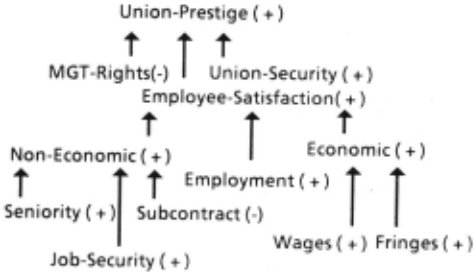
Figure 1 UNION GOAL-TREE
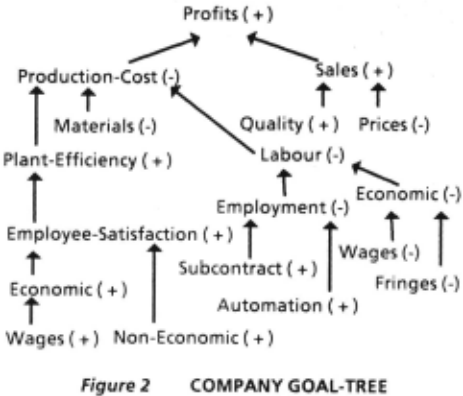
Searching goal trees in order to understand and/or predict the behaviour of various actors has been investigated by Carbone 11, ( 1979) , Spohrer and Riesbeck, (1984), and Wilensky, (1983). The relationships among goals are adapted from Spohrer and Riesbeck, (1984). A (+) sign corresponds to the goal of increasing the particular quantity to which it refers while a (-) sign corresponds to decreasing the quantity. For example, PROFITS(+) means that the company's highest level goal :s to increase profits. A goal is violated by an action when the action opposes its sign. For example, a reduction in employment, EMPLOYMENT(-), violates the union's goal EMPLOYMENT(+).
The children of a node, connected to it through support 1 inks, denote the subgoals through which the supergoal is satisfied. For example, in the company's goal tree, diminished labour costs can be achieved either by decreasing the economic concessions granted to the union, ECONOMIC(-), or by decreasing the number of employees, EMPLOYMENT (-) · Thus, a path X to Y in a goa 1 tree constitutes a causal chain that produces an explanation of the change in Y in terms of the change in X, assuming no other change has occured in the rest of the tree.
A conflicting S2!l has a (+) sign in one goal tree and a (-) sign in the other. When, in one party's goal tree, the same goal exists in more than one place with opposite signs, an internal conflict exists for this party. The company has an internal conflict: it wants to increase economic concessions, ECONOMIC(+), in order to increase efficient plant operation, while simultaneously it wants to decrease economic concessions, ECONOMIC(-) , in order to reduce its labour costs.
The above representation, while allowing the arguer to do some qualitative reasoning (de Kleer and Brown, 1982) regarding the parties' goals, is clearly a crude approximation of reality. Not only the direction, but also the amount by which a quantity is being changed, is important for determining the acceptability of a proposed settlement. To simplify our explanation, we will assume that a mediator has a means of generating a reasonable value for each demand, and that her task is to generate convincing arguments for their acceptance.
I I I GENERATING THREATENING ARGUMENTS
Argument generation is guided by the goals of the parties. In addition, the processing depends on which party must be convinced. To convince the union, the strategy is to discover a company action which threatens one of the union's important goals. To convince the company, the strategy is to discover whether the company's refusal will result in a violation of an important company goal. Since the company controls the hi r i ;.gs, firings and concessions, both of these strategies require a goal directed search of the company's S2!l tree. The union goal tree is used to find the threatened union goals and their importance. The process assumes that the other party has agreed to the proposed settlement.
Creating an argument to convince the union regarding issue X and change of quantity (*),
(where(*) is either(+) or(-)), is as follows:
(1) Find out which company goals are violated by the union's refusal.
This is done by following the support links starting with X(NOT*) in the company's goal tree i.e., tracing the consequences for the company of the negation of its goal. The effects of negating X are propagated by changing the signs of X's ancestor goals along the path.
(2) Find out what compensating actions the company might carry out to offset the effects of negating its goal X.
This is done by considering the children Zl, ··· Zn of each goal Y found in step 1. To qualify as a threatening argument, a potential compensating action Zi has to satisfy three conditions: 1) it must be controllable by the company, 2) it must violate a union goal and 3) the importance for the union of this violated goal must be greater than the importance of the demand under discussion. If the third condition is not satisfied by Zi, its children are checked to see whether they satisfy conditions 1) to 3) ; otherwise, the subtree of Z i is pruned, and the siblings of Zi are considered in the same way. If some Zk proves suitable, a potential argument is saved. Whether or not an argument has been generated, steps 1 and 2 are repeated starting from Y. Thus, the whole set of arguments is generated.
Consider, for example, the generation of the argument used in Event 2. At issue was a decrease in wages. The process starts by following WAGES(+), a negation of company's goal WAGES (-) up the tree. Figure 3 shows the fragment of the company tree after propagation of WAGES(+) has started.
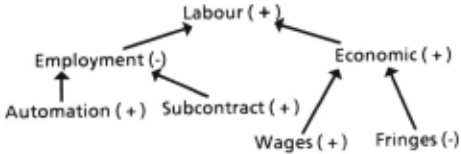
WAGES(+) leads to ECONOMIC(+). FRINGES(-) is considered as a possible action of the company to offset the increase in economic concessions. Thus, a possible argument might be: "If the company is forced to grant higher wages, it will reduce the granted fr inges". Generating this argument depends on whether the company can reduce the fringes. Assuming that the fringes were not under negotiation in this case, the argument is rejected and the search continues from ECONOMIC(+) · LABOUR(+) is reached, whose chi 1 d, EMPLOYMENT(-) is controllable by the company and conflicts with the union goal EMPLOYMENT(+). Assuming EMPLOYMENT(+) is more important for the union than a wage increase, the argument "If the company is forced to grant higher wages, then i t will lay off workers" is generated.
Generating an argument to convince the company about issue X is simi 1 ar: the X (NOT>~ ) path is followed in the company 's goal tree . The me~iator points out to the company the deleterious resu 1 ts that X (NOTte) has on one of its higher level goals.
IV AN EXAMPLE FROM THE PERSUADER
The PERSUADER is a program that generates appropriate cont r act proposals and tries to persuade the parties involved in the negotiation to accept them. In this ex amp 1 e, it is hand 1 i ng an impasse in negotiations between a transit company and its union . The PERSUADER has generated a fair wage value, which the company has accepted and the union refused. The goals are organised as in figures 1 and 2. Importance of goals is expressed on a 0 to 10 scale. Here we see the PERSUADER trying to generate a threatening ar gument for the union.
Importance of #<M-WAGE-GOAL 22416471> is 6 for #<M-LOCAL 22405743> Searching #<M- TRANSIT-COMPANY 22412106> goal tree. Matching #<M-WAGE-GOAL 22416471> ... INCREASE i n #<M-WAGE-GOAL 22416471> by #<M-TRANSIT-COMPANY 22412106>
results in INCREASE in #<M-ECON-GOAL 224224741>
At this point, the PERSUADER considers fringe benefits but rejects it because it i s not involved in the negotiation. It continues its search from #<M-ECON-GOAL 224224741>.
INCREASE in #<M-ECON-GOAL 224224741> results in INCREASE in #<M-LABOR-COST 22420554> To compensate, #<M-TRANSIT-COMPANY 22412106> will DECREASE #<M-EMPLOYMENT 22420562> which is contrary to #<M-LOCAL 22405743> goal Importance of #<M-EMPLOYMENT 22420562>
is 8 for #<M-LOCAL 22405743> One possible argument found
V THE CONVINCING POWER Ql ARGUMENTS
When the argument-generating process described above produces more than one potential argument, the best one must be chosen. One strategy is to try the "weakest" argument first, presenting "strong" arguments only if the weaker ones fail. This requires a means of ranking arguments according to their "convincing" power. The ranking follows the order of importance of the goals that the arguments threaten. In particular, the importance of the goals of a company (union) depends on the financial situation of the company, the state of the industry, the labour supply and the general economic climate. For example, the goal of reducing labour cost is more important for a company in an industry with high labour cost; if there is abundant labour supply in an area, the goal of employment is stronger for a union in that area. In this case, a threat to the union of layoffs has the greatest convincing power. Without enough information, the default ranking of arguments, from weakest to strongest, is:
1) Appeal to universal principle
Here, the arguer appeals to sam~ moral belief of the interlocutor. For exampl~, a particular wage value may not afford the workers a "decent 1 iving standard".
2J Appeal to precedents as counterexamples
Counterexamples point out contradictions between the claimed and the actual behaviour, thus threatening the credibility goal of a party.
3) Appeal to "prevailing practice" standard
Arguments based on this standard address economic goals. For example, a company cannot underpay its employees for fear of losing them to competitors; a union cannot insist on concessions much above what is given in the industry for fear of 1 ay-offs.
4) Threat of Strike (Lockout)
A strike threatens to stop production, necessary for company profits. A 1 ockout threatens the ex i stence of the union. The mediator's role here is to convey to the recalcitrant party the d i re consequences of the action.
VI SUMMARY
To generate a threatening argument to convince a union, the company's goal tree is searched to find company actions that wil 1 offset the effects of a union demand. To convince a company, the deleterious effects on the company of its demand are found by searching its goal tree. Though we have not addressed it, generation of arguments based on furthering of goals, can be done by a similar search.
ACKNOWLEGMENTS
wish to thank Janet Kolodner and Bob Simpson for helpful discussions and comments.
@inproceedings{ijcai1985p55,
  title     = {Arguments of Persuasion in Labour Mediation},
  author    = {Sycara, Katia P.},
  booktitle = {Proceedings of the Ninth International Joint Conference on
               Artificial Intelligence, {IJCAI-85}},
  publisher = {International Joint Conferences on Artificial Intelligence},
  editor    = {Aravind Joshi},
  pages     = {294--295},
  year      = {1985},
  note      = {Cognitive Modelling},
  url       = {https://ijcai.org/proceedings/1985/55},
}
TY - CPAPER TI - Arguments of Persuasion in Labour Mediation AU - Sycara, Katia P. T2 - Proceedings of the Ninth International Joint Conference on Artificial Intelligence, IJCAI-85 PB - International Joint Conferences on Artificial Intelligence PY - 1985 SP - 294 EP - 295 UR - https://ijcai.org/proceedings/1985/55 ER -Copied
Machine-readable versions of this paper, for tools and AI agents:
 Welcome
 Future Conferences
 AI Journal Division
 IJCAI Proceedings
 About IJCAI
 IJCAI Awards