
Computational Neurolinguistics - What Is It All About?
Proceedings of the Ninth International Joint Conference on Artificial Intelligence. Cognitive Modelling. Pages 260-265.
© 1985 International Joint Conferences on Artificial Intelligence
Abstract
Computational Neurolinguistics (CN) integrates art ifi cia 1 intelligence (AI) methods with concepts of neurally motivated processing to develop cognitive models of natural language processing. HOP~ is on~ ex amp 1e of a mode 1 deve 1oped to addres~ ~ssues 1n CN. The model is parallel, and exemp~1f1es language as the result of time synchronlzed processes which are asynchronous in nat~re. Furt_hermore, the model is substantially val1dated to 1nclude normal behavioral evidence in its design. In addition, it attends to aspects of 1anguage breakdown which are we 11 documented in the literature of neurolinguistics or aphasia. This paper discusses assumptions which und~rlie the_ CN approach to model development. It w1ll descr1 be the neurally motivated or "natural computational" processes which produce the model's observable and verifiable behavioral results. The differences in the CN approach to other models of parallel memory process and behavior will be presented . Finally, the contribution of the CN research approach as a tool for investigating the b~eakdown ?f l_anguage performance and its potentlal contr1but1on to understanding brain function will be discussed.
- Baron, R.J . A Theory for the Neural Basis of Language . Part l : A Neural Network Model . Int.
- J . Man-Mach . Stud . l974a, 6, 13-48.
- Baron, ~A Theory for the Neural Basis of Language. Part 2: Simulation Studies of the Model . Int . J. Man-Mach. Stud . l974b, 6, 155-204.
- Brookshire, R. H. Effects of Trial Time and Inter-Trial Interval on Naming by Aphasic Sub- jects. Journal of Communication Disorders. 1971, 3, 289-301. -
- Collins, A.M., and Loftus, E.A . A sprea~ing activation theory of semantic process1ng. Psychological Review . 1975, 82 : 6, 407-428 .
- Cottrell, G.W . and Small, S.L. A Connec- tionist Scheme for Modelling Word Sense Disam- biguation. Cognition and Brain Theory. 1983, 6:1, 89-120.
- Cunningham, A. M . and Gray, H.J. Design and Test of a Cognitive Model. Int . J . Man-Mach . Stud . 1974, 6, 49-104. ---
- Fahlman, S.E. Representing Implicit Know- ledge . In G. E. Hinton and J.A. Anderson (Eds.) Parallel Models of Associative Memory . Hillsdale, NJ: Lawrence Erlbaum Associates , Publishers, 1981.
- Feldman, J.A. A Connectionist Model of Visual Memory. In G. E. Hinton and J.A. Anderson (~ds.), Parallel Models of Associative Memory. H1llsdale, NJ: Lawrence Erlbaum Associates, Publishers, 1981.
- Gigley, H.M. Neurolinguistically Based Modeling of Natural Language Processing. Paper at ACL Session of the Linguistic Society of America Meeting, New York, December, 1981.
- Gigley, H.M. ~ computational neurolinguis- tic approach to processing models of sentence comprehension. COINS Technical Report 82-9, University of Massachusetts, Amherst (available from author), l982a.
- Gigley, H. M. Neurolinguistically con- strained simulation of sentence comprehension : Integrating artificial intelligence and brain theory . Unpublished Ph.D. Dissertation, Univer- sity of Massachusetts, Amherst, l982b .
- Gigley, H. M . , Artificial Intelligence Meets Brain Theory: An Integrated Approach to Simula- tion Modelling of Natural Language Processing. Proceedings of the Sixth European Meeting on Cybernetics and Systems Research.
- Gigley, H.M . HOPE --AI and the Dynamic Process of Language Behavior. Cognition and Brain Theory . l983a, 6: 1, 39-88.
- Gigley, H. M . Experiments in Artificial Aphasia Dynamics of Language Processing. Poster Session presented at the Academy of Aphasia, Minneapolis, l983b .
- Gigley, H.M. From HOPE en l'ESPERANCE --On the Role of Computational Neurolinguistics in Cross-Language Studies. Proceedings of COLING. 1984. ---
- Gigley, H. M. Grammar Viewed as a Func- tioning Part of a Cognitive System. ACL Proceed- ~. July, 1985. -
- Gigley, H.M. and Boulicaut, J.-F . GRASPER: a graph processing tool for knowledge engineering in cognitive modelling . Proceedings •coGNITIVA, Paris, June, 1985.
- Gigley, H.M., and Duffy, J.R . , The Contri- bution of Clinical Intelligence and Artificial Aphasiology to Clinical Aphasiology and Artificial Intelligence. CLINICAL APHASIOLOGY, Proceedings of the Conference, R.H. Brookshire (ed.), Minnea- po l is , 1982 .
- Gordon, B. , Confrontation Naming: Computa- tional Model and Disconnection Simulation. In M.A . Arbib, D. Caplan, and J. Marshall (Eds.), Neural Models of Language Processes. Academic Press, 1982.
- Hinton, G.E . Implementing Semantic Networks in Parallel Hardware. In G.E. Hinton and J.A. Anderson (Eds . ), Parallel Models of Associative Memory. Hillsdale, NJ : Lawrence Erlbaum Asso- ciates, Publishers, 1981.
- Laskey, E.Z . , Weidner, W.E., and Johnson, J.P . Influence of linguistic complexity, rate of presentation and interphrase pause time on audi- tory verbal comprehension of adult aphasic pa- tients. Brain and Language . 1976, 3, 386-396 .
- Lavorel, P.M. Production Strategies : A Systems Approach to Wernicke's Aphasia . In M . A. Arbib, D. Caplan, and J. Marshall (Eds. ), Neural Models of Language Processes . Academic Press, 1982.
- Lavorel, P.M. and Gigley, H.M. Elements pour une theorie generale des machines intel- ligents. Intellectica. 1983, 7, 20-38.
- Lecours, A.R . , and Lhermitte, F., Phonemic Paraphas i as: Linguistic Structures and Tentative Hypotheses. CORTEX. 5, 1969 .
- Marcus, Consequences of Functional Deficits in a Parsing Model: Implications for Broca's Aphasia. In M.A. Arbib, D. Caplan, and J . Mar- shall (Eds.), Neural Models of Language Processes . Academic Press, 1982.
- McClelland, J . L., and Rumelhart, D.E. An Interactive Activation Model of Context Effects in Letter Perception: Part l. An Account of Basic Findings. Psychological Review . 1981, 88, 5, 375-407 .
- Quillian, M.R. Semantic Memor•y. In M . Minsky (ed.), Semantic Information Processing. MIT Press, 1968/1980 .
- Waltz, D.L. and Pollack, J.B . Massively Parallel Parsing: A Strongly Interactive Model of Natural Language Interpretation . Cognitive Science, 9, l, 1985, 51-74.
- Wood, C. C. Variations on a theme ley: Lesion experiments on the neural Anderson, Silverstein, Ritz, and Jones. logical Review . 85, 6, 1978.
- by Lash- model of Psycho-
References were extracted automatically from the PDF and may contain errors.
Full text extracted automatically from the PDF; figures, tables and equations may differ. The PDF is the version of record.
1. INTRODUCTION
Computational Neurolinguistics (CN) was first described by Arbib and Caplan (1979) as a possible approach to enhancing studies of aphasia by em ployi~g a HEARSAY-like, interactive processing parad1gm to model aspects of aphasic language performance.
The HOPE system (Gigley, 1981; 1982a; l982b; 1982c; 1983a) encompasses a proposed solution to the issues raised by Arbib and Caplan (1979). CN, as a research approach has evolved during HOPE's development to include many issues which were not obvious in that first discussion. HOPE represents an approach to cognitive modelling which attempts to develop computational models of process that are behaviorally relevant on two levels--
- at the neural processing level , where the encoded processing mechanisms are based on
*The research described in this paper was sup ported through an Alfred P. Sloan Foundation Grant to the University of Massachusetts in Amherst, through a Faculty Research Initiation Grant and a Biomedical Research Support Grant at the Univer sity of New Hampshire .
current evidence of neural process, and
- at the natural language behavioral level, where the results of the observable computa tions of the model and its final result states are verifi ab 1 e with respect to human language performance, both normal and patho logical.
The development _of CN models emphasizes process. A primary assumption of this approach which is not an assumption for much of AI, is that much is gained by including neural-like computa tions in models which attempt to "simulate" any cognitive behavior .
Furthermore, the assumption that time is a cri t i ca 1 factor in neura 1 processing mechanisms and that it can be a significant factor in l an guage behavior in its degraded or "lesioned" state can only be studied within a computation a 1 para digm as provided in CN models. The complexity of the computation that arises in defining the time coordination of parallel interactive processes under both a "normal" state and in the "lesioned" condition requires an implemented model to keep track of the process .
The CN methodology as it has developed during design and implementation of a first example of such a model, will first be presented within the scope of its goals in defining such models. Then, the working implementation of that model, HOPE will be briefly described to demonstrate the re 1 evance of the approach and how it meets the simultation criteria at the neural process or natural computation level , as well as at the natura 1 1 anguage performance level . The CN ap proach will be briefly compared to other neurally motivated processing models of aspects of sentence comprehension such as the connectionist models (Feldman, 1981; Cottrell and Small, 1983), the parallel interpretation model of Waltz and Pollack ( 1985), and the perceptual processing mode 1 s of Anderson, Silverstein, Ritz, and Jones (1977), McClelland and Rume l hart ( 1981), Wood ( 1978) and Gordon (1982), to illustrate how the present implementation differs from each.
Finally, the potentia 1 use of CN mode 1 s as investigative tools will be described to illus trate the most obvious practical application of the research and the potential contribution of the research to understanding brain function.
- ASSUMPTIONS UNDERLYING THE CN APPROACH TO NATURAL LANGUAGE PROCESSING
One goal in approaching the study of natural language processing as it can be computed within a neural-like processing paradigm is to obtain a better understanding of how brain function can subserve language behavior.
The first constraint on the design of such models is the neural-like control paradigm. Because of its adoption, with the associated internalized contra l of the process, the problem decomposition is different than in the development of serial-order models of language processing such as are usually found in linguistic theory and other AI approaches to language processing.
Developing a CN model requires that evidence from errorful language performance provide criti cal clues that are used to define the interactions among the defined representations. This data is available in the behavioral literature such as that of slips of the tongue, the literature of neural inguistics and even in the descriptions of the effects of brain stimulation on language per formance.
The critical emphasis in the CN approach is that language behavior is defined within both the "normal" state and within the "lesioned" condition using evidence from psycholingustic studies and neurolinguistic studies of aphasia. When there is insufficient evidence within the literature, linguistic theory provides the basis for design decisions which are consistent with the processing paradigm. The role of the grammar in the approach is presented in Gigley (1985) and will not be further described here. What should be noted is that all representations that are independently specifiable in the model find support in the literature mentioned above. This is documented in Gigley (l982b) and will not be repeated here.
The primary use of the model in its simula tion state is to determine what the effects of specifiable, interpretable . processing "lesions" are on the overt behavior of the model and whether the performance finds any clinical support.
2. l An Overview of the Neural Processes in HOPE s Design
HOPE is a neurolinguistically constrained processing model of natural language comprehen sion. It is implemented at the single sentence comprehension level. Although there is substan tial evidence that comprehension occurs within context, the test paradigm most often used in studying aphasic patients comprehension abilities is within a task that precludes any preset con text . For this reason, the single sentence level was considered sufficient in the first level implementation .
Neura 1-1 ike representations and functions that are encoded in the processing paradigm and that effect the control include:
- ( l) nodes interpreted as representations of information that are threshold mechanisms, and are ambiguous in their interpretation,
- automatic meaning access that includes a fixed-time spreading activation scheme,
- an automatic decay scheme that affects all
active information if it does not receive any subsequent input or change state, and
- ( 4) node state changes that are automatic and related to the threshold firing of a node.
Models of neural-based computations that existed prior to the development of HOPE discussed some of these aspects of neural behavior and applied them to psychologically defined models (Baron, l974a; l974b; Cunningham and Gray, 1974), or applied a systems analytic approach to the analysis of aphasic behavior (Lavorel, 1982; Lecours and Lhermi tte, 1969; Marcus, 1982). However, in the case of the latter models, they do not meet the requirement of the CN approach that neither redesign nor reprogramming be requisite to defining 11 1 es ion" performance of the model .
2.2 Behavioral Constraints Underlying HOPE's Design
As briefly mentioned above, the representa tions that are included in the design of CN models are required to be supported by adequate evidence. Evidence from the psycholinguistic and neurolin guistic literature supported the inclusion of knowledge structures that represent a PHONETIC representation, a representation of morphological relationships, case-control information for verbs, a representation of a GRAMMAR, word-meaning representations and a contextually determined memory representation that is distinct from world knowledge called a PRAGMATIC representation.
Additional behaviorally motivated constraints were included in the design of HOPE to provide a parameterized processing ability to satisfy the "lesionabil ity" criterion of the CN approach. Specific "lesion" conditions that are possible within the design are not claimed to be the only relevant lesion conditions that need study. Those included are based on clinical observation and hypothesized causes of the observed language degradations in the aphasic populations.
One hypothesized cause of performance degradation available in HOPE and in no other approaches is that time-coordination of serial order processing is ~ critical part of the neural processing mechanisms of brain function and may be affected under "lesion" conditions. Its inclusion is further supported by clinical studies that indicate that the time course of input presenta tion to aphasic patients affects their processing ability (Brookshire, 1971; Laskey, Weidner, and Johnson, 1976) . Prior to HOPE's definition, there was no suitable way to include such a dynamic factor as a suggested cause of the behavior defi cit.
Other specific clinically defined "lesion" conditions addressed in the design include:
- (l) degradation of knowledge representations within the different structures,
- inability to access knowledge representa tions, and
- short-term memory capacity problems.
Having presented HOPE as an example of one model which meets the behavioral and processing criterion of the CN approach, the next sections will describe the serial-order processing com putations and how they effectively compute in a "natura 1" sense to produce results which can be compared with normal and pathological language behavior.
3. FOCUS ON PROCESS
This section will describe what the serial order processes included in HOPE's design repre sent. For complete detail of the model with examples of simulations in both "normal" and "lesion" states, the interested reader is referred to Gigley (1982a; 1982b; 1983a). Furthermore, as the processes are defined at a meta-level in HOPE, the implementation permits definition of a set of specific instantiated mode 1 s within the overall processing paradigm. It is due to the meta-level implementation of the neural processing algor ithms, that the resultant model is more general in its overall processing paradigm than the paradigm that is found in other parallel approaches to cognitive modelling. This will be further elab orated in the subsequent section.
HOPE stresses the process of natural language by incorporating a neurally plausible control that is internal to the processing mechanism. There is no externa 1 process that decides which path or process to execute next based on the current state of the solution space. It is a time-locked pro cess. At each process time interval, six types of seri a 1-order computations occur. Each of these computations can be interpreted to represent an aspect of "natura 1 computation" ( Lavore 1 and Gigley, 1984).
Information in HOPE is encoded at a phono logical level as phonetic representations of words (a stub for a similar interactive process under lying word recognition), at a word meaning level as multiple representations each of which has a designated syntactic category type and ortho graphic spelling associate to represent the word's meaning (also a stub), within a grammar, and as a pragmatic interpretation.
Each piece of information is a thresholding device with memory. It has an activity value, initially at a resting state, that is modified over time depending on the input. Interconnec tions are of two types . Associational inter connections permit multiple interpretations for any active information in the process. Using this concept, an active node can represent information that is shared among many interpretations. Other interconnections are defined across representa tional levels and are asynchronously traversed. They are not defined between specific instances of the encoded representations, but are defined to affect any information within a specific level of representation. (Cf Gigley and Boulicant, 1985 for an e 1 abo ration of the inherent ambiguity in the representation and its role in cognitive modelling.) There is an automatic activity decay scheme whose magnitude is affected by the state of the information, whether it has reached threshold and fired or not.
Activity is propagated in a fixed sense to all aspects of the meaning of words that are "connected" by spreading activation (Collins and Loftus, 1975; Fahlman, 1981; Hinton, 1981; Quil lian 1968/1980). Simultaneously, information interacts asynchronously due to threshold firing. This is achieved by the time-coordination of six serial order processes. The exact serial-order processes that occur at any time-slice of the process depend on the "current state" of the global information; they are context dependent .
The independent seri a 1-order processes "com puted" at each update include:
- NEW-WORD-RECOGNITION: Introduction of the next phonet1cally recognized word in the sentence .
- MEANING-PROPAGATION: Fixed-time spreading actwat1on to the distributed parts of recognized words' meanings.
- DECAY: Automatic memory decay exponentially reduces the activity of all active informa tion that does not receive additional input. It is an important part of the neural pro cesses that occur .during memory processing.
- FIRING-INFORMATION-PROPAGATION: Asynchronous act wat ion propagat 1 on that occurs when information reaches threshold and fires . It can be INHIBITORY and EXCITATORY in its effect . INTERPRETATION is a result of acti vation of a pragmatic representation of a disambiguated word meaning.
- REFRACTORY-STATE-ACTIVATION: An automatic change of state that occurs after active information has reached threshold and fired . In this state, the information can not affect or be affected by other information in the system.
- POST-REFRACTORY7STATE-ACTIVATION: An auto matic change of state which all fired in formation enters after it has existed in the REFRACTORY- STATE. The decay rate is dif ferent than before firing, although still exponential.
The computations are defined over the repre sentation types: PHONETIC, PHON-CAT-MEAN, GRAMMAR and PRAGMATIC. Each is referred to in the HOPE representation as a space . Algorithmically, the above processes are computed in order and applied to all active information at time, t-l, to produce a current state at time, t .
FIRING-PROPAGATION requires different pro cedures for each representation type. Firing can excite and inhibit other types of representations in both a bottom-up and top-down manner. It occurs asynchronously as a result of "accumulated" activity. This is in contrast to the fixed-time spreading activation which occurs across . the "meaning representations" due to the lex1cal access . These processes are mutually affective .
Figure 1 contains snapshots of three con secutive intervals during the "normal" simulation run for the sentence, "The boys ran." It illus trates how different "actual" computations can occur with these processes depending on the con text of the information.
The state of the "gl oba 1" representation at time t-1 determines the exact instantiations of information which are affected during the pro cesses. The effect is shown at time t. Time intervals, t3 and t4 will be discussed in the context of the re 1 evant computations which occur and result in the states represented in t4.
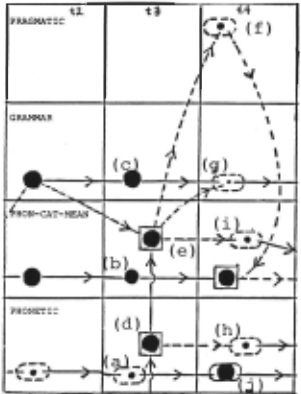
Parenthesized labels within the text refer to Figure 1. The Figure is a variation of one found in Gigley ( 1983a) where a more detailed exp 1 ana tion of the dynamics of the simulations is pro vided. The actual implemented algorithm is pre sented in Gigley (1982a; 1982b).
In Figure 1, the size of the circles or nodes represents the relative activity value of the information; larger means more active. The thres hold value is a user defined parameter . Any ~nf~rmation i~he Figure that is at threshold is 1 nd1 cated as LJ . The REFRACTORY state is de noted(::, , while the POST-REFRACTORY state is denoted c:::> . The lengths of time (number of intervals) for each state and for automatic decay are user parameters, set at 2. Information "knows" its own state. Changes of state and decay computations occur when the information "knows" that they should. To achieve this, all informa tion includes time interval counters, its activity value, and its appropriate rate of decay.
Each of the above listed independent com putations are applied at time interval, t-1. Any results that arrive simultaneously are summed, except for . NEW-WORD introduction which presently initializes all meanings for a word as if it were the word's first occurrence in the sentence, even though it may not be.
The context at t3:
The state at t3 contains previously computed states from t2 as follows: the word, "the," is in the REFRACTORY state in the PHONETIC space (a). Its meaning, shown in PHON-CAT-MEAN has just decayed (b). .The grammatical aspect of the mean ; ng of the determiner, "the," the noun prediction is shown at its initial activity level in GRAMMAR (c). It is ready to decay because of length of time without input.
Computations at t3:
- NEW-WORD introduction: second word of sen tence, "boys" enters PHONETIC (d).
- Spreading activation of meaning(s): one meaning for boys activated at a subthreshold value . Spreading activation from GRAMMAR: All noun meanings are excited from t2. Noun meaning for "boys" is at threshold (e) in PHON-CAT MEAN.
- Nothing is ready to DECAY: None computed.
- FIRE all information at threshold: PHONETIC representation of boys (d) and disambiguated meaning (e) in PHON-CAT -MEAN, produces noun INTERPRETATION (f) at t4 and inhibitory feedback (g) in GRAMMAR.
- FIRING change of state: Firing information, (d) and (e) change to REFRACTORY state (h) and (i), respectively.
- REFRACTORY change of state: PHONETIC repre sentation of "the" in REFRACTORY STATE (a) is ready to enter POST-REFRACTORY state (j) in t4.
Th.is example illustrates how the design of HOPE d1ffers from the other models especially in t~e "met~-1 eve 1" speci fi ca.t ion of the computa tlons, wh1ch depend on the 1nterconnections of the information to be fully specified. As the affects of the processes are context dependent there is a variability in the performance that do~s not occur in other neurally motivated approaches to language behavior.
. Due _to the various ~ombinations of computat 1 ons wh1 ch can occur, s1 mul at ions of the mode 1 often produce surprising, but behaviorally inter pretable results. One example which occurred during a "lesion" simulation of slowed propagation for the sentence "The boy saw the bui 1 dings . " ; s: "saw" is interpreted as a noun and "building," as t~e verb o! the sentence. A possible interpreta tlon relat1ng a saw with building is suggested for the "simulated patient." While plausible this is unlik~ly _to be included in a clinical ~tudy. A contr1but1on of the CN approach may be to provide a mechanism for predicting "possible" foils that provide insights about incorrect processing (Gigley and Duffy, 1982).
During processing, change of state over time as we 11 as the cause of the change can be ob served. Analyzing both aspects of the process provides the information that is useful in com paring the "normal" and "lesion" simulations of the model. In this way, the effects of a given "1 es ion" can suggest hypotheses in a well defined 1 i ngui st i c context. Because each s imul at ion must be run on a complete cover set of sentences that are specified for any specific model, there is a unique hypothesi zed patient profile defined that can be clinically verified (Gigley, 1982b; 1983a; 1983b) . A cover set of sentences is the mathe mat i ca 1 cover of all va 1 i d syntactic sentences possible for the defined model.
The next section will briefly describe other neurally based processing approaches to cognitive modelling at several levels to illustrate how HOPE differs from each . The chief difference is in the inclusion of "lesionabil ity" as a dynamic aspect of the processing definition in the CN approach which is not present in any of the other mode 1 designs.
4. PARALLEL MODELS OF BEHAVIOR
Recently, the concepts of neura 1 processing have been incorporated into AI models of cognitive process. Models which incorporate neural-like processing mechanisms exist at several levels and are mainly intended to model normal behavior. A few have addressed the "lesion" evidence.
4.1 Perceptual Recognition Models
These models represent the earliest attempts to integrate the behavior of neural-like computa tion devices with observable, verifiable behavior. They all utilize the basic model of Anderson, Silverstein, Ritz, and Jones (1977).
The Anderson, et a 1 mode 1 represents a neura 1-1 ike convergent approach to 1 earning pat tern di scri mi nation. The mode 1 is comprised of threshold mechanisms which are mutually intercon nected. There is a vector of inputs, each of which is transmitted using weights to each of the cells which make up the recognition device. Given a suitable training set of inputs, the inter connection vectors of weights can be suitably tuned to produce pattern discrimination of input patterns, even under noisy conditions .
"Lesion" experiments on versions of this model have been studied and interpreted with respect to understanding phonemic mi spercept ions by aphasic patients (Wood, 1978) and for anomia (Gordon, 1982) .
4.2 Associative Models of Memory Processing
Two recent models of associative memory processing are relevant to understanding HOPE's "memory" processing scheme, Fahlman' s NETL (1981) and HINTON's model (1981). Both assume spreading activation. However, Fahlman's marker passing schema is able to include information in the acti vation . HOPE's spreading activation is more similar to the original Quillian model (1968/1980) and Hinton's (1981) in that only activity is propagated. There is no contained "meaning." Activation can only be interpreted within the global context of the memory in this latter case. This introduces more ambiquity throughout into the process. Memory process is only one aspect of the HOPE model. It plays an important role in the sentence comprehension process.
4. 3 Connectionist Approaches to Sentence Processing
One of the most developed approaches to parallel, neurally-movivated process models is the connectionist approach (Feldman, 1981; Cottrell and Small, 1983). This approach concentrates on specifying networks of ce 11 s to represent per cepts, or concepts, depending on the level of application .
While the CN approach assumes that there are networks of ce 11 s to effect the neura 1-1 ike com putations, the explicit definition of such net works is not the goa 1 of the work. There is an emphasis in the CN approach to define processing interconnections at a meta-level, such as between meaning representations and pragmatic i nterpreta t ions of them; between phonetic representations and the associated meanings. The interconnections in HOPE are defined as suggested from the aphasic 1 i terature .
The CN approach does not include mutual inhibitory factors to the extent that the con nectionist models do. In connectionism, the inputs to nodes are constrained to act in an OR of AND condition . While the spreading activation schema is similar to that in HOPE and in the CN approach, the use of vector inputs to each node is not. The CN approach assumes that time will affect the computation in a manner that eliminates the need for many of the above connectionist constraints.
Finally, the para 11 e 1 mode 1 of sentence parsing that has recently been developed by Waltz and Pollack assumes similar constraints to the connectionist approach . While the interactions that can be observed during the time-course pro cess of their model are similar to those obtain able in the "normal" process of HOPE, the parallel algorithm is not, as it relies heavily on mutually exclusive connections at different levels of the process.
4. 4 A Cognitive Model for Letter Perception in Context
McClelland and Rume 1 hart ( 1981) imp 1 emented and have validated a parallel model of letter per ception in context. Of all the models discussed, their implementation is the closest in design to that of HOPE. There are three main differences . Their input is in parallel, while HOPE input is time sequenced. Secondly, their memory decay, is fixed rate across the computation without change of state. And finally, they include a binary feature detection, mutual inhibition schema, to recognize the input. While this assumption is neurophysiologically supported for perceptual visual processing, it is not for auditory. When one hears a sound such as "ah" what is its binary counterpart -- "not ah?". Because of this, in the CN approach, only the recognized input is act i vated. There is no explicit inhibition of any information at the perceptual level; it is just not activated.
The CN approach assumes that each entity in the model is defined in a local context. There is no built-in knowledge about the global intercon nectivity patterns that exist in the model. Therefore, there is no way of explicitly defining the mutual inhibition that is a critical part of the convergence in all of the above mentioned models.
4.5 The HOPE System
The system design in HOPE includes two sub systems. One subsystem allows an experimenter to define the representations that are re 1 evant to the sentence comprehension tasks that are being studied. It permits definition of the appropriate vocabulary, the related grammar, and interpreta tion functions that define the compositional aspects that occur when words are disambiguated in the course of understanding the sentence.
The second subsystem allows the experimenter to tune the mode 1 so that it ex hi bits "norma 1" performance. This must be done on a complete cover set of sentences to assure that the base line performance of the mode 1 is intact. After tuning the model, this second subsystem permits the experimenter to simulate lesion conditions by modifying the parameters in interpretable ways to depict a "lesion. " As when the model is tuned, each "lesion" simululation must be run on every sentence of the given cover se.t of sentences to fully define the patient profile for subsequent validation.
4.6 Summarizing the CN Approach
The main aspects of the CN approach to neural control that differ from the above described models and which provide a more general framework for studying natura 1 1 anguage processing can be summarized as follows:
- CN knowledge representations are ambiguous without assessment in a global context.
- Interconnections among representations are implicitly encoded rather than being ex plicitly defined, as in the connectionist models.
- Control is encoded independently of what is specifically represented in any defined model and is defined at a meta-l eve 1 with respect to the kinds of knowledge representations used.
- Model design permits the definition of a set of problem models such that for any expli citly "tuned" control simultation, one can modify the "tuned" parameters in ways that can be interpreted to reflect hypothesi zed causes of deviation in performnce and observe the results on the control simulation without any necessary redesign or re-implementation.
The next section will assess the contribution of CN models to our understandings of brain func tion within language processing, especially in regard to hypothesizing behavior degradations under "lesion" conditions.
5. INVESTIGATING BRAIN FUNCTION USING CN
Development of CN models does not assume any direct correlation with explicit physical areas of the human brain. Instead, it provides a dynamic, interactive, parallel processing paradigm in which to formulate hypotheses about degradations in processing ability. Questions raised within the approach concern interactions that can become desynchroni zed. This can be as much a prob 1 em with a process, as elimination of information . However, it is much more difficult to study when there is no means available to trace the dynamics.
The CN approach provides this facility. Researchers can now raise questions concerning the effect that an aspect of processing such as of s 1 owing propagation has on the overall perform ance. Furthermore, the results which have been produced under such conditions, indicate that behavior that was previously only attributed to a degradation in representation, could be explained by the processing degradation and that furthermore, because the processing degradation is the cause, the observed behavior is not always com pletely affected. The resultant behavior is variable, but perhaps affects only one type of information.
. Under a "lesion" condition of slowed propa gat 10n, the mode 1 produces the fo 11 owing "patient profile":
The "model" patient should be able to repeat correctly all sentences up to five words in length. The "model" patient recognizes that a complete sentence has been heard, although it often is not understood correctly. Proper nouns are always understood, while referential nouns with an appropriate determiner are not. Sentence comprehension for the "model" patient is sometimes correct. When a sentence contains only proper nouns then there is correct understanding. How ever, when either noun is a referential noun, the agent or the direct object in the sentences being studied, the comprehension is affected to the extent that a noun interpretation for the intended verb of the sentence occurs . The above result is described and documented in Gigley (1982b; 1983a· 1983b). '
The importance of the above profile is that it is mathematically defined and covers an entire set of possible inputs within a computationally we 11-defi ned mode 1 of performance. Other neuro linguistic studies do not require such explicit definition.
What is hoped in developing models which can ex hi bit the above qua 1 it i es is that greater in sights can be developed about the role of aspects of processing in the brain and how they work in an integrated fashion to produce cognitive behavior. The HOPE model represents a beginning.
6. WHERE WE ARE AND WHERE ARE WE GOING?
Current work is underway to deve 1 op va 1 ida tion techniques to adequately study the results of the model. There are extensive sets of studies which must be done on a single patient populations to provide information on the model's validity. It is hoped that results of such carefully coor dinated studies will provide information that will lead to better model definition (Gigley and Duffy, 1982).
Planned system development includes a repre sentation for meaning and assessment of the representations for production under the same processing control as is used in comprehension. In both cases, there is extensive behavioral evidence to assimilate to define sufficient representations with their interconnections. In addition, an i nit i a 1 attempt has been made to specify a model of HOPE for processing French. This has raised some interesting cross-linguistic issues (Gig 1 ey, 1984) .
The CN approach pro vi des a first attempt to imp 1 ement mode 1 s of natura 1 1 anguage performance that addresses how language might be processed in a neural mechanism, such as the human brain. It is the first model that integrates behavior evi dence at two levels in its design, at the neural computation 1 eve 1 and at the human performance level . Furthermore, CN provides researchers with a facility to consider behavior as the result of a time-dependent, interactive, parallel process that is dynamic and can produce variable results in a manner that is consistent with human performance.
7. REFERENCES
- [l] Anderson, J . , Silverstein, J., Ritz, S. and Jones, R. Distinctive Features, Categorical Perception, and Probability Learning: Some Ap pl i~ations of a Neural Model. Psychological Rev1ew. 1977, 84, 5, 413-451.
[2]Jirbib, M.A. and Caplan, D. Neurolinguistics Must be Computational . Behavioral and Brain Sciences. 1979, 2, 449-483. - --
[3] Baron, R.J . A Theory for the Neural Basis of Language . Part l : A Neural Network Model . Int. J . Man-Mach . Stud. l974a, 6, 13-48.
[4] Baron, ~A Theory for the Neural Basis of Language. Part 2: Simulation Studies of the Model . Int . J. Man-Mach. Stud. l974b, 6, 155-204.
- Brookshire, R. H. Effects of Trial Time and Inter-Trial Interval on Naming by Aphasic Sub jects. Journal of Communication Disorders. 1971, 3, 289-301. -
[6] Collins, A.M., and Loftus, E.A. A sprea~ing activation theory of semantic process1ng. Psychological Review. 1975, 82 :6, 407-428.
- Cottrell, G.W. and Small, S.L. A Connec tionist Scheme for Modelling Word Sense Disam biguation. Cognition and Brain Theory. 1983, 6:1, 89-120.
- Cunningham, A.M. and Gray, H.J. Design and Test of a Cognitive Model. Int . J . Man-Mach . Stud. 1974, 6, 49-104. -- -
- Fahlman, S.E. Representing Implicit Know ledge . In G. E. Hinton and J.A. Anderson (Eds.) Parallel Models of Associative Memory . Hillsdale, NJ: Lawrence Erlbaum Associates , Publishers, 1981.
- Feldman, J.A. A Connectionist Model of Visual Memory. In G. E. Hinton and J.A. Anderson (~ds.), Parallel Models of Associative Memory. H1llsdale, NJ: Lawrence Erlbaum Associates, Publishers, 1981.
- [ll] Gigley, H.M. Neurolinguistically Based Modeling of Natural Language Processing. Paper at ACL Session of the Linguistic Society of America Meeting, New York, December, 1981.
- Gigley, H.M. ~ computational neurolinguis tic approach to processing models of sentence comprehension. COINS Technical Report 82-9, University of Massachusetts, Amherst (available from author), l982a.
- Gigley, H. M. Neurolinguistically constrained simulation of sentence comprehension: Integrating artificial intelligence and brain theory . Unpublished Ph.D. Dissertation, Univer sity of Massachusetts, Amherst, l982b.
- Gigley, H.M. , Artificial Intelligence Meets Brain Theory: An Integrated Approach to Simula tion Modelling of Natural Language Processing. Proceedings of the Sixth European Meeting on Cybernetics and Systems Research. H. Trappl (ed.), l982c.
[15] Gigley, H.M. HOPE -- AI and the Dynamic Process of Language Behavior. Cognition and Brain Theory. l983a, 6: 1, 39-88.
[16] Gigley, H.M. Experiments in Artificial Aphasia Dynamics of Language Processing. Poster Session presented at the Academy of Aphasia, Minneapolis, l983b.
- Gigley, H.M. From HOPE en l'ESPERANCE --On the Role of Computational Neurolinguistics in Cross-Language Studies. Proceedings of COLING. 1984. - --
- Gigley, H.M. Grammar Viewed as a Func tioning Part of a Cognitive System. ACL Proceed~. July, 1985. -
- Gigley, H.M. and Boulicaut, J.-F. GRASPER: a graph processing tool for knowledge engineering in cognitive modelling. Proceedings ·coGNITIVA, Paris, June, 1985.
- Gigley, H.M., and Duffy, J.R. , The Contri bution of Clinical Intelligence and Artificial Aphasiology to Clinical Aphasiology and Artificial Intelligence. CLINICAL APHASIOLOGY, Proceedings of the Conference, R.H. Brookshire (ed.), Minnea po l is , 1982.
- Gordon, B. , Confrontation Naming: Computa tional Model and Disconnection Simulation. In M.A. Arbib, D. Caplan, and J. Marshall (Eds.), Neural Models of Language Processes. Academic Press, 1982.
- Hinton, G.E . Implementing Semantic Networks in Parallel Hardware. In G.E. Hinton and J.A. Anderson (Eds . ), Parallel Models of Associative Memory. Hillsdale, NJ : Lawrence Erlbaum Asso ciates, Publishers, 1981.
- Laskey, E.Z. , Weidner, W.E., and Johnson, J.P . Influence of linguistic complexity, rate of presentation and interphrase pause time on audi tory verbal comprehension of adult aphasic pa tients. Brain and Language . 1976, 3, 386-396 .
- Lavorel, P.M. Production Strategies : A Systems Approach to Wernicke's Aphasia. In M. A. Arbib, D. Caplan, and J. Marshall (Eds. ), Neural Models of Language Processes . Academic Press, 1982.
- Lavorel, P.M. and Gigley, H.M. Elements pour une theorie generale des machines intel ligents. Intellectica. 1983, 7, 20-38.
- Lecours, A.R. , and Lhermitte, F., Phonemic Paraphas i as: Linguistic Structures and Tentative Hypotheses. CORTEX. 5, 1969.
- Marcus, Consequences of Functional Deficits in a Parsing Model: Implications for Broca's Aphasia. In M.A. Arbib, D. Caplan, and J . Mar shall (Eds.), Neural Models of Language Processes . Academic Press, 1982.
- McClelland, J . L., and Rumelhart, D.E. An Interactive Activation Model of Context Effects in Letter Perception: Part l. An Account of Basic Findings. Psychological Review. 1981, 88, 5, 375-407 .
- Quillian, M.R. Semantic Memor·y. In M. Minsky (ed.), Semantic Information Processing. MIT Press, 1968/1980.
- Waltz, D.L. and Pollack, J.B. Massively Parallel Parsing: A Strongly Interactive Model of Natural Language Interpretation . Cognitive Science, 9, l, 1985, 51-74.
- Wood, C. C. Variations on a theme ley: Lesion experiments on the neural Anderson, Silverstein, Ritz, and Jones. logical Review. 85, 6, 1978. by Lash model of Psycho-
@inproceedings{ijcai1985p48,
  title     = {Computational Neurolinguistics - What Is It All About?},
  author    = {Gigley, Helen M.},
  booktitle = {Proceedings of the Ninth International Joint Conference on
               Artificial Intelligence, {IJCAI-85}},
  publisher = {International Joint Conferences on Artificial Intelligence},
  editor    = {Aravind Joshi},
  pages     = {260--265},
  year      = {1985},
  note      = {Cognitive Modelling},
  url       = {https://ijcai.org/proceedings/1985/48},
}
TY - CPAPER TI - Computational Neurolinguistics - What Is It All About? AU - Gigley, Helen M. T2 - Proceedings of the Ninth International Joint Conference on Artificial Intelligence, IJCAI-85 PB - International Joint Conferences on Artificial Intelligence PY - 1985 SP - 260 EP - 265 UR - https://ijcai.org/proceedings/1985/48 ER -Copied
Machine-readable versions of this paper, for tools and AI agents:





