
Shape Recognition and Illusory Conjunctions
Proceedings of the Ninth International Joint Conference on Artificial Intelligence. Cognitive Modelling. Pages 252-258.
© 1985 International Joint Conferences on Artificial Intelligence
Abstract
One way to achieve viewpoint-invariant shape recognition is to impose a canonical, object-based frame of reference on a shape and to describe the positions , sizes and orientations of the shape's features relative to the imposed frame. This computation can be implemented in a parallel network of neuron-like processors. but the network has a tendency to make errors of a peculiar kind: When presented with several shapes it sometimes perceives one shape in the position of another. The parameters can be carefully tuned to avoid these "illusory conjunctions" in normal circumstances, but they reappear if the visual input is replaced by a random mask before the network has settled down. Treisman and Schmidt (1982) have shown that people make similar errors.
- Ackley, D. H., Hinton , G. E., Sejnowski, T. J. A learning algorithm for Boltzmann machines. Cognitive Science, 1985, 9,147-169.
- Ballard, D. H. , Cortical connections and parallel processing: Structure and function. The Behavioral and Brain Sciences in press.
- Ballard, D. H. & Sabbah, D. Viewer independent shape recognition. IEEE Transactions on Pattern Analysis and Machine Intelligence, 1983, PAMI-5 , 653-659.
- Geman , S., & Geman D. Stochastic relaxation, Gibbs distributions, and the Bayesian restoration of images. IEEE Transactions on Pattern Analysis and Machine Intelligence, 1984, PAMI-6, 721-741 .
- Hinton, G. E. A parallel computation that assigns canonical object-based frames of reference. In Proceedings of the Seventh International Joint Conference on Artificial Intelligence, Vol 2. Vancouver BC, Canada. August 1981a. IJCAI
- Hinton, G. E. Shape representation in parallel systems. In Proceedings of the Seventh International Joint Conference on Artificial Intelligence, Vol 2. Vancouver BC, Canada. August 1981b. IJCAI
- Hinton , G. E. & Sejnowski, T. J. Optimal perceptual inference. In Proceedings of the IEEE conference on Computer Vision and Pattern Recognition, Washington DC, June 1983.
- Hopfield, J. J. Neural networks and physical systems with emergent collective computational abilities. Proceedings of the National Academy of Sciences USA, 1982, 79 2554-2558.
- Hopfield, J. J . Neurons with graded response have collective computational properties like those of two-state neurons. Proceedings of the National Academy of Sciences USA, 1984, 81 • 3088-3092.
- Hummel, R. A., & Zucker, S. W. On the foundations of relaxation labeling processes. IEEE Transactions on Pattern Analysis and Machine Intelligence, 1983, PAMI-5, 267-287.
- Marr, D. & Nishihara, H. K. Representation and recognition of the spatial organization of three-dimensional shapes. Proceedings of the Royal Society. London B, 1978, 200, 269-294.
- Rock, 1., Orientation and Form. New York: Academic Press, 1973.
- Treisman, A. M. & Schmidt, H. Illusory conjunctions in the perception of objects Cognitive Psychology, 1982, 14, 107-141.
References were extracted automatically from the PDF and may contain errors.
Full text extracted automatically from the PDF; figures, tables and equations may differ. The PDF is the version of record.
1. Introduction
People can recognize objects from a wide range of viewpoints, even if ti1ey have never seen them from these precise viewpoints before. There is psychological evidence (Rock, 1913; Marr and Nishihara, 1978) that people do ti1is by imposing an appropriate frame of reference on tiJC object to be recognized. They then redcscribe the rctinotopic features of the object relative to the imposed frame and thus they get an object-based description ti1at docs not depend on viewpoint. For example. given a square tilted at 45°, a . person can impose an object-based frame tilted at 45°. Relative to this frame, the object has horizontal edges at top and bottom and vertical sides. so it is a square. Alternatively. a vertical frame can be imposed and all the edges will then be seen as diagonal and the object will be recognized as a diamond. The fact that we can sec ti1c same shape in either way is good evidence that we impose object-based frames in order to separate out the effects of viewpoint from the intrinsic shape of the object.
In general. it is difficult to choose the appropriate frame to impose on a collection of rctinotopic features even if we have already solved the problem of segmenting out a set of features that all belong to a single object. We would like to usc the frame th'at leads to a familiar object description. but the frame is required in order to access object descriptions so it is hard to sec how object descriptions can give top down guidance in picking the frame. When we sec an upside-down capital R. for example, we recognize it by imposing an upside-down frame of reference, but how do we know to usc this frame before we have recognized it as an R? Hinton (198la) suggests that ti1is chicken·
Lillis research was supported by a grant from the System Development Foundation.
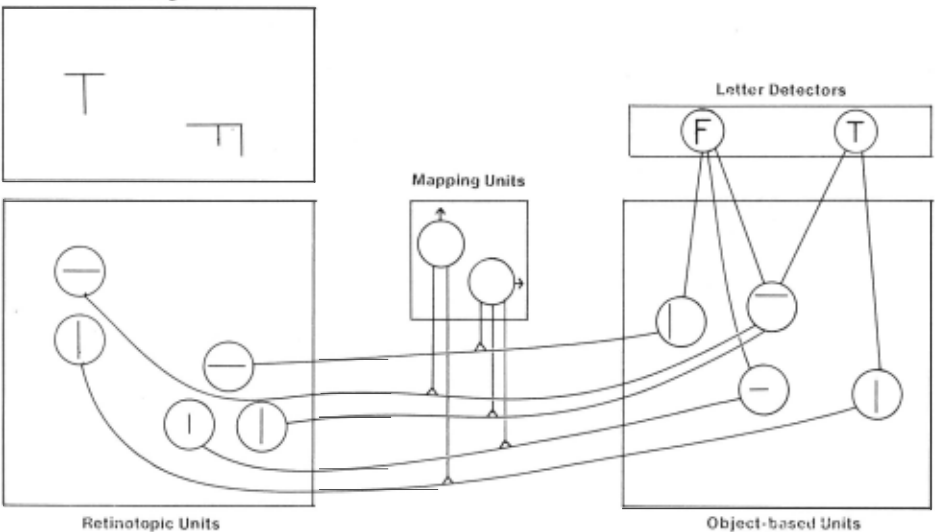
the frame of reference is known in advance the retinotopic features can be made to activate the appropriate object-based features by simply turning on the right mapping unit and inhibiting all the others.
Each pairing of an activated object-based feature and an activated retinotopic feature sends activation to the corresponding mapping unit. so if the shape is known in advance it is easy to find the reference frame by simply activating the object-based features of the shape. If the shape contains f features there will be f correct pairings of an activated object-based feature with an activated retinotopic feature. These f pairings will all send activation to the same mapping unit and it will therefore be able to win a competition among the mapping units even though some of its rivals receive input from other spurious pairings of activated object-based and retinotopic features.
When neither the reference frame nor the shape are known in advance, the network will still settle to a consistent state when presented with a single familiar letter. Initially many different mapping units will be active and the activity in the object-based units will represent the superposition of many different ways of mapping the retinotopic features. However, combinations of object-based features that correspond to familiar letters will receive top-down support from the letter units and so they will be enhanced. Once this happens, the· mappings that led to these features will be enhanced because the input to a mapping unit depends on the product of activity levels in the object-based and retinotopic units. This mutual enhancement is a non-linear cooperative process that eventually leads to one set of object-based features and one mapping unit becoming dominant.
The Image
A different. but equivalent, view of the network is that the retinotopic units gate the connections between the mapping units and the object based units. Each retinotopic feature is consistent with various possible conjunctions of a mapping with an object-based feature and so it allows all such pairs to support each other. The network settles into a state which allows as many of these pairs as possible to be active, subject to the constraint that only one mapping unit must be active in the final state. This view is helpful in understanding illusory conjunctions. It is the retinotopic features which determine the consistency between object-based features and mappings. If they are removed before the network has finished settling, there is nothing to prevent the object-based units and the mapping units from settling to inconsistent states.
2_ The Simulation
To test the claim that a parallel model of shape recognition can explain the psychological evidence on illusory conjunctions, a simulation of such a model was performed on a Symbolics 3600 lisp machine. A network of continuous valued, neuron-like units was presented with the retinotopic features of several letters. and the activation levels of the units were repeatedly updated starting from balanced initial values and using a detenninistic. synchronous relaxation algorithm until a letter had been located and identified. When allowed to run to completion, the network never made any errors. However, when a random mask replaced the ilnage before the network was finished, illusory conjunctions occurred.
2.1 Structure of the Network
The units of the net arc organized into four sets that are called planes to emphasize their spatial interpretation. The rctinotopic plane contains units that represent rctinotopic features that could be extracted by low-level visual processing. The mapping plane contains units that represent pairings of rotations and translations which are used to map the retinotopic image into a standard orientation on the object plane so that the image can be identified. The mappings used in this simulation do not pcrfonn scaling, so the letters presented on the retinotopic plane must all be of the same size. Units on the rctinotopic. mapping, and object planes arc connected by the special three-way links that are describe above. Each letter unit is connected to the features on the object plane which define the shape of the letter.
2.1 .1 The Retinotopic Plane
The features on the rctinotopic plane are based on an imaginary 13 by 13 array. The two types of features that are represented by units on the plane arc strokes and junctions. A stroke is defined to be a horizontal or vertical line segment whose length is 2. 3, 4, or 5 pixels. There are 1092 units of this type on the rctinotopic plane. Junctions occur at the endpoints of segments. A corner occurs when two strokes meet at a 90 degree angle at their endpoints. A T-joint occurs when the endpoint of one stroke meets the interior of another stroke at a 90 degree angle. Any endpoint that is not a corner or aT-joint generates a free-end feature. Every junction unit also has an orientation of up, down. right, or left, so that the T-joint on tl1c left side of an E is different from the T-joint on the top of an I. There arc a total of2028 junction unit~ on the rctinotopic plane. It is redundant to have both stroke units and junction units, since the information in eitl1cr set can be derived from the other. ll1is redundancy is crucial when the network needs to map several letters onto the object plane at tl1e same time without confusing them. The junctions contain information about which stroke goes with which other stroke and similarly t11e strokes contain inf01mation about which junctions go together. Every unit in the network has a real-valued activation level between zero and one. but the units on the rctinotopic plane arc always clamped to zero or one in this simulation.
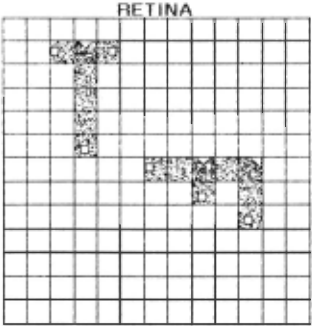
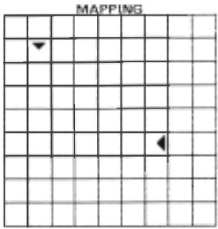
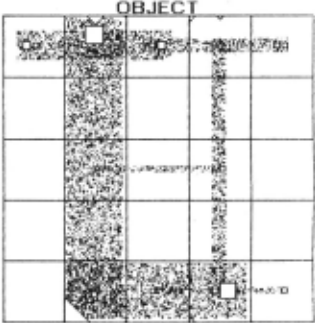
Figure 2-1 shows t11c display used to illustrate tl1c state of the network. Retinotopic units arc drawn on a 13 by 13 array of squares that suggests the image from which t11c features could have been extracted. Stroke units are drawn as stippled rectangles witl1 tl1c same length, oriemation, and position as the strokes which they represent. Corner units arc drawn as white triangles in tl1c corners of the squares. T joint units arc shown by white triangles at the sides ·of tl1e squares. Free-end units are drawn as small white squares on the ends of the strokes. The orientation of each junction unit is represented by the orientation of its symbol in the obvious way.
2.1 .2 The Object Plane
1be object plane is basically just a smaller version of the rctinotopic plane. It uses 100 su·oke units and 300 junction units to encode all possible features in its 5 by 5 array of object-based locations. In figure 2-1, the object plane is drawn the same size as the retinotopic plane, even though it contains fewer units. This provides the space required to clearly represent the activation level of each unit by the size of its symbol. The area of a junction symbol is exactly proportional to activation of its unit, but for stroke units, the correspondence is only approximate.
2.1.3 The Mapping Plane
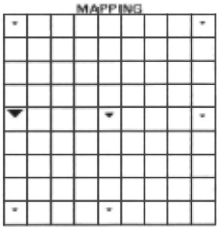
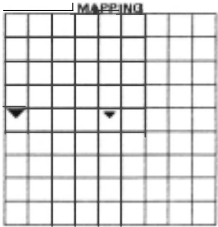
The mapping plane contains units that represent rules for matching features on the retinotopic plane with features on the object plane. The 324 units on the mapping plane are the cross product of nine x-translations, nine y-translations, and four rotations. These mappings specify all the ways that the object plane can be associated with a 5 by 5 subset of the rctinotopic plane. In figure 2-1. t11e mappings are drawn as small black triangles in a 9 by 9 array of squares which corresponds to the central portion of the retinotopic plane. The
·
·
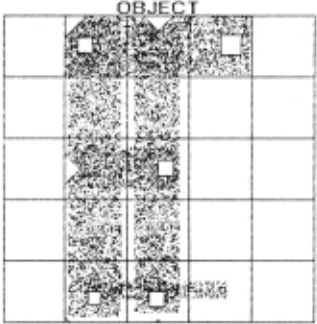
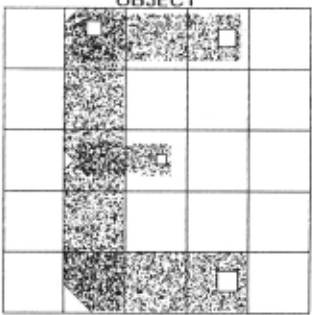
square in which a triangle is drawn shows the point which will be mapped to the center of the object plane. The rotation which a mapping performs is indicated by the orientation of its triangle. Try looking at Figure 2-1 to compare the positions of the vertical T and the sideways F with the two active mappings that associate them with their canonical images on the object plane. The activation levels of mapping unil~ arc indicated by the area of the triangles which represent them.
2.1.4 The Letter Plane
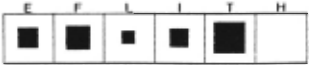
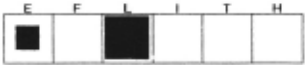
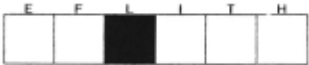
The six units on this plane represent the letters E, F, L, I, T, and H. Each unit's activation level is shown by the area of the black square in its box.
2.1.5 Links
The first type of link in the network is a simple two-way link between a letter unit and a feature unit on the object plane. The existence of such a link means that the feature is part of the definition of the letter. There arc 47 of these links in the current model. The second type of link is a three-way link between a rctinotopic feature. a mapping, and an object feature. ·n1crc are 129,600 of these links, which means that some sort of optimization technique is needed to reduce the space and time requirements of the simulation. Although it is conceptually attractive to view the links as channels between the rctinotopic plane and the object plane which are gated by mappings, one may think of them as channels between mappings and object-based features which are are gated by rctinotopic features. In fact, the clamping on the rctinotopic plane means that these channels arc either completely open or completely closed, so it is possible in a simulation to scan the rctinotopic plane for features that arc on, arrd then wire up only the corresponding links between the mapping plane and the object plane. l11is reduces the network to about 3,000 two-way links that can be implemented in the same way as the links between letters and object features.
2.2 Relaxation
The deterministic relaxation algorithm employed in this simulation proceeds in synchronous cycles whkh have three phases. At the beginning of each cycle, the units exchange activation via their links. Next, a competition phase cuts the units' activation down by factors which depend on their size. Finally. all activations arc scaled up by constant factors which are computed separately for each plane so that the total activation in the plane is normalized to a predetermined quantity. In more intuitive terms, each unit is a competitor of the other units on its plane but is an ally of the units to which it is connected.
In the following sections. units arc designated by lower-case Greek letters ncar the beginning of the alphabet. Their activation levels are represented by the corresponding Latin letters. These activations are functions of time. which is measured in iterations and indicated by subscripts on the activations.
2 .2.1 Propagation of Activation
l.ct ai denote the activation level of unit a at time i. Then the activation of a at time i+ l is given by
where L (a) is the set of all units which arc linked to a, wap is the weight of the link between a and {3 , and· T is a constant that is associated with a's plane. The purpose of T is to adjust the rate at which activation levels change. Setting T close to 1.0 causes the units to evolve slowly and feel little influence from their links. It turns out that T also affects the competitive behavior of a plane. A winner-take all selection cannot occur unless T is set high enough to preclude an equilibrium state where the fresh activation that each unit gets from its links balances out the effect of competition on that unit.
With these facts in mind, it is easy to make rough estimates of appropriate T values for the model. The letter and mapping planes should evolve slowly so they will have time to communicate their hypotheses. and should settle down to a state where only one unit has been selected on each plane. ·n,c high values of T which were originally chosen worked moderately well, but some experimentation was required to locate the values of0.995 for the letter plane and 0.98 for the mapping plane that always worked correctly. '!he object plane. on the other hand, should have fast reaction time but weak competition so that the other planes can exchange information quickly and keep many options open. In fact. a number of features should remain alive even in the final state. The first guess of T = 0.5 has worked for every version of the model ever tested, so the network is clearly not very sensitive to the exact value of tl1is parameter.
2.2.2 Competition within Planes
Without competition. the network rapidly settles into an uninteresting equilibrium state where a large number of units are on and the activation boosts that arc being transmitted over tl1c links balance each other out. In order to force progress towards a solution. it is necessary to exert pressure on the units which will cause weakly supported ones to die out. The method of competition used in tl1is simulation consisted of taking the activation level of each unit and raising it to some power greater than one. Since the activations arc between zero and one. this forces them to shrink by an amount that is a function of their size, with small activations getting beaten down more than large ones. Furthermore. t11c discrimination against weak unit.~ increases as the exponent increases. which provides the simulator with the ability to control the intensity of competition. The precision of the competition control mechanism and the smoothness of activation decay under the influence of tl1c competition algoritl1m were t11c keys to achieving interesting behavior from t11c network while using monotonic competition schedules. 'lhe exact schedules which proved to be acceptable arc discussed in section 2.4.
2.2.3 Normalization
The final step in an iteration is to normalize the activation levels in each plane so that they add up to a target sum. This total corresponds to the number of units that ought to be on in a solution stltc. For the mapping and letter planes, the target sum is clearly 1. For the object plane. it is harder to say what the total should be. since the number of units that ought to be on at t11c end depends on tl1e letter that is being recognized. To solve tl1is problem, a new target sum is computed before every iteration by having the letter units vote for how much activation they would like to sec on tl1<: object plane.
Once a target sum has been chosen for a plane, tl1c normalization is pcrfom1cd by adding up the activations ofall the units on the plane, and then multiplying each activation by t11e ratio of the target sum to the actual sum.
2.2.4 Initial State
Each relaxation of the network begins in a balanced initial state where the unit~ on a given plane have equal activations that add up to the target sum defined in section 2.2.3.
2.2.5 Orientation Bias
The network described so far is unrealistic because it gives no preference to letters in their upright orientation. This can be corrected by modifying equation (2.1) to read
where v is a factor that equals 1.0 for a unit a on the letter or object plane. For a on the mapping plane, v equals 0.2 if the unit being updated is rotated from t11e vertical and the mapping with the same translation but no rotation has nonzero activation. Otherwise, v equals 1.0 for the mapping plane also. The purpose of v is to deflate rotated mappings that are directly competing with nonrotated mappings. However. this rule is not strong enough to kill off mappings by itself, because the deflating effect of v quickly comes into equilibrium with the positive boost coming over the links. The only effect is to de-emphasize rotated mappings in the presence of upright mappings so that the latter can win through ordinary competition.
2.3 Assignment of Weights
Each link possesses a weight which can be thought of as an amplification factor for signals sent over that link. Weights arc needed to balance t11e network so that the simple relaxation technique is able to find an appropriate final state fur every input. The main problem is that the unit with the most links often wins the competition even when other units are receiving more support per link. For example, the letter unit for E will always beat the unit for L just because E has more features and therefore more links. The solution to this problem is to compute a link's weight using a function that takes into account t11c connectivity of both of the link's endpoints.
2.3.1 The Weighting Fun<ction
The weight wap of the link between units a and fJ is given by
where Uap is a weighting factor that compensates for the number of connections a has with units on fJ's plane. Specifically,
where L (a) is the set of units which arc linked to a and 'IT (a) is the plane on which a is located. For a concrete example, let a be the letter unit which represents E and fJ be a feature unit which is linked to a. Since E has links to 4 stroke units and 6 junction units, the denominator of equation (2.4) is 10. The numerator is the average number of links to t11e object plane from units on the letter plane, namely 47 I 6 = 7.8. so uap = 7.8 I 10 = .78 is the weighting factor for E. The unit for L only has links with 2 stroke units and 3 junction units, so its weighting factor is u 11 p = 7.8 I 5 = 1.54. Thus the weighting factors for units on t11c letter plane cancel out inbalances caused by the different number of features found in the various letters.
The mirror image factors uap for a on the object plane and fJ on the letter plane take care of a more subtle problem. Letter units can support each other by sending activation indirectly through units representing shared features. Unfortunately. the six letters fall into the cliques {EFL}. {IT}. and {H} based on shared feature counts. Without these weighting factors, the survival of a letter unit depends on t11c size of its clique. Finally. when a and fJ arc on the object and mapping planes. uap = I since every object unit is linked to every mapping unit and vice versa.
2.3 .2 Tuning the Weights
Equation (2.3) provides a good approximation to the weights required to balance the network. However. some hand tuning needs to be performed to ensure proper handling of superimposed images on the object plane. This extra tuning can be implemented by amending the definition of wap to read
wherefap is an adjusU11cnt function that is associated with the ordered pair('IT(a),'IT(/1)).
TI1e main challenge in balancing t11e letters is keeping subset relationships untangled. For example, the features ofF arc basically a subset of the features of E. so it is difficult to find a set of weights for which E is not identified as F and F is not identified as E. The problem becomes much worse when more than one letter is being mapped onto the object plane at the same time, because F + L looks like E. F + I looks like E + T, and so on. Since the features being mapped onto the object plane contain redundant information and equation (2.3) balances things out about right, a one-dimensional adjustment based on discriminating between large letters and small letters is sufficient to solve these difficulties. A function which performs this discrimination is fap(x) = x + k for unit a on the letter plane and unit fJ on the object plane. Since k is added to the weighting factor for each link to a letter unit, it provides a boost which is a function of the letter's size. A k value of 0.1 prevents confusion with up to three letters on the retina.
The next adjustment function is necessary because the clique effect described in section 2.3.1 is much less pronounced than the other imbalances between letters. The weighting factor which primarily addresses this effect should therefore be de-emphasized by setting fap(x) = vX for units a on the object plane and fJ on the letter plane.
2.4 Competition Schedules
The behavior of t11e network while it is settling down into a solution state is primarily determined by the rules for varying the amount of competition through time. By changing these rules, a variety of behaviors can be induced, most of which arc patl10Iogical when there arc multiple letters in tllc input. The network tends to get wedged into either an uninteresting equilibrium state where too many units are active, or an inconsistent final state where the winners on the various planes do not correspond with each other or the input The next two sections describe a strategy for managing the settling process and the effect of replacing the input with a backward mask before the network has finished settling.
2.4.1 A Successful Search Strategy
The ideal method of running the simulation would be to gradually increase the competition on all of the planes, so that a variety of options would remain open as long as possible. with a consensus eventually emerging as to what was seen where. The final selection of a letter unit and a mapping unit would occur simultaneously. Figure 2-1 shows why this approach doesn't quite work. The simulation has progressed to the point where the correct pair of mappings and the · correct pair of letters are winning. However. due to slight in balances in the amount of support the various units arc giving to each other, the letter unit for T is winning its competition, while on the mapping plane the unit transmitting F is ahead. If the simulation were to proceed with the same gradual competition on both planes, the units which arc currently ahead would win, resulting in a spontaneous illusory conjunction. Although the weights could be adjusted to balance the activations in this example, the new weights would make the problem worse for some other pair of\etters.
A better solution to the problem is to allow one plane to decide first and then transmit its choice to the other plane so that it can choose the corresponding option. During a relaxation based on this strategy, the competition increases gradually at first, as in the ideal simulation described above. A small number of likely mappings emerge as likely candidates. and the images which they specify arc superimposed on the object plane. The letter units also evolve slowly, relying on the redundant features which encode the letters to sort out the combined image they see on the object plane. After the network has run for a while in this consensus-building phase, the competition is turned up on t11c letter plane to force a choice. Figure 2-2 shows t11c state of t11e network shortly after this letter selection process has begun. The unit for L is leading because all of its features arc strongly on, whereas some of the features for E arc less activated. (Wit110ut the weight tuning described in §2.3.2. E would be winning at this point because it is linked to units containing more total activation.) After the unit for L has won. the image on t11e object plane will look much more like an L than an E, and the correct mapping will win after about 40 more iterations.
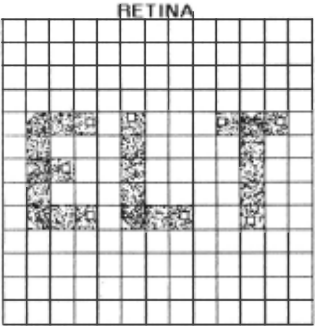
Although the scenario just described sounds quite reasonable. it is very difficult to adjust t11e competition schedules so t11at t11e network never makes mistakes. A workable solution depends on getting the rate of mapping competition exactly right. and is bounded by the following problems. In tigure 2-2 it is apparent that t11e mapping forE is far ahead of the mapping for L. even though the letter unit for L is going to win. If the mapping competition docs not occur slowly enough, the mapping unit for L will be so far behind at t11is point that it will have no hope of catching up. If. however. the mapping competition occurs too slowly, the spurious mappings 3 visible in figure 2-2 will sufficiently distort t11c relative activations of the various features on the object plane to cause cit11cr outright misidentification of t11e letters. or t11e kind of letter blending mentioned in section 2.3.2.
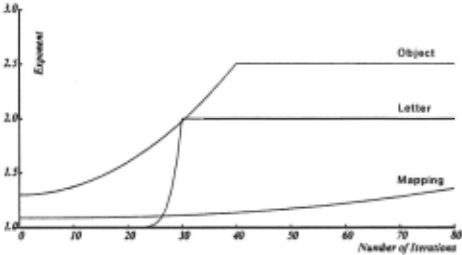
A competition schedule that works is shown in tigurc 2-3, which is a plot of the competition control parameters for the t11rce active planes as functions of time. These parameters arc the exponents used in the competition scheme described in §2.2.2. The behavior of the network is sensitive to t11c exact shape of the parameter curves, and simple piecewise-linear functions were not sufficient to eliminate all errors. It is important to note that the primary type of error which occurs is illusory conjunction, and that all of this tuning effort is necessary to eliminate them, not to introduce t11cm. The final result of the adjustment process was a network that would correctly select and identify a letter from any set of one, two, or three upright letters encoded on the retinotopic plane.
3 These mappings are actuatly partial symmetries of the letters. which explains why the f1gure resembles an X·ray diffraction pattern.
2.4.2 Backward Masking
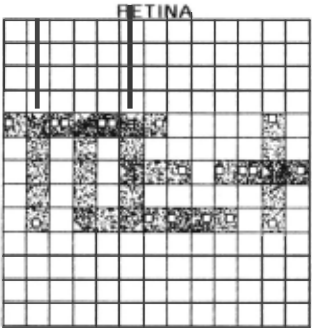
In the absence of interference, the network always works correctly. On the other hand, if the input is replaced by noise at some point in the relaxation process, a variety of errors can occur, depending on when the disruption occurs. If a backward mask replaces the input very early, the network will end up in a random state completely unrelated to its original input If the mask is introduced in the middle of the simulation when the selection process is already underway, the relaxation will either finish correctly or produce an illusory conjunction, depending on how the noise interacts with the unstable activations in the network. For an cxJmple of a simulation that produced an illusory conjunction, look at figure 2-4, which belongs to the same sequence as figure 2-2. ll1c letter unit for L has gone on to win, and there is a fairly clear image of an L on the object plane, but the mapping units no longer have any meaningful information on the rctinotopic plane with which they could correlate that image.
..
Consequently, the leftmost mapping unit proceeds to win in this case, which would produce the perception of an L on the left to any sort of binding mechanism which looks at the letter and mapping planes to determine what was perceived. It is interesting to note that in this case it is the absence of meaningful in formation on the retinotopic plane, and not the noise per se that causes the error. Human subjects need a random mask to produce this type of error because information persists in their lower vision centers unless it is actively overwritten.
3. Discussion
- The model we have described is incomplete in many ways. It ignores · the problem of integrating perception across many fixations, though the scheme can be extended to allow this (Hinton, 198lb). It also uses a two-dimensional domain instead of a three-dimensional one. though the extension to 3-D would be feasible if the scheme could be made more efficient. At present, the network requires too much hardware. Even if we restrict ourselves to rigid transfonnations, our scheme requires N 2 gated connections to map N retinotopic features through N possible mappings into N object-based features.
One way to save hardware is to take advantage of the suucture of the set of possible mappings. The scheme we presented would work for any set of one-to-one mappings. But the allowable spatial transfonnations are much more restricted than this. For example, small changes in the mapping cause small changes in the parameters of the object-based feature to which a given retinotopic feature maps. This means that it is possible to usc "coarse coding" (Hinton. 198lb) to economize on units. Coarse coding uses activity in a unit to represent a whole collection of similar alternatives and it represents each specific alternative by the joint activity of many such units. It relics on Inca! linearity: If B lies between A and C, then the representation of B must have the average of the effects of the representations of A and C. On a local scale, this holds for spatial features and their transfonnations.
An even stronger property of the set of rigid transformations is that each of them can be expressed as a matrix which opcrat\'S on a vector containing the retinotopic parameters of one feature to produce a vector containing the object-based parameters of the transformed feature. Arbitrary one-to-one mappings cannot be expressed in this way. lt should be possible to make great economies by representing features and mappings as collections of parameters rather than as single active units, though we know of no connectionist scheme which fully exploits this possibility.
Another way of economizing on gated connections is to introduce several sequential stages into the network (Ballard, 1985; Ballard and Sabbah, 1983). Each stage handles one aspect of the overall transformation. A typical decomposition is to let one stage handle translation and the next stage handle rotation and scaling. If there are six degrees of freedom in the total transformation and each degree of freedom has d discriminable values, this two stage method reduces the number of gated connections per retinotopic feature from d 6 to 2 x d 3 . However, it also slows down the relaxation process and makes it much harder to ensure that it converges to a sensible solution.
A possible criticism of the simulation is that we have not proved that the network converges, and we have not given any systematic procedure for tuning the connection strengths. Hop field (1982, 1984) and Hummel and Zucker (1983) have shown that in networks with symmetrical connections (like ours). there is an "energy" function which governs the behavior of the network. If each unit computes the derivative of the energy function and updates its state accordingly, the network is guaranteed to find an energy minimum. Our relaxation procedure has similarities to the model in Hop field (1984). The use of a variable power law to suppress weak activations plays the same role as the variable gain in Hopfield's model. A further elaboration is to use a stochastic decision rule (Hinton & Sejnowski, 1983; Geman and Geman, 1984). This allows networks to escape from local energy minima and it also leads to a simple local algorithm for tuning the weights (Ackley, Hinton and Sejnowski, 1985). We have deliberately avoided using these more sophisticated relaxation techniques in this simulation because they introduce extra complexity which simply obscures the relationship between parallel cooperative models of shape perception and illusory conjunctions.
The usc of coarse coding or multiple sequential stages or stochastic relaxation would not remove the tendency of these networks to produce illusory conjunctions, and so it would not affect our central result: Illusory conjunctions are a natural consequence of using relaxation to search for consistent states of a parallel network in which connections between retinotopic and object-based features are gated by mapping units that explicitly represent the viewpoint.
@inproceedings{ijcai1985p47,
  title     = {Shape Recognition and Illusory Conjunctions},
  author    = {Hinton, Geoffrey E. and Lang, Kevin J.},
  booktitle = {Proceedings of the Ninth International Joint Conference on
               Artificial Intelligence, {IJCAI-85}},
  publisher = {International Joint Conferences on Artificial Intelligence},
  editor    = {Aravind Joshi},
  pages     = {252--258},
  year      = {1985},
  note      = {Cognitive Modelling},
  url       = {https://ijcai.org/proceedings/1985/47},
}
TY - CPAPER TI - Shape Recognition and Illusory Conjunctions AU - Hinton, Geoffrey E. AU - Lang, Kevin J. T2 - Proceedings of the Ninth International Joint Conference on Artificial Intelligence, IJCAI-85 PB - International Joint Conferences on Artificial Intelligence PY - 1985 SP - 252 EP - 258 UR - https://ijcai.org/proceedings/1985/47 ER -Copied
Machine-readable versions of this paper, for tools and AI agents:





