
Nonlinear Planning: A Rigorous Reconstruction
Proceedings of the Ninth International Joint Conference on Artificial Intelligence. Planning and Search. Pages 1022-1023.
© 1985 International Joint Conferences on Artificial Intelligence
Abstract
- Chapman, David, Planning f or Conjunctive Goals. MIT Tech- nical Report 802 , May, 1985.
- McCarthy, John , and Hayes , Patrick , "Some Philosophical Problems from the Standpoint of AI. " Machine Intelligenc e 4 , B . Meltzer and D. Mitchie, eds. Edinburgh: Edinburgh University Press, 1969.
- Sacerdoti , Earl D. , A Structure for Plans and Behavior. New York : Elsevier North Holland , 1977.
- Stefik , Mark Jeffrey, Planning with Constraints . Stanford Heuristic Programming Project Memo 80-2.
- Tate , Austin, "Project Planning Using a Hierarchie Non-linear P lanner." Department of Artificia!Intelligence Research Report No. 25, University of Edinburgh , Edinburgh , August 1976.
- Wilkins, David E. , "Domain-Independent P lanning : Rep- resentation and Plan Generation." A rtificial Intellig ence 22:3 (1984) pp. 269-301.
References were extracted automatically from the PDF and may contain errors.
Full text extracted automatically from the PDF; figures, tables and equations may differ. The PDF is the version of record.
NONLINEAR PLANNING: A RIGOROUS RECONSTRUCTION
David Chapman
MIT Artificial lntelligence Labaratory 545 Technology Square Room 709 Cambridge, MA 02139 Net: ZVONA@MIT-MC.ARPA
The problern of achieving several goals simultaneously has been central to domain-independent planning research ; the non linear constraint-posting approach has been most successful. Pre vious planners of this type [3, 4, 5, 6! have been complicated , heuristic , and ill-defined. I have combined and distilled the state of the art into a simple, precise, implemented algorithm (TWEAK) whi ch I have proved correct and complete. The simplicity and rigor of this algorithm illuminate the workings of previous plan ners. the range of applicability of current planning technology , and suggest future direct ions for research. This paper presents the mathematical foundations for non-linear planning ; due to space limitations , I have omitted proofs , some detail , and much discussion. These appear in [1].
This paper begi ns by presenting a series of necessarily dry and obvious definitions, leading up tothat of a plan that solves a problem. I present a "truth criterion" which provides an efficient means of analyzing a plan to determine when a proposition will be true in the world as the plan is executed. The truth criterion also provides a way of making a plan achieve a goal, and this is the basis of the TWEAK al gorithm. Finally I state a complete ness / correctness theorem and present conclusions.
TWEAK is a constraint posting planner . Constraint posting is the definition of an object , a plan in this case , by successively specifying more and more partial descriptions it must fit. Alter natively, constraint posting can be viewed as a search strategy in which rather than generating and testing specific alternatives , chunks of the search space are progressively removed from con sideration by constrain ts that rule them out, until finally every remaining alternative is satisfactory. The advantage of the con straint posting approach is that properties of the object being searched for do not have to be chosen until a reasoned decision can be made. Thi s reduction of arbitrary choice often reduces the amount of backtracking necessary .
Thi s report describes research done at the Artificial Intelli gence Labaratory of the Massachusetts Institute of Technology. Support for the laboratory 's artificial intelligence research has been provided in part by the Advanced Research Projects Agency of the Department of Defense under Offire of Naval Research con tract NOOOJ4-80-C-0505, in part by National Science Foundation grants MCS-7912179 and MCS-8117633. andin part by the IBM Corporation. The views and conclusions contained in this doc ument are those of the author. and should not be interpreted as rcpresen ting the policies. either expressed or implied , of the Department of Defense. of the :'\ational Science Foundation , or of the IBM Corporati on.
As TWEAK works on a problem, it has at all times an in complete plan, which isapartial specification of a planthat may solve the problem. This incomplete plan could be completed in many different ways , depending on what constraints are added to it , thus it represents a class of complete plans. The incom plete plan supplies partial knowledge of the complete plan that will eventually be chosen; ideally all possible completions of the current plan should solve the given problem. I will say "neces sarily foo" if foo is true of all possible completions of the current plan, and "possibly foo" if foo is true of some completion of the current plan .
A complete plan is a total "time" order on a set of steps , which represent actions. The plan is executed by performing the actions corresponding to the steps in the order given. A step has a set of preconditions , which are things that must be true about the world for it tobe possible to execute the action . A step also has postconditions , which are things that will be true about the world after the corresponding action has been executed . Pre- and postconditions are both expressed as propositions. Propositions can be positive or negative , and have a content, which is a tuple of elements. Elements can be variables or constants. Functions , propositional operators and quantification are not allowed .
Plans in TWEAK can be incomplete in two ways: the time order may be incompletely specified , using temporal constraints, and steps may be incompletely specified, using codesignation con straints. A temporal constraint is a requirement that one step be before another; thus a set of temporal constraints is simply a partial order on steps. A completion of a set of temporal con straints C is any total order 0 on the same set of steps such that sCt implies sOt.
Codesignation is an equivalence relation on variables and con stants. In a complete plan , each variable that appears in a pre or postcondition must be constrained codesignating with a spe cific constant. In execution , that constant will be substituted for the variable when the action is performed . Distinct constants may not codesignate. Two propositions codesignate if both are positive or both are negative and if their contents are of the same length and if corresponding elements in the contents codesignate.
TWEAK represents the state of the world as a set of propo sitions. This set changes as steps are executed. A plan has an initial situation, which is a set of propositions describing the world at the time that the plan is to be executed. Associated with each step in a plan is its input situation , which is the set of propositions that are true in the world just before it is executed, and its output situation, which is the set of propositions that are true in the world just after it is executed. In a complete plan , the input situation of each step is required to be the same set as the output situation of the previous step. The final situation of a plan has the same set of propositions in it as the output situation of the last step. The time order extends to situations: the initial and final situations are before and after every other situation respectively. The input situation of a step is before the step and after every other situation that is before the step; the output situation of a step is after the step and before any other situation that is after the step.
Say that a proposition is true in a situation if it codesignates with a proposition that is a member of the situation. Say that a step asserts a proposition in its output situation if the proposition codesignates with a postcondition of the step. Say that a propo sition is asserted in the initial situation if it true in that situation. A proposition is denied in a situation if another proposition with codesignating content. but opposite truth value is asserted there. It 's illegal for a proposition to be both asserted and denied in a situation.
A step can be executed only if all its preconditions are in true in its input situation. In this case, the output situation is just the input situation minus any propositions denied the step, plus any propositions asserted by the step. This model of execution does not allow for indirect or implied effects of actions; any changes in the world must be explicitly mentioned as postconditions.
I will now sketch the derivation of a criterion for when a proposition is necessarily true in a situation. Of course a propo sition is necessariiy true in situation if it is necessarily asserted in it. Once a proposition has been asserted, it remains true until denied. Thus a proposition p is necessarily true in a situation if there is some previous situation in which it is necessarily true , and there is no possibly intervening step that possibly denies it: for if there is a step that is even possibly inbetween that even possibly denies p, there is a completion in which the step actu ally is inbetween and actually denies p . (A step possibly denies p by denying a proposition q which possibly codesignates with p). The converse of this criterion is not true; this plan illustrates an exception:

If p and q are possibly codesignating , this plan has two classes of completions: one in which p and q actually codesignate, in which case p is asserted by step 3; and one in which p and q are noncodesignating, so that p is asserted by step 1, and is never denied. In either case, p is true in the final situation , even though no step necessarily asserts p without an intervening step possibly denying it . The complete criterion is as follows :
Truth criterion: A proposition p is necessarily true in a situ ation s iff two conditions hold: there is a situation t necessarily equal or previous to s in which p is necessarily asserted ; and for every step C possibly before s and every proposition q possibly codesignating with p which C possibly denies , there is a step W
necessarily between C and s which asserts r , a proposition such that r and p codesignate whenever p and q codesignate. The cri terion for possible truth is exactly analogous, with all the modal ities switched (read "necessary" for "possibl e" and vice versa) .
This criterion can be computed in polynomial time, though it does exponentially much "work" by describing properties of the exponentially !arge set of completions of a plan . The remain der of TWEAK depends heavily on this theorem; its proof is surprisingly complex. lt can be usefully viewed as a complete ness/ soundness theorem for a version of the situation calculus .
Now I will define problems and their solutions. A problern is an initial situation and a final situation , which are two sets of propositions . A plan for a problern is a plan every proposition of whose initial situation is true in the initial situation of the problem. A goal is a proposition which must be achieved (true) in a certain situation. The goals of a plan for a problern are defined to be the propositions in the final situation of the prob lern , which must be true in the final situation of the plan , and the preconditions of steps in the plan , which must be true in the corresponding input situations. A complete plan for a problern solves the problern if all its goals are achieved . Thus, a complete plan solves a problern if it can be executed in the initial situation of the problern and if the final situation of the problern is a cor rect partial description of the world after execution. The aim of TWEAK is to produce a plan that necessarily solves the problern it is given. This plan may be incomplete: in this case any of its completions may be chosen for execution.
TWEAK's contract is to produce a plan for a specific problern it is given. TWEAK has at all times an incornplete plan , initially null, which is an approximation to a plan that solves the problem. The top-level loop of the planner nondeterministically chooses a goal that is not already achieved and uses a procedure which I will now describe to make the plan achieve that goal.
The goal-achievement procedure is derived by interpreting the truth criterion as a nondeterministic procedure. Universal quan tification over a set becomes iteration over that set; existential quantification a nondeterministic choice from a set; disjunction a simple nondeterministic choice; and conjunction several things that must all be done . Also, an existentially quantified situation can be satisfied by nondeterministically choosing either an ex isting situation in the plan or a situation belanging to a newly added step. The newly added step must represent an action that is possible to execute in the domain in which the problern is spec ified ; the choice is among those that. are allowed in the dornain and that possibly assert the desired goal.
To make a situation be before another or to make two proposi tions codesignating or not codesignating , the procedure just adds constraints. These constraints may be incompatible with exist ing constraints: for example, you can't constrain s before t if you have already constrained t before s. The constraint mainte nance mechanism signals failure in such cases , and the top-level control structure backtracks. Since the set of things of things possibly asserted in a situation can not be changed , to make a proposition necessarily asserted there, the procedure constrains codesignation of the given proposition with one of those assert.ed .
The following diagram defines the nondeterministic proce dure:
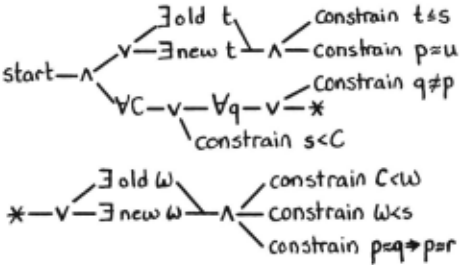
Because the truth criterion is sufficient as weil as necessary, this achievement procedure encompasses all the ways to make a plan achieve a goal. In this respect TWEAK can not be improved upon .
Step addition adds new preconditions to the plan that need tobe achieved, and the added step may also deny, and so undo, previously achieved goals. Therefore , TWEAK tries to avoid step addition. This is not always successful. There are three possible outcomes to planning: success, in which a plan is found ; failure, when the planner has exhaustively searched the space of sequences of plan modification operations, and every branch fails ; and nontermination, when the plan grows !arger and !arger and more and more operations are applied to it, but it never converges to solve the problem.
The central theorem of this paper is the following:
Correctness/completeness t h eor em: If TWEAK, given a problem, terminates claiming a solution , the plan it produces does in fact solve the problem. lf TWEAK returns signalling failure or does not halt , there is no solution to the problem.
The theorem follows easily from the truth criterion.
The rigor of TWEAK's formu lation has several uses. Pre vious planning research becomes substantially clearer when an alyzed with the tools built in constructing TWEAK. In 11) I present a detailed history of planning, showing that the dassie planners are more similar than has previously been realized .
Another use of this rigor is that the range of applicability of state-of-the-art planning techniques becomes clear. The correct ness of TWEAK and similar planners depends crucially on details of the representation of actions . Useful extensions to this repre sentation , such as range restrictions for variables. non-atomic propositions , derived effects of actions, actions whose effects de pend on the situation in which the are applied. and changes in the world due to agencies other than execution of the constructed plan , invalidate the truth criterion , and so the ·correctness of TWEAK. There seems tobe no simple way to extend the crite rion to accommodate these effects. The difficulty is just that of the McCarthy frameproblern !2); my thesis suggests an approach to its solution.
ACKNOWLEGEMENTS
This paper incorporates suggestions Phi! Agre , Steve Bagley, Alan Bawden , Mike Brady, Gary Drescher , Margaret F leck, Wal ter Hamscher, Scott Layson , David McAllester, Kent Pitman , Charles Rich, Mark Shirley, Reid Simmons, and Dan Weid .
@inproceedings{ijcai1985p205,
  title     = {Nonlinear Planning: A Rigorous Reconstruction},
  author    = {Chapman, David},
  booktitle = {Proceedings of the Ninth International Joint Conference on
               Artificial Intelligence, {IJCAI-85}},
  publisher = {International Joint Conferences on Artificial Intelligence},
  editor    = {Aravind Joshi},
  pages     = {1022--1023},
  year      = {1985},
  note      = {Planning and Search},
  url       = {https://ijcai.org/proceedings/1985/205},
}
TY - CPAPER TI - Nonlinear Planning: A Rigorous Reconstruction AU - Chapman, David T2 - Proceedings of the Ninth International Joint Conference on Artificial Intelligence, IJCAI-85 PB - International Joint Conferences on Artificial Intelligence PY - 1985 SP - 1022 EP - 1023 UR - https://ijcai.org/proceedings/1985/205 ER -Copied
Machine-readable versions of this paper, for tools and AI agents:
 Welcome
 Future Conferences
 AI Journal Division
 IJCAI Proceedings
 About IJCAI
 IJCAI Awards