
Learning Shape Descriptions
Proceedings of the Ninth International Joint Conference on Artificial Intelligence. Perception. Pages 922-924.
© 1985 International Joint Conferences on Artificial Intelligence
Abstract
We report on initial experiments with an implemented learning system whose inputs are images of two-dimensional shapes. The system first builds semantic network shape descriptions bascd on Brady's smoothed local symmetry representation. lt learns shape models from them using a modified version of Winston's ANALOGY progranl. The learning program uses only positive examples, and is capab le of learning disjunctive concepts. We discuss the learnability of shape descriptions.
- Brady, Michael, and Asada, Haruo, [1984], "Smooth- ed Local Symmetries and their Implementation," lnt. J. Robotics Research, 3 (3} .
- J. Connell and M. Brady 925
- Brady, Michael, Agre, Philip, Braunegg, David J., and Connell, Jonathan H., [1984], The Mechanic's Mate, ECAI 84: Advances in Artificial Intelli- gence, O'Shea, T. (ed.), Elsevier Science Publishers B.V. (North-Holland).
- Brooks, Rodney A., [1981], "Symbolic Reasoning A- mong 3-D Modelsand 2-D Images," Artij. Intell., 17, 285-348.
- Brooks, Rodney A., and Binford, Thomas 0., [1980], Representing and Reasoning About Partially Spccified Scenes, Proceedings, DARPA Image Under- standing Workshop, Baumann, Lee S. (ed.), Science Applications Inc., 150 -156.
- Canny, John Francis, [1983] , Finding Edges and Lincs in Images, MIT Artificial Intclligence Laboratory, Cam- bridge Mass., AI-TR-720.
- Connell, Jonathan H., [1985], forthcoming SM thesis, MIT Departmcnt of Electrical Engineering.
- Dietterich, T. G., and Michalski, R. S, [1981], "In- ductive Learning of Structural Descriptions," Artif. Intell., 16 .
- Doyle, Richard J., and Katz, B, [1985], Exploring the Boundary Between Natural Langnage and Knowl- cdge Represcntation, MIT Artificial Intclligcnce Lab- oratory, Forthcoming AI Memo.
- Heide, S, [1984], A Hierarchical Representation of Shape, SM thcsis, MIT Department of Mechanical Engineer- ing.
- Katz, Boris, and Winston, Patrick H, [1983], A Two- way Natural Langnage Interface, Integrated lnterac- tive Camptding Systems P. Degano and Erik Sandewall (eds.), North-Holland, Amsterdam.
- Marr, D., and Nishihara, H. K, [1978], "Represen- tation and Recognition of the Spatial Organisation of Three Dimensional Shapes," Proc. Roy. Soc. Lond. B, 200 , 269 -294.
- Winston, Patrick H., [1980], "Learning and Reasoning by Analogy," Comm. ACM, 23, 689-703 .
- Winston, Patrick H., [1981], "Learning New Principles from Precedents and Exercises," Artij. Intell., 10 , 321-350.
- Winston, Patrick H., [1982], Learning by Augmenting Rules and Accumulating Censors, MIT Artificial In- telligence Laboratory, AIM-678.
- Winston, Patrick H., [1984], Artificial Intelligence, 2nd. Ed., Addison-Wesley, Reading, Ma ..
- Winston, Patrick H., Binford, Thomas 0., Katz, B., and Lowry, M., [1984], Learning Physical De- scriptions from Functional Definitions, exan1ples, and precedents, Robotics Research, Michael Brady and Richard Paul ( eds.), MIT Press, Can1bridge, 117-135.
References were extracted automatically from the PDF and may contain errors.
Full text extracted automatically from the PDF; figures, tables and equations may differ. The PDF is the version of record.
1. Introduction
We report on initial experiments with an implemented system that learns two-dimensional shapes from images. The system first build~ semantic network descriptions of the imaged shape based on Brady's smoothed local symme try representation [Brady and Asada 1984, Heide 1984]. It learns shapc models from the descriptions using a modified version of Winston's ANALOGYprogram [Winston 1980, 1981, 1982; Winston, Binford, Katz, and Lowry 1984]. The inputs to the program are grey-scale images of real objects, such as tools, model airplanes, and model ani mals. The outputs of the program are production rules that constitute a procedure for recognising subsequent in stances of a taught concept.
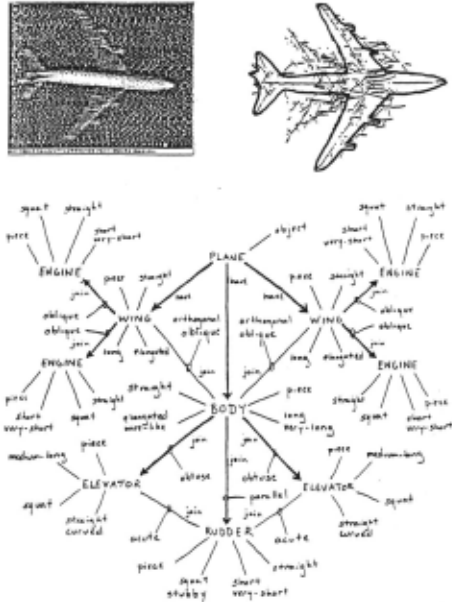
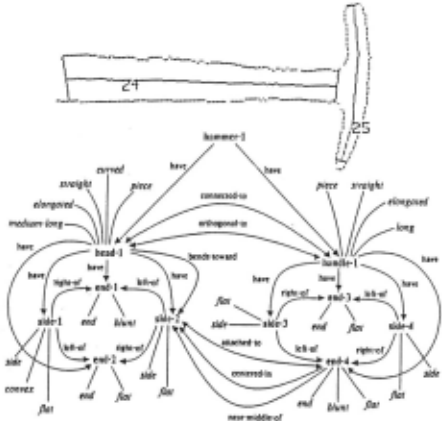
Figure 1a shows the gray-scale !mage of (<· model of) a Boeing 747, Figure 1b shows the results of Brady's smoothed local symmetries program, and Figure 1c shows a portion of the semantic network that is computed from them by our program. The semantic network is trans formed into a set of associative triples [Doyle and Katz 1985] and input to our learning program. The 747 gener ates 239 associative triples. Similarly, Figure 2a shows the subshapes found from the smoothed local symmetries of a tack hammer and Figure 2b shows the full semantic net for this image. The tack hammer generates 51 associative triples.
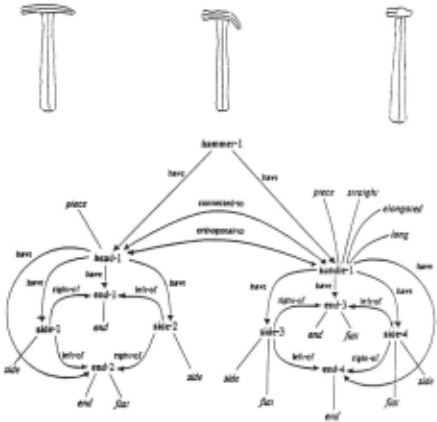
The learning program is a modification of Winston's ANALOGY [Conncll 1985]. It is capable of learning con cepts containing disjunctions. The program learns shape models using positive examples only. Figure 3b shows the concept hammer that is learned from the three positive instances shown in Figure 3a.
The novelty of our work is the ability to learn vi sual shape representations from real visual data. Previous work has not been based on real data because such data was unavailable or too complex and unstructured for ex isting learning algorithms. However, recent developments in edge-detection [Canny 1983] and middle-level vision [Brady and Asada 1984] have provided a solid base on which to build a robust vision system. Using this system we can generate shape descriptions in a form amenable to learning. Furthermore, although the descriptions typi cally comprise between fifty and three hundred assertions, various forms of abstraction keep this volume of data man ageable.
2. Representing Shape
To describe an object it is necessary to first segment it into separate subshapes. In terms of the mathematical analysis in [Brady and Asada 1984], a subshape is defined as maximal with respect to smooth variations in the defin ing parameters. For example, the portions of fuselage in front of and behind the wings of the B747 in Figure 2 are joined, but the handle and blade of a screwdriver are per ceived as separate pieces. Once a part has been found, its shape is specified by three numbers: the aspect ratio, the curvature of the axis, and the change in width along the axis.
Joins between subshapes are det~:rmined by examin ing the spines of the regions and the adjacency of the contour segments. A join is specified by the relative angle and sizes of the pieces, and the location of join with re· spect to each piece. Few previous representations of shape have described subshape joins. For example, A CRONYM [Brooks 1981, Brooks and Binford 1980] specified the Co ordinate transformation between two joined pieces, but did not explicitly describe the join.
Once we break the image into pieces and find the joins wc must somehow represent this information. Images are noisy, so it is necessary to develop representations that are stable, in the sense of being invariant under localized changes such as image noise. However, tasks involving visual representations, for example inspection, often re quire that programs be sensitive to fine detail. A variety of techniques for simultaneously achieving stability and sensitivity have been proposed, each expressing some as pect of hierarchical description. The underlying idea is that gross Ievels of a hierarchy provide a stable base for the representation, while finer Ievels increase sensitivity.
A vision program needs to maintain several different rep rescntational hierarchies, including the following:
· Numeric values and symbolic descriptors
Specifying a shape parameter of interest, say a mea sure of the elongation of a shape, by a numerical value is sensitive, but highly unstable. Symbolic names that correspond to an interval of numeric values are (usually) more stable but less sensitive. Our representation employs symbolic descriptors that have overlapping ranges. For ex ample, an end which is determined tobe on thc borderline between blunt and sharp is declared to be both blunt and sharp. Overlaps like this help to combat the quantization error introduced by encoding a continuous range as a set of discrete symbolic values. A small change in value Ieads to a small change in the representation.
· Structural approximations to shapes
Marr and Nishihara [1978] proposed summarizing the lesser subparts of an object, leaving them unspecified until they are needed. For example, all airplanes have a fuse lage, with pairs of symmetrically attached wings and ele vators. Upon closer examination, a wing of a B747 has two attached engine pods, a DCIO has one, and an 11011 none. Suppressing mention of the engine subshapes, as weil as summarizing the parameters that desnibe the shapes of the wings and fuselage, enables the descriptions of the three airplanes to closely match each other.
In general, !arger subshapes tcnd to determine gross categorization, and so they tend to appear higher in the structural hierarchy. Conversely, smaller subshapes tend to allow finer discrimination and occur lower in the hier archy. The smaller subparts of a tool typically determine the specific function of the tool. For example, deciding whether a tool is an awl, a gimlet, or a Phillips screwdriver involves looking closely at the end of the blade; the relatively localized context of the business end of the blade is established by the grosser Ievels of the hierarchy, where it is recognized (for example) that the tool is not a hammer or wrench. In this way, the Marr-Nishihara pro posal tends (heuristically) to relate )arge scale geometric structure to gross functional use.
· A-kind-of hierarchies
Family hierarchies are ubiquitous, and apply as much to visual shape representations as to the more cognitive situations in which they were developed in Artificial In telligence. ACRONYM represents the fact that the sets of B747-SPs, B747s, wide-bodied jets, jets, and aircraft, are ordercd by subset inclusion. Similarly, a claw harnmer is a-kind-of framing hammer, which is a-kind-of hammer. In general, a subset hierarchy is a partially-ordered set, but not a tree. From the domain of tools, for example, a shinglc ax is both a-kind-of ax, and a-kind-of hammer.
3. Learning
The commonest form of inductive generalization used to learn concepts from positive examples is the drop con dition heuristic [Dietterich and Michalski 1981, Winston 1984, page 398]. This is the method used in our program. Through careful design of the representation the method has been extended to allow generalizations of intervals and structural graphs.
The idea behind the heuristic is that if two things be long to the same dass then the differences between them nmst be irrelevant. Accordingly, when we have a partial model of a concept and receive a new example, we modify thc model by deleting all the differences between it and the example. This can be seen by comparing Figure 2b with Figure 3b. Notice that the network in Figure 3 puts very little constraint on the size or shape of the head. This is because the shapes of the heads in the examples vary widely. For instance, the heads of the first and third ham mer are straight while the head of the second hammer is curved. Note also that the manner in which the handle joins the head is only loosely specified. This is because the handle is joined to the side of the head in the first two examples but to the end of the head in the third example.
This is a simplified explanation of the learning algo rithm. The matehing involved is not graph isomorphism nor is it merely counting the number of required features an object has. Rather it is a complex local matehing scheme. Consider using the semantic net shown in Fig ure 1 as the model for the airplane concept. For an object to match this model, at the top Ievel it must have three pieces which Iook similar to the three in the model. A piece of the example is similar to the wing model if, first of all, it has the shape specified in the network and, sec ond, it has two things which Iook like engines attached to it. Suppose that a certain piece has the right shape for a wing but has only one engine attached to it . At the Ievel of the wing modcl thc program notices that there is a dis crcpancy yet judges that thc picce is still dose enough to the dcscription to be callcd a wing. When the top Ievel of the mateher asks if the piece in question Iooks like a wing the answer is ''yes". No mention is made of the fact that the wing is missing an engine. The difference only matters locally and is isolated from the higher Ievels of matching.
Another important concern is limiting the scope of generalizations made. lmagine that the program is shown a positive examplc that is substantially different from its current model. Altering the model by the usual induc tion heuristics typically Ieads to gross over-generalization. This, in turn, runs counter to what Winston [1984, page 401] has dubbed Martin's law, namely: learning should proceed in small steps. Therefore our program creates a new, separate model based on the new example, splitting the concept being taught into a disjunction.
In some cases, the disjunction will be replaced by a single model as positive examples are taught that are in termediate to the disjuncts. For example, suppose that the first example of a hammer shown to the program is a claw hammer, and that the second is a sledge hammer. The program will create a disjunction as its concept of hammer, but it will be consolidated into a single model once it has seen such examples as a mallet and ballpein hammer.
Even though the program only generalizes a concept using an example that is structurally sinlilar, it is some times deceived and must recover from over-generalization. We follow Winston [1984] and provide censors that over ride the offending rule. Censors can be generalized and there can be disjunctive censors; in fact this is the usual case. Since censors can be generalized they also have the possibility of being over-generalized. This is countered by putting censors on the censors. In general, a concept is not represented by a single model but by a group of mod els. There can be several positive models corresponding to the disjuncts as well as several negative non-models summarizing the exceptions to the other models.
4. Current Work
The goals of our research are not limited to learning. The work reported here forms part of the Mechanic 's Mate project [Brady, Agre, Braunegg, and Connelll984], which is intended to assist a handyman in generic assembly and construction tasks. The primary goal of that project is to understand the interplay between reasoning that involves tools and fasteners and representations of their shape.
For example, instead of learning that a certain geomet ric structure is called a hammer, we learn that something which has a graspable portion and a striking surface can be used as a hammer. These two functional concepts are then defined geometrically in terms of the shape repre sentation. Reasoning from function as weil as from form allows more .flexibility. For instance, faced with a ham mering task, but no hammer, one might try mapping the hammer structure onto that of any available tool. A screw driver provides a good match, identifying the blade of a screw driver with the handle of the hammer, and the (as sumed .flat) side of the screw driver handle with the strik ing surface of the head of the hammer . In this way, the Mechanic 's Mate can suggest improvisations, like using a screw driveras a hammer.
Our initial goal was to learn shape models cast in the representation described previously. Eventually, the Me chanic 's Mate will have to learn ab out the non-geometric properties of objects: weight, material type, and the pro cesses that use them. Currently we are using Katz's En glish interface [Katz and Winston 1983] to tell our pro gram such things. This is not satisfactory. Instead, we hope to teach dynamic information using a robot arm and hand.
Another area of interest is inducing structural sub classes from examples. Since the subclasses that form the a-kind-of hierarchy are an important part of the shape representation, they should be learnable. However, in learning subclasses there is a danger of combinatorial ex plosion. Learning subclasses requires a suitable similarity metric. Feature-based pattern recognition systems learn subclasses as clusters in feature space, and clusters are sets that are dense with respect to the Euclidean metric. Part of our research in learning shape descriptions has been to determine what makes objects Iook similar. This suggests using the metric employed in the learning pro cedure to form subclasses through a process analogaus to feature space dustering. This is the focus of our current work.
5. Acknowledgements
This report describes research done at the Artificial Intelli gence Labaratory of the Massachusetts Institute of Tech nology. Support for the Laboratory's Artificial Intelli gcnce research is provided in part by the the System De velopment Foundation, the Advanced Research Projects Agency of the Department of Defense under Office of Na val Research contract N00014-80-C-0505, and the Office of Naval Research under contract number N00014-77-C '0389. We thank the people who have commented on the ideas presented in this paper, particularly Phi! Agre, Steve Bagley, Bob Berwick, Ben DuBoulay, Alan Bundy, Margaret Fleck, Scott Heide, Boris Katz, Tomas Lozano Perez, John Mallery, Tom Mitchell, Sharon Salveter, Dan Weid, and Patrick Winston.
@inproceedings{ijcai1985p186,
  title     = {Learning Shape Descriptions},
  author    = {Connell, Jonathan and Brady, Michael},
  booktitle = {Proceedings of the Ninth International Joint Conference on
               Artificial Intelligence, {IJCAI-85}},
  publisher = {International Joint Conferences on Artificial Intelligence},
  editor    = {Aravind Joshi},
  pages     = {922--924},
  year      = {1985},
  note      = {Perception},
  url       = {https://ijcai.org/proceedings/1985/186},
}
TY - CPAPER TI - Learning Shape Descriptions AU - Connell, Jonathan AU - Brady, Michael T2 - Proceedings of the Ninth International Joint Conference on Artificial Intelligence, IJCAI-85 PB - International Joint Conferences on Artificial Intelligence PY - 1985 SP - 922 EP - 924 UR - https://ijcai.org/proceedings/1985/186 ER -Copied
Machine-readable versions of this paper, for tools and AI agents:





