
Tense, Aspect, and Cognitive Representation of Time
Proceedings of the Ninth International Joint Conference on Artificial Intelligence. Natural Language. Pages 806-813.
© 1985 International Joint Conferences on Artificial Intelligence
Abstract
This paper explores the relationships between a computational theory of temporal representation (as developed by James Allen) and a formallinguistic theory of tense (as developed by Norbert Harnstein) and aspect. II aims to provide expliclt answers to four fundamental questions: (1) what is the computational justification for the primitives of a linguistic theory; (2) what is the computational explanation of the formal grammatical constraints; (3) what are the processing constraints imposed on the learnability and markedness of these theorelical constructs; and (4) what are the constraints that a linguistic theory imposes on representations. We show that one can eflectively exploit lhtl Interface between the lanyuage faculty and the cognitive faculties by using linguistic constraints to determine restrictions on the cognitive representations and vice versa. Three main results are obtained: (1) We derive an explanation of an observed grammatical constraint on tense .. the Linear Order Constraint ·· from the Information monotoniclty property of the constraint propagation algorithm of Allen's temporal system; (2) We formulate a principle of markedness for the basic tense structures based on the computational efliciency of the temporal representations; and (3) We show Allen's interval-based temporal system is not arbitrary, but it can be used to explain independently motivated linguistic constraints on tense and aspect Interpretations. We also claim that the methodology of research developed in this study ·· "cross-level" investigation of independently motivated formal grammatical theory and computational models .. is a powerful paradigm with which to attack representational problems in basic cognitive domains, e.g ., space, time, causality, etc.
- AIIen84]
- James Allen, "Towards a General Theory of Action and Time", Al Journal, Vol23, No. 2, July, 1984. "Maintaining Knowledge about Temporal lntervals", CACM Vol26, No. 11, Nov. 1983.
- Bernard Comrie, ~. Garnbridge University Press, 1976.
- Hornstein81J Norbert Harnstein, "The study of meaning in natural language", in: Explanation in Linquistics, Longman, 1981.
- Hornstein77) "Towards a Theory of Tense", Linquistic lnquirv, Vol8, No. 3, Summer 1977.
- Otto Jespersen, The Philosophy of Grammar, Norton Library 1965.
- A.P.D. Mourelatos, "Events, processes and states", Linquistics and Philosophy 2, 1978.
- Kira Ota, Tense and Aspect of Present Day Amerjcan Enqljsh, Tokyo, 1963.
- Barry Taylor, "Tense and Continuity", Linquistics and Philosophy 1, 1977.
- Zeno Vendler, Linquistics and Philosophy, Cornell University Press.
References were extracted automatically from the PDF and may contain errors.
Full text extracted automatically from the PDF; figures, tables and equations may differ. The PDF is the version of record.
1. Objectives and Main Results
One major effort in modern linguistics is to Iimit the class of possible grammars to those that are psychologically real. A grammar is psychologically real if it is (a) realizable. possessing a computational model that can reproduce certain psychological resource complexity measures, and (b) learnable . capable of being acquired (at least, in principle) despite the poor quality of input linguistic data. A shift of emphasis from the pure characterization problem of grammar to the realization and leamability problems naturally brings linguistics closer to Al work in natural language understanding concerned with computational ln the following, I shalllist the main results of this study:
- A better theory of tense with revised primitive tense structures and constraints.
- We derive an explanation of Hornstein's Linear Order Gonstraint, an observed formal ::onstraint on linguistic tense, from properlies of the constraint propagation algorithm of Allen's temporal system. This shows this formal grammatical constraint need not be learned at all. We also show that the rule of R-permanence follows from the hypothesis !hat only the matrix clause and the subcategorizable SCOMP or VCOMP can introduce distinct S and R points. Finally, we prove that certain boundedness condition on the flow of information of a processing system Ieads directly to the locality property of a constraint on sequences of tense.
- A principle of markedness for tense structures based on the comoutational efficiency of the temporal representation. The principle predicts that (1) of the six basic tenses in English, future perfect is the only marked tense, and (2) the notion of a distant future tense, just like the simple future, is also unmarked.
- A better account of the state/event/process distinction based on Allen's interval-based temporal logic and the idea that the progressive aspect specifies the perspective from which the truth of a Situation is evaluated.
- An account of theoretical constraints on the representation of time at the computational Ievei, e.g., three distinct time points are necessary to characterize an elementary tensed sentence, and the distinction between instantaneous and non-instantaneous time intervals.
2. Tense
We begin by first outlining Hornstein's theory of tense. ln section 2.1, we describe the primitives and constraints on tense of his theory. ln sections 2.2 and 2.3, we show how the primitives and constraints can bE' derived from computational considerations.
2.1 Revisions to Hornstein's Theorv of Tense
Hornstein develops a theory of tense within the Reichenbachian framework which postulates three theoretical entities: S (the moment of speech), R (a reference point), and E (the moment of event). The key idea is that certain linear orderings of the three time points get grammaticalized into the six basic tenses of English. 1 The following is the Iist of basic tense structures:
1. Hornstein actually listed nine basic tenses. but I think the progressive belongs to the province of aspect rather than tense.
| 1. SIMPLE PAST | E,R_S |
| 2. PAST PERFEGT | E_R_S |
| 3. SIMPLE PRESENT | S,R,E |
| 4. PRESENT PERFEGT | E_S,R |
| 5. SIMPLE FUTURE | S_R,E |
| 6. FUTURE PERFEGT | S_E_R |
The notation here demands some explanation. The underscore symbol "-" is interpreted as the "less·than " relation among time points whereas the comma symbol "," stands for the "less-than-or-equal -to" relation. As an illustration, the present perfect tense denotes a Situation in which the moment of speech is eilher cotemporaneous or precedes the reference point, while the moment of event is strictly before the other two moments. Note that Hornstein also uses the term "association" to refer to the comma symbol "." .
Given the basic tense structure forasimple tensed sentence, the interpretation of the sentence that arises from the interaction of tense and time adverbs is represented by the modification of the position of the R or E points to form a new tense structure which we call a derived tense structure. in two papers (Hornstein77 & Hornstein81), Hornstein proposes three formal constraints that Iimit the class of derived tense structures !hat can be generated from the basic tense structures in such a way as to capture the acceptability of sentences containing temporal adverbs (e.g., now, yesterday, tomorrow) , temporal connectives (e.g., when, before, alter) , and indirect speech. ln the rest of this section, I shall examine the adequacy of these constraints.
2.1.1 Linear Order Constraint
The Linear Order Gonstraint (LOC) states !hat (p.523·4):
- The linear order of a derived tense structure must be the same as the linear order of the basic structure.
- No new association is produced in the derived tense structure.
LOG is stipulated to account for examples consisting of a single temporal adverb such as (4a) and those with two time adverbssuch as (32) .2
4a. John came harne i. ·now, at this very moment i i. yesterday
iii. ·tomorrow
32 a. John left a week ago [from] yesterday.
b. [From] Yesterday, John left a week ago.
c. ·A week ago, John left [from] yesterday.
The basic tense structure for 4(ai) is:
E, R_S ( s imp 1 e past: John came home)
Now modifies E or R so that they become cotemporaneous with 1he moment of speech S with the derived tense structure as follows:
<1. The numberings are Hornstein's.
On the other hand, 4(ali) is acceptabie because the modifier yesterday leaves the tense structure unchanged:
The crucial example, however, is 5(c):3
LOC predicts (wrongly) that 5cii is good and 5ciii bad. 4 But LOC gives the wrong prediction only on the assumption that the basic tense structures are correct. To account for 5c, I propose to save the LOC and change the following SRE association with the present perfect:
PRESENT PERFEGT E_R,S
With the modified basic tense structure for present perfect, LOC will give the correct anaiysis. Scii is bad because:
Sciii is acceptable since:
{OK: no new linear order and no new comma)
The question that naturally arises at this point is: Why does Hornstein not choose my proposed SRE structure for the present perfect? The answer, I believe, will become apparent when we examine Hornstein's second constraint.
2.1.2 Rule for Temporal Connectives
The rule for temporal connectives {RTC) states that {p.539·40):
For a sentence of the form P 1 -conn-P 2 , where "conn" is a temporal connective such as "when", "before", "alter" etc., line up the S points of P1 and P2, that is, write the tense structure of P 1 and P 2, lining up the S points. Move R 2 to und er R 1 , placing E2 accordingly to preserve LOC on the basic tense structure.
lt can be easily seen that my proposed tense structure for present perfect does not work with RTC since it produces the wrong predictions for the following two sentences:
3. Seefootnote 7 and 11 of Hornstein's paper.
4. There may be doubts as regards the acceptability of 5ciii. An equivalent form of 5ciii is acceptable is Danish (Jespersen65, p.271). Also, in French, the present pertect can be used for a situation that held not more than 24 hours belore the oresent moment (Comrie76, p.61).
- [ 1] · John came when we have arrived.
- John comes when we have arrived.
For [1] the new analysis is:
which does not violate the RTC and hence predicts (wrongly) that [1] is acceptable. Similarly, for [2], the new analysis is:
which predicts (wrongly) that [2] is bad.
This may explain why Hornstein decides to use E_S,R for the present perfect because it can account for [1] and [2] with no difficulty. However, I suggest that the correct move should be to abandon RTC which has an asymmetrical property, i.e., it matters whether P 1 or P 2 is put on top, and does not have an obvious semantic explanation. (See Hornstein's footnote 20, p.543) . My second proposal is then to replace RTC with a Rute of R-permanence (RP) stating that:
(RP) : Both the S and R points of P 1 and P 2 must be aligned without any manipulation of the tense structure for P 2 .
Thus sentence [3]:
[3] John came when we had arrived.
is acceptable because its tense structure does not violate RP:
Now, Iet us reconsider sentences [1] and [2]. Sentence [1] is not acceptable under RP and the new tense structure for present perfect since:
Sentence [2] is still a problem. Here I shall make my third proposal, namely, that the simple present admits two basic tense structures:
SIMPLE PRESENT
S,R,E and E,R,S
Given this modification, sentence [2] will now be acceptable since:
To examine the adequacy ol RP, Iet us Iook at more examples:
The corresponding analysis is as lollows:
We can see that the proposed theory correctly predicts all ol the live cases. There is, however, an apparent counter·example to RP which, unlike RTC, is symmetrical, i.e., it does not matter which ol the Pi's is put on the top. Consider the following two sentences:
RP predicts both 5i and 5ii will be unacceptable, but 5i seems to be good. lt is examples like 5i and 5ii, I believe, that Iead Hornstein to propese the asymmetrical rule RTC. But I think the data are misleading because it seems to be an idiosyncrasy of English grammar that 5i is acceJ)table. ln French, we have to say an equivalent of "John will come when we will arrive" with the temporal adverbial explicitly marked with the future tense (Jespersen65, p.264) . Thus, the acceptability ot sentences like 5i can be explained by a principle of Economy of Speech allowing us to omit the future tense of the temporal adverbial if the matrix clause is already marked with the future tense.
2.1.3 Sequences of Tense
Now, we describe the third and final grammatical constraint on sequences of tense. Consider the following sentences:
ln the (a) sentence, the temporal interpretation of the embedded sentence is evaluated with respect to the moment of speech. Thus, for instance, [6a] means that Mary's leaving is 3 days alter present moment of speech. On the other hand, the (b) sentence has the temporal interpretation ol the embedded sentence evaluated with respect to the interpretation of the matrix clause, i.e., [6b] means that Mary's leaving is 4 days before the moment of speech.
To account tor the sequence of tense in reported speech, Hornstein oroooses the following rule:
ln general, for an n-level embeddPrl sentence, SOT states that: assign Sn with En·t (Hornstein81 , p.140). With the SOT rule, [6a] and [6b] will be analyzed as follows:
The local property of SOT, i.e., linking occurs only between nth and (n·1)th Ievel, has a nice consequence·: it explains why a third Ievel nested sentence like (7]:
has only two temporal readings: (1) in 7(ci), Mary's leaving is two days alter the moment of speech, and (2) in 7(cii), Mary's leaving is two days belore the moment of speech. ln particular, there is not a temporal reading corresponding to the Situation in which Mary's leaving is live days before the moment of speech. We would obtain the third reading il SOT allowed non-local linking, e.g., assigned s 3 with E 1 .
2.2 Explanations of the Formal Constraints
ln the prev1ous section, we have examined three formal constraints on the derivation of .complex tense structures from the basic tense structures: (1) LOC, (2) RP, and (3) SOT. Now, I want to show how the LOC falls out naturally from the computational properlies of a temporal reasoning system along the line suggested by Allen (AIIen64, Allen83), and also how the RP and SOT constraints have intuitive computational motivation.
The basis of Allen's computational system is a temporallogic based on intervals instead of time points. The temporal logic consists of seven basic relations and their inverses (AIIen84, p.129, figure 1):
| Relation | ~ | symbol for jnyerse | meaning |
|---|---|---|---|
| X before Y X equal Y | < | > | XXX YYY XXX yyy |
| X meets Y X overlaps | Y m 0 | mi oi | XXXYYY XXX yyy |
| X during Y | d | di | XXX yyyyy |
| X starts Y | s | Si | XXX yyyy |
| X finishes | Y f | fi | XXX yyyy |
The reasoning scheme is a form of constraint propagation in a network of event nodes linked by temporal relationships. For instance, the Situation as described in the sentence "John arrived when we came" is represenled by the network:
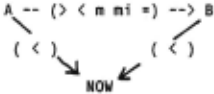
where A = John's arrival and B = Our coming
This network means that both event A and event Bare before now 1 the moment of speechl while A can be before, after or simultaneaus with 8.
When new temporal relationships are added, the system maintains consistency among events by propagating the effects of the new relationships via a Table of Transitivity Relationships that teils the system how to deduce the sei of admissibie relationships between events A and C given the relationships between A and 81 and belween B and C. Thusl for instance, from the relationships "A du ring B" and "B < C" I the system can deduce "A < C".
One property of the constraint propagation algorithm generally is that further Information only causes removal of members from the sei of admissible Iabeis, i.e., temporal relationships, belween any two old events (AIIen83, p.835). No new Iabei can be added to the admissible set once it is created. Let us call this property of the constraint propagation algorithm the Deieie Label Condition (DLC). DLC can be interpreted as a kind of Information monotonicity condition on the temporal representation.
Let us further restriet Allenls temporallogic to instantaneous intervals, i.e.l each event corresponds to a single moment of time. The restricted logic has only one primitive relation, 5~ and three other derived relations: <1 ), and ;::. There is a straighttorward Iranslaiion of Hornstein 1 S SRE notation into the network representation, namelyl replace each comma symbol "I" by 5 (or ;:: with the event symbols reverse their roles) and each underscore symbol "-" by > (or < with similar adjustment on the event symbols). Thus, a tense structure such as: E_R,S can be represented as:
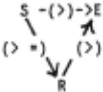
With this representation schemel we can prove the following theorem:
Let A and B range over { S, R, E } and A :1: B. There are live basic types of violations of the LOC:
1. A_B-+ B_A
2.A_8 -+A,B
3. A_B-+ B,A
4.A,B-+ B,A
5.A,B -+B_A
We can see that each of these cases is a violation of the DLC. To spell this out, we have the following operations on the constraint network corresponding to the above violations of the LOC:
1'. A ·(<)->8 -+ A·(>)->B
2 1 . A ·( <)·> B -+ A ·( < = ).>B
3 1 . A ·( < )-> 8 -+ A -(> = )->B
4'. A -( < = )·> B -+ A -(> = ).>B
5 1 . A -( < = )-> B -+ A -( > l·>B
ln each of these cases, the operation involves the addition of new members to the admissible set. This is ruled out by DLC. Thus, we have the result that if LOC is violated, then DLC is violated. ln other words, DLC -+ LOC. 5 -f
The second constraint to be accounted for is the RP which effectively states that (a) the S points of the matrix clause and the temporal adverbial must be identical1 and (b) the R points of the matrix clause and the temporal adverbial must be identical. One hypothesis for this rule is that:
(H1) Only the matrix clause Introduces distinct Sand R points.
ln other words, the non-subcategorizable temporal adjuncts do not add new S and R points.
H1 has to be modified slightly to take the case of embedded sentence into accounl1 namely1
(Revised RP): Only the matrix clause and the subcategorizable SCOMP or VCOMP can introduce distinct S and R points.
where SCOMP and VCOMP stand for sentential complement and verbal complement respectively. The interesting pointisthat both the revised RP and the locality property of SOT can be easily implemented in processing systems which have certain boundedness constraint on the phrase structure rules (e.g., information cannot move across more than one bounding node). To illustrate this, Iet us consider the following tense interpretation rules embedded in the phrase structure rules of the Lexicai·Functional Grammar:
The S rule introduces a new S point and sets its value to now. The VP rule has two effects: (1) it does not introduce new S or R points for the temporal adverbial phrase, thus implicitly incorporating the revised RP rule, and (2) it Iooks at the tense . of the embedded sentential complement, setting the value of its S pointtothat of the E point of the higher clause if the tense is past , and to now, otherwise. Thus, in this way, the secend effect accomplishes what the SOT rule demands.
2.3 lmplications for Learning
II the revisions to Hornstein's theory of tense are correct, the natural question to be asked is: How do speakers attain such knowledge? This question has two parts: (1) How do speakers acquire the formal constraints on SRE derivation? and (2) How do speakers learn to associate the appropriate SRE structures with the basic tenses of the language?
Let us consider the first sub·question. ln the case of LOG, we have a neat answer ·· the constraint need NOT be learned at all! We have shown that LOC falls out naturally as a consequence of the architecture and processing algorithm of the computational system. As regards the constraint RP, the learner has to acquire something similar to H1 But H1 is a fairly simple hypothesis that does not seem to require induction on extensive linguistic data. Finally, as we have shown in the previous section, the boundedness of the flow of information of a processing system Ieads directly to the locality property of the SOT. The particular linking of S and E points as stipulated by the SOT, however, is a parameter of the Universal Grammarthat has to be fixed.
What about the secend sub·question? How do speakers learn to pair SRE configurations with the basic tenses? There are 24 possible SRE configurations seven of which get grammaticalized. Here I want to propese a principle of markedness of SRE structures that has a natural computational motivation.
Let us recall our restrictive temporal logic of instantaneous interval with one primitive relation, :::;;, and three derived relations:
- <. >. and ~ . Represent a SRE configuration as follows:

The admissible Iabeis are among { <, < =, >. > = }. So there are altegelher 64 possible configurations that can be classified into three types:
(1) Inconsistent labelings (16), e.g. ,

R
- Label ings that do not constrain the SE 1 ink given the labelings of SR andRE (32), e.g.:
,.

- Labelings that are consistent and the SE link is constrained by the SR andRE link (16), e.g.,

R
II we assume that labelings of the third type correspond to the unmarked SRE configurations, the following division of unmarked and marked configurations is obtained:
| UNMARKEP E_R_S E,R_S E_R,S E,R,S S,R,E S,R_E S_R,E | |
| S_R_E PAST PERFECT SIMPLE PAST PRESENT PERFECT SIMPLE PRESENT SIMPLE PRESENT SIMPLE FUTURE | E_S_R E,S_R E_S,R E,S ,R S_E_R S_E,R S,E_R S,E,R R_S_E R_S,E R_E_S R_E,S R,E_S R,S_E R,E,S R,S ,E FUTURE PERFECT |
There are only eight unmarked tense structures corresponding to the sixteen SRE network configurations of type 3 because a tense structure can be interpreted by more than one network representations, e.g., the Past Perfeet (E_R_S) has the following two configurations:
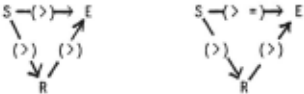
The interesting result is that live out of the six basic tenses have unmarked SRE configurations. This agrees largely with our pretheoretical intuition that the SRE configurations !hat correspond to the basic tenses should be more "unmarked" than other possible SRE configurations. The fit, however, is not exact because the future oerfect tense becomes the marked tense in this classification.
Another prediction by this principle of markedness is that both the simple future (S_R,E) and distant future (S_R_E) are unmarked. lt would be interesting to find out whether there are languages in which the distant future actually gets grammaticalized.
The final point to be made is about the secend type of labelings. There are two other possible ways of grouping the labelings: (1) given SR and SE, those labelings in which RE is constrained, and (2) given SE and RE, those in which SR is constrained. But these types of grouping are less likely because they would yield the simple present tense as a marked tense. Thus, they can be ruled out by relatively Iew linguistic data.
3. Verb Aspect
ln considering the problern of tense, we have restricted ourselves to a subsei of Allen 's temporal logic, namely, using a temporal structure <T . ~> with linear erdering of time points. To make use of the full power of Allen's temporal logic, we now turn to the problern of verb aspect.
The two main problems of the study of verb aspect are the correct characterization of (1) the three fundamental types of verb predication according to the situation types that they signify - state, process and event, and (2) the perspectives from which a situation is viewed, or its truth evaluated -· simple or progressive. 6 ln the first part of his paper, Allen attempts to provide a formal account of the state/process/event distinction using a temporal logic. However, I believe that his characterization fails to capture well-known patterns of tense implications, and does not make the distinction between Situation types and perspective types fundamental to any adequate account of verb aspect. ln the next section, I will present some data that any theory of verh aspect must be able to explain.
6. Some of the better works are: Vendler67, Comrie76, Mourelatos78.
- Data
3.1.1 Tense lmplications
- Statives rarely take the progressive aspect 7 , e.g.,
- I know the answer. *I am knowing the answer.
- For verb predications denoting processes, the progressive ot the verb form entails the perfect form, i.e.,
x is V-ing --+ x has V-ed.
For instance,
John is walking --+ John has walked.
;3. For verb predications denoting events, the progressive of the verbform entails the negation of the perfect form, i.e.,
- x is V-ing --+ x has not V-ed. For instance,
John is building a house --+ John has not built the house.
3 .1.2 Sentences containing When
Sentences containing clauses connected by a connective such as "when" have different aspect interpretations depending on the situation types and perspective types involved.
- John laughed when Mary drew a circle. Situation/Perspective type: X = process/simple; Y = eventlsimple Interpretation:
X can be before, alter or simultaneaus with Y
- [1 O] John was laughing when Mary drew a circle. Situation /Perspective type: X = process/progressive; Y = eventlsimple Interpretation: Y occurs du ring X.
- John was angry when Mary drew a circle. Situation/Perspective type: X = state/simple; Y = event/simple Interpretation:
X can be beton::, alter, simultaneaus with or du ring Y.
[12] John was laughing when Mary was drawing a circle. Situation/Perspective tvpe: X = process/progressive; Y = event/progressive Interpretation: X must be simultaneaus with Y.
3.2 Formal Account of the State/Process/Event distinction
Define:
7. II has ollen been pointed out tnat some Statives do Iake the progressive form. E.g., " I am thinking about the exam.", "The doctor is seeing a patient. " However, a statistical study has shown that the familiar statives rarely occur with the progressive aspect .. less than 2% of the time (Ota63, section 2.2)
- (a) X C Y ++ X d Y V X s Y V X I Y
- (b) X~ Y ++ XC Y V X equal Y
(c) mom(t) ++ t is an instantaneous interval, i.e., consists of a single moment of time
(d) per(t) ++ t is a non-instantaneous intervar 8
where X and Y are generic svmbols denoting state, event or process.
3.2. 1 Progressive
(PROG): OCCUR(PROG{v,t)) ++ mom(t) 1\ .., OCCUR(v,t) 1\ (3 t')(t d t' 1\ OCCUR(v,t'))9
The progressive aspect is the evaluation of a situation . from an interior point t of the Situation which has the property that though the sentence is not true at that instantaneous interval, it is true in a non-instantaneous Interval t' properly containing t.
3.2.2 State
(51): OCCUR{s,t) ++(V t')(mom(t') 1\ t' ~ t -+ OCCUR(s,t'))
A state verb rs true at every instantaneous Interval of t. The definition is similar to Allen's H.1 (AIIen84, p.130).
The following theorem shows that state verbs do not occur with the progressive aspect.
(S·THEOREM): ·OCCUR(PROG(s,t))
OCCUR(PROG{s,t))
- ++ mom(t) 1\ .., OCCUR(s,t) 1\ (3 t')(t d t' 1\ OCCUR(s,t'))
- -+ OCCUR(s,t') for some t' containing t
- -+ OCCUR{s,t) (by S1)
- . ·. contradiction. -l
This theorem raises the following question: Why do some statives occur with the progressive? I think there are two answers. First, the verb in question may have a use other than the stative use (e.g. "have" is a stative when it means "possession", and not a stative when it means "experiencing" as in "John is having a good time in Paris.") Second, the English progressive may have a secend meaning in addition to that characterized by PROG above. A frequent usage of the progressive is to indicate short duration or temporariness, e.g., in "They are living in Cambridge" /"They live in Cambridge".
8. This section benefits from the insights ol Barry Taylor (Taylor77).
9. A reviewer ol this paper polnts out thatthe PROG axiom seems to imply that H something is in progress, it must complete. Thus, H Max is drawing a circle, then at some luture time. he must have dr8wn the circle. This lnlerence is clearty falae bec8use there is nothing Contradietory about "Max was drawing 8 circle but he never drew it." For iostance, Max might sulter a heart 8ttack and died suddenly. This interence problem ol the progressive form ot a event verb is known as the lmperlective paradox in the literature. One way out is to deny that Max was really drawing a circle when he died. Rather he was dr8wing something which would have bun 8 circle had he not died . . This type of analysis would involve aome machinery lrom Possible Wdrld semantics.
3.2.3 Process
A process verb can be true only at an interval larger than a single. moment. This property differs crucially from that of the statives.
- (P1 ): OCCUR{p,t) -+ per(t)
The following theorem shows that for a process verb, the progressiveverbform entails the perfect form.
(P-THEOREM) OCCUR(PROG{p,t)) -+ (3 t')(per(t') 1\ t'< t 1\ OCCUR{p,t'))
OCCUR(PROG{p,t))
- -+ mom(t) 1\.., OCCUR{p,t) 1\ (3 t')(td t' 1\ OCCUR(p,t'))
- -+ OCCUR{p,t') for some t' suchthat t d t'
- -+ 3 m 1 E t'. m 1 < t (since t d t')
- -+ 3 m 2 E t'. m 1 < m 2 < t (by density of time points) Let t" be the interval [m 1 ,m 2 ). Then, we have t" < t and t" ~ t'. By (P2), we have OCCUR(p,t") . That is, p has occurred. -l.
The characterization of process verb by Allen {his 0 .2) is less satisfactory because it combines both the notion of progressive aspect (his "OCCURRING") and the process verb into the same l!xiom. Furthermore, the difference between the predicate "OCCUR" and "OCCURRING" is not adequately explained in his paper.
3.2.4 Event
An event verb shares an important property with a process verb, namely, it can be true only at a non-instantaneous interval.
- (E1): OCCUR{e,t) -+ per(t)
The following theorem shows that the progressive form of an event verb entails the neqation of the perfect form.
(E·THEOREM): OCCUR(PROG(e,t)) -+ ..,(3 t'){per(t') 1\ t'< t 1\ OCCUR(e,t'))
As in the proof of (P·THEOREM), we can find a non-instantaneous interval t" suchthat t" < t and t" ~ t' . But for any sucht", we have .., OCCUR(e,t") because of (E2). That is, it cannot be the case that e has occurred. -l.
Again the crucial property (E1) is not captured by Allen's characterization of events (his 0 .1 ).
3.3 Constraint on temporal Interpretations lnvolving When
To account for the variety of aspect Interpretations as presented in section 3.1.2, I propese the following constraint on Situation/ perspective type:
(C-ASPECT): Let "dynamic" :;tand tor a process or event.
(a) simple/dynamic -+ mom(t)
(b) simple/state -+ per(t)
(c) progressive/dynamic -+ per(t) A ~
Perspective is a way of looking at the situation type. For process or event, the simple aspect treats the situation as an instantaneous interital even though the situation itself may not be instantaneous. For state, the simple aspect retains its duration. The progressive aspect essentially views a process or event from its interior, thus requiring a stance in which the situation is a non-instantaneous interval and the admissible temporal relationship to be the ~ relations, i.e., s, si, f, fi, d, di, equal.
Let me show graphically how C-ASPECT accounts for the aspect interpretations of sentences [9) to (12).
[9'] simple/process WHEN simple/event
Admissible relations:
[10'] progress1vetprocess WHEN simple/event Admissible relations:
[11'] simple/state WHEN simple/event
Admissible relations:
[12'] prog/process WHEN prog/event
Admissible relations:
4. Conclusion
ln this paper, I have examined two problems regarding linguistic semantics: tense and aspect. lmportant relationships between abstract constraints governing linguistic behavior and a computational scheme to reason about temporal relationships are discussed. in particular, I have shown that certain formal constraints, such as the Linear Order Constraint on tense, fall out naturally as a consequence of some computational assumptions. The interesting result is that this formal constraint need not be learned at all.
Another important role of a representation scheme in explaining phenomena that exist on a entirely different -- linguistic ·. Ievei is illustrated by the formulation of the C-ASPECT constraint to account for interpretations of sentences containing temporal connectives.
The study of linguistic semanlies also sheds light on a representation of timP. by revealing the fundamental distinctions that must be made, e.g., a tensed sentence involves three distinct time points, and the aspectual interpretations require instantaneous/non-instantaneous interval distinction.
Acknowledgments
I would like to thanl' Prof. Robert C. Berwick for his insightful suggestion that the relationship between a cognitive theory of time and a linguistic theory of tense is a fruitful and important area for research. He also contributed substantially to the presentation of this paper. Fina.Uy, I also thank Norbert Hornstein who provided useful commentsduring ltle revision of this paper.
5. References
- (AIIen84]
- [AIIen83)
[Comrie76)
James Allen, "Towards a General Theory of Action and Time", Al Journal, Vol23, No. 2, July, 1984.
"Maintaining Knowledge about Temporal lntervals", CACM Vol26, No. 11, Nov. 1983.
Bernard Comrie, ~. Garnbridge University Press, 1976.
[Hornstein81J Norbert Harnstein, "The study of meaning in natural language", in: Explanation in Linquistics, Longman, 1981.
[Hornstein77) "Towards a Theory of Tense", Linquistic lnquirv, Vol8, No. 3, Summer 1977.
[Jespersen65] Otto Jespersen, The Philosophy of Grammar, Norton Library 1965.
[Mourelatos78] A.P.D. Mourelatos, "Events, processes and
states", Linquistics and Philosophy 2, 1978.
[Ota63)
Kira Ota, Tense and Aspect of Present Day Amerjcan Enqljsh, Tokyo, 1963.
[Taylor77] Barry Taylor, "Tense and Continuity", Linquistics and Philosophy 1, 1977.
[Vendler67) Zeno Vendler, Linquistics and Philosophy, Cornell University Press.
@inproceedings{ijcai1985p159,
  title     = {Tense, Aspect, and Cognitive Representation of Time},
  author    = {Yip, Kenneth Man-kam},
  booktitle = {Proceedings of the Ninth International Joint Conference on
               Artificial Intelligence, {IJCAI-85}},
  publisher = {International Joint Conferences on Artificial Intelligence},
  editor    = {Aravind Joshi},
  pages     = {806--813},
  year      = {1985},
  note      = {Natural Language},
  url       = {https://ijcai.org/proceedings/1985/159},
}
TY - CPAPER TI - Tense, Aspect, and Cognitive Representation of Time AU - Yip, Kenneth Man-kam T2 - Proceedings of the Ninth International Joint Conference on Artificial Intelligence, IJCAI-85 PB - International Joint Conferences on Artificial Intelligence PY - 1985 SP - 806 EP - 813 UR - https://ijcai.org/proceedings/1985/159 ER -Copied
Machine-readable versions of this paper, for tools and AI agents:





