
Description-directed Natural Language Generation
Proceedings of the Ninth International Joint Conference on Artificial Intelligence. Natural Language. Pages 799-804.
© 1985 International Joint Conferences on Artificial Intelligence
Abstract
We report here on a äpificant new set of capabilities tbat we have incorporated into our J.anauage generation system MUMBLE. Their impact will be to greatly limplify tbe work of any text planner tbat uaes MUMBLE as ih linguistic:s component linc:e MUMBLE can now take on many of tbe planner's text orpnization and decision-making problems witb markedly lesa han~tailoring of algoritbms in eitber component. Briefly tbese new capabilies are tbe followinJ: (a) A1TACBMENT. A new proceaina stap witbin MUMBLE tbat allows us to readily Implement tbe c:onventiOill tbat ao into definina a text's intended proee style, e.g. whetber tbe text lbould have complex sentences or simple ones, compounds or embeddinp, reduc:ed or fuU relative clauaes, etc. Stylistic c:onventi001 are given as independently stated rules tbat can be changed accordina to tbe lituation. (b) REALIZATION CLASSES are a mechanism for organizing both tbe transfonnational and lexical choices for linguistically rea1izing a c:onceptual objec:t. The mechanism highligbts tbe intentional criteria which c:ontrol telection ctedsi001. 'ibese criteria effectively constitute an "interlingua" between planner and linguistic component, desc:ribing tbe rhetorical uses to wbich a text choic:e can be put wbile allowinJ its lingustk: detaill to be encapsulated. The fint part of our paper (secti001 2 and 3) descn'bes our generat approacb to generation; the rest Wustrates the new capabilldes througb examples from tbe UMUI COUNSELOR Projec:t. Thil projec:t il a larp new effort to develop a natural J.anauage diJCOUne system bued on the HYPO system [R.issland cl Albley 1984], wbich act1 as a legal advisor suggestina relevant dimenäons and c:ase referenc:es for arJUin1 hypothetical legal cues in tradHec:ret law. At various relevant pointl we briefly c:ontrast our work witb tbat of Appelt, Danloil, Gabriel, Jacobl, Mann and Mattbeillen, and McKeown and Derr.
- Relerences Appelt D. (1!8l) "Problem Solvioa Applied to Language Generation", Procedinp of the 18th Annual MeetinJ of the Aaociatioo for Computational Linguisticl, Iune 19-22, 1!8l, University of Pennlylvania, pp.59-63.
- Appelt D. (1981) "P1.annina Natural Lan&ua&e Utterances to Satisfy Multiple GOals" PhD. -Thesis, Stanford University. Available u SRI Technical Note 259.
- Becker 1. (1975) "'be Phrual Laicon" BBN Report No. 3081, Bolt Beranek and Newman, lnc., Cambridge, MA.
- Conklin E.1. (1983) "Data-Driven lndelible Plannin& of Discoune Generation Uling Salience" PhD. Thesis, Department of Computer and Information Science, University of Musadnuettl at Amhent; available u COINS Tec:hnical Report 83-13.
- Cook M., Lehnert W., and McDonald D. (1984) "Conveying Implicit Contcd in Narrative Summaries" Proc. of COLING-84, Stanford University, pp.>7.
- Danl01 L. (1984) "Con~ and Linguistic Decisi.Oill in Generation", Proceedmp of COLING-84, Aaoc:iatioo for Computational Linguisticl, pp.S01-S04.
- Derr M., cl McKeown K., (1984)"Uiing Focus to Generate Complex and Simple Sentencel" Pmceedinp of COLING-84, pp.319-326.
- Harris z. (1951) Methodl er SUudaral LlapiJCia, Chic:ago, University of Chic:ago Prell.
- Harris Z. (1952) "DiJCoune AnalyliJ: a sample tcd", J..aaaoaae 28, pp.474-494.
- 1acobl P. (1983) "Generation in a Natural Languaae Interface," Proc. Eigtb UCAI, pp.610-612.
- 101bi A. (1983) "How much contcd-sensitivity is required to provide reuonable structural delcripti001: Tree Adjoining Grammars" in Dowty, Karttunen, cl Zwicky (eds) Natural J..aaaoaae f'rwewlnp: PIJc:bolou, Compatatloa.al, and Tbeentlal Penpedltea, Cambridge University Press.
- Mann W., Bates M., Grosz G., McDonald D., McKeown K., Swartout W., "Report of the Panel oo Text Generation" Proceedinp of the Workshop on Applied Computational Linguiltics in Penpective, American Journal of Computatiooal Linguistics, 8(2), .,-62-70.
- Mann W, & Matthieaen C., (1983) .. A Systemie Grammar for Text Generation" ISI Tec:hnical Report RR-83-105.
- Matthieaen C., (1983) "How to make grammatical dec:isi001 in tcd generation" ISI Tecbnical Report RS-83-120.
- McDonald D. (1983) "Natural Languaae Generation u a Computational Problem: an Intrductioo" in Brady and Berwick, eds. Compnt•"maa Prelllema ID. Dllceane, MIT Press.
- McDonald D. (1984) "Deecriptioo-Direc:ted Conttol: Its ImplicatiOill for Natural Language Generation" in Cercone, ed. Compatati8aal Uaplstla, Pergamoo Press.
- McDonald D., cl Pustejovlty 1. (198Sa) "Sam100: A computational Theory of Prole Style", Pmceedinp of the Conference of the European AIIOclatioo for Computational LinguiltiCI, University of Geneva.
- McDonald D., cl Pustejovüy 1. (198Sb) '7AO. u a Grammatical Formalilm for Generation", Proceedinp of the 23rd Annual Meetiq of the Aaociatioo for . Computatiooal l..iJiauiltic:s, University of Chic:ago.
- Rissland E., Valcarce E., cl Asbley K., "Exppaining and Arguina with Examples" Pmceedinp of AAAI-84 .2l&294. • wooffs. (1984) "Contcd Dependent Plannin& in a Machine Tutor" PhD. thesis, University of Maaaclausetts.
References were extracted automatically from the PDF and may contain errors.
Full text extracted automatically from the PDF; figures, tables and equations may differ. The PDF is the version of record.
1. Abstrad
We report here on a äpificant new set of capabilities tbat we have incorporated into our J.anauage generation system MUMBLE. Their impact will be to greatly limplify tbe work of any text planner tbat uaes MUMBLE as ih linguistic:s component linc:e MUMBLE can now take on many of tbe planner's text orpnization and decision-making problems witb markedly lesa han~tailoring of algoritbms in eitber component. Briefly tbese new capabilies are tbe followinJ:
- (a) A1TACBMENT. A new proceaina stap witbin MUMBLE tbat allows us to readily Implement tbe c:onventiOill tbat ao into definina a text's intended proee style, e.g. whetber tbe text lbould have complex sentences or simple ones, compounds or embeddinp, reduc:ed or fuU relative clauaes, etc. Stylistic c:onventi001 are given as independently stated rules tbat can be changed accordina to tbe lituation.
- (b) REALIZATION CLASSES are a mechanism for organizing both tbe transfonnational and lexical choices for linguistically rea1izing a c:onceptual objec:t. The mechanism highligbts tbe intentional criteria which c:ontrol telection ctedsi001. 'ibese criteria effectively constitute an "interlingua" between planner and linguistic component, desc:ribing tbe rhetorical uses to wbich a text choic:e can be put wbile allowinJ its lingustk: detaill to be encapsulated.
The fint part of our paper (secti001 2 and 3) descn'bes our generat approacb to generation; the rest Wustrates the new capabilldes througb examples from tbe UMUI COUNSELOR Projec:t. Thil projec:t il a larp new effort to develop a natural J.anauage diJCOUne system bued on the HYPO system [R.issland cl Albley 1984], wbich act1 as a legal advisor suggestina relevant dimenäons and c:ase referenc:es for arJUin1 hypothetical legal cues in tradHec:ret law. At various relevant pointl we briefly c:ontrast our work witb tbat of Appelt, Danloil, Gabriel, Jacobl, Mann and Mattbeillen, and McKeown and Derr.
2. Major Compoaents ol tbe GeneratiOD Process
At nearly everyone wbo bas worked on generation from an Al perspective will agree, it il tbe cbaracter of the decision-making involved, and not any a prlorl division by linguistic Ievel, tbat dictatel bow tbe proce11 divides into
DelcripdOD·Directed Natural
languap GeneratiOD
David D. McDoo.ald and James D. PultejcMty
Departmeot of Computel' and Information Sc:ience Univenity of Ma.acbUiettl at Amhent
components. Decision-making varies in at least tbe three dimensi.001 listed below, witb tbe cllllteriDJ pattenll of groups of decisi001 atona tbese dimensi.001 deterining what different components tbere lbould be.
- o What information does tbe decision draw on: properties of lexical items? Conc:eptual attributes? Details of planned rhetorical structures? Detaill of surface structures?
- o What is tbe decision dependent on: what other generation decisions, if made differently, would force a change in tbis decision? H tbe generation proce11 is to be indelible (i.e. never retracting its decisi001) tben tbis dependency structure will have to be respected.
- o How lbould tbe decision's c:onclusiOill be represented: does a c:onclusion dictate linguistic acti001 or )1st constrain other decisions? Can it be acted on immediately or must it be ICheduled for later?
On tbe basis of such c:onsiderations, we bave determined tbat generation as a wbole involves three different kinds of activities: two tbat are dominated by c:onceptual (typically domain-specific) criteria and decisions, and one tbat is dominated by linguistic criteria and bas a correspondingly wider applicability. These tbree activities are:
- determining wbat goals to (attempt to) accomplisb witb tbe utterance;
- deciding wbat information tbe utterance lbould convey and wbat rhetorical force it lbould have in order to satisfy tb01e goals;
- rea1izing tb01e c:onc:eptual "'pecifications" as a grammatical text tbat il cohelive witb tbe discourse tbat precedes it.
We see tbese activities as intermingled and ongoing tbrougbout tbe duration of a text's generation. Goals are only pa.-tially formulated wben one starts speaking, and may even emerge opportuniltically as tbe linguistic structure of tbe text is incrementally planned and produc:ed. We presume tbat in people tbese activities are carried out in parallel, tbougb in our discourse system for tbe COUNSELOR projec:t tbey are treated as ltrictly gated ~routines.
lt is the last of these activities, the liDguistically most demandiq, that is our c:oocem in this paper. 'Ibis upect of our resean:h hu two goa]J, one pragmatic, the other ICientific. F"U'It, for resean:hen who neecl capable natural language interfaces, we have developed a venatile linguistic COfi'I/JCJMnl ("LC"), implemented u the Zetalisp program MUMBLE, that can be interfaced to domain specific: systems, where it bandies an of the linguistic: c:onsiderati0111 that occur durlog generation. 1be domain specific system supplies a specification of what it wantl said, couched in itl own internal representation, and is then realized by our LC u a grammatical tm.
Our second goal is to projec:t from the camputational architectwe of our LC to hypotheses about the actual generation procea in human beinp. To this end we have disciplined ounelves in the design of the camputer program to employ only devices with specific:, very narrow capacities. 'Ibis influences our choice of linguistic analy1es, in that only a few of the analyses that one could imagine {and appear in the literature) are plausible in our generator, allowißa us to develop linguistic: and psycholinguistic hypotheses that are predictive and falsifiable. We will not discuSI this upect of our resean:h in this paper; eome of our earlier c:oocluai0111 are described in [McDonald 1984].
3. Our Approach to Generation
In this section we describe our approach in general terms and outline the separate compooentl of our system; detailed examples will be given in the section followiq.
3.1 Goal-dlrected Geaentloa
In our view, resean:h on the production of text is most revealing when it c:onsiders how the text advances the goaJJ of a speaker. A generation program lbould produce text1 for an audience that is lituated in a c:ooc:rete discoune contm worki.ng from a particu1ar plan of Information to be communicated with specific rbetorical goa)J. Furthermore, we believe {and it is here that we part campany with researchen such u Mann and Matthiesaen [1983], whose aims we otherwise lbare) that the demands placed 011 an LC by the neecl to work efficiently from a plan have overridiq implicati0111 for the LC's architecture. 'Ibis can require it to take a form very different from what is developed when worki.ng 011 the form/function relationship in ilol.ation. Generation programs like Mann and Matthieaen's NIGEL that have 10 far been Uled only to produced weU-formed text1 in ilol.ation from camputatiooally represented lituati0111 or speaken' goaJJ may teU UJ a great deal about the structure of gramman and linguistic: competence, but it does not follow that they are therefore model1 of the generation proc::ea.
In aa:ordance with this methodology, our LC hu always been developed in the contm of one or more underlying progrt11ft6 which have been responsible for dictatina the communicative goa)J. Bach program hu included a tut planning 'J6Iem, of varyiDa (eometimes trivial) IOpbistication. (For example the program GENARO developed by Jeff C".onklin [1983) and the programs listed in
[McDonald 1983).) 1be text plannen react to their UIOciated prosrams' cammunicative goaJJ Ud COilltruct a c:ooceptual Ievel "plan"-a non-linguistic: specification of what it wantl said-which is given to the LC u itl input.
Although we are presently worki.ng with tm plannen that we are designing ourselvet, we expec:t that the place we have picked for tbe divition between planoins what to say and determinina how to say it is a natural one; c:omequently our Linguistic Compooent lbould be able to be Uled to advantaae with text plannen of very different internal design than tbe ones we happen to have Uled.
3.2 Maidpie lnela ID tbe llqalltk compoaeat
An ongoing trend in our research bu been to introduce more and more Ieveis within the generation proceaes between originatina the goaJJ and ultimately producing the text. At the present time we employ three suceaive Ieveis of proce11ins within the LC: a«ec:hmeat, n·lluff·, and plirille iCrudure eucatlaa. We wiU briefly defme each of these Ieveis later in this tection and will expou.nd on their functional orpnization and give illustrati0111 of the struc:tures they use in tbe second half of the paper.
At each proceaing Ievel there is a sbift in the vocabulary of the rules, the representati0111 that are used, and the character of the reuoning that is brought to bear. Bach Ievel is narrowly restricted in the kind of Information that it can draw on and the textual horizon it is able to work within. Bach is a specialized activity within the "virtual machine" that we have developed for generation, and worb accordiDJ to itl own camputational principles and therefore with the high degree of efficiency that is poaible through specialization of the mecbanism to the task (provided, of c:oune, that the "'boundaries" between the Ievels are in fact weil placed). Dec::isi0111 at each Ievel are limpler than if the Ievels were folded tosether, lince lea linguistic detail is determined at a time.
In this regard we disapee with Appelt [19(1), 1985] about the benefitl of malntainina a lingle camputational paradigm throughout the generation proc::ea (in bis cue axiomatic planning): bis point that al1 of the generation proceaes involve planoins is very weil taken, yet this neecl not imply a homogeneout design. Indeed, one of the implicati0111 of homogeneity iJ that an information il mJllllx available at any point in the procaa, which we do not believe is the cue in generation by pcople or is of any advantap in machine systems. With our multi-level design we can specify quite exactly when a given kind of Information becomes available, whether it is available "early" in 10me more abttract form (i.e. before the representation that would normally carry that Information hu been instantiated), and when it later becomes inacceaible.
1t is crucial to understand that wbile we speak loosely of these different reuoning engines and repreaentati0111 u constitutina "'evels", they are in fact not ltJictly ordered in the proce11 u a whole. AU of them are active limultaniously, includiq the planner tbat lUpplies their input; they operate u clOiely coordinated ~routines, precisely synchrollized to the "point of speecb". paasina informatioo (in the form of propeaively more refined specificati001 and eventually syntaaic and laical stuctures) from ooe to the other alq a weil defined path or "pipeline".
SeUiDa pa11 aad plann'na coateat. Generation ltaJ1I wbeo the underlyina program leb the goalJ of the utterance. In our own wort this il dooe by the decili001 of a "dilcoune cootroller" desiped after Woolf [1984]. lbe goa1s direc:t the actiODJ of a cooceptual or "'informatioo" Ievel planner that makes declä001 about what informatioo to actually communicate (venus leave for the audieoce to infer), bow to structure it u a text, and what rbetorical or discoune effects to achieve. lbe planner also oocuiooally selects key lexical items (anticipatiDJ and preemptiua later choices) wheo this allows the combinatioo of buic informatioo units into a more useful '"packase" (e.g. merging an objcct's temporal BEGINNING and ENDING fieldl by using the word "betweeo", or using a term lUCh u "get revenge" rather than limply ltatiDJ the underlyina events of a story (Cook, Lehnert, & McDooald 1984].) Figure 3 lbows an example of a plan of the IOJt we are presendy using.
To the LC, the output of the text planner appean u a sequence of kernal informatioo units (i.e. objcctl from the intemal conceptual representatioo of the underlyina program, typically pointers to frames or relati001 eltraded from them, see F"18Ufe1 2 and 3). Each unit il typic:alJy acc:ompanied by a rbetorical annotatioo, put there by the text planner, which describet IOIDe penpective or emphuil that the unit'a textual realizatioo il to reßect.
SUU'ACE SI'RUCI'lJU Whüe there are four proceaes in our model of geoeratioo (plannina, attachmeot. realizatioo, and phrue structure executioo), there are ooly two reference ltnlcturel: the plan, and lUdace structure. Tbil secood representatiooal Ievel il the smlx linguiltic Ievel we support; its representatiooal vocabulary il abltrad and for the m01t part syntactic and phrual. lt c::orrespoodl to the Ievel in generative gramman that il the input to the phooological compooeot and incorporates many of the devices of modern linguiltic theory lUCh u "traces" and X-bar categories.
lbe lUdace structure il the core of our LC's desip. It defines the actioo sequence (program) carried out by Phrue StrW:ture E.xecutioo. ablorbl the output (in lllcellive chunks) of Realizatioo, and il the tarpt of Attachmeot. lbe fact that a linguistically motivated descriptioo of an utterance in propell can take oo such a cootrolling, coordinatiDJ role in the geoeratioo procaa il to us too striking to be a fortuitous accideot of our Will u c:omputer programmers. rather it reßects IOIDething crucial about the nature of the geoeratioo procaa operatiDJ in people. Space does not permit a proper tecbnical descriptioo of our lUdace structute or of PSE; interelted readers lbould see [McDooald 1984].
1be AlTACBMENT PROCESS lbe fint thing that must bappen to the units in the plan il for them to be usigned ("attached") to politi001 within the lUdace structure. Thil exteodl the IUrface· structure by inltantiatiDJ ooe of the "attachment points" that have beeo usigned to it according to the grammatical structure it curreody hu (e.g. aat.-ntence, llddltloaal4djectlft embedded~ etc.).
lbe process does not attach all of the units in a plan at ooce; inltead attachmeot il interleaved with Phrue Strudule E.xecutioo 10 that mOit earlier units will have beeo realized and their text spoken before the last ooe il politiooed. To judge wbere to attach a unit, the process COOliden fint the syntactic form of the various text cboices that could be made in realizing the unit, filterins out any that are inc:ompatible with the available attacbmeot points (e.g. ooe cannot politioo an adjcctive to serve the syntactic: functioo of a new seoteoce ). It theo employs a Iet of rules to order the remaining points according to the designated prose style.
'lbe llEALIZATION PR.OCESS Once a unit hu beeo positiooed within the lUdace structure, the next thing that bappens to it il the selectioo of a text that will adequately "realize" its informatioo cooteot. Thil requiret sensitivity to its functiooal role within the tnowledge bue and the plan (e.g. topic: versus instrumeot). to the delired penpective. and to the grammatical coostraints emposed by the lUdace structure at that politioo.
lbe uaociatioo of objcctl (or objcct types) from the underlyina system ·, tnowledge bue with the texts that could be Uled to realize them il made by usignins them to predefined "realizatioo clastet". Realization clastet are higbly parameterized and annotated liltl of "cboices" where eacb cboice defines a poaible syntactic structure and wording. Each choice il annotated by a Iet of "characteriltic:s" whicb summarize the linguistic: nature of the cboice and the functiooal uses to whicb it may be put. lbe characteriltic:s can also be viewed u predicates againlt tbe curreot ltate of the lUdace structure and plan and thus proviele the backbooe of the decläoo procedure that makes the realizatioo cboices. Linguistically, the pattern of cboices in a realizatioo c:l.all m01t strongly resembles the "tramformatioo families" of Harril (1951, 1952].
Cboices are defined in terms of a lchematically described phrue structure plus a "mappins" that takes the parameters of the choice into politi001 in the phrase. Thil parameterizatioo reflects the c:ompolitiooality of the units in the plan: m01t units can be viewed u relati001 over other units; a typical realizatioo il theo the lelectioo of a verb to realize the relatioo with the UJWDeDt units mapped into the verb's thematic: roles.
PHilASE STilUCI'lJU EXECVTION lbe phrase structure defined by a cboice c:oosiltl of a Iabeted tree of eooltitueots with Eoglisb wordl and IIOIDe units u its leaves. lbe depth-fint travertal of thil tree defines a path that will eoumerate the wordl and embedded units (whicb will theo be realized and replaced by a phrase) in their natural left to risht order u a text.
Uliq thiJ patb u itl controll.in& repracotatiOD, Pbrue Structure ExecutiOD ("PSE") carries tbe whole LC forward: Words at tbe leaves of tbe surface ltl'UCture ue morpbologically tpeci·lized and spoten u 1000 u tbey ue reached. When embedded unitl ue reached tbey ue puaed to tbe RealizatiOD Procea; tbe su~tree Ideeted and inltantiated by tbat proc:ea il tben puled back to PSB and incorporated at tbe politiOD of tbe unit, replacina tbe unit and tbereby definina an exteDiioo of tbe travenal patb. Wheo a potential attacbment point il reached tbe Attacbment Procea il awateoed to determine whetber it wisbea to uae tbat point for politiooina tbe n,..q unit in tbe plan.
4. Some Rumpies
Coosider tbe text below, wbic:h our LC seneratea from tbe plan in Fapre 3 (u ßesbed out by later subplannina). 'Ibis text wu originally procluced by a human lawyer u tbe initial delcriptiOD of tbe lep1 cue Oll wbic:h he was seeting advice; our raean:h goal hu been to reproduce it (and tbe reat of tbe dialope it wu part of-wort wbic:h il not yet complete) in a seneralizable way u a precunor to haviq tbe fuU COUNSELOR system eventually plan otber such texts Oll itl own.
" I represent G clknt NIIMd RCAVICTIM wllo wtm11 to n~e SWIPEINC Glld Leruy Soleil for mhappropriDting triiiÜ secret· in cOIIMCtiorc wlllt lOftware developed by my clknt. RCAVICTIM mmbt· tlte ·tftware bowll u AUTUI'EU., G progr(lltl to Glltomtlle lt1IM tf G btml telkr'1 functictu, to tlte bGnking illdumy. 111 1982, LerDJ Sol eil, 011e tf RACVICTIM' · per6t1r1Ml, left RCAVICTIM Glld beg1111 workillg /or SWIPEINC tJfl G competillg product, TEUERMATIC. abo 1111 Glltomtlled teller progr(lltl. SWIPEINC 1tGI beg1111 mmUtillg TEUERMATIC in competitiolt witlt AUTUI'EU.. "
Ff&an 1 Output tat from the LC
4.1 llbetortaiiJ·nnotatecl ID.pat from the Plaaaer
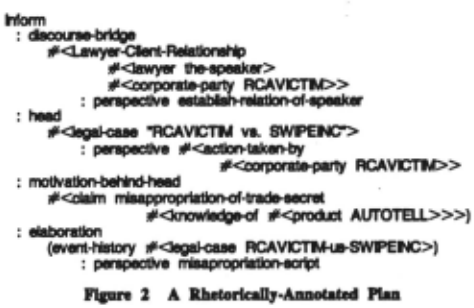
At tbe momeot, thiJ paragrapb il senerated from tbe plan in Fapre 2. 'Ibis ltrUcture tpecifiel tbe foiiO'It'iq. (1) 1be JIWPOIC of tbe utterance, i.e. to inform tbe audieoce of tbe inteotiOD to brin& suit and tbe buic facts of tbe cue. (2) ltl informatiOD content-tbe framea from tbe tnowledge bue tbat will be tbe proximal IOUJ'cel for tbe wordina of tbe text (siven in tbe "#< ... >" notatioo uaed to indicate ßavor inltances in Zet·l Jrp, tbe implementatiOD J.anguaae of our homebrew frame system). (3) Any tpecial perspectivel tbat are to govern tbe realizatiOD of tbose framea (indicated by tbe teyword ": penpective"). 1be specificatiOD of penpective is crucial becauae of tbe potentially enormous range of realizati0111 m01t of tbe framea in thiJ domain may have (e.g. a "neutral" penpective Oll thiJ Legal-case should probably be realiz:ed u IOIDethina lite "RCA VICI'IM is tbe plaintiff and SWIPEINC and Leroy Soleil ue tbr defeodantl"}.
4.2 lacnmeatal Plaaalaa
1be text plannina proc:ea hu two problems: (1) to decide what informatiOD and rhetorlcal organizatiOD will beat render tbe communicative liltent of the underlyina system, and (2) to bridge tbe gap between tbe way informatiOD il organized in tbat system's tnowledge bue and what il poaible in the natural J.anguaae being uaed (i.e. what are tbe words and grammatical construc:ti0111 of tbe language). In our COUNSELOR project thiJ gap il nODtrivial, u illustrated by tbe framea in FJ&We 3. 1be domin·tin& problem is tbe COilliderable difference in "pactaging": the unit framea hold COilliderably more informatioo than should be communicated at ODe time, mating lelectiOD of penpective and otber culling criteria quite important if what il llid is to be relevant.
Our planner, a propam we are callina "CCCERO", is presently quite limited. 1t il organized u a Iet of tpecialim witb namea lite DelcribHepl-c:ue, Dacribe4-party-to4-c:ue, DelcrlbKorponte-pu'tJ (a tpecializatiOD of Dacribe4-party-to4-c:ue) and 10 Oll. 1be procedure used now is a simple conte:ltual dilcrim.inatiOD between alternative, prec:ompiled "'criptt", wbic:h are tben inltantiated and paaed to the LC in the form shown before in Fagure 2. That plan il tbe ltaDdud ooe for unmarked delc:ripti0111 of cue1 ac:ept for tbe additioo of the fint unit (indicatina the relatioo of tbe tpeüer to tbe c:ue), which wu included bec:aue the utterance il tbe fint one in the c:oovenation and that relatioo c:aoJlOt yet be deduced from c:ootat. We recopize tbat tbil ue of ICripCs iJ quite limitißa, and are in tbe midlt of developiJII
more venatile tecbniquea.
Oa.e key part of CICERO'a deaip whicb we apect to retain, bowever, iJ the fad tbat it operatel inc:remeotally. It would be neitber paycholosic:all plaulible nor c:omputationally economical to bave a planner make aU of the decisi0111 about tbe informatioo in an utterance (espec:ially a IODJ one) in '"Olle pua", and tbeo c:ompletely relinquilb c:ootrol to tbe LC until it wu time to plan tbe next utteranc:e. lnltead, planDina lhould proceed incremeotally, leavina tbe detaila of referencea or elaborati0111 u c:ooc:eptual "'tuba" in tbe larpr plan to be worked out in detail later onc:e tbat plan bu been partiaUy realized and a 1iDsuiJtic: chiU'IIderization of that poaitioo of the stub bec:omea available. A recunive invocatioo of CICERO theo 111e1 that chiU'IIderization, u weU u tbe stub'a poaition in tbe original plan, to aid it in dec:idina wbat information and penpec:tivea to ue. 1be resultißa "'ubplan" iJ theo puaed back to tbe LC which c:ootinuea
wbere it left off.
So for example tbe plan in Fagure 2 wu COilltl'udld by Delcrfbe.lepl_.. 1bil tpeeialitt knowa to meotion tbe party (#<corporate-part Rcavlctftl>) tbat tbe lawyer iJ repreaentißa, but doel not itself know bow to delcribe tbat party, leavina tbat deciaion to be made later by DaeribH:orporate-paltJ onc:e PSB reachea tbe ita poaitioo in the IUlfac:e atruc:ture.
4.3 Actacbmcat ud rr.e StJ1e
1be Attachmeot Procea iJ a traDiduc:er from tbe stream of annotated unita ui tbe plan to lllipmeota of active "attachmeot pointa" witbin tbe IUlface atruc:ture. These Ulignmeota modify tbe IUlfac:e atructure at tbe time they are made, in effect "'plicina in" additiooal pbrue structure to ac:comodate tbe new unit. Wbat pointl are active at any momeot is determined by tbe detaill of tbe IUlfac:e atruc:ture already in plac:e and tbe poaitioo of tbe PSB proc:e11. Deliberati0111 over which attachmeot pointl to aelect are mediated by prefereocea which are c:baracterized in terma of "'tyliJtic rulea".
At tbe beginnins of an utterance, tbere il only ooe attacbmeot point active, namely Fmt«Dtenc:e. 1be fint unit of tbe plan will be poaitioned bere, and tbeo almoac immediately will be reached by PSB and puaed to Realization. Realization will aelect a phraJe for it (in tbil c:ue a clauae), and tbeo knit tbe pbrue into tbe IUJfac:e structure in plac:e of tbe unit.

lNP #<corp.1*1J Acavlclm> ) ) )
(Ibe actual repreaentation of IU1'fac:e atruc:ture il COilliderably more elaborate tban tbis limplified pre1e11tatioo augeats.) Oa.c:e tbis replac:emeot occun new attacbmeot pointa are made active, u dictated by tbe form of tbe clauae. These include New«Dtenc:e, varioua c:oojunc:tiOIII auch u Reduc:ed-on-combjcc:t and Recluc:ed-o~K:o-predic:ate, and espec:ially varioua ayntactic extensiona to tbe final NP auch u additional adjcc:tivea, pOICDominal pbuea, or quantifien which would refine tbe chiU'IIderization of Rcavictim, u weU u non-restric:tive attachmeotl relatina IOIDe of itl attributea or activitiea. Wbat attachmeota are aUowed il a func:tion of tbe ayntactic confi&uration of tbe IU1'fac:e ttruc:ture abead of tbe point of apeech; tbe relevant criteria are dilcu.ect in [McDonald & Pustejovüy 198Sb).
Witb tbe realizatiOD of tbe fint unit, tbe attacbment poaibilitiea for tbe leCOild can be c:ooädered. These are narrowed by iporiDa aU poaibilitiea that demand a ayntactic realization for a unit at tbeir poaition tbat il not found in tbe leCOild unit'a realization c:lua (which in tbe pre1e11t c:ue are a.ntially )Ist varlati0111 on dauaea involvina tbe verb "'ue"). At prelellt tbil leavea only tbree pointa still in tbe I'IIDlliDa:
New«Dteoc:e: "I repruerrt a client fUI1Md lli:Gvictim. Tltey
want to sue Swipe111e ll1lll Leroy Soleil."
Simple-eonjunctiOD: "I repre6nlt a client fUI1Md lli:Gvictim. ll1lll tltey want to sue Swipel11e ll1lll Leroy Soleil."
Non-reatric:tive-relativ&dlainiJia-o-final-NP: "I repruerrt a client tfiRMd Rcavictim. wltD want.r to sue Swipel11e ll1lll Leroy Soleil."
We c:ootend tbat tbe deciJion betweeo tbeae three il a matter only of tbe pr01e style ooe prefera: lODJ lelltenc:el or lhort, limple ayntu or compla. Lawyera bave very definite prefereocea in tbeir pr01e style which we can capture u a Iet of "orderißa rulea". These rulea of pr01e style are Uled to order tbe alternatives, each rule ac:companied by a predicate c:baracterizina tbe liDguistic c:ootexta in which it appliea. Our aJaorithma for tbis proce11 are delcribed in [McDonald & Pustejovüy 198Sa).
(deßn&.stylstlc-Ne AMaya-preJ·~Relldlve-dll88 ~;:** NorHeelrlctlve-relaUv~-",.,.. ) ~:"one--~-or.. (relatlv·tect-poeltlon (most-recent-we 'NorHellrlctlve-relaUv~-tlnaJ.NP)))))
Flpn 5 A llmplll Styllldc a·
rs "'<lpeek·>
(yp l'8pl'eeent
WP fNp Jll<corp.-party Rcavlctm> J
(s #<legak:ue ...> J J J J
1be standard technique for combining a sequeoce of conceptual units into a texf hu beeil ·clirect replacement" (see diJcussi.on in [Mann et al. 1982D, in which the sequential organization of the text iJ ideotical to that of the meaage because the meaage iJ used direc:tly u a template. Our use of Attachment dramatically improvea 011 thiJ technique by relievißa the meaaae planDer of any need to koow how to orpnize a lUdace struc:ture, Iettin& it rely instead Oll explicidy stated ltylistic: c:riteria operatiq alter the planni.ng iJ c:ompleted.
Derr and Mc:Keowo (1984) allo improve 011 direct replacement's one-propolition-for-one-tenteoce forced style by permittiq the c:ombination of individual information units {of c:omparable c:omplexity to our own) into compouod sentenc:ea intenpened with rhetoric:al c:onnec:tives. 1bey were, however, limited to extending sentenc:ea only at their ends, while our Attachment Proc:ell c:an add units at lllX grammatic:ally ticit position ahead of the point of specch. Furthermore they do not yet exprea combination c:riteria u explicit, separable rulea.
Dick Gabriel's program Yh [1984] produc:ed polished written texts through the use of c:ritic:s and repeated editiq. It maintained a very limilar model to our own of how a tm's struc:ture c:an be elaborated, and produc:ed texts of quite high fluenc:y. We differ from Gabriel in trying to ac:hieve fluenc:y in a sinsJ.e online Jl8ll in the manner of a penoo talkina off the top of bis head; thiJ requira us to put muc:h more of the respomibility for fluenc:y in the pre-linguistic: tm planner, whic:h iJ undoubtedly subjec:t to timitatiOill.
u Reallzaffaa a...
We have lllid that lanpase pneration iJ a problem of how to orp.nize dec:iJion makina: firlt of what information to CODvey (doo.e inc:rementally within the Tm Planner), then of how to textually c:apture the relation of the units in a plan to eac:h other {doo.e by the Attachment Proc:ell), and finally of how to expr· "realize"-the information in a CODceptual unit, whic:h iJ the tuk of Realization.
Realization iJ the selec:tion of one of a predefined set of alternative text spec:ific:ati0111 {"c:hoicea") subjec:t to grammatical c:omtraints accordina to the polition within the lUdace struc:ture at which the realization oc:cun. 1be predefined c:hoic:ea are orp.nized into "reaaization c:lua" suc:h u shown in Flple 6. At the time thiJ iJ written, these c:lua either orp.nize alternative wordiop, u in the CODc:ept-spec:ific: c:laa or when wordinJ hu beeil determioed, orp.nize the struc:tural (e.a. transformational) alternatives that the languaae permits, u in Transitive-Latioate-verbl,
1be selection dec:iJion iJ bued on the ·c:baracteriJtic:s" that accompany eac:h c:hoice (e.a. in-foc:us(ara), expre~~et-result{verb)). These symboll have attaclled procedures whic:h te1t for prerequisitea, and allo may be telted for preaenc::e or absenc::e by the grammatical c:omtraints. Muc:h of our Oß80Üll resean:h involves determinina what reuon.able c:harac:teristic:s are and what predic:atea they should be allowed to use; thiJ will dic:tate the amount and c:harac:ter of the liquistic knowledp we allow our text planDer to have, sinc::e all further information about a c:andiate text {for example the information used by PSB and morpholoay) iJ enc:apsulated in the c:hoic::e.
It iJ appropriate at timea to think of the c:hoicea in a realization c:laa u items in a "phrual leldcon" [Bec:ter 197S), i.e. u produc:tive, frozen tum1 of phrue that we use not because of their compolitional, titeral meanina, but because they are a CODventional phrue rather like an idiom. Our mec:hanism of UIOc:iatins conc:eptual units direc:tly with c:hoic:ea (rather than mediatins the CIOilc::epCI-teXt relationship with sets of ablttact featuJa, u for example doo.e by Matthi.en [1983D permits us to c:apture these CODventional relationshipl euily, while notioJ th01e abltrad relati0111 that we do understand by labelina the choic:es with c:harac:teriltic:s.
Unpistic:ally, our c:hoic::es are more versatile than the phrual enttiea in use at Berkeley where phrual laicoal are a c:ommon part of languaae procelliDJ prosrams, e.a. (Iac:obl 1983). Oun are traDJparellt to the addition of other modifyioa or elaboratins conc::eptl within the phrue because of the thoroughn· of the liDguiltic specific:ation given with a c:hoic::e and the use of the Attachment Procell.
As one of the two loci of dec:isioo-mWD& within the LC (the other beiDa Attadunent), we think of the proc:e11 of Realizatioo u limultaneously drawiDI oo koowledp from syntactic, semantic, and prasmatic Ievels, wbich, u we ltatcd at the very beJinniol of thil paper il a natural property of the generatioo proc:e11. In thil we apee with Danlois [1984], and see a familial raemblance between our realizatioo classes and the set1 of cro~~~-level alternatives sbe describel. We do, bowever, believe that a peater a prlorl ordering among dec:isioo classes il poaible than Danlois would permit. In particular it appean to us u more than just programmer's convenience il involved in our delip dccisioo to reduce the combinatoric complc:xity of realizatioo c:I8Jiel by · havina the lc:xicalizatioo dec:isi001 for pbrual heads made l!$fm alternative arranaements of thematic arguments are considered; we suspect that Danlois' motivatioo for her "ffatter" delip (i.e. more classes of alternatives combi.ned into a lingle dec:isioo) 1tem1 from the fact that sbe worb from an underlyins repraentatioo (Conceptual Dependency) that il less difierentiated and more expreaion-bued than ours.
5. Conclusloas and Future Raearcb
Our generatioo delip now uses a significantly richer computational an:hitecture than it bu in the palt; in particular, we bave introduced the noti001 of an attadunent process and realizatioo clulel, both operatins within a llelc:riptioo-Directed conttol structure coordioated by the Phrase Structure Executioo Procell. 1biJ hu allowed us to produce a peater variety of tem with an intuitively more satisfying modularity in delip (tbat il, the effects of stylistic rules, attadunent points and realizatioo c1u1e1 are limited and well-defined).
Our experience with thil . new an:hitecture il still small, and our designl continue to evolve, especially u we now begin to work out a conttol structure for tcd plannina that il not script bued and to develop an executable ltatement of the compentence grammar that unCJerliel the liquiltic: knowledge in the realizatioo clulel and PSB. We do expect though, that the major outlines of wbat we have described will remain the same at least over the next several years. A robust, weil documented versioo of the system is under development for general releue in the fall of 1986; preliminary versi001 are available now to people doing rese8rch oo generatioo.
6. Acknowleclgments
Funding for thil research bu been provided by DARPA under order number N(D)14-8S-K.0017, by NSF grant ISl' 8104984 and Atari Corporatioo. We would like to thank Kevin Gallagher and Marie Vaughan for help in the preparatioo of the tcd.
7. Relerences
- Appelt D. (1!8l) "Problem Solvioa Applied to Language Generation", Procedinp of the 18th Annual MeetinJ of the Aaociatioo for Computational Linguisticl, Iune 19-22, 1!8l, University of Pennlylvania, pp.59-63.
- Appelt D. (1981) "P1.annina Natural Lan&ua&e Utterances to Satisfy Multiple GOals" PhD. - Thesis, Stanford University. Available u SRI Technical Note 259.
Becker 1. (1975) "'be Phrual Laicon" BBN Report No. 3081, Bolt Beranek and Newman, lnc., Cambridge, MA.
- Conklin E.1. (1983) "Data-Driven lndelible Plannin& of Discoune Generation Uling Salience" PhD. Thesis, Department of Computer and Information Science, University of Musadnuettl at Amhent; available u COINS Tec:hnical Report 83-13.
- Cook M., Lehnert W., and McDonald D. (1984) "Conveying Implicit Contcd in Narrative Summaries" Proc. of COLING-84, Stanford University, pp.>7.
- Danl01 L. (1984) "Con~ and Linguistic Decisi.Oill in Generation", Proceedmp of COLING-84, Aaoc:iatioo for Computational Linguisticl, pp.S01-S04.
- Derr M., cl McKeown K., (1984)"Uiing Focus to Generate Complex and Simple Sentencel" Pmceedinp of COLING-84, pp.319-326.
- Gabriel R., (184) PhD. tbesis, Computer Science Department, Stanford University.
- Harris z. (1951) Methodl er SUudaral LlapiJCia, Chic:ago, University of Chic:ago Prell.
- Harris Z. (1952) "DiJCoune AnalyliJ: a sample tcd", J..aaaoaae 28, pp.474-494.
- 1acobl P. (1983) "Generation in a Natural Languaae Interface," Proc. Eigtb UCAI, pp.610-612.
- 101bi A. (1983) "How much contcd-sensitivity is required to provide reuonable structural delcripti001: Tree Adjoining Grammars" in Dowty, Karttunen, cl Zwicky (eds) Natural J..aaaoaae f'rwewlnp: PIJc:bolou, Compatatloa.al, and Tbeentlal Penpedltea, Cambridge University Press.
- Mann W., Bates M., Grosz G., McDonald D., McKeown K., Swartout W., "Report of the Panel oo Text Generation" Proceedinp of the Workshop on Applied Computational Linguiltics in Penpective, American Journal of Computatiooal Linguistics, 8(2), .,- 62-70.
- Mann W, & Matthieaen C., (1983) .. A Systemie Grammar for Text Generation" ISI Tec:hnical Report RR-83-105.
- Matthieaen C., (1983) "How to make grammatical dec:isi001 in tcd generation" ISI Tecbnical Report RS-83-120.
- McDonald D. (1983) "Natural Languaae Generation u a Computational Problem: an Intrductioo" in Brady and Berwick, eds. Compnt·"maa Prelllema ID. Dllceane, MIT Press.
- McDonald D. (1984) "Deecriptioo-Direc:ted Conttol: Its ImplicatiOill for Natural Language Generation" in Cercone, ed. Compatati8aal Uaplstla, Pergamoo Press.
- McDonald D., cl Pustejovlty 1. (198Sa) "Sam100: A computational Theory of Prole Style", Pmceedinp of the Conference of the European AIIOclatioo for Computational LinguiltiCI, University of Geneva.
- McDonald D., cl Pustejovüy 1. (198Sb) '7AO. u a Grammatical Formalilm for Generation", Proceedinp of the 23rd Annual Meetiq of the Aaociatioo for . Computatiooal l..iJiauiltic:s, University of Chic:ago.
- Rissland E., Valcarce E., cl Asbley K., "Exppaining and Arguina with Examples" Pmceedinp of AAAI-84 .2l&294. ·
- wooffs. (1984) "Contcd Dependent Plannin& in a Machine Tutor" PhD. thesis, University of Maaaclausetts.
@inproceedings{ijcai1985p158,
  title     = {Description-directed Natural Language Generation},
  author    = {McDonald, David D. and Pustejovsky, James},
  booktitle = {Proceedings of the Ninth International Joint Conference on
               Artificial Intelligence, {IJCAI-85}},
  publisher = {International Joint Conferences on Artificial Intelligence},
  editor    = {Aravind Joshi},
  pages     = {799--804},
  year      = {1985},
  note      = {Natural Language},
  url       = {https://ijcai.org/proceedings/1985/158},
}
TY - CPAPER TI - Description-directed Natural Language Generation AU - McDonald, David D. AU - Pustejovsky, James T2 - Proceedings of the Ninth International Joint Conference on Artificial Intelligence, IJCAI-85 PB - International Joint Conferences on Artificial Intelligence PY - 1985 SP - 799 EP - 804 UR - https://ijcai.org/proceedings/1985/158 ER -Copied
Machine-readable versions of this paper, for tools and AI agents:





