
An Expert System for Indications and Warning Analysis
Proceedings of the Eighth International Joint Conference on Artificial Intelligence. Expert Systems. Pages 259-261.
© 1983 International Joint Conferences on Artificial Intelligence
Abstract
An expert system was constructed to aid the military intelligence analyst in performing the Indications & Warning task: assimilating hundreds of incoming reports, and predicting where and when an armed conflict might erupt next. The system currently contains 60 condition/action rules and 170 other frames that deal with the sorts of objects and processes that are being repmted on. It employs a two-dimensional Blackboard to accomodate reports from very different sources, to efficiently trigger relevant rules, and to keep the human analyst abreast of the situation. In the process of building this system, and testing it with professional analysts, - we were led to some nonstandard design decisions which may be of general AI interest: (1) each rule has strong and weak conditions, which are run in separate worlds. By examining which important, high-level conclusions differ, it is possible to pinpoint which few specific facts should be doublechecked (i.e., facts whose certainty the system is very sensitive to); (2) each rule is represented as a frame, facilitating browsing through the rules, adding new rules, and assigning credit and blame to rules.
- Barr, A vron, and Edward A. Feigenbaum, eds., The Handbook of AI, William Kaufman Pub., 1982.
- Belden, Thomas G., "Indications, Warning, and Crisis Operations", International Studies Quarterly, 21, 1, March, 1977, pp. 181-198.
- Clarkson, Albert, Toward Effective Strategic Analysis, Westview Press, 1981.
- Hayes-Roth, Frederick, Don Waterman, and Douglas Lenat (eds.), Building Expert Systems, • Addison- Wesley, 1983 .
- Lenat, Douglas B., "Eurisko: A program that learns new heuristics and domain concepts: The Nature of Heuristics III", A.!. Journal, March, 1983.
- Erman, Lee D., and V. R. Lesser, "A Multi-Level Organization for Problem Solving, Using Many, Diverse, Cooperating Sources of Knowledge", Proc. 4th IJCA/, Tbilisi, USSR, 1975, pp. 483-490. IJCAI
- Wohlstetter, Roberta, Pearl Harbor: Warning and Decision, Stanford University Press, 1962.
References were extracted automatically from the PDF and may contain errors.
Full text extracted automatically from the PDF; figures, tables and equations may differ. The PDF is the version of record.
AN EXPERT SYSTEM FOR INDICATIONS & WARNING ANALYSIS
Douglas B. Lenat Stanford U. and Tcknowlcdge Palo Alto, Ca.
Albert Clarkson ESL Sunnyvale, Ca.
Garo Kiremidjian ESL Sunnyvale, Ca.
ABSTRACT
An expert system was constructed to aid the military intelligence analyst in performing the Indications & Warning task: assimilating hundreds of incoming reports, and predicting where and when an armed conflict might erupt next. The system currently contains 60 condition/action rules and 170 other frames that deal with the sorts of objects and processes that are being repmted on. It employs a two-dimensional Blackboard to accomodate reports from very different sources, to efficiently trigger relevant rules, and to keep the human analyst abreast of the situation. In the process of building this system, and testing it with professional analysts, - we were led to some nonstandard design decisions which may be of general AI interest:
(1) each rule has strong and weak conditions, which are run in separate worlds. By examining which important, high-level conclusions differ, it is possible to pinpoint which few specific facts should be doublechecked (i.e., facts whose certainty the system is very sensitive to); (2) each rule is represented as a frame, facilitating browsing through the rules, adding new rules, and assigning credit and blame to rules.
I. The I& W Task
Intelligence analysts are charged with monitoring an area (say, the two fictitious countries Upper and Lo~er X), and must alert their superiors to any f~rthcommg outbreak of hostilities in that area. In particular, the analyst must explain where and when he predicts . an attack on Lower X will originate, and what specific evidence he has to support that expectation. !his task is referred to as the Indications -and W armng (I& W) P12.blem. To solve it, the analyst. reads hundreds ?f incoming reports each day from vanous sources (media articles, broadcasts, reconnaisance reports, human operative repmts, etc.) and maintains a d~tailed model of what is happening in his assigned countnes. For more information, see [Wohlstetter 62), [Belden 77), and [Clarkson 81].
The I&W task was deemed one of the most significant problems of national security by former US Secretary of Defense Harold Brown, in a visit to ESL in the summer of 1982. The overwhelming array of data confronting an analyst suggested a man-machine system to support him.
An expert systems approach was called for because (i) the analysts themselves describe their reasoning in informal rules of thumb; (ii) experts for the task are clearly recognized nnd were accessible to us; (iii) e_x~ertise for this task is often not present where and when It IS needed, due to the high job turnover rate among US defense analysts, and due to the relatively small number of such analysts compared to the number of trouble spots in today's world; (iv) analysts must justify their predictions with a line of reasoning, which is easily available in rule· based expe1t systems.
II. Design of an Expert System for the I&W Task
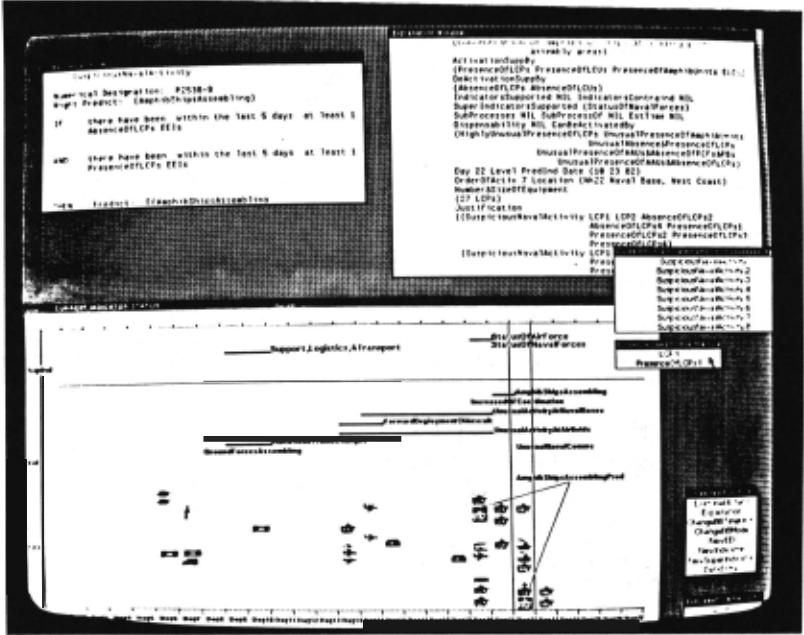
Working in conjunction with current and fonner I&W analysts, we have built an expert system to aid in this task. The various kinds of incoming reports are posted on a Blackboard [Erman et a! 75] (see Fig. 1), whose dimensions are time (marked off in days) and these three levels of abstraction:
- (i) specific reports: "expect a report of200 troops assembling at Area803 two days from now"
- (ii) higher-level indicators: "Ground forces are massing at embarkation points all over Upper X"
- (iii) very general states: "Upper X's military forces are now at full readiness"
Sixty rules react to changes on the Blackboard by drawing conclusions and making predictions; i.e., the system "works forward". A new repmt enters and is recorded on the Blackboard, various rules fire, they cause additional entries to be added, etc. Eventually this process dies down, and the · next report is read. A typical rule says:
R1: If a barracks is suddenly reported to be empty, Then expect a report, within a day, of (those) troops moving by rail or road to a nearby staging area.
When a BarracksEmpty report is posted on the Blackboard, this rule fires and synthesizes a new TroopsMoving report, and posts it on the Blackboard farther to the right (to indicate it's to occur one day later in time), with a tag indicating that it's only a prediction, not (yet!) an actual · incoming report
Rule R1 takes incoming reports and predicts future ones. Similar rules exist which predict past events that were not recorded; this is important, since intelligence gathering is quite incomplete. For instance, the inverse to the former rule says that if troops are moving by rail, they must have come from somewhere, and a few days earlier some barracks probably emptied out. It is important to make and record these postdictions, as they sometimes cause additional rules to fire which in turn make predictions reaching even farther ahead in time than the current day. If we were to redesign the system, ·aware of the frequency of these rule&inverse pairs, we would choose only state the single causal relationship, and have both Rl and its inverse derived automatically from that.
Other types of rules add entries at a higher level of abstraction, namely the indicator level rather than the incoming report level. A typical such rule, which adds one high-level entry to the Blackboard and several low level ones as well, says:
R2: IF there have been, within a 4-day period, at least 6 reports of troops readying to leave their usual base, and at least 5 are real reports (not just predictions), and in at least 4 the number of troops exceeds 500 and there is also an air de4ense system with them, and CivilianSupport&Preparedness indicator is active, Then activate the GroundForcesAssembling indicator, and keep it active for at least the next 6 days, and add predicted reports of troops moving in those areas (for each of the next 4 days)
It's often quite important to know when an indicator stops being active, and thus there are rules whose Then parts deactivate indicators, or predict such deactivation events.
III. AI Issues
So far, this design sounds like a rather standard expert system [Feigenbaum 77; Hayes-Roth et a/ 83). The program has, however, a few nonstandard features of interest to the AI community:
Representation. Knowledge is represented as frame like assemblages of attribute/value pairs. The program has separate frames for each abstract indicator (UnusualNavalActivity), each type of incoming report · (LCU'sAbsent), and -- as actual reports filter in -- the program creates a new frame for each such report (LCU'sAbsent00081). In general, a frame is created for each entry made on the Blackboard.
Most reports are of events, and each event is usually just a sub-process in an easily recognizable larger process. Thus, emptying barracks is· a subprocess of troop movement, which in turn is a subprocess of ground force readiness, which is a subprocess of military readiness for attack, etc. Each frame for a type of report records what it might be a subprocess of, how long it takes, what subprocesses it entails, which of those can be done in parallel, etc. From this information, estimates can be derived of the minimal time to various states (such as full readiness). Knowing what processes are going on, and how soon vmious states mght be achieved, "solves" the I&W problem. The analyst-reads off, at as high a level as desired, predictions of the content and date of future reports.
Besides the types of frames already described, there is a hierarchical network of frames for objects mentioned in reports. This is necesary so that, e.g., a rule that specifies 'tracked vehicles' will trigger if the incoming report mentions 'tanks'.
A separate frame also exists for each rule. For instance, R2 has not only an If and Then slot, but a Name, a NumericaJOesignator, a Creator, a CreationOate, a MightActivate, an IsA, a CertaintyOfConclusion, an OveraiiWorth, and values for several other slots. This facilitates browsing through the rules, adding new rules, debugging a faulty set of rules, finding related rules when a rule is "almost" relevant, assigning credit and blame to rules, and (hence) automatically modifying the If and Then parts of rules, their certainties, and their worths.
Control. An experimental aspect of the system is to provide rules with two different triggering conditions, an Itstrong and an !tweak. Usually, the former conditions imply the latter, though this is not essential to the idea, and in some cases in our system it is not what the experts told us; for instance, one rule's IfStrong has a conjunct of the form " ... seen 6 reports in 6 days", and its I tweak has a corresponding conjunct that tests " ... seen 2 reports in 1 day'' -- neither of these implies the other.
Two separate blackboards are in effect maintained, two entire runs of the program, if you will. In one case, mles' conditions are assumed to be their Itstrong's; in the other case, their !tweak's. Naturally, this often leads to discrepancies of which rules fire, hence which predictions get made. If the "true" conditions lie somewhere between the Itstrong and !tweak, then the "true" best predictions ought to be a superset of the Itstrong world's Blackboard, and a subset of the !tweak. world's Blackboard. In particular, if both of them make the same high-level prediction at nearly the same time, it is more likely to be correct. Conversely, if there is a crucial difference between the blackboards, we can list the rules whose difference in Ttweak and Itstrong conditions led to that discrepancy. The specific conditions can then serve to focus our attention on exactly what detailed data we should gather in the immediate future; this data is handed to collection tasking planners, whose job is to close such "information gaps", and is no longer part of the I&W problem.
The important point to make here is that, even if there is a wide difference between the low-level predictions that are made on the two blackboards, only those differences which led to important high-level differences are worth paying attention to. For instance, in a typical run, the UnusualActivityAtNavalBases and UnusualActivityAtAirfields indicators triggered on different days and in different orders in the Itstrong and !tweak cases, but still they were both close enough to each other in time that in each case the general Air&NavaiReadiness state was highlighted at the topmost level.
Explanation. The analyst must support his predictions, both qualitatively and quantitatively. As our program runs, the user can point (using a mouse-driven cursor) to an item posted anywhere on the Blackboard. S/He then receives information on it, including (if it is not a primitive report coming in as raw data) a listing of the rules that led to its posting. The user gets a stylized English translation of those rules, and can inspect them in detail if s/he desires. By pointing to any Glause in the rule's If part, the pmticular reports (or predictions or indicator activations) that were used to satisfy that clause are highlighted down below, on the display of the Blackboard. The quantitative support the analyst requires is calculated from the times taken by all the subprocesses an event requires.
Interface. The program was written in Jnterlisp-0, and runs on all Xerox 0 (1100 series) machines. Even on a Dolphin (1100) itself, rep01ts are handled so rapidly (30/minute) that we were forced to artifically slow the program down for demo purposes. The screen is divided into several windows (sec Fig. 1), the largest of which is a display of the current state of the Blackboards. The x-axis represents time, the y-axis level of abstraction and certainty. Other windows are used to display: the frame representing each incoming report; a running commentary by the program of what it's reasoning about; menus to customize the display or access the explanation facility; a tree of processes and subprocesses from which readiness time estimates are derived; and finally a list of information gaps (critical pieces of missing or uncertain information, as determined by running in two separate worlds, using Strong and Weak versions of the rules). A separate color screen is maintained, with a map of Upper and Lower X on it. As each entry is made on the blackboard, it is also drawn on the map, at its proper location. Figure 2 shows this map display, and Figure 1 the primary llOO screen, during one run.
IV. Conclusions & Future Directions
The small (50-rule) system we built is little more than a prototype system for aiding an intelligence analyst with the l&W task. Although it is incomplete in some respects, it has served as a concrete example to stimulate analysts into giving many comments for the next generation system for this task. From an AI point of view, the way we overcame some obstacles in this problem may prove to be general methods to add to the Knowledge Engineer's toolkit. We are referring to the fl~ibility of what the user sees, the representation of rules as frames, and the use of two Blackboards (driven respectively by Itstrong and !tweak conditions on rules) to find the most sensitive details in the reports, and hence to guide collection tasking.
Two directions are being pursued to continue this work in 1983. {1) The existing system is being expanded, to cover a broader range of report types. (2) We are using techniques of open-ended exploration [Lenat 83] to perform scenario generation, based on the same knowledge base of facts and rules used in the I&W
system. The goal of that project is t<;> prod';lce Ion& chains of cause and effect which terrnmate .m parucul~ly undesirable results, and then suggest spec1fic mforrnat10n to gather which, quite early on, could detect such a scenario being attempted.
ACKNOWLEDGEMENTS
This work was pursued at ESL, Inc., funded through internal R&D funds. Ed Richardson, Paul Clarke, and Len Karpf . participated in the project a!ong w~th the authors, and we.re largely responsible for the explanation fac1il~y and the map. Erme Chaves provided useful management gmdance. Consultants from Teknowledge, Inc. and analysts from government intelligence agencies were also crucial to its success. In particular, we thank Penny Nii and Mike Mitani.
@inproceedings{ijcai1983p64,
  title     = {An Expert System for Indications and Warning Analysis},
  author    = {Lenat, Douglas B. and Clarkson, Albert and Kiremidjian, Garo},
  booktitle = {Proceedings of the Eighth International Joint Conference on
               Artificial Intelligence, {IJCAI-83}},
  publisher = {International Joint Conferences on Artificial Intelligence},
  editor    = {Alan Bundy},
  pages     = {259--261},
  year      = {1983},
  note      = {Expert Systems},
  url       = {https://ijcai.org/proceedings/1983/64},
}
TY - CPAPER TI - An Expert System for Indications and Warning Analysis AU - Lenat, Douglas B. AU - Clarkson, Albert AU - Kiremidjian, Garo T2 - Proceedings of the Eighth International Joint Conference on Artificial Intelligence, IJCAI-83 PB - International Joint Conferences on Artificial Intelligence PY - 1983 SP - 259 EP - 261 UR - https://ijcai.org/proceedings/1983/64 ER -Copied
Machine-readable versions of this paper, for tools and AI agents:
 Welcome
 Future Conferences
 AI Journal Division
 IJCAI Proceedings
 About IJCAI
 IJCAI Awards