
Integrating Multiple Knowledge Representations and Learning Capabilities in an Expert System: The ADVISE System
Proceedings of the Eighth International Joint Conference on Artificial Intelligence. Expert Systems. Pages 256-257.
© 1983 International Joint Conferences on Artificial Intelligence
Abstract
The ADVISE system is an integrated set of tools for the development of and experimentation with expert systems in various specific application domains. It functions as a multi-purpose inference system that employs three knowledge representations : a rule-base, a conceptual network and a relational data base. In addition, it includes learning capabilities by incorporating the inductive learning program s GEM (for learning from examples) and CLUSTER (for constructing cl assifications). Three expert syste ms ha ve bee n developed using ADVISE: PLANT/ds (venion 2)--for diagnosing soybean di seases, PLANT fed--for predicting cutworm damage to corn, and BABY--a cons ultant for the neo-natal intensive care unit.
- Baskin, A. B., "LOGIC NETS : Variable-valued Logic plus Semantic Networks.t" in Policy Analy1i1 and Information Sy1tem1, No. 3, l98u.
- Boulanger, A., "The Expert System PLANT/cd: A case study in applying the general purpose inference system ADVISE to predicting black cutworm damage to corn ," M.S. Thesis, Department of Computer Science, University of Illinois, Urbana, Illinois, 1983.
- Buchanan, B. and Duda, R ., "Principles of Rule-B ased Ex- pert Systems ," Hueristic Programming Project, Report No. HP P-82-14 , August 1982.
- Davis, R. and King, J ., "An Overview of Production Sys- tems" in Machine Intelligence 8, Elcock and Michie (eds.), 1976.
- Duda, R. 0 ., Hart, P. E . and Sutherland, G. L. , "Semantic Network Representation in Rule-Based Inferenc e Systems," in Pattern Directed Inference S y1tem1, D. A .. Waterman and F . Hayes-Roth (eds .), Academic Press, 1978.
- Feigenbaum, E. A., "Knowledge Engineering for the 1980's," Computer Science Departm ent, Stanford Universi- ty, 1982.
- Michalski, R. S. and Larson, J . B., "Selection of Most Representative Training Examples and Incremental Gen- eratio n of VL 1 Hypothes is: The Underlyi ng Methodology and t he Descriptions of Progr ams ESEL and AQ II, " Re- port No. 877, Department 9f Computer Science, University of Illinois, Urbana, Illinois, 1978.
- Michalski, R . S. and C hilausky, R . L., "Learning by Being Told and Learning from Examples: An Experimental Com parison of the Two Methods of Knowledge Acquisition in t he Context of Developing an Ex pert System for Soybe- an Disease Diagnosis ," International Journal of Policy Analy1i1 and Information Sy1tem1, Vol. 4, No.2, 1980.
- Michalski, R. S., Davis, J. H., Bisht, V. S. and Si nclair, J . B., "PLANT /ds: An Expert System for the Diagnosis of Soy bean Diseases," European Conference on Artificial In- telligence, Orsay, France, July 12-14, 1982.
- Michalski , R. S., "A Theory and Methodology of Inductive Learning," C hapter in the book, MACHINE LEA RNING: An Artificial Intelligence Approach, TIOGA Publishing Co., R. S. Michalski , J . Carbonell and T . Mitchell (eds. ). 1983.
- Michalski, R. S. and Stepp, R ., MACHINE LEARNING: A n Artificial Intelligence Approach, TIOGA Publishing Co., 'l. S. Michalski, J . Carbonell and T. Mitchell (eds.), 1983.
- Michalski, R . S., Baskin , A. B., Boulanger, A. G., Seyler, M. R., "A Technical Description of the ADVISE Meta- ex pert system," in preparation.
- Rodewald, L. E., "BABY: An expert system for interpre- tive reporting in a neo-natal intensive care unit," M.S. Thesis, Department of Computer Science, University of Illi- nois, Urbana, Illinois, 1983.
- Spackman, Kent, " Integration of Inferential Operators with a Relational Database in an Expert System," Masters Thesis, Department of Computer Science, University of Illi- nois, Urbana, Illinois, 1983.
- Van Melle , W ., "A Domain Independent Production Rule System for Consultation Programs," Pro c. Sizth /JCAI, 1979. IJCAI
References were extracted automatically from the PDF and may contain errors.
Full text extracted automatically from the PDF; figures, tables and equations may differ. The PDF is the version of record.
Integrating Multiple Knowledge Repret!entations and Learning Capabilitii)ll in an Expert System: The ADVISE Syetem
R. S. Michalski A. B. Baskin Department of Computer Science University of lllinois Urbana, Illinois 61801-2987
ABSTRACT
The ADVISE system is an integrated set of tools for the development of and experimentation with expert sys tems in various specific application domains. It functions as a multi-purpose inference system that employs three knowledge representations: a rule-base, a conceptual net work and a relational data base. In addition, it includes learning capabilities by incorporating the inductive learn ing programs GEM (for learning from examples) and CLUSTER (for constructing classifications).
Three expert systems have been developed using AD VISE: PLANT/ds (venion 2)--for diagnosing soybean diseases, PLANT fed--for predicting cutworm damage to corn, and BABY--a consultant for the neo-natal intensive care unit .
I INTRODUCTION
At present , the technology of ex pert systems is under going very rapid growth and is being applied to a wide spectrum of pract ical problems. Current systems, however, suffer from a number of limitations that restrict their use fulness. They typically employ only one form of know ledge representation, usually a rule- base representa tion (Davis & King, 1976; Buchanan & Duda, 1982). They have no learning abilities, use only one type of inference procedure, and use only a single control strategy. Our research on the ADVISE "meta-expert" system has the goal of overcoming these limitations. Some of the relevant papers to our research are by Duda, Hart & Sutherland (1978), Van Melle (1979) and Feigenbaum (1983).
IT MAJOR FEATURES OF ADVISE
The tools which comprise ADVISE form a "knowledge engineer's workbench" for developing expert systems in particular domains, specifically, for building knowledge bases and implementing appropriate inference procedures on them. Main features of ADVISE are:
- allows use or three different forms of knowledge/data representation (a rule-base, a conceptual network, and a relational database),
- supports different schemes for uncertainty propaga tion in a knowledge base (probabilistic, approximate Bayesian, min/max logic, weighting evidence),
- separates control and planning during a consultation {8tralegic information) from more procedural informa tion such as specific action rules (tactical informa tion),
- supports different control strategies chosen when the knowledge base is built (utility optimization, proba-
bilistic network traversal, forward rule chai'ling, backward rule chaining),
- incorporates a number or existing tools for inductively deriving decision rules and control information from examples, and
- is implemented in Pascal and operates in a standard UNIX environment.
ADVISE supports multiple knowledge representations because different types of i.nformation about a problem domain can best be expressed using different formal struc tures. For instance, situation-action pairs can be efficiently represented as rules; interrelationships between concepts, constraints, or clues used in planning can be more suitably described in a network; a large collection of facts (e.g. pa tient records) can be stored and manipulated a5 a relation al database. For similar reasons, ADVISE supports a number of different schemes for defining aspects of the con sultation process on a problem specific basis. Even within a single knowledge base, it is frequently useful to mix stra tegies.
Another major feature of the system is that knowledge is acquired not only through the standard tech nique of "learning by instruction," but also · through " learning from examples" and "learning fro:n observa tion."
The latter two modes of learning have been imple mented by modifying and adapting the inductive learning programs GEM and CLUSTER. The GEM program gen eralizes examples of different concepts and creates formal logic rules for recognizing these concepts. The program is a modified version of the inductive program AQ11 (Michal ski & Larson, 1978). The feasibility of using this program for inductive knowledge acquisition for an expert system has been proven by its successful application in the development of an expert system for soybean pathology (Michalski and Chilausky, 1980; Michalski, et al., 1982).
The second program, CLUSTER, automatically con structs a classification of given entities using an approach called "conceptual clustering." Each grouping in the ob tained classification corresponds to a class of entities ( ob jects, situations, etc.) closely described by a single conjunc tive concept representing a logical product of relations on selected object attributes. Nodes with the same parent in the hierarchy are optimized according to some global "quality" criterion of classification (Michalski & Stepp, 1983).
The system also includes several inferential programs lhat support inductive learning and deal with the selection of most relevant attributes,. selection of most representa tive learning examples, etc. (Spackman, 1983).
ill COMPONENTS OF ADVISE
A functional diagram o~ the ADVISE system is shown 1n Figure I. The system consists of four major com ponents: A) Control block and user interface, B) Knowledge base, C) Query block and D) Knowledge ac quisiti<>n block.
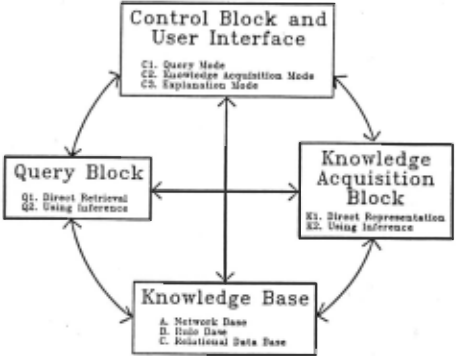
A. Control Block and User Interface
This component provides three modes of user interaction with other components:
- Query mode
- Knowledge acquisition mode
- Explanation mode.
The user interlace portion of the system provides util ity routines to manage the terminal screen and supports the explanation of internal data representations and opera tions .in a textual and graphical form.
I. Query mode (Q-mode)
Query mode is used during consultation. In this mode, the system:
- selects questions to ask the user,
- accepts user answers and
- conducts an inference process involving the knowledge base and information provided by the user in order to compute advice with an associated strength of sup porting evidence.
In one respect, the consulting portion of the system is radical in design. There is no single problem solving stra tegy. Rather, localized problem solving behavior is defined by the choice of an ev.aluation scheme (three of which are implemented) and global problem solving behavior is governed by a choice of control scheme (three of which are also implemented). Explicit provision has been made in the design for the inclusion of additional control schemes and additional evaluation schemes.
2. Knowledge acquisition mode (K-mode)
The knowledge acquisition mode coordinates both the encoding of expert derived rules in a knowledge base and the interactive invocation of the separate induction pro grains. This mode includes modules for defining expert rules, manual refinement of rules, induction of rules from examples, and automated correction and improvement of the rules. The system also provides facilities for testing rules in interactive mode on individual cases, as well as in batch mode on a collection of cases.
3. Explanation mode (E-mode)
The explanation mode paraphrases decision rules, en ables a user to understand the organization and function ing of the system in query and knowledge acquisition modes, allows simple interrogation of the contents of the knowledge base, and displays the steps in the process which led to a given advice.
B. Knowledge Base
The knowledge base integrates three types of representation through a unified "access protocol:"
- a network base (e.g., conceptual network),
- a rule base, and
- a relational data base.
The network base contains structures for representing domain knowledge about relationships among various con ceptual units. The network organization is a form of the "Logic Net" formalism described in (Baskin 1980).
The rule base consists of inference rules in the form:
CTX CONDITION==* CONCLUSION: a,{J
where CTX is a logical expression defining the context in which the rule is applicable, CONDITION is a logical expression defining the conditions that have to be satisfied to assert the CONCLUSION,
- a - the strength of forward implication (from CON DITION to CONCLUSION),
- fJ- the strength of backward implication (from CONCLUSION to CONDITION).
The relational data base consists of a collection of re lational tables. The tables can be created, modified and re trieved through ordinary relational database operators. In addition, a variety of inferential operators can be applied to the database through the facilities of QUIN (Q..y_ery & Inference) subsystem (Spackman, 1983) .
C. Ouerv Block
The Query block contains the programs supporting retrieval from the knowledge base. Direct retrieval is sup ported as a relational algebra for tables and a simple infix display of rules. Retrieval with inference will deductively and inductively extend the knowledge base in response to a user query.
D. Knowledge Acquisition Block
The system supports knowledge acqms1t1on for net works, tables, and rules. Direct encoding is supported by input of tables or rules ("learning by being told") and knowledge acquisition through induction is supported by linkage to learning programs. Additional details about the Query and Knowledge Acquisition blocks can be found in (Michalski, et . al., 1983).
IV SUMMARY
The major modules of the ADVISE system have been implemented In the PASCAL language (approximately 45000 lines of code) for the VAX 780 computer under Berkeley-Unix operating system. The knowledge base management component of the system is well developed and has been used extensively. The query block is partial ly complete and is best developed for the relational data base. Knowledge acquisition currently supports direct representation of information supplied by a human expert as well as induction of class ifications. and rules . The expla nation mode is least developed and currently provides little more than an English paraphrase of rules and links within the network.
The system has already been applied for the develop ment of three expert systems: PLANT/ds (v.2), PLANT/de, and BABY. PLANT/ds (v.2) provides advice on the diagnosis of common soybean diseases in Illinois . PLANT /de predicts damage to corn due to black cutworms. Its operation is based on a close cooperation "surface" model utilizing a rule base, and a "deep" model simulating the black cutworm corn development (Boulanger, 1983 ). The system called BABY provides ex pert advice on monitor and laboratory data for the neo natal intensive care unit. The system reasons from the available data toward specific pathologic states using a Bayesian update scheme (Rodewald, 1983).
ACKNOWLEDGEMENTS
The research described here has been supported in part by the Office of Naval Research, Grant No. N0001482-K-0186 and in part by the National Science Foundation, Grant No. MCS 82-05166. The authors thank A. Boulanger, M. Seyler, L. Rodewald. K. Spackman, C. Uhrik and R. Reinke for their contribution to the develop ment of ADVISE, its first experimental applications and comments on this paper.
@inproceedings{ijcai1983p63,
  title     = {Integrating Multiple Knowledge Representations and Learning Capabilities in an Expert System: The ADVISE System},
  author    = {Michalski, Ryszard S. and Baskin, Arthur B.},
  booktitle = {Proceedings of the Eighth International Joint Conference on
               Artificial Intelligence, {IJCAI-83}},
  publisher = {International Joint Conferences on Artificial Intelligence},
  editor    = {Alan Bundy},
  pages     = {256--257},
  year      = {1983},
  note      = {Expert Systems},
  url       = {https://ijcai.org/proceedings/1983/63},
}
TY - CPAPER TI - Integrating Multiple Knowledge Representations and Learning Capabilities in an Expert System: The ADVISE System AU - Michalski, Ryszard S. AU - Baskin, Arthur B. T2 - Proceedings of the Eighth International Joint Conference on Artificial Intelligence, IJCAI-83 PB - International Joint Conferences on Artificial Intelligence PY - 1983 SP - 256 EP - 257 UR - https://ijcai.org/proceedings/1983/63 ER -Copied
Machine-readable versions of this paper, for tools and AI agents:
 Welcome
 Future Conferences
 AI Journal Division
 IJCAI Proceedings
 About IJCAI
 IJCAI Awards