
Representation of Experts' Knowledge in a Subdomain of Chess Intelligence
Proceedings of the Eighth International Joint Conference on Artificial Intelligence. Expert Systems. Pages 252-254.
© 1983 International Joint Conferences on Artificial Intelligence
Abstract
This paper considers how to represent rule kno~1ledge in a chess-endgame procedure. The rrocedure, to be used jointly with depth-first searching, deals with the King, Bishop and Knight versus King (KBNK) endgame; the rules derive from theory books , discussions with (grand)masters and th e author's experience. The knowledge about rules is structured: partitioning into patterned equivalence classes (Bramer , 1975, 1977) is extended so as to make the procedure act similarly to a human expert, who, in the KBNK domain, prefers to be guided by patterns rather than by exploring move sequences in depth . The procedure, applied by incorporation in PION, a chess-playing program, has been tested and commented upon by Averbach and others and has proved to execute correct mates in all cases submitted . It is concluded that, within its domain, its level is that of a chess expert though no proof is available that its play is optimal. KBNK has been solved constructively by a supplementary data-base approach, establishing it as a 33move game in the maximin sense. This result, as well as some others presented here, are new to the theory of chess. The research reported may well lead to improving experts' play.
- REFERENCES BRAMER, M.A. (1975). Representation of Knowledge for Chess Endgames. Technical Report, The Open Universi- ty: Faculty of !•lathematics , Hilton Keynes, England.
- BRAMER, M.A. ( 1977). Representation of Knowledge for Chess Endgames: Towards a Self-improving System. Ph.
- D. Thesis, The Open University: Faculty of Mathema- tics, Milton Keynes, England.
- BRAMER, M.A. (1982). Refinement of Correct Strate- gies for the Endgame in Chess . SIGART Newsletter, Special issue, Game-playing P•rograms: Theory and Practice (ed.
- M.A. Bramer), pp. 155 -1 63 .
- BRATKO , I. & NIBLETT, T. (1979). Conjectures and re- futations in a framework for chess endgame knowledge. Expert Systems in the micro electronic age (ed. D. Michie), pp. 83-101. Edinburgh University Press, Edinburgh.
- CHERON , A. (1964). Lehr-und Handbuch der Endspiele, Band II. zweite verbesserte Auflage. Printed in Ger- many (1973) , .pp. 10-13. Siegfried Engelhardt Verlag, Berlin 28, (Frohnau) .
- DEKKER, S.T. & AMPT, G.J. (1981). Het matzetten met loper en paard. Computerschaak, Jrg. 1, No. 5, pp. 32-37 .
- DEKKER, S.T. & HERIK, H.J. VAN DEN (1982 a). Aver- bach en Elo in Delft. Computerschaak, Jrg. 2, No. 4, pp. 122-124.
- DEKKER, S.T. & HERIK, H.J. VAN DEN (1982 b). Mat met loper en paard. Computerschaak, Jrg. 2, No. 4, pp. 129-138.
- DEKKER, S.T. & HERIK, H.J. VAN DEN (1982 c). Toch mat in 33. Computerschaak, Jrg. 2, No. 5, pp. 167- 168.
- DEKKER, S.T. & HERIK, H.J. VAN DEN (1983 a). De kon- struktie van een database voor het matzetten met loper en paard (1). HCC Nieuwsbrief 46, Jrg. 5, No. 12' pp. 53-56.
- DEKKER, S.T. & HERIK, H.J. VAN DEN (1983 b). De kon- struktie van een database voor het matzetten met lo- per en paard (2). HCC Nieuwsbrief, in press.
- DELETANG, D. (1923). Mat avec le Fou et le cavalier. La Strategie, Vo~. 56, No. 2, pp. 25-32.
- DERKSEN, J. & HUISMAN, J. (1982). Het schaakprogram- ma PION. Vorderingen in 1981/Y982. Onderafdeling der Wiskunde & Informatica, TH Delft, Delft.
- GROOT, A .D. DE (1965). Thought and Choice in Chess (ed . G.W. Baylor). Second edition 1978. Mouton Pub- lishers, The Hague-Pari s-New York.
- HERIK, H.J. VAN DEN (1980 a). Computerschaak, Direk- te evaluatie door middel van patroonherkenning in het KNPK-eindspel. Technische Hogeschool Delft, Delft.
- HERIK, H.J. VAN DEN (19 80 b). Goal-directed Search in Chess End Games. Delft Progress Report, Vol. 5 , No. 4 , pp. 253-279.
- HERIK, H.J. VAN DEN (1982). Strategy in Chess End- games. SIGART Newsletter, Special issue, Game-Play- ing Programs: Theory and Practice (ed.
- M.A. Bramer), pp. 145-154.
- HERIK, H.J . VAN DEN (19 83) . Computerschaak, Scha~k wereld en Kunstmatige Intelligentie. Ph.D. Thesis, Technische Hogeschool Delft. Academic Service , 's- Gravenhage.
References were extracted automatically from the PDF and may contain errors.
Full text extracted automatically from the PDF; figures, tables and equations may differ. The PDF is the version of record.
1. INTRODUCTION
While the theory of chess is continually being add ed to , it is, by the same token, far from perfect. In the last few years , a new element has entered: extension of the theory no longer depends on human thoughts and ideas only . In the chess field , AI programs and problem-solving programs, consulting a pre-constructed data base, have begun to contri bute . The strategy is known to depend on the con cepts the player has in mind. For example, a grand master "knows" how to handle a certain position and this is why he immediately "sees" the "right" move (De Groot, 1965) . Extending the body of knowl edge capable of supporting the chess-player's concepts may result in an expert 's playing:
- ( i) acceptably in positions where no guidance was available before;
- ii) correctly in positions which were not suffic iently explored before;
- (iii) optimally in positions exhaustively charted by the knowledge supplied .
The fundamental question reads as follows: is it possible to achieve similar results by extending the knowledge of a chess program as by extending
H.J. van den Herik Delft University of Technology Department of Mathematics and Informatics Julianalaan 132 2628 BL DELFT / THE NETHERLANDS
the knowledge available to human experts? For some types of endgame, the answer is in the affirmative, though the process of extending a program's knowl edge is far from trivial (Bramer, 1977; Bratko & Niblett, 1979; Van den Herik , 1980 b).
The knowledge to be supplied is extensive and high ly detailed, e.g., the rules in the KBNK endgame need to be very explicit €Ven if the King Alone is pinioned since he may be in the wrong corner) . This paper will report the results of a new method (Van den Herik, 1980 b, 1982) of representing knowledge, combined with conventional depth-first searching, to the special domain of the KBNK endgame.
2 . THE STRUCTURE OF THE ALGORITHM
Bramer (1975) , introducing the concept of equival ence classes, did not admit any searching beyond a depth of one ply. In his view, in an elementary end game, such as King and Pawn vs . King (KPK), the pro gram should rely on explicit knowledge only. Even for KPK , Bramer's program needs 20 classes for a correct strategy and 38 for an optimal strategy. As the complexity of the endgame increases ·, a point is soon reached where the number of equivalence classes grows beyond reason (Van den Herik, 1980 a). In order to keep the number of classes (embodying knowledge) down to manageable proportions for more complex endgames , the concomitant use of deeper searching is appropriate. This combination has proved succesful in a number of four-piece endgames, such as KNPK, KBNK and KBPK.
Our basic move-finding algorithm (in which White is assumed to be the stronger side and to move first) , derived from Bramer 's algorithm, is structured as follows:
- generate the set Q of all immediate successor po sitions of a position p;
- find the highest ranked element of Q, say q;
- play the move corresponding to q.
In step b) , find means 'determine by goal- directed search' . In accordance with Bramer , we induce a ranking on Q by defining an overall ranking on the set Q*, being the set of all legal BTM (Black to move) ~ositions. We assign each position in Q to exactly one of a number of disjoint subsets, ex haustively partitioning Q*. The aim is for each sub set of the partition, termed a class, to correspond to some significant recognizable feature of the endgame as perceived by chess- players , e.g . , 'Black is in check' . The connection between 'partition', 'feature' and 'class' is given by regarding features as equivalence relations, on which a fundamental theorem reads: "Let F be an equivalence relation on Q*. Then the quotient set Q*/F is a partition of Q* " This allows the programmer to list distinct static board·features F 1 , F 2 , F 3 , ··· , etc., which induce a partition in tne a6ove sense. Therefore, for all q:
Using if-then rules, the construction is as follows:
Notice that in this construction the guaranteed or der of the execution of the tests allows us to sim plify the descriptions of the composite predicate functions Fi' because it is now true that
In order to effect the closure of the equivalence relation on Q*, one introduces a residual class with the empty feature Fn such that
If a position belongs to the residual class, the search must be continued; ·no assignment should be made at this point, an analogous procedure starts with Black to move and Black's set of F . · If two different moves lead to positions whichl.belong to the same class (other than the residual class) , a specific scoring function must be applied in order to break ties. If the tie persists, the first posiE ion examined will be chosen. Of course, a maximum depth of searching has to be decided in advance. Having reached the maximum depth values must be as signed to each position so reached. This means that we need two more sets of· equivalence classes for finaZ positions with White and Black to move respec tively.
The four sets of equivalence classes required to construct an evaluated search tree may be whittled down to three when one determines that a specific side is always to move in the maximum depth posit ion. We introduce the following names for our sets.
stop
- the set of patterns (features of posit ions) with Black to move applicable when the value of the position investigated can be determined straightforwardly;
- haZt similar to stop, but with White to move; bZackevaZ: the set of patterns which differentiate among the positions with Black to move when the maximum depth of searching has been reached and the positions must be evaluated;
whi t evaZ similar to bZackevaZ, but with White to move.
The introduction of these four sets of evaluation functions leads naturally to a tree structure of which the following is a typical instance.
[our example is a 5-ply tree; the numbering of the branches reflects the sequence of traversal in this instance.]
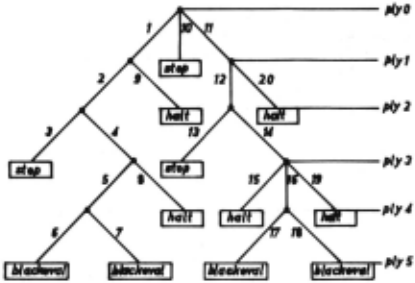
In order to prevent the generation of inappropriate moves, a heuristic function, called reject , has been introduced which trims the generator of all legal moves into a generator of all plausible moves for the endgame in question. In summary, the algorithm constructs a tree with a variable but limited depth. The fanout varies with the level (ply). This and the actual depth depend on the given position.
3 . THE KBNK PROGRAM
In a previous experiment, we used the KNPK ending with the Pawn on the h-file as a test-bed for the representation of ches&"endgame knowledge (Van den Herik, 1980 b, 1982). One of the possible generali zations mentioned in the 1982 article was the appli cation of that technique to the KBNK endgame. The resulting KBNK program, HEDEAM, has been designed and implemented by Van den Herik, Dekker and Ampt. It is based on the theory for this specific endgame as pioneered by Deletang (1923) and very systemati cally described by Cheron (1964). Dekker and Ampt (1981) have recast this theory for specific use in an endgame program.
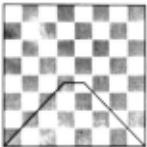
The assumptions in our model are
i) White possesses the Bishop and Knight;
ii) White's Bishop is on a black square;
(iii) The black King (BK) is within the trapez ium a1-h1-e4-d4.
r......:!----'1....1.-0>1 DIAGRAM 1 ·
None of these assumptions detracts from generality: (i) is circumvented by relabelling sides; (ii) can be complied with by reflection in the vertical mid line, while (iii) can always be made to obtain by mirror reflection in one of the diagonals or both.
In st op , haZt , bZackevaZ , whitevaZ and reject , chess knowledge from theory books, grandmasters and the author's experience is accumulated. The numbers of patterns in the evaluation functions total: 17 in stop , 3 in haZt, 4 in bZackevaZ and 4 in whitevaZ . A full description of the patterns in these funct ions is given by van den Herik (1983).
In order to convey some idea about the partitions by class, we cite the first part of stop , with the pat terns transposed into human terms.
class 1: Bishop or Knight are no longer on the board class 2 : Mate
class 3: Stalemate
class 4: Bishop or Knight are under attack
class 5: BK locked in the small Bishop triangle
class 6: BK locked in the proper corner with a Bishop at a distance
class 7: BK locked in the middle Bishop triangle
class 11: BK locked in the large Bishop triangle and so on.
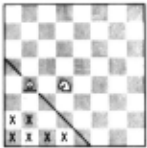
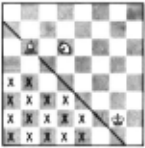
DIAGRAM 3
The middle Bishop triangle The large Bishop triangle [x indicates possible positions of the Black King]
The flavor of stop is possibly illustrated by a mi nor extract: if none of the preceeding classes ap ply, membership of class 5 is the truth of ( (bk<c1) && (wb==a3 llwb==c1)"&& (wk!&refl3sq (\ib) && (d(wk,wb) <3) && (d(wk, c2) <=d(bl~ ,c2) II nd(c2) ==1) && (d(wk,b3) <=d(bk,b3) II nd(b3) ==1));
for three lines out of 39, and incidentally involv ing refl3sq(wb) for reflection (iii) for generality.
4. HEDEAM' s PERFORMANCE
The performance of HEDEAM has been tested by sev eral masters and grandmasters, Averbach, Elo, En klaar and Sosonko among them. It has passed the ex pert test many times, occasionnally summa cum Zaude , producing a more direct way to mate than was fore seen by a (grand)master. Evenso, its play, while correct, falls short of the optimal, as proved by the technique of 5, below. Yet, International Grand master Yuri Averbach, one of the world's best end game specialists, was impressed by HEDEAM's system atic approach to forcing a mate, for example for the following position (Dekker & Van den Herik, 1982 a) .
White: HEDEAM (Ka8 Bh1 Nh8)
Black: Averbach (Kd4)
TH Delft, 19 mei 1982
1. Kb7 Kc5 2. Nf7 Kb5 3. Ne5 Kc5 4. Kc7 Kd4 5. Kd6 Kc3 6. Kc5 Kb3 7. Kd4 Kb2 8. Kd3 Kc1 9. Nc6 Kb2 10. Nd4 Kc1 11. Kc3 Kb1 12. Nb3 Ka2 13. Be4 Ka3 14. Bb1 Ka4 15. Nd4 Ka3 16. Nb5+ Ka4 17. Kc4 Ka5 18. Bf5 Ka4 19. Bd7 Ka5 20. Nc7 Kb6 21. Nd5 Ka5 22. Kb3 Ka6 23. Ka4 Kb7 24. Ka5 Ka7 25. Bc8 Kb8 26. Ba6 Ka7 27. Ne7 Ka8 28. Kb6 Kb8 29. Nc6+ Ka8 30. Bb7 mate
The applicability of HEDEAM is ensured by its being incorporated as an endgame procedure in the chess program PION (TH Delft) · The interfaces are descri bed in Derksen and Huisman (1982).
5. KBNK IS A 33-MOVE ENDGAME
The KBNK endgame can be regarded as a constructive maximin problem: what is the maximum of the minimal number of moves necessary and sufficient for White to mate the black King Alone, starting from an ar bitrary position with White to move and assuming optimal counterplay by Black?
The estimates of chess publicists diverge consider ably; Pachman conjectured 32, Rabinovich 33, Euwe/ Donner 34, Fine 34, Golombek 'about 34', Averbach 'etwa 35', Znosko-Borovsky 40. No specification is found in Bijl, Cheron, Keres and Withuis. Computer chess researcher Bramer ( 1982) stated: ' ··· the .end game King, Bishop and Knight versus King is thought to require up to 34 moves to win and an error in certain critical positions can easily lead to an ex ceeding of the 50-move limit.'
Prompted by the prevailing uncertainty, Dekker and van den Herik decided to build a data base for the KBNK endgame solving the maximin problem, in fact by exhaustive enumeration. Their findings have been pub lished in 'Computerschaak' (Dekker & van den Herik, 1982 b, 1982 c) stressing the chess-theoretical as pects and in the HCC Nieuwsbrief, (Dekker & van den Herik, 1983 a, 1983 b) with stress on the computer science aspects.
The most important results are
- The KBNK endgame has a 33-move maximin solution.
- Rabinovich was the only one to have this predicted.
- No chess publicist (not even Rabinovich) had pub lished an analysis optimal in the maximin sense.
- There are 1104 'mate in 33' positions.
- Not a single 'mate in 33' position had been pub lished before, let alone a 'mate in 33' solution.
- Black's best counterplay often involves his taking refuge in a corner the extreme square of which is opposite in colour to White's Bishop's.
- Forcing the King from the large Bishop triangle to the middle Bishop triangle (the method of De letang) need not represent an optimal method of play.
- The KBNK data base contributes to the theory of chess by providing new patterns.
6 . FUTURE RESEARCH
The implementation of the KBNK endgame, as embodied in HEDEAM, has also led to an improvement of end game-program construction by sparking a new idea in the compilation of knowledge to be fed to programs. In order to be able to deal with a large amount of endgame programs, we are working on a pattern compi ler pursuing the following aims :
- to make the pattern files readable to a chess player who is not a computer specialist;
- to give chess-players of this kind the opportu nity to construct, in person, a pattern file for a given endgame;
- to be able to implement all subsequent programs much faster.
A fuller description of this idea has been published by Van den Herik (1983).
Another research item is based on a contrast between pattern-driven HEDEAM and the brute-force data-base approach. Whenever HEDEAM deviates from the optimal path, it is intended that the program's rules should be refined with the ultimate aim of refining the pro gram's strategy, now correct, into an optimal one in Bramer's 1982 sense of these terms .
7 · ACKNOWLEDGEMENTS
The author wishes to thank Prof.dr. I.S. Herschberg for his many valuable suggestions on the substance of the research described in this paper and its pre decessors. He is also grateful for Herschberg's care ful scrutiny of the English text. The co-operation with the students Sito Dekker and Gilles Ampt has inspired all three of us; it was Sito Dekker, in par ticular whose initiative led to many of the results in this paper . The competent technical assistance of Jan Roerade and of Ms . J.W. Pesch who did all the typing is also gladly acknowledged as having been essential to the production of this publication.
8 . REFERENCES
BRAMER, M.A. (1975). Representation of Knowledge for Chess Endgames. Technical Report, The Open Universi ty: Faculty of !·lathematics , Hilton Keynes, England.
BRAMER, M.A. ( 1977). Representation of Knowledge for Chess Endgames: Towards a Self-improving System. Ph. D. Thesis, The Open University: Faculty of Mathema tics, Milton Keynes, England.
BRAMER, M.A. (1982). Refinement of Correct Strate gies for the Endgame in Chess . SIGART Newsletter, Special issue, Game-playing P·rograms: Theory and Practice (ed. M.A. Bramer), pp. 155-163 .
BRATKO , I. & NIBLETT, T. (1979). Conjectures and re futations in a framework for chess endgame knowledge. Expert Systems in the micro electronic age (ed. D. Michie), pp. 83-101. Edinburgh University Press, Edinburgh.
CHERON , A. (1964). Lehr- und Handbuch der Endspiele, Band II. zweite verbesserte Auflage. Printed in Ger many (1973) , .pp. 10-13. Siegfried Engelhardt Verlag, Berlin 28, (Frohnau) .
DEKKER, S.T. & AMPT, G.J. (1981). Het matzetten met loper en paard. Computerschaak, Jrg. 1, No. 5, pp. 32- 37 .
DEKKER, S.T. & HERIK, H.J. VAN DEN (1982 a). Aver bach en Elo in Delft. Computerschaak, Jrg. 2, No. 4, pp. 122-124.
DEKKER, S.T. & HERIK, H.J. VAN DEN (1982 b). Mat met loper en paard. Computerschaak, Jrg. 2, No. 4, pp. 129-138.
DEKKER, S.T. & HERIK, H.J. VAN DEN (1982 c). Toch mat in 33. Computerschaak, Jrg. 2, No. 5, pp. 167168.
DEKKER, S.T. & HERIK, H.J. VAN DEN (1983 a). De kon struktie van een database voor het matzetten met loper en paard (1). HCC Nieuwsbrief 46, Jrg. 5, No. 12' pp. 53-56.
DEKKER, S.T. & HERIK, H.J. VAN DEN (1983 b). De kon struktie van een database voor het matzetten met lo per en paard (2). HCC Nieuwsbrief, in press.
DELETANG, D. (1923). Mat avec le Fou et le cavalier. La Strategie, Vo~. 56, No. 2, pp. 25-32.
DERKSEN, J. & HUISMAN, J. (1982). Het schaakprogram ma PION. Vorderingen in 1981/Y982. Onderafdeling der Wiskunde & Informatica, TH Delft, Delft.
GROOT, A.D. DE (1965). Thought and Choice in Chess (ed . G.W. Baylor). Second edition 1978. Mouton Pub lishers, The Hague-Paris-New York.
HERIK, H.J. VAN DEN (1980 a). Computerschaak, Direk te evaluatie door middel van patroonherkenning in het KNPK- eindspel. Technische Hogeschool Delft, Delft.
HERIK, H.J. VAN DEN (1980 b). Goal-directed Search in Chess End Games. Delft Progress Report, Vol. 5 , No. 4 , pp. 253- 279.
HERIK, H.J. VAN DEN (1982). Strategy in Chess End games. SIGART Newsletter, Special issue, Game-Play ing Programs: Theory and Practice (ed. M.A. Bramer), pp. 145-154.
HERIK, H.J . VAN DEN (19 83) . Computerschaak, Scha~k wereld en Kunstmatige Intelligentie. Ph.D. Thesis, Technische Hogeschool Delft. Academic Service , 's Gravenhage.
@inproceedings{ijcai1983p62,
  title     = {Representation of Experts' Knowledge in a Subdomain of Chess Intelligence},
  author    = {van den Herik, H. Jaap},
  booktitle = {Proceedings of the Eighth International Joint Conference on
               Artificial Intelligence, {IJCAI-83}},
  publisher = {International Joint Conferences on Artificial Intelligence},
  editor    = {Alan Bundy},
  pages     = {252--254},
  year      = {1983},
  note      = {Expert Systems},
  url       = {https://ijcai.org/proceedings/1983/62},
}
TY - CPAPER TI - Representation of Experts' Knowledge in a Subdomain of Chess Intelligence AU - van den Herik, H. Jaap T2 - Proceedings of the Eighth International Joint Conference on Artificial Intelligence, IJCAI-83 PB - International Joint Conferences on Artificial Intelligence PY - 1983 SP - 252 EP - 254 UR - https://ijcai.org/proceedings/1983/62 ER -Copied
Machine-readable versions of this paper, for tools and AI agents:





