
Artificial Intelligence and Macro-Economy, An Application
Proceedings of the Eighth International Joint Conference on Artificial Intelligence. Expert Systems. Pages 250-250.
© 1983 International Joint Conferences on Artificial Intelligence
Abstract
This paper describes an Expert-System (E.S.) for automatic econometric mouelling. The aim of the system is to build a set of econometric equations on a data base. The specifications of the economic relationships are made explicit in a knowledge-based system in LISP. So the E.S. has two components : the first is an economic problem solving one, the second is a statistical and economic component. A third component which will interpret the econometric test of the statistical correlations and give economic explanation is envisaged.
- J.•L. Roos 251
- Davis R., Buchanam B. and Shortliffe E., "Production Rules as a Representation for a Knowledge Based Consultation Program." Arti- ficial Intelligence 8:1 (1977) 15-45.
- Lauriere J.L., "Representation et Utilisation des Connaissances." Technique et Science Infor- matiques 1:1 et 2 (1982) 25-42, 109-134.
- Phelps E.S., "Substitution, Fixed Proportions, Growth and Distribution." International Econo- mic Review 4:3 (1963) 265-288 .
- Pinson S., "Representation des Connaissances dans les Systemes Experts." Revue Franc;aise d'Analyse d'Informatique et de Recherche Ope- rat~onnelle 15:4 (1981) 343-367.
- Roos J .L., "Les Automates Formels Appliques a l'Etude eta la Classification des Modeles Econometriques." Revue Fransaise d'Analyse d'Inforrnatique et de Recherche Operationnelle 16: 2 ( I 983) .
- Winston P.H., Horn B.K.P., "LISP." Addison- Wesley Publishing (1981).
References were extracted automatically from the PDF and may contain errors.
Full text extracted automatically from the PDF; figures, tables and equations may differ. The PDF is the version of record.
ARTIFICIAL INTELLIGENCE AND MACRO-ECONOMY, AN APPLICATION
Jean-Louis Roos Associate Professor at the University of Aix-Marseille II, France
Centre d'Economie Industrielle
There are five sorts of answers :
- These about the general caracteristics of the production function and the strategy followed by the user. For instance the manufacturing sector, the periodicity, the beginning date of the data, and so on.
- These asking for documentation. At any time it is possible to obtain more information and even bibliographic documentation.
- These about explanation : the system can explain WHY it asked a question, WHAT is this know ledge, and HOW it learned such and such a fact. So it has the complete ability to provide explanations for its behavior and knowledge.
- The order to quit the session.
- A correct answer to the question new fact. it is a
- If the sys tern don't unders Umd the an·swer, it ask again the question.
B. The inference engine
The answer to the question is put in a fact base. At each new fact the rules are invoked. The search strategy is simply a forward chaining. If all the premises of a rule are in the fact base, the rule is applied, and a set of new facts, the THEN part of the rule, is inserted into the fact base. The rules are again invoked and the process continues ·until no applicable rules are found. The rules are not probabilist and all the rules where the premises are right are applied.
When a new fact is added to the fact base, it is analysed, and it modifies the frame. There is a new search for the next NIL value of the frame. When all values are placed in the frame the E.S. makes a parameter file for the econometric estima tion.
Then the second part (the economectric part) is called. Before the E.S. tells the user the fact
it has learned.
C. The rules and meta-rules
In an extented version which will treat a larger part of the macro-economic theory there will
ABSTRACT
This paper describes an Expert-System (E.S.) for automatic econometric mouelling. The aim of the system is to build a set of econometric equa tions on a data base. The specifications of the economic relationships are made explicit in a knowledge-based system in LISP. So the E.S. has two components : the first is an economic problem solving one, the second is a statistical and eco nomic component. A third component which will in terpret the econometric test of the statistical correlations and give economic explanation is en visaged.
I INTRODUCTION
The Expert-System described here is designed to provide assistance in the task of building eco nometric models (Roos, 1983). The aim of the sys tem is to build a set of equations which would help to explain and calculate the factors of the aggregate demand for a manufacturing sector. The E.S. has two components : the first, with a capa city for reasoning, transfers his knowledge to the user and asks questions about the given problem . It works with IF-THEN production rules in the sameway as the usual Expert-Systems (Lauriere, 1982). The second, works with an econometric soft ware and a data base. It uses parameters issued by the first component ro estimate a set of equa
tions.
II THE PROBLEM-SOLVING-SIDE
A. The question-answering overview
This economic problem-solving component runs around a fran·.e which represents the whole infor mation of a production function . This frame has for elements the objects of the E.S ., there are 5 obj~cts : the general caracteristics of the function, the labor factor, the capital factor, investment and index of capacity utilisation. Every ooject has attributes and every attribute has values (Pinson, 1981). At the beginning of the session all the values are at NIL, at each NIL value the "inference engine" activates a call function for a question. The answers are accepted in french natural language (of course it is not really a natural language but the syntactic and semantic analyser can recognize the probable meaning of the answers).
be a number of meta-rules to define the domain of search. In this simple version there are few meta rules : a few to define the user's strategy (if the user searches for production function limited to labor, there will be no question about capi tal !), and a few to recognize if a new fact is correct in the context of the previous fact.
There are thus two types of rules : the error-rules (34 rules) which are invoked each time and applied if a fact is incorrect and the added fact -rules (40 rules) invoked only if no error rules are applied.
When the user answers at a question with a new fact this last is tested with the error-rules to see if it is consis tent with the others facts in the fact-base. If not, the error is explained, the last fact is destroyed and the system asks again for the question. Else the last fact is put in the fact base and the added-fact-rules are in voked.
III THE ECONOMETRIC SIDE
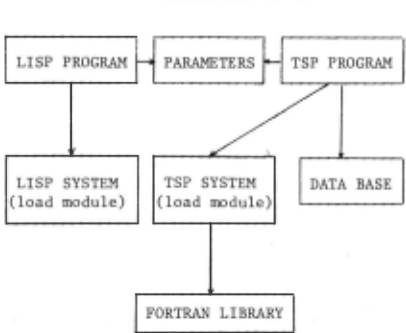
The econometric component contains about a thousand forms of econome tri c estimations. It is made with a TSP (Time Series Processor) program which runs on the 3.5 version. There are a lot of econometric program which are called according to the parameters issued from the first part. A set of equations are so evalued from the data base.
The system can evalue econometric equations for labor (two equations can be estimated if there is a productivity cycle), investment, capital, and sometimes for index of capacity utilisation. So a production function can have 5 equations which are economic consistent : they accept capital - labor substitution (putty-putty), fixed proportion (clay clay) or fixed proportion ex-post with new capital (putty-clay) (Phelps, 1963). ·
The estimations are done with ordinary least square or Almon procedure for quarterly data. The all system is represented in figure I. Actually a complete session with econometric estimation takes about 3 minutes. A micro version will be implemen ted in APPLE II soon with PROLOG.
@inproceedings{ijcai1983p61,
  title     = {Artificial Intelligence and Macro-Economy, An Application},
  author    = {Roos, Jean-Luis},
  booktitle = {Proceedings of the Eighth International Joint Conference on
               Artificial Intelligence, {IJCAI-83}},
  publisher = {International Joint Conferences on Artificial Intelligence},
  editor    = {Alan Bundy},
  pages     = {250--250},
  year      = {1983},
  note      = {Expert Systems},
  url       = {https://ijcai.org/proceedings/1983/61},
}
TY - CPAPER TI - Artificial Intelligence and Macro-Economy, An Application AU - Roos, Jean-Luis T2 - Proceedings of the Eighth International Joint Conference on Artificial Intelligence, IJCAI-83 PB - International Joint Conferences on Artificial Intelligence PY - 1983 SP - 250 EP - 250 UR - https://ijcai.org/proceedings/1983/61 ER -Copied
Machine-readable versions of this paper, for tools and AI agents:
 Welcome
 Future Conferences
 AI Journal Division
 IJCAI Proceedings
 About IJCAI
 IJCAI Awards