
A System for Improving the Recognition of Fluently Spoken German Speech
Proceedings of the Eighth International Joint Conference on Artificial Intelligence. Natural Language. Pages 633-634.
© 1983 International Joint Conferences on Artificial Intelligence
Abstract
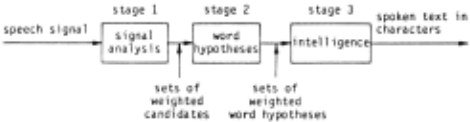
A research project for improving the recognition of fluently spoken German speech is presented. The work is in progress at present.* It should be investigated, how far aspects ofsemantics and inferences could improve the automatic speech recognition. The work is part of a speech recognition system that receives speech sig-nals, converts them into forms suitable for f~rther actions and finally puts out the spoken text 1n characters. The system itself operates at three stages. Within the first one the signal analysis is performed using a well-known method . This analysis segments the signal into certain subword units and, for each segment, produces a set of weighted candidates. At the second stage these candidates areused to generate weighted word hypotheses with the aid of an extensive lexicon. The hypotheses have to be verified or falsified within the following processinq steps at the third stage. Thereby the algo-rithm uses a best-first strategy (hypotheses with highest weight first). Besides syntactic/grammatical aspects, semantic analysis and inferences mentioned above are the methods, that should lead to a certain text-comprehension.
- Dettweiler, H., "An Approach To Demisyllable Speech Synthesis of German Words". In Proc. IEEE Co~f . on Acoustics, Speech and Signar- Processlng, Atlanta, Georgia, USA, March 1981, pp. 110-113.
- Ruske, G. and Schotola, T., "An Approach to Speech Recognition Using Syllabic Decision Units". In Proc. IEEE Conf. on Acoustics, Speech and Signal Processing, Tulsa, Okla- homa, USA, April 1978, pp. 722-725.
- R~esbeck, C.K. and Schank, R.C., "Comprehen- Slon by Computer: Expextation-based Analysis of Sentences in Context". In Levelt, W.J. and Flores Dervais (eds.), "Studies in the Per- ception of Language", John Wiley and Sons, 1978, pp. 247-293.
- Schank, R.C., "Conceptual Information Pro- cessing", Amsterdam, North-Holland Publ. Co. 1975. '
References were extracted automatically from the PDF and may contain errors.
Full text extracted automatically from the PDF; figures, tables and equations may differ. The PDF is the version of record.
Joachim Mudler
Institut fUr Nachrichtentechnik, Technische Universitat Braunschweig Schleinitzstr. 23, D-3300 Braunschweig, Fed. Rep. Germany
ABSTRACT
A research project for improving the recogni tion of fluently spoken German speech is presented. The work is in progress at present.*
It should be investigated, how far aspects of semantics and inferences could improve the automa tic speech recognition. The work is part of a speech recognition system that receives speech sig nals, converts them into forms suitable for f~rther actions and finally puts out the spoken text 1n characters. The system itself operates at three stages. Within the first one the signal analysis is performed using a well-known method . This analysis segments the signal into certain subword units and, for each segment, produces a set of weighted candi dates. At the second stage these candidates are used to generate weighted word hypotheses with the aid of an extensive lexicon. The hypotheses have to be verified or falsified within the following pro cessinq steps at the third stage. Thereby the algo rithm uses a best-first strategy (hypotheses with highest weight first).
Besides syntactic/grammatical aspects, seman tic analysis and inferences mentioned above are the methods, that should lead to a certain text-com prehension.
INTRODUCTION
This paper presents the basic concept of a speech recognition system for fluently spoken Ger man speech. The goal is to improve recognition using methods from the field of Artifical Intelli gence.
The system operates at three stages (fig. 1). The first one performes the signal analysis. The speech signals are segmented into certain subword units and, for each segment, a set of weighted can didates is produced. This is described in chapter II. The second stage uses these candidates to generate weighted word hypotheses. Chapter II I explains how the word hypotheses are produced. The third stage produces a set of weighted sentence hypotheses and performs the recognition. The algorithm is des cribed in chapter IV.
* This work is supported by the Deutsche For sch~ngsgemeinschaft (DFG).
An extensive lexicon is necessary to execute the last two stages. The chapters III.A and IV.A des cribe the lexicon entries.
From the wave form of the speech signal we pick out a section which we call the signal win~ow or window. At present, we presuppose that the s1ze of the window exactly corresponds to one spoken sentence.
II SIGNAL ANALYSIS
The speech signals received by the speech recognition system have to be converted into forms suitable for further actions . The signal analysis uses a well-known method (Dettweiler, 1981; Ruske and Schotola, 1978).
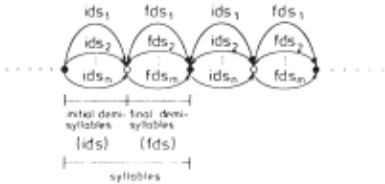
The analysis segments the signal into certain subword units, socalled demisyllables. A syllable contains a vocalic nucleus with an initial conco nant cluster preceding and a final consonant clus ter following the vowel. Now a demisyllable is de fined as one or the other part of a syllable, if the syllable is cut into two parts somewhere during the vowel.
Regarding this method, there exists an inven tory of about 1300 demi-syllables for unrestricted German speech, if all initial consonant clusters are combined with all possible vowels (about 650), and all possible vowels are combined with all final consonant clusters (about 650, too).
By means of this method the speech signal is segmented into demisyllables, and for each segment, a set of weighted candidates is produced. For de monstration we presuppose that this set of weighted candidates is a complete one.
So, at the end of the analysis, a chain of complete sets of weighted candidates for each possible position i s given, that can be used for the next stage of the recognition system (fig. 2).
I I I WORD HYPOTHESES
A. Lexicon Entries
Within the lexicon there exist some entries that _are used for generating word hypotheses, re gardlng the weighted demisyllable segmentation of the preceding stage. For each word in the lexicon ~ts phoneti c transcription using demisyllables and 1ts number of syllables are listed.
B. Generation of Word Hypotheses
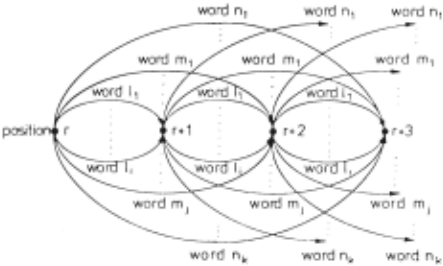
To generate word hypotheses the lexicon is passed through successively word by word. Taking one word out of the lexicon its weight is calcula ted for each possible position within the chain of demisyllables using the weights of the respective subword units.
If we ~ave N syllables within the chain (that means 2N dem1 syllables), a word with the length of one syllable could appear at N positions, a two syllable word at (N-1) positions and so on. Having processed all words of the lexicon, this method leads to a complete set of word hypotheses for the contents of the respective window (fig. 3).
IV INTELLIGENCE
A. Lexicon Entries
Besides the entries mentioned acove the lexicon also containssyntactic/grammaticai and se matic informations for each word. The words are classi~i~d into categories, e.g. noun, adjective, prepos1t1on, verb, auxiliary verb . The inflectable words have a set of possible grammatical forms as a~ entry, and, per~aps, a semantic marker descrip tlon: When a _certa1n word hypothesis i s processed, the 1nformat1on taken from the lexicon i s used to answer pending requests or to produce inferences concerning other possibly appearing words or struc tures within a sentence.
B. Algorithm
As regards the weighted word hypotheses, now the purpose is to attain correct and meaningful sentences by finding pathes from the beginning to the end of the section of the window.
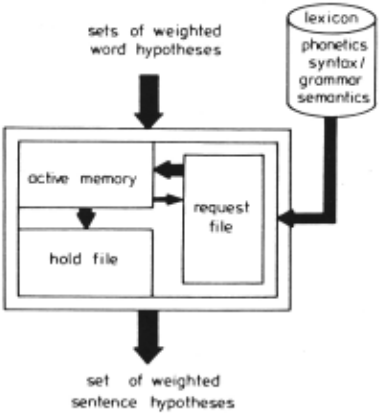
:o ~tart with the algorithm the best word hy pothesls 1s selected . The respective lexicon en tries of this word (the structure hypotheses and th~ir ~equests) are transferred to a request file w~1ch 1s part of the intelligence stage as shown i~ f1gure 4. The structure of the request file is tree-oriented. Within this tree pathes must be t~aced that could lead to the acceptance or rejec tlon of the actual hypothesis.
In addition, the length of the window and the (relative) positions of word hypotheses are always known. In the following the recognition algorithm performs an expectation-based analysis (Riesbeck and Schank, 1978).
Supposing the selected word as a noun the reques t file could have an entry like:
Can an adjective precede the noun directly?
If there could be at least one adjective the path leads us to requests like:
Are the adjective and the noun grammatically congruent?
and
Are the adjective and the noun semantically congruent?
A request as an inference from the lexicon could look at the pending word hypotheses or at a hold list, where recognized parts of a sentence, e.g. noun phrases, are listed. In the first case the request generally concerns word categories. Such a request could look like:
Which words with category cat could pre cede (or follow) the actual hypothesis up to position <i> (or starting from position < j > )?
(The actual hypothesis starts at position <i> and ends at position <j>).
If the request could be satisfied the next requests would concern the grammatical and semanti cal congruences, taking the answer with the best weight first. If any request is rejected the path that led to this request is removed from the re quest file up to that point where an alternative path can be traced. At all points, answers to a re quest are only regarded, if they have a certain minimal weight in order to limit the number of the following requests. Whenever a word hypothesis or a structure hypothesis can be verified in the des cribed way that fact leads to a new selection of the still pending hypotheses. If any part of the section within the window had been verified star ting at any word hypothesis, and if there are still pending hypotheses, respectively - with other words - .so_far there exist only parts of a way from the beg1nn1ng to the end of the window, then the actually best weigthed word hypothesis has to be considered next. The processing ends if there exists at least one path through the word hypothe ses that is accepted. Generally, there would be more than one. Each path has a weight, that is cal culated from the word weights (fig. 5).
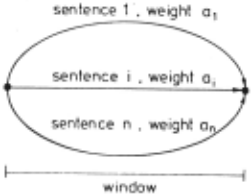
If no path could be found because of the sup posed minimal weigth, this threshold has to be re duced and a new trial has to start.
So, finally there had been a transformation from sets of weighted word hypotheses to a set - an essentially smaller one -of possible sentences. The recognition algorithm takes that sentence for granted that has the best weigth. The spoken text can be printed in characters .
V CONCLUSION
In this paper an overview of an automatic speech recognition system is presented. The system receives speech signals and performs the recogni tion of the fluently spoken German texts.
Some remarks should complete the description of the recognition system. They show what aspects should be investigated in addition.
.. It is possible to limit the sets of word hypotheses by taking only those words that exceed a certain threshold. For this case it becomes necess ary to have a feed-back to the subword level, be cause it is possible that only such a word can satisfy a path that did not exceed the threshold and that had not been considered within the hypo theses so far.
It is planned not to limit the window size. So, the window could also contain only a part of a sentence, parts of more than one sentence or more than one sentence.
There are a lot of methods to realize the weighting of demisyllables, words and sentences.
. Because of an internal knowledge representatlon that could be used to handle inferences a question-answering system could be attached to the system. The representation follows the ideas of Schanks conceptual dependency theory (Schank, 1975).
@inproceedings{ijcai1983p150,
  title     = {A System for Improving the Recognition of Fluently Spoken German Speech},
  author    = {Mudler, Joachim},
  booktitle = {Proceedings of the Eighth International Joint Conference on
               Artificial Intelligence, {IJCAI-83}},
  publisher = {International Joint Conferences on Artificial Intelligence},
  editor    = {Alan Bundy},
  pages     = {633--634},
  year      = {1983},
  note      = {Natural Language},
  url       = {https://ijcai.org/proceedings/1983/150},
}
TY - CPAPER TI - A System for Improving the Recognition of Fluently Spoken German Speech AU - Mudler, Joachim T2 - Proceedings of the Eighth International Joint Conference on Artificial Intelligence, IJCAI-83 PB - International Joint Conferences on Artificial Intelligence PY - 1983 SP - 633 EP - 634 UR - https://ijcai.org/proceedings/1983/150 ER -Copied
Machine-readable versions of this paper, for tools and AI agents:
 Welcome
 Future Conferences
 AI Journal Division
 IJCAI Proceedings
 About IJCAI
 IJCAI Awards