
Structural Relations - A Case Against Case
Proceedings of the Eighth International Joint Conference on Artificial Intelligence. Natural Language. Pages 627-628.
© 1983 International Joint Conferences on Artificial Intelligence
Abstract
Usually semantic parsers of NLU systems rely on some type of 'deep cases' (Riesbeck and Schank, 1976), (Trost and Steinacker, 1981) to control analysis. While we do not want to deny the advantages of such an approach (we use it ourselves), we propose to apply a different approach in order to analyse words that derive their meaning from the semantic category of their dependent constituents. The algorithm we present in this paper disambiguates such words by making use of one of the important properties of an SI-Net (Brachman,1979), the strict distinction between structure and contents of the net. Structurally all semantic relations are represented in the same way therefore we evaluate this level to find out if there is a relation between the representation of the constituents of such a word. After a link has been found its semantic interpretation is taken to be the sense of the word. Besides being used for disambiguation the algorithm is applicable to solve other problems related to parsing as well, e.g. interpretation of metaphors or problems related to resolution of definite anaphora.
- Boguraev B.K.: "Automatic Resolution of Linguistic Ambiguities." TR-11, University of Cambridge, 1979.
- Brachman R.J.: "A Structural Paradigm for Representing Knowledge. " BBN Report No.3605, Cambridge, 1979.
- Hayes P.J.: "Some Association-based Techniques for Lexical Disambiguation by Machine." PhD. Thesis, Ecole Polytechnique Federale de Lausanne, 1977.
- Leinfellner E., Steinacker I., Trost H.: "Reference Resolution and Semantic Coherence." In: Hajicova E.: COLING 82 Abstracts, Charles Univer~ity, Prague, 1982.
- Riesbeck C.K., Schank R.: "Comprehension by Computer: Expectation-Based Analysis of Sentences in Context." RR-78, Yale University, 1976.
- 6j Sidner C.: "1owards a Computational Theory of Definite Anaphora Comprehension in English Discourse." TR-537, MIT, Cambridge, 1979.
- Steinacker I., Trost H. : "Parsing German." In:Horecky J. (ed): COLING-82 Proceedings, North Holland, Amsterdam, 1982.
- Steinacker I., Trost H., Leinfellner E • "Disambiguation in German." In: Trappl R. (ed): Cybernetics and Systems Research, North Holland, 1982.
- Trost H., Steinacker I.: "The Role of Roles: Some Aspects of' Real World Knowledge Representation." Proceedings IJCAI-81, pp23?-239, Vancouver, 1981. IJCAI
- Wilks Y. : "Making Preferances More Active." RR-32, University of Edinburgh, D.A.I., 1977.
References were extracted automatically from the PDF and may contain errors.
Full text extracted automatically from the PDF; figures, tables and equations may differ. The PDF is the version of record.
ABSTRACT
Usually semantic parsers of NLU systems rely on some type of 'deep cases' (Riesbeck and Schank, 1976), (Trost and Steinacker, 1981) to control analysis. While we do not want to deny the advantages of such an approach (we use it ourselves), we propose to apply a different approach in order to analyse words that derive their meaning from the semantic category of their dependent constituents. The algorithm we present in this paper disambiguates such words by making use of one of the important properties of an SI-Net (Brachman,1979), the strict distinction between structure and contents of the net. Structurally all semantic relations are represented in the same way therefore we evaluate this level to find out if there is a relation between the representation of the constituents of such a word. After a link has been found its semantic interpretation is taken to be the sense of the word. Besides being used for disambiguation the algorithm is applicable to solve other problems related to parsing as well, e.g. interpretation of metaphors or problems related to resolution of definite anaphora.
I THE PROBLEM
In natural languages there exist a number of words that derive their meaning from the semantic category of their dependent constituents. We will call such words relational words. They are used to express an association between their constituents. Examples for relational words are:
- possessive pronouns (my job, my sister, my car)
- to have (to have a cold, to have a child)
- to gi ve (to give a kiss, to give an object)
- to get (to get an answer, to get a degree)
To interpret such words on the basis of a semantic net there exist two solutions :
- to list all different senses of a word explicitly within the dictionary associated with information for disambiguation
- to apply a general procedure that relies on a source of knowledge other than the sentence.
This paper demonstrates how the structural properties of the SI-Net (Brachman, 1979) can be evaluated as a basis for such a general procedure.
STRUCTURAL RELATIONS - A CASE AGAINST CASE
Ingeborg Steinacker , Harald Trost
Department of Medical Cybernetics University of Vienna , Austria
li THE REPRESENTATION
The structural level of characterized by the pattern: an SI-Net is
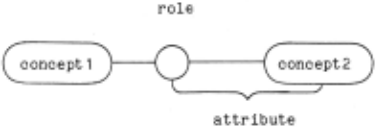
At the semantic level an attribute of Concept1 describes one of its properties. Concept2, the value-restriction, indicates the range of possible fillers, whereas the role describes the function of the filler with regard to the concept (Trost and Steinacker, 1979). Concepts are part of a super-subconcept hierarchy, in which a subconcept inherits the attributes of all superconcepts.
III RELATION BETWEEN VOCABULARY AND SE;MANTIC NET
The meaning of a lexeme is represented in the net by a structure of arbitrary size and complexity. Some words are mapped onto concepts only, e.g.
car -> AUTOMOBILE
house -> BUILDING
sometimes the concept is associated with a given filler, e.g.
to drink -> INGEST ·OBJECT LIQUID (roles are preceded by an asterisk)
Some words refer to a role within a concept, e.g. weight -> PHYSICAL-OBJECT *wEIGHT WEIGHT-SCALE In this case the complete structure CONCEPT - ROLE - VALUE-RESTRICTION represents the meaning. Most relational words refer to roles, e.g.
my bus -> AUTOMOBILE *PASSENGER PERSON.
The fact that there exists a role relation between the representation of constituents of a relational word is the basis for our approach. We will call it 'connectivity condition' (CC).
IV OVERVIEW OF THE PARSER
1he parser of the system VIE-LANG maps German sentences onto instances of net structures without discriminating between syntactic and semantic information. It takes advantage of the strong correlation between syntactic surface cases and the semantic cases represented within the net (Steinacker and Trost, 1982), (Steinacker et al., 1982). The parser uses a parsing lexicon which contains the production rules for each sense of a word by which the mapping is achieved. Both methods for disambiguation mentioned above are used by the parser.
The first approach - listing all word senses explicitly (Boguraev, 1979), (Riesbeck and Schank, 1976) - is applied to words with clearly defined senses. To disambiguate such a word syntactic information combined with selectional restrictions provides sufficient information to select the correct sense. E.g. 'to work' in the sense of to have a job is discriminated from 'the machine works fine' by selectional restrictions of the subject.
Relational words are used in a different way. Besides having one original sense (e.g. ownership tor a possessive pronoun) they have a number of senses indicating an association (Hayes, 1977) between their dependent constituents. The type of relationship is determined by the semantic class of the constituents. By merely looking at the problem of disambiguating the verb 'to have' as an example of a relational word the necessity of a general procedure is demonstrated.
Some ways of using the verb ·to have':
ownership: I have a new car social relationship: I have a friend source: I have good news state of health: I have a cold paraphrase for action: I have breakfast properties: This shirt has a nice colour.To include all senses of a relational word in the dictionary is an approach doomed to failure. It is impossible to foresee all the contexts in which such a word will be used; besides selecting one sense out of a long list of senses in the dictionary would require extensive processing. Additionally the entries in the lexicon would have to be adopted every time there is an increase of vocabulary or concepts in the semantic net.
Therefore a general approach is called an approach that relies on means other semantic classes and surface features of sentences. for, than the
Our method seeks the relationship between two given concepts at the structural level then it returns to the semantic level to find the interpretation.
V DISAMBIGUATION BY STRUCTURAL RELATIONS
Our disambiguation algorithm is based on the connectivity condition. It makes use of the property of an SI-Net to discriminate strictly between the structure of the net and its contents. lo disambiguate a relational word the parser looks at the representations of its dependent constituents to see if the connectivity condition is fulfilled for them (structural level). If the two addressed concepts are connected by a role, this role is taken to be the interpretation of the relational word (semantic level). Instead of having to check syntactic conditions and selectional restrictions for a great number of readings of the verb, the problem is reduced to three cases:
- Most relational words have one 'original' sense characterized by a specific selectional restriction, (e.g. to give - transfer of an object)
- In the case of paraphrasing an event (e.g. to give a kiss = to kiss) the relational verbs hold additional information on how to fill the attributes of that event. The CC is fulfilled for all case-fillers of the designated event.
- If the dependent constituents satisfy the CC, (e.g. to have a cold - relation between a person and his health) the link between them is individuated.
With this general procedure entries for a relational word lexicon is reduced drastically. the number of in the parsing
e.g. the entry for 'to get' ('bekommen') (bekommen (1 (C(CASE ACC) AND C(RESTR -->A(CRI OBJTRANS) A(CRV(+ OBJECT *))) (* 'original' sense *) OWNABLE_OBJ) (C(CASE NOM) -->A(CRV(+ RECIPIENT tt)))) (2 (C(CASE ACC) AND -->A(CRI(*))) (C(CASE NOM) (* paraphrase of action *) C (RES TR EVENT) -->A(CRV(+ A(SELECT-ROLE(OBJECT RECIPIENT)) (3 (* connectivity condition *) (C(CONNECTED (C(CASE NOM) C(CASE ACC))) -->A(INST-ROLE(NOM ACC))))).In the following paragraph the algorithm is demonstrated by some examples analysing different relational words.
- He gave a good answer.
- He got a headache.
- my thoughts
To find the sense of the relational words one has to examine their dependent constituents. Before a relational word can be interpreted, the system must be able to access the concepts onto which the constituents are mapped.
In (1) ·answer' is represented by the concept I~FOTRANS which is a subconcept of EvENT therefore sense2 is applicable. Even if the type of event is not known beforehand the verb 'to give ' controls the way attributes are to be filled. Therefore this information is included in the parsing lexicon. The subject either represents the *AGENT (He gives her a spanking) or the *SOURCE of a TRANSFER. The role which is applicable is selected according to the type of event addressed by the direct object.
The verb 'to get' behaves in a complementary way - its subject is mapped on *OBJECT (he got a kick) or ~RECIPIENT (he gets a kiss).
- In (2) the CC is fulfilled , headache is mapped onto an individual of STATE_OF_HEALTH which
- is connected to PERSON by the role *HEALTH.
- leads to individuation of *AGENT between
- the referent of 'my' and the action MDO.
Sometimes possessive pronouns are ambiguous: present that I get· but the sense 'the present that I give' exists as well. In this case the
'my present' is interpreted preferably as 'the sentential context has to be considered.
vi FUR1HER APPLICATIONS
There is a wide range of applications for such a general procedure which is based on structural properties. Besides interpreting relational words in an efficient way, such procedures can also be used to try to solve ad hoc metaphors that are based on analogy. The well known example 'my car drinks gasoline' (Wilks, 1977) can be interpreted by using the connectivity condition. The concepts GAS and AUTOMOBILE are connected by a role *FlJ~L. Since the connectivity condition is fulfilled this structure is taken to
be the meaning of the sentence.
Another very useful application is reference resolution of definite noun phrases (Leinfellner et al., 1982), (Sidner, 19'(9). 'When I washed the glass the handle broke.' The CC indicates a relationship between glass and handle, therefore handle is interpreted to be part of the glass (and
what a great number of handles are there!).
This research was supported by the Austrian 'Fonds zur Foerderung der wissenschaftiichen Forschung', grant No. · ~158 (supervision Robert Trappl).
Vll CONCLUSIO~
The advantages of a general procedure to select senses of a relational word are obvious:
- There is no need to list the great number of senses explicitly within the dictionary. Although the class of relational words is relatively small they appear frequently in natural language texts. Evaluating the CC therefore saves storage as well as time.
- Independence of changes within vocabulary and semantic net. Since the algorithm relies on structural properties it can be applied to all concepts. New concepts added to the net are covered automatically.
- The same procedure is applicable for all
- relational words.
- The approach can be successfully applied in connection with other problems of parsing: reference resolution and processing of metaphors. The connectivity condition describes an association between concepts. Such an association can be evaluated within different phenomena of language.
@inproceedings{ijcai1983p148,
  title     = {Structural Relations - A Case Against Case},
  author    = {Steinacker, Ingeborg and Trost, Harald},
  booktitle = {Proceedings of the Eighth International Joint Conference on
               Artificial Intelligence, {IJCAI-83}},
  publisher = {International Joint Conferences on Artificial Intelligence},
  editor    = {Alan Bundy},
  pages     = {627--628},
  year      = {1983},
  note      = {Natural Language},
  url       = {https://ijcai.org/proceedings/1983/148},
}
TY - CPAPER TI - Structural Relations - A Case Against Case AU - Steinacker, Ingeborg AU - Trost, Harald T2 - Proceedings of the Eighth International Joint Conference on Artificial Intelligence, IJCAI-83 PB - International Joint Conferences on Artificial Intelligence PY - 1983 SP - 627 EP - 628 UR - https://ijcai.org/proceedings/1983/148 ER -Copied
Machine-readable versions of this paper, for tools and AI agents:
 Welcome
 Future Conferences
 AI Journal Division
 IJCAI Proceedings
 About IJCAI
 IJCAI Awards