
The Role of Roles: Some Aspects of Real World Knowledge Representation
Proceedings of the Seventh International Joint Conference on Artificial Intelligence. Nowledge Representation. Pages 237-238.
© 1981 International Joint Conferences on Artificial Intelligence
Abstract
Our aim is to build a knowledge base for a Natural Language Understanding System. Having chosen the SI-Net formalism as our tool for knowledge representation, we try to develop some pragmatics for its use. Since a prominent feature of SI-Nets is the distinction between concepts and roles this article concentrates on the question which part of the knowledge should be represented as concepts and which part as roles. We distinguish between descriptional (intrinsic) properties, represented as attributes of a concept, and functional properties described through relationships between concepts. Evaluated attributes of concepts can be regarded as states. In the last section of the paper there is a short discussion of the change of these states over a period of time.
- Brachman, R.J. "A Structural Paradigm for Representing Knowledge", Report No.3605, Bolt Beranek and Newman, Cambridge, MA, 1978.
- Brachman, R.J., Bobrow, R.J., Cohen, P.R. and Klovstad J.W. "Research in Natural Language Understanding", Annual Report, September 1978 -August 1979, Report No.4274, Bolt Beranek and Newman, Cambridge, MA, 1979.
- Findler, N.V. (ed.) A §sociatiye Networks, Academic Press, New York, 1979.
- Freeman, M.W. "KNET: An extended SI-Net formalism for knowledge representation systems", TR 80-1, Burroughs Corporation, Paoli, PA, 1980.
- Hays, D.G. "Types of Processes on Cognitive Networks", In: Proceedings COLING-73, 1973 .
- Hayes, Ph.J. "Some Association Based [7)
- Techniques for Lexical Disambiguation by Machine", Comp.Science Deptm., University of Rochester, New York, 1977.
- Miller, G.A. "Practical and Knowledge", In: Johnson-Laird, Wason, P. (eds.), Thinking, University Press, 1977.
- Lexical P. and Cambridge Schank,R.C. Conceptual Processing, North-Holland, Information Amsterdam, 1976.
- Trost, H. "Konzept eines Sprachverstehenden Systems", Berichte der Oesterr. Studienges. fuer Kybernetik, Wien, Austria, 1980.
- Trost, H. and Steinacker, I. "Representing Real World Knowledge in a Semantic Net", In: Trappl, R. et al. (eds.), Progress 1n Cybernetics~ Systems Research, Vol. 11, Hemisphere, Washington, D.C., (in press) .
References were extracted automatically from the PDF and may contain errors.
Full text extracted automatically from the PDF; figures, tables and equations may differ. The PDF is the version of record.
THE ROLE OF ROLES: SOME ASPECTS OF REAL WORLD KNOWLEDGE REPRESENTATION
Harald Trost, Ingeborg Steinacker
Department of Medical Cybern~tics, University of Vienna Medical School, Vienna, Austria
ABSTRACT
Our aim is to build a knowledge base for a Natural Language Understanding System. Having chosen the SI-Net formalism as our tool for knowledge representation, we try to develop some pragmatics for its use. Since a prominent feature of SI-Nets is the distinction between concepts and roles this article concentrates on the question which part of the knowledge should be represented as concepts and which part as roles. We distinguish between descriptional (intrinsic) properties, represented as attributes of a concept, and functional properties described through relationships between concepts. Evaluated attributes of concepts can be regarded as states. In the last section of the paper there is a short discussion of the change of these states over a period of time.
I INTRODUCTION
The aim of our project is the development of an NLU system capable of engaging in a purposeful dialogue with a human partner [9]. In this paper we describe some important aspects of our approach of representing real world knowledge in a semantic net.
During the last few years a couple of semantic net formalisms with a strict discrimination between structure and content have evolved [3]. One can view these formalisms as tools for the creation of knowledge bases in arbitrary domains. But up to now no standards have been developed on how to map real world knowledge into such a kind of semantic net.
For our knowledge base we have adopted the Structured Inheritance Net developed by R.Brachman [1], which . we have slightly modified according to our special needs. His net formalism has the advantage of being epistemologically clear and explicit. He advocates strict discrimination between structural components of a semantic net and its content (what is being represented). Our work was aimed at the development of pragmatics for the application of the SI-Net formalism to real world knowledge. We designed a system for describing real world knowledge, using the very powerful role/~estriction distinction of SI-Nets.
II THE STRUCTURE OF SI-NETS
SI-Nets are built out of very few different types of nodes and links. There are two main layers of knowledge represented in the net: One is the conceptual level (consisting of so-called generic concepts), the other one the episodical (comprising the individualizations). Concepts are defined in terms of their attributes. Interaction of these attributes is explicitly represented in the 'structure' associated with each concept. Attributes consist of two parts: role and value restriction. The value restriction is a link to another concept, which defines the range of possible fillers for the attribute, the role node explains the function of the filler within the concept. Role nodes may be linked to other (more general) ones to explain their function. Though this distinction between role and restriction is not entirely new [6], SI-Nets are the first to incorporate the idea into the net formalism in such a clear and explicit way.
Generic concepts are organized hierarchically via sub/superconcept links. Attributes and structure are inherited through these links as long as they are not modified explicitly. Every concept may have more than one superconcept, inheriting the combined set of properties.
To refer to a specific entity of the world the appropriate concept must be individualized. Individuals inherit attributes and structure, and they may evaluate the attributes by filling them with individuals meeting the value restrictions.
III ROLES AND CONCEPTS
Using this structure we developed our own ideas of how to express real world knowledge in it. The distinction between role and restriction reflects the way humans look at the real world. Concepts are generalizations, resp. abstractions of sets of entities of the real world. In order to reference a specific member of that set the generic concept is individualized. On the other hand concepts fill roles in other concepts. In the same way individuals are used to evaluate attributes of other individuals. In a text the same word may be used to refer either to a concept or to a role, depending on the context. (A reference to a role is of course actually a reference to the individual filling that role.) This happens because we have two ways to refer to something, definitional (descriptional) or functional.
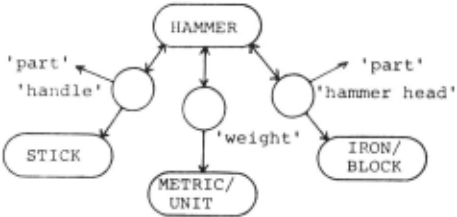
Let's take for example the word 'hammer'. Usually, if one uses 'hammer', one refers to an individualization of the concept 'hammer' which will look more or less like the structure given in fig.1. This concept gives the definitional description of a hammer, describing parts, material, size, etc. It does not explain though, in which circumstances hammers are used.
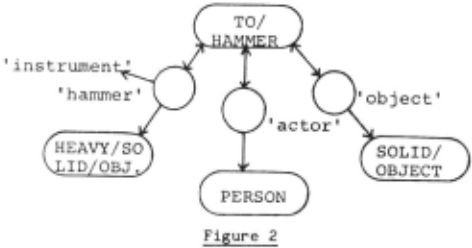
On the other hand one has a concept for 'to hammer' (see fig.2). In that concept there is one attribute which plays the role of a hammer. Of course one could think of providing the concept hammer with an extra attribute 'function' pointing to the concept 'to hammer'. But that does not work very well. Though the role 'hammer' is usually filled by an individualization of the concept 'hammer' this is not necessarily so. One could use practically every compact, heavy thing as a 'hammer'. Therefore the value restriction for the attribute with the role 'hammer' is different from the concept 'hammer', which is only one of the many subconcepts of 'heavy/solid/object'.
Usually people don't pay any attention to these two different aspects of a word, because functional and conceptual definition form a unit. As long as both aspects go together, one doesn't have to care. But from an epistemological view this distinction seems quite important. It is a way to resolve the 'knowledge problem' [7], by integrating 'lexical' and 'practical knowledge' into the net.
Individuals are defined not only in terms of their concepts, but also through all the roles they play. To go back to our example: one does not think about every stone to be a potential hammer, but as soon as a stone plays that role, we draw the connection. Roles become very important, when individuals of a certain concept can fill a variety of different roles. The most prominent example in our net is the concept 'person'. A person can act in a lot of different roles, depending on the situation and the context. 'Father' and 'mother' for example are roles persons play in the concept 'family'. But the same individuals will play different roles in different contexts. People are not only defined in terms of family relations, they have jobs like officer, teacher, farmer, they participate in games and sports, are · chess-players, skiers, football-players, they are educated as students, take trips as tourists and so on.
It seems logical to represent all these relations as role nodes instead of concepts. If you talk about a father, you still refer to a person. You just put that person in the special context of a family. Therefore we have only one generic concept concerning human beings, called 'person'. Attributes of that concept are only those properties which are intrinsic to it. These include body features, basic human abilities and requirements, etc. All the other information about a person is contained in the roles s/he can play in various other concepts.
A typical example for information of that kind are social circumstances of people. We are strictly against creating concepts like 'societal person', since all these things are dependent on the cultural context and therefore not inherent to 'person'. We do not see, for example, why 'address' should be an attribute of 'person' [8]. That way one would run into difficulties whenever one wants to represent in the net people with no or more then one residence. Instead we propose to have a concept 'residence' with the roles 'address' and 'inhabitants' respectively. To find the address of a person one has to search for the residence s/he inhabits.
The roles an individual actually plays characterize that special person. As more information about that person is gathered, more links to other individuals are established, creating a history of that person.
The same thing is true for other concepts as well. Indivi~uals are defined by the attributes they inherit, but also in terms of all the roles they fill in the evaluated attributes of other individuals. To come back to our first example once more: We can say 'That stone is a good hammer' if we use it in that role, even though we know that a stone is no hammer.
IV DYNAMIC ASPECTS OF ATTRIBUTES
Up to now we desribed attributes as being basically static. Once the attribute of an individual is evaluated it stays the same. This is true e.g. for actions, which take place at a certain time. But for individuals which exist over a longer period of time this is only partially true.
Properties of physical objects are described as a number of states. These states are denominated by roles while their restrictions give the range of possible values. There are many different kinds of states: emotional states (anger, fear), physical states (colour, size), physiological states (health, hunger), dimensional states (time, location), possess state, etc.
Some of these states remain (relatively) stable, while others change over time while the individual is still regarded the same. One possible solution to represent that change is to split up every individual into a set of manifestations (5]. For every appearance of an individual a new manifestation is created.
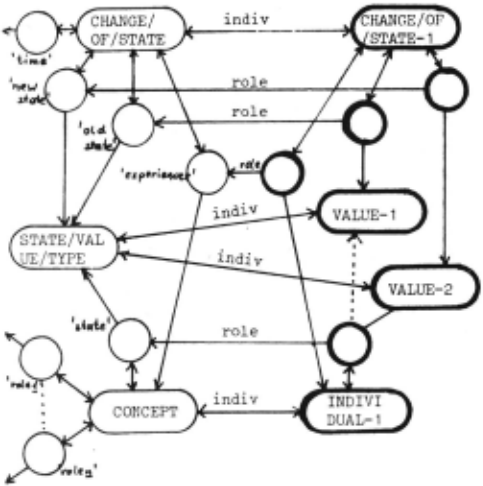
We resorted to a different approach. To every state there exists a corresponding concept representing ·Changes in the value of that state. Attributes are the 'experiencer' of the change,
'old state· and 'new state' (former and new value of that state) plus 'time'. Whenever a change of state occurs, it causes two different modifications in the net. Every change directly affects the individual, changing the value of the respective state. The change-of-state concept is instantiated keeping record of the event. The individual appears as the experiencer, to which that change occured. This way a history of all the changes is kept.
ACKNOWLEDGEMENTS
This research is part of the project 'Development of a Language Understanding System with regard to Medical Applications' (supervisor: R. Trappl), which is supported by the Austrian 'Fonds zur Foerderung der wissenschaftlichen Forschung', grant #4158.
@inproceedings{ijcai1981p49,
  title     = {The Role of Roles: Some Aspects of Real World Knowledge Representation},
  author    = {Trost, Harald and Steinacker, Ingeborg},
  booktitle = {Proceedings of the Seventh International Joint Conference on
               Artificial Intelligence, {IJCAI-81}},
  publisher = {International Joint Conferences on Artificial Intelligence},
  editor    = {Patrick J. Hayes},
  pages     = {237--238},
  year      = {1981},
  month     = {8},
  note      = {Nowledge Representation},
  url       = {https://ijcai.org/proceedings/1981/49},
}
TY - CPAPER TI - The Role of Roles: Some Aspects of Real World Knowledge Representation AU - Trost, Harald AU - Steinacker, Ingeborg T2 - Proceedings of the Seventh International Joint Conference on Artificial Intelligence, IJCAI-81 PB - International Joint Conferences on Artificial Intelligence PY - 1981 SP - 237 EP - 238 UR - https://ijcai.org/proceedings/1981/49 ER -Copied
Machine-readable versions of this paper, for tools and AI agents:
 Welcome
 Future Conferences
 AI Journal Division
 IJCAI Proceedings
 About IJCAI
 IJCAI Awards