
Representation and Inference in the Consul System
Proceedings of the Seventh International Joint Conference on Artificial Intelligence. INFERENCE and REASONING. Pages 375-380.
© 1981 International Joint Conferences on Artificial Intelligence
Abstract
Us ers of interactrve systems need a single cooperative mterface for all of the servi ces 1n their environment. The Interface must behave in a con s1stent manner in understanding natural user requests and in prov1 drng e xpl anation and help as requ1red . The Consul system is des1gn ed to prov1 de such an interface. Its natural i nteract1on capab11ity is ach1eve d by mapp1ng between detailed descriptions of users and systems 1n order to translate requests and provide explanations. An interactive sy stem of th1S k1nd would be infeasible if the onus of construct1ng the kno wledge base and inference techniques were '"aced on the ind1v1dual ser vrc e bu il ders . In Consul . serv 1c e-depende nt rnformat1on is mcor porated 1nto the knowledge base by sem i- aut om atiC acqu1S1t1on , resulting in 1n corporat1on of the new knowledge 1nto the system 's built -In abs tract framework . Th is Incorporation allows the se, vrce -dependent dat a to appropnately 1nfluence Consul's knowledge· based mapp1ng proc esses. The current Consul prototype demonstates natural request han dl i ng and explanation for a mail serv1ce .
- Webber Robert Bobrow and Bonnie Webber. " Knowledge Representation for Syntactic / Semantic Processing ," in Proceedings of the Nationa l Conference on Artific ial Intelligence . AAAI. August 1980.
- Brachman 78
- Ronald Brachman . A Structural Paradigm fo r Represent ing Knowledge. Bolt , Beranek and Newman . Inc .. Technical Report. 1978.
- Lingard 81
- Robert Lingard , "A Software Methodology for Building Interactive Tools." in Proceedings of the Fifth International Conference on Software Eng ineerin g , 1981 .
- Mark
- William Mark. "Rule-Based Inference In Large Knowledge Bases ." in Procee din g s of the National Conference on Artificial Intelligence , American Association for Artificial Intelligence , August 1980.
- R. Stotz. R. Tugender, D. Wilczynski , and D. Oestreicher, " SIGMA : An Interactive Message Service for the Military Message Experiment." in Proceeding s of the National Computer Conference, AFIPS , May 1979.
- Wilczynski 81
- David Wilczynski , "Knowledge Acquisition in the Consul System," in Proceedings of the Seventh International Joint Conference on Artificial Intelligence , IJCAI. 1981 . IJCAI
References were extracted automatically from the PDF and may contain errors.
Full text extracted automatically from the PDF; figures, tables and equations may differ. The PDF is the version of record.
1 .1. Understanding user requests
If the user is allowed to express himself in a "natural" manner. most of his requests will not correspond directly to input forms for the appropriate service actions. Some aspect of the interact ive system must therefore have the capability of mapping user requests into appropriate system action invocations. For example. consider the following user request to a mail service 2
Forward this message to Jones.
This request is simple enough from the user's point of view. However. from Consul 's point of view. its interpretation depends on the circumstances of the request and the details of the particular service involved . In most mail services. if this message referred to a previously received message and if Jones were a valid user address. interpretation of the request would mean mapping the parse of the request into an invocation of the message forwarding function with the appropriate parameters. However, if this message referred to a just composed message, many (though not all) mail services would consider the request to be in error and would require restatement . As we will see below, the situation in a SIGMA-like mail service is somewhat more complex: "messages" are never actually forwarded (or sent in any form); only citations of messages are sent between users--the actual message remains in a central database. Therefore. the user's request can never be taken literally. but must be redescribed in system terms. Even then the request is either ambiguous (the user must either "forward for action" or "forward for information") or in error (if this message is a "draft message") .
Thus. understanding user requests requires mapping the input forms into the conceptual framework of the particular service that must fulfill the request. This process requires some understanding of both the context of the user's request and the characteristics of the service.
1 .2 . Explaining the system
When the user requires information about some aspect of the system. he must be able to ask about it in a natural manner and receive a response that he can understand. Consul must therefore be ready to recognize and respond to "help requests" (e.g .. What has to be in a message? What does forwarding do?) . This problem of "explanation" has several parts:
2 All examples in this paper are based on a SIGMA-like service ([SIGMA 79]) currently berng implemented under Consul.
Abstract
Users of interactrve systems need a single cooperative mterface for all of the services 1n their environment. The Interface must behave in a cons1stent manner in understanding natural user requests and in prov1drng explanation and help as requ1red. The Consul system is des1gned to prov1de such an interface. Its natural interact1on capab11ity is ach1eved by mapp1ng between detailed descriptions of users and systems 1n order to translate requests and provide explanations. An interactive system of th1S k1nd would be infeasible if the onus of construct1ng the knowledge base and inference techniques were '"aced on the ind1v1dual servrce builders. In Consul . serv1ce-dependent rnformat1on is mcorporated 1nto the knowledge base by semi-automatiC acqu1S1t1on, resulting in 1ncorporat1on of the new knowledge 1nto the system's built-In abstract framework . This Incorporation allows the se,vrce-dependent data to appropnately 1nfluence Consul's knowledge· based mapp1ng processes. The current Consul prototype demonstates natural request handl ing and explanation for a mail serv1ce.
1. Introduction
An interactive system should provide a natural interface for its users and behave in a consistent manner across a wide range of functi onal services. The Consul system attempts to achieve these goals by providing natural language input and explanation facilities for users of 'interactive services such as electronic mail, automated appointment calendar. and document preparation.
Users· needs change constantly, and vary greatly from one environment to another. The needs of any particular group of users must be satisfied by service builders familiar with those needs. However, the task of building an interactive service that provides a natural interface and remains consistent with other services is too great to be left as a burden for individual service builders. What is needed is a system that has already solved the basic problems of providing a natural. consistent interface. and into which new services (or changes to existing services) can be incorporated with relative ease.
In Consul. a single knowledge base framework consistently represents riot only the objects and actions of users and interactive systems. but also the inferential capability to map between the user and system worlcs. This mapping mechanism is the foundation of Consul 's natural language understanding and Consul must first decide whether a user utterance is a request for help or a request for action . This is by no means straightforward. and ultimately relies on an understanding of the user's intent in making the request (as in Could you send th is message to Smith') .
1 Thrs research is supported by the Defense Advanced Research Pro1ects Agency under C.ontract No. DAHC15 72 C 0308. ARPA Order No 2223. Views and concl usions contained in this paper are the author's and should not be interpreted as representing the official opinion or pol icy of DARPA. the US Government or any person or agency connected with them.
Even when a request for help is recognized as such. the system must understand the user's statement of what he wants to know in terms of those aspects of the system that are relevant to answering his question. For example. although Why was message 17 deleted? is a perfectly reasonable user help request. it makes no sense at all in the world of the SIGMA-like service. Messages do not have numbers associated with them nor are they ever deleted. Consul must map the user's question into a question that is appropriate from the mail system viewpoint .. a question that takes into account that messages are accessed only through their citations, that citations have numbers by virtue of being in a user's mailbox, and that the relevant deletion process is the one that removes particular citations from a particular user's mailbox.
Next , the system must discover an appropriate answer to the reformulated question, requiring information gathering (as in What has to be in a message?), cause/effect reasoning (as in Why was message 17 deleted?) , or other special processing depending on the type of question asked.
The answer. which is in system terms, must then be mapped back into terms that the user can understand in order to create a true response to the original question.
An additional explanation problem occurs because the system cannot always do what the user wants. Thus. although the intent of a user request may be that the system should perform some action. the response of the system may have to be an explanation of why it cannot meet this intent. For example. as discussed above. if this message in the request Forward th is message to Jones refers to a just composed message, the system cannot do what the user is asking . Instead, it must respond with an explanation of why it cannot forward the message to Jones. and suggest a restatement or alternative course of action to the user.
1.3. Acquiring domain-dependent knowledge
All of the above discussion assumes a carefully built, detailed model of what a particular interactive service can and cannot do This raises the question of how such a model is built into the Consul system. Builders of interactive services know about the characteristics of their service .. not the higher level models and mapping knowledge required by Consul for cooperative behavior . Therefore. Consul must be responsible for the task of incorporating the details of a particular service into its knowledge base . It must figure out (or at least lead the service builder to tell it) how the operations and objects of a service can be seen in terms of its higher level model.
It is very likely that the relationship between specific service characteristics and Consul's built ·in knowledge base will go beyond straightfQrward instantiation: some service characterist ics will not instantiate anything in the knowledge base. For example. Consul's model of transfer operations assumes that the argument of the operation (say. a message) is what ends up being del ivered to the specified destination. However , SIGMA send operations send citations of the message, not the message itself. SIGMA
send operations thus do not directly instantiate Consul's model of transfer operations. But Consul will not be able to bring to bear its knowledge about transferring (e .g .. how explanations and user requests about sending map into transfer operations) .unless it can relate the SIGMA send operations to its built-in model of transferring . Consul's acquisition task therefore comprises not only instantiation of its knowledge base. but also the construction of more complex mappings between what it knows and what the service builder tells it.
2. Approach
The main feature of Consul is its knowledge base of descriptions of users. services. and interact ive systems. Relationships between descriptions .. mappings .. are represented in terms of inference rules, which are "applied" to transform one kind of description into another . The handling of a natural language request from the user is treated as the reformulation (via the application of inference rules) of a description in the conceptual framework of the user as a description in the conceptual framework of the service model. This service description represents an actual function that can be executed in order to satisfy the user's request. Similarly, help and explanation are treated as reformulation of service descriptions in terms of user descriptions.
Consistent treatment of services is achieved by pre-building a service-independent model of interactive systems into Consul. and then acquiring knowledge about particular services in terms of that model. Acquisition is accomplished via a stylized dialogue with the service builder . directed by Consul based on the servtce builder 's implementation of his service in terms of a programming formalism specially designed for this task.
2.1. The Knowledge Base
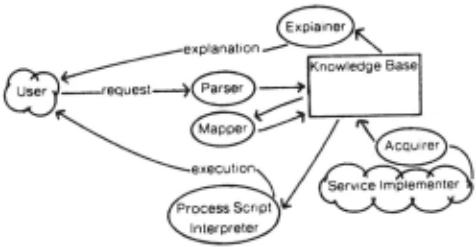
The basic structure of the Consul system is shown in Figure 1. The knowledge base, implemented in KL-ONE [Brachman 78] . is central to all system activities .. parsing , explanation . mapping , execution, and acquisition . It contains several kinds of information:
Knowledge Qf l&lli: a representation of the relation between English language constructs (e.g., "send request") and the actions and objects of the user's world that (he thinks) have some correspondence in the system world (e.g .. "send " . "message"). For example, since users have the concept of sending information from one user to another, the knowledge base includes User Send and User Message (see Figure 2) . This representation is purely in terms of the user's conceptual structure··correspondence with the actions and objects of the system. if any. has yet to be established .
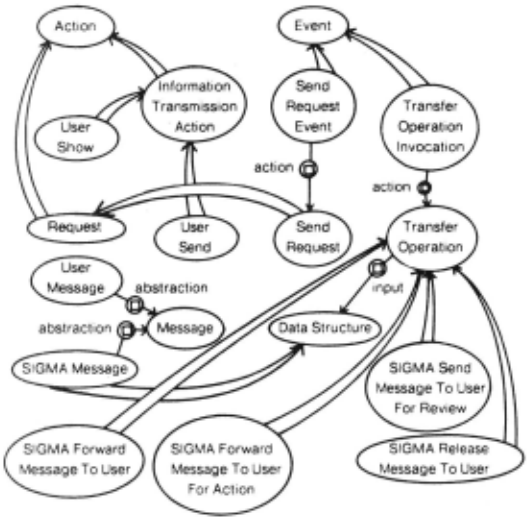
~ knowledge : a service·independent representation of basic operations (e.g .. deletion. transfer. display) and the data structures these operations work on (files. tables. display lists. etc.) . For example. any service will probably have a transfer operation of some sort . Consul's systems knowledge provides an organizational framework for structuring knowledge about transfer operations. based on the concept Transfer Operation (see Figure 2) . The particular transfer operations of 3ny service can be described 1n terms of that framework, and thus be "understood" by Consul (i .e .. seen in relation to the other things that Consul knows about) .
~knowledge : a particularization of systems knowledge to the actual operations and data structures of some interactive service that is implemented in Consul. For example. the model for a mail service would describe a variety of specific (actually executable) transfer operations for sending messages. SIGMA has several specific transfer operations for sending different kinds of message citations (see Figure 2) .
Dynamic Environment : a model of system and user activ1ties as events in time . i.e .. invocations of the actions defined in the user and service models. This event model serves as a dynamic environment for expressing the behavior of the user and the system. Thus. Send Request Event and Transfer Ope ration Invocation in Figure 2 represent potential occurrences during an interactive session with Consul.
Figure 2 shows some of the instantiation relationships among Consul 's descriptions of users. systems. and services. Consul must be able to map between these various descriptions in the knowledge base in order to understand requests. generate explanations, and acquire service specific information.
2.2. Mapping
In Consul , this mapping capability is provided by a rule·based inference process that can reformulate a given knowledge structure in terms of another. The rules are simple transformation relationships between modelled structures. When a given description instantiates a structure that is a rule condition. the mapper can reformulate the description in terms of the structure that is the rule conclusion. This process can be used to redescribe a wide class of incoming descriptions (user requests. explanation forms, and service specific information) in terms of Consuls built· in knowledge base 3 .
This section shows the system's mapping activity on the request Forward this message to Jones . The first operation on any incoming request is parsing 4 . i.e .. classifying the request in the knowledge base in terms of Consul's model of what the user can express. The new description is then redescribed by the mapping process until it can be seen to instantiate either a description of some service action (in which case the action is executed . thus satisfying the request) or some explanation form (in which case an explanation response is generated) .
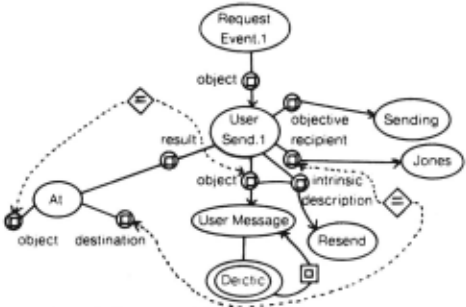
The parse of Forward this message to Jones is shown in Figure 3. The parser has described the request as a Request for the user action whose objective is Sending . The fact that the user has specified "forwarding" is represented by the intrinsic description of this Send Action as Resend . The result of the action is that both the object (the message) and the intrinsic description arrive at Jones.
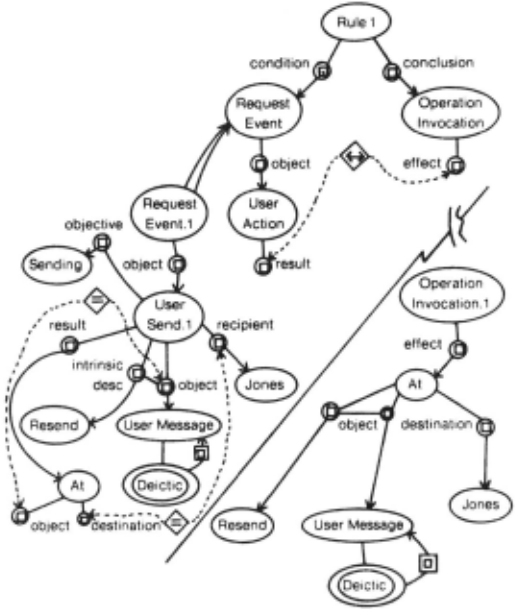
When this parse is classified in the knowledge base, it does not instantiate any service action or explanation form (i .e .. the system does not contain a description of the "Forward this message to Jones" action). However. as shown in Figure 4, the description does instantiate a (very general) knowledge structure that happens to be a rule condition . The rule simply says that a request for a user action with a particular result can be redescribed as·a call to an operation whose effect is that results This does not imply that such an operation is really implemented in the system: it merely creates a description of a call to such an operation. In this case, rule application produces a call to an operation (Operation Invocation. 1) whose effect is "this message" and "resend" ending up at "Jones" (see Figure 4) .
3 rhe underlying philosphy and Implementation ot the rule appl icat1on and redescr~pllon process 1S descr~bed 1n detail1n [Mark 80] .
4 rhe PSI·KLONE parser [Bobrow& Webber 80] has been integrated into the Consul system.
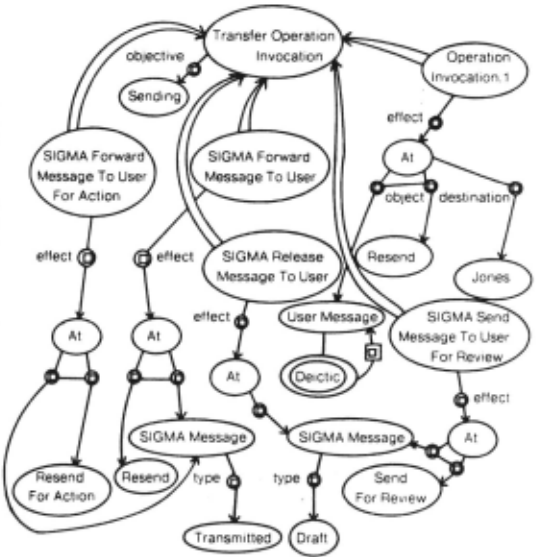
This redescription is then classified in the knowledge base (Figure 5) . If, via this classification process. the new description is found to be a subconcept of a call to some actually executable operation, inference is complete .. operation Invocation. 1 can simply be passed on to the interpreter to produce the required execution results. Otherwise Consul will have to use additional rules to refine the description until it can be seen as some executable form.
As shown in Figure 5, Operation lnvocation.1 can be classified as a Transfer Operation Invocation, but not as any of the actually executable SIGMA send operation invocations. This means that Consul will have to look for additional applicable rules. However, in this case none of the structures instantiated by the current description happen to be rule conditions. In order to proceed, the mapper will have to change tactics.
5 1f Consul had had a more specific rule that applied to reQuests for send actions. that rule condition would have been instantiated, and that rule would have been applied instea~
When no additional rules are applicable, the system goes into a target -based reasoning mode. The idea is to find rules that can redescribe parts of the description (rather than the whole thing at once, as before) until the whole description instantiates some "actionable entity " .. executable function , explanation form. or other rule condition. Since the number of rules that can apply to parts of the description is potentially much larger than the number that can apply to the whole thing. target finding is used to determine whether redescribing the description part by part is worthwhile. Part-by-part redescription will be attempted only if the whole new description produced could be an instantiation of an actionable entity.
Actionable targets for this redescription process are found by noting all parts of the current description that could possibly be redescribed by some rule (i.e., that instantiate some rule condition) . Then , treating these parts as "wild cards" (concepts that instantiate anything) , the classifier finds all oi the actionable entities that the whole description instantiates: these are the targets. Once the targets have been found, the mapper knows that applying rules to parts of the description can produce an actionable entity. It can then apply the rules and see if the resulting new description actually instantiates a target actionable entity. If so, the mapping process either succeeds (if the entity is an executable function or explanation form) or continues (if the entity is a rule condition) .
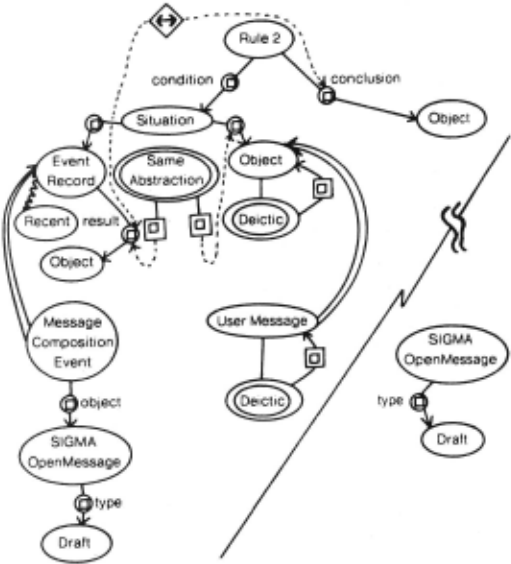
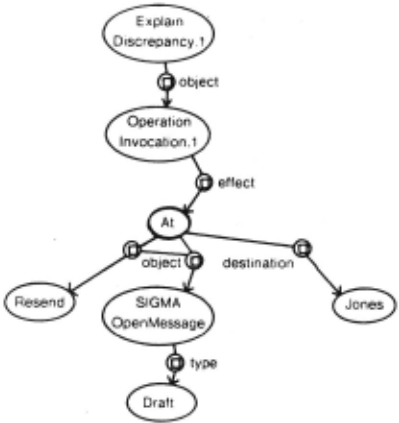
In this example, only one rule applies to a part of the current description. This rule, shown in Figure 6, attempts to resolve a deictic reference to an object (e.g .. this message) by looking for a similar object that appeared in a recent event . Here it is possible (depending on the actual resolution of the reference) that the rule will redescribe this message as a Transmitted message, thus making the current description a subconcept of the actuall y executable SIGMA Forward Message To User shown in Figure 5. However. let us assume in this case that when Rule 2 is applied. this message turns out to be a Draft. as shown in Figure 6. SIGMA Forward Message To User is therefore not applicable. and target-based reasoning fails. The mapper must now conclude that the user's request cannot be satisfied , and that an explanation response must be generated instead. It creates an explanation form noting the structure it gave up on (Figure 7) and passes the problem on to the explainer.
2.3. Explanation
Now that Consul has given up on the attempt to perform the user's request for action . it must explain why it cannot perform the action, and perhaps suggest alternatives to the user. This requires finding the service operation or operations that the user was probably trying to get Consul to perform. and explaining to the user in his own terms why his request did not cause their invocation. Then, since Consul assumes that the user is really making an effort to do something with the system. it tries to make reasonable suggestions for corrections of the original request that will make something happen. Of course. the system must make sure that the user knows what that something is and how it differs from what he was requesting.
The first step of the explainer is therefore to find a reasonable set of targets--service operations-- that the user could have been trying for . This target finding operation is somewhat different than the one used during target -based mapping. For mapping purposes the only reasonable targets are those that could be reached by rule application. The explainer assumes that no such targets are available (otherwise the user's request would have been satisfied). Instead. its notion of potential targets are those service operation invocations that have the same objective as the user action specified in the original request.
As shown in Figure 3, the user's request specified the User Send action, that is, the action whose objective is the abstract concept of Sending. The explainer assumes that any service operations (or their invocations) that share this objective are close enough to the intent of the user's request to be considered potential targets. All service operations constructed as instances of the system's Transfer Operation will inherit the objective Sending. Figure 5 shows that four SIGMA operation invocations. Forward. Forward For Action , Release. and Send For Review. are instances of the system's Transfer Operation lnvocation 6 .
This initial list of targets is then examined to determine the differences between the targets and the user's requested action. A comparison of the desired operation invocation in Figure 7 with each of the potential targets (of which only a few relevant parts are shown in Figure 5--the full model of SIGMA's forwarding function is shown in Figure 9) reveals that Forward has the right intrinsic description but sends the wrong type of message. Release and Send For Review send the right type of message but have the wrong intrinsic description (Release has none at all), Forward For Action both sends the wrong type of message and has the wrong intrinsic description. Since Forward For Action happens to differ in all of the ways that any of these targets differ. it is pruned from the target list. This leaves only Forward, Release . and Send For Review to be used in the explanation .
But the explainer also notes that one of these targets . Forward. differs from the requested invocation in a different way than the other two. The specification this message in the user's request has been resolved into a description of a unique object in the world. i.e .. a particular message. The explainer will not suggest alternatives to the user's specification of unique objects (i .e .. 11 will not respond to the user's request with "You can·t forward this message. would you like to forward a different one?") . Therefore.
6 The way that these serv1ce specific operations came to be so modelled IS d1scussed in the following sect1on.
given that the user really wants to send th iS message. only two of the possible targets. Release and Send For Review . remam as viable alternatives.
All of the necessary information for the response has now been gathered. Comparison of the explanation form in Figure 7 with the target descriptions shows why the user's requested action could not be applied to his requested object : the indicated intrinsic description and message type are incompatible with respect to the target set (while the recipient Jones , for example, is compatible, and will not enter into the explanation) . The response will therefore explain that the user's request for forwarding could not be satisfied because this operation cannot be applied to messages of type "draft" . And , since there are other targets in the set that can still satisfy the user's objective for his requested object . the response will go on to suggest Release and Send For Review as alternat ives.
Once the content of the response has been decided upon. the explainer must determine whether there are user concepts that correspond to the system concepts ("forwarding" . "sending for review", " releasing" , and "draft message") in the planned explanation. Those concepts that have a direct correspondence in the user model can simply be incorporated into the response (e.g. , since the user's concept of message and the system's concept of message share a common abstraction , Consul can make the direct translation) . Those concepts that do not have a direct correspondence in the user world must be redescribed in terms of component parts that do have user equivalents (e.g .. " forwarding for action is like forwarding except that the user receives the note 'requires action' with the message") . We have already seen that the user has the concepts of "forwarding " and "message" : for simplicity. we will assume that the other system concepts to be explained also have user equivalents. The explanation response resulting from the user request Forward this message ro Jones is therefore
Draf t messages cannot be forwarded. You can release this message or send it for review .
2.4 . Acquisition
It should be clear from the preceding sectiors that Consul s abil ity to understand user requests and produce appropnate responses relies crucially on proper classification of service dependent information in the knowledge base. Th is means that the service dependent information must be seen in relation to the built-in concept structures represent ing Consul's systems knowl edge. Consul 's rel iance on precise service modelling would be infeasible if model construct ion were the responsibil ity of the individual service builder: the service builder is unaware of Consul 's needs. and certainly unaware of the intricacies of its KL· ONE model. Instead. Consul provides an acquisition mechanism to incorporate the builder's description of his service into the Consul framework.
The service builder is never directly aware of the system knowledge base. He implements his service as a set of process scr ipt programs [Lingard 81] . The process script language is a programming formalism spec ially designed for the acquisition task. Programs consist of a procedure and some descriptive informat ion about that procedure. The descriptive part is in the form of a small number of categories of information required by Consul in order to see how the function represented by the process scri pt fits into its knowledge base. The process scripts. along with descriptions of service-dependent data structures. are acquired into the knowledge base to form the service model. The process script to implement the SIGI\1A Fo1ward operat ton tS shown in Figure 8.
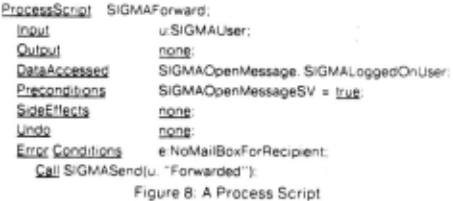
The process script is expressed completely in terms of the service builder's programming environment . It must therefore be translated into the appropriate KL-ONE representation called SIGMA Forward Process Script in Figure 9. This descript ion must then be incorporated into the knowledge base. As I mentioned earlier . the service builder's pr0gram (embodied tn SIGMA Send) transfers citations of messages rather than the messages themselves. This means that the operat ion defined by this process script is not an instance of the system's Transfer Operation . whtch would expect SIGMA Open tAessage to actually be sent However . Consul will not be able to understand SIGMA Forwa rd unless it can see it in relat ion to Transfer Operation.
The required relat ionship is constructed by the acquirer in accordance wi th a stylized dialogue with the service builder (see [Wilczynski 81] in this Proceedings for a detailed descriptton). Briefly. the acquirer uses its built-in model of the Transfe r Operation to ask the service bui lder questions about the parameters of SIGMA Forward . The service builder's answers to these questions are used to construct an instantiation of Transfer Operation with the same functionality as the process script . The result is called SIGMA Forward Operation in Figure 9
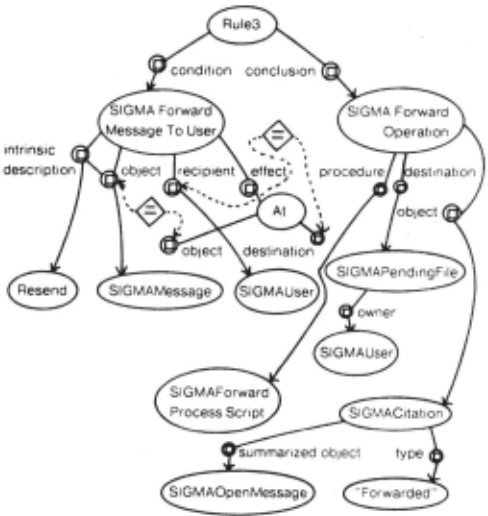
Unfortunately, this is not a Transfer Operation in the sense intended by the service builder: it does not transfer SIGMA Open Message, but instead a citation of that message. In order to capture this intended meaning of SIGMA Forward, the acquirer must use the results of its dialogue with the service builder to generate the mapping rule shown in Figure 9.
The description generated as the condition part of the rule, SIGMA Forward Message To User, is the appropriate representation of SIGMA Forward as a function for forwarding messages: the mapping rule shows how its invocation can be mapped into an invocation of the actual process script . As shown in Figures 2 and 5. it is the generated description SIGMA Forward Message To User that is found during the mapping process (because the user also speaks of messages rather than citations being sent ). If such a description had not been generated by the acquirer . Consul would not have been able to find the SIGMA Forward process script during its natural language understanding and explanation act ivities. and the user's request could not have received the correct response. The acquirer will not allow process scripts to be entered into the system until it has related them to system model concepts either by instantiation or by mapping rules.
3. Conclusion
The Consul system is still in the early stages of development . It currently demonstrates all of the capabilities discussed in this paper for a small class of user requests and service functions . Only part of the SIGMA-like mail service has actually been modelled and implemented . Immediate plans (the next year or so) call for the expansion of the knowledge base and service implementation to allow cooperative interaction with the full mail service. Then (over the next several years) . in order to prove the generality of the system as a cooperative interaction environment. the knowledge base will be extended to model the characteristics of other interactive services. The major problems now facing the Consul project are the acquisition. maintenance. and efficient use of large amounts of organized knowledge. In part . the solution to these problems awaits the higher speed . larger address space machine architectures that are now becoming available.
Acknowledgements
Thomas Lipkis is responsible for the explainer and the classification algorithm. Robert Lingard for the process script programming methodology, and David Wilczynski for the acquisition mechanism.
@inproceedings{ijcai1981p73,
  title     = {Representation and Inference in the Consul System},
  author    = {Mark, William},
  booktitle = {Proceedings of the Seventh International Joint Conference on
               Artificial Intelligence, {IJCAI-81}},
  publisher = {International Joint Conferences on Artificial Intelligence},
  editor    = {Patrick J. Hayes},
  pages     = {375--380},
  year      = {1981},
  month     = {8},
  note      = {INFERENCE and REASONING},
  url       = {https://ijcai.org/proceedings/1981/73},
}
TY - CPAPER TI - Representation and Inference in the Consul System AU - Mark, William T2 - Proceedings of the Seventh International Joint Conference on Artificial Intelligence, IJCAI-81 PB - International Joint Conferences on Artificial Intelligence PY - 1981 SP - 375 EP - 380 UR - https://ijcai.org/proceedings/1981/73 ER -Copied
Machine-readable versions of this paper, for tools and AI agents:





