
Knowledge Acquisition in the Consul System
Proceedings of the Seventh International Joint Conference on Artificial Intelligence. Learning. Pages 135-139.
© 1981 International Joint Conferences on Artificial Intelligence
Abstract
Ma ny knowledge-based systems feature general ma chinery that operat es on externally supplied information . These systems must solve the acquisition problem : how to represent the external knowledge . determine it it is adequate . and inco rp orate it into the know l ed ge base . As a mediator bet ween users and interactr ve services. the Consul system must understand the intent and behavi or of programs that perform interacti ve functions . To Consul . understanding a function means classifying a description of it in a highly structured . prebuilt know ledge base . A special form alism has been designed in wh ich a ser vice builder both programs functions and describes their actions. The resulting functional descriptions are then translated and interacti vel y classi fi ed into Consul 's knowledge base by Cons_~JI's acquisition co mponent . The acquisition dialogue with the service builder will be shown to be robust with respect to the information provided by the service builder. Inference ru les are automaticall y generated to acc ount tor discrepancies between a program 's specifications and expectations derived from Consul's knowledge base .
- Ronald Brachman . A Structural Paradigm for Representing Knowledge . Technical Report. Bolt, Beranek. and Newman , Inc., 1978.
- Randall Davis.
- Interactive Transfer of Expertise: Acquisition of New Inference Rules. In Proceedings of the Fifth International Joint Conference on Artificial Intelligence . IJCAI, 1977. IJCAI
- David Wilczynski, William Mark, Robert Lingard, Tom Lipkis. Cooperative Interactive Systems. In 1980 Annual Technical Report,. USC/Information Sciences Institute, 1981.
- Robert Lingard. A Software Methodology for Building Interactive Tools. In Proceedings of the Fifth International Conference on Software Engineering . 1981 .
- William Mark. Rule-Based Inference In Large Knowledge Bases. In Proceedings of the National Conference on Artificial Intelligence . American Association for Artificial Intelligence, August, 1980. 140
- Will iam Mark. Representation and Inference in the Consul System . In Proceedings of the Seventh International Joint Conference on Artificial Intelligence . IJCAI , 1981 . IJCAI
- Edward H. Shortliffe. MYCIN: A Rule Based Computer Program for Advising Physicians Regarding Anti-Microbial Therapy Selection. Technical Report AI Lab Memo AIM -250, Stanford University, October, 197 4. •
- • R. Stotz, R. Tugender, D. Wilczynski, and D. Oestreicher. SIGMA: An Interactive Message Service for the Military Message Experiment. In Proceedings of the National Computer Conference . AFIPS, May, 1979.
- w. A. Woods. Theoretical Studies in Natural Language Understanding . Annual Report . Technical Report BBN Report No. 4332, Bolt, Beranek. and Newman, Inc .. 1979.
References were extracted automatically from the PDF and may contain errors.
Full text extracted automatically from the PDF; figures, tables and equations may differ. The PDF is the version of record.
1. lnt roduction
The Consul system ( [3) , [6) in this proceedings) is being desrgned to support natural , helpful , and consistent interactions between users and onl ine services. In order to provide these cooperative fac ilities. any user interface must have a great deal of knowledge about the functionality of its services. However. unlike attempts at enhancing spec ific tools, Consul is being constructed as a general framework in which a wide variety of services can be embedded. The necessary functional knowledge is carefully organized within a central knowledge base comprising (1) user knowledge. service-independent , user-independent knowledge relating basic user needs to user actions, objects, and English language expressions, (2) systems knowledge, a service independent representation of the detailed behavior of the basic operations found in any service (e.g.. moving , deleting, schedul ing) , and (3) service knowledge, an instantiation of the systems knowledge to the actual operations and data structures of some interactive service implemented in Consul .
1 Th·s research is supported by the Defense Ad \lanced Research Projects Agency under Conlracl No OAHC15 72 C 0306. ARPA Order No 2223 Views and conclus·ons contained tn thtS paper are the author's and should n,Jf be ·nterpreted as represent·ng the off·c·al opmton or pol·cy ot DARPA, the US government or any person or agency connec te~ wt lh them
2 Many of the ideas tn this paper were developed 1n collabor at ·on wtl h Robe· t Ltngard
Knowledge Acquisition in The Consul System,
David Wilczynski
USC/Information Sciences Institute 4676 Admiralty Way Marina Del Rey, California 90291
Except for service knowledge, all concepts and relations in the knowledge base are built in. Because of the complicat ions of formally integrating service-dependent information . Consul has a component to acqu ire thrs information from the service builder. Consul relies on proper classification throughout its knowledge base: the relations between the service-independent concepts are carefully built in ; the proper relation between the service and systems knowledge is the responsibil ity of the acquisition component. It is only through proper classification that a function 's intent and behavior can be derived; having that information is the basis of Consul 's cooperative features. Many of Consul's interactions with users rely on application of service independent inference rules to map between descriptions in the knowledge base [5) . If the service-dependent information can be organized within the system model framework, those inference rules will automatically apply. The interface consistency that Consul provides is also a direct result of acquiring service-specific knowledge in terms of the carefully worked out systems model.
2. The Acquisition Process
A service in Consul is defined solely by its data structures and process scri.pts. Process scripts are programs that consist of two parts: a procedure body to perform some action and some descriptive information about that procedure, its parameters. its output . etc. The simplest process scripts, called process atoms. have a procedure body which consists of only a single call to some application code that is not further described to Consul .
Process scripts are the basis of a software design methodology for buiiding interactive tools [4) . Us1ng this method. a tool builder explicitly differentiates between code that is " interesting" to the end user (implemented using the process script language) and code that is not (hidden as the bodies of process atoms) . Informally, the code implemented via process scripts is the highest level code generated using a top-down or composite system design methodology. The information about the programs of the service being implemented comes solely from the process scripts and the acquisition dialogue with the service builder; it is not deduced by analyzing the code called by process atoms.
The acquisition of a service's process scripts occurs in four steps:
1. translating the process script into a knowledge ba!;e structure;
2. building a potential description of that structure from an initial classification by the service builder;
- refining the potential description into a validated descriptiofj. i.e.. one that is consistent with the knowledge base:
- building inference rules that relate the actual process script parameters to their roles in the validated description.
The goal of the acquisition process is recognition of the input structure in terms of the existing model . or in our terminology. classifying it in the knowledge base. Step 3 above requires interaction with the service builder in order to to extract information about the script that is not represented explictly.
Step 4 is necessary because functions commonly name parameters that are not actually manipulated by the function . Instead, due to a desire for brevity, simplicity, or information hiding , these parameters act as access paths to the actual data structures to be processed. For example, a person may talk about "dialing Joe on the phone," instead of the more precise "dialing Joe's phone number on the phone." The casual, simpler statement is understandable if a unique phone number is associated with a person and if that association is known to be applicable in the context of dialing phones. Since the validated description shows how the process script parameters are actually used, the necessary inferential knowledge to account for this metonymic style can be explicitly represented .
3. Acquisition Requirements
The Consul approach is predicated on a detailed, coherent knowledge base. Given the complexity of the knowledge base, a service builder would find it impossible to update it correctly when adding ·new process scripts to the system. Consul therefore provides a semiautomatic acquisition process to aid the service builder. Major requirements of this process are:
It supports different implementations. Consul's model of interactive functions does not impose any implementation decisions on the service builder. On the contrary, the knowledge base will be shown to be 1) sufficiently general to support services whose functions depend on fundamentally different architectures and 2) detailed enough to support cooperative interactions with the end user.
The service builder need not know all the details of the knowledge base. The service builder uses the process script language to write his programs and an object definition language (still to be designed) to describe his objects. The acquisition process has the responsibility of translating his input into the system's representation , n.apping it into Consul 's knowledge base, and accounting for any inferential relationships discovered during acquisition .
Acquisition must report anomalous conditions to the service builder in a way that will elicit an appropriate response. A number of anomalous situations can arise during acquisition : inconsistency in an object's definition may not be detectable until that object is used in a process script ; a rrew process script may conflict with. specialize. or generalize existing scripts; a process script may be imprecise in its input specifications (as is the case in the scenario to be presented) . Whatever the situation , the acquisition process must give the service builder the information that not only explicates the problem, but induces a helpful response.
Consul's acquisition process is intended to be robust, i.e., to successfully model service-specific information without overly constraining the service builder. The next section shows· that this goal is achievable.
4. An Acquisition Scenario
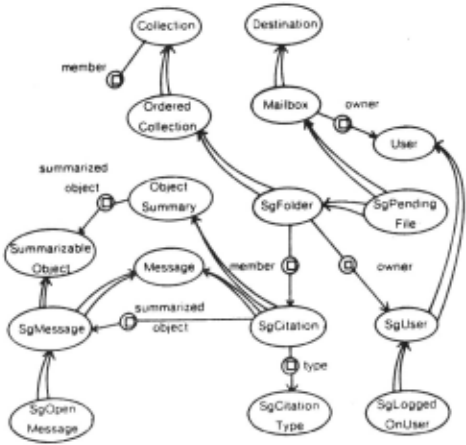
The service·dependent concepts in this scenario are modelled after those in the SIGMA message system [8) . Figure 5-1 shows how the SIGMA concepts. prefaced by Sg, relate to the service independent concepts in the knowledge base 3
In SIGMA. messages are kept in a central data base. A user is never sent messages. Instead. he gains access to them through citations delivered to his pending file . his personal mailbox. Besides having a pointer to the referenced message, the citation also contains addressing information, the subject of the message, and other summary information. Because a message can be "sent" or "forwarded" for different reasons (lor review, for action , for information. etc.), the citation type is used to identify the nature of the transmission .
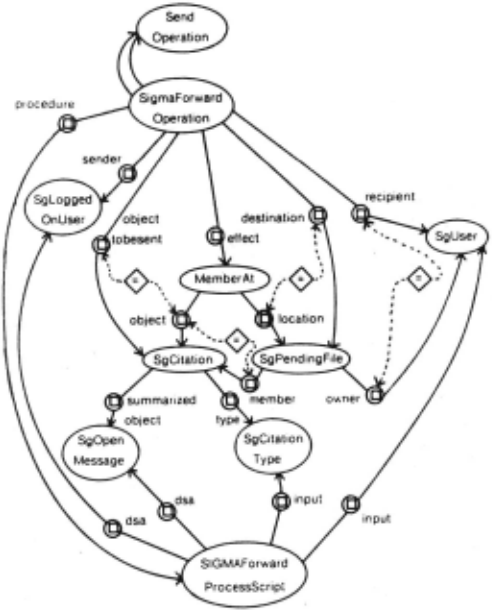
The SIGMAForward process script to be acquired (Figure 5-2) sends a citation of the SgOpenMessage--the message currently being worked on by the Sglogget;IOnUser-- to a designated user . The input to the script is the SgCitationType and the name of the intended recipient , SgUser. Since this scenario will be concerned only with the Input and DataStructuresAccessed descriptors of the process script. only they appear as roles in the translation shown in Figure 5·3 Notice that the process script itself has no statement of intent . since intent is derived solely through proper classification within the knowledge base.
Figure 5-4 shows the service-independent part of the knowledge base relevant to the acquisition of SIGMAForward . II defines a Send Operat ,on as a specialization of Move: there is a
3 consul's knowledge base 15 Implemented in the KL-ONE formalism [1]
ProcessScript
!illU.!1
Qlili2.u.1
DataStructuresAccessed
Preconditions
SideEffects u:SgUser, ct :SgCitationType; .!lQ.ru!;
SgOpenMessage,
SgloggedOnUser;
SgOpenMessageSV = ~;
.!lQ.ru!;
l.!.!!.Q.Q
fill!! Conditions
.!1Q.ru!;
e:NoMaiiBoxF orRecipient;
!&!! SIGMAForwardCode(u,ct) ;
SIGMAF orward ;
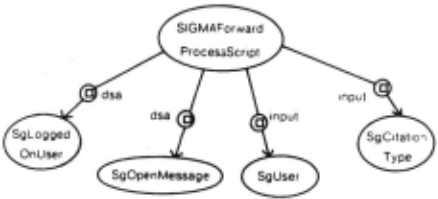
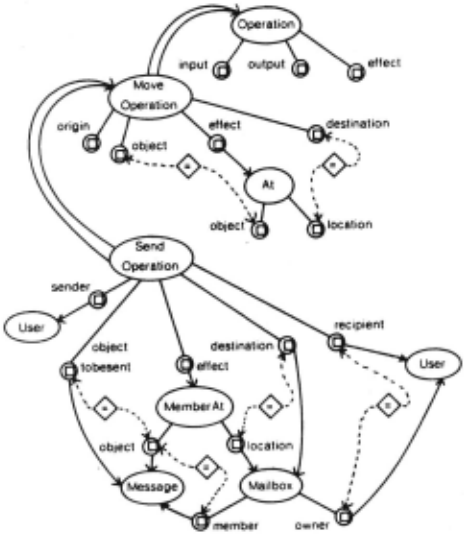
Figure 5-4: The Model of the Move and Send Operations
sender : the object to be sent is a Message ; the destination is a Ma ilbox whose owner is the recipient of the Message ; the effect of the Send is that the object is At a location which is the destination of the Send and that the object being sent is a val id member of the Mailbox.
The following scenario shows the process of building a description of the SIGMAForward script in terms of the modelled Send operat ion. It results in the informal notion of "sending messages to people" being redescribable as an invocation of the SfGMAForward function .
4.1. The Acquisition Dialogue
The scenario starts as the translation of the process script (Figure 5-3) is presented to the acquirer.
Acquirer:
WHAT KIND OF AN OPERATION IS THIS? (gives the service builder a list of top level system operations to choose from)
Service Builder : Move
Acquirer:
WHAT KIND OF A Move IS THIS? (gives the service builder a list of kinds of Move to choose from)
Service Builder : Send
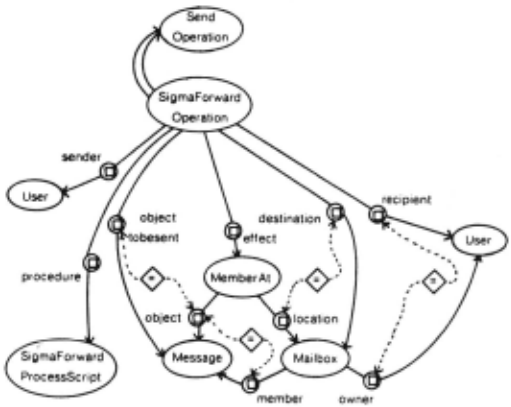
The acquirer builds a potential Send operat ion SIGMAForwardOperat ion (Figure 5-5) with the SIGMAForward process script as the filler of the procedure role. It then tries to match the roles of the process script with those of the operat ion it has just built.
Acqui rer:
WHAT IS THE destina tion?
Service Builder : u:SgUser
Acquirer:
(examines knowledge base (Figure 5·1) to see if a u:SgUser is a kind of Mailbox)
THE destinat ion OF A Send HAS BEEN DEFINED TO BE A Mailbox . u:SgUser IS NOT KNOWN TO BE A Mailbox . IS IT?
Service Builder : No
Acquirer:
CAN YOU GIVE ME MORE INFORMATION ABOUT THE destination of Send?
Service Builder : The destination of Send is the SgPendingFile whose owner is the u:SgUser. 4
Acquirer:
(examines knowledge base to see if SgPendingFile is a kind ofMailbox; since it is, the destination role is validated)
If SgPendingFile were not classified as a Mailbox. we cpuld add that relationship as part of this scenario (being aware that the addition of a new relation may have effects beyond the current acquisition session) . We expect that many service-dependent relations will be discovered through their use and hence built during process script acquisition.
Acquirer :
(because the "recipient" and the "owner " of the Mailbox are coreferential 5 . the u:SgUser is expected to be the recipient)
I ASSUME THAT u SgUser IS THE RECIPIENT. IS IT? 6
Service Builder : Yes.
Acquirer :
WHAT IS THE sender?
Service Builder : SgLoggedOnUser
Acquirer:
(sender role validated since SgLoggedOnUser is a kind of User)
WHAT IS THE ObJeCttobesent?
Service Builder : SgOpenMessage
Though the SgOpenMessage is a satisfactory filler for the objecttobesent role. its coreferen!lality to the object of the Member At causes a problem.
4 The Jargon parser [9] accepts input like this and produces forms from wh1ch we generate the appropriate KL·ONE. We are assuming this class of input to be sufficient for now.
5 Shown in Figure 5-5 by the links to the 0structural descnpt1on.
6 The Teiresias extension [2] to the Mycin [7] rule-based system generates expectations during rule acQuisition by comparing the new rule bemg acqu~red to ex isting ones. As pointed out by Davis, because Teiresias has no domain model. some of those expectations are wrong because coincidental correlations could not be separated from real ones. In Consul . all expectat,ons are based on characteristics o! the built-in systems model.
Acquirer THE effect OF YOUR PROCESS SCRIPT IS THAT THE SgOoer1.:essa9e WILL SgPendingF!Ie OF THE u.SgUser . THE SgOpenMessage TO BE MEMBER OF THE SgPendingFile . BE At THE I EXPECT A VALID
In order for the MemberAt effect to be satisfied . the locat ,on must be a Mailbox whose member is the ObJect of the MemberAt . The problem here is that SgPendingFiles contain SgCitations as members. not SgOpenMessages; so. sending an SgOpenMessage to it is invalid. Several things could be wrong: SgOpenMessages could be valid members (the service builder simply hasn 't told us yet); the SgPendingFile is not the destination of the Send : the SgOpenMessage is not the object of the Send (the actual case here) . The acquirer must frame these possibilities in a questton or questions that will elicit the right response.
Acquirer:
IS THE SgOpenMessage A VALID member OF SgPendingFile?
Service Builder : No
Acquirer:
CAN YOU GIVE ME MORE INFORMATION ABOUT THE otuecttobesent?
Service Builder: The objecttobesent of the Send is a SgCitation whose summarizedobject is the SgOpen Message.
Acquirer :
(revalidates the ob)ecttobesent role; validates the effect role; finds that one of the process script parameters is still unaccounted for)
WHAT IS ct:SgCitationType USED FOR?
Service Builder : The ct :SgCitat ionType is the type of the SgCitation .
Acquirer:
(builds the correspondence between ct:SgCitationType and the the type role of the SgCitat ion)
SIGMAForward VALIDATED'
At this point the description shown in Figure 5·6 is complete and can be classified in the knowledge base. The acquisition process has successfully discovered the intent of the process script via the above dialogue. Now it remains to account tor the relatt onship between the the process script's parameters and roles of the validated description.
4.2 . Building the Inference Rules
The validated description of the SIGMAForward process script shows that there is an implied access path from a SIGMA user to his pending file, and one from an open message to its citation . Because of these relationships, the following statements are logically equivalent (assume that "Forward" implies a certain citation type) :
1. Forward the open message to Jones.
2. Forward the open message to Jones' pending file.
- Forward a citation of the open message to Jones.
- Forward a citation of the open message to Jones· pending file.
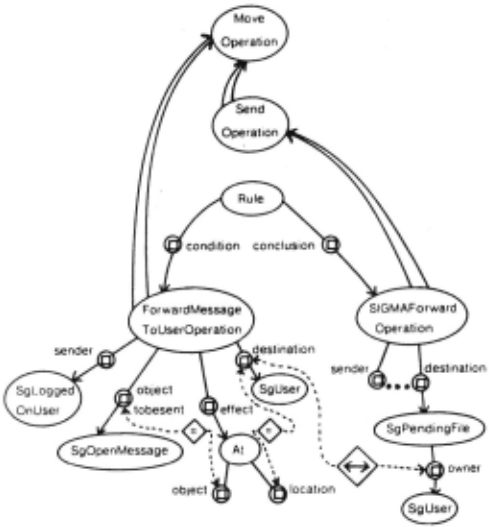
The last statement would instantiate the validated description of Figure 5·6 and is therefore executable. The first (and briefest one) matches the specification required' by the process script, but not that of the validated description. Since statement 1 should cause the same process script to be invoked, inferential knowledge is needed to map it into the validated description. The necessary inference rule, shown in Figure 5· 7 shows how a description of a Move operation whose object to be sent is a SgOpenMessage and whose destination is a SgUser can be transformed into the validated description 7 . Similar rules are constructed to account for statements 2 and 3.
The inference rules are completely determined by the relation between the parameters as defined in the process script and the roles of the operation as defined by the service· independent model. Whenever the correspondence is not direct, inference rules need to be generated. Notice that in comparison to the validated description, the condition parts of these inference rules are always less precise, potentially less constrained . and may (as in this example) have a more general classification These factors combine to allow the end user a certain amount of informality in making his requests. However. they may also lead to problems. For example. the generation of a new rule may introduce ambiguities when distinct validated descriptions produce identical rule conditions. This and other issues, such as using rules to represent defaults, giving the service builder some control of the rule generation process, and recognizing and handling cases when new rules specialize or generalize existing ones. are currently under study.
5 . Conclusions
The prototype acquisition component described in this paper just begins to address the requirements specified in section 3. We have, however, shown that acquisition has the capabilities to make the Consul approach feasible. The service builder can write his functions in a language suited to his task and have them interactively assimilated into Consul's knowledge base. Any inferential knowfedQ.t! needed to account for service-dependent conventions is automatically generated.
What remains to be shown is the robustness of the process. Even though the scenario showed how the acquirer directs the dialogue. how it detects some anomalous situations, and how it can make certain assumptions, many issues remain. Robustness is a critical concern if the acquirer is to interact with real service builders and not Consul specialists.
The task of building a cooperative user interface is too large and complex to attempt for each new service. One of our goals is to build a framework in which many new services can be embedded. Acquisition. as described in this paper. is a fundamental part of that framework.
7 The ~ structural description indicates how roles in the rule cond1tton corresponds to roles in the rule conclusion In order to simplify Figure 5· 7. oniy one of them is shown .
@inproceedings{ijcai1981p28,
  title     = {Knowledge Acquisition in the Consul System},
  author    = {Wilczynski, David},
  booktitle = {Proceedings of the Seventh International Joint Conference on
               Artificial Intelligence, {IJCAI-81}},
  publisher = {International Joint Conferences on Artificial Intelligence},
  editor    = {Patrick J. Hayes},
  pages     = {135--139},
  year      = {1981},
  month     = {8},
  note      = {Learning},
  url       = {https://ijcai.org/proceedings/1981/28},
}
TY - CPAPER TI - Knowledge Acquisition in the Consul System AU - Wilczynski, David T2 - Proceedings of the Seventh International Joint Conference on Artificial Intelligence, IJCAI-81 PB - International Joint Conferences on Artificial Intelligence PY - 1981 SP - 135 EP - 139 UR - https://ijcai.org/proceedings/1981/28 ER -Copied
Machine-readable versions of this paper, for tools and AI agents:





