
Don't Be Stupid
Proceedings of the Seventh International Joint Conference on Artificial Intelligence. INFERENCE and REASONING. Pages 345-346.
© 1981 International Joint Conferences on Artificial Intelligence
Abstract
We are studying control knowledge for a general problem solver, named BLOCKHEAD. Currently the problem solver is based on negative heuristics, which has led to surprising efficiency in suitable domains. The lesson seems to be that it is easier to avoid being stupid than to try to be smart. Stupid plans are defined and a plan improvement method proposed. Analyses of stupid plans and failed plans suggest effective negative heuristics.
- Ill Nilsson, N.J., Principle .of Artificial Intelligence, Palo Alto: Tioga, 1980. 121
- Fikes, R.E. and Nilsson, N.J., STRIPS: a new approach to the application of theorem proving to problem solving. Artificial rntelligence, 1971, 189-203. 131 IJCAI
- warren, D.H.D., WARPLAN: a system for generating plans, Memo 76, Dept. of Cooq:lutation Logic, Univ. of Edinburgh, School of Artificial Intelligence, June 1977.
- Sacerdoti, E.D., A Structure .tQI. ~ .and Behavior, New York: Elsevier, 1977.
- Vere, S.A., Relational Production Systems, Artificial rntelligence, Vol 8., 47-68.
References were extracted automatically from the PDF and may contain errors.
Full text extracted automatically from the PDF; figures, tables and equations may differ. The PDF is the version of record.
Introduction
We are investigating a general problem solver which incorporates control knowledge in the form of negative heuristics. The problem solver accepts problems represented relationally, as did STRIPS [1,2], WARPLAN [3], and OOAH [4]. Operators are represented as relational productions, following Vere (5]. An unusual feature is that preconditions must match distinct relationships in the current state. This allows a more natural description of operators. For example, in the Bl.OCKS world the operator to move a block X onto a block Y includes the preconditions clear(X) and clear(Y). Since these may not match the same item, we do not need the additional condition notequal(X,Y).
In contrast to the above mentioned problem solvers, BLOCKHEAD does not employ goal reduction: it is a forward-chaining system. Nevertheless, it
This research was supported by the Naval Ocean
Systems Cen~er under grant N66001-BO-c-0377.
DON'T BE STUPID
Dennis Kibler Paul Morris
Information & Computer Science Department University of California at Irvine
is goal directed, as we shall see. Forward-chaining systems have been generally neglected in studies of problem solving, perhaps because goal direction has been (erroneously) regarded as synonymous with goal reduction; Note that forward systems avoid the difficult issue of integration of partial plans.
Both breadth first and depth first variants of the interpreter have been constructed. Each variant avoids repeating already visited states; this generally produces a finite search space.
Negative Heuristics
The problem solver is guided by negative heuristics. These tell one what lUI' to do. They are not intended to replace positive heuristics, but rather to complement them. Negative heuristics are so natural that people are generally unaware of them. In the blocks world, four negative heuristics surprised us by eliminating nearly all search. Informally, they are:
- Don't add to a pile containing a block that needs to be moved.
- Don't add to a pile containing a block that requires adding another block to it (unless you are
presently achieving that goal).
- Don't move a block off an irrelevant pile.
- Don't move a block onto an irrelevant pile.
A more formal statement of the first heuristic is, (capital letters stand for variables):
don't ma.ke on (X, Y) if for sane W and z, an unachieved goal conjunct is on(Z,W), and Y covers w.
Note that the heuristics relate the goal to the current state and anticipated action. 'lbe heuristics are designed to eliminate actions which clearly do not contribute to the goal. 'Ibis provides a form of goal direction which can be highly effective. Using these heuristics, both the breadth first and depth first systems solved typical ten block problems with almost no consideration of fruitless paths. A full width search of a ten block world might generate over 30 million states, so we were sanewhat amazed that these few guidelines produced such limited searches.
It is of interest that the depth first system usually required less search than its breadth first cousin. 'Ibis occurred because, in the breadth first approach, equally good partial solutions must all be explored. With the heuristics, most paths being explored did in fact lead to solutions, giving the depth first system an advantage with its "don't care" approach. However, the breadth first problem solver has the advantage of always generating a least cost solution (modulo the heuristics). 'lbe depth first problem solver sometimes generates non-optima.! plans.
We say a plan is stupid if it contains a (proper) subplan that solves the problem. A plan which is not stupid need not be optima.!. For example, suppose the initial state consists of four blocks, with b and d on the floor, a on b, and c on d. Let the goal be d on b and a on c, as pictured below.
| initial state | goal |
|---|---|
| I a I I c I | ld a I |
| I b I I d I | I b I I c I |
A non-optima.l plan to solve this problE!II is: c to floor; a to floor; d to b; a to c. 'Ibis plan is not stupid because no subsequence of the plan will solve the problE!II. Each operation in the plan contributes to the solution. 'lbe plan can be improved by omitting the second operation and interchanging the last two operations. In our view this goes beyond plan simplification.
One could detect and siJ!t>lify a plan by trying all possible subplans. Here we describe a less expensive algorithm which is not completely effective. Form a graph, the ~ ~. in which each node corresponds to an operation in the plan and is labelled with that operation. A directed edge connects nodel to node2 if there are postconditions of nodel which are preconditions of node2 and are not preconditions of any intervening operations. 'l1le edge is labelled with this set of (instantiated) postconditions. Plan graphs are closely related to the triangle tables of Nilsson.
The plan given as an example would have the following plan graph. Nodes are enclosed in boxes. The arcs are directed downwards and are labelled with relationships.
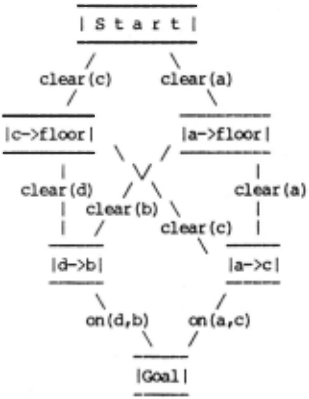
Using a plan graph, we simplify a plan in the following way. Mark all the nodes that finally establish one of the goal conjuncts. All nodes that are not ancestors of any marked node can be deleted fran the plan. Also, any directed path consisting of unmarked nodes that is reducible to the identity transformation can also be excised. This reduced plan graph can now be translated into a plan by choosing any total ordering of the operations which is consistent with the partial ordering determined by the plan graph.
Negative Heuristic DiscovetY
Stupid plans and examples of poor search played an important role in our discovery of effective negative heuristics. When examining such failures, certain actions struck us as "stupid." Attempts to explain WHY they were stupid led to the negative heuristics. We believe this process can be mechanised. Work is proceeding on methods to identify the "point of stupid departure" and to generalize a description of the system state at that point.
l.nl'>lementation notes: The breadth first problem solver was first programmed in LISP and then in P~r.a;. The canpiled ~r.a; code executed four times faster than the canpiled LISP code. The ~r.a; code was more concise than the LISP code and easier to modify. If an AI problem requires pattern matching, non-determinism or execution of and/or trees, then ~r.a; seems to have advantages over LISP.
@inproceedings{ijcai1981p68,
  title     = {Don't Be Stupid},
  author    = {Kibler, Dennis F. and Morris, Paul},
  booktitle = {Proceedings of the Seventh International Joint Conference on
               Artificial Intelligence, {IJCAI-81}},
  publisher = {International Joint Conferences on Artificial Intelligence},
  editor    = {Patrick J. Hayes},
  pages     = {345--346},
  year      = {1981},
  month     = {8},
  note      = {INFERENCE and REASONING},
  url       = {https://ijcai.org/proceedings/1981/68},
}
TY - CPAPER TI - Don't Be Stupid AU - Kibler, Dennis F. AU - Morris, Paul T2 - Proceedings of the Seventh International Joint Conference on Artificial Intelligence, IJCAI-81 PB - International Joint Conferences on Artificial Intelligence PY - 1981 SP - 345 EP - 346 UR - https://ijcai.org/proceedings/1981/68 ER -Copied
Machine-readable versions of this paper, for tools and AI agents:





