
The Nature of Generalization in Understanding
Proceedings of the Seventh International Joint Conference on Artificial Intelligence. INFERENCE and REASONING. Pages 348-352.
© 1981 International Joint Conferences on Artificial Intelligence
Abstract
True l.l'lderstanding of natural lanJuage text requires the inclusion of generalization and loOJterm memory. 'Ihis paper describes the generalization . process and memory used in the Integrated Partial Parser (IPP), a comp.Jter program that reads and remembers news stories, 'Ihe need for generalization and generalization-based memory as an integral part of l.l"lderstanding natural language text is illustrated with examples from IPP. In addition, the nature of generalization is discussed.
- carbonell, J. G. Jr. SUbjective understandirg: Canputer models of belief systems. Tech. Rept. 150, Yale University Department of Canputer Science, 1979.
- ~lodner, J. L. Retrieval and organizational strategies in conceptual memory: A compu~er model. Tech. Rept. 187, Yale University Department of Canputer Science, 1980.
- Lebowitz, M. Generalization and memory in an integrated understandirg system. Tech. Rept. 186, Yale University Deparbnent of Canputer Science, 1980. PhD Thesis
- Schank, R. c. "Ian:Juage and Memory." aognitive Science i• 3 (1980), 243-284.
- Schank, R. C. arrl Abelson, R. P.. Scriots, Plans, Goals and Understandin;J. Lawrence Eri6aun Associates, Hmsd'aie, New Jersey, 1977.
- Schank, R. c. and carbonell , J. c. Re: The Gettysburg Address: Representirg social and p.:>litical acts. In Findler, N., W., Associative Netw:>rks: ~resentation and Use of I<OOwled(je ~ Canputers, Acaaemlc Press;New YorK', 1979.
- Soloway, E. I<OOwledge-directed learning. Tech. Rept. cons Technical Rep.:>rt 77-6, University of Massachusetts at Amherst, 1977.
- Wilensky, R. Understanding goal-based stories. Tech. Rept. 140, Yale university Department of Computer Science, 1978.
- Winston, P. H. Learning Structural Descriptions from EXamples. In P. H. Winston, W., The ~l §hology of Canputer ~, fot:Graw-Hill, New York, 72.
References were extracted automatically from the PDF and may contain errors.
Full text extracted automatically from the PDF; figures, tables and equations may differ. The PDF is the version of record.
1. Introduction
A comp.Jter system designed to read and remember natural language text must do rrore than just determine the meaning of each separate piece of text. It must also try arrl understarrl the "big picture" by comparing separate episodes. 'Ihis requires making generalizations based upon the texts read that represent the general course of events in the world.
For example, proper l.l"lderstanding of international terrorisn requires generalizations such as those in Figure 1.
Figure 1: Typical generalizations about the ~oUrld
- Terrorist attacks in 1-brthern Ireland are carried out by members of the Irish Republican Army.
- lob one is ever hurt by bombings in El Salvador.
- '!he victims of kidnappings in Italy are usually businessmen.
- Takeovers in Latin lmerica are usually carried out by left-wing groups.
--------------
'!he research described here was carried out at Yale University and was supported in part by the Advanced Research Projects J!gency of the I:epartment of I:efense and rroni to red by the Office of Naval
Research under contract N00014-75-c-llll.
THE ~TURE OF GENERALIZATION IN UNDERSTANDIN:J
Michael Lebowitz
Colunbia University, I:epartrnent of Comp.Jter Science
406 Mudd Building, New York, NY 10027
All of these generalizations were made by a computer program, IPP (the Integrated Partial Parser), a complete understanding system that reads arrl remembers stories fran newspapers arrl the UP! news wire. The generalizations made, besides being interesting observations about the ~oUrld, provide useful information for text processing arrl the organizing memory of events. Irrleed, to have a computer system that understands in as powerful fashion and over as wide a range of texts as do people it is necessary for the system to have a dynamic, generalization-based memory that can be accessed during understanding.
Further details of the topics discussed here, inclLrliOJ the specifics of the generalization process arrl an extensive discussion of the memory based parsing process developed for IPP can be fourrl in [3).
2. Generalization as part of understarrling
As an illustration of the role of generalization in understanding, consider stories Sl and 52.
(1-bte: All the stories use::l as examples in this paper are actual, unedited news stories. II"P does not require any special preparation of the stories that it reads.)
51 -Boston Globe, 5 February 79, Italy
'lhree g1..1111len kidnapped a 67 year-old retired industrialist yesterday outside his oouse near this north Italian town, p.:>lice said,
52 - New York Times, 15 April 79, Italy
A building contractor kidnapped here on Jan. 17 was released last night after payment of an undisclosed ransom, the police said.
Mter reading these t~oU stories, we know more that just the independent meanings of the stories. Even asslllling no prior knowledge of terrorism in Italy, it is possible to make some tentative conclusions about the nature of kidnapping in that country. In particular, the stories lead to the plausible conclusion that businessmen are coomon targets for Italian kidnappers. Generalizations of this sort are a basic part of understanding.
Conclusions made so quickly are hardly sure things. fbwever, such hypotheses allow the best information currently available to be used for future Ll)jerstarding ard memory organization. 'As long as it is p:>ssible to later disconfirm these generalizations (a process discussed in [3]), then this is an effective "NaY to make use of all existing information.
In order to g_enerali ze from a story, it must t;>e p:>ssible to fird similar examples already 1n memory. IPP allows the retrieval of such examples by organizing memories in terms of generalizations.
Continuing with the previous example, suppose 53, which appeared after Sl ard 52, is oow read.
53 - New York Times, 25 June 79, Italy
Kidnappers released an Italian shoe manufacturer here today after p3yment of an undisclosed ransom, the p:>lice said.
In order to fully understard this story, it is necessary to recall the previous t't«l stories ard the generalization made from it. In effect, we urderstard this story as being an instance of the existing generalization.
'!he use of generalizations shown here is a very imp:>rtant one - they allow a reader (human or computer) to explain events in terms of existing generalizations, rather than trying to explain each new event from scratch.
Sometimes generalizations must be used toore explicitly in l.l'lderstarding. For instance, consider the way that IPP processed story 54, after it had generalized that bombin]S in Spain are usually carriErl out by Basques (BASQUE-Ge:N), as shown by the computer output in Figure 2.
Figure 2: IPP inferring default role features
*(PARSE 54)
Story: 54 (8 24 79) SPAIN
( BCJ>1BS EXPLODED IN A FRENCH BANK AND A ffiENCH IMMIGRATION OFFICE IN NORTHERN SPAIN EARLY TODAY CAUSING l:W-1AGE BlJI' NO INJURIES ACCORDING 'ro POLICE)
>>> Beginning final memory incorp:>ration ···
Feature analysis:
RESULTS
METHOIE
LOCATION
EV16 (S-DESTRUCTIVE-ATTACK)
AU
CAUSE-l:W-1AGE
AU
NATION
$EXPLODE-BCJo1B
SPAIN
Irdexing EV16 as variant of BASQUE-GEN Inferring feature ACTOR DEMAND-TYPE SEPARATISM Inferring feature ACTOR NATION BASQUE
>>> Memory incorp:>ration complete
In this ex~ple, IPP recognizes that 54 is an instance of the generalization BASQUE-GEN ard uses that generalization to supply default characteristics of the terrorists. In particular, IPP assumes, corresp:>rding with the generalization, that the terrorists are Basque separatists. Supplying information of this sort is an imp:>rtant use of generalizations, without ...tlich we 't«luld be required to initially provide an text processing system with every piece of information it 't«>uld ever need for urderstard ing. '}:n this example, the identity of terrorists in Sp.:un 't«>Uld have to be directly provided IPP if it could not learn that infonnation itself.
3. Generalization ard memory
New events are often interpreted during urderstarding in terms of known stereotypical situations. For reasons of economy of storage ard efficiency in processing, it is advantageous to record events in memory in terms of these standard situations. In order for a computer progrcrn such as IPP to begin to process text, it must begin with some koowledge of such situations, before it can begin to generalize further.
'!here are t't«l types of structures that capture different forms of regularity initially providErl to IPP - Simple Memory Organization Packets (5-MOPs) that describe causal stereotypes such as extortions ard attacks, ard Jlction Units (AUs) that represent concrete events, such as shootings, people being 't«lurded, ard hostages being releasErl. AUS serve as JOOdular units in the makeup of 5-MOPs. I will oot give a detailed description of S-MOPs or AUS in this paper, al thoUJh they must be well specified, as is done in [3]. '!he idea of Memory Organization Packets was first introduced by Schank in [4].
The stereotypical p3tterns of events captured by IPP's initial S-MOPs are oot the only p3tterns that exist. '!hey represent the basic information needed to l.l'lderstand stories. Further p3tterns are recognized in the form of generalizations of the sort shown earlier.
Generalized p3tterns serve as excellent organizers for memories of actual events, since they require only the explicit recording of unusual details (e.g. those oot captured by a generalization) of a story. Furthermore, the generalizations made provide an adequate number of different p:>ints around ...tlich to organize memory.
'!he co~bination of a generalization and the events it organizes is known as a specialized MOP, or spec-MOP. As events are added to an 5-MOP or spec-MOP, IPP is usually able to make generalizations that allow the memories of events to be spread ~ong several spec-MOPs. This enables events to be stored in a distinctive, easy to retrieve fashion.
5-MOPs and spec-MOPs are fundcrnentally similar structures. Presumably &-MOPs could be created from spec-MOPs that are used quite frequently. Both &-MOPs and spec-MOPs describe abstract situations. Ebth structures are used to organize memories of events and mre specific spec-MOPs, as well as beir¥] used to make predictions for use in urrlerstanding. &-MOPs simply provide that information needed to initially understand stories.
IPP's memory, then, is a set of &-MOPs, each pointing to a net of spec-MOPs. Associated with each spec-MOP are events (in terms of the AUs and role fillers that make them up) indexed by the ways in v.hich they differ from that spec-MOP. 'Ihis index uses a discrimination net that allows easy retrieval of those events similar to a new event that might be explained by the sa.rne spec-MOP.
Figure 3 provides a concrete example of IPP' s memory structure. It shows one snall piece of memory, t~ spec-MOPs, after approximately 300 stories had been read and remembered.
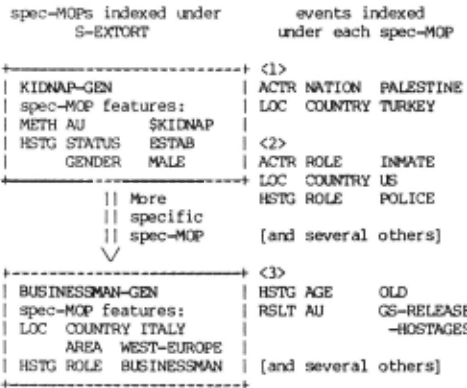
| spec-1\IOPs indexed under S-EXTORT | events indexed under each spec-MOP | ||||
|---|---|---|---|---|---|
| +-----------------------~ | <1> | ||||
| KIIJNAP-{;EN I spec-MOP features: I | ACTR LOC | NATION COUNTRY | PALESTINE TURKEY | ||
| METH I I | AU SfATUS | $KIDNAP ESTAB MALE | |||
| HS'm I | GENDER II | ---+ | <2> ACTR LOC HS'm | ROLE COUNTRY ROLE | INMATE 1.E POLICE |
| II II | More specific spec-MOP | [arrl several others] | |||
| I BUSINES9o!AN-GEN | v | <3> | |||
| +-----------------+ | spec-MOP features: COlMI'RY | ITALY | RSLT | AU | |
| I | AREA ROLE | BUSINESSMAN | HS'm | AGE | OLD GS-RELEASE -HOSTAGES |
| I LOC I I | HS'm | WEST-EUROPE | [and | several | others] |
+-------------- ---1-
The section of memory in Figure 3 contains t~ spec-MOPs (given names for purposes of this discussion) that describe situations concerning extortion. 'Ihe first spec-MOP in Figure 3, KIDNAP GEN, describes the kidnapping of establishment males. Several events are shown irrlexed l..l'lder it, <1> a kidnapping by Palestinians in Turkey, arrl <2>, a kidnapping of police by il'lllates in the United States.
Since each unique feature of an event is used to index it tnder KIDNAP-GEN, r..henever this spec-MOP has been determined to be relevant to a situation it is a simple matter to firrl events with features we are concerned about.
A similar scheme is used to irrlex spec-MOPs urrler S-MOPs am other more general spec-MOPs. Basically, all the features of the spec-MOP are used as irrlices pointing fran the higher node to the spec-MOP. !vJain, this indexinJ simplifies the process of finding the spec-MOP at the times it is relevant.
Such irrlexing of spec-MOPs is shown in Figure 3. KIDNAP-<JEN turns out to be a widely applicable spec-MOP, arrl still more specific spec-MOPs are quickly created, inclooing one shown in Figure 3. cnce IPP encounters several exanples of businessnen being kidnapped in Italy, it conclooes that this, too, is a generalizable situation. This decision results in the creation of a new spec-MOP, BUSINESSMAN-<JEN, that is also used to organize memories of events (inclooing <3>).
'Ihe indexing of spec-MOPs under &-MOPs and events urrler spec-MOPs makes it easy to firrl similar events as a new story is being read. By looking at the index for spec-MOPs urrler the relevant S-MOP, it is possible to find generalizations that share features with an incoming story. After features have been extracted fran a story, IPP uses the index for spec-MOPs under an identified 5-MOP to fetch any spec-MOPs with the same features as the story.
cnce IPP has found the best available spec-MOPs, it can then firrl events that differ fran those spec-MOPs in the same ways the new story does. 'Ihis time the event index is used to find other instances with some of the same ron-stereotypical features.
4. The range of generalization
'n!a inclusion of generalization in IPP lead to considerable insight about the kinds of generalizations that are useful to make as part of the urrlerstanding process. These fall into t~ basic classes - factual generalizations that can be made directly fran information in texts or require vnly simple inferences and abstract generalizations that require processing of input texts beyorrl the initial identification of the events described. Factual generalizations are fully implementa:i in the IPP as are some aspects of abstract generalization.
4.1. Factual generalization
'Ihe generalizations made by IPP are models of specific situations that are useful in future understandin;J. IPP concentrates on noting the cornnon factors in similar situations. In this section I will look at the nature of factual generalization, an:'l the basic knowledge needa:i to make them.
A typical factual generalization can be made from SS arrl 56. IRA-<JEN (paraphrased below) is the generalization made by IPP from these two stories.
55 - Boston Globe, 12 April 79, tbrthern Irelaoo
Irish Republican Army guerrillas ambushed a military p3trol in West Belfast yesterday killif)J one British soldier aoo badly woundif)J another army headquarters reported.
56 -New York Times, 28 Au::Just 79, En:}laoo
Earl Jlbuntbatten of Burma one of the heroes of modern British history was killed today ...tlen his fishif)J boat was blown up in the sea, apparently by terrorists of the Irish Republican Army.
IRA-(;EN: The IRA is a coomon actor of terrorist attacks ~ainst the British.
In each of these . stories about attacks in Great Britain, the terrorists involve'! belof)JOO to the Irish Republican Army. As it iooexes the two stories in memory, IPP notices that they share a mrnber of features. From this it makes the generalization that the IRA is normally associated wi th terrorist attacks ~ainst British citizens.
It is important to realize that generalizations first arise from noting similarities in events, aoo may not be further analyzed. 'lb use another terrorism example, it is quite p:>ssible to recogni'ze that hijackif)Js in Lebanon ar,e usually the work of ::hiite Jlbslems, ...tlile knowing very
little about ::hiite Jlbslems.
'Itle factual generalizations that IPP makes teoo to be observations of properties of staooard role fillers in given situations aoo normal Action Units (concrete events) for situations. Knowil');) detailed characteristics of potential role fillers assists in identifyil');) actual role fillers in stories, aoo can supply defaults, as . in Figure 2. Staooard Action Units can supply defaults in situations in which events that take place are only partially specified.
Q1ly a limited <m>unt of knowledge in addition to 5-MOPs and Action Units is needoo to understaoo a s i zable mrnber of stories and begin begin to make generalizations. The properties about people, organizations, objects and countries that are initially provided IPP are shown in Figure 4.
Figure 4: Necessary properties in memory
AGE AREA AlJI'H BODYPART GENDER IMPORTANT
MINORITY ~TIONALITY POLITICS RELIGION
ROLE srATUS TERRORIST-<:;ROUP
Some of the information initially provided IPP to aid it in understandil'llJ later proved to be learnable from stories. Fbr instance, the property TERRORIST-<:;ROUP names the default terrorist organization associated with a given country. :.-ben IPP was first developed, it was provided with the knowledge that the IRA normally carries out attacks in tbrthern Ireland, the Red Brigades in Italy and so forth.
lb~ver, it was later discovered that even if this information was deleted from IPP's initial store of knowled]e, it would make similar generalizations itself. Furthermore, the knowledge from the generalizations was somewhat more specific than that initially provide'! the progrcm. Fbr excnple, instead of assllllirg that the IAA was behioo all terrorist actions in tbrthern Ireland, IPP was able to generalize that the IAA was often behind bombin:JS and shootirgs, but not usually kidnappings aoo hijackir)JS.
4.2. Abstract generalization
tbt all generalizations can be made on a basic, factual level. It is alSJ possible to make generalizations of a more abstract sort. I will consider here three classes of such generalizations -- generalizations that require high-level analysis of stories, generalizations requiri113 reasonin:J, and generalizations of other generalizations. In each case, the basic generalization process remains the sene - notici113 similarities <m>n:J events - but the kind of information used as input is more abstr-1ct.
4.2.1. High-level generalization
It is possible to base generalizations on any of the levels of urrlerstaodin:J that take place, not just the factual level that IPP concentrates on. All the kinds of processin:J that have been discussoo by other researchers, such as that involvin:J plans, goals, themes [1, 5, 8], political ACTs [6] , and other high-level structures can be the sources of generalizations. 'l1'le same processes -- recordin;J events in memory in terms of their representations and assllllirg that similarities amol');) events indicate potential generalizations works for stories analyzed at all levels.
Q1e excnple of the nee'! for many levels of knowledge involves the nee'! for recogni zi113 political situations. Stories 57 and 58 are both about events that took place shortly before Rhodesia's first bi-racial elections.
57 - UPI, 24 February 80, Rhodesia
'Itle last day of formal camp3ignirYJ for Rhodesia's indepeooence elections was overshado~ by a po~rful bomb blast SUOOay that killed two people aoo demolished the plant of an influential lbrnan catholic newspaper.
58 - UP!, 28 February 80, Rhodesia
Gunmen rel_:))rted to be followers of guerrilla chief lbbert M.lgabe tried LI1Successfully to ambush a mobile f))ll if)J station in an isolated attempt to wreck Rhodesia's independence election authorities ref))rted today.
RHODE5IA-GEN: Attempts at democracy in Rhodesia are opf))sed by terrorists.
The generalization that terrorists will try to undermine democracy in Rhodesia is one that most of us would make (or consider) , but is based on rather complex analysis of these stories. In order to make such a generalization, a reader has to recognize tl1at an attack on a newspaper Ll'ldermines a free press which in turn decreases the likelihood of fair elections. Similarly, in the second story the reader must determine that an attack on a l_:))ll irYJ place will deter people from votirY;J, v.hich again minimizes the I_:))Ssibil i ty of impartial elections.
From examples such as this we see that the generalization ability encompasses not only the level of concrete, factual analysis described in the previous section, but aloo higher-level knowledge, such as goals, plans, and political ACTs. It is necessary to notice similarities amorY;J events at these high levels, as well as just analyzif)J each story to such levels.
4.2.2~ Generalization requirirYJ _reasonirY;J
UnderstandirY;J is not always a matter of simply matchirg up new events beirg described with stereotypical situations (even high-level ones) that we already know about. At times it is necessary to use sequences of inference rules to determine how a new event relates to what we already know. 'l11e results of such reasonirg can be the source of generalizations in the same way as more explicit information.
Consider, for example, 59 and SlO which might lead to the generalization LEBANOO-GEN.
59 - New York Times, 23 January 79, Lebanon
The Palestinian guerrilla leader who reputedly planned the attack on the Israeli Olympic team at M.mich in 1972 was fatally wounded here today in the explosion of a remote-controlled bomb.
SlO - UPI, 28 July 80, Lebanon
Unidentified gunmen Monday ambushed a pro-Iraqi f))litician riddlirY;J him and his bodY]uard with bullets "in the latest of the region's almost daily f))litical assassinations.
LEBANOO-GEN: Israeli a;~ents are willirY;J to kill their enemies in Lebanon.
UnderstandirY;J these stories well enoUJh to be able to make LEBANOO-GEN requires reasonirq about several different f)) i nts, but I will concentrate uf))n the determination that both killirYJS were carried out by Israeli agents. ·
Neither story mentions the identity of the actor of the killirq described. In each case a rather complex chain of reasonirq is needed to infer th:'lt the killii)JS were carried out by Israeli agents. 1-bwever, once these inferences have been rnr.~de, it is an easy matter to make the generalization that Israelis kill their enemies in Lebanon, usirq the methods described in this paper. The dit:ficul t task here is to determine when and how to apply the relevant inference rules that make up the reasoning procedure.
Inferences such as these can easily serve as input to the generalization process. 1-bwever, it is necessary to perform extensive inferencirq only when needed, and rely 1oostly on the stereotypical situations previously observed as ·nuch as f))Ssible, in order to avoid extensive computational problems.
4.2.3. Generalizing generalizations
The generalizations I have considered so far describe specific situations that are useful in explainirq events. 1-bwever, generalization is actually a multi-layer process, requirirq the recognition of generalities at based upon other generalizations. Ultimately this process allows for the creation of stroctures applicable to wider ranges of situations.
To see the need for such a procedure, consider the generalizations in Figure 5.
Figure 5: Similar generalizations
ITALY-KILL-GEN: Terrorists in Italy kill people with guns.
GUAT-KILL-GEN: Terrorists in Guatemala kill people with bombs.
COL-WOUND-GEN: Terrorists in Colombia wound people with guns.
These generalizations clearly have somethirY;J in comnon. Each describes a location where attacks take place, a standard result (victims being killed or wounded) , and a standard method (shooting or bombing) · If we assune that features of this sort frequently appear in generalizations (i.e., if we generalize the generalizations) then we will know to expect similar features in other generalizations about attacks. This corresponds to the way we can predict elements of events from the concrete generalizations that we make.
IPP concentrates upon makirq accurate factual generalizations. These generalizations provide the predictions that are needed for roost of the understarrli~ done by IPP. Sxne experimentation was done with high-level generalization, in particular, generalizations based on well-defined goals of terrorist groups such as black nationalists in Africa and the IRA. Hbwever, these more abstract generalizations, like those requiri~ reasoni~ and generalizations based on generalizations, are not as directly applicable to the l.llderstandi~ of new stories as factual generalizations and was left largely as a topic for future research.
5. Other research on generalization
Generalization, as performed by IPP, is the learni~ of rules that 4efine behavior in a certain set of circllllstances. Wlile litUe has been done concern!~ learni~ from natural la~uage texts, there has been w:>rk on learnin,J in other contexts that has some relevance to IPP.
Winston's well-known program [9], is given structural descriptions of examples of blocks w:>rld constructions (and near misses) and determines the rules behind the specification of these structures. unlike the w:>rk described here, Winston provides his system with the concepts to be learned. In addition, Winston does not have to deal with problems of organizin,J and findin,J instances in memory, since he is deali~ with snall m.mbers of cases.
A piece of w:>rk that deals with problems closer to those of IPP is that of Soloway [7]. His program takes episodes from a game of baseball, and attempts to generalize the rules of the gcYne. 'n'le program involves multiple levels of analysis of generalizations about the data, and is able to determine the more basic rules of baseball. The most imp.:>rtant difference here is IPP' s use of generalizations to help find excwples that are relevant.
'1\lo pieces of recent research in the area of memory organization are relevant. Schank [4] introduced ~ as a method of organizi~ personal episodic memories. ~lodner [2], with the progrcw CYRllS, addresses the problems of organizi~ large aoounts of such information in a manner sui table for efficient update, retrieval and question answerin,J.
6. O:>nclusion
In this f8per I have illustrated the role of generalization in the understand!~ process, arrl considered the ran:Je of generalizations that can be made. '1he use of generalization and memory has made IPP a p.:>werful l.llderstandin;J system. IPP is written in Yale/Rutgers/UCI LISP on a IECSystem 20/60 and uses approximately 100,000 w:>rds of storage for the progrcw (inclu:UI'f.] 3200+ dictionary entries for . parsin;J) · The generali zatiorH:>ased memory is kept in a separate LISP core image, ~ere over 500 events can be recorded in atx>ut 20,000 w:>rds of storage.
Wlen IPP reads all the available stories about international terrorism taken from local newspapers and the UPI news wire, it successfully identifies the events and role fillers for about 70-80%. <Ner the course of readirg better than 300 stories, IPP was able to make about 125 generalizations about terrorisn, approximately half of which it later rejected.
Wlile many of its generalizations were rather mundane, some were more interestirg, such as the one in Figure 1 indicatin;J that there are never casual ties from bombirgs in El Salvador. It is generalizations of this sort that indicate the imp.:>rtance of includirg generalization in an understandirg system.
REFEREl<ICES
- carbonell, J. G. Jr. SUbjective understandirg: Canputer models of belief systems. Tech. Rept. 150, Yale University Department of Canputer Science, 1979.
- ~lodner, J. L. Retrieval and organizational strategies in conceptual memory: A compu~er model. Tech. Rept. 187, Yale University Department of Canputer Science, 1980.
- Lebowitz, M. Generalization and memory in an integrated understandirg system. Tech. Rept. 186, Yale University Deparbnent of Canputer Science, 1980. PhD Thesis
- Schank, R. c. "Ian:Juage and Memory." aognitive Science i· 3 (1980), 243- 284.
- Schank, R. C. arrl Abelson, R. P.. Scriots, Plans, Goals and Understandin;J. Lawrence Eri6aun Associates, Hmsd'aie, New Jersey, 1977.
- Schank, R. c. and carbonell , J. c. Re: The Gettysburg Address: Representirg social and p.:>litical acts. In Findler, N., W., Associative Netw:>rks: ~resentation and Use of I<OOwled(je ~ Canputers, Acaaemlc Press;New YorK', 1979.
- Soloway, E. I<OOwledge-directed learning. Tech. Rept. cons Technical Rep.:>rt 77-6, University of Massachusetts at Amherst, 1977.
- Wilensky, R. Understanding goal-based stories. Tech. Rept. 140, Yale university Department of Computer Science, 1978.
- Winston, P. H. Learning Structural Descriptions from EXamples. In P. H. Winston, W., The ~l§hology of Canputer ~, fot:Graw-Hill, New York, 72.
@inproceedings{ijcai1981p69,
  title     = {The Nature of Generalization in Understanding},
  author    = {Lebowitz, Michael},
  booktitle = {Proceedings of the Seventh International Joint Conference on
               Artificial Intelligence, {IJCAI-81}},
  publisher = {International Joint Conferences on Artificial Intelligence},
  editor    = {Patrick J. Hayes},
  pages     = {348--352},
  year      = {1981},
  month     = {8},
  note      = {INFERENCE and REASONING},
  url       = {https://ijcai.org/proceedings/1981/69},
}
TY - CPAPER TI - The Nature of Generalization in Understanding AU - Lebowitz, Michael T2 - Proceedings of the Seventh International Joint Conference on Artificial Intelligence, IJCAI-81 PB - International Joint Conferences on Artificial Intelligence PY - 1981 SP - 348 EP - 352 UR - https://ijcai.org/proceedings/1981/69 ER -Copied
Machine-readable versions of this paper, for tools and AI agents:





