
Learning Problem-Solving Heuristics Through Practice
Proceedings of the Seventh International Joint Conference on Artificial Intelligence. Learning. Pages 127-133.
© 1981 International Joint Conferences on Artificial Intelligence
Abstract
We are interested in automatic improvement of problem solving strategies through practice .** A computer program called LEX is described , which acquires problem solving heuristics in the domain of symbolic integration. LEX learns heuristics from a sequence of presented training problems by ( 11 using available heuristics to solve the practice problem . (21 analyzing the steps it performed in solving the problem . and (31 proposing and refining domain-specific heuristics designed to improve its performance on subsequent problems . We describe the methods used by LEX. results obtained by the program . and strengths and weaknesses in the current system.
- Davis, R. "Applications of meta-level knowledge to the construction, maintainance. and use of large knowledge bases", Technical report STAN CS-76- 552, Stanford Universrty, June 1976.
- J [ 1 2]
- Polrtakis, P , Weiss. S and Kulikowski, C "Designing consistent knowledge bases for expert consultation systems", Technical report technical report DCS- TR-1 00. Rutgers Department of Computer Science. 1979. also 13th Annual Hawaii •International Conference on System Sciences
- Waterman, D A "Generalization learning techniques for automating the learnrng of heuristics " Artificial I nte/1 igence. 1 112 ( 19701 12 1-170.
- Buchanan. B. G and Mitchell, T. M. , "Model-directed learning of production rules ." in Pattern-Directed Inference Systems, Waterman. D. A and Hayes - Roth. F. . eds .. Academrc Press . New York , 1978
- Mostow. D J and Hayes-Roth. F. "Machrne-arded heuristic programming a paradigm for knowledge engineenng", Technical report Rand N-1 007-NSF .
- Anderson. J R "A general learning theory and its applicatron to the acquisition of proof skills in geometry " In Proceedings of the Workshop on Machine Learning. Carnegie-Mellon Universrty, Pittsburgh, PA, July, 1980.
- Anza i. Y. and Simon. H ''The theory of learning by doing." Psychological Review. 362 (19791 124 - 140.
- Neches. R. "Promoting self-discovery of improved strategies." In Annual conference of the American Educational Research Association. San Francisco.
- CA.. April, 1979, , also report CIP 398, Psychology Department. Carnegie-Mellon
- Neves. D. M. "A computer program that learns algebraic procedures.' In Proceedings of the 2nd Conference on Computational Studies of I nte/1 igence. Toronto. 1978.
- Mitchell. T. M.. Utgoff. P E and Banerji. R B "Learnrng problem-solving heuristics by experimentation." In Proceedings of the Workshop on Machine Learning. Carnegie-Mellon University, Pittsburgh. PA .. July, 1980.
- Smith. R. G.. Mitchell. T. M., Chestek. R. A and Buchanan. B. G "A model for learning systems " In I JCAI5. Cambndge, Mass., 1977, 338-343. IJCAI
- Vere. S. A.. "Inductive learning of relatronal productions." in Pattern-Di r eeled Inference Systems, Waterman. D. A. and Hayes-Roth, F., eds , Academic Press. New York. 1978.
- Mitchell. T. M. "Version Spaces An approach to concept learning", Technical report Ph.D. thesrs, Stanford University, December 1978. also Stanford CS report STAN-CS-78-71 1, HPP-79-2
- Mrtchell. T. M. "Generalization as search" Artificial I nte/1 i gence. ( 1981) , to appear
- Nilsson, N. J. Problem-Solving Methods in Artificial I nte/1 igence. McGraw-Hill, 197 1.
- Fikes. R. E . Hart, P. E. and Nilsson, N. J "Learning and executing generalized robot plans." Artificial Intelligence. 3 (19721 251-288.
References were extracted automatically from the PDF and may contain errors.
Full text extracted automatically from the PDF; figures, tables and equations may differ. The PDF is the version of record.
ABSTRACT
We are interested in automatic improvement of problem solving strategies through practice.** A computer program called LEX is described, which acquires problem solving heuristics in the domain of symbolic integration. LEX learns heuristics from a sequence of presented training problems by ( 11 using available heuristics to solve the practice problem. (21 analyzing the steps it performed in solving the problem. and (31 proposing and refining domain-specific heuristics designed to improve its performance on subsequent problems. We describe the methods used by LEX. results obtained by the program. and strengths and weaknesses in the current system.
I INTRODUCTION
Efforts to build powerful. specialized, heuristic problem solvers have met with increasing success over the past decade. Identifying and encoding the domain-specific heuristics necessary for high performance of these systems is a painstaking. difficult process. As the complexity of a heur istic program grows, it becomes Increasingly difficult for the designer to predict how the addition of a particular new heuristic or operator will affect overall system performance [ 1] , [2] In response to this problem, there has been increased interest over the past several years in developing semi-automated and automated methods to help construct expert heuristic problem solvers [3]. [ 1], [4l [5), [21 At the same time, in the Cognitive Psychology literature there have been several attempts to model acquisition of problem solving skills in humans [6] , [7] , (8], (g).
Our research is directed toward devising methods by which heuristic problem solving programs may improve their problem solving expertise through experience. As part of this research we have designed and constructed a computer program, called LEX, that incorporates domain-independent methods to d1scover domain-dependent problem solving heuristi cs. In [ 1 O] we reported a preliminary design for LEX. In this paper we report on the initial implemented system. which is able to learn useful heuristics to improve its performance at solving problems in symbolic integration. We discuss several strengths and weaknesses of the methods used by LEX. which have become evident from our 1nitial experiments with the system.
·Computer Science Department. Temple University, Philadelphia; PA
··Past and current support for th1s research has been provided by the National Science Foundation under grant MCS80-08889, and the National Institute of Health under grant RR-64309.
LEARNING PROBLEM-SOLVING HEURISTICS THROUGH PRACTICE
Tom M. Mitchell Paul E. Utgoff Bernard Nudel Ranan Saner ji*
Computer Science Department, Rutgers University
New Brunswick, NJ 08903
II THE PROBLEM
Given a set of operators for solving problems in symbolic integration, LEX learns a set of control heuristics. each of which recommends applying a particular operator to some general class of problem states. While each operator given to LEX contains a set of preconditions that characterize a class of problem states to which that operator can validly be applied. learned heuristics characterize the subclass of problem states to which the operator should be applied; that is, the subclass of problem states for which the operator leads to a solution. Preconditions for heuristics are learned by generalizing from examples of problem states to which the operator is applied in solving practice problems.
Thus. LEX begins with a heuristic problem solver. without the heuristics. In the domain of symbolic integration. the problem space is a space of mathematical expressions involving indefinite integrals. The operators supplied to LEX correspond to the usual rules of integration (e.g., integration by parts) as well as transformations that characterize algebraic equivalence of expressions (e.g., the associat1ve law). The problem solv1ng goal is to derive a problem state that contains no unsolved integrals.
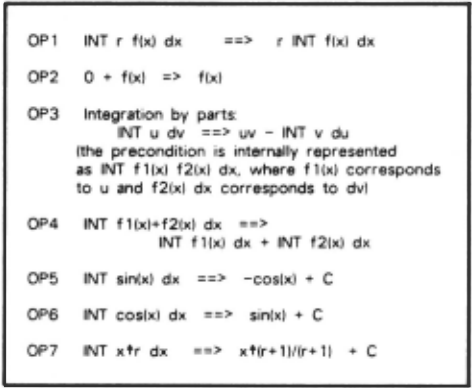
Some of the over 30 operators currently defined in LEX are shown in figure 11-1 . Notice that some of these operators correspond to solutions to primitive integrals. some to problem transformations, and some to rules of algebraic equivalence.
In addition to being given a problem solver. representation for problem states. and problem solving operators. LEX also begins w ith a language with which to describe heuristics that it is to learn. Each learned heuristic is of the form:
IF the current problem state matches the generalization P,
THEN apply operator 0, with variable binding B.
The language of generalizations in the preconditions determines. to a large degree. the range of heuristics that can be learned. In LEX. for the symbolic integration domain. this language of generalizations is based on a grammar for algebraic expressions containing. and contained in. indefinite integrals. The sentences derivable by this grammar are the expressions that form legal problem states The intermediate sentential forms derivable by the grammar constitute legal generalizations of problem states. Briefly, the grammar contains non-terminal symbols that correspond to classes of functions (e.g.. trigonometric, polynomial) and classes of operators (e.g., function composition. multiplication, integration). These can be combined to form generalized algebraic expressions. Figure 11 - 2 shows a portion of this grammar in the form of a hierarchy. Each node in the hierarchy represents some substring .of a sentential form, and each edge corresponds to a rule in the grammar.
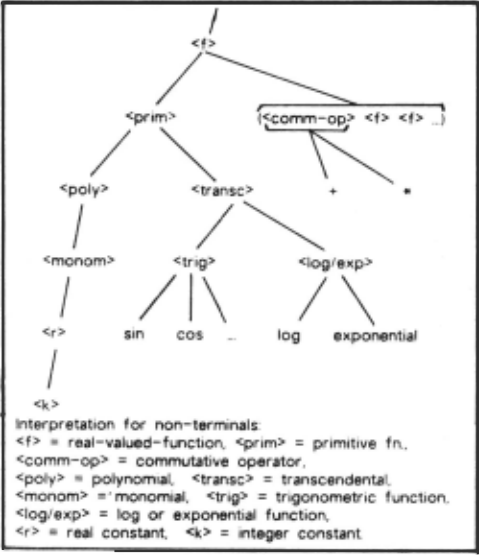
The heunst1c H 1. shown below. is a heuristic that can be described 1n this language. and is one of the heuristics that LEX has proposed In th1s heuristic. the terms "x" and "transc" are combined by multiplication to form a generalized expression that describes the precondition of the heuristic.
Hl:
IF the problem state contains INT x transc(x) dx,
THEN use Integration by Parts: INTudv ·> uv-INTvdu, With u bound to x, and dv bound to (transc (x) dx).
LEX has been able to learn and describe useful heuristics in this language. However. the language is insufficient for describing the most useful forms of many heuristics. For example. the above heuristic incorrectly recommends Integration by Parts to solve INT x tan(x) dx. Although this heuristic is still quite useful. a more appropriate heuristic requires using the term "any twice integrable function", which is not in the current language. One of our major current efforts is toward automating the detection and repair of deficiencies in the generalization language
Ill DESIGN OF LEX
We decompose the problem of learning heuristics into four tasks. The design of LEX involves four corresponding modules - of which we have currently implemented three. These four modules are related to the four components of learning systems described in [ 11). and are characterized below.
Problem Solver: This module utilizes whatever operators and heuristics are currently available. to solve a given practice problem. The output of this module is a solution to the given problem. along with a detailed trace of the search performed in attempting to solve the problem. ·
Critic: This module analyzes the search performed by the Problem Solver in attempting to solve a particular problem. The output of this module is a set of positive and negative training instances. corresponding to useful and wasteful search steps executed in the course of solving a specific practice problem.
Generalizer: This module generalizes from the training instances provided by the Critic. to suggest and refin~ general heuristics intended to produce more effective problem solving behavior on subsequent problems.
Problem Generator: After a given problem has been solved and analyzed, and the training data derived from this problem has been used to propose and refine heuristics. the Problem Generator must produce a new practice problem The generated problem should be tractable given the current level of system expertise. yet should be difficult enough that its solution will yield additional ·informative training data. This module in not currently implemented We mention it here to indicate our plans for the fully implemented system.
The first three of these modules are implemented in the current version of LEX. The results described here have been obtained by presenting practice problems by hand to the system. Below we describe in greater detail the methods used by these modules. as well as results obtained by the current system.
A . REPRESENTING INCOMPLETELY LEARNED HEURISTICS
Since the Generalizer requires many training instances to converge on an appropriate description of the heuristic(s) for a given operator. the Problem Solver must typically depend upon a set of incompletely learned heuristics to guide the search. These heuristics will be refined upon examination of subsequent training data, yet they form the basis for the problem solving necessary to acquire that data.
Although the problem of utilizing partially learned information has received little attention in previous research on learning, it is a central issue in learning by practice. The practice cannot take place unless the system has good methods for representing and utilizing knowledge that has not yet been well-honed by experience.
As an example, suppose that a heuristic is to be proposed to cover a newly encountered positive training instance representing a useful problem solving step (e.g., the application of a given operator to a given problem state) The appropriate generalization required for the new heuristic cannot typically be inferred from the single training instance.
LEX would represent the new. incompletely determined heuristic by representing the set of all describable heuristics that are consistent with this first positive instance. As subsequent training instances are encountered. LEX will refine this represented set of alternative versions of the heuristic, so that at any point it represents exactly the set of all alternative versions of this heuristic that are consistent with the observed training instances. We refer to this set of all plausible versions of the heuristic as the version space of the incompletely learned heuristic, relative to the observed instances. and the provided language for describing heuristics.
Representing an incompletely learned heuristic by storing explicitly all plausible versions of the heuristic is impractical. However. this version space can be represented efficiently, simply by storing its maximally specific and maximally general elements. according to the following definition of "more specific"-.
Heur i s tic H 1 i s more specific then or equal to heuristic H2 if and only if:
1. Hi applies to (i.e. its precondition matches) any instance to which Hl applies.
and We will refer to the subset of maximally specific members of a version space as the subset S of members of that version space. Similarly, we refer to the subset of minimally specific (i.e.. maximally general) members of the version space as the subset G. The version space of each incompletely learned heuristic is represented by computing and storing the sets S and G of that version space. These sets delimit the version space: any representable heuristic is contained in the version space if and only if it is both ( 1) more specific than or equal to some member of G. and 12) is more general than or equal to some member of S.
2. For any instance to which both Hl and H~ apply, both recommend the same operator and the same binding of operator arguments.
-.This definition is similar to that given in [ 12] .
The representation and use of version spaces for generalizing from examples has been used previously in the Meta-DENDRAL program for inferring rules of mass spectroscopy, and is described more fully in [ 13] and [ 14] . By representing the version spaces of incompletely learned heuristics, LEX represents information critical_ to ( 1) converging on the heuristic when subsequent training data become available. 12) generating informative practice problems, and (3) allowing the Problem Solver to make use of incompletely learned heuristics in a reliable manner.
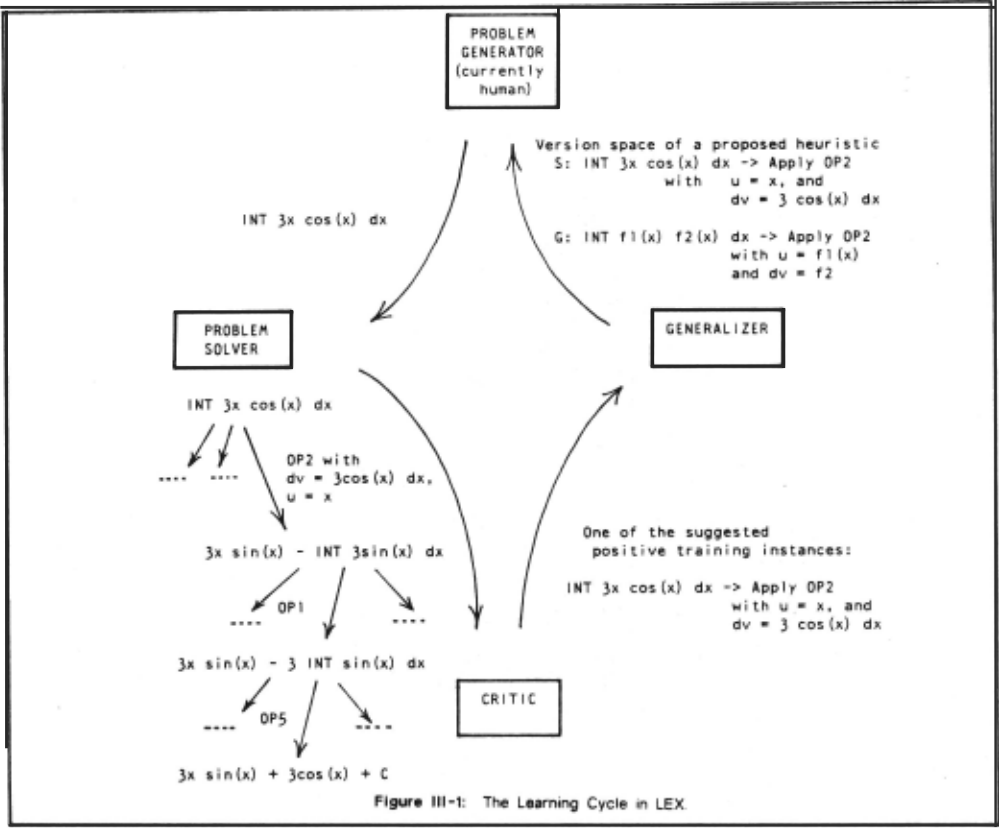
Figure 111-1 illustrates one particular practice problem that was considered by LEX. This figure shows the search generated by the Problem Solver, one of the training instances produced by the Critic, and the sets S and G computed by the Generalizer to describe the resulting proposed heuristic. This example is explained in greater detail in the following subsections. which describe the operation of the three modules.
B. THE PROBLEM SOLVER
The Problem Solver uses a forward search strategy guided by whatever heuristics are available in the current solve-criticize-generalize cycle. It accepts a problem to be solved. along with a resource limit on the cpu time and memory space that it may expend in attempting to solve that problem.
The Problem Solver is faced with solving problems by using a set of incompletely learned heuristics. Because each such heuristic is represented in terms of its version space of alternative descriptions. the "match" of an incompletely learned heuristic to a given problem state may be ambiguous. We define the degree of match of an incompletely learned heuristic to a problem state to be the proportion of the members of the version space that match the given problem state. Thus. if all members of the version space match a given problem state, the recommendation of the incompletely learned heuristic is unambiguous. and its degree of match to that problem state is 1. The degree of match of an incompletely learned heuristic to a given problem state is used by the Problem Solver to weight the associated heuristic recommendation. Since the degree of match is difficult to compute exactly, it is estimated by the proportion of the union of the sets S and G that match the given problem state. This estimate seems to work well empirically, and is relatively inexpensive to compute.
The Problem Solver strategy for choosing a node to expand, and an operator with which to expand it. is characterized below. Here. the "cost" of a node refers to the sum of execution costs for each step along the least cost path from the root of the tree to the current node. An open node refers to any node in the search tree with at least one applicable operator that has not yet been applied.
IF no heuristics are applicable to any open node
THEN expand the lowest cost open node, using any applicable operator
ELSE IF exactly one heuristic applies to exactly one open node,
THEN execute the step recommended by this heuristic,
ELSE follow the recommendation of one of the applicable heurist i cs, ~hoosing that heur i stic which applies with the highest estimated degree of match, breaking ties in favor of expandi ng the highest cost open node.
The main features of the Problem Solver strategy may be summarized as follows: In the absence of heuristics. the problem solver conducts a uniform cost search for a solution When available heuristics apply to any of the open nodes in the search. their recommendations are followed. weighted bv their estimated degree of match.
C. THE CRITIC
After the solution has been determined. the Critic examines the search trace. and selects certain search steps as training instances for forming general heuristics. Each training instance corresponds to a single search step: that is. the application of a single operator to a given problem state. with a particular bind1ng of operator arguments.
Those problem solving steps that lead to the lowest cost solution found. are isolated as positive training instances. Other steps that lead away from the lowest cost solution path are isolated as negative instances - choices that the learned heuristics should not recommend. The output of the Critic is a set of these positive and negative examples Figure Ill- 1 illustrates the search tree generated by the Problem Solver for a given practice problem. and one of the associated positive training instances · produced by the Crit ic. The positive instance shown there corresponds to the first step along the path to the solution
The criterion used by the Critic to produce training instances may be summarized as follows:
- The Critic labels as a positive instance every search step along the lowest cost solution path found. Here, the cost of a solution is taken to be the sum of the execution times of all operators applied along the solution path
- The Critic labels as a negative instance every search step that (a) leads from a node on the lowest cost solution path found, to a node not on this path, and (b) when its resulting state is given anew to the Problem Solver, leads either to no solution or to a high cost solut1on. Here a solution is considered high cost if its cost is more than High -Cost Factor times the cost of the lowest cost known solution (for the results reported here High-Cost-Factor was set to 1 15) The resource allocation g1ven to the Problem Solver in this case is equal to the resources spent in obta1ning the known solut1on
Notice that the Critic is not infallible. It is possible for the Critic to produce positive training instances that are not on the minimum cost solution path. but are rather on the lowest cost solution path found More importantly. it is possible for the Critic to label as negative a search step along the true (but not found) minimum cost solution path. Both kinds of erros can arise because the Problem Solver 1s not assured of finding the minimum cost solution. Criterion 2b above is included in order t9 reduce the likelihood that such errors will occur. Here. the Critic reinvokes the Problem Solver. giving it a problem state associated with a potential negative instance. in order to explore a portion of the problem space that may not have been sufficiently considered during the solution of the onginal problem. If the Problem Solver is unable to find an appropriate solution from the given state within the specified resource limits. the confidence that this is a negative instance is increased. If the Problem Solver finds a lower cost solution when it is reinvoked. this new solution is used in determining pos1tive training instances. Of course. the only completely error-free strategy for labelling tra1ning instances requires a full . uniform-cost search [ 15] . We have found emp1ncally that the current approximate strategy of the Critic does not seem to be a lim1ting factor in overall system performance at this point.
D. THE GENERALIZER
The Generalizer considers the positive and negative tr a1nmg instances supplied by the Critic w1thin the current learn1ng cycle. in order to propose and subsequently refine heunst1cs to improve problem solving performance. The generalization problem faced by this module is one of learning from examples. Given a set of train1ng instances corresponding to search steps involving a given operator. the generalization problem here is to infer the general class of problem states for which this operator will be useful. along with the appropriate bind1ngs of variables in the operator.
The Generalizer represents the version space for each proposed heuristic for each operator . 1n terms of the sets S and G that delimit the plausible vers1ons of that heuristiC For example. figure Ill- 1 shows a pos1tive tra1ntng instance assoc1ated with OP2 as input to the Generalizer. The output of the· Generalizer 1n this case IS a vers10n space corresponding to a part1ally learned heunst1c. and represented by the (singleton) sets S and G shown in figure Ill- 1 This partially learned heuristic is proposed on the bas1s of the single training instance shown. and will be ref1ned as subsequent instances become available. Below we describe the procedures for proposing and refining problem solving heuristics in LEX
Proposing a new heuristic: If no member of the vers1on space of any current heunstic applies to a newly presented positive instance. a new heuristic is formed to cover this instance. This is the case in the example of figure 111-1 . In forming a new heuristic. the set S is init1alized to the very specific version of the heuristic. that applies only to the current training instance (this is the most specific describable version consistent with the single observed training instance). G 1s initialized to the version of the heuristic that suggests the operator will prove useful 1n every situation where it can validly be applied In the example of figure Ill- 1. G is therefore initialized to the vers1on whose precondition 1s exactly the description of the precondition for OP2 That is. INT of 1 f2 dx represents the integral of the product of any two real functions of x. and corresponds to the precondit1on INT u dv as it is stated in the system·s generalization language.
At this point. S and G delimit a broad range of alternative versions of the proposed heunstic. corresponding to all the generalizations expressible in the given language. and consistent with this single train1ng instance. As subsequent pos1tive mstances are considered. S will become more general to include newly observed instances in which OP2 is found to be usefuL Likewise. G will become more specific in order to exclude negat1ve instances 1n which OP2 may validly be applied. but in which 1t does not lead to a solution Thus. the range of alternative plausible versions of the heuristic delimited by S and G will narrow as new information is acquired through subsequent practice problems. and the uncertainty regarding the correct description of the heuristic is reduced
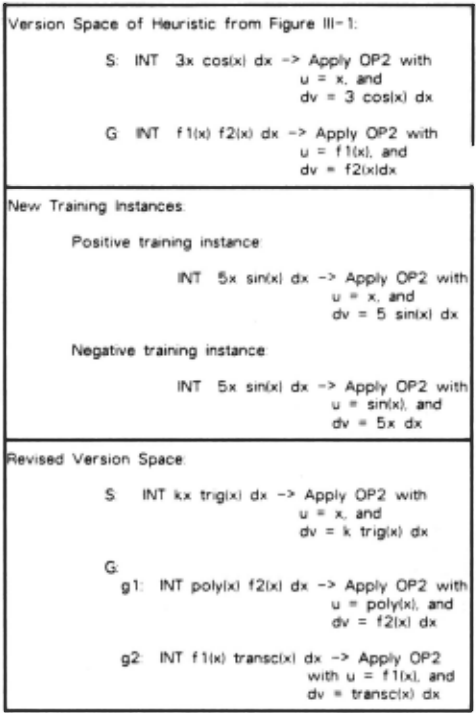
Refining incompletely learned heuristics: If an exist1ng heuristic applies to a newly presented posit1ve or negat1ve instance. then that heuristic IS revised by ellm1nating from its version space any version that IS inconsistent with th1s tra1ning 1nstance In the current example. the next practice problem that is considered is INT 5x sin(x) dx. The solution to this problem leads to both a positive and a negative training instance for the heuristic from figure 111-1 Figure 111-2 shows these two new training instances. and the way in which they allow refining the version space of th1s heuristic. In the revised version space shown there. the most specific version. S. of the heurist1c has been generalized just enough to allow it to apply to the new posit1ve training instance. Here triglxl replaces coslxl so that the heuristic will apply to integrals contain1ng any trigonometric function of x Similarly. k ldenot1ng any 1nteger constant) replaces the 3 in the specifiC heuristic. The program determ1nes this revision by first noting that the terms 3 and cos(x) 1n the old S prevent this generalization from applying to the new instance It then consults the grammar for expressing heunst1cs (shown in f1gure 11-2) to determ1ne the next most general terms that can be substituted in order to include this new instance Although the disjunction "coslxl OR sin(x)" would be a more specif1c generalization than "trig". this disjunction is not currently in the generalization language. and therefore cannot be stated by the program The general boundary of the revised version space of figure 111-2 has also been altered so that it does not apply to the new negative training instance. In this case. there are two maximally gen6ral versions (g 1 and g2) of the heuristic consistent with the three observed training instances. Here. "poly(x)" refers to any polynomial function of x. and "transc(x)" denotes any transcendental function of x. As with revising the set S. revisions to G depend upon the generalization language being used. For 1nstance. g 1 is computed by replacing f 1 (x) (which represents "any real valued function") by the next more specific acceptable expression. Notice in the hierarchy of figure 11-2. this expression is "poly ·.
As subsequent training instances are considered. this partially learned heuristic will be further refined so that S and G converge toward a useful statement of the heurist1c. such as
Although the above example illustrates the basic method used to propose and refine heuristics. the Generalizer allows a slightly more complex method in order to deal with errors in the training data (the Critic is fall ible) The method used is an extension to the basic version space approach. originally suggested in [ 13] . Th1s extension Involves comput!ng several concentnc" vers1on spaces. each one consistent with a smaller proportion of the training instances. We are currently experimenting with the Generalizer to collect data regarding its effectiveness in dealing w ith data errors. The results reported in this paper do not use this extens1on The Generalizer currently deals with learning disjunctions 1n the following straightforward manner: if a positive instance associated w1th operator 0 is not consistent w1th any current heuristic that recommends operator 0 . then begin a new heuristiC (i e . disjunct) for operator 0 that covers this instance This new heuristic will be updated by all subsequent negative instances associated with operator 0 . and by any subsequent posit1ve instances associated w1th operator 0 and to wh1ch at least some member of the version space applies
IV RESULTS AND DISCUSSION
We have written the LEX program as a means toward developing and testing methods for learning heuristics. The value of this system IS as an e)(perimental tool rather than as a problem solver in symbol1c integration (much better problem solvers exist in this domain) Here we present empirical results showing the · improvement of problem solving performance through practice. and discuss some insights gained through experiments with LEX.
A . RESULTS
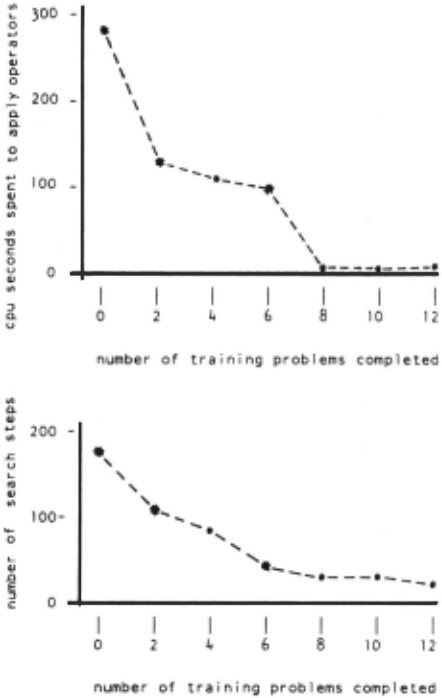
We have measured the performance improvement of LEX. on solving a set of 5 test problems (shown in f igure IV-3). between stages of training on 12 training problems (shown in figure IV- 2) No training was allowed during solution of the test problems. Performance on the test problems was measured before any training had occurred. and again after every second tra1ning problem. Two performance measures were considered ( 1 l total number of search steps required to solve the 5 test problems. and (2) total c.p.u. t1me spent applying operators in solving the :. test problems (this excludes the resources spent 1n match1ng preconditions of operators and heuristics to problem states). The resource allocation given to the Problem Solver was 240 c.p.u. seconds and 800.000 cons cells to be spent in applying operators (running in RUCILISP on a DEC-2060)
Fourteen heuristics were formed by LEX during this training sess1on. covering th1rteen of the 32 operators available !shown in figure IV-1). Twelve of these fourteen heuristics remained incompletely learned at the end of the training sequence (i .e . their version space still contained multiple plausible generalizations of the heurist ic).
Figure IV-4 displays the improvement in performance by LEX for this experiment For both ·of the performance measures shown. performance improved by roughly two orders of magn1tude. In those cases where the Problem Solver could not solve a test problem w1thin the given resource allocation. the data point represents a lower bound ol'l the required effort (the lower bound was taken to be the resources spent before aborting the solut1on attempt! Each such lower bound data point is shown as an .. .... 1n figure IV- 4. A third performance measure not shown here - - total c.p.u. time spent including time matching operators and heuristics to problem states - improved by roughly one order of magnitude for the same training sequence INT sin(x)dx => -cos(xl INT xtr dx => xt(r+ 11 \ (r+ 11 INT r f(x)dx => r INT flx)dx INT x t(- 1) dx => ln(x) INT exp dx => exp etf(x) => exp(f(x)) INT ln(x) dx => x ln(x) - x 1 *fix) => f(x) INT COS(X) dx => sin(x) INTiflxl+glxlldx => INTf(x)dx+INTglx)dx INT u dv = > uv - liNT v dul INT r dx => rx Ootf(x) => 0 INT x dx => (xt2) / 2 O+f(xl => f(x) flxl - 0 => fix) ln(exp(x)) => x exp(ln(xll => x r 1otr2 => evaluated (r 1 * r21 tan(x) => sin(x)/cos(xl cotlx)· => 1/ tan(xl seclxl => 1/coslxl CSC(X) => 1/ sin(X) 0 * expr => 0 1 * expr => expr expr - 0 => expr 1 I f(x) => f(x) t (-1) INT!f(x)/r)dx => liNT f(x) dx)tr f 1 .. (f2 .. f 3! => f2 .. (f 1 .. f 3! f 1 + (f 2 + f 31 => f2 + (f 1 + f 31 f1 .. (f2 + f31 => (f1 .. f21 + (f1 .. f3) r 1 +r2 => evaluated (r 1 + r2l
Figure IV-1: Operators Available to LEX.
- 1 INT 4 dx
- 2 INT coslyl dy
- 3 INT 5*(3+4) dx
- INT 3x dx
- INT ><*>< dx
- INT 3*(x+51 dx
- INT 0 * ((5+2. 11/ sin(x)) dx
- INT x+(etx) dx
- 9 INT xt3 dx
- INT !3+coslxll*4 1 dx
- 11 . INT x*(3+41 dx
- INT 5.3*sin(x) dx
Figure IV -2: Sequence of 12 training problems
- 1 INT ><*sin(x) dx
- 2 INT 3·(4*COS(x)) dx
- INT O*(Sin(x)+(x t 311 dx
- 4 INT (2*(x t4))+x dx
- INT 13·xl*letxl dx
Figure IV-3: Set of 5 test problems
B. DISCUSSION
The most useful results we have obta1ned are not quantitative measurements of system performance. but rather 1ns1ghts ga1ned 1n developing and runn1ng the system Follow1ng are some observations about the performance of LEX that 1nd1cate the most significant deficiencies and successes of the init1al design.
The ability . of the Problem Solver to utilize incompletely learned heuristics is very important in allowing it to solve problems that will provide additional training data. In our experiments it has almost always been the case that the majority of heuristics available for solving practice problems are only incompletely determined by the data Witho~.;t reasonable methods for utilizing these incompletely learned heuristics. the Problem Solver would be faced with unrealistically large searches in solving subsequent practice problems.
The use of learned heuristics by the Problem Solver during training is not without drawbacks. however. Having reached an adequate level of problem solving ability. LEX typically becomes conservative. following its current heuristics while training rather than applying operators for which no heuristics exist. It thus improves slightly by refining known heunstics. but may miss out on larger improvements that would be possible by learning heuristics for new operators.
A st1ll more disconcerting problem is that Incompletely learned heuristics can lead LEX to expensive excursions down absurd search paths. preventing solution of the problem within the allocated resources. In the experiment described above. for example. while LEX could solve all f 1ve test problems after the fourth training problem. it could only solve four of the test problems following the sixth training problem. This phenomenon was due to its formulation of new. incompletely learned heuristics that prevented the Problem Solver from obtaining the solution it had found using the earlier set of heuristics We are currently considering various refinements to the Problem Solver's strategy for utilizing incompletely learned heuristics We have noted that the Critic may produce rncorrect training instances. In spite of this possibility. it rarely produces instances that are inconsistent with our own intuitions In a significant number of cases. when the Critic calls the Problem Solver to consider a possible negative instance (see criterion 2.b in the earlier discussion of the Crrticl an improved problem solution is found. This occurred in 4 of the 1 2 training problems in the current experiment The approximate Critic algorithm seems to work reasonably well . and the Critic does not seem to be a limiting factor in determining overall system performance at this point Our initial experiments rndicate that the insufficiency of the language for expressing heuristics is an important limrtation of our system. In experimentrng with the system. and observing it sometimes unable to represent heuristics for which it has training data. we have already been led to extend the language manually. We have tried to understand the reasoning that we go through in coming up with an appropriate extension to the language We consider the issue of detecting and repainng defrcrencres in the generalization language to be a major focus for future work.
One shortcoming of the initial design of the Generalizer is that it fails to take advantage of an important source of information for chosing an appropriate generalization: analysis of the problem solution. As an example of the kind of information available from analyzing the problem solution. consider the example of figure Ill- 1. By considering the role that the· rndicated positive instance played in reaching the solution. it is reasonable to infer that the appropriate generalization of the heuristic should cover all problem states for which the operator sequence OP2, OP 1, OP5 leads to a solution. By reasoning about the definitions of these operators. the system might determine the generalization corresponding to this class of instances (i . ~ . . the precondition for the "macrooperator" [ 16] composed of this operator sequence). In the example of figure Ill- 1 the value of the constant 3 in the problem does not effect the feasibility or utility of the operator sequence <OP2, OP 1, OP5>. Thus, the S boundary of the version space in figure Ill- 1 could be generalized by replacing the constant 3 with the symbol "r'' that matches any real constant.
Summary: The initial implementation of LEX has been described via an extended example. Empirical results, showing the improvement in performance with training, have been given. While LEX is able to learn heuristics that lead to improved performance at solving problems of symbolic integration, the methods used by each of the modules of LEX can be characterized as domain-independent methods for learning domain-dependent heuristics.
V ACKNOWLEDGMENTS
We greatfully acknowledge the aid of Mr. William Bogdan. who took part in the implementation of the current system.
@inproceedings{ijcai1981p27,
  title     = {Learning Problem-Solving Heuristics Through Practice},
  author    = {Mitchell, Tom M. and Utgoff, Paul E. and Nudel, Bernard and Banerji, Ranan B.},
  booktitle = {Proceedings of the Seventh International Joint Conference on
               Artificial Intelligence, {IJCAI-81}},
  publisher = {International Joint Conferences on Artificial Intelligence},
  editor    = {Patrick J. Hayes},
  pages     = {127--133},
  year      = {1981},
  month     = {8},
  note      = {Learning},
  url       = {https://ijcai.org/proceedings/1981/27},
}
TY - CPAPER TI - Learning Problem-Solving Heuristics Through Practice AU - Mitchell, Tom M. AU - Utgoff, Paul E. AU - Nudel, Bernard AU - Banerji, Ranan B. T2 - Proceedings of the Seventh International Joint Conference on Artificial Intelligence, IJCAI-81 PB - International Joint Conferences on Artificial Intelligence PY - 1981 SP - 127 EP - 133 UR - https://ijcai.org/proceedings/1981/27 ER -Copied
Machine-readable versions of this paper, for tools and AI agents:
 Welcome
 Future Conferences
 AI Journal Division
 IJCAI Proceedings
 About IJCAI
 IJCAI Awards