
Tactile Sensation for Robots
Proceedings of the Seventh International Joint Conference on Artificial Intelligence. Robotics. Pages 791-794.
© 1981 International Joint Conferences on Artificial Intelligence
Abstract
In this paper we provide a brief discussion of the relationship of tactile sensation to other sensory modalities currently showing prominence in industrial robots. A- tactile sensor is presented which provides a matrix of the forces existing between it and the object with which it is in contact. The possible uses of this information in the control of the manipulation of objects by a robot arm/hand system are considered. Examples of the data retrieved from the sensor are given and possible initial processing steps are discussed.
- Binford, T.O. et al., "Computer Integrated Assembly Systems," Progress Report to NSF, Covering Period March 15, 1974 to September 15, 1974, Stanford AI Lab, September 1974.
- Briot, H., "The Utilization of an 'Artificial Skin' Sensor for the Identification of Solid Objects," Proceedings of the 9th ISIR, pp. 529-548, Washington, D. C., March 1979. 7
- Dixon, J.K., Salazar, S .. ana Slagle, J.R., "Research on Tactile Sensors for an Intelligent Naval Robot," Pr oceedi ngs of the 9th !SIR, pp. 507-518, Washington, D.C ., March 1979.
- Drake, S.H., Watson , P. C., and Simunovic, S.N., "High Speed Assembly of Precision Parts Using Compliance Instead of Sensory Feedback," Proceedings of 7th !SIR , Tokyo, 1977 .
- Garrison, R.L. and Wang, S. S. W. , "PneUDatio Touch Sensor," IBM Technical Disclosure Bulletin, vol. 16, no . 6, November 1973.
- Goto, T., Inoyama, T., and Takeyasu, K. , "Precise Insert Operation by Tactile Controlled Robot HI-T-HAND Expert-2," in Proceedings of 4th ISIR, Tokyo, pp . 209-218 , 1974.
- Goto, T., "Compact Packaging Tactile Sensors," Proceedings Chicago, 1972.
- by of Robot 2nd with !SIR,
References were extracted automatically from the PDF and may contain errors.
Full text extracted automatically from the PDF; figures, tables and equations may differ. The PDF is the version of record.
TACTILE SENSATION FOR ROBOTS
** Kenneth J. Overton Computer and Information Science Department University of Massachusetts Amherst, Massachusetts
ABSTRACT
In this paper we provide a brief discussion of the relationship of tactile sensation to other sensory modalities currently showing prominence in industrial robots. A-tactile sensor is presented which provides a matrix of the forces existing between it and the object with which it is in contact. The possible uses of this information in the control of the manipulation of objects by a robot arm/hand system are considered. Examples of the data retrieved from the sensor are given and possible initial processing steps are discussed.
A. Introduction
To date, the dominant area in robot sensing research has been vision. Notable exceptions include the force feedback or active accommodation work done in connection with the task of peg insertion, e.g. [6] and [11], and the use of vision and force sensing in assembly [1], [11], [12], [18] and [4] (passive accommodation). Other areas of sensor research include range finding techniques, [14] [15], proximity sensing and some limited investigations into the use of tactile force sensor arrays in manipulation (see below). For a comprehensive review of the current state of robot sensor technology the reader is referred to [ 131.
An area receiving limited attention in the literature, but comprising an important area in and of itself is that of the · use of tactile sensory data in the control of robot systems. Research in this area has been in progress, and for further discussions, the reader is referred to [17] and recent work by Dixon [3]. Research in the use of tactile data by robot manipulators has been generally limited to gross force sensing in the wrist, and in some cases the fingers, for two general reasons. First, until recently, there has been a lack of high resolution sensing arrays which ceuld be utilized in the end effectors of a manipulator. Second, and probably more important, people are far less conscious of the role that the "sense of touch" plays in everyday activity, as compared to vision. While vision may continue to
· This work was supported in part by NIH Grant NS 14971-03 (Michael A. Arbib, Principal
Investigator) and Digital Equipment Corporation.
·· International Business Machines Graduate Fellow during the 1980-81 acadanic year.
Thomas Williams Corporate Research Group Digital Equipment Corporation Maynard, Massachusetts
be the primary sense utilized sensing fills an important vision is inapplicable due to but in the very fine manipulation. in robots, tactile role, not only when inherent ambiguities, control of delicate
Tactile sensors can be divided into three general categories depending upon the type of information they provide. Contact sensors compose the first class and yield information indicating either the presence or absence of physical stimuli. A robot hand with contact sensing on several sides was developed by Goto [71 to handle blocks placed on a table. In latter work, Garrison and Wang [5] constructed a hand containing an array of contact sensors. Recent sensor arrays have utilized woven graphite fibers as the physical transducer [10]. The Laboratory for Autumation and Systans Analysis at CNRS in Toulouse, France, has developed an "artificial skin" tactile sensor suitable for gross object recognition [2]. A high spatial resolution conductive rubber contact sensing array has been developed at the Artificial Intelligence Laboratory at M.I.T. and has been successfully used to identify a bolt from its contact pattern (9].
The second category contains the sensors which provide infonnation regarding the magnitude of the force at each sensing point. A hand constructed by Hill and Sword [8] employed analog force sensing arrays. Several of the contact sensing arrays mentioned above can and are being extended to provide analog force images. Depending upon the compliance of the material supporting such sensors, the force information can be related to the amount of deflection of the sensor, thus providing information describing the three dimensional shape of the object being sensed.
The final class of tactile sensors provides this information directly. This group consists of sensors which are designed to transduce the three dimensional shape of an object. Page and Pugh [16] presented a sensor which builds a contour map of the object being sensed as the sensor is lowered onto the object. Takeda constructed a hand with arrays of free floating needles as sensors. The needles would conform to the shape of the surface being touched, thereby providing identification information [17].
B. The Tactile Sensor
This section describes the physical and electrical characteristics of the conductive elastomeric tactile sensor currently being investi~ated by the authors in the Digital Corporate Research Group. The sensor is designed to provide an analog image of the forces produced when an object comes in contact with the sensor. The columns are arranged in a square matrix with their center to center spacing equal to .1 inches, providing a resolution of 100 detectors per square inch of sensor surface. Along the upper surface of the sensor, the force elements are connected by fine wire in such a way as to form 10 rows. The sensor rests on a printed circuit board which provides connection in the orthogonal d\rection. The matrix is scanned by an LSI-11/23 computer which collects the data and provides some initial preprocessing.
As indicatea by Larcombe [10] and Hillis [9], sensing of a single pressure point is possible in an array as just described. However, complex force patterns are difficult to understand due to the electrical interconnection of the individual force detectin& elements. This problem is alleviated in the present design by the insertion of a diode in series with each of the elements.
The scanning process produces a raster of force values that we call a "force image". Of cource any sampling sequence is possible since the sensor is a random access device. The values returned are proportional to the resistance across the force detector connected to the selected digital line. Since the resistance is proportional to compression of the element, the value returned is an indication of the force being experienced at that detector. The diodes eliminate interference due to alternate current paths in the network.
The second function of the computer is to provide some preprocessin~ of the raw sensor data. This includes the removal of the offsets of the individual detectors, scaling of the data, and the removal of nonlinearities. The change in resistance of the detectors versus the amount of force applied is nonlinear. The degree of nonlinearity and the range over which the detector is applicable is the subject of a series of ongoing tests. Experiments are also being performed to determine the effects of ambient temperature changes and drift of the resistance during prolonged application of force. All of these characteristics have yet to be understood but the initial test results are quite favorable.
C. Sensor Data
This section presents some of the force ima~e data produced by the sensor. The sensor was mounted on a circuit board and placed on a table. A stimulus was applied to the sensor by pressing the object to be sensed down onto the sensory sur face. The computer was programmed to continually scan the sensor and store each ima~e in a file. The images were later transported to a VAX 11/7eo*computer where they were displayed on a color graphics terminal ana a plotter.
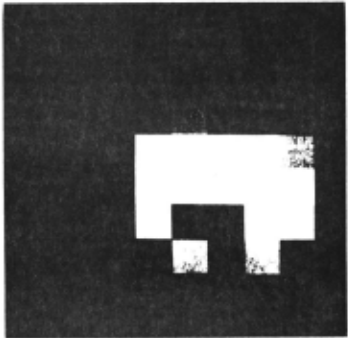
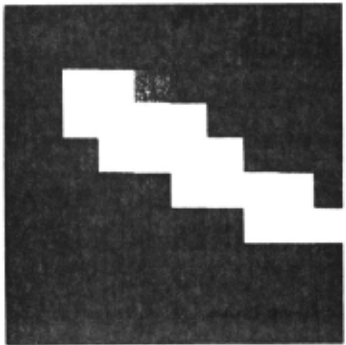
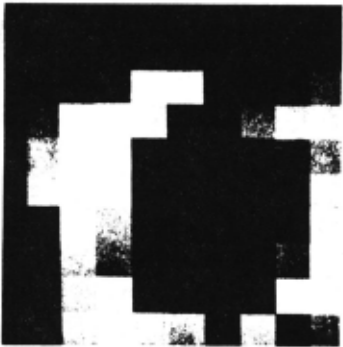
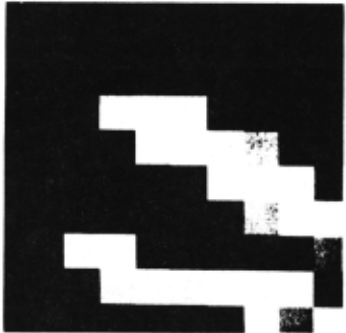
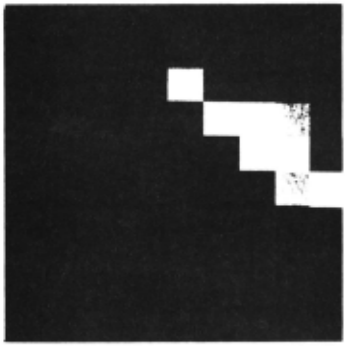
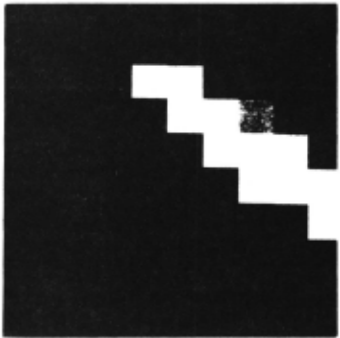
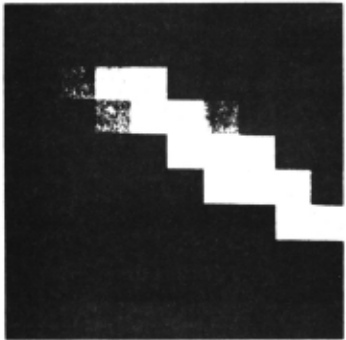
1 LSI-11/23 and VAX are registered trademarks of the Di&ital Equipment COrporation The most common usage for such sensors is to record the stati c image · produced by an object. Figures 1 through 4 contain grey scale representations of four static force images produced by various stimuli. Each grey scale display is composed of a square array of 100 "forcels" (force elements), one corresponding to each force detector in the sensor, where the brightness of the forcel is proportional to the force at the corresponding element. Figure 1 is the image produced when a spherical object is pressed onto the sensor. Note that there are three bad forcels in the image: the element in the upper left corner and the two near the center of the pattern of forces produced by the stimulus. ·Figure 2 resulted when a long thin cylinder was used as the stimulus. The force image of a plate with a hole through it appears in Figure 3 and Figure 4 shows a "V" shaped object depressing the sensor.
Another form of data can be collected with this sensor and computer system. That is, the sensor can be used to record the sequence of force images resulting when an object moves across the sensory surface . Figure 5 contains four consecutive force images collected as a cylindrical object rolled across the sensor from the upper left corner. The motion of the nbject is clearly visible and measureable relative to the sensor. Thus, if the sensor had been mounted on a robot gripper, the motion of the stimuls would be directly available to the computer system controlling the robot. Notice .again the bad forcels.
The grey scale representation is one possible form for the display of such data. Recall that the forces produced are proportional to the deflection of the sensor. It is then reasonable to plot the data as a surface where the height of the point corresponding to an individual force detector is proportional to the force at that location. Figures 6 through 9 correspond to the grey scale representations shown in Figures 2 through 4.
D. Use of the Data
The tactrfe-sinsor provides the host computer with an array of n\Dbers, or a "force image", representing the magnitudes of the forces being applied across the sensory surface. The question now becomes one of how the control structures of the robot system are to utilize this information. One such use is to provide accurate information regarding the identity, position, and orientation of the object being touched .
In particular, given the geometric descriptio!, of the surface of an object, the exact location and orientation in space of the object can be derived from arrays of such !ensors. The array of force values may be thought of as comprising a set of control points for a surface patch [19] . This patch can be compared with the representation of the surface of the object, thus allowing determination of the location and orientation of the corresponding patch on the object. The accuracy in this case is limited by the possible placements of the surface patch on the object due to symmetry. When two or more fingers are utilized, the force images represent very localized views of the complete object. Each view provldes the orientation of a subpatch on the object. Further information is available from the known spatial relationships between the force sensing arrays at the ends of the fingers. In this case the subpatches are constrained in their relative locations in space. One has very localized samplings of the surface contour detail by the force sensing arrays and global sampling of the contour by knowing the relationships between the finger tips. This information can be used to determine the position or the object, configuration of the grasp, etc.
All of the work cited earlier and the approach outlined in the discussion above have one basic idea in common. That is, the information sensed is static. The sensors are employed to take a "snapshot" of the environment which is then processed to yield the desired information. The concept of touch extends beyond this to include the sensing and analyzing of the <;lynamic characteristics of the tactile information. Consider, for example, the case when one reaches behind a coffee cup and "feels" for the handle. In many cases partial matching in one sensory modality, e.g. vision, may elicit actions which focus sensors in other modalities in the area containing the object in question. Biological evidence of this comes with both foveation (in vision), and exploration with the glabrous skin in hapsis. This allows initial hypotheses to be confirmed by obtaining additional sensory information.
Just as static image processing techniques could be applied to static force images, moving image analysis techniques could be applied to dynamic force images. Consider the increase in resolution or reduction in noise that can be obtained by comparison of sequential visual images. One would expect similar improvements w1 th dynamic force sensed images. Although no results are given for such processing, experiments are underway to evaluate its applicability.
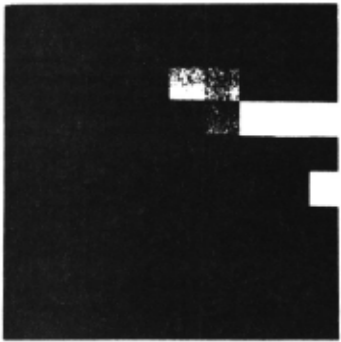
a
b
c
Figure 5
A sequence of images produced by a cylindrical object moving across the sensor represented as grey scale images.
d
[3] Dixon, J.K., Salazar, S .. ana Slagle, J.R., "Research on Tactile Sensors for an Intelligent Naval Robot," Pr oceedi ngs of the 9th !SIR, pp. 507-518, Washington, D.C ., March 1979.
[4) Drake, S.H., Watson , P. C., and Simunovic, S.N., "High Speed Assembly of Precision Parts Using Compliance Instead of Sensory Feedback," Proceedings of 7th !SIR , Tokyo, 1977 .
[5] Garrison, R.L. and Wang, S. S.W. , "PneUDatio Touch Sensor," IBM Technical Disclosure Bulletin, vol. 16, no . 6, November 1973.
[6) Goto, T., Inoyama, T., and Takeyasu, K. , "Precise Insert Operation by Tactile Controlled Robot HI-T-HAND Expert-2," in Proceedings of 4th ISIR, Tokyo, pp . 209-218 , 1974.
[7] Goto, T., "Compact Packaging Tactile Sensors," Proceedings Chicago, 1972. by of Robot 2nd with !SIR,
E. Conclusion
We have briefly reviewed the position of tactile sensory research for robots in light of the other modalities and have outlined the research to date in this area . A tactile sensor was presented and examples of the data from the sensor were given. The work being conducted by the authors in this area is just beginning and an extensive program for the investigation of tactile sensation and its applications to industrial robotics is planned.
@inproceedings{ijcai1981p152,
  title     = {Tactile Sensation for Robots},
  author    = {Overton, Kenneth J. and Williams, Thomas},
  booktitle = {Proceedings of the Seventh International Joint Conference on
               Artificial Intelligence, {IJCAI-81}},
  publisher = {International Joint Conferences on Artificial Intelligence},
  editor    = {Patrick J. Hayes},
  pages     = {791--794},
  year      = {1981},
  month     = {8},
  note      = {Robotics},
  url       = {https://ijcai.org/proceedings/1981/152},
}
TY - CPAPER TI - Tactile Sensation for Robots AU - Overton, Kenneth J. AU - Williams, Thomas T2 - Proceedings of the Seventh International Joint Conference on Artificial Intelligence, IJCAI-81 PB - International Joint Conferences on Artificial Intelligence PY - 1981 SP - 791 EP - 794 UR - https://ijcai.org/proceedings/1981/152 ER -Copied
Machine-readable versions of this paper, for tools and AI agents:
 Welcome
 Future Conferences
 AI Journal Division
 IJCAI Proceedings
 About IJCAI
 IJCAI Awards