
A Learning System and Its Psychological Implications
Proceedings of the Sixth International Joint Conference on Artificial Intelligence. .
© 1979 International Joint Conferences on Artificial Intelligence
Abstract
ACT Is a computer simulation prooram IMI useos a propositional neolwork to rflptesenl knowledge of facta and a aet of productiona (condition - action rules) to rl'prcsl'nl knowlt'dge of procl'dlxt~s. Thl're are currently four different mechanisms by which ACT can make additions and modifications to its stol of product i on~: dl'$ignalion, strengthening, gtont~ralization, and discrimination. Designation refers to the ability of productions to call for thl' crl'ation of neow productions . Strengthening a production involves adjusting the amount of system reaources that will be allocated to its proct'ssing. Finally, gc.-noralizalion and discrimination refer to complementary processes that produce better performance by either extl'nding or restr icting the rangto of situations in which a production will apply. These learning mechanl- are used to simulate experiment• on prototype formation. ACT succeosslully accountt lor the effecla of dlatance of instances from a central tendency, freqt,.ncy of individual instances, and the family resemblance~ structure of categor i es.
- Anderson, J.R. Language, memory and thought. Hillsdale, N.J.: Lawrence Erlbaum Associates, 19!6.
- Anderson, J. A. Induction of AUQ~Mnled Transition Networks. Cognitive Science, 1977, f, 125-157.
- Anderson, J.R. & Bower, G.H. Human Auoclatlve Memory. Washington: Winston & Sons, 1973.
- Anderson, J.R., Kline, P.J ., & Beasley, C.M. Complex ltoarning processes. In R.E.Snow, P.A. Federico, & W.E. Montague (Eds.}, Aptitude, Learning, and Instruction, Cognitive Process Analyses, 1979a, in press.
- Anderson, J.R., Kline, P.J ., and Beasley, C.M . A general learning theory and its application to Schema Abstraction. In G.H. Bower (Ed.) The Psychology of Learning and Motivation, Vol. 13, 1979b, in press.
- Anderson, J.R., Kline, P.J., & Beasley, C.M. A theory of the acquisition of cognitive skills. ONR Technical Report 77•1, Yale University, 1977.
- Anderson, J.R ., Kline , P.J., & Lewis, C. A production system model for language processing. In P. Carpenter & M. Just (Eds.), Cognitive Processt.ts In Comprehension. Hillsdale, N.J.: Lawrence Erlbaum Associates, 1977.
- Bailey, N., Madden, D., & Krashen, S.D. Is there a "natural sequence• in adult second langu3ge learning. English language Institute and LinQuislics Department, Queens College and the Graduate Center, City University of New York, 1974.
- Brown, R. A first language. Cambridge, Mass.: Harvard University Press .-1973.
- Bransford, J.D. & Franks, J .J . The abstraction of linguistic ideas. Cognitive Psychology, 1971, 2, 331-350.
- Dreyfus, H. L. What Computers Can't Do. New York: Harper and Row, 1972.
- Forgy, C. L. A production aystem monitor for parallel C0f111Uiers. Technical Report, Con1pUier Science Department, Carnegie-Mellon University, 1977.
- Franks, J .J. & Bransford, J.D. Abstraction of visual patterns. Journ111 of EKperlmental Psychology, 1971, 90, 65-74.
- Hayes-Roth, B. & Hayes-Roth, F. Concept learning and the recognition and clas:;ification of exemplars. Journal of Verbal Learning and Vt.trbal/lehavlor, 1977, 16, 321-338.
- Hayes-Roth, F. Thfl Role of Partial and Best Matches in Knowlellte System3, "-' nd Corporation, P-5802, 1977.
- Hayes-Roth,F. & McDermott, J. Learning structured patterns 'from examples. Proceedings of the Third International Joint Conference on Pattern Recognition, 1976, 419-423.
- Medin, D.L. & Schaffer, M.M. A context theory of classification learning. Psychological Rev/ow, 1978, in press.
- Neumam, P.O. An attribute frequency model for the abstraction of prototypes. Memory and Cognition, 1974, 2, 241-248.
- Neumam, P.O. Visual prototype formulation with discontinuous representation of dimensions of variability. Memory and Cognition, 1977, 5, 187-197.
- Newell, A. A theoretical exploration of mechanisms for coding the stimulus. In A.W. Mellon & E. Martin (Eds.), Coding processes In human memory, Washington, D.C.: Winston, 1972.
- Newell, A. Production Systems: Models of control structures. In W.G . Chase (Ed.), VIsual Information Processing. New York: Academic Press, 1973.
- Norman, D.A. & Rumelhart, D.E. EKp/oratlons In cognition. San Francisco: Freeman, 1976.
- Posner, M.l. & Keele, S.W. Retention of abstract ideas. Journal of EKperlmental Psychology, 1970, 83, 304-308.
- Quillian, M .A. The leachable language c~ehender. Communications of the ACM, 1969, 12, 459-476.
- Reed, S. Pattern recognition and categoriutlon. Cognitive Paychology, 1972, 3, 382-407.
- Reitman, J.S. & Bower, G.H. Structure and later recognition of exemplars of concepts. Cognrtlve Psychology, 1973, 4, 194-206.
- Rosch, E. & Mervis, C.B. Family rtosemblances: Studies in the internal structure of categories. Cognitive Psychology, 1975, 7, 573-605.
- Rychener, M.D. & Newell, A. An instructible production system: Basic design issues. In D.A. Waterman & F. Haytos-Roth (Eds.), Pattern-Directed Inference Systems, New York, N.Y.: Academic Press, 1978.
- Schapiro, S.C. A net structure for semantic information storage, deduction, and retrieval . Proceedings of the Second International Joint Conference on Artificiallntelligt~nce, 1971, 512•523. IJCAI
- Simmons, R.F . Semantic networks: Their computation and use for understanding English sentences. In R.C. Schank and K.M. Colb~ (Eds.}, Computer models of thought and language. San Francisco: Freeman, 1973.
- Sussman, G.J. A Computer Model of Skill Acquisition. New York, N.Y.: American Elsevier Publishing Co., 1975.
- Vere, S.A. Induction of relational productions in the presence of backgrolK1d information. Proceedings of Filth International Joint Conference on Artificial Intelligence, Boston, Mau., 1977, 349-355.
- Waterman, D.A. Generalization learning techniques for automating the learning of heuristics. Artificial Intelligence, 1970, 1, 121-170.
- Winston, P.H . Learning structural d.-criplions from examples. MIT Artificial Intelligence Laboratory Project AI•TR-231, 1970.
- Wittgenstein, L. Philosophical Investigations . New York: Macmill""• 1953.
References were extracted automatically from the PDF and may contain errors.
Full text extracted automatically from the PDF; figures, tables and equations may differ. The PDF is the version of record.
I Introduction
ACT is a theory that combine>$ idtou from cQOnitive payehology and artificial inlelligencl'. II is both a Pf'l'l<>rmanee theory and a learning theory. As a performance thl'ory ACT is concerned with the factors thai deteormint~ how quickly, how re-liably, and in what ways humans can perform a CO!II'IIIive task. As a le-arning theory il is concerned with how the knowledqfl neotoded to pe-rform such a task is acquired and properly inteorated.
The behavioral domains we have tried to model with the performance system Include rntomory, inlc.orence, and language. This work is describeod in Andt'rson (1976), Ande-rson, Kline, and lewis (1977), Anderson and Kline (1977). Our l!'ltrning rt'st'arch has concentrated in the past on language acquisition, but more recently we have also become interested in modl'llin<; le-arning of high school gf'ometry and learning of LISP by j.lrogramn:ing novices. Preoliminary reports of this work are Andf'rsoro, ;·;l ine, and Beoasle>y (1977, 1979a, 197'Jb). This paper focuses on how till' ACT lht!ory would apply to prototype formation. Thflre is a considNable> body of empirical research on thia topic in cognitive psychology.
The ACT system f:~lls at the intersection between cognitive psychology and artificial intt'lligt'nc:e. Many of the concepts dNcribf'd in this papor can already bo found in the fields of knowledge representation and knowll'dgl' acquisition but there are some new ~onceopts developtod out of dot:~ilt'd consilk'ration of human behavior. The ACT system architllclurl' provick's a novel synthesis of these individual conce-pts. With lhll -~e concepts and architecture we are able to account in detail for some important psychological phenomena. Thus, we hopt~ lh;~t this P<'~PN will provide reseoarcht!rs in AI with a few new conct~pts but mainly a nllw perspective on familiar concepts and their possibleo combination. We also hopt~ that the paper will indicate to reseoarchers in cognitive psychology new potentials for some of the conceots in artificiAl inte>lligt'net~ .
The ACT System
In ACT knowledge> tS dividl'd into two catepies: declarative and proceoduntl. Theo dl'clarative!' knowle>dgll ia represented in a propositional network, which is similar to other se>mantic network reopre$e>ntatlons (Quillian, 19fi!J; AnciNson and Bower, 19731 Norman and Flumeolharl, 19751 Sh11piro, 1971 ; Simmons, 1973). While the network aspl'cts of this rt'prt'$t'ntation are important for such ACT processes as spreading activation, they are not important to the current learning discussion. For prtosMt purposes we will consider ACT's declarative knowlt'dge as a sot of assertions or propositions and ignore the technical aspects of its nlllwork rt'prllsontalion.
ACT represt~nts its proce-dural knowlt'dgo as a set of productions. The ACT production systtom can bt~ St'l'n as a considerable extension and modification of the production sy .~ttoms de-veloped at Carnegie-Mellon (Newell, 1972, 1973; Rychener 11nd Newllll, 1978). A production is a condition-action rule. The condition is an abstract spt~eif ication of a set of propositions in the network. To be matd·lld to tht~ condition, the propositions must be active. ACT's activation mtochanism Is designed such thai the only active proposi tions are those that have recently boon added to the data base or thai are closely associated lo such propositions. Propositions are addt~d to the data base either through input from tht~ environme-nt or through lht~ execution of productions. Thus, this acliva1ion system gives ACT the properly of being responsive lo ch~tngt~s in its environmllnt or in its internal alate.
ACT's basic control structure is an iloralion through successive cycles, where each cycle ccMisls of a production selection phase followed by an execution pha ,;eo . On uch cvcle an APPL YLIST is computed which is a probabilisticlllly dt'fint~d ~ubst~t or the productoons whose conditions have all their const11nls active in the data base. The probability that a production will beo place>d on the APPL YLIST depends on the strength (s) of thai production rlllalive to the sum (S) of the strengths of all tht' productions whose conditions mention active elements; that is, this probo1bility var ills with s/S. Discussion of the process of assi9"i"9 a .,trength to a production will be postponed unt il a later section; all that nt'C!'ds to be said ht're is th:~t this strength reflects just how succossful past applications of this production have been. Thus ont' component of tht' production-selection phase consists of choosing those productions which are the most l ikely to apply successfully.
II learning In ACT
ACT can learn both by adding propositions to its data base and by adding productions. It can also lt~Mn by modifying the slre>ngths of its propositions and productions. We will conc:l'ntrate hNe on the learning that involves produc tions. Product ion lt'arnong tt'ncl· to involve the more signific11nt t'Vt'nt$ of cognitivto rllstructurong. II is also through production loarnirog that ACT accounts for prototype format ion. Productions can bt' addl'd lo th·.· d.,ta b.1sc- in one of two ways. They can be addt'd by o. lolobNal~ do:,ignalion as in the t'ncoding of instructions or they .:. .. n be addt~d through the spontaneous r<~:.tructuring ot productions in response to eY.perience. Our focus in this paper will be on spontaneous restructuring. The dosignatoon proct~ss plays only a amall role in our modelling of the prototype formation literaturto.
Generalization
A very important compont~nt ot the spontant-ous INrning process involves gt-noralization. ACT uses an algorithm which finds the maximal common genNillizalion ot two productions in the seNe developed by Vere (o.g. 1977) and Hayt~s-Roth (e.g. 1976). The. basic idea bt~hind thi.!o gt'Mralization tt~chnique is to compare pairs of similar productions P 1 and P 2 ilnd to form new procklctions P 3 which have the f,..llnwinq charllctf'ristics:
(a) P 3 will apply in the circ·.IIT1~tances that either P 1 or P 2 did (and possobly nf'w cercumstances) {b) P 3 will have the s11me efff'ct as P1 or. p 2 in the circumstances that P 1 or P 2 apphed (c) There is no production P 4 that sahsftes (a)
and (b) and only applit's in a subset of the circumstances that P 3 does.
The maximal common genrralization is not always unique; in which ease ACT .!-elects in a random fashion. Tht~se genNalizations are formed basically by delt'lting clllllSf'S in the conditions of P 1 and P 2 and by replacing constants by variables.
We have a numbN of hf'uristics to help direct the gf!lnt~ralization process, ~>ut obviously have no genf!lral solution to the NP-complete partial matching pro-bltlm embt'ddt'd in tho procf!lss of genNalization (see Hayes-Roth, 1977). Most of the examples we run into seem to be computationally tractable. E><ampltls c11n be df!lsipd that push the computational limits of thf' systom but tht'y do not sef!lm particularly easy generalization probloms for humans either. We have been concerned in ACT with devPioping (a) principles for deciding whl!ln to attempt forming qeneralizations in a realistically large system with .very many productions; and (b) principlu of cAution for iniPgraling generalizations (lhf're is alw01ys a danger of overgeneralization) into the operation of lhl' syslt~m.
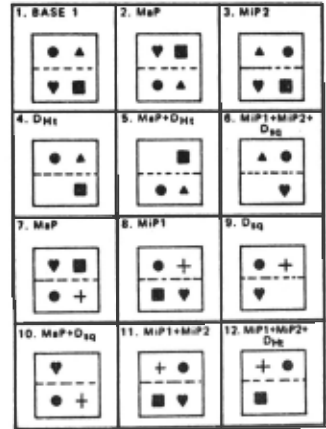
An example will ht'lp to illustrate ACT's automatic generalizateon mechanism. Figo.rro I illuslri!IN tho stimuli studied by subjects in Experiments 3 and 4 of Franks and Bransford (1971). We will assume that subjects dt'lsi!ln.lto productions to recognizto each stimulus. So tor the ti~t stimulus item subjects would designate the following production:
Ple IF a trlangl, ir. to the rlqht of a circle and a square Is to the r I gh t of a h,art and the flrr.t pair Is above the second pair
THEN this Is an Instance of the study Material For Itt., third 'stimulus the followinq production would be designated·
P2s IF a circle Is to the rlqht of a trlarrg/e and a squartJ Is to I he r lqh t of a heart and the first pair Is above the second pair
THEN this Is an lnstAnco of the study Material From tho.se two production~ il gf'nNOIIi;:ation c01n be lormf'd that captures whill lht~~e two productions have in common. This involvea. deleting terms on which the two productions differ and replacing these terms by local variables. Thus, we have the following generalization.
P3s IF a LV.shapel is to tl'le ri9hl of 11 LVshitpe2 and a square Is tn the rlqht of a heart and thn first pa ; r Is above the second pair
THEN this Is ~ :. ln· t~nce ot the study ftiAierlal The local vari3blt- s on ono~ gt-nN~IiZ3Iion 3,, .,refaccd by LV. This gent~ralization can b<- thought of as lln att!.'mpt on ACT's part to arrive at a more gt'nt~ral ch.uactNi;,,tion of the study maiNial. Nolo that ACT's gt'nNahzation m!.'<:h3ni··m nepd~ only two to><ampl<'s to prop?se a generalization. This gent>r31iz01tion does not rl!lplace the original two but rather co-t>xi$IS with lht>m as an alternate mf!lans of char01cterizing the stimulus set. Which production will actu.llly procklce the response depends on the strongth mechanism that we will describe shortly.
·The actual ." syntax of ACT productions is cons.idf'rably more complex than this. We present them in a pseudo-English to facilitate readability.
Restrictions are needod on how many elt'mtonls can be deleted in making a generalization. Con~idt'r, ACT's rl!lpresentation lor the sixth stimulus from the Franks and Bransford set:
P4: H a clrcltt I~ to the riqht of · triangle and a heart Is to the rlqht of a blink. and the first pair lr. above the second pair
THEN this Is 11n Instance ol the stl.ulua Material
If we allowed this stimulus to bo gent'ralized with stimulus i (PI) we would get a production that would accPpt 01ny 01rray of four gf'ometric obJects as an in.stance of thP ~tudy mOIINial. While it is conceivable that any such 11rray m.,y be an t>><perimtonllll stimulus, this St!'f!lms like too strong a gf!lnNalization to make just on the b1uis of thl!'se two examples. Therefore, a limit is pl11ced on lhf' proportion of constants that can be replaced by variables in forming a generalization. Of the two productions from which tilt' g!.'nNalization is formed, the one with the least number of constants is used as a reference. The number of constants in the gt'noralization can be no lower than half this quantity. The terms that ACT considf'rs constants aro italicized. There are five constants in productions PI, P2, and P3. Procklction P3 is an acceptable generalization from PI "'ld P2 bt'cause it only involves replacement · of two of the constants. PI and P4 ere prevented from forming a generalization becau~to this would require replacing four of the five constants with variabltos.
Even with this restriction on the proportion of constants dell'ted it is likely that unacceptably m.lny g<'neralizations will be formed. A realistic simulation of an adult human's entire proct'dural knowledge would require hundreds of thou~ands of ACT productions. Under these circumstanc!.'s it sot'ms inft'3siblt' to attempt to generalize all possible pairs ot productions. ACT only attempts to form generalizations when a new production h11s bepn designated. Also, generalizations are attempted only tor pi!iring$ of ntowly·df'sign.1ted productions with the productions on the APPL VLIST. Since a production is on the APPL VLIST only if the consl11nts it reff'rf!lnCPS are active and it has met a strength critNion, this implies that Olltl'mpts to generalize will be restricted to productions th01t are reltwant to the currf'nt context and which have enough strength to indicatf!l e history of past succtoss.
Discrimination
Even woth toof'Sf' rt'slrir.tion~ placed on it, ACT's Qfllf'ralozauon. mechanisms will product!' productions that art!' overgeneralizations of the desired production. Howl!'vl!'r, givl!'n our goal of a psychologically reali ~tic simulation, s·Jch ovNgt'nflralizations on ACT's part are actually d~:>~irable since it r.an be shown that people make similar overgt'neralizations. For fl><··mplt-, childrt>n lt-arning langu11ge (and, it appt-ars, ad\olt~ lt-:~rning a st-r.ond languagt- - -st'e Bailey, Maddt'r, and Krashen, 1974) ovtorg~:>nNalizt> morpht'mic rult's (Brown, 1973). Thus a child will g<'Mrato mllns, glvtJd, file. ACT will do the same.
Use of a discrimination mt-ch.1ni~m set>ms rl!'lativl!'ly uniqtlf' in the knowll!'dge acqui~ition literahlfe--Winston's (1972) usl!' of ·near 'misse-s· bt'ing thf' nnh· rt'latt'cl .'lf't:hanism WI!' are aware of. The use of discrimination is mo>tivaii!'·J. by thfl fact that any system that tries to improve itself by ,.~lo.ing grnl!'ralizations mu.~t. occasioMIIy, make overgenNaliz.ations. Oiscrimin>otion provide.s an automatic mt"ans for "debugging· such errors. To corrt'ct ovt'rgt'neoralizalions ACT must create more discriminate productions.
Tht' discrimin>olinn ml!'t:hilni.·m will only attempt to discriminate an ovt'rgeneral produc.tion wht'n il has both a corrt'cl and an inc01recl application of that procltoction to compart' . (Productions place new propositions into the d"t" b.,'" and I!' mil obsf'rvable responses; either of tht'se action~ c.·n bl!' dt'dMt'd incorrt-cl by a llumiln obsl'rvl'r or by ACT Itse-lf . In thf' ;~b~l'nct' of such a doclaration an action is considered corrocl .) B.,~ic~lly, lhi~ algNithm rt-mt'mbNs and compares the variablt' binding.s in lht' o:orrt'cl and incorrt'cl applications. It attempts to find a variabll' thai h"d diffNt'nl binding.s in these two applicaliohs. In forming lht' do<crimiMiion, rNirictions areo placl!'d on thai variabll!' to prev<'nl lht- match thai It'd to the unsuccessful application whitt' still pNmittinQ tht' mo1tch th,,t led to lh<' successful application. In thfl simulo\tion.· of scht'mil abstraclton that will be discuss<'d, a nt'W production w.u formt'd from the old production simply by rl!'placing lttt' v:triilbll!' by tht- constant it was bound to during the successful apptic:atinn. In .·omt- of our othN work (e.g. Anderson, Klint~, & Bl':t .·lf'y, 1979") lhf' variablf' was kt'pt but an additional clausto was 11cldf'd to rt- .·trict wh.11 lht' vilri,,hlfl cOtJid match.
As ;~n f'><ampl<' of thf' disr.rimin.ltion procrs.s, we will consider a catl'goriz~tion N<pNimf'nl fr<>m Mrdin and Schafft'r ( 1978). We will focus on two instances they presenlt>d from category A. Onto was two lttrgo rod trl.mglos and lhl\ olhN W3S two /llrge blue circles. From tht'5t' two t'~. amplf' .·, ACT WOIJid designate thto following categorization production~:
P6o IF a stiMUlus hu two tarqe red trlanqt .. THEN It Is In cateqor~ A
P7o IF a s tiMU Ius has two larqe b tue c Ire les THEN II IR In t:Aie~~ A
From the.,f' two ACT would form tho following (lfiM'ralization:
P8o IF a st I MUtus has two IArCJ· LVcolor LVshapes THEN It Is In c·t~qory A
HoWf'Vt'r, this turnod nut In he- an ovNgrnl!'rAiization. To be in cattogory A th~:> .~timulu~ h:~d to be t-ilhl!'r rod or a circll!' or both. Thus, thf' countN-t--.amplt- w~~ prt' :.rntrd of two largt' blue triangles which wu a slimulu· in r.lllf'(l"'Y B. �l'nNalir;~tion P8 miS31'fllieod in this circum~t:~nct- . By notin(l wh.,l dosting<Ji~hl'd theo circumstances of correct applic.1tion~ ol gf'nN.11ollllinn P8 from lhfl circumstanctos of incorrect applicatinn, both of the following productions WOIJid eventually bt' forml!'d by thfl discriminatoon mt'chanism. These productions will AlWAys product!' correct classifications.
P9 o IF a st !Milius h·~ two IArqe red LVahapes THfN It Is In cAteqnru A
Pl8 : IF a stiMUlus ha~ t~o tarqe LVcotor circles THEN It Is l,n c·I~CJMlJ A
Thf)SI) prodoo,, ti"ns WN'l form"d fr""' P8 by rt'placing one of its variabltos ( t-ilhf'r LV color or l v ·.h.,pes) by lht' binding that variable had during a soJcce.s.sful application- - i .e- . an application to a stimulus that was actuAlly from clllf'gory A. (As an asideo, these two productions iltu.strate how IICT c~n encodf' disjunctive conct-pts by the use ol multiple production$).
Production Strength and Specificity
When a ne-w production is crt-.11f'd by lhl' dl'siqnation procpu there is no assurancl!' th.11 its conclotion is rMIIy tho bi!SI characterization of the circumstanct's in which its action is appropriate. For this reason, generalization and discrimin:~tion pr oct's.·t'S f!Xi~t to giveo ACT the opportunity to evatu.111' altPrn,.tivto conditions for this Action. It is the responsibi lity of ACT's .strl'f191h mf'chilnisms to ptorlorm the evaluation of tht'sfl atternativt' productions .
Through t':oo:perif'ncfl yoith thfl IICT syslt'm wt> have created a set of parame-ters which, 111though SOmt'wh-'11 arbitrary, aPI)f'ilr to yield human-like perform.1nceo. The first timt- a production is created (by designation, gt"nN~Ioution, or do.<erimiMiion) it is givt-n a strt'nglh of · 1. Should that production bf) rt-cr1!'.1lt'd its slrtongth is incrl!'monted by .05. Furthl!'rmorl!', 11 production hu it~ strl!'ngth incrl!'ml!'nted by .025 every time it Applit>s or a production cnnsi·tf'nt with it applies. (Onto production is con.~idl!'red consi.·tent with another if its condition is more gent'ral 11nd its action is idt-ntical .) Finally, wheni!'Vt'f a production receives nt>gativt' ft't-dh.,ck it.\ Slrf'ngth is rf'du<::l'd by a factor of 1/4. Productions consi slflnl with lht' misapplil'd production ;~lso have their strength reduct-d by 11 factor of t/4. Sine(> a multiplicativl' adjustment produces a grt>ator changt- in strPngth than an additivt> adjustml!'nt, a "punishmt'nt· is more t'flt'ctivf) than a "rt'inlorct'mt"nl". Since increments and drcrt-mt'nts in strl'ngth prop11gato to more general productions ;~nd sine!!' g<'nN :~I productions can have a number of more specific prodoJCiions consoslt'nt with lht>m, tht'y tl!'nd to reflect quite rapidly and stonsitivoly the Wl'ight of I!'Xpt'riPnce.
Recall that a production's slrt'ngth dt-torminu the probability that it will apply. If s is lht' strt-nglh of a produr.tion and S tho total strength of all activl!' prod1Jclions, lht- probability of that production beinq chosen on a cycll' lor application is I - ~~-bs/S where b is a p;~rameter currently St't at 15. If a production passt-s this probabilistic hurdle it is placed on tht' APPL VLIST. 01 course, if a production is not applied one cycle and the circumst11nct>s do not chilng!', it can apply on a later cycle. Thus, strt>ngth afltocls both lht' lalt'ncy and reliability of production application.
While sele-ction rules basl!'d on slrl!'ngth can makto some of the required choicos among compt'ting produclion.s, it is clt'ar that strt'nglh camot be the sole criterion for confl ict rl!'solution. For ex;~mplt-, pl!'ople reliably gl'noratt' irrl'gular plurals (e.g., mon) undl!'r circumstances in which the "add s· IIIII!' for rt'gul3r plural~ is prt'sumably also applicablt'. This reliablt' pNform;~nct' is obtaint>d df':.pitt' lh!' fact that the productions rf' ~ponsiblo for g<'nNolling rt-g<Jiar plurals are appl it'd much more frequently than tho~(> for orrt'gul;~r s and thNelore should bo much atronger. ACT hils 11 $pt'cificity ordering on its productions which makes it po~ .sibl1!' to dl!'al with t>xct'ption~ to strong rull's: If two productions both havt' onough ~lrt'nglh to bf' ptactod on the- APPL VLIST but the condition of onl!' of th'!'m is a morl' specific version of the condition of the other (i .e . Mtisfil'd in a subsrt of thfl situations that satisfy the otht'r), then the mnrfl spl!'cific production will apply 11nd w ill block out tht' more gl!'nl!'ral production. This pr incipii!' accounts lor the e><f'CUtion of a production gt"nf'rating an irrt'gular plural since ita condition preso.~m<1bly contAins all of thfl rl!'quirt'ml!'nts for gt'neorating the regular plural tmd mo.o·l, in ad<1itinn, makt- ref!'rl'nce to thfl spt'cific noun to be pluralizt-d. Thi~ special cue princirat c11n be- tract'd back to Waterman ( 1970) ~~nd v11riant< of it can be found in many current production systt-m.~ (t' .g. RychrnN & Newt'll, 1!:178).
The precedf'nct' of l!'><t:f'ption.~ over much strongf'r IJI!'nt'ral rult'S does not imply that f'><Ct"ptions 11IW11y .~ llpply. In ordtor to bt'neofit from the specificity-ordl!'ring principlt- t'lnf'plions fT'IIJ<t first havt'l achit'Ved tht amo\J'\t of strf'ngth nt'Ct'Hary to be plat:t'd on thfl APPLVLIST. Thia property of the ACT moclt-1 is con<i .~lf'nt with the fact that words w i th Irregular infl~:>ction< h.wt' high frNI'Jt'ncit's of occurrtoncf' .
Production str!'ngth is nnothf'r import11nt WilY in which ACT diffl!'rS from most olht'r compolf'r -b:o<t"d lf1,1fning sy.~tf'm.· (l!'.g., AndNson, 1978; Vere, 1977; Hay!'s- noth & McDNmoH, 1!!76; Su~sm11n, 1975:
Winston, t97.0; W3tNman, 1970. The lt'arning of all thNe systems has an all-or-nont' char<lclt'r th.1t ACT would share if cre3ling new productions wert' its only lt>arning mt>chani$m, The strength mechanisms modulate the all-or-none char11ctor of production creation enabling ACT to copt> with lht> kind of world that people have to cope with--a world whort> d.1ta is not pcrft'clly reli3ble and contingencies change In such 11 w11y th31 I'Vt>n bt'ing liS cautious as possible it Ia certain that occuional t'rrors will be made.
Ill Applications to Prototype Formation
Thtore is a growmg litt'rattrr<' conct'rnt'd with the proct'ss by which humans form conct'pls by dt'trr.ling rt'gul,,rilit's 01mong stimuli (e.g., Franks & Br:~nsford, 1971; H.1yes-Roth & Hayt's-Roth, 1977; Newmann, 1974; Po$nN & Krole, 1970; Rt't'd, 1972; Reitman & Bower, 1973; Rosch & MN, ·is, 1!175). This lilt'ralt.rre is often referred to as studyi"g protrtyptt form11tlon, but for various reasons we also refer to it :u; .studying ~chtrmll abslri!Jctlon.
In the remaindN of this papN Wt' dt'scrihe how ACT's automatic learning ml!'ch.:mosm.< c11n bt' u<t'd to modt'l schema 11bstr:oclion. In outline, this 11pplic<1lion is 35 follows: For f'llch instance presented, ACT design<llf's a production th.·t rpcognizes and/or Cillf'gorizes thai instance 11lone. Gt'nN<lliralion< occur through the comparison of pairs of tht~se productions. II ff't'rlh.lck about the correctnNs of these genl!'ralizalions is providt'd lht'n tht' discrimination process can be evoked. Our working dt'linition of a concept will be thos set of designations, genf'r alizations, ;,nrl discriminations.
Franks and Bransford: Illustration of Basic Phenomena
We havo alrt'.ldy introl1tJc-:od (· otl'.trt' 1) lht' ml'llt'tial used by Franks and Bransford in one- of thr-ir t'~I'Nimt'nls on scht'ma abstraction. Subjt'cts studied the- 12 picture-' in Figurr- 1 twict> and lht'n were transferred to a recognition phase- in which theoy rated te-st pichns according to whether tht>y had bt'l'n studif'd or not. Tht' teosl picturt's could be classified according to hnw many transformations St'paralt'd them from the ctonlral tendency of tht' study stimuli. There WNe ll!'sl stimuli 0, 1, 2, or 3 transform3tion.~ from the study stimuli and some ·non-cases· which Wl!'re still furlhN rl!'mO"t'd. Some of the INI liguru were actually sludil!'d and ~nme wrr,.. not. Franks and Bransford rt'port that confidence- ratings '"' ·t'cngrul"'" gt-nt'rally decreased with the- nurt'lbt>r of transformations from lhe b.l .'t' 01nd was lowt'sl for the non-cases.
To simulate the Fr:mks and Br,,n:.ford e.v.pt'rimt'nt we ran ACT through propositional encoding.< of lht' it~ms in thtl study set lwict', design31ing a recognition procluclton lor l'ach stimulus it ~aw . Then at test ACT was again presl!'nlt'd with 11 propositional t'ncoding of each stimulus and the production which ·'PI'Iit'd to this t'ncoding (if any) was noll!'d. Sufficient gt'nNalozation h"d occ:urrt'd so that most of the stimuli we-re recognized by at lt'ast one- of the productions.
Since- most eo><pt'rimt'nts in this liiNOIIlrreo rt'rort d01ta on subject$ confidence in tht'ir judgmt'nls, 11 critical qut'~tion was how to map thtl production st-ll'tc:lt'd onto 11 cnnlidt'nc:e rating. We assume-d that ACT'' confidence would bt' a lunctinn of lht> numbt't of constants in the stimulus (and tht'tt'lorl!' an invt'tsf' function of the numbe-r of variabll!'s) . This procl'tdure for IIS$igning conlidt~nc:e will bf' usl!'d thl'oughout this papt'r . Thi ., i .< a r.-a<oMble proct~dt.rre lor assigning confidence-, since- the morr- cnn-,tants in lht' rt'cognizing production lhtl close-r it is to an t'ncoding of 01n .lclu.ll lost ilt'm. In the t' .~lreome, if the stimulus is rt-c<'gnilt'd by a f'I'Odooc:tinn with no variables the- subjf'ct c11n be- sure- that lh«' itl'm w"s studi.-d since a non-v11riabililf'd production is en pncoding of 11 study ill'm.
To obtain prl'tdictions for lhi$ t>xpNimt'nt WI.' ran a SNit's of ACT simulations. Altopt'thN Wt' obti\iMd filly ratings for each tt'sl stimulus and the data we- rt'port will be bast'd on 11ver;~ges of the-se fifty ratings.
0-transformation test stimuli WNI!' given a mun rating of 1.66 (i .e. mean number of constants in matching produclions)r the one-transformation tpst stimuli wNe rated 1.24; the two-transformation stimuli WNt' r<~lt'd 1.11; the thrt'e-lransformation stimuli wNe ratt'd 1.13; and lht' non-cast'S were- rated .65. This correspond~ to Fr3nks and Br:\nslord's rt~port of an ovNall correlation between clost'nt'H to hast' 11nd rating. (They do not rt~port the actual ratings.) Neumann ( 19711) performod a replicalion of Franks and Bransford and he did report mt'an raltngs for each of the five categories of If'S! stimuli. Tht' conlidt-ncPs 11uigned to the stimuli by his subjects corrl'l~ponds t'><llclly in rank ordering to tho results obtained from ACT.
This experiment sNvcs to illustrate lho1t ACT can account for one- of the basic pht'ncmt'n<~ of scht'ma abslr3clion -- namt'ly that confidence falls off with distanct' of tht' stimuli from lhtl ce-ntral tt'ndt'ncy (prototypt') of the calt'gory. The gt'nN31iz3tions ACT forms represent what variou.s stimuli will h<~Vt' in common. Thf'rt'fore, there will be more genNalization· formt'd lh.11 match centr31 stimuli than onf's that match periphN:'II stimuli. It is this gtt'.llf'r density of gent'raliulion that give central stimuli this advantage.
Hayes-Roth artd Hayes-Roth: Variation of Instance Frequency
Hayes-Roth and H<lyf's- Roth ( 1977) rt'porl a study, one function of which w;u to oht,.in d,,,,, rrlev11nl lo the issue of memorv lor instancl!'s. Tht'y rresrnted 'lrl>jt·cts with lhrt>e-altribull!' dNcriptions of more than one hundrt'd pt'orle. OnP attribute was <IQf' 11nd could have valul!'s 30, 40, 50, and 60. Anolht'r was t'duc;~ti~n and could havl!' valtrt'S junior high, high srhool, trade school, and collt'gt'. The third was m;~rilal status which could havr- valut's single, m.1rrit'd, divorc .. d, and widowed. The dt>sc:riplions also includt'd proper names and hobbies but this information was not critical. Thus, a subject might hear the deo.scription "John Dol', 30 yeotrs old, junior high education, ~in~le, plays che-ss. · Subjt'cts' task was to learn to classify the-se indovrdui'lls u membNs of club 1, ml!'mbt'rs of club 2, or nt'ilht'r club.
We will assumt' th.lt for t'<!Ch designatt'd a productinn mawing prediction about club mt'mbNship. form the following production: individual encoW~ttorl!'d, subjects thai indovidual'a ft'atureos rnto a So, for instance, a subject might
II · person '' forty ye·r· old ·nd he h·~ gone to high school ·nd he Is single
Then he Ia · .,..lllh,.r of c l!ob 1 Hayl'ls-Roth and H.1yos-Roth varit'd lht' lrt'qo.ot'ncy with which varoous instanct'S Wt're studi('d. Som(' inslanc('s wNe prest'ntt'd 10 timtos while olhNs only onct'. A study trial consislt'd of first prf'st'nting the subje-ct with an inst11nce, 11'~ing him lo cl11ssily it, and lht'n providing fee-dback as to which club the- in~l3nce camp from. Som~ instance-s rect'oved equivocal f('t'db.,ck in lhl\ st'nSt' that half tht' limeo the> feedback for those insl<~ncl's speciford club 1 and half the- timr club 2.
After studying a st'l of stimoJii, suhjt'Cis Wf'rl!' shown a criticlll tf'sl set of 28 stimuli. Subjt'cts Wt'tl' first askt'd In c.ltl'gorizf' Pac:h of thtl stimuli and tht'n tht'y WNl'l as .. t'd to dt'~idt' wht'lht'r t'ach of lht' stimuli had bet'n studit'd or not. Thr- rt'coqnilion j\Jdqmt'nt was assignpd 1 confidt'nce from 1-5 as was lht' catt'(lorization judgment.
This I!'Xporiml!'nt w:u ~imorlatrd with the sllmf' rarAmt'tt't seottings as the Frank~ 11nd 1\raMiord f'·.f'Nimt'nl. The ont' signifocant difference was that ACT w:u givr-n lrrclh,,~k about the corr.-clness of its classifications . Thi .s mr;tnl lh,,l rrodorc:toons would Mt simply increase in slrt'nglh with t'VNY ·'l'f'li<".,loon, but r:'llhf'r would eoilhpr increoase or dtocr035(' in strr-nglh drpt'ndong on lilt'ir SUC'Ct'SS in claHificalion. Providing lt't'dbaclo. also mt'.,nt that ol w~· pos·ohlt' lor ACT to compare variablt'-bindinq~ on suc<"t''''"l arf'li<'.lloons in ordpr to pro~rce more discrimin.1ting vNsoons of its ovNpt'nNal productions.
the number of constants in tho production th.1t recogni.tt~d the stimulus. In this experiment that numbN would vary from 1 to 3. A valueo of 0 was assigne-d if no production was e-voke-d to categorize thfl stimulus. The categorization scort-s for a tt'st stimulus were calculatt~d by weighting neg.:~tively tho confidences of incorrect clusifications, weighting positively tho confidt'nees of correct classifications, and ignoring the confidences of classifications to the neither-club category. Figure 2 presents .the actual and preodictt-d recognition and classification confidt'nct's for the seven c01teogories of test stimuli. The confidence scale use-d by subjects and tilt\ match scale used by ACT have be-en adjusted to covf'r approxim.:Jit'ly e-qual ranges. As can be seen the ACT predictions close-ly correspond to the data obtained by Hayes-Roth and Hayes-Roth.
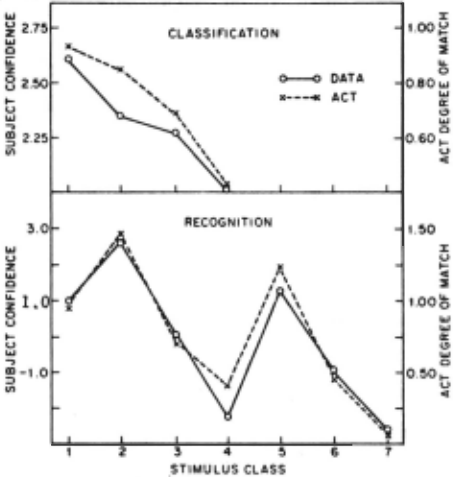
Class 1 in Figoxo 2 is formed lrc>m lwo prototyllf'S which, in fact, were never studied. However, lht'y rect'ived tho hight'St cate-gorization rating and 1 rt-13tively high rN·ognition rating indicating that subjects have extracted tho ct'ntr31 IC'ndt'ncies of tho catC'gorit~s. Class 2 items, while not as similar It' tht' prototypC's as Class 3 ite-ms, had categorization ratings srcond only to tht' prototypC'S themseolvt~s. Since each item in Class 2 wa.< 5ludit~d trn tim.-s whilt~ items in Class 3 Wl'rfl only studte>d once-, it appNtrS that lrequt'ncy of exposure has an effect on catf'gori~OIIion th.11 can compeonsate lor lack of similarity to the prototypt's. A r:omp.,.iwn of COitrgnrir.ation ratings for Clus 3 versus CIOIH 4 holds lreoquen<"y of e~.post.Jrt' const11nt and the effect of similarity to prototyres re - e.,wrges: Class 3 is closer to the prototypes and receivtoS highe-r rating.s.
Items in the last three classt's were neutral with regard to category membership so that corrt~ct categorization is undefined and only recognition confidt'nce.· coln bf' reoportt'd. WhNI'as the data reviewed earlier from Cl11ueo· 1-4 showod that fr«-quC'ncy of t~xposure afft~cts categoriz01tion r3tifl9~ whl.'n we might have eoxpoctt~d it only to affect recognition r11tings; tht' d.1ta from Clas .~t's 5·7 shows that similarity to prototypN affects rt'cognilion wht'n w~ might have expeclt'd it only to affect categorization. Cia~~ 5 has lht' Mmo t>xposure as Class 2 so only its di.~tance from th<' prototypes can e-xplain its lower recognition· ratings. Simil;:uly, no inst:mct'~ of eithN Class 6 or Class 7 was ever studie-d by ~ubj.-cts, but C:lau 6 received highe-r recognition ratings and this mu·t bo du<' to the fact that, although very far from the prototypes, Class 6 is not as far from them as is 1,;1ass 7.
In summary, this ~xpeoriment serves to illustrate how ACT correctly models the combined e-ffects of frequ~ncy of exposure and closeness. to prototype. Stimuli that are fre-quently studied will have fairly strong specific productions to recognize tht-m. Stimuli which are close to the prototype will have many goneranzations that can recognize them.
Comparison of ACT with Other Prototype Theories
There aro thrl'e baste ·YPN of th~orit'S for prototype formation. One type proposes that subjects form ol single- character ization of the central tendt'ncy of the- C3tt'gory. A frequt'nt ~uggt'stion is that they distinguish a particular instance (it nt't'd not beo one they have actually seen) as tht' prototypo lor the conct'pt . Other instance-s are me-mbers of the category to the extent that they are- similar to this prototype, This class of lht'orios would include Franks and Bransford ( 1971), Bransford and Fr .. nks ( 1972), RMch nnd Me-rvis ( 1975), Posne-r and Keele ( 1968), and Reed ( 1972) . In order to account lor the effects of instanct~ frequency dt'monstralod by Hayes-Roth and Hayes·Rott the prototypes would have to b~ augmeont~d by some memory for the individulll instancn~ ~tudit'd . HowevN, it ts much more difficult for prototype theorie.s to nccomod~teo the reor:l'nt re-sults of Me-din and Schaffer ( 1978) that indicate that subjects are sensit ive to similarities among individu01l in.stanr: t's. On thfo other h;md ACT is able to simulate this data (Andeor~on, Kl ine, & Beasley, 197911).
A second cla~5 of theories ( ~ . q. Me-din & ,;chaffe-r, 1978) are tho.e that propose subjrcts store individu.,l inst01nceos only, and makt~ their category judgml.'nts on the basis of the similarity betwet~n the test instance and the- store-d iMtanct'~ . In a cNtain sense, any result· that can be accountt~d for by a tht"ory that says that subjects store abstractions can also bt~ acco11ntPd for by a the-ory that S3ys subjecta only store- instancns. The instance th<'ory r.ould always be m.1dt1 to go through a lost procPss C'quival('nt to c"lculat ing an abstraction lrom the stored instances and m.1klng a judgme-nt on lht~ b,1Sis of tht~ abstraction, However, a difficulty for the in.stance theory is that subjects frequeontly rl'port having .:Jbstrar.t characte-r izations or prototypes (e.g., Reed, 1972).
The third class of tht'ories propo .~n s th.,t suhjl'cts store co- occurrence -information ahout ft"ature combin.1tions. ACT is an instance of such a theory as are those- propo.·l'd by Rt" itman and Bower ( 1973), Hayes-Roth and tlayo~ ·Roth ( 1977), and one aspect of Neurnam's ( 1974) model. The sf' models can potrntially store all subsets of feature combinations. Thus, they store instanct~s as a special case. The Hayes-Roth and H3yos- noth Mperim«-nt showed this model has advantagt's ove-r many vNsions of tht~ in~tance·only or prototy.,. modet.s.
It is veory difficult to find eompiric11l prt'dictions that dist ingtJish ACT from the various othe-r feoaturf' · St"l lhl'or iu . r erhaps it would be best to reog11rd them as equiv:\l<'nl givl'n thfl currrnt state of our knowledge and simply conclude that sub)t'cts respond in te-rms of feature-set·. However, there are a number of reasons for preferring ACT's ver~ion of the feature - sot tht'orics. First, i t is a fully SJ!f'clfied process model . It Is oftt~n difficult to see in any detail how some of the feature-set theori~s apply to particular paradigms or produce particular results.
Second, ACT has a reasonably efficit"nt Wily of storing h·ature··ets. It only stores those ... Jh,~ts of propeortieo· and features that have arisen because of gt"nl.'lalization or discr imtMtion rather than attempting to stort~ .111 po.,sibleo sub.sets of fC'atures from all observed Instances. While lhNe 0110 t'mpirical con~t'Q'J<'ncos of theM dtfferent ways of storing feature - sets, the difiNeonct~s are so subtle that existing experiments have fail"d to tt'st thrm. However , if there is very little difference in brhavior, that would seem to be all the more reason to prefer lh<' morf.'O t'fficiont storagr rt'quiremC'nts of ACT.
Third, it ne«ods to be emph.uized that the ACT learning mechanisms were not fashioned to account for scht'ma abstraction. Rather they were designed in light of more general considerations about the nature of the rules that net'd to b«o acquired and the information typically availllble to acquisition mt'chani~ms in rt'.11 world situations. We were particularly con<:Nned that our mechanism.\ should be capable of dealinQ with langtJolgo acquisition and acquisition of rules for making Inferences and prt'dictions about one's l'nvironl'l1ent. The mf'chanisms were designed to both be robust (in bt'ing able to deal with many different rules in many differt·nl situations) and to be efficieonl. Their success in accounlinQ for schema abstraction represents an independent confirmation of the gt'noral learning theory.
Before concluding, Wf' wo·.old like to discuu one characteristic of feature-set models which m.-.y sot'm un3ppl'aling on first f'ncounler. This is the· fact lhnl 11\oy store so many diffcrf'nl characleri~ alions of the catt'gory. ACT may not be so b.1d as somt' of tho other theories, yet havinQ a sot of productions lor rt'cognizing instances of a category still seoms f3r loss oconomic31 than having a single prototype. However, two rem<Jrb net'd to bt' made hert'. The first remark is that the complexity of tho rt'prosontalion of a category dt'pt>nds on one's production system implt'mt'ntalton. This can be quito complt'X if each production is rt'prost'nlod srp.1ratt'ly. Howl'VN, the reopresf'ntalion. can be quite economical in a data-flow system like Forgy's ( 1977). Here a single discnmiMiion nt'l is constructed to encodt' the conditions of all productions. This allow.\ ovNiapping productions to share the same net .tests in t'ncoding their conditions.
A second remark is that n.11ural calt'gories defy economical representation. This hils bN·n streossl!'d in discussions of lht~ir family resemblance strucllKo by Witlgonstein (e.g. Witlgt>nstein, 1953) and more recently by Rosch (e.g. Rosch & Mervis, 1975). The important fact about many nalunl calt>gnr iM (e.g., g3mes, dogs) is that there is no set of features that define thl' ci'ltt'gory nor is there a prototypical instance that flK1clions 1u 11 stilnd.1rd to which all other category members mu.~t be comp.1rl'd. On the olhl'r h3nd, lht>se categories de not seem to be unslrucllKI'd; th<'y ;ue not mert~ly a list of ins1.1nces. It Is interesting to nolo hert' lh3t Ort'yfus (1972) has claimed thai computer implf'mentations arf' not Cllpolble of representing the family resemblance structure of categories. ACT shows just the opposite to be true.
- (1] Anderson, J.R. Language, memory and thought. Hillsdale, N.J.: Lawrence Erlbaum Associates, 19!6.
IV References
- (2] Anderson, J. A. Induction of AUQ~Mnled Transition Networks. Cognitive Science, 1977, f, 125-157.
- (3] Anderson, J.R. & Bower, G.H. Human Auoclatlve Memory. Washington: Winston & Sons, 1973.
- (4] Anderson, J.R., Kline, P.J ., & Beasley, C.M. Complex ltoarning processes. In R.E.Snow, P.A. Federico, & W.E. Montague (Eds.}, Aptitude, Learning, and Instruction, Cognitive Process Analyses, 1979a, in press.
- Anderson, J.R., Kline, P.J ., and Beasley, C.M. A general learning theory and its application to Schema Abstraction. In G.H. Bower (Ed.) The Psychology of Learning and Motivation, Vol. 13, 1979b, in press.
- Anderson, J.R., Kline, P.J., & Beasley, C.M. A theory of the acquisition of cognitive skills. ONR Technical Report 77·1, Yale University, 1977.
- Anderson, J.R., Kline , P.J., & Lewis, C. A production system model for language processing. In P. Carpenter & M. Just (Eds.), Cognitive Processt.ts In Comprehension. Hillsdale, N.J.: Lawrence Erlbaum Associates, 1977.
- (8] Bailey, N., Madden, D., & Krashen, S.D. Is there a "natural sequence· in adult second langu3ge learning. English language Institute and LinQuislics Department, Queens College and the Graduate Center, City University of New York, 1974.
- Brown, R. A first language. Cambridge, Mass.: Harvard University Press.- 1973.
- ( 10] Bransford, J.D. & Franks, J.J. The abstraction of linguistic ideas. Cognitive Psychology, 1971, 2, 331-350.
- ( 11] Dreyfus, H. L. What Computers Can't Do. New York: Harper and Row, 1972.
- ( 12] Forgy, C. L. A production aystem monitor for parallel C0f111Uiers. Technical Report, Con1pUier Science Department, Carnegie-Mellon University, 1977.
- ( 13) Franks, J .J. & Bransford, J.D. Abstraction of visual patterns. Journ111 of EKperlmental Psychology, 1971, 90, 65-74.
- ( 14) Hayes-Roth, B. & Hayes-Roth, F. Concept learning and the recognition and clas:;ification of exemplars. Journal of Verbal Learning and Vt.trbal/lehavlor, 1977, 16, 321-338.
- (15] Hayes-Roth, F. Thfl Role of Partial and Best Matches in Knowlellte System3, "-'nd Corporation, P-5802, 1977.
- ( 16) Hayes-Roth,F. & McDermott, J. Learning structured patterns 'from examples. Proceedings of the Third International Joint Conference on Pattern Recognition, 1976, 419-423.
- [ 17] Medin, D.L. & Schaffer, M.M. A context theory of classification learning. Psychological Rev/ow, 1978, in press.
- (18] Neumam, P.O. An attribute frequency model for the abstraction of prototypes. Memory and Cognition, 1974, 2, 241-248.
- [ 19] Neumam, P.O. Visual prototype formulation with discontinuous representation of dimensions of variability. Memory and Cognition, 1977, 5, 187-197.
- Newell, A. A theoretical exploration of mechanisms for coding the stimulus. In A.W. Mellon & E. Martin (Eds.), Coding processes In human memory, Washington, D.C.: Winston, 1972.
- [21) Newell, A. Production Systems: Models of control structures. In W.G. Chase (Ed.), VIsual Information Processing. New York: Academic Press, 1973.
- Norman, D.A. & Rumelhart, D.E. EKp/oratlons In cognition. San Francisco: Freeman, 1976.
- Posner, M.l. & Keele, S.W. Retention of abstract ideas. Journal of EKperlmental Psychology, 1970, 83, 304-308.
- Quillian, M.A. The leachable language c~ehender. Communications of the ACM, 1969, 12, 459-476.
- Reed, S. Pattern recognition and categoriutlon. Cognitive Paychology, 1972, 3, 382-407.
- Reitman, J.S. & Bower, G.H. Structure and later recognition of exemplars of concepts. Cognrtlve Psychology, 1973, 4, 194-206.
- Rosch, E. & Mervis, C.B. Family rtosemblances: Studies in the internal structure of categories. Cognitive Psychology, 1975, 7, 573-605.
- Rychener, M.D. & Newell, A. An instructible production system: Basic design issues. In D.A. Waterman & F. Haytos-Roth (Eds.), Pattern-Directed Inference Systems, New York, N.Y.: Academic Press, 1978.
- (29] Schapiro, S.C. A net structure for semantic information storage, deduction, and retrieval . Proceedings of the Second International Joint Conference on Artificiallntelligt~nce, 1971, 512·523.
- Simmons, R.F. Semantic networks: Their computation and use for understanding English sentences. In R.C. Schank and K.M. Colb~ (Eds.}, Computer models of thought and language. San Francisco: Freeman, 1973.
- Sussman, G.J. A Computer Model of Skill Acquisition. New York, N.Y.: American Elsevier Publishing Co., 1975.
- (32] Vere, S.A. Induction of relational productions in the presence of backgrolK1d information. Proceedings of Filth International Joint Conference on Artificial Intelligence, Boston, Mau., 1977, 349-355.
- Waterman, D.A. Generalization learning techniques for automating the learning of heuristics. Artificial Intelligence, 1970, 1, 121-170.
- [34) Winston, P.H. Learning structural d.-criplions from examples. MIT Artificial Intelligence Laboratory Project AI·TR-231, 1970.
- Wittgenstein, L. Philosophical Investigations. New York: Macmill""· 1953.
@inproceedings{ijcai1979p5,
  title     = {A Learning System and Its Psychological Implications},
  author    = {Anderson, John R. and Kline, Paul J.},
  booktitle = {Proceedings of the Sixth International Joint Conference on
               Artificial Intelligence, {IJCAI-79}},
  publisher = {International Joint Conferences on Artificial Intelligence},
  editor    = {Bruce G. Buchanan},
  year      = {1979},
  month     = {8},
  url       = {https://ijcai.org/proceedings/1979/5},
}
TY - CPAPER TI - A Learning System and Its Psychological Implications AU - Anderson, John R. AU - Kline, Paul J. T2 - Proceedings of the Sixth International Joint Conference on Artificial Intelligence, IJCAI-79 PB - International Joint Conferences on Artificial Intelligence PY - 1979 UR - https://ijcai.org/proceedings/1979/5 ER -Copied
Machine-readable versions of this paper, for tools and AI agents:





