
Knowledge-Based Problem Solving by a Labelled Production System
Proceedings of the Sixth International Joint Conference on Artificial Intelligence. .
© 1979 International Joint Conferences on Artificial Intelligence
Abstract
The paper problems. System. A the system design and summarizes a system that understands, solves, and learns how to solve geometry The system is represented homogeneously as production rules of Labelled Production brief introduction to the system architecture is given, followed by an example of how works. Then the paper discusses briefly some theoretical problems focused upon in implementation of the system.
- Ill
- Anzai,Y., Ishibashi,N., Mitsuya,Y. & Ura,S. "Knowledge-based Problem Solving by a Labelled Production System." Keio Engineering Report, Faculty of Engineering, Keio Univ., to appear.
- I2l
- Bobrow,D.G., Winograd,T. et al. "Experience with KRL-0: One Cycle of a Knowledge Representa- tion Language." In Proc. IJCAI-77. MIT, Cambridge, Mass., August, 1977, pp.213-233. IJCAI
- Elcock,E.W. "Representation of Knowledge in a Geometry Machine." In E.W.Elcock & D. Michie (eds.), Machine Intelligence~, 11-29, Ellis Horwood, 1977.
- Forgy,C. & McDermott J. "The OPS2 Reference Manual." Dept. of Computer Science, Carnegie- Mellon Univ., 1978.
- Greeno,J.G. "Processes of Understanding in Problem Solving." In N.J.Castellan et al. (eds.), Cognitive Theory~, 43-83,Lawrence F~lbaum,l977.
- Nevins,A.J. "Plane Geometry Theorem Proving Using Forward Chaining." Artif.Intell. 6 (1975) 1-23.
References were extracted automatically from the PDF and may contain errors.
Full text extracted automatically from the PDF; figures, tables and equations may differ. The PDF is the version of record.
1. INTRODUCTION
Recent development of cognitive science has revealed that problem solving is a total activi ty of understanding, s0lvin~, and learning how to solve problems, controlled on a unified know ledge base. This paper summarizes an effort toward building a system that encompasses such a broad range of knowledge-based problem solving, taking elementary geometry as a task domain.
Our fundamental assumption is that knowledge acquisition exerts a considerable influence on problem-solving behavior. Thi~ leads to our emphasis on post-solution analysis for acquisi tion of new knowledge from the solution process. It also leads to a homogeneous representation of the. system as production rules of Labelled Production System (LPS): knowledge acquisition on a well-structured knowledge base of geometry requires a representation which has capability to represent structured knowledge and high learnability at the same time. Also we believe that all information necessary in solving a given problem is not always available when the problem was understood. Some information might be necessarily inferred through subgoals, or popped up by demon-like procedures during the solution process. So interaction of subgoal oriented and pattern-directed processing is one of our concerns in designing a knowledge-based problem solver.
The above assumptions and thus motivations make our system different from traditional geometry theorem provers (e.g., [6)). Our main concern is to theorize problem solving from a broader view point. The current version of LPS is written in INTERLISP, and running on DEC-20. The version is only features for an experimental use, but all the described here are already implemented in it.
* Presently at SONY Corporation.
2. SYSTEM ARCHITECTURE
The system comprises four components: the Natural Language Understander, Problem Solver, Post-solution Analyzer, and factual knowledge about geometry. Understander transforms a (Japa nese) problem sentence to a set of semantic primitives such as geometric objects and rela tions, and goals for the proof. Solver works on this set toward solving the problem. It is able to try drawing additional line segments by using a partial-match algorithm and knowledge acquired through solving similar problems. Analyzer undertakes Solver's output, and tries to create possibly helpful productions. First Analyzer generates a hypothesis of a proposition . If the proposition was tested successfully by Solver , Analyzer adds it to the knowledge base. Inter action of subgoal-oriented and pattern-directed processes is realized by ACTIVATE as seen later .
The above process proceeds by utilizing factual knowledge about geometry. All the four compo nents of the system are represented homo geneously as production rules of LPS. LPS is, in short, a production system in which knowledge elements are labelled . Although global control of LPS is basically similar to 'recognize-act cycle' type production systems [4], its labelled structure greatly facilitates dealing with structured knowledge and reorganization of it. For example, labels such as CATEGORY and A-PART OF can be used for inference, similarly to slot-names in frame systems [2). Also we can use labels for referring to a knowledge element i n another production directly without using work ing memory (WM). See [1] for the details of LPS .
3.KNOWLEDGE-BASED PROBLEM SOLVING: AN EXAMPLE
An example outlines the system's behavior most explicitly. Fig.l shows a simple geometry prob lem. First of all, Understander transforms the sentence to a set of semantic primitives, which are shown in Fig.2.
Problem: Senbunno chuutenwo toori, koreni suichokuna chokusenjouno tenwa senbunno ryoutankara toukyorini aru. (A point on the line through the midpoint L
of a line segment and perpendicular to it is equally distant from the endpoints of the line segment.)
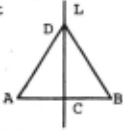
Fig. 1 Example problem.
((PGOAL(LEQUAL(LS D A) (LSD B))) (LSD A) (LSD B) (EP A (LS A B)) (EP B (LS A B)) (PERP (LS A B) (LS C D)) (ON (LS C D) (LINE L)) (LS C D) (ON D (LINE L)) (PT D) (PERP (LS A B) (LINE L)) (ON C (LINE L)) (LINE L) (ON C (LS A B)) (LEQUAL(LS A C) (LS C B)) (LS A C) (LS C B) (MP C (LS A B)) (PT C) (PTA) (PT B) (LS A B) (READNIL) (READ-START))
Fig. 2 Understander's output for the example problem. (For simplicity, ·notation is slightly different from the original output.)
Evoked by the goal (PGOAL (.LEOUAL (LS D A) (LS D B) )), meaning to prove equality of some quantity (length here) of the same type of objects (line segments here), Solver tries to ACTIVATE the pattern (CONGRUENCE) to WM. ACTIVATE collects productions related to (CONGRUENCE) by chaining productions backwards, and executes production firing only on the collected subset of produc tions. One of collected productions, TRIANGLE, pops up two new triangles, (TRIANGLE D A C) and (TRIANGLE DB C). Then these triangles make the production CONGRUENCE executed, and (CONGRUENCE) deposited into WM. Note that the two triangles did not exist in WM when Solver started to work (Fig.2). They were necessarily recognized in the ACTIVATE function mode. Solver needs to recognize some more relations to attain the goal. It is the end of the problem-solving process when the geometric relation, (LEQUAL(LS D A) (LSD B)), PGOAL's argument, is placed in WM.
The current version of Analyzer intends to con struct new propositions from Solver's output by means of three different ways. First, note that Solver concludes not only the conclusion for the problem, but also other two relations generated by a side-effect: (1) line segments DA and DB have equal length, (2) angles lADC and lCDB have equal degrees, and (3) angles lDAC and lDBC have equal degrees. So Anal~·zer builds three separate productions, 'if conditions of the problem hold, then (k) is true,' for k=l,2 and 3.
Productions generated in this manner can deal only with problems that have essentially the same conditions as the original problem. Ana lyzer's second way of knowledge acquisition is to build a production: for a given problem X, 'if most of geometric objects, relations and goals generated by Solver for solving the example problem matched WM for the problem X, then try to apply to solve X geometric concepts and propositions used in solving the example problem. ' 'Most of' implies that, if this pro duction can be executed, X is similar to the example problem if not totally the same. Hence conditions of this production should match partially.
Analyzer's last way of restructuring Solver's output is to use task-dependent heuristics to extract some small amount of mutually related objects and relations, and construct a 'specu lative' hypothesis . Fig.3 shows an example of such hypothesis. It needs to be tested by Solver, which goes successfully in this case, and the production in Fig.3 is registered as a new production. Testing the hypothesis by Solver, in this case, happens to involve drawing an additional line segment. Analyzer searches for a production already acquired and similar to the hypothesis, and here draws the segment which connects D with C, the midpoint of AB, in Fig.l.
Analyzer builds up several productions consecu tively in the above manners. It is the end of the system's problem-solving process: after Analyzer worked out, the system waits for another problem, which is to be fed first to the understander.
(G0900
#A0901 (PGOAL(LEQUAL(ANGLE $A0906 $A0909 $A0907) (ANGLE $A0906 $A0907 $A0909)))
#A0902 (LS $A0906 $A0907)
#A0903 (LS $A0906 $A0909)
#A0904 (LS $A0909 $A0907)
#A0905 (LEQUAL(LS $A0906 $A0909)
(LS $A0906 $A0907))
ACT (RESULT(LEQUAL(ANGLE $A0906 $A0909 $A0907)
(ANGLE $A09Q6 $A0907 $A0909)))
(LEQUAL(ANGLE $A0906 $A0909 $A0907)
(ANGLE $A0906 $A0907 $A0909))
CATEGORY (TRIAL))
Fig. 3 A hypothesis produc tion created by Analyzer.
4. ISSUES IN KNOWLEDGE-BASED PROBLEM SOLVING ----
4.1 Partial-match and drawing additional line segments
Some work on geometry problem solving is con cerned with drawing additional line segments I3] It is a tempting task for AI because it is a good example of generating new appropriate representations.
'Drawing additional line segments,' in our case, is a process of finding a once-solved similar problem, and generating a set of new geometric objects and relations that reduces the difference of the once-solved and currently attacked problems. Selecting a similar problem corresponds to deciding a best-match between the current WM and condition sides of some learned productions. We have tried to avoid the curse of computational explosion inherent in partial match by introducing a few heuristics: only geometric objects and relations are taken into account, and an object which is A-PART-OF ano ther object is neglected. This kind of semantic categorization and inference uses the labelled structure of LPS, and saves a fair amount of computation time.
4.2 Interaction of SUbgoal-oriented and pattern directed processing
Psychological research IS] tells us that elemen tary geometry problem solving involves organiza tion of subgoals. This basic problem-solving structure is represented in our system by the function ACTIVATE. ACTIVATE tries to achieve a specified subgoal by organizing related produc
tions as exemplified in the last section.
ACTIVATE is a powerful function for our purpose be.cause knowledge of geometry is well-structured enough to activate reasonable subsets of produc tions. However, popping up objects or relations in a pattern-directed manner also plays a key role in solving problems, as it might generate useful but formerly unrecognized objects or relations. But since bottom-up processing may easily blow up computationally, efficient embedding of some interactive structure of top down and bottom-up processes is highly desirable in any knowledge-based problem solver. Using ACTIVATE actions within pattern-evoked produc
tions is a realization of this general framework.
4.3 Structuring new productions from solution experience
To build a hypothesis production as shown in Fig.3, Analyzer must select suitable elements in
WM for creating conditions and actions. The mechanism for gathering them is analogous to the heuristics incorporated in the algorithm for drawing auxiliary line segments, but slightly more complex. Analyzer picks up one geometric relation arbitrarily, and makes it as the action in the hypothesis. Then Analyzer collects objects and relations related (in a certain sense) to the action, and assumes them as conditions. The mechanism makes use of LPS's labelled structure.
Note that the example in Fig.3 is equivalent to: the two base angles of an isosceles triangle is congruent. The system succeeded in generating the production in Fig.3 without solving this problem. We believe that the effort of Analyzer deverves doing, as this kind of self-organizing performance is the heart of intelligent tasks.
5. CONCLUSION
We have chosen geometry as the task domain mainly because it satisfies our general motiva tions stated in Section 1, and involves issues described in Section 4. We believe that those motivations and issues are general and central in any knowledge-based problem solving task. LPS is a general-purpose representational system, and our research presented here is a working study toward a general theory of know ledge-based problem solving. Though some detailed part of the used techniques are task specific, and we have yet little experience on LPS in other domains, our work has achieved a step toward a computational unification of understanding, solving and learning within a general framework of problem solving.
@inproceedings{ijcai1979p6,
  title     = {Knowledge-Based Problem Solving by a Labelled Production System},
  author    = {Anzai, Yuichiro and Ishibashi, Naoto and Mitsuya, Yuichi and Ura, Shoji},
  booktitle = {Proceedings of the Sixth International Joint Conference on
               Artificial Intelligence, {IJCAI-79}},
  publisher = {International Joint Conferences on Artificial Intelligence},
  editor    = {Bruce G. Buchanan},
  year      = {1979},
  month     = {8},
  url       = {https://ijcai.org/proceedings/1979/6},
}
TY - CPAPER TI - Knowledge-Based Problem Solving by a Labelled Production System AU - Anzai, Yuichiro AU - Ishibashi, Naoto AU - Mitsuya, Yuichi AU - Ura, Shoji T2 - Proceedings of the Sixth International Joint Conference on Artificial Intelligence, IJCAI-79 PB - International Joint Conferences on Artificial Intelligence PY - 1979 UR - https://ijcai.org/proceedings/1979/6 ER -Copied
Machine-readable versions of this paper, for tools and AI agents:





