
Inferring the Direction of the Sun from Intensity Values on a Generalised Cone
Proceedings of the Sixth International Joint Conference on Artificial Intelligence. .
© 1979 International Joint Conferences on Artificial Intelligence
Abstract
An initial attempt to synthesise some of the ideas of Marr and Horn about surface geometry and lighting is described. In some situations the direction of the sun can be deduced from intensity values on a section of a generalised cone which flanks a bounding contour.
- Brady • J. H. "Occlusion seems to be hiding" (in preparation) 1979.
- Horn. B.K.P. "Understanding Image Intensities" • Artificial Intelligence !!.• (1978).
- Harr 1 D. "Analysis of occluding contour"• Proc. Roy. Soc. Lond. B .!22.• 1977 1 pp.44l• 475.
- Marr. D. and Nishihara. H.K. "Spatial disposition of axes in a gen8ralised cylinder representation of objects that do not encompass the viewer" • HIT AI memo 341, 1975.
- Woodham. B. "Reflectance map techniques for analysina surface defects in metal castings"• (Ph.D) HIT TR-457• 1979.
References were extracted automatically from the PDF and may contain errors.
Full text extracted automatically from the PDF; figures, tables and equations may differ. The PDF is the version of record.
INFERRING INTENSITY THE DIRECTION VALUES ON A OF THE SUN GENERALISED FROM CONE
Mike Brady. Department of Computer Science, University of Essex, Colchester. C04 3SQ 1
Essex 1 England.
An initial attempt to synthesise some of the ideas of Marr and Horn about surface geometry and lighting is described. In some situations the direction of the sun can be deduced from intensity values on a section of a generalised cone which flanks a bounding contour.
l, INTRODUCTION
A key problem in developing a computational theory of visual perception is to discover the constraints which hold between lighting. and the geometry and photometric characteristics of a surface, which together with the prior assum ptions of a viewer enable the interpretation of a two dimensional image as depicting a three dimensional scene. The work reported here arose from a study of the ever-present problem of determining occlusion relation~hips in a single image. A companion paper [1] argues firstly that the current stock of ideas about occlusion are extremely limited. and secondly that the best way forward currently seems to be to aim for a s~nthesis of. the work of Marr [3] and Horn [2.J. Marr [3] argues persuasively that a viewer has strong preconceptions regarding the three dimensional surface which generated a given silhouette in an image, and proves that under a number of precisely stated assumptions ·hese preconceptions amount to requiring that the generating surface be a "generalised cone", Several accounts of generalised cones have appeared in print. and we adopt here the restricted version defined by Marr [3] , A gen eralised cone results from moving a twice continuously differentiable planar closed curve p(r, e), called the cross-section function along a straight axis A, subject to expansion accord ing to a twice continuously differentiable positive real-valued function h(z), ~. p,467 and fig, sJ, Horn [2] shows how surface geomet ry, lighting and the reflectance characteristics of a surface combine to produce intensity values, and points out that in some cases one can deduce surface 'eometry from intensity shading. Woodham LS] and Ullman (personal communication) have pointed out that although one can make surprisingly detailed assertions about the curvature of a surface from a small region in an image. it is hard to decide whether it is convex or concave. However. this ambiguity is usually resolved if one can see a portion of the bounding countour of an object, This su& gests that a good way to begin synthesising the ideas of Marr and Horn is to see what can be deduced when the contour region of a generalised cone is illuminated. This paper describes an initial attempt to develop such an analysis, and shows that in some cases the direction of the sun in an image can be deduced from the intensities near the surface of a generalised cone,
2, THE BASIC APPROACH
Following Marr ~, p.467], "let V be a distant vantage point for the generalised cone ~ such that ( i) the image formed from V is an orthogon& projection. and (ii) the rays in the projection all be parallel to the plane of the cross-secticn of~". V is associated with a specific angle + in the polar coordinate system of p. Let v be a unit vector in the direction of V, The contour generator re is the set of points
{(p(e) · h(z), e. z>lz> and lies in the same section plane ne as A. The normal n to the surface~ at a point on re can be separated into two components, namely its projection ~ onto the section ne· and its projection ~ onto the cross-section p, Since one can decouple the expansion function h and cross-section function p for a generalised cone ~ = h x p· differenti ating along re leaves~ constant, so that 6~ is equal to ~~· We shall be interested in pixels close to the specific contour generator r,. and it is reasonable to suppose for a sufficiently fine spatial image resolution that they lie on a contour generator r 8 where e is close to '·
Let an arbitrary vector direction 1 be given Later 1 will be specialised to point towards the single-distant light source (the sun), Suppose we denote che scalar product 1 , n by X, Con sider a short displacement along r,. say 6s, so
that the surface normal changes from ~l to ~·
since we are differentiating along r,. If we consider a Hom-like model of illumination, X can be the intensity Int = t(I, E, G) [3], In this way, we hope to extract 1, the sun position, from 6Int/6s. -
3. COORDINATES
!n order to flesh out the above proposal, we need to be aware that there is a problem regard ing the coordinate systems we use. The "natural" coordinate frame for a generalised cone is one that is local to it: cylindrical coordinates z along the ax1s, and the girdle angle ' about the axis A relative to some dorsal zero. The "natural" coordinate frame for a vector field, to facilitate the computation of scalar products, is a global frame, such as· a Cartesian system, In fact · Harr and Nishihara [4] faced precisely this difficulty and their methods propose a solution in the form of specifying a space arrow vector ("$spasar") relative to a given axis ("$axis"). In fact · their methods apply to specify a general vector relative to the axis A of the generalised cone I. Given an origin on A, they suggest encoding a vector of magnitude s at a point Q on the surface of I using six parameters. The first three parameters (z, r, 8) specify the point Q, while the other three (a, B. s) define the vector. Here a is the inclina tion of the vector to A and B the girdle angle uf the vector about A.
In the cases considered here, Q will always be the position on r+ at which the normal is computed, and it will be supressed. Moreover, we are only interested in vector directions and so we dispense with the norm s. Thus two parameters (a, 6) are required to specify a vector. We need to compute the scalar product of two such vectors, and the following easily proved lemma achieves this.
Suppose we have a vector (a, 8). We shall need to consider its projection onto the section plane 0+ containing the axis A and a vector with girdle angle ;.
Lemma 2 The projection on (a, 6) on 0+ has girdle angle · and inclination ~ where
tan~ = tana cos(B - +>
Proof: (refer to Fig. 1).
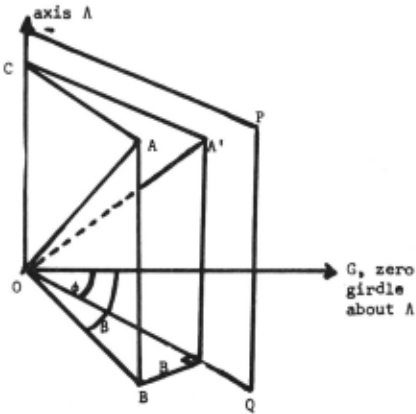
BOG = 6, AOC = a, QOG = +. The projection of oA onto the plaiit OPQ is defined by keeping OC = loAicosa and ~rojecting AB onto A'B' in POQ. Now los·l = losjcos(B- +> ~ = loAI~ina cos(S - ·> Thus the inclination of OA' is arctan OB' ~ OC = tana cos(B - +>
4, THE NORMALS OF A GENERALISED CONE AND THE MAIN RESULT
Consider the section o, of a generalised cone
(Fig. 2), The contour geoerator r+ i~ {(z, h(z) * p(+) * sin~+>lz on axis} where~. is the eccentricity of the cross radial p in the section n.. Clearly, the direction of the tan gent is given by
so the tangent vector is (a, +>. The normal~ is given by (90 -a, +>.
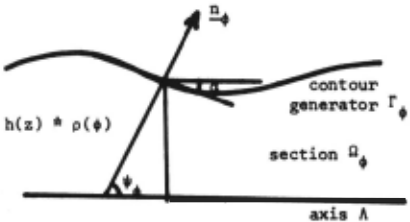
Consider now an arbitrary vector ()., ll} and define the scalar product X=(). , p),(90- a,~. At a neighbouring point of the contour genera tor r+' a' =a+ ~a. As in section 2
where sis taken along r ·· By lemma 1,
- -sin). cos(+- ll)(cosa- cosa')}
recall that
and
Now ~a/~s is the curvature of r and can be measured in the silhouette. We.denote it by curvat+(z). Thus
We now specialise the vector (A, ll} used in the above derivation to be the sun vector (A , ll ), s a Clearly, there is no change in the ~hase angle G along r + and so following Horn [2J we have
We can now apply formula (1} deduced above to compute ~using the sun vector (). , ll ) and dS S S aE/as using the view vector v. This doesn't exploit the fact that the contour r. along which we are differentiating is a bounding con tour, however.
There are two ways to incorporate this extra constraint.
- Take the general formula for the surface normal n and use the fact that n · v is zero, since n-is orthogonal to v. Th!s has the dis advantage that the formula defining n is rather complex, It can be cleaned up by restricting v to line in a plane parallel to p as in Harr's - [3] first three theorems> but this misses the essence of the idea that it is largely irrele vant as~~=~~ along r+.
- Build the assumption e = w/2 (i.e,, E = zero} directly into the function t, so that t is a function only of I, G. We then get t(I, 0, G) = R(I, G), so that
In particular, at a stationary point of inten sity along r+' aintensity/as is zero. If we assume that neither eurvat+(z} nor 3R/3I are zero, we get
which by lemma 2 is the projection of ().s· lis} onto the sector containing (a, +>, that is, the image plane.
Hence the direction of the sun can be deduced from a stationary point of intensities taken along a section which flanks a bounding con tour. Future work will develop the idea that the assumption of a Marr generalised cone allows one to make useful inferences from shading.
ACKNOWLEDGEMENTS
The research reported here was completed while the author was a visiting scientist at the HIT Artificial Intelligence Laboratory. Thanks are due to the many workers at the Laboratory who made the visit so memorable. especially Patrick Winston. David Harr and Berthold Horn. The American referee for this paper made a number of valuable suggestions for improving its presentation.
@inproceedings{ijcai1979p24,
  title     = {Inferring the Direction of the Sun from Intensity Values on a Generalised Cone},
  author    = {Brady, Mike},
  booktitle = {Proceedings of the Sixth International Joint Conference on
               Artificial Intelligence, {IJCAI-79}},
  publisher = {International Joint Conferences on Artificial Intelligence},
  editor    = {Bruce G. Buchanan},
  year      = {1979},
  month     = {8},
  url       = {https://ijcai.org/proceedings/1979/24},
}
TY - CPAPER TI - Inferring the Direction of the Sun from Intensity Values on a Generalised Cone AU - Brady, Mike T2 - Proceedings of the Sixth International Joint Conference on Artificial Intelligence, IJCAI-79 PB - International Joint Conferences on Artificial Intelligence PY - 1979 UR - https://ijcai.org/proceedings/1979/24 ER -Copied
Machine-readable versions of this paper, for tools and AI agents:
 Welcome
 Future Conferences
 AI Journal Division
 IJCAI Proceedings
 About IJCAI
 IJCAI Awards