
A System for Fuzzy Reasoning
Proceedings of the Sixth International Joint Conference on Artificial Intelligence. .
© 1979 International Joint Conferences on Artificial Intelligence
Abstract
This paper describes an implementation of a system for fuzzy reasoning which facilitates the execution of approximate reasoning from the specified propositions and gives the result in both fuzzy-set and linguistic forms. The description of the Approximate Reasoning System contains the Universe of Discourse Block which defines several universes of discourse; the Primary Term Block which defines several primary terms; the Proposition Block which states propositions using primary terms, linguistic hedges and IF .. . THEN ... , and the Approximate Reasoning Block which executes approximate reasoning and linguistic approximation. The Approximate Reasoning System is implemented using the FSTDS System for fuzzy-set manipulation and is running on a FACOM 230-45S computer.
- Zadeh, L.A. "Fuzzy Sets" Information and Control 8 (1965) pp.338-353.
- Zadeh, L.A. "Fuzzy Logic and Approximate Reasoning" Synthese 30 (1975) pp.407-428.
- Zadeh, L.A. "A Fuzzy-Set-Theoretic Inter- pretation of Linguistic Hedges" Journal of Cybernetics 2 (1973) pp.3-34.
- Lakoff, G. "Hedges: A Study in Meaning Criteria and the logic of Fuzzy Concepts" Journal of Philosophical Logic 2 (1973) pp.458-508.
- Umana, M., Mizumoto, M. and Tanaka, K. "FSTDS System: A Fuzzy-Set Manipulation System" Inform. Sci. 14 (1978) pp.llS-149.
References were extracted automatically from the PDF and may contain errors.
Full text extracted automatically from the PDF; figures, tables and equations may differ. The PDF is the version of record.
1. INTRODUCTION
Much human reasoning is fuzzy rather than preci se in nature. An example of such reasoning may be "If x is small and x and y are approximate ly equal , then y is more or less small" . The fuzziness in the words: small, approximately equal etc. may be defined by fuzzy sets and fuzzy relations[l]. Reasoning with fuzzy concepts has been formulated by Zadeh[2] who calls it approximate reasoning.
In this paper, we describe a system for fuzzy reasoning, called an Approximate Reasoning System, which is based on Zadeh's formulation of fuzzy reasoning. This system facilitates the def i nitions of universes of discourse and primary terms, the description of fuzzy propositions, and the execution of approximate r easoning using the specified fuzzy propositions. The result of approximate reasoning is given in both fuzzy-set and l inguistic forms.
2 . APPROXIMATE REASONING AND LINGUISTIC HEDGES
Zadeh's formulation of approximate reasoning is defined as the compositional rule of inference which is expressed in symbols[2] as
where x and y are object names, A is a fuzzy set in U, R is a fuzzy relation in UxV, and AoR is the composition of A and R, i.e., is a fuzzy set in V. If P 2 is a conditional proposition such as
where x and y are object names and P and Q are fuzzy sets in U and V, respectively, then it is translated into the fuzzy relation R of x and y using the arithmetic rule for conditional propositions[2],
where x, and $ stand product, the complement and respectively. for the the Cartesian bounded sum,
[Example 1] Let U be a universe of discourse expressed by
If we have the fuzzy set small in U as
and the fuzzy relation approximately equal in uxu as
then from the premise propositions:
P1: x is small . P2 : x and y are approximately equal.
we can infer by approximate reasoning the consequence:
y small o approximately equal {1/1; 0.6/2, 0.5/3, 0.2/4}.
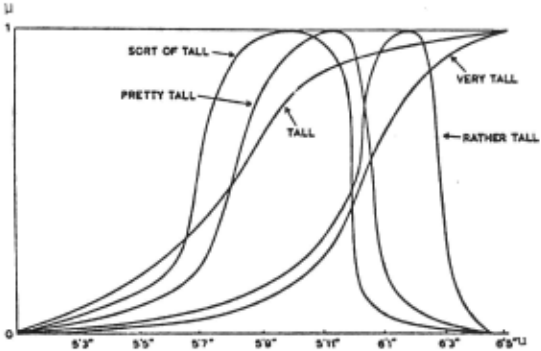
A linguistic hedge such as very, more or less , much and slightly can be viewed as an operator which operates on the operand fuzzy set. For example, several hedges are defined by Zadeh[3] and Lakoff(4].
The effects of some linguistic hedges are shown in Fig.l in the case where a fuzzy set is taU [4].
We can obtain a fuzzy set as the consequence of approximate reasoning. If the consequence remains in fuzzy-set form, it is difficult for us to understand its meaning, as was the case in Example 1. So the consequence would be better given "more or less small" rather than a fuzzy set {1/1, 0.6/2, 0.5/3, 0.2/4}. Thus representing a fuzzy set approximately in a linguistic form by some appropriate hedges and fuzzy sets already defined is called linguistic approximation.
3. APPROXIMATE REASONING SYSTEM
The Approximate Reasoning System (AR System for short) facilitates the execution of approximate reasoning from the specified propositions and outputs the consequence in a linguistic form by linguistic approximation.
We shall illustrate the facilities of the Approximate Reasoning System using a simple example.
[Example 2] If we have a description in the AR System as in Fig.2, then we obtain the output as in Fig.3.
The UNIVERSE OF DISCOURSE BLOCK defines a universe of discourse U and the PRIMARY TERM BLOCK defines fuzzy sets SMALL, MIDDLE and LARGE on U. In the PROPOSITION BLOCK, we describe the propositions Pl and P2. In the AR BLOCK (APPROXIMATE REASONING BLOCK), PARA sets parameters (the threshold value of the evaluation function and the depth of nested hedges) for linguistic approximation and AR executes
******* UNIVERSE OF DISCOURSE BLOCK *********
U·<l· 2· 3· 4, 5)1 ******* PRIMARY TFRM BLOCK ****************** /U/ SMALL·(l/1· OoB/2· 0.5/3· Oo2/4)1 lUI MIDDLE·(Oo2/l, Oo5/2· 1/3· 0~5/4· Oe2/5) 1 /U/ LARGE·<Oa2/2· 0·5/3· OoB/4, 1/5)1 ******* PROPOSITION BLOCK ******************* Pl: X IS LARGFI P2: IF X IS VERY LARGE THEN Y IS NOT LARGE! ******* AR RLOCK **************************** PARA<C·2·T·l3)1 AR(Pl·P2/SMALL MIDDLE LARGE)! ******* END OF APPROXIMATE REASONING ********
Fig.2. A description in the Approximate Reasoning System.
..... OBTAINED SUFFICIENTL-fNGUJSTIC APPROXIMATION
- . -. --L:fNGuis'frT-APPROX (MAT ION·;·;-, -i41 NUS- MORE··-oR LFSS . S-MACC --
- -.-PR (MARY TFRM~~-;--SMA-u.:.----------------··
- FUZZY SET WHICH IS PRIMARY TERM.,, ---- - FSFT <lilt -0~-8)2-; -0; 5/3.- 0. 21'+; : ----------
- FUZZY SET GENERATED BY COMPOSITIONAL RULE OF INFERENCE··· FSET<lll· D.96/2, D.e,,, o.561'+· o.5/5~1
- *FUZZY SET MODIFIED BY SOMF HF.OGES··· -~ .. . FSETCl/1· 0~9197/2 ·, 0~771/3, o~;46fti4)· a- - --------
- ·------- ________________ ~.,. ___ --------····------- .THRESHOLD VALUE··· Ool30
Fig.3. A result of the Approximate Reasoning System.
approximate reasoning from the propositions Pl and P2, and approximates the consequence linguistically by the primary terms SMALL, MIDDLE and LARGE.
As shown in Example 2, a description in the AR System contains four blocks, namely, the Universe of Discourse Block, Primary Term Block, Proposition Block and Approximate Reasoning (AR) Block. We have no more detailed explanation of their blocks on account of limited space.
4. IMPLEMENTATION OF THE AR SYSTEM
The Approximate Reasoning System is implemented using the FSTDS System (Fuzzy-Set-Theoretic Data Structure System)[S] which enables a user to write a program in FSTDSL/FORTRAN using 52 fuzzy-set operators on fuzzy sets and fuzzy relations.
The AR System passes to the FSTDS System the sets and fuzzy sets defined in the Universe of Discourse Block and Primary Term Block. A composite term is translated into an expression in FSTDSL, that is, hedges are replaced by the corresponding operators in FSTDSL and connectives are translated into prefix operators. A conditional proposition IF ... THEN is translated by (3).
For the AR statement, the AR System passes the
statement:
to the FSTDS System. Note that AoR in (2) reduces to the image of A under R since A is a
unary fuzzy relation.
As for the linguistic approximation, we can not use the really best linguistic approximation, since it generates too many composite terms.
Therefore we use the following strategy.
First, we apply each hedge to given m primary terms and compare its result with the consequence fuzzy set B. If we obtain a sufficient approximation, that is, the value of evaluation function is less than or equal to the threshold value, then it is accepted as the linguistic approximation of B. Otherwise we choose one composite term of the best approximation in the first step of linguistic approximation and apply each hedge again to it. I f we cannot still obtain a good one, the same is repeated n times. If a sufficient approximation has not been obtained yet after n r epetitions, the best approximation by this time would be considered as a linguistic
approximation of B. There is, however, no guarantee for the really best approximation.
For the evaluation function, there might be several definitions. We have adopted the evaluation function such as
where B is the fuzzy set obtained by approximate reasoning, B' the fuzzy set modified by hedges in linguistic approximation and U a universe of discourse of B and B' and II(U) denotes the number of elements in U, \xi the absolute value
of real number x and r the ordinary sum over U.
5. CONCLUSION
We have described an Approximate Reasoning System which facilitates the definition of universes of discourse and primary terms, the description of propositions and execution of approximate reasoning and linguistic approximation. In the implementation of the AR System, the translation of the description in the AR System to FSTDSL is programmed in PL/I and the construction and manipulation of fuzzy sets and fuzzy relations are programmed in FSTDSL/FORTRAN[S], and it is currently running on a FACOM 230-45S computer. The current AR System is an interpreter version.
As a basis of question/answering system and intelligent access to database systems, fuzzy reasoning plays so important role in the interface between such systems and users that we expect the AR System will find various other applications.
@inproceedings{ijcai1979p202,
  title     = {A System for Fuzzy Reasoning},
  author    = {Umano, Motohide and Mizumoto, Masaharu and Tanaka, Kokichi},
  booktitle = {Proceedings of the Sixth International Joint Conference on
               Artificial Intelligence, {IJCAI-79}},
  publisher = {International Joint Conferences on Artificial Intelligence},
  editor    = {Bruce G. Buchanan},
  year      = {1979},
  month     = {8},
  url       = {https://ijcai.org/proceedings/1979/202},
}
TY - CPAPER TI - A System for Fuzzy Reasoning AU - Umano, Motohide AU - Mizumoto, Masaharu AU - Tanaka, Kokichi T2 - Proceedings of the Sixth International Joint Conference on Artificial Intelligence, IJCAI-79 PB - International Joint Conferences on Artificial Intelligence PY - 1979 UR - https://ijcai.org/proceedings/1979/202 ER -Copied
Machine-readable versions of this paper, for tools and AI agents:





