
Detection of the Movements of Men for Autonomous Vehicles
Proceedings of the Sixth International Joint Conference on Artificial Intelligence. .
© 1979 International Joint Conferences on Artificial Intelligence
Abstract
This paper describes a method for detecting the movemens of men waking on a passage using two consecutive TV image. The method consists of three steps: (1) finding a passage region and regions of objects in a TV images, (2) locating men in the region map, and (3) detecting the movements of men using their location in tow consecutive region maps. High speed processing is to be achived by employing a special hardware for image processing.
Full text extracted automatically from the PDF; figures, tables and equations may differ. The PDF is the version of record.
1. INTRODUCTION
This paper describs a method for detecting the movements of men walking on a passage using two consecutive TV images. Our final goal is to develop an autonomous vehicle with a TV camera, such as the one in a hospital for guiding the blind · Here, we deal with a simplified case where a TV camera is fixed and only men are on a passage.
There have been some works for detecting moving objects using cross-correlation [1). But they are not effective for our purpose, because the size and the orientation of moving objects may change to a great extent and the numbers of objects are not always equal between the images.
The method in this paper finds the men by locating them in each consists of three steps as follow: a passage region, (2) locating detecting the movements of men. movements of image. It (1) finding men, and (3)
In order to catch up with the the processing for finding done very fast, say every 0.7 special hardware for the high movements of men a path should be sec. We used a speed processing.
2. FINDING A PASSAGE REGION
A passage is assumed to be illuminated sufficientry by many lamps on the ceiling and color of the surface of a passage is light enough. Under these conditions, vertical surfaces are much daker than horizontal ones, up to a certain height. The mean of brightness of men is smaller than that of the passage. However, some parts of men's cloths may be a little brighter than the passage due to wrinkles. In this case, the variance of brightness of the parts is expected to be lager than that of the passage. Therefor, we use the mean and the variance of brightness of TV image to find a passage region.
Let I(i,j) denote the light intensity of the pixel at (i,j) in a image. We use the following measures for the mean M(i,j) and the variance D(i,j) at the pixel at (i,j);
Each pixel is classify into a passage region or the other region by the following procedures.
(1) If M(i,j))91, then it is classified into a passage region.
(2) If M(i,j)<e2, then it is classified into the other region.
(3) If 9l~M(i,j)~92 and D(i,j)(93, then it is classified into a passage region.
- Otherwise, the pixel is classified into the other region.
91, 92 and 83 are fixed based on the first TV image.
Here, we call the other regions the object regions on the passage. The small object regions are merged with a passage region. Since the width of the passage and the direction of the TV camera are known in advance, some erroneous parts such as wall regions, can be eliminated.
Fig.l shows an example of a TV image and a passage region.
3. LOCATING MEN
We use the shapes of men and their size in order to find men in the object regions. We define an X-Y coordinate on a plane parallel to the passage plane of which the origin is at the location of TV camera and of which the Y axis coincides with the direction of the passage, Since the range information about points on passages can be obtained from the declination of the TV camera and its height, a passage region in a TV image can be transformed to the plane as shown in Fig.2. The area surrounded with broken lines in Fig.2 represents the maximum of a passage region and we call the area a region map.
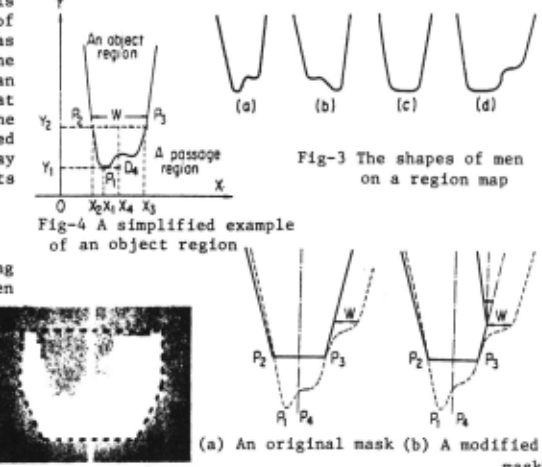
The shapes of men on a region map can be clasified into four types as shown in Fig.3 according to the position of feet. The type (d) represents the situation that one man overlaps another.
We shall explain the method for locating men on a region map using an example as shown in Fig,4, First, the region map is scanned from the bottom to the top to find the bottom point Pl. Next, the curve is searched for a pair of P2 and P3 such that the width W of the curve is greater than th~ threshold 94 (0.3m) for the firs t time. If a pair of points P2(X2,Y2) and P3(X3,Y2) satisfies the condition, the man is located at the point P4((X2+X3)/2,Yl). Third, the detected man region is deleted from the region map. The lower part of the curve is deleted from the region map, The upper part of the curve is covered with a mask like a horn as shown in Fig,S(a). If the width W of the protruded part under the mask is greater than the thresshold 95 (O.lm), we determine that another man is also included inside the curve, Then, the shape of the mask is changed into that of Fig.(S), so that another man may be easily found later. This process repeats until no man is found.
4. DETECTING THE MOVEMENTS OF MEN
The movements of the correspondence men are obtained by finding of the positions of 'men
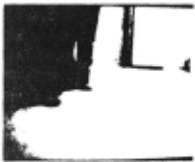
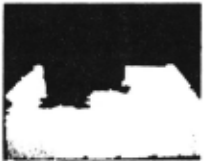
Fig-1 An example of finding a passage region
y
between two consecutive region maps. Suppose that the position of the k-th man in the first and in the second region maps are (X 1 ~, Y 11,) and (Xl~· Yl.;>, respectively, the distance between them is less than V·4t, where V is the maximam speed of men (assumed 1m/sec) and At is time interval (0.7sec). If the candidate position is only one under this condition, the correspondence is immediately determined. If there are n positions with more than one candidate, the correspondence of them is determined as follows.
Assuming that men are apt axis than the X axis. weighted distance for the to move along the Y Now, we define a k-th man as follows.
We determine the correspondence such that the following evaluation function may be minimized:

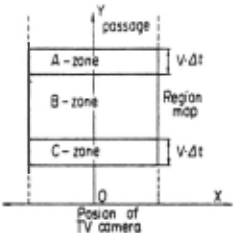
Now, we consider the case where men come into or out of the region map and occlusion, A region map is divided into three zones (A,B and C zones) as shown in Fig.6. It is assumed that men always come into or go out of the region map through A or C zone.
First, the correspondence is found in B zone on the first map and whole area on the second map. between men those in the In this procedure some corresponding pairs are found. The remaning men in both maps are dealt with in the following way.
(a) An original mask (b) A modified mask
CASE 1 :there is no man in A and C zones on the first map.
In this case, men on the first map can not go out of the map. The remaining men on the first map are determined that they are behind
some one on the second map. Conversely, the remaining men on the second map are determined to behind some one on the first map. The remaining men in A and C zones on thsecond map are determined that they have entered the map from the outside area.
CASE 2 :ther are some men in A or C zone on the first map.
The correspondence is found between men in A and C zones on the first map and the remaing men on the second map. If there still remain some men without correspondence, they are dealt with in the similar way as in CASE 1, except that the remaining men in A and c zones on the first map are determined that they have gone out of the map.
5. EXPERIMETAL RESULTS
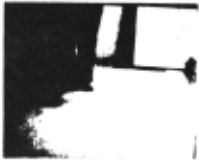
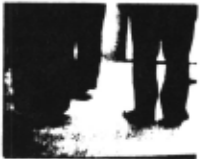
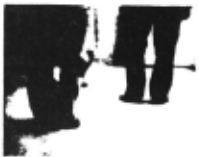
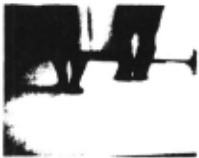
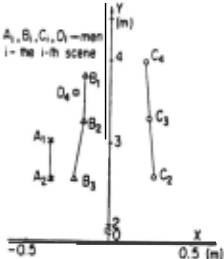
We examine the metod in many cases. The four consecutive scenes as shown in Fig.7 are examples of input images. The men in these images are located on the map and the movements are detected as shown in Fig.8.
6. DISCUSSIONS
We used the Parallel Patten Processor (PPP) [~] for high speed processing. The PPP has several basic image procssing function in hardware, memories for pictur data and a microprogrammed processor. We estimated the time needed for finding the region of a passage. The time was 580 msec as shown in Table 1. The total time for the processings includeding the location of men and the detection of the movement is larger than the time interval (0.7sec) at present. But the improvements of the hardware and the program will make the total time less than 0.7 sec.
In order to realize autonomous vehicles, we must consider the following problems: (1) a TV camera moves on a passage, (2) a passage is hook-shaped one, and (3) there are some objects on a passage, besides men.
| OPERATION | NUMBER OF INSTRUCTION | EXECUTION TIM!: | FREQUENCY IN USE | CONSUMED TIME |
|---|---|---|---|---|
| HASX | ~ 3 e | m•ec 65 !.mage | 0 . 4 | 26 maec |
| MEAN OF BRIGHTNESS | S or 6 | 130 | 0 . 36 | 47 |
| VARIANCE 0 BRIGHTNESS | 12 | 195 | Q.24 | 47 |
| 2D- CONVOLUTIO | by hardwar | 65 | 3 | 195 |
| REGION LABELING | by hardware | 200 | l | 200 |
| DATA CONVERSION | by hardwar | 65 | l | 65 |
An instruction of the microprogram needs 250 n·ec. The memory cycle i· l ~·ec/pixel . An image has 256x256 pixel·.
Table-1 The detail of consumed time
ACKNOWLEGEMENT
The authors would like to thank the members of Computer Vision Section for their advices.
REFERENCE
[1] J.Z.butnicka, et al.,"Automatic Movement Analysis and Classification of Moving Object", the 4-th IJCPR pp.750-752 1978.
[2] K.Mori, et al.,"Design of Local Parallel Pattern Processor for Image Processing", National Computer Conference, pp.1025-1031, 1978.
@inproceedings{ijcai1979p200,
  title     = {Detection of the Movements of Men for Autonomous Vehicles},
  author    = {Tsukiyama, Toshifumi and Shirai, Yoshiaki},
  booktitle = {Proceedings of the Sixth International Joint Conference on
               Artificial Intelligence, {IJCAI-79}},
  publisher = {International Joint Conferences on Artificial Intelligence},
  editor    = {Bruce G. Buchanan},
  year      = {1979},
  month     = {8},
  url       = {https://ijcai.org/proceedings/1979/200},
}
TY - CPAPER TI - Detection of the Movements of Men for Autonomous Vehicles AU - Tsukiyama, Toshifumi AU - Shirai, Yoshiaki T2 - Proceedings of the Sixth International Joint Conference on Artificial Intelligence, IJCAI-79 PB - International Joint Conferences on Artificial Intelligence PY - 1979 UR - https://ijcai.org/proceedings/1979/200 ER -Copied
Machine-readable versions of this paper, for tools and AI agents:





