
Multiple Representations of Knowledge in a Mechanics Problem-Solver
Proceedings of the Fifth International Joint Conference on Artificial Intelligence. Representation of Knowledge. Pages 299-303.
© 1977 International Joint Conferences on Artificial Intelligence
Abstract
Expert problem-solving programs have focused on working problems which humans consider difficult. Octdly, many such problem-solvers could not solve less difficult versions of the problems addressed by their expertise. Th1s shortcoming also contributed to these programs' inability to solve harder problems. To overcome this 'paradox' requires multiple representations of knowledge, inferencing schemes for each, and communication schemes between them . This paper presents a program, NEWTON, applying this Idea to the domain of simple classical mechanics . NEWTON employs the method of envisionment, whereby simple questions may be answered directly, and plans produc('d for solving more complex problems. Envisioning enables NEWTON to use qualitative arguments when possible, with resorts to mathematical equations only if the qualitative reasoning falls to produce a solution.
- Bobrow, 68
- Bobrow, G.D., "Natural Language Input for a Computer Problem Solving System", In Minsky (ed .), Semantic Information Processing, Cambridge: M.I.T. Press, 1968.
- Bundy, Alan, "Analyzing Mathematical Proofs (or readin g between the lines)", Department of Artificial Intelligen ce, Research Report •2, University of Edinburgh, 1975.
- Bundy, Alan, "Will it Reach the Top? Prediction in the Mechanics World", Department of Artificial Intellige nce. Research Report •!31, University of Edinburgh. 1977.
- Charniak.
- Charnlak, E., CARPS, "A Program which solves Calculus Word Problems", Project MAC TR-51, Cambridge: M I.T ., 1968.
- de Kleer 75
- de Kleer, Johan, •q.ualitatlve and Q.uantitative KnowledgP. an Classical Mechanics , Artificial Intelligence Laboratory TR -352, Cambridge: M .I.T, 1975. [Kieppner & Kolenkow 7!3
- Kleppner, Daniel, and Robert J. Kolenkow, An Introdu ction to Mtchantcs, New York: McGraw-Hill, 197!3.
- Mathlab Group, "MACSYMA Reference Manual", Cambridge: M.I.T., 1974.
- & Sussman 7i] McDermott, Drew, and Gerald Jay Sussman, "The Conniver Reference Manual", Artificial Intelligence Laboratory, AIM- 259a, Cambridge: M.I.T ., 1974.
- Minsky 7!
- Minsky, Marvin, "A Framework for Representation of Knowledge", Artificial Intelligence Laboratory, AIM -!306, Cambridge: M.I.T., 197!3.
- Novak.
- Novak, Gordon Shaw, "Computer Understanding of Physics Problems Stated in Natural Language", The University of Texas at Austin, Ph.D. Thesis, 1976.
References were extracted automatically from the PDF and may contain errors.
Full text extracted automatically from the PDF; figures, tables and equations may differ. The PDF is the version of record.
Introduction
Expert. problem-solving programs have focused on A problem-solver which employs these two working problems which humans consider difficult. Charniak representations for solving the same problem has a number of demonstrated the expertise of CARPS [68) by using it to solve distinct advantages: problems from a freshman calculus text. The achievements of (I) It solves simpler problems with drastically simpler M ACSYM A [Math lab 7i] are touted by exhibiting some techniques. . complicated expressions It can integrate. There is no doubt (2) Even when qualitative analysis fails, it sets up spectflc plans that these two problem areas are difficult, but before we which greatly simplify the quantitative analysis of the problem. attribute expertise to these programs we should first examine (3) Q..ualitative analysis can handle indeterminacies in problem the depth of their understanding of the problem areas . I specification. propose one criterion: As well as betng able to solve th.e diffiwlt The first advantage has already been discussed. problems, th.e expert problem-solver should be able to solve simpler versions of a problem with. qulllttattvely stmpler tech.niqzus. We will see that the inability to solve simple problems is the source of many of the difficulties problem-solvers encounter in attacking harder problems.
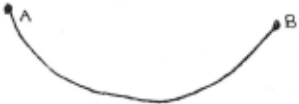
would solve the problem directly. The mark of an expert is that such qualitatively simpler problems are attacked by qualitatively different techniques.
Theory
I propose that an expert problem-solver should be able to employ multiple representations for the ~arne problem. Within each representation radically different reasonmg techniques can be used. By .employing the different representations, the problem-solver can solve problems of varying difficulty and, more importantly, use only those reasoning techniques which are appropriate to the dtfftculty of the problem. By definition, such a problem-solver meets the above criterion.
In mechanics, a useful distinction can be made between qualitative and quantitative knowledge. O~uali t ~t1 ve knowledge represents the scene in terms of gross features such the general type of curve and the relative heights between points. Q..uantitative knowledge represents the same scene m terms of mathematical equations describing the shapes of the curves and the numerical distance between points. A simple qualitative rule uses the relative heights to determine whether an object released at one point can reach the other Q..uantitative reasoning, on the other hand, symbolically manipulates the mathematical equations and numencal quantities to obtain the same result.
Even If we were only interested in problems requiring equations, the qualitative analysis still performs a crucial role in the problem-solvmg. By ttself a mathematical equation contains no useful information. To make use of an equation the meanings of each of the vanables must be specified and the conditions of its applicability must be known. objects and relating the dimensions of physical objects, but how do we determine which of these equations are relevant to the problem at hand? Although the qualitative analysis of the problem may fall, requiring quantitativ·e analysis , the qualitative analysis determines the kind of event happenmg thus providing a concise suggestion as to which equations are relevant.
The quaUtative ana.lysis also provides an overall structure for the solution of the problem. A problem can involve a number of independent parts each rt·quiring quantitative solution. Consider the problem of a block sliding over a hill, first you must determine whether the block can on the other side. The qualitative analysis first present$ the · To determine whether an the object released at A problem of reaching the top for quantitative analysis, and if reaches B on the roughened track requires a careful analysis of the top is reachable it presents the problem of whether the the shape and frictional properties of the track. object falls off the hill on the other side. .
My experience teaching electrical network theory suggests that this criterion also applies to students. Consider There are many equations describing the motion of mov mg the problem of determining the average power dissipated by a network. A general technique which solves this problem is to write down Kirchoff's current law for all the nodes and solve the resulting equations. A poor student always applies this technique immediately, while the better student looks first to see whether some simplifications are possible. For example, if the network consisted of only capacitors and inductors, the poor student still sets up equations while the bener student immediately replies zero since capacitors and inductors do not dissipate power. The reason the student who immediately sets up equations does worse, is that without first simplifying the problem the resulting equations are often unmanageable. If the topology of the network was unspecified, the poor student make it to the top of the hill, and then you must determine would be unable to even set up the equations while the better whether or not the block flies off the hill because it is too ste('p student would still be able to solve the problem.
The slightly different problem where friction is zero can be The qualitative argument does not rP.qutre a solved with the same technique. This would be a rather stupid completely described scene. For example, qualitative analysis since a simple comparison of the relative heights of A and B tells you that a ball wi11 roll down an inclined plane without needing to know the slope of the incline or the radius of the ball. To determine the velocity of the ball at the bottom of the incline these other quantities must be incorporated in to equations which are subsequently solved for the final velocity.
A difficulty Introduced by multiple representations is communication . One problem is that the way one representation refers to a particular entity is often rad lea lly different from how the other representations refer to this same object. Another problem is the format of the queries and replies between representations.
The Program NEWTON
Although the theory suggests that multiple representations are useful, it does not provide any information about the details of the representations or how to utilize them. In order to explore the theory further an expert problem-solver NEWTON has been constructed. It solves problems in the mechanics mini-world of "roller coasters" (the kinematics of objects moving on surfaces). NEWTON is not intended to be a general mechanics problem-solver, but is only used to demonstrate the above principles. Within its mini-world it can handle a wide range of problems. It uses qualitative arguml'nts when possible, but will resort to equations if necessary. It recognizes nonsensical problems. It does not become conf11scd or inefficient when given irrelevant facts, objects or f"quat1ons.
One extremely important piece of qualitative knowledge is the ability to roughly predict what will happen in a given scene. For example, qualitative knowledge tell' you that an unsupported object will fall or that a rubber ball w1ll bounce. We will call this envisioning. More formally, envisioning means generating a progression of snapshots which describe what might or could happen. The most important feature of a scene in the roller coaster world is the position of the moving object, and so the snapshot is best described by the position of the object. An entire event is described by a tree, each node being a possible position for the object and each arc indicating an action which moves the object from one position to another.
The quantitative knowledge uses a FRAME-like organization to package together mathematical equations. There are an extremely large number of different equations that could be applicable to any problem. Fortunately, since equations tend to come in groups, an individual decision need not be made about the relevance of every single equation. The relationships between the angles and sides of a triangle form one such group or FRAME. Another possible FRAME is the kinematic equations which hold for uniformly accelera ting objects. With this representation only a small number of decisions are required to determine which equation s are relevant. It also provides a convenient way to provide meaning to the variables in the equations. Since the FRAME only applies when certain conditions are met, the variables in the equations of the FRAME can refer to these conditions to provide a meaning to the variables which is genl'ral among all the FRAMEs.
In order to actually solve mechanics problems two other distinctly different representations become important. One of the representations originates from the qualitative knowledge and the other originates from the quantitative knowledge. The envisioning can often solve the problem directly, however, If it fails it must be able to articulate its difficulty for the FRAME-representations. This requ1res carefully analyzing and transforming the trees generatl"d by the envisionment utilizing separate analysis and transformation rules. This analysis determines which top-level FRAME is relevant to the problem and which variables need to be solved for. The result of instantiating the FRAMEs is an information structure which relates all the equations and variables relevant to the original problem. This dependency network is then analyzed to identify possible paths to the solution. Symbolic mathematical techniques are then applied to check the poss1ble path. If the manipulation is unsuccessful or intractable with the symbolic techniques available other paths are tried.
With these added refinements the organization of NEWTON Is as follows: ·
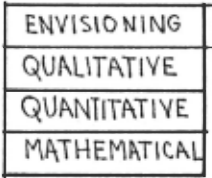
Envisioning represents the original scene in terms of tts gross features determining what might possibly happen and recording this information in a tree. Its knowledge is represented by rules which look at gross features and then extend the envision·ing tree. The remaining qualitativ e knowledge represents the original problem in terms of the tree generated by the envisionment. Its knowledge is represented as transformation and analysis rules whose application eventually results in a plan to solve the pr'oblem. The quantitative knowledge is represented in FRAMEs, a small subset of which is instantiated for any particular problem. It rna inta ins a CONNIVER-like [McDermott & Sussman 7i] data-ba se to represent the semantics of variables. After instantiation the FRAMEs are examined for possible paths to the solution, ~nd symbolic techniques are invoked to evaluate these possible paths.
The only entities which can be referred to in messages between representations are physical objects, instances of time, and variables describing them. Every representation refers to these primitive entities in the same way. The problem of the format of the messages has been resolved by ha v mg special purpose experts between each two representations that ever wish to communicate. This is not as unsatisfactory as it might seem since our theory imposes very rigid constraints on the nature of this communication. A query is generated only after the problem is discovered to be unsol va ble in one representation, and thus the query asks a very precise and restricted question. The answers generated by queries He limited by the kinds of questions asked.
To get an overall idea of the different representations consider the following simple mechanics problem:
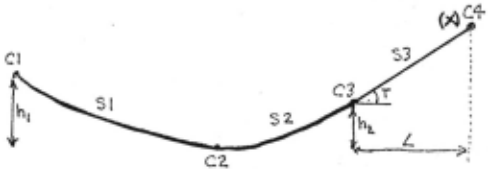
A small block slides from rest along the indicated frictionless surface. Will the block reach the point marked X?
The following Is a possible protocol of a human solving the problem.
"The block will start to slide down the curved surface without falling off or changing direction . After reaching the bottom it starts going up. It still will not fall off, but it may start sliding back. If the block ever reaches the straight section it still will not fall off there, but it may reverse its direction. To determine exactly whether the block reaches X
we must study the velocity of the block as it moves along the surface. The velocity at the bottom can be computed by using conservation of energy:
Similarly, this velocity and conservation of energy can be usPd to set up an equation which can be solved for the velocity (v 2 ) at the start of the straight section:
If the solution for v 2 is imaginary, then the straight segment is never reached. At the straight section we can use kinematics to find out whether the block ever reaches X. The acceleration of the block along the surface must be:
The length of the straight segment is L I cos T, so by the well known kinematic equation relating acceleration, distance and velocities:
Ag~ln if v 3 is Imaginary, X is not reachable."
The first part of the protocol which involved identifying a possible path to reach X we call envisioning. Envisioning describes (and so limits) the problem space formed when we ignore the specific values of the variables. The problem had variables la 1 , la 2 , T and L which were required for the solution but the protocol (before the decision to calculate velocities) held true for a wide range of values for thPse variables. The reasoning depended on Ia 1 > 0, h 2 > 0. L > 0, 0 < T < 90 and the facts that all the curves were concave from the perspective of the object and that the curves were differentiable everywhere. All this information could be assumed from the diagram. Everything that was predicted by the envisioning was achievable for some values of the variables and every possible assignment of values to variables was described.
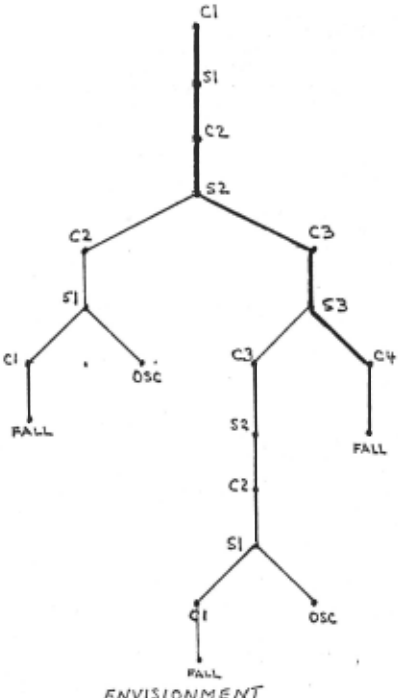
The envislonment NEWTON generates for this problem is described by the following figure. The object mrrs at corner Cl, slides through segment 51. reaches corner C2. slides through segment 52, either slides back on segment S2 or reaches corner C3, and so forth.
Many questions can be answered directly from the envislonment. For the above problem the question "Will it reach 52?" can be answered without further reasonin g-. Envisioning fails to answe·r the question when it predicts ·-a number of possibilities. When the block was sliding up the hill, it could not be determined when or if it would start slidmg back. It is in identifying these multiple possibility points that the envisioner sets up specific subproblems. Even whC'n further reasoning Is required to resolve such a qualitative ambiguity, envisioning identifies those possibilities it must distinguish between. Although there was the problem of determining whether the block would or would not slide back on the curve, the possibility of the block falling off had been eliminated by envisioning. In summary, envisioning gives local and very specific problems for further analysis and, on a global scale, envisioning provides an organization and plan to solve the entire problem. The trace of the possibilities through t1me provides the basis for such a plan.
Quantitative knowledge i~ used to disambiguate between the possibilities occuring at each fork . It is important to note that FRAMEs are not procedures, but descrrbe dependencies and assignments between variables. These dependencies are searched for solutions to the goal variable. A FRAME Is first examined to determine whether it has the solution for the goal variable. If this search is unsuccessful all equations which reference the goal variable are examined, and a subgoal is generated to find the remaining unknown variables In these equations. All the sub FRAMEs referenced by the FRAME are eventually included in this search. Viewed from another perspective, the instantiation of a top-level FRAME resultS in a and-or graph which must be analyzed for possible solutions. Each equation which references the goal variable contributes to a disjunction since each such equation could possibly yield its solution. Unknown variables in equations referencing the goal variable contribute to conjunctions since every unknown in the equation rnust be determined to achieve the goal.
The MASS-MOVEMENT FRAME knows about movements of objects on surfaces, but is not concerned about the possibility that the objects may fall off the surfaces. The following is a description of MASS-MOVEMENT and the other FRAMEs it references. A FRAME uses two kinds of variables: the names of the objects it is concerned about and mathematical variables describing properties of these objects such as velocity or acceleration.
FRAME mass-movement OF object surface tl t2 VARIABLES:
Ia : ACCELERATION OF object,
theta : ANGLE OF surface)
IF surface IS flat THEN
(USE right-triangle ON surface,
USE kin ON object surface tl t2,
a · G sinlthetall.
USE energy ON object surface tl t2.
FRAME energy OF object surface tl t2 VARIABLES:
(vi : VELOCITY OF object AT TIME tl,
vf : VELOCITY OF object AT TIME t2,
h : HEIGHT OF surface!
vf 2 - vi 2 - 2 G h.
FRAME right-triangle OF triangle VARIABLES:
lh HEIGHT OF triangle,
base BASE OF triangle,
hyp
: DISTANCE OF triangle,
thetal ANGLE! OF triangle,
theta2 : ANGLE2 OF triangle)
hyp · sqr t (h 2 + base 2 l
sin(thetall · h I hyp
sin(theta21 · base I hyp.
FRAME kin OF object surface tl t2 VARIABLES:
lvf VELOCITY OF object AT TIME t2,
vi VELOCITY OF object AT TIME tl,
d DISTANCE OF surface,
t TIME BET~EEN tl AND t2,
a ACCELERATION OF object)
vf · vi + a t
vf 2 · vi 2 + 2 a d
d · vi t + .5 a t~
NEWTON would solve this problem without FRAMES by comparing the heights of the endpoints directly. In order to demonstrate the quantitative knowledge, this poSSible solutiOn (among many others) will be ignored. The FRAMEs NEWTON uses are much more sophisticated th .~n these presented here; they are not shown since they involve many features which are not relevant to this presentation. In order to get a better understanding of how FRAMEs interact m the problem-solving process we will artificially make hi' h 2 , T and L unknown and only provide their values when necessary.
Envisioning determines that there is never a possibility that the object will fly off. Since the envisionment tree for this problem has a fork at 52 and 53, the problem is decomposed Into the two subproblems of first disambiguating what happens at S2 and then disambiguating what happens at S3. Thts IS the plan the qualitative knowledge develops for solving the problem. In order to analyze what happens on S2. the velocity of the object at the beginning of 52 must be determined. The velocity at the beginning of S2 is the same as at the end of Sl, so the first problem to be solved by the quantitative knowledge is to find the velocity at the end of SL
To find the velocity at the end of Sl MASS MOVEMENT must be invoked:
!MASS-MOVEMENT !Bl 51 HMEl TIME21 I
Before MASS-MOVEMENT is invoked, varrables must be assigned values and meanings:
!VELOCITY Bl TIMEll -known
IVELOCI TY Bl TIME21 -desired goal
When MASS-MOVEMENT is invoked !FRAME attempts to fmd a value for this variable. There are two places in MASS MOVEMENT where possible assignments to VF take phce. IF RAM E discovers that the assignment in the cond it ton a I cannot be reached since Sl is not flat. The only alternative is the ENERGY FRAME. Using ENERGY is unsuccessful since HEIGHT is unknown. Every possible attempt to achieve a value for VF having now failed, the alternative is to generate subgoals of discove.ring the variables which are blocking a solutton to the destred goal variable. The path to VF is blocked by HEIGHT, but there are no other access1ble references to HEIGHT In ENERGY or MASS-MOVEMENT. Problem-solving now halts until HEIGHT is given, after which !FRAME reexamines ENERGY and returns a value for VF. This value is remembered and the segment S2 is el\amined in much the same way using the VF on Sl as VI on S2:
!MASS-MOVEMENT !Bl 52 TIME2 TIME311
Note that ENERGY returns an "impossible" result if the equations result In an imaginary solution, thus .indicating that the object cannot traverse S2.
If ENERGY is tried it fails because HEIGHT is unknown . Since 53 is flat KIN can be tried for a solution. For KIN to succeed either D or T must be known. Again every path to VF is blocked. Finding a value for either HEIGHT, D or T would be sufficient to solve for VF. There are no other references to Tin the FRAMEs soT cannot be achieved in MASS MOVEMENT. The two variables HEIGHT and D can be found by the FRAME RTRI. RTRI is then invoked on segment S3. There is not enough information to solve for the>f" variables. The values for Tl (angle of surface) and L (ha ;e length of surface) in the instantiation of RTRI on S3 are given and IFRAME proceeds. Now RTRI returns with value~ for both D and HEIGHT. !FRAME has a choice between reexamining KIN or ENERGY to solve the pro.blem . Depending on whether this results in an "impossible" solution or a particular value for VF, the question of whether Ci 1s ·reachable has been answered.
In order to demonstrate the importance of envisioning and to illustrate the nature of the communiC:Ition between representations, a simplified version of envisioning a~d Its Interaction with quantitative knowledge will be dtscussed In the next section. For a more complete discussion of this topic and the other representations the reader is ref erred to [de Kleer 75].
Envisioning and Planning_
The most basic and primitive knowledge about physics Is envisioning. For NEWTON, envisioning means generating a progression of scenes encoded in a symbolic description which describe what could happen. Both in NEWTON and in people, the envisionment of the event is the first step in the understanding of the problem.
In fact, envisioning is necessary to understand the event at all. To understand that a pencil might roll off a table requires the ability to envision that event without actually seeing it happen. Envisioning is pre-physics knowlcdv.e and its presence Is independent of the goal of solving n'::echanics problems. Envisioning is, however, the fundamental tool for understanding mechanics.
The envisioner requires that the original path be described in terms of segments for which the slope and concavity don't change sign, and achieves the envisionment by applying general rules which describe object motions on segments whose concavity and slope don't change sign. As a consequence points at which the slope or concavity are zero or diSContinuous are identified. In NEWTON envisionment starts with the initial situation, identifies what is happening in that sttuatJOn, generates changed situations, and recursively analyzes these new situations until all possibilities are exhausted. It may seem that it would be more efficient to only explore the situations that lie on some path to the goal [Bundy 77]. Unfortunately, this goal directed reasoning requires some measure of how close it is to the goal, and this requires a separate analysis of the scene. An extra pre-analysis of the scene to identify paths to the goal (nearness to goal) must mvolve as much work as the envisioning itself . Simple strategies such as "when the goal is left, move left" are insufficient when the path turns around.
The envisionment results in a tree, every fork of which indicates a qualitative ambiguity which needs to be resolved. The forks for the roller coaster domain can be classified Into the actions that occur there:

On S3 IFRAME has two possible paths to a solution. SLIDE-SLIDE
FLY-SLIDE
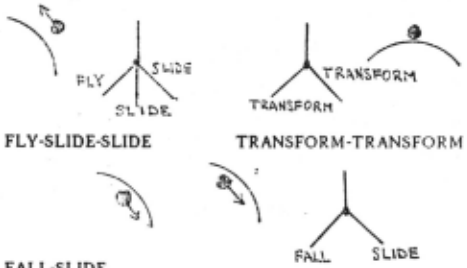
FALL-SLIDE
For each kind of qualitative ambiguity there exists a top-level of FRAME which can be used to resolve that ambiguity. Many of the FRAMEs for different ambiguiti('s reference each other. We have already seen one such collect1on of FRAMEs for SLIDE-SLIDE: MASS-MOVEMENT.
After the envisionment is completed, NEWTON accumulates a list of ambiguities which must be resolved to reach the desired goal. This primitive plan is then analyzed to optimize the disambiguations that must be done. The rna in optimization Is the deletion of plan steps. Plan stPps can be deleted· if succeeding plan steps implicitly repeat it. The plan for the example sliding block problem is:
Solve SLIDE-SLIDE on 52 and fail if C3 is not reached.
Solve SLIDE-SLIDE on S3 and fail if X is not reachl:'cl . The second plan step completely determines the relevance of the first step to the goal. Hence it can be eliminated. Some other eliminations are:
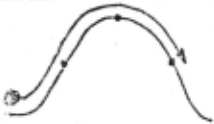
SLIDE-SLIDE, FLY-SLIDE-SLIDE, FLY-SLIDE -> FLY SLIDE-SLIDE
SLIDE-SLIDE, FALL-SLIDE, FALL-SLIDE(symmetrical) ·> FALL-SLIDE
Envisioning looks at only one point or segment at a time and the possible actions it determines pertain only to that particular point or segment. Since the envisioner uses local information to determine local actions, the primitive plan it generates is restricted to employing local quantitative techniques With the help of these transformation rules which eliminate unimportant local plan steps, the important global structure of the problem can be identified. The resulting plan can take maximal advantage of the global quantitative technique of conservation of energy.
handle every possible qualitative ambiguity which can be generated by the envisioner. Given the absolute numerica I position of every point and the shape of every segment, NEWTON can always determine what will happen if it has the FRAMEs to deal with the segment types. There are man y other qualitative questions which can be asked besides "What happens?" The qualitative formulation of a problem leaves out many details in both the description of the scrne a~1d the quPry about that scene. NEWTON attempts to reduce questions to the simple "What hap.Pens?" type as much as possible. NEWTON also has some techniques to deal with othfr question types, but these are severely limited and it is difficult to characterize what class of problems they solve.
The question can involve a quantitative request about a qualitative predicate: "What is the velocity of the object when it falls off?" NEWTON fi rst tries to satisfy the qualitative predicate, and if that predicate is satisfied attempts to determine the velocity when it falls off.
If the original problem contains symbolic paramet('rs, and all the qualitative disambiguations can be made, it returns the final result in terms of these parameters. NEWTON fails when an unknown parameter makes a qualitativ e disambiguation impossible. (A smarter system might give a disjunctive answer.) If NEWTON is provided with an explicit numerical range for a particular parameter, It will attempt to do the disambiguation with this limited information.
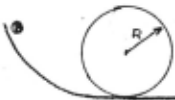
A problem can specify a resultant effect and ask what Initial conditions lead to that effect. NEWTON solves this type of problem by hypothesizing variables for all the relevant initial conditions and the comparisons which otherw1se would be used In disambiguation are used to accumulate Inequality constraints on these initial conditions. The loop-the loop problem is an example of this type:
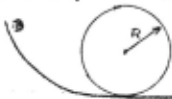
A small block starts at rest and slides along a frictionless loop the-loop as shown In the figure. What should the minimal initial height be so that the block successfully completes the loop-the-loop?
The problem can implicitly refer to points which are not present in ~he original figure. NEWTON can introduce points In a figure which are not zeroes or singularities.

A small block slides from rest from the top of a frictionl ess sphere. How far below the top does it lose contact with the sphere?
There are many questions about the roller coaster world that NEWTON cannot solve:
"What is the period of an object on a cycloid?"
"Would the object still make It if the height of the hill was increased?"
"What is the curve of shortest time between two points?"
"If the fall-off velocity is determined what must the initia I height be?" ·
Concluding Remarks
Problem Formulation We have seen how NEWTON can solve a wide range of problems in its mini-world . The power of the techniques It uses are appropriate to the difficulty of the problem It Is asked to solve. When qualitative arguments will NEWTON contains quantitative techniques to work it uses them, and otherwise resorts to mathematical equations. The organization of multiple representations allows it to limit the calculations as the problem-solving progresses.
Envisioning Is an extremely powerful tool for problem-solving and deserves further attention. In order to do any problem-solving about moving physical objects some kind of envisioning Is required. Clearly, an envisioner is needed in order to build a general mechanics problem-solver. Envisioning would be useful in other domains such as electronics which depend on mechanical intuitions. In general, envisioning might be useful in every problem-solving domain for which models exist. An example of a dom;,~in where envisioning plays no role is pure mathematics or the solving of equations independent of some domain. ·
NEWTON has three weaknesses which should be the subject of future research in this area: a lack of a theory of question types, an insufficiently powerful envisioner, and an inappropriate theory of mathematical expertise.
The current envisioner is relatively simple since it works with a single point object in only one dimension. More general envisioning requires the manipulation of more than one object at a time and an analysis in more th<~,n one dimension. Funt [76) describes a program WHISPER which can do certain kinds of two dimensional envisioning. He is more Interested In exploring the use of analogues th an problem-solving in general. A slightly extended world for NEWTON would be a world with two movtng obJects. The difficulty here is that the envisioner needs a notion of time. A naive solution would be to envision the movement of f?ach object Independently, and then assume a possible collision at each intersecting point. Each such point again yields two new trees. Two dimensional envisioning is far more complex since It Introduces a large variety of new objects and poss ible interactions between them. Consider the problem of computing ··· ~,,. m thb ~··~:~
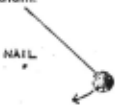
Two dimensional envisioning Is needed to see that the nail shortens the length of the pendulum string thus shortening the the period.
NEWTON has no good theory of question types . NEWTON can solve all "What happens?" questions which are totally described, and fortuitously slight modifications of these techniques can solve many other problem types. Unfortunately, these other problem types cannot be characterized very well. There is a need for a more powerful theory of question types. and techniques to deal with these.
One of the unexpected difficulties encountered in implementing NEWTON was the interaction between quantitative knowledge and mathematical expertise . NEWTON's mathematical expertise is provided by routmes culled from MACSYMA. The problem in using thl'Sl' routines is that they are just black boxes, and the quantitative knowledge needs other kinds of interactions than those normally provided by these routines. A simple example is the occurrence of multiple roots. In general MACSYMA does not generate appropriate explanations for why it fails to achieve some particular manipulation. NEWTON should have had another representation between the quantitative and the mathematical which knew about mathematics and about MACSYMA.
These difficulties originate from a far more serious shortcoming of NEWTON: it treats equations purely as constraint expressions. It Is solving a physical problem for which an inherent duality exists between the symbolic structure of the expressions and the actual physical situations. Each mathematical manipulation of the equations reflects some feature of the physical situation. The manipulation should be under constant control and observation such that any unusual features or difficulties should be immediately reported to the rest of the problem-solver which then decides how to proceed. This requires that the problem-solver have much more control over the symbolic manipulation routines and constantly monitor transformations on the expressions to what import theY, have on the physical situation. One possibility for the manipulation routines are those suggested by Bundy [Bundy 75).
Aoknowledgemen ts
This research was conducted at the Artificial lntelli !_~ence Laboratory of the Massachusetts Institute of Technology. Support for the Laboratory's artificial intelligence resrarch is provided In part by the Advanced Research Projects Agency of the Department of Defense under Office of Naval Rt>search contract number NOOOI4-75-C-064!3.
@inproceedings{ijcai1977p67,
  title     = {Multiple Representations of Knowledge in a Mechanics Problem-Solver},
  author    = {de Kleer, Johan},
  booktitle = {Proceedings of the Fifth International Joint Conference on
               Artificial Intelligence, {IJCAI-77}},
  publisher = {International Joint Conferences on Artificial Intelligence},
  editor    = {Raj Reddy},
  pages     = {299--303},
  year      = {1977},
  note      = {Representation of Knowledge},
  url       = {https://ijcai.org/proceedings/1977/67},
}
TY - CPAPER TI - Multiple Representations of Knowledge in a Mechanics Problem-Solver AU - de Kleer, Johan T2 - Proceedings of the Fifth International Joint Conference on Artificial Intelligence, IJCAI-77 PB - International Joint Conferences on Artificial Intelligence PY - 1977 SP - 299 EP - 303 UR - https://ijcai.org/proceedings/1977/67 ER -Copied
Machine-readable versions of this paper, for tools and AI agents:





